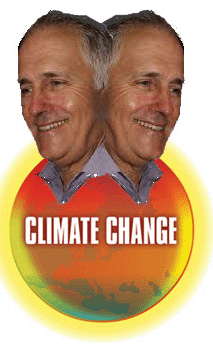
the bind faced by the formerly green-tinged Prime Minister Malcolm Turnbull
the Australia Institute, which has taken over the intellectual property of the Climate Institute, says even Dr Finkel’s model would be insufficient on its own to meet the international obligations signed under Mr Abbott.
“This analysis of the economic modelling demonstrates meeting these targets for the electricity sector with a policy like the clean energy target is likely to require 66-75 per cent of electricity to be supplied by renewables,” said Australia Institute executive director Ben Oquist.This was because a CET “provides less of an incentive for gas generation than an EIS (emissions intensity scheme) or a carbon price“.
The first assessment by the Australia Institute’s new Climate and Energy Program, to be released on Monday, has found that unless a higher burden is placed on the more expensive process of carbon reductions in other sectors – agriculture, transport and manufacturing – then the electricity generation sector will need to aim for a renewable energy target of at least 66 per cent by 2030, and possibly as high as 75 per cent.That is, a power generation sector where the fossil fuel component is reduced to perhaps a quarter of the size it is now.
Power generation currently accounts for 35 per cent of total emissions, which is twice as much as the next biggest contributor, fuel combustion and transport, at 18 per cent.
Industry produces 14 per cent and agriculture 13 per cent.
The current emissions reduction target, committed to in Paris while Mr Abbott was prime minister, is 26-28 per cent lower than the 2005 level – part of Australia’s contribution to a global effort to restrict the planet’s temperature increase this century to no more than 2 degrees Celsius.
The government is now wrestling with how to go about this after Chief Scientist Alan Finkel proposed a clean energy target which would lock in a 28 per cent reduction in energy-related emissions by 2030 through a four-pronged strategy emphasising energy security, reliability, affordability for households and business, and meeting Australia’s emissions targets.
Last week Mr Abbott indicated he would cross the floor in Parliament to stop further renewable-friendly policies, calling it “unconscionable for a government that was originally elected promising to abolish the carbon tax and to end Labor’s climate obsessions to go further down this renewable path”. Continue reading →
Bill Shorten visits South Korea to address nuclear tensions
Australian opposition leader calls on China and Russia to put pressure on the North Korean regime over missile tests, Guardian, Amy Remeikis, 24 Sept 17, Australia’s opposition leader, Bill Shorten, will meet with South Korea’s prime minister as part of a bid to reassure the region that Australia’s position on North Korea will not change, even if there is a change in government.
Shorten and his foreign affairs spokeswoman, Penny Wong, have left for a four-day trip to South Korea and Japan, with meetings scheduled with Lee Nak-yeon, the former UN secretary general Ban Ki-Moon, the commander of the US Forces in Korea, Gen Vincent Brooks, and Japan’s foreign minister, Taro Kono.
The trip comes just days after the Australian foreign minister, Julie Bishop, used her address to the United Nations general assembly to condemn North Korea’s ongoing nuclear and missile provocations, and to call on the rogue nation’s allies China and Russia to continue applying pressure.
On his way to the political hotspot, Shorten said North Korea was one area where Labor and the Coalition were in lockstep.
“South Korea and Japan are critical to the economic and national security of our region,” he said.
Government denies claims it knocked back Chinese climate change offer and reveals ‘joint action plan’ Fergus Hunter SMH, 23 Sept 17
The Turnbull government rejected a landmark Chinese invitation to issue a formal joint statement on climate change earlier this year, Greenpeace has claimed, saying Australia vetoed an unprecedented step in the Asian power’s emerging international role in reducing greenhouse gas emissions.
But the Australian government has denied the claim and revealed the two countries’ energy departments were working on a “joint action plan” on climate change as part of their commitments under the Paris agreement.
According to Greenpeace East Asia senior climate policy adviser Li Shuo, the government quietly knocked back an offer – perhaps the first time the Chinese government had proactively sought such an arrangement – during Premier Li Keqiang’s state visit to Australia in March.
Mr Li said the offer was “very, very significant” because it suggested China had become “diplomatically proactive” after previously being on the receiving end of invitations from the European Union and United States to outline mutual commitments on climate change.
He observed it would have been a concrete political signal for the international community amid the uncertainty triggered by the election of President Donald Trump, who has wound back American leadership on climate change and begun the process of withdrawing the US from the Paris accord.
“The Chinese delegation with Li Keqiang came with the proposal but that didn’t get the green light from the Australian side,” Mr Li said, adding that his awareness of it came from a directly involved figure in the Chinese government.
“It was clearly the intention from the Chinese side to build up international climate momentum. I think the proposed bilateral statement was part of that effort to send a signal back to the rest of the world and primarily the US.”
A spokesperson for the Australian government said it “did not decline an offer from the Chinese government earlier this year to make a joint statement on climate change” and labelled the March leaders’ meeting “highly successful”……..
Previously an advocate for sweeping action on climate change, Mr Turnbull has had to compromise since taking the leadership of a Liberal-National Coalition still internally divided on the issue. A significant portion of his party room are keen supporters of coal-fired power and some do not accept the scientific consensus on climate change.
Under the Paris accord, former prime minister Tony Abbott’s Coalition government committed to reducing emissions by 26-28 per cent from 2005 levels by 2030. His government also renegotiated the Renewable Energy Target in the electricity sector down to 23.5 per cent by 2020.
What’s next for Minerals Council’s coal and climate policy?
The abrupt and unexpected departure of the Minerals Council of Australia’s CEO, Brendan Pearson, may well be a crucial tipping point in Australia’s debate over domestic energy policy.
The Turnbull government’s $5 billion Northern Australian Infrastructure Facility has never received a proposal to help fund a coal-fired power station since it was created two years ago.
While senior minister, including Prime Minister Malcolm Turnbull, continue to link the NAIF to funding a next-generation coal plant, it is understood the NAIF board has not assessed any proposal for a high-efficiency low emissions or a carbon capture and storage coal project.
When contacted by AFR Weekend, NAIF chief executive Laurie Walker would not comment on specific proposals, but confirmed the board was on track to announce the first round of funding from the project later this month.
The project would then be put to Deputy Prime Minister Barnaby Joyce, who has taken over the portfolio after resources minister Matt Canavan stood aside following doubts over his citizenship.
Ms Walker said the NAIF board was now looking at 10 projects in due diligence, up from five projects a few months ago, based on 161 inquiries, and was on track to make a decision by the end of the month.
“We are still on target for our first investment decision. The decision hasn’t yet been made but we’re on track,” she said. Once a decision by the NAIF board has been sent to the minister he has 21 days to decide whether to veto – a period which can be extended to 60 days.
Other as yet undisclosed projects which have made it to the NAIF short-list include renewables, resources, transport and tourism, Ms Walker said.
Despite the lack of coal projects which have applied for NAIF funding, the infrastructure funding body – established by former treasurer Joe Hockey after the 2015 budget – is constantly linked by senior ministers as a potential funding source for next-generation coal projects.
Mr Turnbull, on a three-day trip to Queensland marginal seats this week, specifically highlighted the NAIF as a way to get new coal projects across the line.
Once a decision by the NAIF board has been sent to the minister he has 21 days to decide whether to veto – a period which can be extended to 60 days.
Other as yet undisclosed projects which have made it to the NAIF short-list include renewables, resources, transport and tourism, Ms Walker said.
Despite the lack of coal projects which have applied for NAIF funding, the infrastructure funding body – established by former treasurer Joe Hockey after the 2015 budget – is constantly linked by senior ministers as a potential funding source for next-generation coal projects.
Mr Turnbull, on a three-day trip to Queensland marginal seats this week, specifically highlighted the NAIF as a way to get new coal projects across the line.
The Queensland Liberal National Party has vowed to back a HELE coal project in the state if it wins the next election, which is due to be held later this year or early next year. But it says it wants it to be mostly privately funded.
Green Energy Markets director Tristan Edis said the concept of using taxpayer funding for a coal-fired power station in Queensland – which could cost between $2 billion and $5 billion – was not justified.
“It doesn’t make environmental or economic sense, but it makes perfect political sense [for the LNP],” he said.
Labor vowed to ban ‘trans-shipping’ in reef waters after UN’s scientific body raised concerns about proposal in 2014, Guardian, Joshua Robertson, 23 Sept 17, The Queensland Labor government has flagged breaking a 2015 election promise by allowing the loading of coal ships at sea in the Great Barrier Reef marine park.
Labor vowed to ban so-called “trans-shipping” in reef waters after the United Nations’ peak scientific body raised concerns about a proposal off Hay Point near Mackay in 2014.
‘A South Australian Wirangu Elder says its a win that the word “massacre” will be included on a memorial plaque recognising the site where a large number of his people were shot and driven over cliffs by colonial settlers in 1849.
‘While the Waterloo Bay massacre remains strong in the memory of the local Wirangu people,
the local Elliston District council has finally acknowledged that the truth must be told after decades of refusing to acknowledge the massacre. … ‘
Mark Bailey is returning to duty as Minister for Main Roads, Road Safety and Ports and Minister for Energy, Biofuels and Water Supply, effective today.
Governments should stick to their job of making policy
Fears of the unstoppable energy transition are reinforced and amplified by vested interests and selfish, small minded losers who try and slow it down. Look at how energy prices jumped since Coalition’s intervention on Liddell.
Six things we learned: Death spirals and Tony Abbott’s sense of timing
It seems there is no climate and clean energy myth conservatives and the Murdoch media won’t repeat. Just as well we have renewable energy and smart businesses.
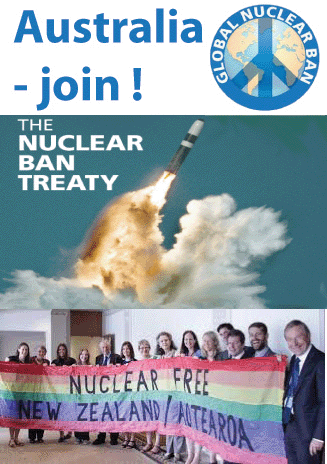
Australia joins boycott of UN treaty outlawing nuclear weapons
Foreign Minister Julie Bishop joined representatives from the US, Britain, France and others who were absent from the event at the annual United Nations gathering of world leaders overnight.
A total of 51 countries lined up to sign the new treaty.
The treaty was adopted by 122 countries at the United Nations in July following negotiations led by Austria, Brazil, Mexico, South Africa and New Zealand.
None of the nine countries that possess nuclear weapons — the United States, Russia, Britain, China, France, India, Pakistan, North Korea and Israel — took part in the negotiations.
“There remain some fifteen thousand nuclear weapons in existence. We cannot allow these doomsday weapons to endanger our world and our children’s future,” UN Secretary-General Antonio Guterres said as he opened the treaty for signing.
NATO condemned the treaty, saying that it may in fact be counter-productive by creating divisions.
As leaders formally signed on the sidelines of the annual UN General Assembly, Secretary-General Antonio Guterres hailed as historic the first multilateral disarmament treaty in more than two decades.
But Guterres acknowledged that much work was needed to rid the world of its stockpile of 15,000 atomic warheads.
“Today we rightfully celebrate a milestone. Now we must continue along the hard road towards the elimination of nuclear arsenals,” said Guterres.
The treaty will enter into force when 50 countries have signed and ratified it, a process that could take months or years.
“At a time when the world needs to remain united in the face of growing threats, in particular the grave threat posed by North Korea’s nuclear program, the treaty fails to take into account these urgent security challenges,” the 29-nation Western alliance said.
It added: “Seeking to ban nuclear weapons through a treaty that will not engage any state actually possessing nuclear weapons will not be effective, will not reduce nuclear arsenals, and will neither enhance any country’s security, nor international peace and stability.
Rejecting need for nuclear weapons
Foreign Minister Sebastian Kurz of Austria, one of the few Western European nations that is not in NATO, rejected the idea that nuclear weapons were indispensable for security.
“If you look at the world’s current challenges, this narrative is not only false, it is dangerous,” he told AFP.
“The new treaty on the prohibition on nuclear weapons provides a real alternative for security: a world without any nuclear weapons, where everyone is safer, where no one needs to possess these weapons,” he said.
Brazilian President Michel Temer was the first to sign the treaty. Others included South African President Jacob Zuma and representatives from Indonesia, Ireland and Malaysia as well as the Palestinian Authority and the Vatican.
The prime minister says with electricity demand flat and even falling in Australia, he doesn’t see there being a commercial demand for expensive nuclear power. Roje Adaimy, 21 Sept 17, Malcolm Turnbull doesn’t see there being the commercial demand for nuclear power in Australia to warrant pushing its development.
The prime minister says that while the country has among the biggest uranium reserves in the world, building nuclear power stations takes a very long time.
China has a number of plants under construction but there is no “cookie cutter” design to help efficiently roll out the technology.
There also needed to be bipartisanship, which right now “is not even remotely there”, he told a ‘politics in the pub’ event on Queensland’s Sunshine Coast.
“The projects take so long to build that they would be very likely to span the lifetime of several governments,” Mr Turnbull said on Thursday night. “They’re all bespoke, so it takes a very long time to construct them and very expensive.”
On top of that, demand for electricity in Australia was flat or declining. “I don’t see there being the commercial demand for nuclear power,” he said. “That’s putting my businessman’s hat on rather than my politicians’ hat on.”
It comes just a few weeks after the Minerals Council released a paper setting out the case for nuclear power.
Nuclear power has relatively strong support among coalition MPs, but it remains a political hot potato and has been repeatedly ruled out by governments because of its cost.
Junko Morimoto, author of My Hiroshima, urged Malcolm Turnbull to sign nuclear weapons ban treaty, ABC, By political reporter Anna Henderson, 21 Sept 17, Best-selling children’s author and Hiroshima bombing survivor Junko Morimoto urged the Australian Prime Minister to sign a treaty banning nuclear weapons before her death.
Key points:
Junko Morimoto wrote an eye-witness account of the dropping of the atomic bomb on Hiroshima
Morimoto urged Malcolm Turnbull to sign and ratify the new Treaty on the Prohibition of Nuclear Weapons
Morimoto was in her 80s when she died on Thursday morning.
Last month Ms Morimoto sent a letter to Malcolm Turnbull calling on his Government to sign and ratify the new Treaty on the Prohibition of Nuclear Weapons.
“When I was 13 years old, I survived hell on earth,” the letter said.
Solar Batteries: Australians see energy storage as the future, poll finds, ABC By consumer affairs reporter Sarah Farnsworth and the National Reporting Team’s Rebecca Armitage, 22 Sept 17, As power prices continue to surge, Australians believe household solar storage batteries are the key to cheaper and more reliable energy, according to a new poll of 2,000 households.
Key points:
A survey found almost three-quarters of people believe solar batteries will become commonplace
68 per cent of households with solar panels are considering purchasing a battery
The price of storage batteries in the first half of 2017 only dropped by 5 per cent
The Climate Council found nearly three-quarters of those surveyed believe batteries, coupled with solar systems, would become commonplace within 10 years.
Of those who already had solar systems, 68 per cent were considering adding a household storage battery.
Most said the primary motivation for buying a solar battery was to reduce power bills.
Only 6 per cent believed consumers were driven by the need to protect their homes from blackouts.
More than half said they expected large-scale batteries like the one being built by Elon Musk in South Australia would also become common in the next 10 years.
“It shows that Australians do understand that renewables — particularly solar and increasingly battery storage — provide a solution to high power prices,” the Climate Council’s Andrew Stock said.
“I think it’s very encouraging that Australians really do get the importance of new technology. There is very little appetite for keeping aging coal fire stations running in the Australian populace, frankly,” he said……..
Energy economist and director of Carbon and Energy Markets, Bruce Mountain, agreed South Australians would benefit from installing batteries sooner rather than later.
“That is simply because battery and solar prices have come down, and in South Australia energy prices have gone up so much,” Mr Mountain said.
Mr Mountain said he wanted the Federal Government to invest more in the local industry to bring down solar battery costs, instead of seeking to subsidise coal fire power generators like Liddell.
“They can accelerate the installation of these batteries, they can grow a local equipment suppliers and often than incentive creates new industry and scale economies,” Mr Mountain said.
Australia’s southern winters are drying out. Here’s why, ABC 20 Sept 17 ,By Ben Deacon and Kate Doyle Winter rains are in decline across southern Australia, and while it is too early to say beyond doubt it is due to climate change, scientists say it is not just about climate variability.
Key points:
This winter was particularly dry given there was no El Nino event
Winters in Australia’s south are drying out, affecting farmers
Scientists say it is not just due to climate variability
“It’s actually quite unusual for us to get such a widespread dry through the winter without having an El Nino,” Bureau of Meteorology senior climatologist Blair Trewin said.
El Nino often brings dry conditions to Australia, but this year it is in neutral.
“It’s almost more about what hasn’t been happening,” Dr Trewin said.
Normally in winter, storms come up from the southern Indian Ocean and clip the bottom of Western Australia, delivering rain to the south of the country.
But until mid-July, the storms largely missed the continent………. Rainfall continues to decline in southern Australia. According to the Bureau of Meteorology, May to July rainfall has reduced by about 19 per cent since 1970 in the south-west of Australia.
There has been a decline of about 11 per cent since the mid-1990s in the April–October growing season rainfall in the continental south-east.
CSIRO Agriculture and Food senior principal research scientist Zvi Hochman said winter rain in Australia’s southern wheatbelt had declined by a whopping 28 per cent since 1990.
“I was surprised as anyone to find the extent to which that trend, across the 50 weather stations, is there,” Dr Hochman said.
Nuclear annihilation was the common childhood nightmare for those growing up in the late 20th century. When the Cold War ended, the issue dropped off the public radar, to be replaced by other existential concerns such as global warning.
In the meantime, states with nuclear weapons got on with modernising their arsenals away from the glare of community awareness, and other states forged ahead with their own nuclear programs because, as noted by Australia’s former UN Ambassador Richard Butler, “as long as any state holds nuclear weapons, others will seek to acquire them”.
Now, two man-children possessed of odd hairdos, nuclear arsenals and twitchy fingers have brought the issue back to where it should have been all along. Uppermost in our minds.
Nuclear weapons are uniquely destructive to human health and the environment, because of the nature and extent of the devastation they cause and the ongoing radioactive fallout. Some nuclear weapons today are more than 3000 times more powerful than the atomic bombs that wiped out Hiroshima and Nagasaki 72 years ago. A single nuclear warhead, if detonated on a large city, could kill millions of people, with the effects lasting for decades.
While other destructive weapons — land mines, cluster munitions, biological and chemical weapons — are already banned, the most powerful of all, nuclear weapons, remain the only weapons of mass destruction not yet explicitly prohibitedunder international law.
This year, more than 135 other countries came together at the United Nations to negotiate a nuclear weapons ban treaty. You’d think Australia’s participation in the negotiations would have been a no-brainer for the federal government, what with the Australian public being overwhelmingly supportive, with Australia’s proud record of advocacy of nuclear disarmament, and with the Labor Opposition expressing its strong support.
This so-called ‘nuclear deterrence’ policy requires rational behaviour by all those who control nuclear weapons. Do we really have confidence that North Korean leader Kim Jong-Un and U.S. President Donald Trump will always behave rationally in not launching an attack on other nuclear states or their allies?
The nuclear deterrence policy also assumes that nuclear weapons make the world safer, not more dangerous. Patently, the reverse is true. The production, testing and possession, let alone the use, of nuclear weapons pose inherent risks.
There have already been a number of close calls (think Cuban Missile Crisis) and accidents, including last June, when a test missile involving the British Trident nuclear deterrence program malfunctioned and veered towards the U.S. coast before self-destructing. Luckily the missile was not armed with a nuclear warhead on that occasion but the British and U.S. governments did not reveal the incident when it happened, which incidentally, was just before the UK Parliament voted on renewing the Trident nuclear program.
Channeling Kath and Kim’s ‘I’ve got one thing to say to you’, the former UN Secretary-General was heard to say: “There are no right hands for wrong weapons.”
John Carlson, former head of Australia’s nuclear safeguards office for more than two decades, has pointed out in articles for the Lowy Institute that, as a party to the non-proliferation treaty, Australia is legally required to pursue negotiations in good faith on effective measures relating to nuclear disarmament.
It is difficult to see how Australia’s boycott of the nuclear ban treaty negotiations could be compatible with that obligation. Carlson also noted that:
“The world still has 15,000 nuclear weapons and the risk of nuclear war is increasing. A ban treaty is needed to re-energise disarmament efforts. The treaty will help to stigmatise nuclear weapons and change mindsets about retaining them”.
Notwithstanding Australia’s immoral (and likely illegal) boycott of the negotiations, the treaty text was finalised on July 7, and opened yesterday, September 20, for signature.
The treaty prohibits nations from developing, testing, producing, manufacturing, transferring, possessing, stockpiling, using or threatening to use nuclear weapons, or allowing nuclear weapons to be stationed on their territory. It also prohibits them from assisting, encouraging or inducing anyone to engage in any of these activities. Nations are obliged to provide assistance to all victims of the use and testing of nuclear weapons and to take measures for the remediation of contaminated environments. The preamble acknowledges the harm suffered as a result of nuclear weapons, including the disproportionate impact on women and girls, and on indigenous peoples around the world.
Many Australian indigenous and service personnel victims of British colonial nuclear testing at Maralinga, Emu Field and the Montebello islands in the 1950s and ’60s would no doubt attest to the importance of the treaty, which will come into force upon the ratification of 50 nations.
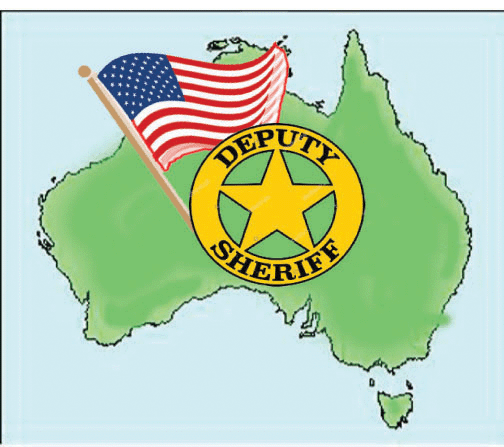
Just as it is time for Australia to have its own head of state, it is time for Australia to finally let go of our long-time strategic dependence on a great power, and to pursue fully independent foreign and defence policies.
Our ties with the U.S. will always be close — as Paul Keating said recently, “we couldn’t shake the Americans, even if we wanted to”. But surely, the time has come, particularly following the election of Donald Trump, to distance ourselves from counter-productive defence policies that are based on false assumptions, and take our place among the majority of nations as a constructive contributor to global peace.
I urge the Turnbull Coalition government to sign and ratify the UN nuclear ban treaty. If the present government fails to act, I urge the great Australian Labor Party of luminaries like Tom Uren, to convert its present support for nuclear ban treaty negotiations in Opposition into future support for the treaty in government, with a firm commitment at next year’s ALP national conference to ratify the nuclear ban treaty early in its first term.
Solar sedan and sports coupe in race across Australia – and to commercial market
A UNSW-built “solar sedan” is taking on a Brisbane-built solar sports coupe in a race across Australia – and to drive as registered vehicles on Australian roads.
Policy uncertainty is blocking investment in low carbon assets
Australian institutional investors have a strong appetite for low carbon assets, but policy uncertainty and a lack of scalable deals are major barriers.
Whyalla’s not a ghost town, it’s the centre of a green industrial revolution
Garnaut says renewables will cut energy costs to Whyalla steelworks by at least a third, and outlines plans for large scale solar, rooftop solar and pumped hydro and battery storage.
Solar boom underpins big surge in renewable energy jobs in August
Large-scale power project construction work has broken through 10,000 jobs and rooftop solar installs almost broke 100MW for the month. Given they’ll deliver something close to $180m in bill savings the large lift in solar shouldn’t come as much surprise to anyone but Tony Abbott.
Commonwealth Bank acknowledges climate risk, shareholders discontinue proceedings
Commonwealth Bank shareholders Guy and Kim Abrahams have discontinued their Federal Court proceedings against the bank for failing to disclose climate change risks in annual reports.
Infigen Energy announces announces who will be appointed to the Boards of Infigen Energy Limited, Infigen Energy (Bermuda) Limited and Infigen Energy RE Limited (the Infigen Boards).





 REneweconomy





