Australian govt -‘no plans’ to build or fund coal power, says PM Malcolm Turnbull
 Malcolm Turnbull says Government has ‘no plans’ to build or fund coal power, ABC 28 Aug 17 By political reporter Henry Belot ,
Key points:
- The Coalition has accepted 49 of the 50 recommendations from the Finkel Report
- Barnaby Joyce, Tony Abbott among MPs wanting the CET to allow more coal power plants
- PM Malcolm Turnbull says his Government has funded green energy “to a large degree”
Prime Minister Malcolm Turnbull says his Government has no plans to build a new coal-fired power station, and he wants to resolve a fractious debate over a clean energy target (CET) by the end of the year.
17 August More REneweconomy News

-
Turnbull doesn’t need new baseload, he just needs some ballsNo-one wants to invest in new baseload power. It makes no economic, or environmental sense. Deep down, Malcolm Turnbull understands this, but does he have the courage of his convictions, if that is what they were, to overcome the nonsense from the conservative ideologues?
-
WA could be solar exporter, but it needs a solar industry firstReport says WA’s Pilbara must first establish local solar industry if it wants to offer Indonesia competitive rates on PV generation.
-
AGL hits pause on virtual power plant in technology “rethink”AGL tells its “virtual power plant” customers in Adelaide their installation will be delayed while it reviews technology choices for the program.
-
New demand management plan could match “half a Hazelwood”AER’s proposed demand management scheme could deliver flexible capacity equivalent to half the closed Hazelwood coal-plant.
-
Hundreds register interest in Qld renewables + storage auctionQueensland’s 400MW reverse auction for renewables and energy storage has been flooded with interest.
-
Wind and solar produce three times more energy than IEA admitsThe IEA energy statistics underestimates the role of wind and solar in the world’s energy mix – by a factor of three. Here’s why.
-
Vector to boost its smart energy solutionsVector will be expanding its energy storage options for residential, industrial, and commercial customers, starting with LG Chem’s battery storage products.
-
Delta Electricity engages Entura to support Vales Point solar farmSpecialist power and water consulting firm Entura has been appointed by Delta Electricity to provide engineering services to support the development of the proposed Vales Point power station solar farm.
-
Battery storage: Who’s leading on quality and brand recognition?Tesla and LG Chem are leading the battery storage market in terms of brand recognition, but the issue of quality throws up some other names.
REneweconomy news 30 August
-
Renewables delivering – despite enemies and “lukewarm defenders”Green Energy Markets Renewable Energy Index shows an industry delivering on its promise: fulfilling a large and growing part of Australia’s energy needs while also providing meaningful employment.
-
Sapphire Wind Farm seeks community investors in possible Australian firstSapphire Wind Farm developer calls on community investors to take shares in what will be NSW biggest wind farm.
-
Snowy Hydro 2.0 Powering AheadSnowy Hydro 2.0 is already employing 350 people and will create more than 5000 new jobs during the construction phase of the development.
-
Know your NEM: Canberra fiddling while Rome burns on energy pricesFederal Government turns attention back to electricity prices, but while their interest is welcome, it is in a sense just fiddling while Rome burns.
-
WA mulls three gigawatt-scale PV plants to export solar to AsiaPlans to build three gigawatt-scale solar farms in Western Australia’s Pilbara and Kimberley regions and sell their output to Indonesia via submarine cables, could soon be commercially viable.
-
Victoria proposes “hybrid” contracts for new wind and solar farmsVictoria “hybrid” contract for its 650MW large scale renewable energy action, combining fixed payment with “contract for difference” that will cap its exposure.
-
NSW on renewables: All talk, not much actionNSW talks a good talk on renewable energy but offers few actions. Its share of new renewables is far smaller than its share of electricity consumption and this is particularly marked in PV, yet Transgrid sees huge opportunities.
-
S.A. calls tender for “next generation” renewables and storageSouth Australia seeks bids for “next generation” of renewable energy technologies, including “firming” capacity for wind and solar projects, bulk energy storage, and bio-energy.
-
Shell wins approval for 250MW solar plant in Queensland coal countryShell wins planning approval for 250MW solar plant in heart of Queensland’s coal country, in what appears to be its first big move into large scale solar in Australia.
-
WA bathes in sunshine, but poorest households lack solar panelsSolar panels are still a rarity in WA’s lower-income areas.
Radioactive wastes: South Australia
 Royal Adelaide Hospital waste to be shipped back overseas when it closes http://www.adelaidenow.com.au/news/south-australia/royal-adelaide-hospital-waste-to-be-shipped-back-overseas-when-it-closes/news-story/a3cdebd7c500f00e67b7913b48e7d900?nk=ba26857f63080120cbd5fc74c94d3959-1503908527, Daniel Wills, State Political Editor, August 27, 2017
RADIOACTIVE waste currently stored at the old Royal Adelaide Hospital is set to be sent back overseas as the site is cleared when health services shift to the other end of North Tce.
With demolition and redevelopment of the site imminent once medical services are transferred to the new hospital next week, The Advertiser can reveal the State Government is developing plans to return the waste back to it European or British origin.
More than a year ago, Renewal SA chief executive John Hanlon told a State Parliament committee how the Government was working on plans to house the waste in SA when the old RAH closed. While no proposal was settled, officials investigated a new SA site that could also be a repository for other low-level radioactive waste scattered in other sites around the state.
A SA Health spokeswoman said the old RAH waste, mostly used for patient treatment and research, was no longer needed once the shift to the new hospital was complete.
“The radioactive sources are currently stored in lead-lined boxes in a secure store in preparation for the removal process,” she said. “Once the old RAH site is decommissioned, the majority of waste radioactive sources will be safely returned to the country of origin.”
Most of the radioactive sources at the old RAH used for medical purposes came from the UK or Europe. SA Health is also working to identify any other origin countries. Final disposal is expected to be dealt with by the source material’s manufacturers.
The department is working with the Australian Nuclear Science and Technology Organisation and the state Environment Protection Authority to ensure safe, and legal removal. The old RAH is one of 78 different facilities in SA currently storing low or intermediate level waste, according to the government’s Nuclear Fuel Cycle Royal Commission.
Low level waste is generated in hospitals and by industry. It comprises paper, rags, tools, and gloves with short-lived radioactivity that do not require shielding during normal handling.
Intermediate waste is typically metal and other materials from decommissioned reactors. It emits higher levels of radiation and requires shielding during handling, transport and storage.
Parliament was told in 2011 that radioactive waste currently at the old RAH is in a basement.SA Health is responsible for the removal of all known radioactive sources before the site is handed over to Renewal SA, which will oversee a $1 billion redevelopment.

A truly good news story – the cuttlefish are back in Spencer Gulf
 South Australians – pat yourselves on the back. When the nuclear lobby wanted to put the nuclear industry up at the top of Spencer Gulf – South Australia said “NO” – as South Australians have been doing for decades – fighting back. Nuclear power would have caused releases of hot water into the Gulf, ruining the special temperature conditions essential for the breeding of these unique and beautiful animals.

We don’t really know why they dwindled, and why they’re now back. But hooray for their return!
Thousands of giant cuttlefish back in SA http://www.heraldsun.com.au/news/breaking-news/thousands-of-giant-cuttlefish-back-in-sa/news-story/f859a1f7bd568fb213ae2fe4fe66b680, Australian Associated Press, August 25, 2017 Thousands of giant cuttlefish are flocking to the rocky coastline of the upper Spencer Gulf in South Australia to spawn in record numbers, reserving a worrying decline.
More than 100,000 cuttlefish have journeyed to Point Lowly near Whyalla to breed, according to data from the state government’s principal research institute.
The number is up from a record low of just over 13,000 in 2013.
The giant Australian cuttlefish – which can reach up to 60cm in length and weigh five kilograms – live for two to three years and migrate annually to Spencer Gulf to spawn.
The worrying decline in their numbers in 2013 promoted more research into their breeding patterns. This year’s population estimate is the third-highest recorded over the last decade,” said senior research scientist Dr Mike Steer.
It is still not completely understood why cuttlefish migrate to the Spencer Gulf nor why their numbers declined, but fishing restrictions have been put in place until 2018 as a precaution.
“The last five years of research has clearly demonstrated the population’s capacity to rebound from low numbers very quickly,” Dr Steer said.
Without Clean Energy Target, Australia’s booming renewable energy will flounder: Frydenberg prevaricates
 Renewable energy booming but could soon turn to bust, analysts warn, The Age, Nicole Hasham , 27 Aug 17
Australia produced enough renewable energy to power 70 per cent of households last financial year, new data shows, but advocates warn the booming industry will flounder unless the Turnbull government commits to a clean energy target.
The government is sharply divided over whether to adopt the target, the central recommendation of Chief Scientist Alan Finkel’s review of the national electricity market…….
Mr Frydenberg cited Clean Energy Council figures showing there was a record $8 billion of renewable investment underway, delivering more than 4000MW of new renewable generation capacity.
He has previously said the clean energy target, if implemented, would not come into effect until 2020 so there was “no rush” for the government to make a decision……http://www.theage.com.au/environment/energy-smart/renewable-energy-booming-but-could-soon-turn-to-bust-analysts-warn-20170825-gy4egf
Enough renewable energy to power 70% of Australian homes
 Renewable energy generates enough power to run 70% of Australian homes https://www.theguardian.com/environment/2017/aug/27/renewable-energy-generates-enough-power-to-run-70-of-australian-homes
Renewable Energy Index shows sector will generate power to run 90% of homes once wind and solar projects being built in 2016-17 are completed, Guardian, Joshua Robertson, 28 Aug 17, Australia’s renewable energy sector is within striking distance of matching national household power consumption, cranking out enough electricity to run 70% of homes last financial year, new figures show.
The first Australian Renewable Energy Index, produced by Green Energy Markets, finds the sector will generate enough power to run 90% of homes once wind and solar projects under construction in 2016-17 are completed. The index, funded by GetUp through supporter donations, underlines the advance of renewables, despite Australia’s electricity markets still leaning heavily on carbon-emitting coal and gas-fired generation.
Renewables, which made up just 7% of national electricity output a decade ago, accounted for 17.2% last financial year. This jumped to 18.8% last month. This is saving the power sector from carbon pollution equivalent to taking more than half of all cars in Australia off the road, according to Green Energy Markets.
Green Energy Markets analyst Tristan Edis said the emergence of renewables, in particular wind and solar, as a “significant source of power” had ushered in a “construction jobs and investment boom”.
“The renewable energy sector has staged a remarkable recovery, after investment completely dried-up under former prime minister Tony Abbott,” Edis said.
He said investors had “recovered their confidence under Malcolm Turnbull”, with help also from “a range of state government initiatives”. Edis said the renewables sector was on track to meet the federal government’s renewable energy target of 20% of total generation by 2020 over a year early, by the end of 2018.
However, the renewable jobs boom underpinned by the RET could “soon turn to bust”, he said.
Renewable investment beyond the RET risked collapsing without the Turnbull government moving forward on chief scientist Alan Finkel’s recommendation for a future “clean energy target”, he said.
At least 46 large-scale energy projects under construction by the end of June were providing enough work to employ 8,868 people full-time for a year. This figure had surged to 10,000 by July. Most jobs were in NSW (3,018), thanks largely to wind farms, while Queensland (2,625) was next, with 70% of its jobs coming from solar farms.
Rooftop solar installations supported a further 3,769 full-time jobs across Australia in 2016-17.
With most projects underway in Queensland, large solar farms still generated less than 2% of renewable energy in 2016-17, the index found.
Generation from rooftop solar, which was “back in 2008 little more than a rounding error”, had “grown spectacularly”, Edis said.
More than 150,000 systems installed in the last year alone would produce enough energy for 226,000 homes, he said.
“Meanwhile these solar systems will also save consumers $1.5 billion off their electricity bills over the next 10 years.”
Miriam Lyons, GetUp’s energy campaigns director, said that “everyday Australians are voting with their rooftops” in a move that “heralds the end of the era of big polluting energy companies dominating the market and manipulating prices to fill their own pockets”.
“Who do we have to thank for the renewables boom? Certainly not the federal government,” she said.
“Instead we can thank the thousands of everyday Australians who stood up and defended the national [RET] from Tony Abbott’s attacks, who saved [the Australian Renewable Energy Agency] from federal government budget cuts, and who pushed their state governments into showing some leadership on clean energy.”
The Australian Renewable Energy Index will be published monthly.
Voices of reason call for immediate end to NT Indigenous Intervention
 ~ Jeff McMullen https://independentaustralia.net/australia/australia-display/voices-of-reason-call-for-immediate-end-to-indigenous-intervention,10655
” … Several outspoken Elders, including Utopia’s Rosalie Kunoth-Monks and speakers from the Yolgnu Nations Assembly will launch the statement of support in Melbourne.
“They say the slow strangulation of services to the smaller homelands and the suffocating government control of almost all aspects of community life is a creeping extinction for these Aboriginal people. …
“The group statement concludes:
“We call on the Australian Government to heed the call of Northern Territory Elders for an immediate end to the racism and discrimination of the Intervention policies which are an ongoing stain on the Australian nation.
“It is time that the Australian Governments respect and negotiate with remote living Indigenous people in good faith, demonstrate proper duty of care to them and allow all First Nations of Australia the right to self-determination.”
Malcolm Turnbull tries to look climate change good, with Snowy Hydro funding
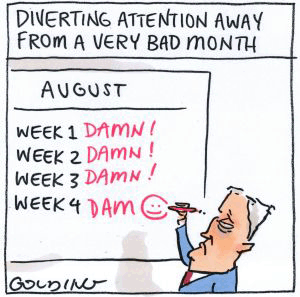 Malcolm Turnbull to announce millions in funding for Snowy Hydro 2.0 pet project, The Age, James Massol, 27 Aug 17 Prime Minister Malcolm Turnbull is set to announce millions in extra funding for his pet project, Snowy Hydro 2.0, after visiting the power station on Monday morning. Prime Minister Malcolm Turnbull is set to announce millions in extra funding for his pet project, Snowy Hydro 2.0, after visiting the power station on Monday morning.
The announcement is due to be made in News Corp papers on Monday, but Fairfax Media has learnt the details ahead of time.
Mr Turnbull will attempt to focus on electricity prices and energy policy for the entire week ahead, in an attempt to shift focus away from the citizenship fiasco….
The feasibility study is due to be completed by the end of year; work is already under way on technical and drilling work and it will soon ramp up to be a 24-hour-a-day operation……
The expansion of Snowy Hydro, which will conservatively cost at least $2 billion and which will take at least four years to complete, is designed to provide power for an extra 500,000 homes when finished. The bill for the project could effectively double from $2 billion to $4 billion because of essential upgrades to power transmission lines into Melbourne and Sydney.
When completed, it will effectively function as a giant battery for the east coast electricity market and the new power station will have an estimated generation capacity of 2000 megawatts…..
ARENA began talks with Snowy Hydro about working on the project in February, about a month before the Prime Minister announced the project, and it is hoped the know-how the agency gains from working on Snowy Hydro 2.0 will be used on other pumped hydro storage projects.
The Commonwealth owns 13 per cent of the scheme, NSW 58 per cent and the Victorian government 29 per cent. http://www.theage.com.au/federal-politics/political-news/malcolm-turnbull-to-announce-millions-in-funding-for-snowy-hydro-20-pet-project-20170827-gy5042.html
Australia eclipsed in commercial solar uptake
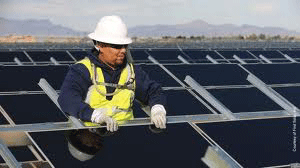 http://www.examiner.com.au/story/4876719/australia-eclipsed-in-commercial-solar-uptake/?cs=97 Reece Turner, 27 Aug 2017, Australia is seeing a new boom in solar energy generation powered by nose-bleeding electricity and gas price rises. In fact, Australian households are approaching 25 per cent solar uptake, which is the highest in the world by a large margin.
In Illawarra, there are 11,259 households powered by the sun and, according to advocacy group Solar Citizens, this saves residents $5.4 million every year. This is great for job creation and the environment.
However, when it comes to businesses installing solar power, Australia’s doing far worse. Estimates are we’re not even in the top 20 countries for commercial solar.
Community energy group Repower and solar engineering company Planet Ark Power hope to change that by helping more companies in Illawarra to take up solar.
This month, at the Wollongong Tennis Club, we’ll be launching “Repower Wollongong”. This follows successful launches of Repower Shoalhaven and Repower Southern Highlands. Indeed, this model of community energy group is one of the most successful in the country, assisting 17 businesses save thousands on their bills.
Many businesses are interested in going solar, but there are some hurdles. One of them can be the upfront costs. A commercial solar system generates free energy for 25 or 30 years, but the initial investment can be anything from $20,000 upwards.
The Repower community energy model removes this hurdle by collecting community investment that pays for the system upfront and then sells the clean energy back to the business at a rate cheaper than grid electricity and with a degree of certainty against rising energy hikes.
It’s a brilliant model delivering returns to the community, helping save on business costs and supporting local jobs. Find out more at www.repower.net.au
Reece Turner is business development manager at Planet Ark Power.
28 August REneweconomy news
-
Renewables delivering – despite enemies and “lukewarm defenders”Green Energy Markets Renewable Energy Index shows an industry delivering on its promise: fulfilling a large and growing part of Australia’s energy needs while also providing meaningful employment.
-
Sapphire Wind Farm seeks community investors in possible Australian firstSapphire Wind Farm developer calls on community investors to take shares in what will be NSW biggest wind farm.
-
Snowy Hydro 2.0 Powering AheadSnowy Hydro 2.0 is already employing 350 people and will create more than 5000 new jobs during the construction phase of the development.
-
Know your NEM: Canberra fiddling while Rome burns on energy pricesFederal Government turns attention back to electricity prices, but while their interest is welcome, it is in a sense just fiddling while Rome burns.
-
WA mulls three gigawatt-scale PV plants to export solar to AsiaPlans to build three gigawatt-scale solar farms in Western Australia’s Pilbara and Kimberley regions and sell their output to Indonesia via submarine cables, could soon be commercially viable.
-
Victoria proposes “hybrid” contracts for new wind and solar farmsVictoria “hybrid” contract for its 650MW large scale renewable energy action, combining fixed payment with “contract for difference” that will cap its exposure.
-
NSW on renewables: All talk, not much actionNSW talks a good talk on renewable energy but offers few actions. Its share of new renewables is far smaller than its share of electricity consumption and this is particularly marked in PV, yet Transgrid sees huge opportunities.
-
S.A. calls tender for “next generation” renewables and storageSouth Australia seeks bids for “next generation” of renewable energy technologies, including “firming” capacity for wind and solar projects, bulk energy storage, and bio-energy.
-
Shell wins approval for 250MW solar plant in Queensland coal countryShell wins planning approval for 250MW solar plant in heart of Queensland’s coal country, in what appears to be its first big move into large scale solar in Australia.
-
WA bathes in sunshine, but poorest households lack solar panelsSolar panels are still a rarity in WA’s lower-income areas.
Australia’s coastal communities already vulnerable to climate change
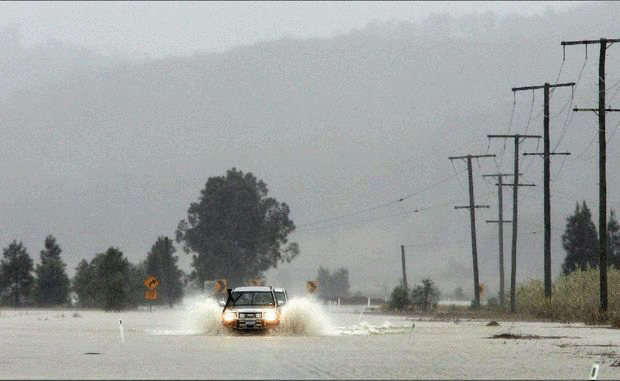 Flooding proved how vulnerable Coast is to climate change, Sunshine Coast Daily, Bill Hoffman | 26th Aug 2017 THE Sunshine Coast received a taste Monday night of the future normal for low-lying coastal communities everywhere when, in the middle of a drought-like winter, water flooded through storm water outlets and over the top of revetment walls and onto key streets across the region.
The cause wasn’t an intense east coast low, a cyclone or intense rain event normally associated with flooding of low-lying areas across the region. If it had occurred during daylight, particularly at peak hour, Mooloolaba would have been left grid-locked and Bradman Avenue, Maroochydore, reduced to one-lane along the river.
Twin Waters residents would have seen water up into the parks and footpaths along Twin Waters Drive and the river spilling into bushland for more than 100 metres along Nojoor Road.
At Caloundra the vulnerability of Tay and Maloja Avenues at Bulcock Beach would have been fully exposed.
What occurred required no more than a couple of days of strong southerly winds blowing up the NSW and Victorian coasts to set off the Ekman Transport Effect which lifted the Highest Astronomical Tide for the season at Mooloolaba from 2.03metres by additional 0.4 of a metre.
While for many the resulting impact of that degree of sea level rise went largely unnoticed, scientists at the University of the Sunshine Coast and hydrologists took note.
They are in agreement that Monday night’s short-term increase in sea levels afforded a glimpse of the future impact of the best-case 0.8 metre permanent rise now locked in by 2100 because of climate change.
The Ekman Transport Effect refers to the shift leftward that occurs when sustained winds blow in a consistent direction over the ocean moving the top 30m layer of water. The resultant upwelling is most likely to occur along New South Wales, south-east Queensland and the Bonney Coast (South Australia) coastlines.
Professor Tim Smith, director of the University of the Sunshine Coast Sustainability Research Centre, says the region has received a wake-up call in terms of what it needs to prepare for. “We are pretty lucky it was not combined with other things to intensify the situation like a low-pressure system or a high-intensity rainfall event or it would have been a much more devastating outcome,” Prof Smith said.
“We have to think about the design and placement of infrastructure and assets. We can’t continually defend and protect ad finitum. “Alternative adaptation strategies will be needed.”
He says the options are limited. The first is to try to protect assets without changing their location. Professor Smith said the approach was the emphasis of local authorities across Australia who don’t want to change but preferred to protect investments made in calm weather 40 years ago.He said the problem was that the environment was not static and could not be controlled.
The second strategy was to accept there were going to be impacts and to retrofit existing settlement and infrastructure to experience less damage. “You could raise houses to protect from periodic impacts if you were willing to live with them,” Prof Smith said.
The other option was to retreat in the process relocating settlement and assets out of harm’s way. “That’s a taboo subject, he said. “People don’t want to talk about it but eventually we will need to have a serious discussion.”
Hilo in Hawaii, Grantham in Queensland’s Lockyer Valley and Twin Rivers in New Zealand all provide limited examples of communities that have bitten the bullet and shifted their communities out of harm’s way.
“We can’t keep building walls higher and higher,” Prof Smith said. “The longer we leave it the more difficult it will become. The sooner we act the better.” He says the danger of protecting assets is that the protection gives confidence to put more in harm’s way, doubling the risk.
He takes issue with the failure of governments to be explicit about the planning time horizons of capital spending. If it’s 20 years it doesn’t matter. Longer than that may become problematic. What won’t cut it is a piecemeal response to climate change…… https://www.sunshinecoastdaily.com.au/news/how-flooding-provided-a-window-to-the-future/3216185/
Safety concerns about Port Pirie’s former uranium plant site raised by Liberal candidate
 Liberal candidate raises safety concerns about Pirie’s former uranium plant site, Port Pirie Recorder, 25 Aug 17, Frome Liberal candidate Kendall Jackson is calling on the state government to restore the fence at the former Port Pirie Uranium and Rare Earth Treatment Plant and Tailings site.
She said the State Development Department was responsible for managing the area and was yet to release the Radiation and Environment Management Plan for the site.
This was expected to be released in the first half of this year.
“The government must publicly release its plans for the former uranium plant site,” Mrs Jackson said.
“Residents deserve to know what the government has planned for the site and why the report is taking so long to be publicly released…..http://www.portpirierecorder.com.au/story/4877490/fears-over-former-uranium-plant-site/
Bundaberg MP insists that coastal communities must prepare for climate change.
 MP says preparing for climate change is vital for the Bundaberg region https://www.news-mail.com.au/news/mp-says-preparing-for-climate-change-is-vital-for-/3216829/, Jim Alouat | 26th Aug 2017 LOWER house insurance premiums could be on the cards if Bundaberg home owners take steps to embrace climate and weather-resilient designs.
Preparing for climate change is important for communities like Bundaberg where flooding is already a significant threat, says Bundaberg MP Leanne Donaldson.
According to the Queensland Climate Adaptation Strategy report, Queensland already experiences climate extremes such as floods, droughts, heatwaves and bushfires and climate change is likely to exacerbate the frequency and/or severity of these events.
Ms Donaldson said the government was having ongoing discussions with the insurance industry to see how actions to reduce exposure to climate hazards could reduce insurance premiums.
“However, the Queensland Climate Adaptation Strategy identifies the need to improve access to information on insurance options as a method to manage climate risk, and to investigate how we can improve access to finance for priority activities that improve our readiness and resilience to climate change,” she said.
Ms Donaldson said the suggestion of building ground floors that were ready for floods, was raised as just one example of many innovative solutions the sector might consider when adapting to changed weather patterns and greater climate risk.
“Whether it’s finding innovative solutions to make homes more flood resistant, or choosing to build in locations that are less prone to flooding, it is important that these risks are considered when planning our infrastructure,” Ms Donaldson said.
“There is a lot of work going into this area at the moment, particularly on how these climate risks can be better incorporated into planning guidelines.
“It’s also important to note that flooding is just one of many climate hazards identified in the sector adaptation plan that need to be considered when planning for changes in the climate.”
Ms Donaldson said the Built Environment and Infrastructure Sector Adaptation Plan will not affect the 10-year Flood Action Plan for the Bundaberg region.
“However, adapting to climate change is complimentary to building resilience and fulfilling the actions included in the Burnett River Floodplain,” she said.
Adani: Australian Conservation Foundation loses appeal against $16b Carmichael coal mine
 The Age, By Ellie Sibson, 26 Aug 17, Environmentalists have lost another appeal against Adani’s $16 billion Carmichael coal mine in Queensland’s Galilee Basin.
The Australian Conservation Foundation (ACF) lodged the appeal last year after an earlier court ruling endorsed the mine’s environmental approval.
The full bench of the Federal Court in Brisbane today dismissed the foundation’s arguments that the Federal Environment Minister had failed in his duty to consider the mine’s impact on the Great Barrier Reef.

ACF spokesman Paul Sinclair said they would continue their fight to stop the mine.
“Today’s decision is just another step in the most significant environmental campaign of our generation,” he said.
“[It] shows that our national environmental laws are broken and are not protecting the places we love, like the Great Barrier Reef.
“We depend on the passion, commitment and determination of the Australian people to stop the Adani mine.”
In June, Adani’s board gave final investment approval for the proposed coal mine, which would be the largest in Australia.
In a statement, Federal Environment Minister Josh Frydenberg said the Government welcomed the decision…..http://www.abc.net.au/news/2017-08-25/conservation-foundation-lose-appeal-adani-carmichael-coal-mine/8842578
1 This month


Help Aunty Sue Protect Her Land and Sacred Sites From Destructive Rocket Testing.
.

Australians deserve the truth
about
AUKUS – https://aukuspublicinquiry.com/

PETITION – To: Prime Minister Anthony Albanese and the Australian Labor Government

of the week – Australians for War Powers Reform (AWPR)
To see nuclear-related stories in greater depth and intensity

