The dilemma of North Korea’s nuclear weapons
North Korea: What can actually be done to deal with a nuclear Pyongyang? http://www.abc.net.au/news/2017-09-03/north-korea-is-it-time-to-accept-it-will-remain-a-nuclear-threat/8868138, ANALYSIS, By chief foreign correspondent Philip Williams, From the first tweak of the seismograph it was clear this was no ordinary tremor — it signalled the most powerful bomb of all.
The North Korean TV newsreader announced with a flourish this was the state’s first hydrogen bomb.If that now means Pyongyang has the weapon and the delivery system that could wipe out a Los Angeles, a San Francisco or a Sydney in a flash, then the world is now a different place.
Nuclear weapons are supposed to be a deterrent — make yourself so dangerous no-one will ever dare challenge you — and it is a fact that barring some Scuds aimed at Israel during the 1991 Gulf War and some border skirmishes between China and Vietnam and India and Pakistan, no nuclear-armed state has ever faced a serious attack by another country.
Clearly the thinking for three generations of Kim is that the regime is made safe if everyone fears you. And the clear impression you are crazy helps too — no-one wants to aggravate a disturbed mind.
But what to do? US President Donald Trump has described the test as hostile and dangerous and said Pyongyang “only understands one thing”.
Appeasement was not working, he said, and the rogue nation has become a “great threat and embarrassment” to China. He later tweeted the US was considering “stopping trade with any country doing business with North Korea”.
That would include both China and Russia. While both signed on to the latest UN sanctions, cutting trade altogether would be a far more serious step.
Beijing would have to cut off oil supplies and Moscow send back the North Korean labourers who “volunteer” to work in Siberian forestry camps in what have been described as slave-like conditions.
The whole region and beyond is in a fix. China especially is feeling the squeeze from the United States, and even Australia has argued Beijing has not applied full muscle against North Korea to mend its errant ways.
But the Chinese Government has agreed to the latest sanctions and deeply resents the assertion it could stop Kim Jong-un if it really wanted to. There is nothing for the Chinese to gain from a nuclear war on the Korean Peninsula.
Not only would there be the risk of nuclear contamination, what really worries Beijing is the thought of millions of refugees pouring over the border seeking shelter from a nuclear storm. Not to mention the terrible human and economic cost of shattered neighbours.
The constant refrain from Mr Trump and Malcolm Turnbull for China to do more and do it now could soon become counterproductive. Beijing’s influence on North Korea’s leadership is often overstated.
Its troublesome neighbour has repeatedly embarrassed China by testing bombs or missiles at an inopportune moment. This latest test happened at the opening of a major BRICS (Brazil, Russia, India, China and South Africa) conference held in China and hosted by President Xi Jinping.
Not only was his thunder stolen, he and guest Vladimir Putin were forced to issue a joint statement condemning the test but urging a negotiated solution. Mr Trump underlined that via a tweet, saying: “North Korea is a rogue nation which has become a great threat and embarrassment to China, which is trying to help but with little success.”
For his part, the US leader has wedged himself with rhetoric — it was only a couple of days ago he said the time for talking was over. But what does that leave?
The US military will have its plans ready, just in case. And Mr Trump is the only person with power to order what would be the destruction of North Korea. Is he really contemplating the death of millions, the ruin of cites on both sides of the 38th parallel?
Only if North Korea crosses his red lines. Do they exist in the seas off Guam, Hawaii, or the West coast of the mainland itself?
Surely Mr Kim and his predecessors have not come all this way to self-destruct. After all, these bombs and missiles are supposed to protect, not trigger an end game conflict. No party to this conundrum wants this to happen.
But the scene is set, the main players less than predictable and the talk tough. North Korea will never willingly trade away its newfound military clout, it is seen as vital for survival, but successive US presidents have made it clear they will never live with a nuclear armed and able North Korea.
It is a country that revels in regular threats to wipe out entire US cities. It is no longer trash talk that can be ignored and no-one, it seems, has a plausible answer.
One commentator suggested arming both South Korea and Japan with nuclear weapons to act as a foil to the North. That would mean five countries in the region with the ability to erase entire cities from the planet.
Our once relatively safe and increasingly prosperous neighbourhood is taking a serious turn for the worse. Only two people on the planet can change all that, and neither is showing signs there is a safe way out.
Asked by a reporter if the US would attack North Korea, Mr Trump said: “We’ll see.”
Greens warn Labor not to do clean energy deal that protects coal power
Guardian, Katherine Murphy, 4 Sept 17, Opposition told to be wary of doing a Finkel review deal with the Coalition that would prolong the life of coal plants The Greens are attempting to warn Labor off doing a deal with the Turnbull government on a new clean energy target, saying a Finkel handshake could trigger a “valley of death” for short-term investment in renewables, and lock in coal, rather than stranding it.
With parliament due to resume on Monday, and with the Turnbull government inching closer to finally resolving and outlining its energy policy, the Greens climate change spokesman, Adam Bandt, will bring forward a bill to prolong and expand the existing renewable energy target scheme.
While the Bandt bill won’t win parliamentary support, in political terms, it is a clear shot across Labor’s bow as the opposition begins to assess whether or not to sign on to the clean energy target – in the event the Coalition overcomes its internal brawl, and proposes one…….https://www.theguardian.com/australia-news/2017/sep/04/greens-warn-labor-not-to-do-clean-energy-deal-that-protects-coal-power
Minerals Council to lobby Malcolm Turnbull in favour of nuclear power
 Turnbull faces new push for nuclear power, news.com.au , SEPTEMBER 1, 2017 Malcolm Turnbull faces calls to remove legal hurdles for nuclear power in a report giving the government advice on ensuring enough baseload power for future electricity needs.
The Minerals Council, which will host the prime minister at its annual dinner in Canberra next Wednesday, has released a paper setting out the case for nuclear power. Nuclear power has relatively strong support among coalition MPs, but it remains a political hot potato and has been repeatedly ruled out by governments because of its cost.
The paper, Removing the Prohibition on Nuclear Power, by the Minerals Council’s Daniel Zavattiero says Australia is trying to build a reliable, affordable and low emissions electricity system with “one hand tied behind its back”.
Having been banned in 1998, the paper suggests the ban could be lifted with a single amendment to the Environment Protection and Biodiversity Conservation Act, removing four words – “a nuclear power plant”.
However, any projects would still have to meet stringent environmental and safety requirements.
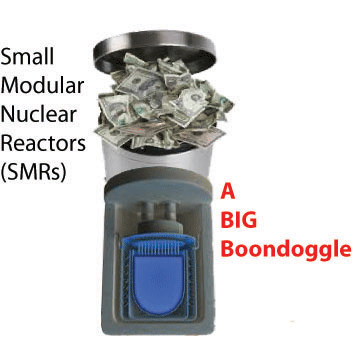 Mr Zavattiero said a new generation of venture-capital backed nuclear start-ups are coming through, with designs for smaller reactors with significantly reduced up-front costs.
“Any objective science-based discussion devoid of hyperbole and emotion invariably finds that nuclear power is clean, economic and reliable, that it plays a vital role in the world today, will continue to do so in the future, and that it makes no sense for it to be banned in Australia,’ Vimy Resources chief Mike Young said.
A review of the electricity sector by chief scientist Alan Finkel found that while nuclear power had zero emissions “any development will require a significant amount of time to overcome social, legal, economic and technical barriers” and deal with the waste issue……..http://www.news.com.au/national/breaking-news/turnbull-faces-new-push-for-nuclear-power/news-story/13f1fa010017160b8c72ebbf340e03ab
Climate change and the link to Australia’s record-breaking winter warmth
 Australia’s record-breaking winter warmth linked to climate change https://theconversation.com/australias-record-breaking-winter-warmth-linked-to-climate-change-83304 Climate Extremes Research Fellow, University of Melbourne, September 1, 2017 On the first day of spring, it’s time to take stock of the winter that was. It may have felt cold, but Australia’s winter had the highest average daytime temperatures on record. It was also the driest in 15 years.
Back at the start of winter the Bureau of Meteorology forecast a warm, dry season. That proved accurate, as winter has turned out both warmer and drier than average.
While we haven’t seen anything close to the weather extremes experienced in other parts of the world, including devastating rainfalls in Niger, the southern US and the Indian subcontinent all in the past week, we have seen a few interesting weather extremes over the past few months across Australia.
Drier weather than normal has led to warmer days and cooler nights, resulting in some extreme temperatures. These include night-time lows falling below -10℃ in the Victorian Alps and -8℃ in Canberra (the coldest nights for those locations since 1974 and 1971, respectively), alongside daytime highs of above 32℃ in Coffs Harbour and 30℃ on the Sunshine Coast.
During the early part of the winter the southern part of the country remained dry as record high pressure over the continent kept cold fronts at bay. Since then we’ve seen more wet weather for our southern capitals and some impressive snow totals for the ski fields, even if the snow was late to arrive.
This warm, dry winter is laying the groundwork for dangerous fire conditions in spring and summer. We have already had early-season fireson the east coast and there are likely to be more to come.
Climate change and record warmth Continue reading
Tony Abbott to join Britain’s Nigel Lawson in climate denial lecturing in Britain
 Tony Abbott to lecture leading climate-change sceptic think tank, http://www.theaustralian.com.au/news/nation/tony-abbott-to-lecture-leading-climatechange-sceptic-think-tank/news-story/ce897ce09992d942256245dd08edf0fd, GRAHAM LLOYD, 1 Sept 17, Former prime minister Tony Abbott will give the annual lecture to one of the world’s leading climate change sceptic think tanks, the Global Warming Policy Foundation in London.
The title of Mr Abbott’s address will be “Daring to doubt”.
The invitation-only lecture will be held at the Institution of Mechanical Engineers in Birdcage Walk, London, on October 9. Mr Abbott will follow John Howard who addressed the foundation’s lecture in 2013 with a speech “One religion is enough”.
The foundation is chaired by former Thatcher government treasurer Lord Nigel Lawson.
The foundation is one of the world’s most active groups promoting debate about the state of climate change science.
It republishes articles and material both supportive and against the mainstream science view and commissions research on climate change-related issues.
The foundation is funded by private donations and does not accept gifts from energy companies or anyone with a significant interest in an energy company.
Mr Abbott’s spokeswoman said the trip would be privately funded by the foundation
2 September REneweconomy news
 RenewEconomy
-
Australia’s energy future on grid edge – can AEMO give it a push?AEMO again stresses vital role that demand management solutions – and not more baseload coal – will play in the safe, stable and economic running of Australia’s electricity grid, as it transitions away from centralised fossil fuel generation and towards distributed renewables.
-
Worsening climate change melts winter heat recordsAustralia has experienced its hottest winter on record as a result of intensifying climate change.
-
Fossil fuel marketing terms swamp the ABC and mainstream mediaThe term “low emissions coal” has been used 100s of times in Australia’s mainstream media – which is a lot for something that doesn’t exist.
-
Queensland removes feed-in tariff cap on regional solar systemsSolar PV systems of up to 30kW in size will now have access to 11c/kWh feed-in tariffs in regional Queensland.
- Big energy players back major power shift, as GreenSync unveils deX
-
GreenSync’s game-changing distributed energy trading platform officially unveiled with backing of AEMO and major energy market players.
Time for Australia to have an inquiry into nuclear waste production and storage.
Advertiser, (Dr) MARGARET BEAVIS, 1 Sept 17, THE federal Government is still pushing hard for South Australia to take Australia’s nuclear waste. They make a big song and dance about nuclear medicine, but leave out facts that don’t suit them.
Firstly, most waste is not from nuclear medicine, but from CSIRO and industrial uses.
Secondly, most countries, including the UK and the US, import nuclear medicine. We sometimes do, too, with ANSTO reactor breakdowns or maintenance. Less than 1 per cent of waste comes from actually using nuclear medicine, as it loses radioactivity so quickly almost all goes in the normal rubbish.
Thirdly, the proposed facility for the most toxic waste (which lasts over 10,000 years) is  substandard – way below world’s best practice.
Finally, they don’t mention that taxpayer-subsidised ANSTO is massively ramping up production of waste. There is no shortage of nuclear medicine – this is about grabbing market share, leaving us with lots more future waste. And no community consultation.
What we need right now is an inquiry into nuclear waste production and storage. Dodgy claims and a shonky dump should not be used to pressure SA communities.
Aboriginal women’s long walk to stop uranium mining in Western Australia
‘Walkabout’ protesters get their day in court to fight uranium mining in WA http://www.watoday.com.au/wa-news/walkabout-protesters-get-their-day-in-court-to-fight-uranium-mining-in-wa-20170831-gy82w9.html, David Allan-Petale, 31 Aug 17,
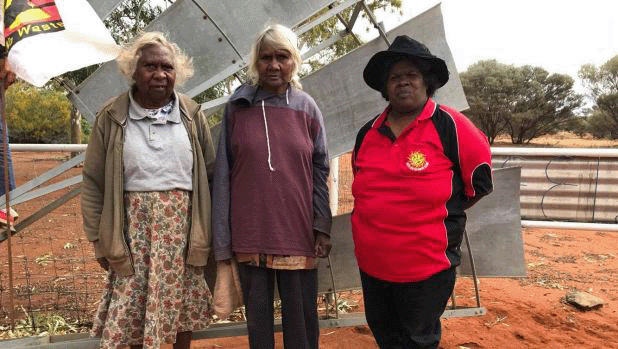
A group of indigenous women have completed a month long ‘walkabout protest’ against uranium mining in Western Australia that saw them travel on foot through remote lands being considered as mine sites.
The protest was kindled by the WA government’s move in June to allow four uranium projects previously granted environmental approval to proceed, whilst blocking any future mining bids.
Toro Energy’s Wiluna project, Vimy Resources’ Mulga Rock project, and Cameco’s Kintyre and Yeelirrie projects all had the approval before Labor won the March election.
Mines and Petroleum Minister Bill Johnston said Labor, which banned uranium mining when last in power between 2002 and 2008, had received advice it could not legally deny secondary approvals for the purpose of frustrating those already granted.
“In making this decision, the McGowan government has carefully considered the potential liability risk for WA taxpayers,” Mr Johnston said.
The Conservation Council of WA is part of a legal challenge against a proposal by the Canadian uranium company Cameco to develop a uranium mine at Yeelirrie, 70 kilometres south-west of Wiluna in the northern Goldfields.
Shirley Wonyabong, Elizabeth Wonyabong, and Vicky Abdullah from the Walkatjurra Walkabout against uranium mining protest are part of this legal challenge, and they started their walking protest to highlight their struggle against it.
“Yeelirrie is important to my family. We have fought to protect this site for over 40 years and we won’t stop now,” Vicky Abdullah said.
“I grew up here, my ancestors were Traditional Owners of country, and I don’t want a toxic legacy here for my grandchildren.
“We have no choice but to defend our country, our culture, and the environment from the threat of uranium mining – not just for us but for everyone.
“The last government made a mistake approving the Yeelirrie mine – now we have a chance to make that right through the courts.”
The women were joined by fifty other people from around the world who wanted to join the protest, which saw the group walk through traditional lands, including Yeelirrie.
They finished the walkbout on Thursday, and were told by supporters that the Supreme Court will hear an application for Judicial Review of uranium mine proposal on November 14.
Minerals Council wants “clean” “affordable” nuclear power for Australia
 Australia should add nuclear to the clean energy mix: Minerals Council, SMH, James Massola. 1 Sept 17, Australia should develop a nuclear power industry to reduce its emissions, the Minerals Council says, and the Turnbull government should take the first step by removing legal road blocks.
In a new paper titled Removing the Prohibition on Nuclear Power, the lobby group argues just four words – “a nuclear power plant” – need to be cut from the Environmental Protection and Biodiversity Act to begin clearing the legal path to the development of a nuclear industry…….
Most contentiously, it argues the technology is safe, citing a British study by Friends of the Earth – a claim opponents would dispute by highlighting the Fukushima, Chernobyl and Three Mile Island disasters – and affordable, which opponents would also dispute.
The call to re-think the prohibition on nuclear power comes as the Turnbull government grapples with how, or whether, to implement a post-2020 clean energy target, as recommended by Chief Scientist Alan Finkel’s review of the electricity sector.
It also comes after Fairfax Media revealed in March that at least one in 10 of Mr Turnbull’s MPs backed nuclear power to be part of Australia’s energy mix…….http://www.smh.com.au/federal-politics/political-news/australia-should-add-nuclear-to-the-clean-energy-mix-minerals-council-20170831-gy7ysq.html
Australian government watering down the climate recommendations of the Finkel energy report
 Coalition watering down Finkel review climate ambitions, leaked document reveals
Draft implementation plan lacks electricity emissions trajectory, Paris agreement alignment and low-income subsidies, Guardian, Michael Slezak 31 Aug 17, The climate ambitions of the Finkel review appear to be being watered down by the government as it is implemented, according to a draft Coag Energy Council implementation strategy obtained by the Guardian.
The draft implementation plan removes a key recommendation for an agreed emissions trajectory for the electricity system, alignment with the Paris agreement and subsidised solar and batteries for low-income houses.
Sources tell the Guardian the document was prepared by the federal government and distributed to state and territory representatives on the morning of the meeting, leaving little time for state representatives to analyse it…..
At a teleconference on Friday last week, state and territory energy ministers were presented with a draft implementation plan for discussion.
That document, obtained by the Guardian, appears to water down those recommendations in relation to climate change, and removes some altogether.
One key recommendation in the Finkel review that has been severely weakened in the draft implementation document is a change that would force the electricity market to align efforts to meet government emissions reduction commitments made as part of the Paris agreement.
But the draft implementation document removes the reference to international emissions reduction commitments, instead saying merely that the agreement will “reaffirm Australian governments’ commitment to the [national electricity market] and a national, integrated approach to energy and emissions reduction policy”.
Among Finkel’s key recommendation for an “orderly transition”, he called for three things: the clean energy target; a three-year notice of closure for existing large generators; and “an agreed emissions reduction trajectory”. All three moves were part of one recommendation, numbered 3.2.
The Coalition has not agreed to adopt the clean energy target but it has agreed to the three-year notice-of-closure rule, which appears in the implementation plan. However, the plan does not contain any mention of an agreed emissions reduction trajectory…….
Another Finkel recommendation calls for low-income households to be given subsidised access to “energy efficient appliances, rooftop solar photovoltaic and battery storage systems”.
Explicit references to renewable energy has been removed in the draft implementation plan and replaced with “energy efficiency and demand management technologies”.
Sources say representatives of the ACT raised the question of the trajectory being removed, and asked for it to be included. Representatives of Queensland and Victoria also apparently raised concerns about some of the other changes.
Sources said the document, which was prepared by the federal government, was circulated to state energy ministers only hours before the meeting was held, leaving little time for proper scrutiny.
The document is expected to be finalised and sent to heads of government today. https://www.theguardian.com/australia-news/2017/aug/31/coalition-watering-down-finkel-review-climate-ambitions
Australian government cracking down on environmental activists
 Charity crackdown would be a ‘torpedo’ to environmental groups, Bob Brown says, ABC, 7.30 , By Liz Hobday and Gus Goswell , 31 August 17, The Federal Government has denied it is trying to silence environmental activists, as prominent voices in the environment and charities sectors speak out against a series of regulatory changes.
Key points:
- Federal government is proposing changes to regulations dealing with charities
- Some environmental groups could face the loss of their tax-deductible charity status
- Charities concerned about appointment of coal seam gas company boss
- Government will not re-appoint charities commissioner
As Treasury canvasses a proposal to limit tax concessions for green groups, there have been changes at the top of the Australian Charities and Not-for-profits Commission (ACNC), including the appointment of Peter Hogan, chairman of coal seam gas company, Carbon Energy, to the regulator’s advisory board.
That has raised the ire of environment groups, many of which are registered charities.
“We’ve got the Turnbull Government arranging to put the fox in charge of the chicken coop,” former Australian Greens leader Bob Brown told 7.30……..
former ACNC advisory board member, and now head of the Community Council for Australia, David Crosbie says the sector is under attack.
“It feels, right now, there is a campaign to try and restrict the voice of charities,” he told 7.30.
“And there are a number of elements to that.”
Tax deductibility status at risk
Among the changes is a push to make environmental groups curb their activism or risk losing their charity taxation status. Continue reading
1 September More REneweconomy news
RenewEconomy-
Turnbull’s new energy target: Drop the “clean” and ignore climateCoalition reportedly drops links to emission trajectories in draft proposal for a Clean Energy Target. It comes as Turnbull changes tone again on new coal, and the Queensland LNP releases a renewables policy derided immediately as a “farce”.
-
How consumers got burned on electricity prices: It started with networksPolicy responses to high electricity prices should pay more attention to how consumers can be helped to use less electricity
-
Inspiring green homes open their doors on Sustainable House DayAustralia’s most innovative green homes will be open to the public on Sustainable House Day, taking place on Sunday 17 September.
Australian media mindlessly regurgitates nuclear lobby spin about medical wastes
Misconceptions about radioactive medical isotopes, http://www.onlineopinion.com.au/view.asp?article=19251 , By Noel Wauchope -29 August 2017
Australians get their information about medical isotopes straight from The Australian Nuclear Science and Technology Organisation(ANSTO) via handouts faithfully retailed via the mainstream media. Some recent examples of media coverage:
- from the ABC, 19/08/17 ‘Nuclear medicine production in Australia at risk if dump site can’t be found, industry head says‘ and Australians get their information about medical isotopes straight from The Australian Nuclear Science and Technology Organisation(ANSTO) via handouts faithfully retailed via the mainstream media. Some recent examples of media coverage:
- Eyre Peninsula Tribune 02/08/17 ‘Kimba landowners visit Lucas Heights nuclear facility’.
The message is straightforward and goes like this:
The purpose of the Opal nuclear reactor at Lucas Heights is to make medical radioisotopes to treat cancer. Australia needs a national radioactive waste dump in rural South Australia, thousands of miles away from Lucas Heights, to dispose of the low-level medical radioactive wastes produced. And this will be a bonanza for the lucky rural community of Kimba.
Is this story true?
No. It is misleading on a number of counts.
First of all, a nuclear reactor is not essential for making medical isotopes. The IAEA lists 39 countries that use cyclotrons to produce them. That includes Australia, which has them not only at Lucas Heights itself, but also at hospitals in Victoria, New South Wales, Queensland, and Western Australia.
From the invention of the cyclotron (1931) , and discovery of artificial radioactivity (1934), non nuclear particle accelerators were used to produce them. Globally, particle accelerators produced the vast majority of radioisotopes with medical applications until the 1950s. Radioisotopes of medical interest began to be produced as a byproduct of nuclear weapons reactors during World War II. After the atomic bombing of Hiroshima and Nagasaki in 1945, the USA Atomic Energy Commission (AEC)’s main mission was promoting the military use of nuclear material, but “giving atomic energy a peaceful, civilian image” was also part of it. In1948 the AEC took over, and isotopes for biomedical research, cancer diagnostics and therapy were made in nuclear reactors and even became free of charge.
Australia was a bit slow to jump on the medical isotopes bandwagon. The Lucas Heights nuclear reactor began its life in 1958 as the start of a plan for nuclear weapons for Australia.Then it was promoted as research for nuclear power, and later as for making medical radiopharmaceuticals. Lucas Heights and ANSTO itself are very much part of the nuclear lobby’s plan to promote the entire nuclear industry in Australia.
Australia does not need a national radioactive waste dump for medical wastes. Nearly all medical radioactive wastes are very short-lived – a matter of days, or even hours. There is no need to transport them across the continent. Australia does have a problem with higher level wastes: Spent reactor fuel sent to France, USA and UK for processing must be returned. This is the type of waste that needs deep and very secure disposal. That is sure to be the underlying purpose of the South Australian waste dump plan.
The planned national radioactive waste dump will not benefit the local community. Yes, there will be bribes – so far, not much – a $2 million Community Benefit Package to fund local projects, but I’m sure that the Feds will come with better than that. Jobs, no doubt. However, the underlying problem remains. The community is being asked to accept a temporary nuclear waste dump, which is to be set up long before any permanent dump is set up, if it ever is. Kimba, the proposed dump site, is likely to suffer the fate of so many sad sites in America –stuck with “stranded wastes” of radioactive trash. Think what that would do to Kimba’s environment and reputation as an agricultural area.The nuclear lobby has argued persuasively that the Lucas Heights area has held nuclear wastes for decades. However, the Lucas Heights residents did not grasp the implications when the nuclear reactor was set up. They do now – that’s why they want the wastes sent far away.
The global nuclear lobby is fighting a losing battle. The industry has always struggled to win over public opinion. In Australia, the industry’s “foot in the door” is the Opal reactor at Lucas Heights. Following the South Australian Nuclear Fuel Cycle Royal Commission’s failed attempt last year, to introduce radioactive waste importing, the next sortie is to use Lucas Heights to get a national nuclear waste dump happening. To justify this, the argument put forward is the medical argument.
In the slick salesmanship from ANSTO and the nuclear lobby in general, they don’t mind a few lies and half truths,. For example, they’ll say ” The most important isotope technetium-99m can be made only with nuclear reactors” – conveniently forgetting that Canadian researchers achieved this with a cyclotron in 2015.
They’ll say that cyclotrons are too expensive to set up, conveniently forgetting that the Lucas Heights 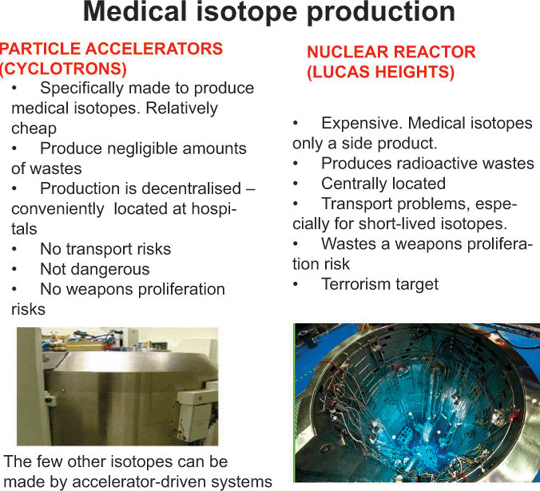 nuclear reactor was set up at tax-payer expense, and that tax-payer will have to fund its waste management virtually for eternity.
They’ll ignore the facts that cyclotrons produce negligible wastes. As most medical radioisotopes have very short half lives – it makes sense to produce them in a decentralised way – in cyclotrons close to the hospitals where they will be used. The transport of isotopes from cyclotrons is much less of a problem, than from the centralised nuclear reactor.
The nuclear reactor produces radioactive wastes suitable for use as nuclear weapons fuel – and present a safety problem, with the reactor itself also a target for terrorism. Cyclotrons do not have these risks, and this need for huge, and expensive security measures.
Canada, having abandoned nuclear reactor production of medical isotopes, is now leading the way in their production and export without use of a nuclear reactor. ANSTO’s boast of a future thriving export industry in isotopes is sounding hollow.
We should bear in mind that medical radioisotopes are used 80% for diagnosis, and only 20% for actual treatment of cancer. They are an additional means of diagnosis, but not the only means.
We should also be mindful that radioactive isotopes in medicine carry a small increased risk of cancer for the patient, staff, and sometimes the patient’s family.
Therefore our enthusiasm for nuclear medicine should be tempered with an understanding of its limitations and risks, both at the individual patient level, and in the broader context of nuclear fission and its health and environmental dangers.
Deep divisions caused in rural community of Kimba, over Federal govt’s radioactive trash dump plan.
Community torn over Kimba nuclear plan, Eureka Street Michele Madigan | 28 August 2017 The Unlucky Australians, the documentary of the Gurindjis’ campaign for their land, aired on the ABC late on Sunday night 20 August 2017. The Gurindjis’ successful struggle against the combined might of the Vestey empire and the Australian federal government is one of the greatest Australian stories……
Half a century after the Gurindji Walkoff and half a continent away, on Saturday 19 August at a gathering in Port Adelaide, two modern beleaguered groups, one Aboriginal, one non-Aboriginal, shared their current experiences in striving to protect their own lands and ways of life. Like the Gurindji, their struggle is with the federal government and this time, indirectly, with another big business — the nuclear industry. In contrast to the Gurindji struggle however, modern day communities and even families are being torn apart by enticements and pressures.
Two months ago, South Australia’s Premier Jay Weatherill conceded that there is ‘no bipartisan government support’ and ‘not sufficient community support’ to continue with the extraordinary scheme that a SA government sponsored nuclear royal commission had recommended. The Premier gave a commitment that a State Labor government, if re-elected, would now not pursue a high-level international nuclear waste dump.
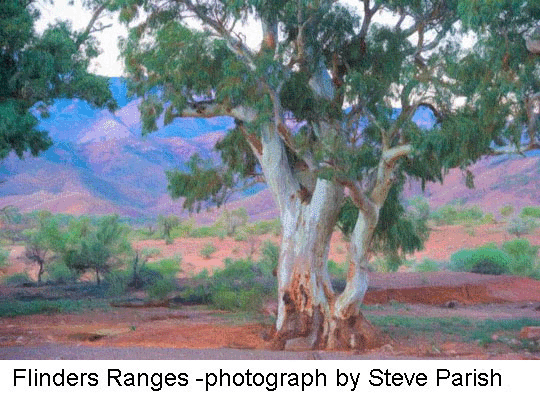
The federal government however continues its pursuit in SA — the disposable state — of a federal dump for the intermediate long-term nuclear waste from the Lucas Heights nuclear reactor and for medical waste. Now, once again, three sites are being offered up: two in Kimba, at the top of Eyre Peninsula in South Australia, as well as the ongoing Flinders Ranges site.
At the 19 August meeting, Kimba farmers spoke of the offers of a paltry $10 million and a tiny 15 (or fewer) permanent jobs as the payoff for the deep divisions and the certain risk to their markets a federal dumpsite would bring. Farmer Toni Scott, overcome by describing a formerly close-knit community now torn apart, broke down in tears. The close voting statistics for and against the site belie the former Minister for Resources and Northern Australia, Matt Canavan’s assertion that Kimba is clearly in favour.
Farmer Tom Harris’s neighbour is one of two Kimba farmers who have offered possible dumpsites. However the site is closer to Tom’s family homestead than it is to the neighbour’s. It was sobering to hear his facts. Kimba region farmers ‘are recognised as some of the best dry farmers in the world’ but the competition between grain farmers for international markets is so intense that the warning from the professionals is clear: proximity to a nuclear waste dump will have predictably disastrous negative effects. And the irony — ‘It’s the farmers who’ve kept the town going.’
Meanwhile, the Adnymathanha and other Flinders Ranges station and townspeople continue their efforts to protect SA’s iconic Flinders Ranges from the same fate. During the 31 months it has been a preferred site, their trauma has deepened as they have seen other locals acquiesce. Sadly, with the government’s ‘no-strings-attached’ $2 million for community projects, the tearing apart of families has intensified.
The Gurindji had Frank Hardy and Australian unions supporting them during their terrible privations. Many Kimba farmers and townspeople, and the Adnyamathanha, together with some of the townspeople and most of the Flinders Ranges landholders, are grateful for their own southern (or eastern) supporters. They plead for more: ‘Please help us to be heard!’ https://www.eurekastreet.com.au/article.aspx?aeid=52964#.WaXSuvMjHGh
The Finkel clean eneergy target will not meet Australia’s goals in Paris climate agreement
 Finkel clean energy target too weak for Paris climate goal,
  analysis shows Target will transfer pressure to other sectors of the economy to reduce their emissions, research shows, Research commissioned by the Australian Conservation Foundation on the clean energy target says the trajectory of emissions reduction is not strong enough. Guardian, Katharine Murphy, 29 Aug 17
The clean energy target recommended by Australia’s chief scientist, Alan Finkel, won’t deliver Australia’s obligations under the Paris agreement and will only transfer pressure to other sectors of the economy to reduce their emissions, according to new analysis.
The new research comes as the Coalition’s difficult internal deliberations over the Finkel review are set to resume, with a report due from the Australian Energy Market Operator about the dispatchable power requirements of the electricity grid after the closure of two ageing coal-fired power stations.
And it comes as the prime minister will on Wednesday hold a second meeting with Australia’s major energy retailers in an attempt to make it easier for consumers to switch their power provider – a response to acute political pressure over rising electricity bills.
Discussions between the government and the companies in the lead up to Wednesday’s talks have centred on whether energy companies can offer monthly billing to try and prevent bill shock, and whether more can be done to communicate with hardship customers to ensure they aren’t locked in to inflated power contracts.
The new research on the clean energy target has been commissioned by the Australian Conservation Foundation.
The modelling says the Finkel trajectory would see Australia’s electricity emissions being phased out between 2095-2101 – a timeframe that is inconsistent with the Paris goal of limiting warming to two degrees, and of reaching carbon neutrality by mid-century.
It also points out that if the electricity sector does comparatively less of the heavy lifting on emissions reductions, the burden will fall more heavily on other sectors, with the largest reductions then falling on high emissions growth sectors, rather than the sectors with the largest share of total national emissions……..https://www.theguardian.com/australia-news/2017/aug/30/finkel-clean-energy-target-too-weak-for-paris-climate-goal-analysis-shows
1 This month


Help Aunty Sue Protect Her Land and Sacred Sites From Destructive Rocket Testing.
.

Australians deserve the truth
about
AUKUS – https://aukuspublicinquiry.com/

PETITION – To: Prime Minister Anthony Albanese and the Australian Labor Government

of the week – Australians for War Powers Reform (AWPR)
To see nuclear-related stories in greater depth and intensity

