25 August REneweconomy news

- 100% renewable energy for 139 nations detailed in new Stanford report
Mark Z. Jacobson and 26 of his colleagues have compiled a report that shows exactly how 139 nations could transition to 100% renewable energy by 2050 without throwing millions of people out of work.
-
Australia urged to aim for 100% renewables by 2030sAs climate impacts mounts, there is a growing push for a 1.5°C target. This would mean reaching 100% renewable energy within 20 years. Australia could lead, and reap enormous economic benefits.
-
Neoen may expand Vic solar farm to 126MW after tram tender winNeoen says it may treble size of its Nurmukah solar project off back of Victoria government tender win.
-
Infigen eyes commercial and industrial sector for new renewablesInfigen Energy reports a jump in profit for FY2107, as the company continues its transformation into an “active energy markets participant.”
-
Victoria leads, Federal government leans on energy transitionYesterday was an historic day for Victoria’s energy future. And there’s more good news on the way. Not that you would know it from listening to federal energy minister.
-
AEMC suggests new body to decide on battery storage standardsAs industry rejects Standards Australia home battery ban proposal, AEMC calls for new body to govern standards for distributed energy market.
-
Windlab to receive $10 million milestone success payment in respect of the Coopers Gap Wind FarmWindlab has become entitled to receive a milestone success payment of just over $10 million in respect of the Coopers Gap Wind Farm.
-
Rethinking the grid: Changes in power sector are an opportunity, not a threatThe Department of Energy’s study on grid reliability and resilience offers an incomplete picture of our grid’s transformation.
North Korea’s angry response to Australia participating in USA- South Korea war games
North Korea fires back at ‘suicidal’ Australia over war games http://www.theaustralian.com.au/national-affairs/north-korea-fires-back-at-suicidal-australia-over-war-games/news-story/de1d5835b92982ee2eee237da4e2b7cf, PRIMROSE RIORDAN, Political reporter, Canberra, @primroseriordan 22 Aug 17
North Korea has attacked Malcolm Turnbull for sending Australian Defence Force personnel to join US-led war games, describing it as a “suicidal act”.
After being singled out by the North Korean regime, the Prime Minister issued a statement late yesterday staring down threats against Australia.
“North Korea has shown it has no regard for the welfare of its own population, no regard for the security and good relations with its neighbours and no regard for international law,” he said.
“We call on all countries to redouble their efforts, including through implementation of agreed UN Security Council resolutions, to bring North Korea to its senses and end its reckless and dangerous threats to the peace of our region and the world.”
North Korea has warned Australia against further aggression in response to the government’s commitment to the Ulchi-Freedom Guardian War Games, which began yesterday.
“Not long after the Australian Prime Minister had stated that they would join in the aggressive moves of the US — even referring to ANZUS which exists in name only — the Australian military announced that they would dispatch their troops to the aggressive nuclear exercises of the US,” said a spokesman from North Korea’s Ministry of Foreign Affairs.
“This is a suicidal act of inviting disaster as it is an illustration of political immaturity unaware of the seriousness of the current situation.”
Defence Minister Marise Payne sent more than two dozen ADF members to join the 10-day war games between the US and South Korea.
Yesterday, defence analysts warned that Australia must “get used to” thuggish threats from the North Korean regime. The director of the International Security Program at the Lowy Institute, Euan Graham, said this would not be the last time Australia was threatened by Pyongyang, as Australia’s participation “matters” to the regime. Continue reading
Non nuclear production of medical radioisotopes st South Australian Health and Medical Research Institute
 85% of ANSTO Lucas Heights isotope production is for Technetium 99. This can also be made in a cyclotron by using electricity – which makes NO Intermediate Level Waste & NO long lived LLW – thereby negating a national radioactive dump facility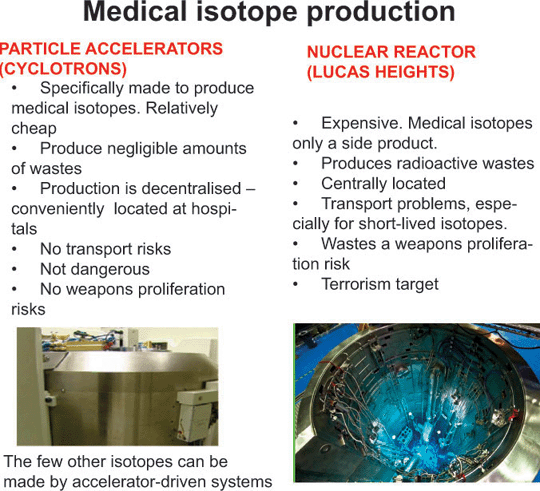
State’s most advanced clinical imaging centre, worth $13m, opens at SAHMRI http://www.adelaidenow.com.au/news/south-australia/states-most-advanced-clinical-imaging-centre-worth-13m-opens-at-sahmri/news-story/a20eb257edad98bb0597dd787aa6837b?nk=ba26857f63080120cbd5fc74c94d3959-1503458683, Brad Crouch, Medical Reporter, The Advertiser February 15, 2017 THE growing South Australian Health and Biomedical Precinct takes another step forward today with the opening of the most advanced clinical imaging centre in the state.
The $13 million Clinical and Research Imaging Centre at the South Australian Health and Medical Research Institute has been established in partnership with Dr Jones and Partners Medical Imaging.
Space on the ground level of the SAHMRI building on North Terrace has become a Dr Jones & Partners clinic, with dedicated time allocated to SAHMRI researchers for clinical research without compromising the scheduling of patient treatments.
State-of-the-art imaging equipment in the centre includes CT, MRI and PET/CT platforms.
Officials say the arrangement is moving SAHMRI in a new direction of commercialisation with industry partners to create a facility to benefit researchers with the aim of improving the treatment and diagnosis of patients. Continue reading
Traditional Owners fighting Adani undeterred by Qld Court outcome
“Where there’s mining there is no justice” http://wanganjagalingou.com.au/traditional-owners-fighting-adani-undeterred-by-qld-court-outcome/
“Responding to a Supreme Court decision in Brisbane today, Traditional Owners fighting Adani’s proposed Carmichael coal mine say that yet again the Queensland Government and Adani have benefited from laws designed to suppress Aboriginal peoples’ rights.
“The Queensland Court of Appeal today upheld an earlier decision that the Queensland Minister for Mines did not have to afford Wangan and Jagalingou people natural justice when he issued the mining leases for Adani’s Carmichael Mine. The Wangan and Jagalingou Traditional Owners Council
is now seeking legal advice on grounds to appeal to the High Court.
“Senior spokesperson for the W&J Traditional Owners Council, Adrian Burragubba, says,
““Where there’s mining there’s no justice for Traditional Owners. The mineral resources regime so often puts massive barriers in the way of Traditional Owners and the wider community which opposes coal mining in Queensland.
““We appealed the decision of Queensland Mines Minister, Anthony Lynham MP, to issue leases over our country to Adani, only to find our common law right to natural justice is of little worth. We have always aimed higher than this in pursuit of our rights. We are not deterred by today’s outcome.
““The Court decision has let the Minister get away with sacrificing our heritage and sacred places to promote his own political interests.
““Instead of standing up for our rights in the lands and water of our ancestors, in April 2016 the Queensland Government preferred not to wait for our fight to be resolved in the Federal Court court and instead issued leases to Adani. …
““As Traditional Owners we wait more than a decade for our native title claim to be dealt with, while Adani can get a lease quickly, without our consent and with no money for its project.
““We have clearly and unambiguously rejected a land use deal with this shyster company, yet they push on. … ““We are not done yet. We will exhaust all legal avenues in our fight to for our rights and to protect our country. … “We have further litigation challenging their fake ‘land use agreement’ in the Court, with a hearing date set for March 2018.
““There will be no surrender. … ”, Mr Burragubba concluded.”
Continue reading W&J’s statement here:
http://wanganjagalingou.com.au/traditional-owners-fighting-adani-undeterred-by-qld-court-outcome/
23 August More REneweconomy news
-
Origin Energy faces three shareholder resolutions on climateCoordinated by environmental finance group Market Forces, shareholders in Origin Energy have filed a series of resolutions with the oil and gas major.
-
Graph of Day: How solar tower and storage sailed through eclipseMurdoch media’s “Monkey’s uncle” thinks solar towers and storage are intermittent. But its performance during eclipse shows otherwise.
-
CEFC backs waste management sector with $90m Cleanaway loanCEFC extends $90m corporate loan to Cleanaway, its first major transaction with a leading Australian waste management company.
-
30MW battery to create renewables-based mini grid in South Australia
 http://reneweconomy.com.au/30mw-battery-to-create-renewables-based-mini-grid-in-south-australia-63304/, By Giles Parkinson on 23 August 2017 The Australian Renewable Energy Agency says it is providing $12 million towards the $30 million cost of a major battery storage installation to be located on the Yorke Peninsula in South Australia and close to the Wattle Point wind farm.
The 30MW/8MWh large scale battery will deliver both network services and market services, and is the result of a lengthy study begun in 2014 called ESCRI (Energy Storage for Commercial Renewable Integration) by local grid operator ElectraNet, Worley Parsons and AGL.
It is designed principally to provide fast frequency response and help balance the local network, but it will also help reduce congestion on the Heywood interconnector with Victoria, because its placement means more power can be transported over the line. This should relieve constraints imposed by the market operator.
It will also have the ability to “island” the local network – pairing with the local 90MW Wattle Point wind farm and local rooftop solar PV as a local micro-grid to ensure grid security and so keep the lights on in case the network failures elsewhere in the state.
ARENA CEO Ivor Frischknecht says having a series of mini-grids across the state would help ensure grid security. If more were added, “it means over the longer term that state wide blackouts will be a think of the past,” he told Reneweconomy.
Indeed, AGL – which will operate the battery – said last year after the state-wide blackout that renewable-based micro-grids were the best way to ensure grid security. Continue reading
23 August REneweconomy news
-
BOC to collaborate with CSIRO on revolutionary $3.4m hydrogen projectBOC will support CSIRO during its $3.4 million ammonia to hydrogen cracking and membrane purification project that is set to revolutionise the global supply chain for hydrogen.
-
Know your NEM: Wind output and “baseload” renewablesAre Australia’s wind farms living up to expectations? Why the market preferred Origin’s results to AGL’s; and a dive into the Windlab prospectus and its “busload” wind and solar plant.
-
Battery install standard needs to change, not be thrown on scrapheapChanges to the draft Australian Standard for installing home battery units are essential, but it is also important to ensure appropriate technical standards are in place to ensure consumers are protected, the Clean Energy Council said today.
-
Victoria to unveil wind and solar tenders in push for 40% renewablesMajor renewable energy tender announcements expected from Victoria, along with more details of state renewable energy target architecture.
-
California grid survives solar eclipse, as Australia prepares for 2028California’s solar-centric grid manages eclipse without a hitch. In Australia, preparations already being made for 2028 eclipse.
-
Super cheap solar – and why that’s good for Australia’s mining sectorSolar pioneer Martin Green says solar PV will fall to $US10/MWh within a few years, but this will be good news for Australia’s mining industry because the fall in Australia’s thermal coal exports will be offset by a factor of more than 5 by demand for other resources.
-
AEMC backs down on rooftop “solar tax” proposalEnergy market rule maker backs down on proposal to charge solar households to export excess PV generation back to the grid.
- Why solar towers and storage plants will reshape energy markets,
More details emerge of the contract for the Port Augusta solar tower and storage project, and why it means huge change for energy markets, and a shift of focus from “base-load” fossil fuel to clean, flexible capacity built around “base-cost” renewables.
-
“Unaccredited” rooftop solar installer nabbed by Clean Energy RegulatorClean Energy Regulator continues rooftop solar crack-down, this time taking action against “unaccredited” individual installer.
-
Aurora: What you should know about Port Augusta’s solar power-towerMuch has been written about the $650m Aurora project, and I set out here to collect together what is known and fill in some of the gaps.
-
By train or by ship, transporting coal causes troubleDerailment of 30 coal wagons is just latest in long list of coal transport accidents which highlight risks from shipping fossil fuels long distances to markets.
South Australian govt’s pro nuclear propaganda campaign was expensive
 Agency formed to push nuclear waste dump to SA spent $7.6 million http://www.adelaidenow.com.au/news/south-australia/agency-formed-to-push-nuclear-waste-dump-to-sa-spent-76-million/news-story/34c2ed1ade9a24c8d195ecf32f45709d 20 Aug 17, Miles Kemp,
THE taxpayer has been handed a “catering” bill that is the equivalent of 45,000 cups of coffee, for a talkfest on nuclear energy. The catering bill for the so-called “Nuclear Fuel Cycle Royal Commission Consultation and Response Agency” was $182,580.
Dryness of vegetation in Sydney area adds risk to coming bushfire season
 Dry winter primes Sydney Basin for early start of bushfire season The Conversation, Matthias Boer, Associate Professor, Hawkesbury Institute for the Environment, Western Sydney University, Postdoctoral research fellow, University of Technology Sydney. Professor, Centre for Environmental Risk Management of Bushfires, University of Wollongong, August 21, 2017 It might feel like the depths of winter, but Australian fire services are preparing for an early start to the bushfire season. Sydney has been covered with smoke from hazard reduction burns, and the New South Wales Rural Fire Service has forecast a “horrific” season.
Predicting the severity of a bushfire season isn’t easy, and – much like the near-annual announcements of the “worst flu season on record” – repeated warnings can diminish their urgency.
However, new modelling that combines Bureau of Meteorology data with NASA satellite imaging has found that record-setting July warmth and low rainfall have created conditions very similar to 2013, when highly destructive bushfires burned across NSW and Victoria.
Crucially, this research has found we’re approaching a crucial dryness threshold, past which fires are historically far more dangerous……..https://theconversation.com/dry-winter-primes-sydney-basin-for-early-start-of-bushfire-season-82641?utm_medium=email&utm_campaign=Latest%20from%20The%20Conversation%20for%20August%2021%202017%20-%2081136562&utm_content=Latest%
Malcolm Turnbull in Tasmania – praising wind and solar power!
 Turnbull trumpets Tasmania’s ability to lead the country in renewable energy, ETHAN JAMES, AAP, Mercury, August 18, 2017 Prime Minister Malcolm Turnbull has trumpeted Tasmania’s ability to lead the nation in renewable energy at the state’s Liberal Party council meeting.Mr Turnbull today addressed 250 delegates at the annual conference in Launceston, the party’s final gathering before a state election in March. He praised Liberal Premier Will Hodgman’s economic management in a speech that touched on energy, terrorism and mental health.
Community energy in Canberra – backing a solar energy future
 Investing in a brighter energy future for Australia http://www.examiner.com.au/story/4860382/investing-in-a-brighter-energy-future-for-australia/?cs=97, 20 Aug 2017, We’re backers, not bystanders. Like many, we’re concerned about climate change – and want to play our part. That’s why we’re among the 867 people who invested in what will be Australia’s largest, community-owned solar farm.
SolarShare is building its flagship project, a one-megawatt solar farm that shares land with a vineyard, in the Majura Valley in Canberra.
It’s the first of hopefully many solar farms and projects owned by the community.
SolarShare has been funded by people like us, who will receive a good return on our initial investment as the electricity it generates from the sun is sold. At the same time, the farm will power 260 homes, reducing our reliance on polluting fossil fuels.
While governments can be slow to act, individuals, communities and businesses across Australia are finding their own solutions.
The transition to renewable energy has started – and it’s exciting. But it needs to happen faster if we are to leave this place better, cleaner and safer for our grandchildren. None of us can do everything, but we can all do something.
As soon as we could, we put solar panels on our roof making our house somewhat of a novelty in the neighbourhood. These days, solar covers 21 per cent of Australia’s suitable rooftops.
A couple months ago we bought an electric car, which we fuel for free with the rooftop panels. We were amazed to see that India, Britain, France and Norway have announced plans to ban the sale of new petrol and diesel cars.
Until governments pick up the pace, individuals will have to work together. Being part of a larger project, like a community solar farm, is a great way to be part of an exciting new vision. David and Lainie Shorthouse are SolarShare investors, and Canberra residents.
The ABC swallows the nuclear lobby line on medicine – hook line and sinker
 The post below this is an extract from the ABC article “Nuclear medicine production in Australia at risk if dump site can’t be found, industry head says”. I left out the bits where ANSTO officials orgasmically discussed how much Australia needs the Lucas Heights nuclear reactor for medical reasons.
Anyone would think that this humanitarian motive is the sole raison d’etre for this nuclear reactor. The ABC apparently buys that story.

Two Kimba farmers happy at the prospect of stranded radioactive trash on their land
 Nuclear medicine production in Australia at risk if dump site can’t be found, industry head says ABC, Landline By Marty McCarthy 19 Aug 17, Australia may have to stop producing nuclear medicine if it cannot find a central site to dump all of the radioactive rubbish made in the process in the next decade.
The Federal Government has been trying to find a site somewhere in Australia to dump nuclear waste for 30 years, including all the waste produced by the government-owned OPAL reactor at Lucas Heights.
There is about 4,250 square metres of radioactive waste in Australia — enough to fill two Olympic-sized swimming pools — and most of it is held at the Australian Nuclear Science Technology Organisation (ANSTO) at Lucas Heights…… the facility also stores a small amount of intermediate-level waste.
This waste comes from the spent fuel rods used in Australia’s first nuclear reactor, HIFAR, which operated for 50 years and was decommissioned in 2007.
The TN81 cask is a 120-tonne rubbish bin that currently contains more than half of the waste from 2,000 spent fuel rods used in HIFAR over its half-a-century-lifespan.
“This does actually represent one of the more radioactive things in Australia,” said James Hardiman, waste operations manager at ANSTO…..
‘It’s for Kimbra we are doing this’
The rural town of Kimba, on South Australia’s Eyre Peninsula, could be the eventual home of all of Australia’s nuclear waste. Two farmers in the region have put forward their properties, along with a third at Barndioota in the Flinders Rangers, for the Federal Government to build its facility on.
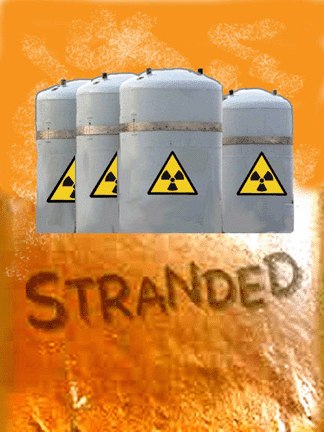 The site would be a permanent dump for all of the low-level waste, which would be buried in cement chambers and left for 300 years, and a temporary storage site for the more dangerous, intermediate-level waste…..To guarantee your town’s future for the next 300 years is pretty good reason for me, because they are talking 100 years of storing the waste and 300 years of monitoring,” Jeff Baldock said.
Bob Maitland, who owns farmland next to Mr Baldock’s property, said he had a moral obligation to support his neighbour’s nuclear dump plan. “It’s for Kimba we are doing this, not for ourselves.” http://www.abc.net.au/news/2017-08-19/nuclear-medicine-production-in-australia-at-risk:-industry-head/8815902
Australia failing in migration and humanitarian help for Pacific Islanders in their drowning islands
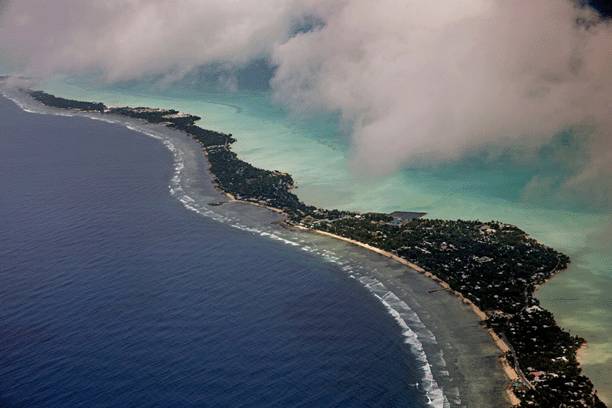 Pacific Islanders forced to leave, The Saturday Paper, Chris Woods 18 Aug 17, “Last month,” Ursula Rakova says, “when I returned home just to visit family and talk to the islanders about the situation, it was really, really hard to see a lot of the land being lost to the sea.”
Rakova is from the Carteret Islands, commonly known as Tulun, the horseshoe-shaped scattering of low-lying coral atolls 86 kilometres north-east of Bougainville. “More and more, palm trees are falling, the scarcity of food is becoming a real issue, and the schools close, and close for long periods,” she says.
With an indigenous population of 2700 on seven small islands with a maximum elevation of just 1.5 metres above sea level, there are few other places on Earth where the injustice of global warming is more apparent than on the Carteret Islands.
The Carterets have been on the front line of climate change for decades: one of the islands, Huene, was cut in half by shoreline erosion about 1984. While seawalls and mangroves had been holding the ocean back until this period, further seawater inundation and storm surges over the past few decades had salinated crops and water supplies, intermittently shut down the island’s five schools due to childhood malnutrition, and destroyed homes.
Part of the reason the area is so vulnerable is that, while the Intergovernmental Panel on Climate Change has reported a global sea level rise of about three millimetres per year from 1993 to 2012, the fact that water expands exponentially as heat is applied means that bodies of water that are already hot rise more swiftly. For the western Pacific Ocean, this has meant an increase of about eight to 10 millimetres a year.
“The western Pacific is a lot hotter than the water is in the eastern Pacific – hotter by about five or six degrees – and where the islands are is amongst the hottest ocean water in the world,” says Ian Simmonds, professor of earth sciences at the University of Melbourne. “Hence a warming of one degree there gives you just so much more of a sea level rise.”
Simmonds notes that the same is true for the severity of storms in the region: a warmer planet means more moisture, and, therefore, stronger and more frequent storms.
In response to increasingly severe events, Carteret elders initiated a voluntary relocation program in 2006, named Tulele Peisa, or “Sailing the Waves on Our Own” – outwardly a response to failed talks with neighbouring governments dating back to 2001. The group contacted Ursula Rakova, a Huene expatriate who had gone on to direct a Bougainville-based non-government organisation, to lead the initiative. After unsuccessfully applying for land through official channels, she was given four different locations by the Catholic Church in 2007, and relocation to the first of the abandoned plantation sites started that year.
Now, after more than a decade of leading the first recorded example of forced displacement due to global warming, Rakova has almost completed housing for the first group of 10 families. She has successfully established food gardens and a mini food forest, rehabilitated plantations and begun selling crops of cocoa. New education and management facilities have been set up, and both funding and food relief arranged to be sent back to the Carterets.
But the plight of the Carterets is not unique. Three other atolls within the Bougainville area are facing similar challenges with rising sea levels, and extreme weather events have caused internal displacement everywhere from Bangladesh to Syria to Australia.
The Australian government does not, broadly speaking, have the greatest track record on the issue. Not only did then prime minister Tony Abbott refuse to meet a call from Pacific Island leaders in 2015 to reduce emissions – indirectly resulting in Immigration Minister Peter Dutton’s infamous “water lapping at their doors” quip – but the current budget offers the lowest foreign aid in eight years, at $3.82 billion over 2016-17.
Yet Australia has offered a range of targeted, if less publicised, initiatives in the region, largely funnelled through the Autonomous Bougainville Government, in consultation with Papua New Guinea……..
Australia was also a member of the Nansen Initiative, a program launched in 2012 by Switzerland and Norway intended to strengthen the protection of people displaced across borders by disasters and the effects of climate change. Along with 108 other countries, Australia endorsed its Protection Agenda in 2015, leading to a range of partnerships between policymakers, practitioners and researchers as part of the follow-up Platform on Disaster Displacement.
The director of the Kaldor Centre for International Refugee Law, Jane McAdam, has worked with Nansen and similar initiatives for more than a decade, and advocates Nansen’s “toolbox approach”. Solutions range from better supporting disaster risk reduction and climate change adaptation, to developing humanitarian visas in the immediate aftermath of disasters and offering new migration opportunities such as “labour visas, educational visas, bilateral free movements agreements”.
While forced climate migrants are often incorrectly referred to as “climate refugees” – a term that would require persecution – the issues are distinct in a legal sense. The first person to seek asylum on the grounds of climate change, Ioane Teitiota, of Kiribati, lost his New Zealand application in 2015.
McAdam says there is no political appetite to change the United Nations’ refugee convention definition. While there is scope to expand the definition of refoulement, governments are better suited to developing new migration opportunities.
“It’s interesting that both the Lowy Institute and the Menzies Research Centre – two think tanks, one more conservative, the other less conservative – along with the World Bank, all in the last six months or so, have each recommended that Australia enhance migration opportunities from the Pacific,” she says.
“They say this would really make a huge difference to development and assistance generally, livelihoods generally, than would humanitarian assistance – it would cost us a lot less, and it would yield a lot more.”
While Labor offered more overt leadership on the issue while in opposition in 2006, specifically in terms of training islanders for skilled migration programs, neither Coalition nor Labor governments have since restructured our migration system to the extent McAdam recommends……..
Despite Rakova’s work, which led to a Pride of PNG award in 2008, the Carteret group is struggling to fund homes for the final two families, who are sharing houses, let alone start resettling the remaining 1700 volunteers meant to migrate over the next five years. She says the delay, exacerbated by intercultural challenges and the emotional toll of abandoning ancestral homes, is causing anxiety……..https://www.thesaturdaypaper.com.au/news/immigration/2017/08/19/pacific-islanders-forced-leave/15030648005088
Australia’s clean energy wave now an $11b tsunami
 AGL Energy wind farm helps turn clean energy wave into tsunami, http://www.afr.com/news/agl-energy-wind-farm-helps-turn-clean-energy-wave-into-tsunami-20170818-gxzbmm The wave of wind, solar and battery energy investments across Australia is becoming a tsunami, with $11 billion of projects under way or set to begin construction this calendar year.
AGL Energy and QIC’s blockbuster 453-megawatt Cooper’s Gap wind farm in north Queensland won financial close on Thursday, pushing the combined power of projects in the pipeline to 5661 MW, the Clean Energy Council says.
That’s close to the 5900MW that Bloomberg New Energy Finance says is needed to meet the federal Renewable Energy Target of about 23 per cent of total generation by 2020.
“There’s no question that 2017 has been a game-changing year for the industry, with record investments being made in renewable energy projects across the country,” said Clean Energy Council chief executive Kane Thornton.
Cooper’s Gap will cost the $2-3 billion Powering Australian Renewables Fund (PARF) – backed by AGL, QIC and the Future Fund – $850 million, and deliver electricity and renewable energy credits to AGL for below $60/MWh.
Low-cost energy
It’s the latest in a series of big wind and solar projects to promise energy at lower prices than a new high-tech coal-fired power station of the kind promoted by former Prime Minister Tony Abbottcould manage commercially.
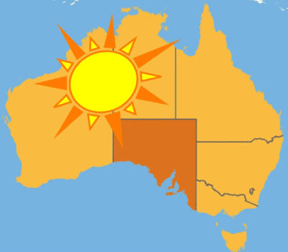 On Monday US company Solar Reserve said it would build a 150MW solar thermal power plant near Port Augusta, South Australia, for $650 million, and sell the power to the SA government for $78/MWh or less.
Earlier this year Origin Energy sold its 530MW Stockyard Hill wind farm in Victoria to China’s Goldwind with a deal to buy the power and renewable energy credits for about $52/MWh, and AGL sold its Silverton wind farm in NSW to PARF with a power and credits purchase deal at $65 /MWh.
According to figures compiled by the Clean Energy Council and AFR Weekend, 2600MW of wind and solar projects are under construction or have already been commissioned in 2017 at a cost of $4.6 billion. Another 3190MW of projects worth $$6.35 billion are committed or expected to begin construction this year or in January.
More conservatively, Bloomberg New Energy Finance counts about $3.7 billion of renewable energy investment commitments for the first half of the year, and $1.1 billion for the September quarter to date – or nearly $5 billion.
Post-2020 challenge
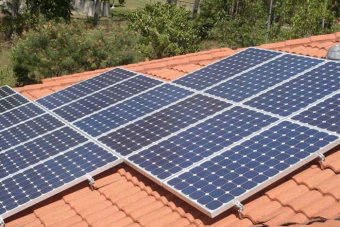 Smaller-scale solar rooftop installations are not included in these figures and are also running at record levels for the first half of the year, with more businesses installing panels as the price drops. But the boom in large-scale renewables may not continue after 2020 if the Finkel energy review’s proposal to extend the Renewable Energy Target into a Clean Energy Target is not adopted.
Bloomberg New Energy Finance’s Kobad Bhavnagri said that from 2020 to 2025 not much new capacity will be needed, because rooftop solar installations by households and businesses will continue to grow and “crowd out the need for large scale” wind and solar.
He expects the installed base of rooftop solar to jump from 6400MW by end of this year to 16,100MW by end 2025.
“Without further policy we think there’ll be a large-scale downturn from 202 to 2025,” Mr Bhavnagri said.
1 This month


Help Aunty Sue Protect Her Land and Sacred Sites From Destructive Rocket Testing.
.

Australians deserve the truth
about
AUKUS – https://aukuspublicinquiry.com/

PETITION – To: Prime Minister Anthony Albanese and the Australian Labor Government

of the week – Australians for War Powers Reform (AWPR)
To see nuclear-related stories in greater depth and intensity

