Will Australia join in the war if Trump’s USA attacks North Korea?
Australia will join the conflict if North Korea attacks the US: Malcolm Turnbull, SMH Fergus Hunter, 11 Aug 17, Prime Minister Malcolm Turnbull has declared Australia would invoke the ANZUS security treaty for only the second time in its history in response to any attack by North Korea against the United States.
Mr Turnbull also pushed back against calls – including from former prime ministers Tony Abbott and Kevin Rudd – for Australia to develop a missile defence shield to protect the mainland from the threat of North Korea’s nuclear weapons and long-range missile program.
The Prime Minister’s commitment to assist the US caps off days of escalating tensions, with US President Donald Trump threatening to unleash “fire and fury” on the rogue state and the North Korean regime warning it would attack the US Pacific territory of Guam.”The United States has no stronger ally than Australia. We have an ANZUS agreement and if there is an attack on Australia or the United States … each of us will come to the other’s aid,” Mr Turnbull told Melbourne radio station 3AW on Friday……
After invoking ANZUS in 2001, Mr Howard said Australia would consult with the US and consider any requests “within the limits of its capability”.
A month later, the government committed Australian troops to the US-led invasion of Afghanistan.
Opponents have criticised the treaty, arguing it unnecessarily places Australia’s security at risk.
Greens leader Richard Di Natale said: “The last thing we need here is a Prime Minister backing an unhinged and paranoid leader into a conflict that could potentially end life on Earth as we know it.”
He accused Mr Turnbull of putting a target on Australia’s back and called on him to tell the US President to “back off”.
“If there was ever a clearer example of why Australia needs to ditch the US alliance and forge an independent, non-aligned foreign policy, this is it. Malcolm Turnbull now needs to pick up the phone, he needs to talk to Donald Trump and urge him to de-eascalate.”
AGL Energy has continued to rubbish suggestions from members of the Coalition, as well as the Murdoch media and the ABC, that Australia should invest in new baseload generation, particularly in coal plants.
“We just don’t see the development of a new coal-fired power plant as economically rational, even before carbon costs,” AGL Energy CEO Andy Vesey told analysts and journalists at a briefing on Thursday, to mark the release of its annual profit results.
And nor would the company consider extending the life of existing coal-fired generators, such as the Liddell plant in the NSW Hunter Valley, which is scheduled to close in 2022.
AGL made a point in its presentation that the most economic option to replace the 2000MW Liddell would not be coal, or baseload gas, but a mix of energy from wind and solar, and various load shaping and firming capacity from other sources.
This could include battery storage, pumped hydro, demand response mechanisms, and gas peaking plants. It confirmed it is looking at all possibilities but it highlights the shift from reliance on “baseload” power, which as we saw last summer does not equate to reliability, and dispatchable generation.
Already, the 200MW Silverton wind farm is under construction near Broken Hill, and the 465MW Coopers Gap wind farm in Queensland is expected to begin construction soon. Vesey said this would provide “clean reliable energy” for the grid.
AGL also reproduced its estimates of the current cost of wind and solar PV. Both renewable energy technologies delivered energy at a lower cost than brown or black coal, and were still competitive even after adding “firming costs”.
These estimates do not include carbon risk, and the only thing stopping increased investment in those technologies was the lack of policy certainty, Vesey said.
“The challenge is that we are at a point where the lack of certainty around carbon policy is preventing people from investing in the right options, which we think is wind, solar, and storage,” he said. Asked if the company would extend Liddell, built in 1973, particularly given the windfall earnings from the ageing and fully depreciated coal plants in its portfolio given the high wholesale prices, Vesey said no.
Even without factoring in the carbon risk, it would require significant investment in an asset that would be less reliable and have higher cost than other possibilities, such as renewables.
Indeed, Liddell only operated at a capacity factor of 50 per cent in the last financial year, barely above the best performing wind farms.
Turnbull “eyeballs” energy bosses, kids himself on solution
Big energy retailers didn’t so much blink, as wink in face of Turnbull’s “eyeballing” episode. Here’s why they will be high fiving each other in the Qantas lounge at Canberra airport.
Turnbull has failed to axe Australia’s power price “laziness” tax
The PM only had to push energy reforms slightly further to make a world of difference, and protect consumers from the “laziness tax” exploited by utilities.
Australia’s biggest solar retailer forced to replace non-compliant panels
Euro Solar forced to surrender STCs or replace PV modules after being found to have installed non-compliant solar panels, as part of a Clean Energy Regulator crackdown on Australia’s rooftop solar industry.
AGL says solar, wind, storage cheapest way to replace coal
AGL says new coal plants not economically rational; facilities like Liddell will be replaced by wind, solar, batteries, pumped hydro and other firming capacity.
AGL cashes in on coal splurge, renewable investment drought
AGL’s multi-billion investment in coal generators, and the recent investment drought in new wind and solar plants, have delivered windfall gains to the country’s biggest generator. It also increased its margins from consumers, despite its offer of discounts.
EnergyAustralia pays dearly for gas, consumers pay more
EnergyAustralia says profits fell as it got hit by having to buy gas, but it was offset by increased gains from its retail business as consumer bills surged.
Why Sunshine Coast church groups fear climate change https://www.sunshinecoastdaily.com.au/news/why-sunshine-coast-church-groups-fear-climate-chan/3209868/, Bill Hoffman | 8th Aug 2017 CONCERN for the welfare of future generations and protection of the environment were the principal concerns that drove more than 1000 people of faith on the Sunshine Coast to sign a petition calling on the Federal Government to do more to address the looming impact of climate change.
The petition signed by 1053 people has been presented to Fisher MP Andrew Wallace calling for stronger action on greenhouse gas emissions and for Australia to increase its assistance to vulnerable nations already struggling to respond to the impacts of climate change.
It drew together the Caloundra Catholic Community Social Justice Network, the Caloundra Uniting Church Social Justice Group and the Anglican Church.
Bob Cullen of the Caloundra Catholic Community Social Justice Network said he had been inspired to launch the petition by the 2015 “On Care for Our Common Home” letter from Pope Francis.
“The Pope said that climate change represents one of the principal challenges facing humanity today,” Mr Cullen said. Mr Cullen joined Mrs Wendy Lowry of the Caloundra Uniting Church Dr Ray Barraclough of the Anglican Church to present the petition to Mr Wallace.
“When I met two people from islands to the north of Australia and heard their poignant descriptions of losing their homelands because of sea level rise caused by climate change, I realised the need for action,” Mr Cullen said.
“Rising sea levels have seen communities lose sources of clean drinking water to flooding and salinity. In the worst cases, communities have been forced to abandon their homes and to watch their family graves being washed away.”
Dr Ray Barraclough, who has taught students from Kiribati and Tuvalu, has seen families forced to leave their ancestral homes.
Mrs Wendy Lowry expressed her deep concern about the legacy being left for future generations.
“I have 12 grandchildren and am concerned about the pollution that we are leaving for their generation,” she said.
Mr Cullen said the meeting with the Fisher MP ended with the prayer Mr Wallace had concluded his Maiden Speech to the House of Representatives: ‘God grant me the serenity to accept the things I cannot change, courage to change the things I can, and wisdom to know the difference’.
The Fisher petition was part of a Community Climate Petitions campaign raised simultaneously in almost 100 federal electorates across Australia.
It was driven by a diversity of faiths including Christians, Buddhists, Muslims, Jews and Brahma Kumaris.
It was supported by the Australian Religious Response to Climate Change, Caritas Australia, Catholic Earthcare, Common Grace, Edmund Rice Centre, Pacific Calling Partnership, TEAR Australia and the Uniting Church in Australia.
Snowy retreat: Climate change puts Australia’s ski industry on a downhill slope, SMH, Peter Hannam, 8 Aug 17 Australia’s ski resorts face the prospect of a long downhill run as a warming climate reduces snow depth, cover and duration. The industry’s ability to create artificial snow will also be challenged, scientists say.
Resorts are also going to become more reliant on big snow dumps such as this weekend’s blizzard – after a poor start to the season – as the frequency of smaller, top-up snowfalls diminish.
A snow retreat has been observed for half a century, with rising temperatures rather than reduced precipitation to blame, according to a major CSIRO-Bureau of Meteorology report. Under high greenhouse gas emissions pathway, snow at lower-elevation sites such as Mt Buffalo could all but disappear by 2050.
Warming springs have led to stark impacts at the end of the ski season. Early October snow depths fell 30 per cent during the 2000-13 period compared with 1954-99, a separate study in 2015 found.
Snow is a “threshold variable”. A slight temperature rise can turn snowflakes into rain that washes away, rather than adds to, snow cover.
That’s why all climate projections point in one direction, says Tom Remenyi, a researcher at the Antarctic Climate & Ecosystems Cooperative Research Centre. It’s both “encouraging and terrifying” that observations have matched models, giving researchers confidence about their bleak predictions, he said…….
Snow guns are becoming less efficient as humidity rises, reduce output of artificial snow by as much as 70 per cent as they ice up, Dr Remenyi said.
New “snow factories” have been introduced to Mt Buller and Mt Selwyn in Victoria, and more are likely. They create ice shavings with longer durability than gun-fired snow.
The endangered pygmy possum, for instance, has had its range shrunk to a little as 10 square kilometres.
“The wildlife that lives in the Australia snowfields are at the front line of global warming because they are so sensitive to rising temperatures and changed snowfall patterns,” Kate Smolski, council chief executive, said.
US Government department tells staff to not use term ‘climate change, A PUBLIC sector department has told employees to cease using the term ‘climate change’ and opt for other more benign words instead. Benedict Brook@BenedictBrook, news.com.au , 8 Aug 17, ….
While Australian public sector staff have not been told what to say, they have been warned what they’re allowed to like or say on social media.
If they “like” or share a Facebook post critical of the government, they could find themselves in hot water — even if they select the “angry face” reaction.
Government employees could also be in breach of the public service code of conduct for material they send in a private email, or for failing to remove “nasty comments” posted by other people to their social media pages.
The new social media guidelines, published on Monday by the Australian Public Service Commission, reinforce that while APS employees “have the right to participate in public and political debate”, it is “not an unlimited right”.
“If you ‘like’ something on a social media platform, it will generally be taken to be an endorsement of that material as though you’d created that material yourself,” the guidelines read.
Proceedings have been filed in the Federal Court on behalf of shareholders Guy and Kim Abrahams claiming the bank did not disclose the risk in its 2016 annual report.
The shareholders alleged it was a breach of the Corporations Act which required businesses to give a true and fair view of their financial position and performance.
Earlier this year, one of Australia’s financial regulators warned climate change could threaten the stability of the entire financial system, as it prepared to apply climate change “stress tests” to the nation’s financial institutions.
A lawyer for Environmental Justice Australia, David Barnden, said the Federal Court action would be a test case which could have wide-ranging repercussions.
“This case is the first of its kind to test the extent of climate change risk disclosure in annual reports,” he said. The claim sought an injunction to stop the Commonwealth Bank from making similar omissions in future annual reports.
The bank’s 2016 annual report discussed climate change as an environment, social and governance priority.
‘Financial interest’ in climate change
Mr Barnden said it should have been disclosed as a major or material risk.
“Generally climate change risks pose financial risks to a bank like CBA by virtue of the bank receiving mortgage repayments from people who own residential housing on the coast — those houses might be at risk from things like sea level rise,” he said.
“There’s other financial risks that CBA has in terms of its loans to fossil fuel companies.
“So as the market adjusts to a low carbon economy, the bank may not receive those repayments.” Shareholder Guy Abrahams is a climate change advocate who bought shares in the bank 25 years ago.
“As their customers and as their shareholders and even people who invest through their superannuation would have a financial interest, most of them, in the Commonwealth Bank, this is a matter of public interest,” Mr Abrahams said.
“This is a really important issue and I think the bank should lead by example.”
Mr Barnden said there was also reputational risks for the bank with shareholders raising concerns about the bank’s position on funding Adani’s proposed Carmichael coal mine.
“We say that the Adani mine is a substantial matter of concern for the Australian public and that the shareholder needs to know how the bank is dealing with that concern,” he said.
The Commonwealth Bank has been contacted for comment.
“Wangan and Jagalingou (W&J) are the Indigenous Traditional Owners of a vast area of land in central-western Queensland.
We are the first people and our country – Wangan and Jagalingou country – is in what is now called the Galilee Basin; and in the area designated as Northern Australia for the operation of the Northern Australia Infrastructure Facility (NAIF).
“The W&J are directly impacted upon by the NAIF Board’s pending decision on an application by the Adani Group, as we are Traditional Owners of the area in which the Carmichael mine and related mining infrastructure is proposed. … “
Making the energy transition more equitable and inclusive
The transition to a clean, affordable and equitable supply of energy is finely on the agenda in Australia, compounded by soaring electricity prices and the mostly favourable response to the Finkel review.
SA’s energy policy: five steps forward, two steps back
South Australia’s energy security target could increase electricity prices while providing an incentive for power companies to pump out more carbon emissions.
Poles and wires: Consumers using less, paying more
Malcolm Turnbull should have a word with network owners and regulators this week, as well as the gentailers. Network charges per unit of electricity have more than doubled.
Tesla Powerpack battery added to wind turbine at NZ salt factory
In “Australasian first”, 250kW Tesla Powerpack added to 660kw wind turbine, to provide 75 per cent of energy for NZ salt manufacturer.
Tesla, Zen, Lyon slam S.A. energy security target as industrial “relic”
Tesla, Zen, Lyon and others slam South Australia’s proposed energy security target, saying it lacks technical expertise and will deliver windfall profits to incumbent gas generators, and not encourage new technologies like battery storage.
Tesla says favouring gas akin to choosing paper records over digital files
Tesla says battery storage can deliver many grid services provided by gas generators, and thinking otherwise is like supporting paper records over digital files.
The Japanese city of Hiroshima of around 350,000 people, was the first city to be attacked with a nuclear weapon when a single bomb was dropped by the USA on August 6, 1945 towards the end of World War 2.
The bomb and its firestorm destroyed two-thirds of the city, with an estimated 70,000 ordinary people killed immediately and a similar number over the next five years. These deaths resulted from the immediate explosion, burns, radiation and cancers.
The city was devastated with destruction of most buildings. Photos appear to show a scene from hell with the city burned out, and civilians with horrendous burns and injuries.
Nuclear proliferation has ensued internationally since then, with an estimated 19,000 nuclear weapons now in existence, all much more powerful than the bomb dropped on Hiroshima. The threat of nuclear war was strongly present throughout the Cold War, and is again rising today.
The cost of nuclear weapons is enormous with an estimated $40 billion spent annually by the US alone.
Countries known to possess nuclear weapons are Russia, USA, UK, France, China, India, Pakistan, Israel and North Korea — not necessarily all reliable international citizens whom we would trust to have a finger on the nuclear trigger, particularly in view of recent inquiries confirming that unreliable information led to the recent war in Iraq with ongoing consequences.
Some countries such as Australia without nuclear weapons choose to be under the US “nuclear umbrella”.
Today, the use of nuclear weapons would result in extraordinary numbers of immediate deaths, devastation of medical facilities to care for those injured, and destruction of infrastructure of a city on a much larger scale than seen in Japan.
It is also predicted that the atmospheric debris from a limited regional nuclear war could cause global cooling and prolonged worldwide famine.
The good news is that a new Treaty on the Prohibition of Nuclear Weapons has been adopted by the United Nations in July this year.
This treaty prohibits states from developing, testing, possessing, transferring or deploying nuclear weapons under any circumstances.
This treaty was passed by 122 nation, unfortunately not Australia, as our government decided not to attend these discussions. Unsurprisingly, those countries with nuclear weapons are also non-participants.
Nuclear weapons will now join the list of banned weapons such as chemical and biological weapons and cluster bombs, which seems highly appropriate given that they are designed primarily to indiscriminately cause death to massive numbers of civilians. In a recent poll about 75 per cent of Australians support nuclear disarmament.
Our government believes that the US nuclear umbrella provides protection for Australia.
Australia’s official view is that a “building block approach” is required towards improving global nuclear weapon safety, with the initial step being increased transparency regarding nuclear stockpiles among those possessing them, which seems highly unlikely to happen given the secrecy surrounding military matters.
Somewhat ironically, international nuclear weapon treaties until now have made it legal for those signatories with nuclear weapons to continue to have them, but illegal for non-nuclear countries to manufacture or buy them.
The current international situation with escalating conflict between North Korea and the US and their respective leaders, illustrates what a precarious situation the world is in with the threat of nuclear weapons being used again very real. There is also the possibility of terrorist groups gaining nuclear weapons.
Nuclear weapons are abhorrent to a civilised society. Whilst in existence they are a threat to all.
Their cost is enormous. The existence of nuclear weapons cannot enhance international safety
The only winners in the nuclear arms race are the arms manufacturers. Australia still has an opportunity to participate in this current UN nuclear abolition treaty, and truly make our country — and our planet — safer.Sally Atrill is Tasmanian GP and the Tasmanian convener for the Medical Association for Prevention of War.
Australia doesn’t ‘get’ the environmental challenges faced by Pacific Islanders http://theconversation.com/australia-doesnt-get-the-environmental-challenges-faced-by-pacific-islanders-81995 Steven Cork, Adjunct Associate Professor, Crawford School of Public Policy, Australian National University, Kate Auty, Vice Chancellor’s Fellow, University of Melbourne, August 7, 2017 What actions are required to implement nature-based solutions to Oceania’s most pressing sustainability challenges? That’s the question addressed by the recently released Brisbane Declaration on ecosystem services and sustainability in Oceania.
There once was an Island
Compiled following a forum earlier this year in Brisbane, featuring researchers, politicians and community leaders, the declaration suggests that Australia can help Pacific Island communities in a much wider range of ways than simply responding to disasters such as tropical cyclones.
Many of the insights offered at the forum were shocking, especially for Australians. Over the past few years, many articles, including several on The Conversation, have highlighted the losses of beaches, villages and whole islands in the region, including in the Solomons, Catarets, Takuu Atoll and Torres Strait, as sea level has risen. But the forum in Brisbane highlighted how little many Australians understand about the implications of these events.
Over the past decade, Australia has experienced a range of extreme weather events, including Tropical Cyclone Debbie, which hit Queensland in the very week that the forum was in progress. People who have been directly affected by these events can understand the deep emotional trauma that accompanies damage to life and property.
At the forum, people from several Pacific nations spoke personally about how the tragedy of sea-level rise is impacting life, culture and nature for Pacific Islanders.
One story, which has become the focus of the play Mama’s Bones, told of the deep emotional suffering that results when islanders are forced to move from the land that holds their ancestors’ remains.
The forum also featured a screening of the film There Once Was an Island, which documents people living on the remote Takuu Atoll as they attempt to deal with the impact of rising seas on their 600-strong island community. Released in 2011, it shows how Pacific Islanders are already struggling with the pressure to relocate, the perils of moving to new homes far away, and the potentially painful fragmentation of families and community that will result.
Their culture is demonstrably under threat, yet many of the people featured in the film said they receive little government or international help in facing these upheavals. Australia’s foreign aid budgets have since shrunk even further.
As Stella Miria-Robinson, representing the Pacific Islands Council of Queensland, reminded participants at the forum, the losses faced by Pacific Islanders are at least partly due to the emissions-intensive lifestyles enjoyed by people in developed countries.
Australia’s role
What can Australians do to help? Obviously, encouraging informed debate about aid and immigration policies is an important first step. As public policy researchers Susan Nicholls and Leanne Glenny have noted, in relation to the 2003 Canberra bushfires, Australians understand so-called “hard hat” responses to crises (such as fixing the electricity, phones, water, roads and other infrastructure) much better than “soft hat” responses such as supporting the psychological recovery of those affected.
Similarly, participants in the Brisbane forum noted that Australian aid to Pacific nations is typically tied to hard-hat advice from consultants based in Australia. This means that soft-hat issues – like providing islanders with education and culturally appropriate psychological services – are under-supported.
The Brisbane Declaration calls on governments, aid agencies, academics and international development organisations to do better. Among a series of recommendations aimed at preserving Pacific Island communities and ecosystems, it calls for the agencies to “actively incorporate indigenous and local knowledge” in their plans.
At the heart of the recommendations is the need to establish mechanisms for ongoing conversations among Oceanic nations, to improve not only understanding of each others’ cultures but of people’s relationships with the environment. Key to these conversations is the development of a common language about the social and cultural, as well as economic, meaning of the natural environment to people, and the building of capacity among all nations to engage in productive dialogue (that is, both speaking and listening).
This capacity involves not only training in relevant skills, but also establishing relevant networks, collecting and sharing appropriate information, and acknowledging the importance of indigenous and local knowledge.
Apart from the recognition that Australians have some way to go to put themselves in the shoes of our Pacific neighbours, it is very clear that these neighbours, through the challenges they have already faced, have many valuable insights that can help Australia develop policies, governance arrangements and management approaches in our quest to meet the United Nations Sustainable Development Goals.
This article was co-written by Simone Maynard, Forum Coordinator and Ecosystem Services Thematic Group Lead, IUCN Commission on Ecosystem Management.
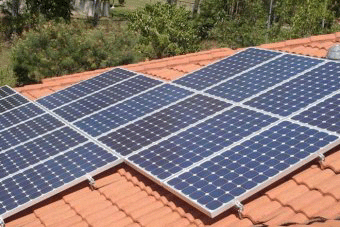
Another 93MW of solar PV was installed on Australian homes and business in the month of July, as booming markets in every state continue to deliver the nation’s best year to date, with a total of 568MW installed so far in 2017.
In its latest monthly market update, solar analysts Sunwiz said the solar PV market had maintained the record-breaking momentum of the previous two months, painting a picture of “a market that is level – at exceptionally high levels.”
According to Sunwiz, this July marked the second highest ever for registrations in that month, maintaining the record solar tally for any year to date that has put the market 47 per cent ahead of the same time last year.
The report notes that part of the reason for this sustained PV market momentum is that every state is doing so well at the same time, not least Western Australia, which is having its best ever start to the year.
Of course, one significant down-side to the booming installation market has been the sudden drop in small-scale renewable energy certificate (STC) prices – which, as we reported here, caught many PV installers off-guard and pushed up the cost of installing solar by around 10 per cent for households and small business.
According to Sunwiz, STC prices – which last month fell from around $40 to as low as $26 – are likely to keep falling as long as the STC creation rate continues to exceed the target, “something we feel is very likely to happen,” it says.
“So expect a soft STC price that will only turn north in early 2018.”
Elsewhere, the report notes that commercial solar systems of larger than 10kW notched up record high monthly and tri-monthly figures, with 33 per cent of volume in June down to commercial installations.
In July the proportion of commercial fell slightly to 31 per cent, as the volume in the 6-10kW range expanded to 20 per cent of the market.
NSW again led the pack on commercial installs, although it was briefly overtaken by Victoria and then Queensland, “but rounded out July on top again” after Victoria stalled and then Queensland fell, the report says.
In the residential market, average rooftop solar system sizes remained steady at and average of 6.5kW, sustaining a new record.
Equis plans 1,000MW solar farm in heart of Queensland’s gas country, REneweconomy By Giles Parkinson on 7 August 2017 Singapore-based renewable energy developer Equis Energy has announced plans to build a 1,000MW solar farm – which would be Australia’s largest – in the heart of Queensland’s coal and gas region in the Surat Basin.
The Wandoan solar farm, to be built near the town of the same name, adds considerably to the huge pipeline of wind and solar projects in Queensland, which now stands at more than 4,000MW.
Wandoan won approval from the Western Downs Council late last week and will begin construction when the first of several negotiations on off-take agreements is complete.
The $1.5 billion project is expected to be built in stages, and Equis could go bigger – this plant is likely to cover 1,400 hectares but is has more than 5000 hectares available.
Equis is taking advantage of existing infrastructure, including new transmission assets, which has been built to support the gas industry. Demand for energy is highest in the region because of the gas export industry.
Equis is also planning to build the 127MW Tailem Bend solar project in South Australia, to be built near a 28M diesel plant owned by Snowy Hydro.
That solar farm will begin construction when negotiations for contracts are concluded, and Equis also has an interest in the 150MW Collinsville north solar farm, where PPAs are also under construction, and other projects in the pipeline in South Australia and NSW.
All project are considered to be “battery storage ready”…….
Why doesn’t this otherwise excellent article mention green energy supplied by Powershop? I’m poor and I use renewable energy, (on scheme that supports community projects, too) from Powershop.
Poor households are locked out of green energy, unless governments help, REneweconomy, By Alan Pears on 7 August 2017, The Conversation
The underlying issue is the fundamental change in energy solutions. As I pointed out in my previous column, we are moving away from investment by governments and large businesses in big power stations and centralised supply, and towards a distributed, diversified and more complex energy system. As a result, there is a growing focus on “behind the meter” technologies that save, store or produce energy.
What this means is that anyone who does not have access to capital, or is uninformed, disempowered or passive risks being disadvantaged – unless governments act.
The reality is that energy-efficient appliances and buildings, rooftop solar, and increasingly energy storage, are cost-effective. They save households money through energy savings, improved health, and improved performance in comparison with buying grid electricity or gas. But if you can’t buy them, you can’t benefit.
In the past, financial institutions loaned money to governments or big businesses to build power stations and gas supply systems. Now we need mechanisms to give all households and businesses access to loans to fund the new energy system.
Households that cannot meet commercial borrowing criteria, or are disempowered – such as tenants, those under financial stress, or those who are disengaged for other reasons – need help.