The most senior Liberal expressing doubt is former prime minister John Howard, who remains an influential figure in conservative circles.
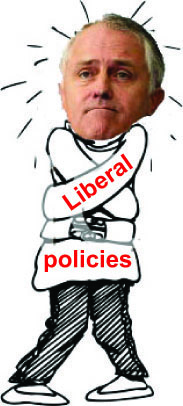
Some of Mr Turnbull’s conservative critics cite his belief in global warming as evidence he is too left-wing for the Liberal Party.
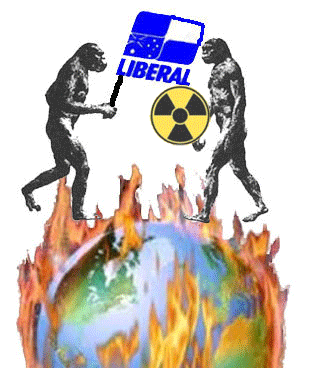
The split within the Liberal Party is illustrated by its own think tank, the Menzies Research Centre.
More than half of federal Liberal MPs ‘don’t trust’ climate science: think tank http://www.afr.com/news/policy/climate/more-than-half-of-federal-liberal-mps-dont-trust-climate-science-think-tank-20170714-gxb7r2 The majority of federal Liberal MPs are not convinced the science behind climate change is settled and support reductions in emissions of greenhouse gases for political reasons, according to an prominent conservative think tank.John Roskam, the executive director of the Melbourne-based Institute of Public Affairs, said he hadn’t conducted a formal count but found most Liberal politicians shared his doubts about what many experts say is the greatest global threat to mankind.
“More than 50 per cent are solid sceptics and more than 50 per cent feel they need to be seen to do something,” he said in an interview. “The science is not settled.”
The overwhelming majority of climate change scientists accept the atmosphere is warming and humans are responsible. The burning of fossil fuels contributed to an increase in atmospheric carbon dioxide from 280 parts per million before 1800 to 396 parts per million in 2013, according to the Australian Academy of Science. Continue reading →
Four Labor states and governments have formalised their push to purse their own clean energy target mechanism, officially breaking away from the federal government after the Coalition refused to endorse the Finkel Review’s recommendation on the issue.
The COAG energy council meeting in Brisbane endorsed 49 of the 50 recommendations from the Finkel Review, and endorsed the decision to get rid of the “limited merits review” that affects network spending. However, the federal government said it could not commit to a clean energy target.
South Australia, Victoria and Queensland, along with the ACT, said they would ask the Australian Energy market Commission to study how a CET might be implemented by the states saying “they can’t wait any longer”.
It is not clear how long this will take, and how quickly legislation can be introduced, or if it can survive state-based partisan politics given that both the South Australia and Queensland Labor governments are facing elections in the next 12 months.
The role of the ACT is also unclear, given that it will reach its target of 100 per cent renewable energy by 2020.
These same states this week all committed to zero net emissions by 2050, in a ceremony marking the visit of former vice-president and climate campaigner Al Gore.
“It is incredibly frustrating that despite the overwhelming community support for a market mechanism, the Federal Government is still resisting committing to all 50 Finkel recommendations,” South Australia energy minister Tom Koutsantonis said in a statement.
“Opposition from the coal lobby and the right wing of his party is preventing the Prime Minister from acting in the interests of all Australians.”
The federal Coalition has been riven by divisions over the proposed CET, with conservative commentators unanimously condemning the idea, and the rump of Far Right Coalition MPs also voicing their opposition.
Federal energy minister Josh Frydenberg said COAG had agreed a “significant set of reforms …. to ensure a more affordable and reliable energy system.”
The recommendations include the creation of an Energy Security Board. Each jurisdiction will send through a name; and the next few weeks the states will agree on a chair and deputy chair. The other members will be the heads of the three main energy industry regulators, rule-makers and operators.
It is an absurd situation we find ourselves in. The public support for these new technologies is overwhelming, as it is in business (apart from those seeking to protect stranded assets), and among most politicians – even many in the Liberal Party, as NSW energy minister Don Harwin revealed late last month.
Yet here we are: Short-term policies; a patchwork of rules on energy efficiency; the worst building stock in the world; the most inefficient and polluting cars; and the world’s most expensive and dirty grid, soaring emissions, and rising temperatures.
And two years after obtaining power, prime minister Malcolm Turnbull is still defending policies he once describes as “bullshit,” too afraid to call out the nonsense spread by those keeping him in power.
Conservatives have been railing against renewables and carbon pricing for at least a decade. So ingrained has it become in our national psyche that it is like a State of Origin contest between energy sources and their fans. “Queenslander”, shout the league fans. “Fossil fuels” screech the incumbents.
But it plumbed further depths this week. And it got really stupid and really nasty. Conservatives in the government and the media rebooted their attacks on wind and solar energy, and extended it to battery storage and vehicle emission standards, with the Murdoch media dubbing the latter as a “carbon tax on cars.”
Craig Kelly, the chair of Coalition’s energy policy committee, said renewable energy “would kill people”, a claim happily repeated by columnist Andrew Bolt.
Resources Minister Matt Canavan urged the Queensland government to “forget about climate change”, while the LNP in Queensland will this weekend consider a motion urging Australia to quit the Paris climate deal.
Worse, the conservatives started attacking individuals. The verbal assault on chief scientist Alan Finkel was launched way back in February when it was clear he would not toe the fossil fuel line. And even after delivering what many consider a “soft option”, the conservatives rekindled their attack. Continue reading →
On a technicality – an Australian politician, of both integrity and intelligence , has had to resign. As far as I can see, there is no Australian parliamentarian who has the understanding of nuclear/climate issues, combined with the intelligence and ability to advocate for the public good, except for Senator Scott Ludlam.
I watched his Senate interviews, and marvelled at his ever courteous, but ever persistent and probing, questioning of bureaucrats who tried, unsuccessfully, to cover up the hypocrisies that surround Australian politics on nuclear issues.
Sometimes, people can achieve much outside of parliament, as well as inside. We will have to wait to see what Scott Ludlam will do from now on. Anyway, we wish him well, while much regretting his departure from politics.
And Ludlam has a sense of humour too. Where are we now going to get those sly amusements in the drab world of Australian politics?
Greens shock: Scott Ludlam resigns over NZ citizenship https://www.crikey.com.au/2017/07/14/greens-shock-ludlam-resigns-over-citizenship/, In a shock announcement, the Greens’ Scott Ludlam has resigned after learning he remained a NZ citizen,Bernard Keane, Politics EditorWest Australian Greens senator Scott Ludlam has resigned from the Senate effective immediately after revealing he had recently learnt he remained a New Zealand citizen despite being naturalised as an Australian citizen as a child.
Ludlam, who was born in New Zealand and moved to Australia at the age of three, says he assumed his naturalisation removed his New Zealand citizenship, but that it had recently been drawn to his attention that he remained a New Zealand citizen. Under section 44 of the constitution, anyone who “is under any acknowledgement of allegiance, obedience, or adherence to a foreign power” cannot stand for parliament.
Ludlam, the co-deputy leader who holds the communications and foreign affairs portfolios and who was first elected to the Senate in 2007, took responsibility for the oversight.
“This is entirely on me and I should have addressed it in 2006,” he said. The issue had been drawn to his attention by a “community member” who, according to Ludlam, was neither a journalist nor a political opponent. Ludlam made the decision to resign once the New Zealand High Commission had confirmed he remained a NZ citizen.
Ludlam is required to repay his salary for his period in the Senate — a sum that will exceed a million dollars. He says he intends to follow former senators Bob Day and Rod Culleton in seeking an exemption from repayment from the Special Minister of State.
Ludlam was one of the few senators with credibility in the communications sector, given his grasp of information issues, and led the fight against the Rudd government’s internet filter and the Abbott government’s mass surveillance regime. He was also an unstinting supporter of WikiLeaks and one of the few politicians to forcefully criticise the government’s failure to support Julian Assange. He was re-elected in 2014 after a special WA byelection caused by the loss of ballot papers by the Australian Electoral Commission during the 2013 federal election. The byelection became an early test of the Abbott government’s rapidly declining popularity and Ludlam’s politely phrased, but ferocious, “welcome to Western Australia” attack on Tony Abbott prior to the byelection drew huge attention.
“Thanks to you all and see you in the next life,” Ludlam said at the end of his media conference. Australian politics will miss an intelligent, articulate and credible young leader.
Clean energy target: how the states might make it work Victoria and South Australia have suggested a states-led initiative if the federal government continues to stall on a clean energy target. Could it work?, Guardian, Michael Slezak, 14 July 17,
Australian states exasperated by federal government inaction on the key Finkel review recommendation of a clean energy target have indicated they might band together and go it alone if the federal Coalition does not provide the required leadership.
States harden threat to got it alone on clean energy target, THE AUSTRALIAN, 15 July 17 ROSIE LEWIS, Reporter, Canberra @rosieslewis and SID MAHER, NSW Editor, Sydney@sidmaher
Labor states have ramped up pressure on the Turnbull government to adopt a clean energy target but refused to lift bans on gas exploration, triggering warnings from industry leaders that time was running out for a national approach to lowering electricity costs and securing supply.
A crucial meeting of the nation’s state and federal energy ministers yesterday signed 49 of the 50 recommendations handed down by Chief Scientist Alan Finkel, but Queensland, Victoria, South Australia and the ACT stuck to their threat to “go it alone” on a target and moved to “immediately develop and design” options for implementing the mechanism………
The Australian Energy Council, representing major gas and electricity businesses, said brokering a national and bipartisan CET was fundamental to overcoming the energy crisis.
“Successful reform and lower energy bills will only come from bipartisan support and national implementation. Investment behind this reform will run for decades, so we need to find broad and enduring agreement to give it the confidence to proceed.’’
Key Finkel recommendations agreed to at the Council of Australian Governments Energy Council meeting in Brisbane include an obligation on intermittent sources of generation such as wind and solar to provide appropriate levels of backup power to guard against blackouts; a requirement for large generators to give at least three years’ notice before closing; and the establishment of an energy security board to scrutinise the National Electricity Market’s health, security and reliability.
The states also backed the federal government’s decision to abolish the Limited Merits Review — a tool the government says has been used by power companies to increase electricity prices — and accelerate the timetable for gas pipelines reform.
The price and availability of long-term electricity retail contracts will be published so big consumers can understand the market they are competing in.
Grattan Institute energy director Tony Wood said the only factors likely to drive any easing of prices were a decision by the Queensland government to order its generators to lower their returns, and the final commissioning of the Gladstone LNG export facilities, which could see more gas made available for domestic use and ease gas prices……
Government’s letter to conservation groups has ominous implications,Guardian, Lenore Taylor, @lenoretaylor New reporting rules seem to represent a big win for the campaign by the mining sector and conservative politicians to stifle environmental advocacy. 15 July 2017
The environment department has recently begun sending letters to conservation groups registered as eligible for tax deductible donations, as they do every year. But this year the correspondence is different, in a disturbing way.
In the past the groups, which include all the big names such as the Australian Conservation Society, The Wilderness Society, Lock the Gate, Greenpeace etc, as well as small local conservation organisations, were simply asked to reveal the total expenditure from their public fund. This year they have also been asked to break down their expenditure into the amounts spent on “on ground environmental remediation”, “campaign and advocacy”, “research” and other administration.
It sounds like a boring technicality but it seems to represent a significant victory in the long-running campaign by the mining industry and conservative politicians to hobble advocacy for the environment.
According to the mining industry’s argument, enthusiastically adopted by conservative politicians including the resources minister, Matt Canavan, environmental groups should not be able to claim tax deductions for all the donations they get from members of the public who want to support their campaigns.
Canavan, while a backbencher, conducted his own deep investigation of green groups’ activities for a previous Senate inquiry, concluding that tax deductibility should be pared back……
The mining industry peak bodies believe they should themselves be free to campaign for public subsidies for new coal mines or coal-fired generators, or to spend millions to overturn a mining tax, in the interests of, and funded by, their cashed-up multinational members.
But they say the environmental groups that argue for the interests of the natural environment should be able to receive tax deductible donations only for “on ground environmental remediation” – planting trees and the like – and not for public debate and advocacy.
That’s why the new reporting requirements are seen as ominous……..
But if you believe Australia is a richer place for doing its part to address global warming, for limiting tree clearing, protecting endangered species or the Great Barrier Reef, or for insisting on proper remediation of mine sites, then it’s taxpayer money well spent. And, by definition, that’s a belief the hundreds of thousands of Australians who donate to environmental groups share.
Queensland LNP pledges to promote coal and ‘resist environmental groups’
Proposals before LNP state convention include pulling out of Paris climate agreement and banning migrants from nations that recognise sharia, Guardian, Joshua Robertson, 14 July 17, Queensland’s Liberal National Party has resolved to use its next stint in state government to push for the promotion of coal mining and “fully resist environmental groups” that stand in the way.
The pro-coal vow was one of the opening resolutions of an LNP state convention set to rule on up to 77 rank and file proposals for new policy, including calling on the federal government to echo Donald Trump’s US administration by pulling out of the Paris climate agreement.
A mixed agenda from the three-day event also includes calls to ban immigration from nations that recognise sharia, privatise the ABC, and condemn public spending on “altering traffic lights for ideological purposes”.
That proposal is from the LNP’s Moggill branch, in Brisbane’s leafy, well-heeled western suburbs.
Moira Williams, from the activist group Stop Adani Brisbane, said this showed “that the grassroots of the LNP are concerned about Adani’s reliance on tax havens, and they know that lending $1 billion of taxpayers’ money to this company is a risk for the taxpayer”.
“That the Adani Group has a complex network of companies that extends to a global tax haven, the Cayman Islands, is no secret. It is no wonder that the LNP membership are concerned about the potential for Adani to receive significant public funds from the Northern Australia Infrastructure Facility.”
The first vote of the convention on Friday backed a resolution from the rural Burnett branch to call for “Get Up and other blatantly political organisations” to register as third parties with electoral authorities to enable scrutiny of funding sources, advertising and political activities.
The convention, which sets official party policy for consideration but is not binding on the LNP parliamentary arm, is the last before a Queensland election due by May 2018.
A proposal from the Groom branch near Toowoomba called on the federal government to “pull out of the Paris Climate Accord as it weakens Australia’s sovereignty and economy without helping the environment in any measurable way”.
The Queensland environment minister, Steven Miles, said the fact the LNP was debating a withdrawal from the “historic Paris climate treaty … underlined the differences between Labor and the LNP on climate policy”.
“In the very same week as Queensland Labor announces we will decarbonise Queensland’s economy in line with the treaty, the LNP wants to pull out of it,” he told Guardian Australia.
Northern Australia Infrastructure Fund set up to funnel billions to Adani, Independent AustraliaMark Zanker 15 July 2017, The NAIF was set up to allow the Coalition Government to pump billions of dollars of public money into Adani’s Galilee Basin coal mine and other coal mining projects, writes former public servant Mark Zanker.
THE Northern Australia Infrastructure Facility(NAIF) was set up ostensibly is to fund the states and territories to carry out infrastructure works to assist economic growth and increased population in northern Australia. However, a close look at the bill, and the people and circumstances surrounding it, suggests that it is, in fact, a tiny fig leaf behind which the Federal Government seeks to hide its desire to shovel billions of dollars of taxpayers money into Adani’s Galilee Basin coal mine project.
The legislation precludes the appointment to the board of representatives of traditional owners, pastoralists, scientists, environmentalists, the tourism industry, and historians. These groups also have significant expertise in northern Australia — pastoral, cultural, spiritual, historical and scientific. Pastoralism, aquaculture, tourism, including conventional, cultural and ecological tourism, are very important industries in northern Australia, but none of them have a seat at the table here.
With the possible exception of Innisfail Mayor Bill Shannon, the board members of the NAIFall have strong links to the mining industry. Chair Sharon Warburton was a board member of Gina Rinehart’s Fortescue Metals Group, and previously worked at Rio Tinto and other resources companies. Continue reading →
Zibelman is not on board the coal-power train with former Prime Minister Tony Abbott, Nationals leader Barnaby Joyce and Jones.
Views such as Jones’s are alien to virtually anyone who works in – or closely observes – the energy industry.
Energy executives are impressed. “I was quite buoyed by Audrey’s approach on demand response,” said Steven Neave, head of electricity networks for Powercor and Citipower, the largest Victorian distributor, who attended the CEDA lunch.
Zibelman said while the CET and consistent national policy would be useful for energy companies – because it would make their investment decisions easier – it wouldn’t make much difference to AEMO’s actions because the shift to renewables is happening and they have to deal with it.
Zibelman landed in this cauldron in March, fresh from New York, to run the Australian Energy Market Operator – one of three agencies responsible for delivering stable, secure and affordable energy markets.
She is a cleanskin in the local energy debate but is hugely experienced, most recently as chair of the New York state utilities regulator–- responsible for implementing New York’s pro-wind and solar “Reforming the Energy Vision” plan – under Democratic governor Andrew Cuomo. Before that she was chief operating officer of PJM, a huge utility company covering 13 north-eastern states and Washington DC. Continue reading →
Josh Frydenberg warns states against going it alone on clean energy target, The Age, Adam Gartrell, 14 July 17 The Turnbull government has warned the states their threat to “go it alone” on a clean energy target will only create chaos and inefficiency in the nation’s electricity system.
Energy ministers will clash on Friday as the states seek to pressure the Turnbull government to decide whether it will adopt a clean energy target – the key recommendation of Chief Scientist Alan Finkel’s review of Australia’s energy security – despite ongoing internal divisions over the policy proposal.
Led by South Australian Treasurer Tom Koutsantonis, the Labor states on Thursday threatened to bypass the federal government altogether. Without swift progress on Friday they would ask the Australian Energy Market Commission to model how a state-based target would work, Mr Koutsantonis said.
“The time to act is now – Australian households and businesses cannot be held hostage by the impotence of the federal Liberal government,” he said.
But federal Energy Minister Josh Frydenberg cautioned against the move, urging patience from the states…..
What Elon Musk’s investment tells us about our energy crisis, The Age, Perry Williams and Jason Scott JULY 14 2017 – Elon Musk’s intervention in Australia’s energy crisis is widening a divide over the future of coal.
The billionaire Tesla founder, who’spromised to help solve South Australia’s clean energy obstacles, sees no place for the fossil fuel.That conflicts with the federal government’s push for it remaining a mainstay source of electricity generation, as well as the “clean, beautiful coal” technologies that US President Donald Trump sees helping to save American mining jobs.
“Coal doesn’t have a long-term future,” Musk told reporters in Adelaide last week during a short trip to Australia. “The writing’s on the wall.” His declaration in energy-strapped South Australia, where the 46-year-old entrepreneur announced plans to build the world’s biggest battery to support the state’s blackout-plagued power grid, has rankled politicians.
Energy minister Josh Frydenberg, 45, accused the state of tapping a celebrity to paper over its patchy clean energy record. Tesla’s battery plan “is a lot of sizzle for very little sausage”, Frydenberg, a member of the conservative Liberal-led federal government, said on Monday. Deputy Prime Minister Barnaby Joyce, 50, said Musk’s plan “doesn’t make a hell of a lot of difference” to the nation’s struggles over energy security.
Most of Australia’s states and territories – free to determine their own energy and climate policies independent of the national government – beg to differ. Just hours after Musk’s announcement, the neighbouring state of Victoria closed the door on new coal-fired power stations, saying energy companies would rather invest in renewables.
Energy policy is a fraught subject with a push by the majority of Australians for more renewable power sources from the Australian majority is clashing with the government’s political imperative to keep a lid on soaring power prices. Currently, some 76 per cent of Australia’s electricity is drawn from coal-fired power stations which, while a cheap supply source, are at odds with a commitment to lower climate emissions……
The economics of building new coal plants don’t stack up and increasingly renewables will dominate base-load power, AGL chairman Jeremy Maycock said last week. Australians overwhelmingly want the government to focus on clean energy, according to a June poll by the Sydney-based Lowy Institute.
‘Highly improbable’
“It’s highly improbable that AGL will be constructing new coal-fired power stations because we don’t think the economics are likely to favour that,” Maycock said in a phone interview. “As the largest generator, we want to play our fair share in the country’s emissions reduction targets.”
For Prime Minister Malcolm Turnbull, banging the drum on coal is proving a treacherous task…….
the existing and perceived political and environmental costs attached to coal are deterring lenders.
“The high risk and cost associated with new coal plants make investors and financiers run a million miles from it in Australia,” said Ali Asghar, an analyst with Bloomberg New Energy Finance in Sydney. “The only way new coal could get built is if the government funds it and indemnifies any private entity against all future carbon risks.”
And doing so makes little sense, given that the cost of building cleaner, so-called high-efficiency, low-emission coal plants in Australia exceeds that of new projects relying on solar, wind, or gas, Asghar said.
New battery storages that can deliver four hours of power to two regional Victorian towns of 100,000 people, and a solar farm that would power more than 400 trams are key projects in Victoria’s new plan to increase renewable energy supply and reduce reliance on burning coal.
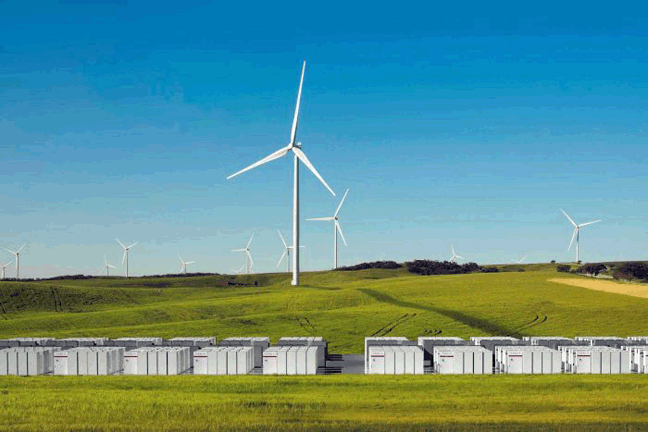
The battery will be up and running by this summer, the state government says, and will provide at least 40 megawatts of power in western Victoria, where the electricity network is relatively weak, boosting reliability in towns including Bendigo, Horsham, Ararat, Red Cliffs and Kerang.
Proposals that Bendigo or Ballarat lose electricity during a record-breaking east coast heatwave in February to guarantee power to NSW were angrily rejected by Victoria’s energy minister Lily D’Ambrosio, who told the Australian Energy Market Operator “it was absolutely not appropriate that Victoria had to pay consequences for failures in New South Wales”.
Victoria’s roll-out of renewable energy supply has gained extra urgency since the April closure of the Hazelwood coal-fuelled generator, which provided 20 per cent of the state’s baseload power supply.
Tenders for the $25 million project are being evaluated by the Department of Environment, Land, Water, and Planning, and is part of a nationwide embrace of battery energy, including Tesla founder Elon Musk’s commitment this month to build the world’s largest lithium-ion battery in South Australia.
Grid-scale batteries can store renewable energy to be used at times of peak demand, improving energy security and shielding consumers from severe price spikes.
The Andrews Government announced on Thursday its plan to spend $146 million on a series of renewable energy initiatives in a bid to meet its target of 40 per cent green energy for the state by 2025.
The renewable energy action plan, launched by former US vice-president Al Gore, will underpin the state’s attempt to achieve zero net greenhouse gas emissions by 2050.
It includes $48.1 million for the purchase of renewable energy certificates, much of which will go towards solar power for Melbourne’s trams.
A 75mw solar farm that will power Melbourne’s 410 trams is due to open in the state’s north-west late next year. The powering of Melbourne’s tram network with solar energy is notional. Electricity from the solar farm will flow into the general power supply and the government will purchase renewable energy certificates for 35mw of power, which is enough to operate the city’s tram system.
The plan also features $8 million for small-scale “micro-grid” initiatives to create power at a local level, independent of the energy grid.
Mr Gore said the renewable energy plan was a “highly impressive” example of a state taking the initiative to create jobs through projects that will cut carbon emissions.
“All over the world there has been a dramatic change in the marketplace, with electricity generated with renewable sources falling below the cost of electricity generated by fossil fuels,” Mr Gore said.
Before taking a short ride on an E-Class tram, Mr Gore predicted Melbourne’s solar-powered trams “will become a symbol of the renewable energy revolution worldwide”.
Energy and Environment Minister Lily D’Ambrosio said the renewable energy plan “represents the most significant government investment in renewable energy in Victoria’s history”.
She said the plan would also drive down power prices for Victorians, who face a 15 to 20 per cent hike in their power bills from January 1.
Ms D’Ambrosio said the global economy was moving away from coal-generated power and Victoria had no option but to head in the same direction.
“When we stand still at a national level we are actually taking Australians backwards,” she said.
“The only investment that is occurring globally in new generation is around renewable energy.”
The government’s launch of a new renewable energy plan follows recent comments by Ms D’Ambrosio that Victoria might work with other states and set a renewable energy target to the exclusion of the Turnbull government.
The Turnbull government has not committed to a renewable energy target, despite it being one of the recommendations of the Finkel review it commissioned into Australia’s energy needs.
State energy ministers are due to meet with federal Energy Minister Josh Frydenberg this week, however, Mr Frydenberg has signalled there will be no resolution on a clean energy target for Australia at the meeting, because the federal cabinet is still debating the issue.