Australia can play a role in promoting dialogue, not war, with North Korea
There is no point in Australia waiting to be a pallbearer at the funeral. We need to use what influence we have to shape a better response in Washington and other capitals.
We should also open a line of communication with Pyongyang — to see if there is any dialogue that might help to prevent conflict.
Australia can play a role here. Our embassy in Seoul is accredited to Pyongyang, where there hasn’t been a US embassy for years. We should co-ordinate this with key allies, but Australia should look to open a line of dialogue with the regime.
Australia has performed a similar role in Iran, where the US hasn’t had diplomatic representation since 1979.
Has Australia got the gumption to do this, or will we just wait for the conflict to start and hope others fight the war for us?

 Dialogue better than all-out war with unpredictable North Korea http://www.theaustralian.com.au/news/inquirer/dialogue-better-than-allout-war-with-unpredictable-north-korea/news-story/f471a9a09b1dae1fe0d2464f5501d03e?nk=ba26857f63080120cbd5fc74c94d3959-1499480511, PETER JENNINGS,The Australian, July 8, 2017
The members of the G20 are meeting during one of the most serious global situations since the Cuban Missile Crisis of 1962.
Then the Soviet Union was intent on deploying nuclear-armed missiles to an island a few minutes’ flying time from America’s southeast.
The risk was not only what missiles could be launched from Cuba but whether a conflict might spiral out of control and lead to an all-out nuclear war between Washington and Moscow.
Today the situation on the Korean peninsula is just as uncertain. With help from Pakistan and China, North Korea is within a sprint of developing a nuclear-armed intercontinental ballistic missile, with a widely dispersed arsenal of such weapons able to be launched from silos, mobile vehicles and, in time, from submarines.
The North already has about 20 nuclear devices and although these may not fit on missiles, it is possible they could be detonated inside submarines sent on suicide missions to Seoul or Tokyo.
After an American strike in response, we don’t know how China might react to the destruction of its ally. Once the nuclear threshold is breached we face a global situation as dire as those 13 days in October 1962 when nuclear war seemed likely. Continue reading
If North Korea attacks USA with nuclear warhead, Australia will join US in fight – Deputy PM Barnaby Joyce
Australia will join US in fight against North Korea if war breaks out, Yahoo News, JULY 6, 2017 Australia would join military action against North Korea if the rogue nation fires a nuclear warhead at the United States, acting Prime Minister Barnaby Joyce has confirmed.
As Malcolm Turnbull heads to Germany for talks with other G20 leaders, Mr Joyce is ramping up pressure on China to step in and “stop this madness”.
His call comes after US ambassador to the United Nations Nikki Haley warned that America would use force “if we must” against North Korea, after Pyongyang tested an intercontinental ballistic missile (ICBM) with the potential to reach Darwin or Alaska.
“No one should ever go too far in testing the resolve of the United States of America,” Mr Joyce told Sky News on Thursday.
“If North Korea was to deliver a warhead into the United States of America then the ANZUS alliance would be called in.”……One of Australian’s most senior military commanders insists the risk of a strike on the country’s north by North Korean remains low.
Chief of Joint Operations Vice Admiral David Johnston says that despite Pyongyang’s aggressive demonstrations, the range and capability of the missile launched this week is still to be determined.
“There is very little risk at the moment to the northern part of our country,” he told reporters in Canberra……Given the low threat to Australia’s mainland, Vice Admiral Johnston says there hasn’t been an immediate focus on amassing a system to defend against missiles.
The focus now was on applying diplomatic pressure on North Korea to stop their nuclear program and the development of missile technology.
“Where there’s emerging issues that require military support, the ADF has the capability to provide the government (with) options and we’re able to do so.” https://au.news.yahoo.com/a/36295225/australia-will-back-us-if-nuclear-war-breaks-out-with-north-korea/#page1
PM Turnbull says THAAD anti- missile system is “not really suitable” for Australia
US anti-missile system THAAD ‘not really suitable’ for Australia http://www.afr.com/news/world/us-antimissile-system-thaad-not-really-suitable-for-australia-20170707-gx781e, 8 Jul 17 Australia is developing defences against missile attack but the US THAAD anti- missile system is “not really suitable” for Australia, Prime Minister Malcolm Turnbull says.
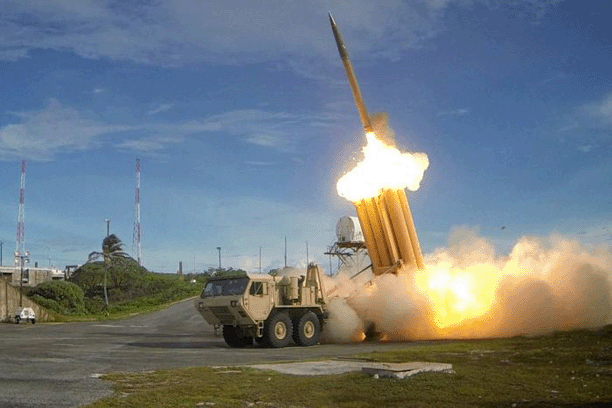 When asked about a possible Australian missile defence system against such threats as a North Korean intercontinental ballistic missile, Mr Turnbull said the Australian focus was on protecting deployed forces in the field.
Speaking to reporters in Hamburg, where he’s attending the G20 summit, the prime minister said the answer to the Korean threat was the denuclearisation of North Korea.
“We are developing missile defences … but the focus is on protecting our deployed forces in the field.”
Mr Turnbull said that in terms of a missile defence shield for Australia there had been talk of the THAAD system. “That’s not really suitable for our situation but I can assure you we are constantly examining how we can ensure that Australians are safe.”
Former PM Kevin Rudd now suggesting missile defence system for Australia
 Australia should consider missile defence to counter North Korea: Kevin Rudd, The Age, Peter Hartcher, James Massola, 8 Jul 17
Australia needs to consider deploying a missile defence system to defend against attack from nuclear-armed North Korea, according to former prime minister Kevin Rudd. Mr Rudd has reversed the position he held in office, saying that North Korea’s newly demonstrated ability to reach northern Australia meant it was time to consider homeland defence.
And top regional security and defence experts have backed that call, arguing Australia and its regional allies must invest heavily in missile defence as the “only alternative”.
A roll out of the US-made Terminal High Altitude Area Defense (THAAD) missile defence system began in South Korea but was suspended last month, amid objections from China and Russia.
North Korea’s recent provocative launch of an intercontinental ballistic missile potentially brings Darwin and the US states of Alaska and Hawaii in range – though their missile’s accuracy remains in question – and has prompted dire warnings from the United States ahead of the G20 meeting in Hamburg, where it is set to dominate discussions.
The Rudd government’s Defence White Paper of 2009 explicitly opposed missile defence for Australia, as “such a system would be at odds with the maintenance of global nuclear deterrence,” the paper said, though it signalled an annual review.
On Friday, the former prime minister said: “Given North Korean developments, Australia would be well advised to begin analysing ballistic missile defence needs, available technologies and possible deployment feasibility for northern Australia.”
On Friday, the former prime minister said: “Given North Korean developments, Australia would be well advised to begin analysing ballistic missile defence needs, available technologies and possible deployment feasibility for northern Australia.”……. http://www.theage.com.au/federal-politics/political-news/australia-should-consider-missile-defence-to-counter-north-korea-kevin-rudd-20170707-gx6t0u.html
Greens Senator Scott Ludlam at nuclear weapons ban treaty talks
 Ludlam, not Australia, in New York for nuclear weapons ban treaty talks, Greens Senator Scott Ludlam has slammed Australia for not taking part in talks on a global ban on nuclear weapons. By Andrea Nierhoff, SBS News, 6 July 17, Senator Ludlam is in New York with delegates from 120 countries to discuss a treaty to ban nuclear weapons around the world.
A farmer deplores the planned giveaway of precious water to Adani coal mine project
Adani Carmichael mine: Water is too important for farmers to risk wasting it on a mine, 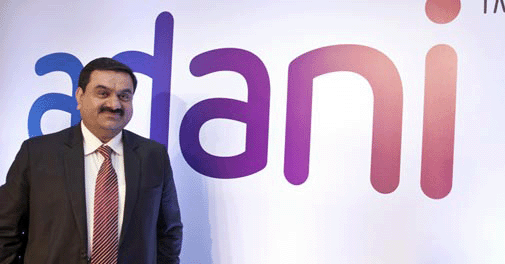 ABC News, 6 Jul 17 By Robert Quirk, I’m no activist. I’m a farmer, and as a farmer I’m against the Adani coal mine for one reason: water.
My sugar cane farm is on the flood plains of northern NSW. Many of my friends and colleagues are in the industry located all over Queensland.
All farmers, no matter what the crop, or livestock, rely on water. Sugar cane requires about 1300 millimetres of well-spread rain to grow a crop. You might manage, with good irrigation, on 600-700mm. Too much in the form of a flood and you might end up with a damaged crop.
In a good year, everything you need falls from the sky, at the right time, in the right amount. Of course, not every year is a good year. In fact, good years are rare and that’s why farmers manage risk with irrigation. You store the water for use later with dams and the like, you try to use it efficiently and sometimes you need to extract it from underground, or truck it in.
It’s all pretty basic stuff, so it’s truly bowled me over to learn the detail of the Adani mine in relation to water.
Two sets of rules
Many farmers in Queensland have licences to draw their water from the Great Artesian Basin. The same basin that the Carmichael mine, once in operation, also plans to draw massive amounts of water from.
How much you ask? Good question. As much as the owners please, because the Queensland Government has granted this company unlimited access to extract groundwater…….
Those in favour of the mine are right about one thing — it is a really good deal. It’s just not a good deal for the Australian people……http://www.abc.net.au/news/2017-07-07/adani-mine-water-is-too-important-to-farmers/8686890
World’s first solar-powered train – for Byron Bay
Byron Bay to get world’s first solar-powered train, courtesy of a coal baron http://www.smh.com.au/technology/sci-tech/byron-bay-to-get-worlds-first-solarpowered-train-courtesy-of-a-coal-baron-20170702-gx31yo.html Marcus Strom, A coal baron is delivering the world’s first solar train to Australia.
And while bringing solar to Byron Bay might be a bit like taking coals to Newcastle, that’s just what the Byron Bay Railroad Company is doing. “I think this is a world first,” said John Grimes, chief executive of the Australian Solar Council, which is not connected to the project.
“There is a train in India that has solar panels to power lights and fans, but not a whole train.” The Byron Bay Railroad Company, operated by mining executive Brian Flannery, expects to have its two-carriage heritage train running before Christmas, said Jeremy Holmes, a spokesman for the company.
It will operate on part of the disused Casino-to-Murwillumbah line, which closed in 2004.
Dan Cass, a renewable energy specialist at the Australia Institute, said: “This is the first we have heard of a train this size that is literally solar powered, with PV modules on the roof.”
Federal govt shamed into revealing Australia’s pollution data
Greenhouse gas pollution up, data released after FOI struggle reveal, SMH, Lucy Cormack, 8 Jul 17, The federal government has answered calls to release greenhouse gas pollution data it had been sitting on since last year.
Energy and Environment Minister Josh Frydenberg released the quarterly updates on Friday, less than 24 hours after a Fairfax Media exclusive revealed documents confirming the department had failed to release data for the two quarters leading up to the end of 2016.
The federal government has answered calls to release greenhouse gas pollution data it had been sitting on since last year.
Energy and Environment Minister Josh Frydenberg released the quarterly updates on Friday, less than 24 hours after a Fairfax Media exclusive revealed documents confirming the department had failed to release data for the two quarters leading up to the end of 2016……The whereabouts of last year’s pollution data was confirmed by documents obtained under freedom of information laws by the Australian Conservation Foundation, extracts of which were published by Fairfax Media on Thursday. http://www.smh.com.au/environment/climate-change/greenhouse-gas-pollution-up-data-released-after-foi-struggle-reveal-20170707-gx6qy8.html
Federal govt keeping Australia’s pollution data secret
Independent estimates suggest Australia’s greenhouse gas emissions have risen sharply since the government last released its quarterly data in December – a trend that would make the nation’s commitment to cutting emissions more disruptive and expensive.
Quarterly updates by the National Greenhouse Gas Inventory, described as “up-to-date information on emissions trends for business, policymakers and the public”, have been released 28 times since 2009, but not since last year.
Documents obtained under FOI by the Australian Conservation Foundation reveal that while the government possesses data on greenhouse pollution for the two quarters leading up to the end of last year, it has failed to release them……..http://www.brisbanetimes.com.au/environment/foi-documents-confirm-government-holding-almost-one-years-worth-of-pollution-data-20170706-gx5um3.html
South Australia’s big energy storage battery
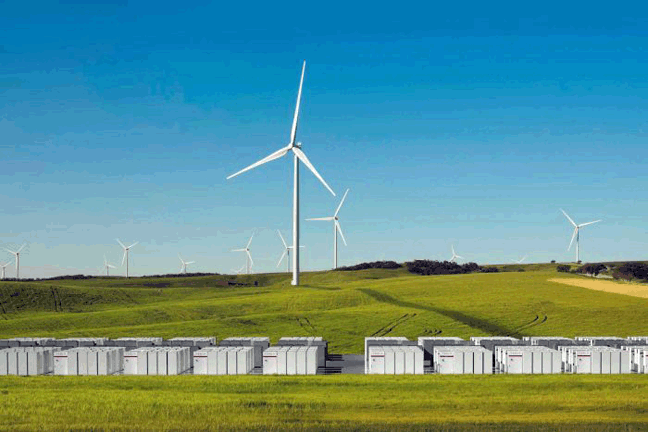
Tesla to supply world’s biggest battery for SA, but what is it and how will it work? ABC By political reporter Nick Harmsen and Alle McMahon, 7 July 17 The “world’s biggest” lithium ion battery is to be built in South Australia by Tesla and French company Neoen.
It is to be close to the French renewable energy company’s wind farm near Jamestown and ready by the start of summer.
What is it?
An array of lithium ion batteries will be connected to the Hornsdale wind farm, which is currently under construction in SA. It will look like a field of boxes, each housing Tesla commercial-scale Powerpack batteries.
The array will be capable of an output of 100 megawatts (MW) of power at a time and the huge battery will be able to store 129 megawatt hours (MWh) of energy so, if used at full capacity, it would be able to provide its maximum output for more than an hour.
It will be a modular network, with each Powerpack about the size of a large fridge at 2.1 metres tall, 1.3m long and 0.8m wide. They weigh in at 1,200 kilograms each.
How will it stack up against the next biggest?
It will have just slightly more storage than the next biggest lithium battery, built by AES this year in southern California. But Tesla’s 100 MW output would be more than three times larger than the AES battery and five times larger than anything Tesla has built previously.
The largest lithium ion battery storage system that Tesla has built to date sits on a 0.6-hectare site at Mira Loma in southern California.
American electricity company Southern California Edison was also involved. It has a storage capacity of 20 MW, or 80 MWh, and is said to be capable of powering 15,000 homes.
The California array took three months to build. Tesla says the lithium ion batteries in the Jamestown array will have a life of about 15 years, depending on their usage and how aggressively they are recharged.
The company says the battery components are replaceable and the circuitry should last 20 to 30 years……..
How will it be used?
Neoen said the battery would primarily provide stability for the power grid, something traditionally the domain of coal, gas and hydro, rather than wind or solar………http://www.abc.net.au/news/2017-07-07/what-is-tesla-big-sa-battery-and-how-will-it-work/8688992
UN poised to adopt nuclear weapons ban treaty today
 The United Nations is set to adopt a global treaty to ban nuclear weapons (Friday 7 July (New York time)) – a long-awaited historic event marred by Australia’s boycott of negotiations.
“This is the biggest step towards nuclear disarmament that we have seen since the end of the Cold War,”  said Associate Professor Dr Tilman Ruff, the Melbourne-based founding chair of the International Campaign to Abolish Nuclear Weapons (ICAN), who is attending the UN talks in New York.
“It comes at a time of growing international nuclear tension, where the risks of armed conflict escalating to the use of nuclear weapons is real and would be a humanitarian and environmental disaster,” he said.
“Pressure must now build on Australia to sign up to the treaty, as it has to treaties for the elimination of other weapons of mass destruction – biological and chemical, and other inhumane indiscriminate weapons such as landmines and cluster munitions.”
More than 130 nations are involved in the UN talks, including New Zealand and Indonesia, but Australia, at the behest of the United States, has boycotted the process. It is the first time ever that Australia has not participated in multilateral disarmament negotiations.
“If passed today, the treaty will stigmatise possession of nuclear weapons by any state, provide a source of legal, political, ethical, economic and civil society pressure on nuclear armed states to disarm, and encourage financial institutions to divest from companies that produce nuclear weapons,” said Tim Wright, Asia-Pacific director of ICAN.
“Of vital interest to Australia and the Pacific, it will also promote addressing the rights and needs of victims of nuclear use and testing, and of remediating contaminated environments,” he said.
“By failing to be involved in these negotiations, Australia has relinquished its responsibilities to its own Indigenous people, and to many others affected by nuclear testing in our region,” Mr Wright said.
Media please note:
Delegates at the UN will decide on Friday —by acclamation or vote—whether to adopt the treaty. If adopted, as is expected, it will open for signature on September 20, after which states will pursue ratification. Once 50 states have completed this process, the treaty will become binding international law.
ICAN Australia and Pacific representatives are available in New York and Australia for interviews, before and after the treaty’s expected adoption on Friday, New York time (likely Saturday morning, Australian time).
Video footage is available of addresses to the UN treaty conference plenary session (Thursday NY time) by: Australian Greens Senator Scott Ludlam, Vanessa Griffen (Fiji), FemLINK Pacific, ICAN Asia-Pacific director Tim Wright.
Elon Musk to build South Australia’s big storage battery, as he promised earlier thisyear
Billionaire Elon Musk to build SA battery, – on July 7, 2017 Billionaire entrepreneur Elon Musk will build the world’s biggest battery in South Australia and if it’s not finished in 100 days, it’s free. Mr Musk first made the bold promise in a Twitter exchange earlier this year, as debate raged over South Australia’s energy woes.
On Friday he said he will stand by the pledge, which has been written into the contract to construct the 100 megawatt lithium ion battery. It will be more than three times larger than any storage station anywhere in the world. “That’s what we said publicly, that’s what we’re going to do,” he told reporters in Adelaide.
Mr Musk’s company Tesla will partner with French renewable energy group Neoen to build the battery near Jamestown in South Australia’s mid-north.
It will be paired with Neoen’s existing Hornsdale Wind Farm to store energy, stabilise and bring added security to SA’s electricity grid, and put downward pressure on prices.
It forms a key part of the state government’s $550 million energy plan which was developed in response to last year’s statewide blackout.
The clock will start ticking on Mr Musk’s 100-day commitment once regulators approve the project, clearing it for grid connection. He said he was confident he could deliver on his promise but admitted the project was not without risk.
“This is not like a minor foray into the frontier. This is going three times further than anyone has gone before,” he said. “The technical challenges are those that come with scale. When you make something three times as big, does it still work as well?” the Tesla boss said. “We think it will, but there is some risk in that.”
Mr Musk said a failure to deliver the project on time would cost his group about $50 million, though the details of the contract have not been revealed.
Premier Jay Weatherill said both Tesla and Neoen were experts in energy security and the project would place SA as a world leader in the integration of renewable energy.
He expects the battery to be up and running in time for next summer. “Battery storage is the future of our national energy market and the eyes of the world will be following our leadership in this space,” he said.
Clean Energy Council spokeswoman Natalie Collard said the pioneering project would set a benchmark for the rest of Australia and the world to follow. “The South Australian government has again cemented its place as a world leader in renewable energy and we look forward to other states following their lead,” she said.”These kinds of projects have a huge role to play in modernising Australia’s energy system and enabling much higher levels of renewable energy.”
Solar Panels on One-quarter of Australian homes
 One-quarter of Australian homes now have solar http://reneweconomy.com.au/one-quarter-of-australian-homes-now-have-solar-70886/, By Sophie Vorrath on 6 July 2017, One Step Off The Grid New data has confirmed the effects of a second rooftop solar boom taking place around Australia – driven by falling technology costs and increasingly volatile electricity prices – with nearly one quarter of all Australian households found to have invested in solar panels. The survey, published by Roy Morgan on Thursday, shows that on average almost one in four Australian households (23.2 per cent) own a “Home Solar Electric Panel”, as at March 2017. Uptake is shown to be strongest in South Australia, at 32.8 per cent; then Queensland, at 30.2 per cent; and Western Australia, at 26.6 per cent.
The numbers are in keeping with the findings of May 2017 data from SunWiz, which suggested Australian households – and businesses – were installing rooftop solar PV at a rate not seen since 2012.
In its May 2017 report, SunWiz said that a total of 5.7GW of rooftop PV had been installed on 1.7 million households and businesses at the end of May, capping off a record first five months of installs in any year in Australia’s history.
The survey, published by Roy Morgan on Thursday, shows that on average almost one in four Australian households (23.2 per cent) own a “Home Solar Electric Panel”, as at March 2017. Uptake is shown to be strongest in South Australia, at 32.8 per cent; then Queensland, at 30.2 per cent; and Western Australia, at 26.6 per cent. The numbers are in keeping with the findings of May 2017 data from SunWiz, which suggested Australian households – and businesses – were installing rooftop solar PV at a rate not seen since 2012. In its May 2017 report, SunWiz said that a total of 5.7GW of rooftop PV had been installed on 1.7 million households and businesses at the end of May, capping off a record first five months of installs in any year in Australia’s history.
And in Western Australia – as we reported here – the residential PV uptake has resulted in a dramatic reduction in both the scale and the timing of peak demand in the state, reducing peak demand by 265MW, or 7.2 per cent in the last summer. Continue reading
Probably illegal: any loan from the Northern Australia Infrastructure Facility (Naif) to Adani’s Carmichael coalmine project
 Loan to Adani by infrastructure fund could be unlawful, says former clean energy head
Oliver Yates says any taxpayer money facilitating the proposed Carmichael coalmine carry reputational risks for the government, Guardian, Michael Slezak, 6 July 17, Any loan the Northern Australia Infrastructure Facility (Naif) gives to Adani’s Carmichael coalmine project would likely be unlawful, according to the former head of the Clean Energy Finance Corporation (CEFC), which operated under an almost identical mandate.
Naif, which was set up to give $5bn of concessional loans to support the development of northern Australia, operates under an investment mandate that includes a clause saying it “must not act in a way that is likely to cause damage to the commonwealth government’s reputation, or that of a relevant state or territory government”.
An almost identical clause exists in the investment mandate for the CEFC, which has sought to give $10bn in concessional loans to support the growth of clean energy in Australia, saying it “has a responsibility to act in a way that is not likely to cause damage to the Australian government’s reputation”.
In December 2016 it was revealed Naif had granted “conditional approval” for a $1bn loan to Adani to finance a rail link between the Abbot Point export terminal and its proposed Carmichael project, which would be the biggest coalmine built in Australia.
Oliver Yates, who was the chief executive of the CEFC since its inception in 2012 until May this year, said that loan should never have progressed past the initial inspection by the Naif board, since it did not pass the reputation test.
He gave a laundry list of factors that would raise reputational risks for the government……. https://www.theguardian.com/environment/2017/jul/06/loan-to-adani-by-infrastructure-fund-could-be-unlawful-says-former-clean-energy-head
Desert Fireball Network (DFN), captures video of fireball across South Australia
Video emerges of fireball streaking across South Australia sky http://www.9news.com.au/national/2017/07/05/10/47/video-emerges-of-fireball-streaking-across-south-australia-sky Jul 5, 2017 New video has emerged of the moment a fireball streaked across the sky in South Australia last week.
1 This month


Help Aunty Sue Protect Her Land and Sacred Sites From Destructive Rocket Testing.
.

Australians deserve the truth
about
AUKUS – https://aukuspublicinquiry.com/

PETITION – To: Prime Minister Anthony Albanese and the Australian Labor Government

of the week – Australians for War Powers Reform (AWPR)
To see nuclear-related stories in greater depth and intensity

