Minister For Nuclear and Coal, Matt Canavan pushes forward with Kimba radioactive trash dump plan
 SENATOR THE HON MATTHEW CANAVAN,Minister for Resources and Northern Australia 27 June 2017 KIMBA SITES TO PROCEED FOR CONSIDERATION FOR NATIONAL RADIOACTIVE WASTE MANAGEMENT FACILITY Two proposed sites for a radioactive waste management facility at Kimba will proceed to the next phase of assessment.
The Government has accepted the nominations of land at Napandee and Lyndhurst under the National Radioactive Waste Management Act 2012.
This decision was made after considering direct representations, the results of an independent postal ballot, and submissions in a more than 90-day consultation process.
Kimba voters were asked, in a poll conducted by the Australian Electoral Commission on behalf of the Kimba District Council, Do you support a nomination for a site being progressed to Phase 2 for further consultation for a National Radioactive Low/Intermediate Level Waste Management Facility?
The AEC declaration reported that of the 690 formal votes, there were 396 ‘Yes’ votes and 294 ‘No’ votes, giving a total in favour of proceeding of 57.4 per cent. The Department of Industry, Innovation and Science community consultation found widespread support from the direct neighbours of the nominated properties, with all but one direct neighbour supporting the assessment moving to the next phase.
In-depth consultation and technical assessments of the Kimba sites will now be undertaken.
Phase Two will engage people with all views. The Kimba community will have another chance to express their views before a decision is made about the suitability of either of the sites to host a National Radioactive Waste Management Facility.
This does not change the Phase Two consultation that continues at Wallerberdina Station in South Australia after the community earlier demonstrated broad support for the discussion.
 This next phase in Kimba will include:
- Progression of a $2 million Community Benefit Package to fund local projects;
- Employment of a Local Community Liaison Officer who will act as a conduit between the Government and community;
- Creation of a Kimba Consultative Committee who will gather views about the project; and
- The extension of the local project office, with staff continuing to be onsite regularly to answer questions as the site process progresses.
 “Nuclear medicine is needed by one in two Australians on average, for diagnosis and treatment of heart, lung and skeletal conditions and a variety of cancers, and along with that comes radioactive waste,” Minister Canavan said.
“Radioactive waste is currently stored in more than 100 locations around the country, and international best practice is that it be consolidated into a single, safe and national facility.
“Progression to Phase Two does not constitute a final decision, rather, we now know that across the community there is broad support for continuing this conversation, and that is what we will do.
“I would like to thank everyone in Kimba for their involvement in this nationally significant discussion.”
At Wallerberdina Station, a process including a heritage assessment, technical studies and community consultation is continuing.
In line with the relevant legislation, the Federal Government can continue to accept and assess any new nominations until a final decision is made on the location of the facility.
For more information on the National Radioactive Waste Management Facility and site selection process, go to www.radioactivewaste.gov.au
Australian and International Hurdles to Adani Coal Mine Expansion
 Final chapter in Adani loan deal, Saturday Paper, Karen Middleton , 24 June 17 “……..While the Queensland government has promised a royalties concession if the development goes ahead, it has also decided not to process the NAIF loan if approved – something that may require federal legislation to circumvent.
And for the Carmichael mine to proceed, the company must have concluded an Indigenous land use agreement, or ILUA, with the area’s native title holders.
Last week, the federal government and Labor combined to pass legislation to reverse a Federal Court ruling that all members of a registered native title claimant group in any relevant area were required to sign an ILUA for it to have force.
The move affected agreements well beyond the Adani ILUA and was welcomed by some Indigenous groups and opposed by others.
That followed Prime Minister Malcolm Turnbull’s promise to Adani owner Gautam Adani during a meeting in India earlier this year that he would fix the native title problems that were preventing the development from proceeding,
 But the Wangan and Jagalingou traditional owners are challenging the ILUA on three other grounds. The court hearing has been set down for next year.
OPPONENTS OF THE MINE ARE GEARING UP TO ARGUE THAT SUCH GLOBAL BAD PUBLICITY SHOULD BE GROUNDS FOR REFUSAL.
Originally, Adani had said it expected to achieve financial close on its Carmichael project by December this year. But recently that date was revised to March – the same month the court is due to hear the ILUA challenge.
What is not clear is whether there is a NAIF deadline by which an applicant must prove it has fulfilled all requirements, or whether an application can remain live for as long as that takes……
In the latest public criticism of the whole proposal, an international group of high-profile conservationists wrote to Malcolm Turnbull late this week urging the government not to proceed.
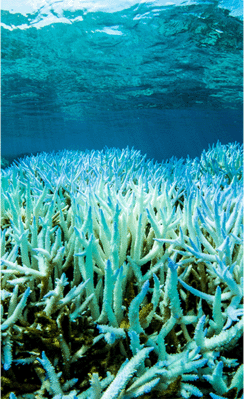 The Ocean Elders, which include ocean explorer Jean-Michel Cousteau, marine biologist Dr Sylvia Earle, businessman Richard Branson and Jordan’s Queen Noor, wrote that the mine would worsen damage to the Great Barrier Reef that Australia, as its custodian, had a global obligation to protect.
The group’s spokeswoman, marine biologist Earle, told ABC Radio that Australia should reject fossil fuels and hence the Carmichael mine, despite its advanced state of official approval.
“It’s never too late as long as the people and as long as rational individuals with power can change course, now that we know what we know,” Earle said.
A prime ministerial spokesman declined to comment on the letter.
One of the conditions of the NAIF approving a loan is that it must not be likely to “cause damage to the Commonwealth Government’s reputation or that of a relevant State or Territory government”.
Opponents of the mine are gearing up to argue that such global bad publicity should be grounds for refusal.
In her speech to the Cairns conference, Sharon Warburton said the NAIF must both reflect government policy and be independent of it.
“First NAIF must align with Commonwealth policy, and that is a whole-of-government position, remembering it is taxpayer funds we are deploying,” Warburton said. “Secondly – importantly – we cannot lend funds if all regulation at both a Commonwealth and state level are not in place.
“The other tremendously important parameter under which we operate is that it was set up to be an independent body making decisions independently of all outside influence.”
Given the attempts at influence being made on all sides of the argument, that may prove to be a challenge. https://www.thesaturdaypaper.com.au/news/economy/2017/06/24/final-chapter-adani-loan-deal/14982264004830
Australia’s nuclear lobby ramps up its propaganda
Surely it is no coincidence that, as the federal government – Resources Minister Matt Canavan – touts a further stage in the plan to park radioactive trash in rural South Australia, and the Liberals introduce a Bill  to expand Australian Nuclear Science and Technology’s activities – our favourite pro nuclear shill, Ben Heard, joins others to promote the nu clear industry – in Adelaide Thurs 29 June
- Ben Heard, Founder & Executive Director, Bright New World Ben is recognised as a leading voice for the use of nuclear technologies to address our most pressing global challenges
- Nick Byrne, Chief Financial Officer, Heathgate Resources, – Uranium mining company, owned by USA weapons maker General Atomics
- Kyra Reznikov, Special Council, Finlaysons Lawyers, part in a study tour in the footsteps of the Royal Commission to visit nuclear sites in Finland, France and the UK
Twists and turns in the saga of Adani loan deal for giant Carmichael coal mine
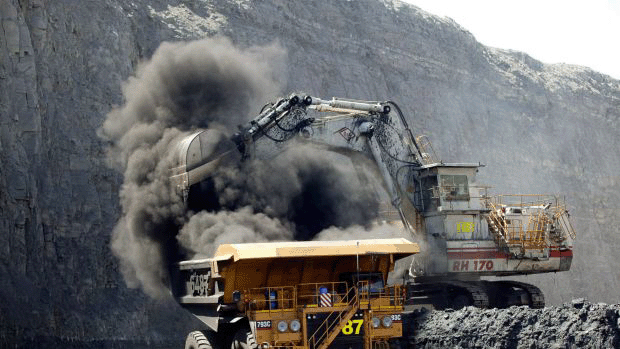 Final chapter in Adani loan deal, Karen Middleton , Saturday Paper, 24 June 17, While the dealings of the government’s Northern Australia Infrastructure Facility remain shrouded in secrecy, pressure mounts over funding for the Adani rail line. “…….Among those addressing the annual Developing Northern Australia conference, held this year in Cairns, was Sharon Warburton, the chairwoman of the somewhat opaque Northern Australia Infrastructure Facility, known as the NAIF.
The NAIF is a $5 billion-government-owned lender, set up to make concessionary loans to companies planning infrastructure projects in northern Australia that are of demonstrated public benefit and would not otherwise be able to proceed…..
The NAIF has not yet lent any money. But Warburton is hinting that it’s close to a decision on at least one application, the one that’s attracted the most controversy and has become an open secret: the request from Indian mining conglomerate Adani for $1 billion to fund a railway line to support its proposed Carmichael coalmine in Queensland’s Galilee Basin.
“We know there is a lot of interest in NAIF and the Adani rail project,” Warburton told the conference on Monday. “I can confirm we are in our due diligence phase on that project.”
That translates as the final stage of assessment, with three other applications apparently also reaching finality. But, Warburton said, she could not say any more about Adani than that…..
Greens senator Larissa Waters said clean coal was “a lie”.
“This is straight from the big tobacco playbook,” Waters said. “Remember ‘light’ cigarettes? To meet the commitment under the Paris Agreement to keep global warming to safe levels, we need to reach zero pollution in the electricity sector transitioning away from coal. Building more coal-fired power stations is simply incompatible with the science.”
Environmental activists continue to mount a strenuous campaign against any kind of coal-fired power and the Adani mine development in particular, on the grounds that it represents an investment in a backwards-looking energy source that will add to Australia’s greenhouse gas emissions and damage the Great Barrier Reef…….
The company has sent mixed messages on whether it needs the NAIF loan to proceed, initially saying it wasn’t essential and then saying it was, a distinction crucial to NAIF’s considerations.
Details of any NAIF decision will only be published after it has been finalised and within 30 days of being taken.
Larissa Waters and Labor senator Murray Watt succeeded last week in establishing a senate inquiry into the NAIF, and Waters is pushing to have Adani called before it.
In recent senate budget estimates committee hearings, Labor and the Greens attempted to extract information on the status of the NAIF’s deliberations in general and the fate of Adani’s bid in particular.
As part of its processes, the NAIF must consult with Infrastructure Australia on projects it proposes to fund.
Greens leader Richard Di Natale asked Infrastructure Australia chief executive Philip Davies whether it had received a submission on the Adani rail line, as per the requirement that it must assess all projects seeking more than $100 million.
Davies said it had not…..
….NAIF director Karla Way-McPhail, who is chief executive of two companies that service the mining industry.
Minister Matt Canavan confirmed to a senate estimates hearing this month that Way-McPhail, who has spoken out in support of opening up the Galilee, was a friend whom he had recommended for the board…..
NAIF chief executive Laurie Walker declined to tell the senate estimates committee whether Way-McPhail or any other NAIF director had recused themselves from any discussions on the grounds of a potential conflict of interest. Walker said that was “not information that I think is appropriate to disclose”.
She said more than six conflicts had been declared…..
The Greens’ main focus has been on the suitability of the loan applicant rather than the assessors.
Larissa Waters wants the government to insert a “suitable person” test into the NAIF’s process for assessing loan bids, arguing she believes it would rule out Adani.
The Greens also want the environmental history test strengthened within environmental law and are calling for Adani’s approvals for the Carmichael project to be reviewed on the basis of “revelations about their environmental and corporate history” in activities overseas.
Waters has produced a private member’s bill to reflect the concerns but the government is not obliged to bring it forward for a vote……
despite Adani having announced with flourish recently that it had taken the final decision to proceed, others argue there are still obstacles to be cleared.
Tim Buckley, a director at the Institute for Energy Economics and Financial Analysis, believes it is not viable without massive taxpayer subsidies.
“The green light that Adani made such a fuss about a couple of weeks ago was actually just a sham,” Buckley told The Saturday Paper.
He has written a paper suggesting “defer, delay and pray” appear to be the company’s unspoken watchwords……despite Adani having announced with flourish recently that it had taken the final decision to proceed, others argue there are still obstacles to be cleared….https://www.thesaturdaypaper.com.au/news/economy/2017/06/24/final-chapter-adani-loan-deal/14982264004830
28 June More renewable energy and climate news
National
CEFC invests in lithium mine to help make Australia storage powerhouse
CEFC makes first investment in mining operation, as Australia seeks to grab lion’s share of lithium supply to the global battery
http://reneweconomy.com.au/cefc-invests-lithium-mine-help-make-australia-storage-powerhouse-51043/
The Turnbull Government has introduced legislation to enable investment in coal despite the fact that there is just no such thing as ‘clean coal’.
https://independentaustralia.net/life/life-display/clean-coal-and-other-dirty-jokes,10445
Kim Shore
Community energy entrepreneurship could help deliver Finkel’s recommendations — especially distributed and independent power systems.
http://reneweconomy.com.au/finkel-mean-community-power-57280/ Abbott’s death-wish on industry: Freeze RET, ban wind, build coal
Giles Parkinson
On same day as major industrial project goes 100% renewables, Abbott calls for freeze on RET, ban on wind farms, and for government to build a new coal generator.
http://reneweconomy.com.au/abbotts-death-wish-on-industry-freeze-ret-ban-wind-build-coal-43357/
Victoria agribusiness turns to 196MW wind farm with 20MW storage
Victoria hydroponics vegetable producer turns to 100% renewable strategy for country’s biggest glass-house after nearly abandoning project due to gas prices. A 196MW wind farm and 20MW of battery storage will be built – separate to the Victoria battery storage tender.
http://reneweconomy.com.au/victoria-agribusiness-turns-to-196mw-wind-farm-with-20mw-storage-79170/
ACT moves closer to reaching renewable energy targets
http://www.canberratimes.com.au/act-news/new-windfarm-feeding-act-comes-online-20170627-gwzi4o.html
Granville Harbour wind farm strikes Hydro Tasmania deal to buy power
The people behind the $280-million Granville Harbour wind farm finally strike a deal to sell the power to Hydro Tasmania but still don’t have someone to build it.
http://www.abc.net.au/news/2017-06-27/granville-harbour-wind-farm-a-step-closer/8655952
West Coast wind farm ready to fly
ANOTHER wind farm in Tasmania’s West has moved a step closer to producing energy as the state reinforces its reputation as the nation’s renewable energy capital.
http://www.themercury.com.au/business/power-supply-deal-gives-wings-to-granville-harbour-wind-project/news-story/0389f7df6987ed186b790984b2169ea5
New South Wales largest solar energy farm to go ahead
 Sunraysia solar farm, largest in NSW, gets planning approval http://reneweconomy.com.au/sunraysia-solar-farm-largest-in-nsw-gets-planning-approval-64560/ By Giles Parkinson on 26 June 2017 The 200MW Sunraysia solar farm project near Balranald in western New South Wales has become the largest solar project in the state to receive planning approval.
Solar farm developer Maoneng, which has built the smaller 13MW Mugga Lane solar farm in the ACT (pictured below), said it received the planning approval last week nd hopes to begin construction by the end of the year and to be complete by the summer of 2018/19.
Maoneng says the solar farm will be located in one of the sunniest parts of NSW and is expected to produce around 530,000MWh of electricity a year. It is considering adding storage at a later date.
According to RenewEconomy data, a total of six solar farms have already begun construction in NSW – on top of the four already completed – and Sunraysia is one of at least 21 aspiring solar projects
“The development approval will be followed by further consultation with various stakeholders in developing detailed construction management plans,” Maoneng vice president Qiao Nan Han said in a statement
“This process will run in parallel to our current contractor selection process to ensure that all conditions of consent are correctly adhered to. We are looking to start construction by the end of the year with an anticipated construction period of 12 months.”
Most Australians want renewables to be primary energy source, survey finds
 Climate Institute survey points to overwhelming frustration with government’s inaction and lack of leadership on clean energy, Guardian, Elle Hunt, 27 June 17, Climate Institute survey points to overwhelming frustration with government’s inaction and lack of leadership on clean energy.
The vast majority of Australians want to see the country dramatically increase the use of renewable energy, a new survey has found, despite attempts by the federal government to characterise renewables as unreliable and expensive.
The Climate Institute’s national Climate of the Nation survey, published on Tuesday, pointed to frustration with the government’s inaction and lack of leadership on clean energy.
Of 2,660 respondents from across Australia, 71% agreed that climate change was occurring, continuing a trend established in the survey through 2014 and 2015. Two-thirds said they were highly concerned by its impacts, while 57% accepted that human activity was the main cause.
Ninety-six percent of respondents said they wanted the country’s primary energy source to be renewable, with support from either storage technologies (58%) or fossil fuels (38%). The phaseout of coal and replacement with clean energy received support from 59%, with 72% of those in favour calling on the government to drive the transition…..
the report found that people were generally in favour of the Paris agreement to curb global warming to 1.5-2C, and could not understand why the Australian government was not making stronger attempts to deliver on it.
Nine out of 10 people opposed walking away from the Paris deal as the US did on 1 June, while almost two-thirds (61%) said Australia should “work harder” to ensure it met its overall goals. https://www.theguardian.com/australia-news/2017/jun/27/most-australians-want-renewables-to-be-primary-energy-source-survey-finds
28 June renewable news Australia
Ketan Joshi
Reality is boring: new technology gets cheap, simple and, increasingly, fit for purpose. There’s nothing magical, mystical or fantastical about this.
http://reneweconomy.com.au/bills-become-centre-energy-discourse-galaxy-australia-24571/
South Australia
S.A. to announce storage winner, delays EST mechanism
Results for South Australia’s battery storage tender expected in next week, as state government delays introduction of energy security target and may drop it altogether. Meanwhile, Victoria reports ‘strong’ response for its battery storage tender.
http://reneweconomy.com.au/s-a-to-announce-storage-winner-delays-est-mechanism-90344/
Tasmania
Cabinet‘s call on West Coast wind farm deal
A power supply deal needed to underpin a $270 million West Coast wind farm development will be considered …
http://www.examiner.com.au/story/4752031/cabinets-call-on-west-coast-wind-farm-deal/?cs=5312
Australia’s Karina Lester at United Nations conference on a nuclear weapons ban treaty
 South Australian woman Karina Lester presents anti-nuclear speech to United Nations in New York http://www.adelaidenow.com.au/news/south-australia/south-australian-woman-karina-lester-presents-antinuclear-speech-to-united-nations-in-new-york/news-story/be7b9ecb4ae5e0f0c568908f117c4be9 Erin Jones, The AdvertiserJune 23, 2017
KARINA Lester’s family remembers the ground shaking and a black mist rolling towards them when nuclear tests were carried out at Emu Field, in the state’s Far North. The residents of Walatina community, 150km south of the explosion, were given no notice of the British tests, in 1953, but they would suffer from lifelong health affects.
Her father, Yankunytjatjara elder Yami Lester, became blind as a result of the testing, while others suffered skin infections, auto-immune diseases and severe vomiting.
Ms Lester shared the poignant story with world leaders in New York this month in a four minute address to the United Nations conference on a nuclear weapons ban treaty. “It was certainly a once-in-a-lifetime opportunity to present to the UN,” Ms Lester said. “It’s really important to be able to share these stories otherwise we forget. “We learn so much about world wars but we don’t hear the history of what happened here.”
The treaty talks have been supported by more than 120 countries, but Australia and those with nuclear powers, including Russia and the United States have boycotted the conference.
Countries which signed the treaty would be forbidden from developing or manufacturing nuclear weapons and they would need to get rid of any weapons they already possess.
“It was disappointing as an Australian person to speak about what happened in our own backyard, when your country wasn’t even in the room,” Ms Lester said.
“This is an opportunity for nations to get together and completely ban nuclear weapons, instead of spending trillions of dollars to improve their technology.”
Ms Lester, of North Plympton, also took part in sessions with Hiroshima survivors to further share stories of the how nuclear weapons affect humanity.
“You can’t help but be moved when you hear those stories from people who survived and what they remember from when the blast when off,” she said.
Talks on the global treaty to outlaw nuclear weapons conclude on July 7.
What tests go on at Woomera – ‘the largest land testing range in the world’ ?
What IS the army testing in the South Australian desert? Mysterious mushroom cloud erupts over historic Woomera range just after a drone flying near the secretive site was ‘forced to the ground’ http://www.dailymail.co.uk/news/article-4616616/Mystery-mushroom-cloud-erupts-Woomera-range.html By Bryant Hevesi For Daily Mail Australia
A man has captured image of ‘mushroom cloud’ near Lake Hart, South Australia Jason Wright said loud explosion occurred after his drone was forced to ground . The cloud formed over the Woomera Prohibited Area, used for military testing The prohibited area is known as ‘the largest land testing range in the world’
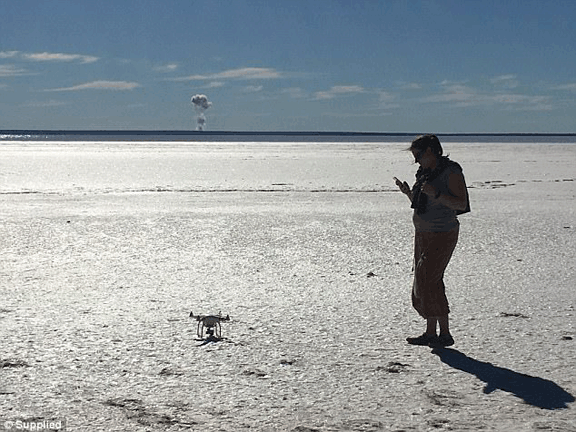
Jason Wright snapped images of the cloud shortly after he says his drone was forced to the ground prior to hearing a loud explosion while he was near the testing range.
Mr Wright told Daily Mail Australia he had stopped off along the Sturt Highway with his partner and children to see Lake Hart on Saturday when the unusual incident occurred. The experienced drone flyer had set-up his drone to take photos near the Lake Hart tourist rest area on the edge of the salt lake when he says it came down out of his control and made a hard landing.
Mr Wright, who lives in Coober Pedy, believes the drone’s GPS-based tracker may have been interfered with. About a minute after the drone fell, a ‘fireball’ erupted in the far distance, estimated to be as high as a 30-storey building, with the ‘mushroom cloud’ forming.
‘It was quite a spectacular explosion. It was very bright and there was a lot of heat in it,’ he said.
Mr Wright said despite criticisms he should not have been flying a drone in the area, he said the Civil Aviation Safety Authority’s ‘Can I fly there?’ app showed was able to have a drone up to 45 metres where he was standing.
The Woomera Prohibited Area ‘is used for the testing of war materiel’ and is ‘the largest land testing range in the world’.
Exclusion zones are in place at various locations within the prohibited area at different times of the year while military equipment is tested.
One is currently in place until June 30.
In a statement to Daily Mail Australia, the Department of Defence said: ‘No weapons were being tested; the activity was a demolition of war materiel’.
Defence did not carry out any action to impact the unmanned aircraft,’ the statement said.
‘Defence carries out operations for the testing of war materiel within the Woomera Prohibited Area. This includes capability being developed and tested for use for defence purposes. The photograph was the result of the demolition of war materiel.
‘An unauthorised person must obtain a permit or approval to enter the Woomera Prohibited Area.
‘In addition to the entry requirements, all unmanned aerial vehicle or remotely piloted aircraft operators must comply with the requirements of Part 101 of the Civil Aviation Safety Regulations 1998, this includes requirements associated with operating within a designated restricted area (for the purpose of regulation 6 of the Airspace Regulations 2007).
‘The Woomera Prohibited Area includes restricted areas for the purposes of the Airspace Regulations 2007 and these areas may be active during periods of defence testing activities.’
Great Barrier Reef headed for death, without a reduction in greenhouse gas emissions
UNESCO warns climate change means time is running out for World Heritage Great Barrier Reef http://www.couriermail.com.au/news/queensland/unesco-warns-climate-change-means-time-is-running-out-for-world-heritage-great-barrier-reef/news-story/4765a338156dd9e5b9b2c1d2b357d655?nk=ba26857f63080120cbd5fc74c94d3959-1498465693, Daryl Passmore, The Courier-Mail, June 25, 2017
THE Great Barrier Reef will be dead by the end of this century without a reduction in greenhouse gas emissions, a world-first study warns.
The threat to Australia’s natural wonder is detailed in the first global assessment of climate change impacts on coral, released yesterday by the United Nations Educational, Scientific and Cultural Organisation (UNESCO).
It comes just a month before the World Heritage Committee meets in Poland to consider the condition of the Great Barrier Reef and the effectiveness of a management plan introduced by the Queensland and federal governments to protect it.
“Soaring ocean temperatures in the past three years have subjected 21 of 29 World Heritage reefs to severe and/or repeated heat stress, and caused some of the worst bleaching ever observed at iconic sites like the Great Barrier Reef,’’ it says.
“The analysis predicts that all 29 coral-containing World Heritage sites would cease to exist as functioning coral reef ecosystems by the end of this century under a business-as-usual emissions scenario.”
The report calls on all countries with World Heritage coral reefs to act to reduce net greenhouse emissions to zero in order to save them.
On current trends, the assessment predicts, global warming will increase by 4.3C by 2100.
Under that scenario, the Great Barrier Reef would suffer severe coral bleaching twice a decade by 2035 – “a frequency that will rapidly kill most corals present and prevent successful reproduction necessary for recovery of corals.’’
The diversity of life on reefs has led to them being been dubbed the “rainforests of the sea”. Covering less than 0.1 per cent of the ocean floor, they host more than a quarter of all marine fish species.
Australian Marine Conservation Society spokeswoman Imogen Zethoven said the Great Barrier Reef and other World Heritage reefs were in grave danger from climate change, mainly driven by the burning of coal.
“Yet the Australian government appears hell-bent on making the problem worse by pushing ahead with Adani’s monstrous coal mine (planned for central Queensland), talking up a coal-fired power station next to the Great barrier Reef and failing to do its fair share of global pollution reduction,” she said.
“The majority of Australians believe the state of our reef is a national emergency, but the Australian government doesn’t care.”
Great Barrier Reef’s huge economic value to Australia
Great Barrier Reef ‘too big to fail’ at $56b, Deloitte Access Economics report says http://www.abc.net.au/news/2017-06-26/great-barrier-reef-valued-56b-deloitte/8649936, By Louisa Rebgetz The Great Barrier Reef has a total asset value of $56 billion and is “too big to fail”, according to a new report.
Key points:
- Deloitte Access Economics says GBR has calculated economic, social and iconic value of $56 billion
- Tourism is the biggest contributor to the total asset value making up $29 billion
- But tourist figures are down 50 per cent in the Whitsundays — operators say “this is as bad as it was during the GFC”
Deloitte Access Economics has calculated the economic, social and iconic value of the world heritage site in a report commissioned by the Great Barrier Reef Foundation.
Tourism is the biggest contributor to the total asset value making up $29 billion.
The Great Barrier Reef generates 64,000 jobs in Australia and contributes $6.4 billion dollars to the national economy, the report said.
It states the brand value, or Australians that have not yet visited the Reef but value knowing it exists, as $24 billion.
Recreational users including divers and boaters make up $3 billion.
The report does not include quantified estimates of the value traditional owners place on the Great Barrier Reef and it said governments should consider doing more to protect it.
Climate change remains biggest threat
It also references the back to back coral bleaching events which have devastated the reef and says climate change remains the most serious threat to the entire structure.
“We have already lost around 50 per cent of the corals on the GBR in the last 30 years. Severe changes in the ocean will see a continued decline ahead of us,” the report states.
“Today, our Reef is under threat like never before. Two consecutive years of global coral bleaching are unprecedented, while increasingly frequent extreme weather events and water quality issues continue to affect reef health,” said Dr John Schubert AO, Chair of the Great Barrier Reef Foundation.
Association of Marine Park Tourism Operators executive director Col McKenzie said the reef is crucial to the industry.
“We don’t have an industry without the Barrier Reef being in good condition.”
He said the negative coverage of the reef relating to the destruction caused by Cyclone Debbie earlier this year and the bleaching event is having an impact on visitor numbers.
Mr McKenzie said tourist figures are down 50 per cent in the Whitsundays and it is being felt along the Queensland coast.
Australian Greens REJECT Australia joining Generation IV Nuclear Energy Accession

 Dissenting Report – Australian Greens, Senator Sarah Hanson-Young Australian Greens Senator,
 Unchecked capacity and resourcing
Prohibited Technology
Lack of Procedural Fairness and over reliance on evidence from ANSTO
Australia’s accessibility to nuclear technology and standing on nuclear non-proliferation
Labor politicians give half-hearted support to Generation IV Nuclear Energy Systems
 MPs Michael Danby, Josh Wilson , Susan Templeman and Senator Jenny McAllister support the recommendation that binding treaty action be taken to enable further collaboration in relation to international research and development of Generation IV Nuclear Energy Systems.
At the same time, they note Labor’s policy :
1 This month
17 October, Free Public Talk on Nuclear Issues in South Australia
David Noonan will speak on public interest concerns over the new Roxby Downs Indenture Act 2026 on BHP copper-uranium mining and ore processing in SA, and on how AUKUS may face SA with a High-Level nuclear waste agenda.
Dr Jim Green will discuss international developments in the field of nuclear power including ‘small modular reactors’ and Generation 4 ‘advanced’ nuclear reactor concepts.


Help Aunty Sue Protect Her Land and Sacred Sites From Destructive Rocket Testing.
.

Australians deserve the truth
about
AUKUS – https://aukuspublicinquiry.com/

PETITION – To: Prime Minister Anthony Albanese and the Australian Labor Government

of the week – Australians for War Powers Reform (AWPR)
To see nuclear-related stories in greater depth and intensity

