From the doctors’ point of view, promoting Adani coal mine is just like promoting tobacco
He wrote that the Carmichael mine posed a “grave danger to public health both in Australia and globally”, given coalmines leading to a resurgence among mine workers of a chronic, irreversible and previously eradicated lung condition known as black lung disease.
The pollution from coal also causes childhood asthma, heart and lung disease, and some cancers, he added.
“Going ahead with it will send a terrible message to the world – [that] we in Australia really don’t care about the planet, or its inhabitants,” Faulkner wrote.
A number of high-profile doctors and researchers were signatories to Faulkner’s letter, including leading child and public health researcher Prof Fiona Stanley and the former chair of the Western Sydney Local Health District Board, Prof Stephen Leeder. Both are members of Doctors for the Environment Australia’s scientific advisory committee…….https://www.theguardian.com/environment/2017/jun/06/medical-experts-say-lending-to-adani-is-the-same-as-supporting-big-tobacco
Major commercial shopping sites in NSW and South Australia to go solar
In an ASX announcement on late last week, Queensland-based solar supplier ReNu Energy said it had entered an agreement with SCA Property to own and operate solar PV and embedded network systems across four shopping centres, for a period of 10 years with an additional three, five year options……..http://reneweconomy.com.au/four-shopping-centres-to-go-behind-the-meter-in-major-commercial-solar-deal-31391/
New South Wales Labor leader to debate NSW Nationals leader John Barilaro on nuclear power for the State
 Mayor welcomes Labor vs Nats debate on nuclear power, Northern Star 5th Jun 2017: LISMORE mayor Isaac Smith has said he welcomed any debate on energy, following the news that NSW Labor leader Luke Foley had accepted a challenge by the NSW Nationals leader John Barilaro to engage in a debate nuclear power in NSW. Mr Foley suggested a public forum in Lismore as the venue for the debate…..
LISMORE mayor Isaac Smith has said he welcomed any debate on energy, following the news that NSW Labor leader Luke Foley had accepted a challenge by the NSW Nationals leader John Barilaro to engage in a debate nuclear power in NSW.
Mr Foley suggested a public forum in Lismore as the venue for the debate. In the letter, Mr Foley described nuclear power as “both risky and irresponsible” and said:
“While I most profoundly disagree that nuclear power is a serious option for our State, I accept your call for a debate and propose that we hold a public debate in Lismore to discuss the issues at stake.
“Lismore would be an appropriate location for such a debate as it is one of the most environmentally conscious communities in NSW.
“I profoundly disagree with your support for nuclear power as there is no secure solution to the problem of safely managing toxic radioactive waste that can be lethal for the next 500,000 years.”
“Labor proposes that the debate would be moderated by an impartial local North Coast media identity with questions from the audience.”
Mr Secord (NSW Labor) said the Nationals needed a mandate from the community on nuclear power and the community had a right to know about their plans.
“It is time the Nationals leader John Barilaro explained his position to the community and the North Coast would provide the perfect venue to do so,” Mr Secord said.
“Sadly, there is a cloak of secrecy surrounding the decisions by the State Liberal-National Government and the community has a right to know about the government’s intentions on nuclear power.
“I am also on the record expressing my concerns about nuclear power. In March 2012, I spoke against the Mining Legislation Amendment (Uranium Exploration) Bill 2012 when the Liberals and Nationals overturned Labor’s long standing ban on uranium exploration in NSW.
“I believe that the North Coast views are clear. The community is against the expansion of nuclear power – and so is NSW Labor.
“Lismore would be a perfect location to debate this important issue. I look forward to helping to organise the debate between Mr Foley and Mr Barilaro.” https://www.northernstar.com.au/news/labor-accepts-nationals-challenge-to-debate-nuclea/3185820/
Another obstacle has arisen to the Adani coal rail line plan
Adani white elephant hits another snag as GVK teeters at brink https://www.michaelwest.com.au/adani-white-elephant-hits-another-snag-as-gvk-teeters-at-brink/June 4, 2017 Never was a white elephant so white … and elephantine.
Besides their empty cries that coal from Australia is good for the poor people of India, while delivering monumental “jobs and growth” at home, the shrinking coterie of ideologues and thermal coal apostles has hit another hurdle.
Part of the push for a rail line from the Galilee Basin to Abbot point has hung on the argument that this railway will be a “common-user facility”; that is, it will not only be used to freight Adani coal but also that of GVK. GVK is a smaller Indian company, teetering on the brink of obsolescence, which apparently still harbours hopes that its Alpha coal project in the Galilee will one day be developed.
GVK Hancock is a joint venture between GVK and Gina Rinehart’s Hancock Prospecting. It is partnering with rail group Aurizon in the southern end of the Galilee Basin while Adani’s Carmichael project lies to the north.
In another blow to those who wish the Galilee to be developed with thermal coal mines, GVK Power & Infrastructure announced on Friday it had sold its remaining 10 per cent stake in Bangalore International Airport to Fairfax India Holdings for $US200 million.
It seems GVK has been reduced to selling core assets to stay afloat. Net debt is now $US1.8 billion versus a market value of equity at $US145 million.
GVK has suffered six years of losses, last reporting a net loss of $US209 million for 2017 as its auditor raised questions as to whether it was a “going concern”. Meanwhile, Adani is still holding out for taxpayer subsidies in a bizarre negotiating process knowing full well that, in India, the cost of building new solar capacity is cheaper that new thermal coal.
Adani Power Management recently conceded that almost $US9 billion in existing thermal coal plants fired by imported coal at Mundra, Gujarat, are no longer viable. It referred to the prohibitively high costs of imported coal.
No doubt, while coal futures languish well below the spot price, rendering Adani’s hopes (if they really still harbour them without taxpayers backing the lot) futile, the Carmichael cheer-squad will gloss over these small details as somehow bad for the poor people of India while they continue to promote this most effulgent of white elephants.
It will never happen, nor should it.
Frydenberg’s carbon capture and storage – it’s a joke, really
 Frydenberg’s carbon capture pipe dream, The Saturday Paper Paul
  Bongiorno , 3 June 17
“…..it was with some bemusement that some of the old hacks who were on that trip greeted Energy and Environment Minister Josh Frydenberg’s announcement that he would remove the legislative prohibition on the Clean Energy Finance Corporation (CEFC) to allow it to support investment in carbon capture and storage (CCS). The very optimistic minister said such technology could reduce emissions by up to 90 per cent.
This week Frydenberg pointed out that government has invested $590 million in CCS and said it is now being successfully employed in three overseas power plants. But a closer look shows the lessons learnt from those plants mean its use has already peaked. The proponents of these plants are on the record stating they won’t be investing in any more. Renewables entrepreneur Simon Holmes à Court told the ABC that exponential cost blowouts and disappointing results are the rule.
One plant visited by the energy minister – Petra Nova in Texas – cost $US1 billion. It’s touted as the world’s largest and most successful operation, yet it captures only about 6 per cent of the output of its adjacent power station. That’s “an incredibly low bang for buck”, concludes Holmes à Court. Another CCS plant targeted to cost $US2 billion will open three years late and with an incredible final bill of $US7.5 billion.
Holmes à Court agrees with Frydenberg that CCS has a role to play in cutting emissions in industrial processes such as cement or steel production. Carbon can be captured in these cases for about $15 to $30 a tonne. “So with a healthy carbon price, those projects make sense,” he says. And there’s the rub. The very government wanting to be a champion of CCS for industry is denying it any incentive to spend a cent pursuing it. It’s commercially cheaper to keep polluting. Industry may get away with that but finance markets are now pricing climate change into lending for major energy projects. Bloomberg New Energy Finance earlier this year costed CCS coal at $352 a megawatt hour, compared with wind and solar at between $61 and $140 megawatts an hour.
It’s little wonder that experts can’t see private industry investing in new coal-fired power stations without substantial government input. But none of this seems to deter the resources and Northern Australia minister, the Nationals’ Matt Canavan……..https://www.thesaturdaypaper.com.au/opinion/topic/2017/06/03/frydenbergs-carbon-capture-pipe-dream/14964120004723
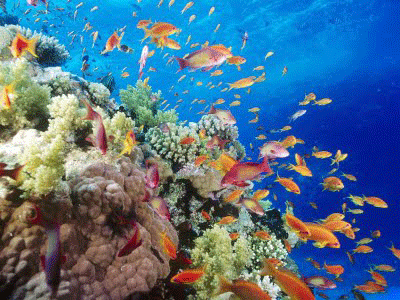
Calls to cut support for coal mines after latest Great Barrier Reef report
 Greens believe Great Barrier Reef future at crucial crossroads after new report released, Brisbane Times Toby Crockford
 JUNE 3 2017 The Greens have issued an ultimatum to the state and federal governments after the latest report expressed “serious concern” regarding the Great Barrier Reef rescue plan.UNESCO, which advises the World Heritage Committee, said on Saturday that key targets in the Reef 2050 plan “are not expected to be achieved” and urged Australia “to accelerate efforts”. In response to the fresh concerns, Queensland Greens Senator Larissa Waters launched a scathing attack on the state and federal governments.
“Meanwhile, Queensland Labor and Turnbull roll out the red carpet and public money for Adani for their deadly mega-coal mine,” Senator Waters said.
“As many scientists have said, our governments must choose between new coal or the reef.
“Will the two old parties back the 70,000 people with reef jobs? Or will they pay back the millions in donations from the mining industry, sign the reef’s death warrant and continue to back Adani?”
Queensland Environment Minister Steven Miles admitted progress had been slow in implemented measures outlined in the reef rescue plan, particularly towards 2018 targets.
In a report released in Paris on Saturday, UNESCO praised progress in the inception and initial implementation of the rescue plan but said reef rescue work “must move faster”.
“Progress towards achieving water quality targets has been slow and the most immediate water quality targets … are not expected to be achieved within the foreseen time frame,” the report said.
A previous report revealed coral bleaching at the Great barrier Reef in 2016 was even worse than expected. The most severe bleaching was found north of Port Douglas where an estimated 70 per cent of shallow water corals had died. http://www.brisbanetimes.com.au/queensland/greens-believe-great-barrier-reef-future-at-crucial-crossroads-after-new-report-released-20170603-gwjrgv.html
In sunny Broome, residents are fed up with restrictions on accessing solar power
Broome residents tire of cap on solar power installations http://www.abc.net.au/news/2017-06-03/broome-residents-tire-of-waiting-for-solar/8584060
Key points
- Horizon Power only allows 10 per cent of the town’s power to come from solar due to issues with grid fluctuations
- This leaves some residents unable to install a solar system that connects to the grid
- Horizon is trialling battery storage technology in other WA towns and hopes to expand this to Broome
State-owned energy utility Horizon Power allows just 10 per cent of the town’s power to be generated from solar to protect the grid from fluctuations during periods of high and low light.
Small business owner Cameron White has been trying to switch to solar for two years in a bid to reduce his power bill but said he has been blocked at every turn.
“We’re in the sunniest place in Australia, probably, but we can’t use it,” he said.
Mr White said the high cost of electricity in regional areas, combined with the inability to access solar was putting added financial stress on homes and businesses already suffering in a post-mining boom era.
“Businesses in town are struggling at the moment, including myself, and you know these power bills [are] enough to tip people over the edge,” he said.
Horizon Power acknowledges the problem and is currently trialling battery-supported solar systems in the WA towns of Carnarvon and Onslow which can store the power to deal with the fluctuations in supply.
Spokesman Frank Tudor said Horizon ultimately wanted regional towns to generate half their energy from the sun. “Broome will be part of the trials that we are looking at across all of our different systems, if that proves worthwhile then we will gradually roll it out,” he said.
But Mr White said he was not going to wait any longer, opting instead to disconnect from the grid and rely solely on the sun. “I’m going it alone, I’m determined to do it myself,” he said.
Australians’ opposition to subsidising Adano coal project – ranges from 70 to 86 per cent
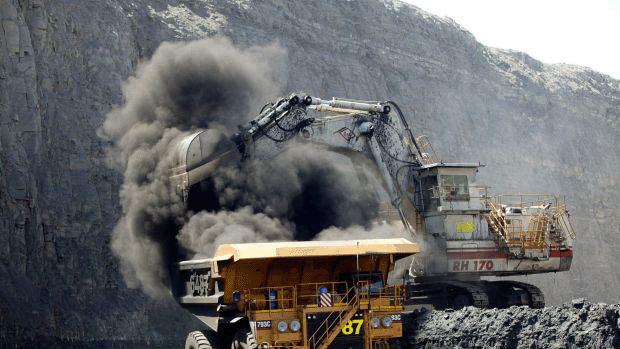 Frydenberg’s carbon capture pipe dream, The Saturday Paper Paul Bongiorno , 3 June 17 “….. no matter what voters think of the [Adani coal] project, they are overwhelmingly against any taxpayer funds bankrolling the Indian billionaire Gautam Adani. Research by the advocacy group GetUp! in marginal seats in Queensland and elsewhere has found resolute opposition to any government loan. Paul Oosting from GetUp! says opposition ranges from 70 to 86 per cent depending on the seat. He has mobilised dozens of his 350,000 members to make 50,000 scripted phone calls into marginal seats in Queensland and around the nation.
It sort of worked with the Palaszczuk Labor government. Much to the delight of Adani, the premier organised a royalties pause. The miner will be given 60 years to pay the tax, although he will attract an interest charge for any delay. That puts all the risk on taxpayers if the project fails to perform as promised or Adani’s labyrinthine company structure for the mine collapses. With some companies registered in the Cayman Islands the existence of a lucrative escape hatch for Adani cannot be ruled out.
Ominously, Indian newspapers are reporting Adani is under pressure to sell its Australian assets. The Reserve Bank of India is worried about a looming debt crisis and is pressuring banks to demand repayment of loans worth billions of dollars. The influential Hindu newspaper noted that the Standard Chartered Bank recalled loans of $2.5 billion from Adani and that “global lenders have backed out from funding the $US10 billion coalmine development project. State Bank of India also declined to offer a loan despite signing an MoU [memorandum of understanding] to fund the group with $1 billion”. What all of this means for Adani’s bid to get a concessional billion-dollar loan from the federal government’s Northern Australia Infrastructure Facility is not yet known. It should make it highly unlikely, but given the zealotry of Canavan and his leader Barnaby Joyce for the project such concerns are a mere bagatelle.
Again we have seen Turnbull’s need for pragmatic appeasement of the conservatives in his ranks undermine his brand on the environment and climate change. It probably goes a long way to explain why again in this week’s opinion polls he is still deep in negative territory for approval of his performance and Labor’s lead looks entrenched.
The resignation of Dr Peter Hendy from the inner sanctum of the prime minister’s offices is being read by some in the Liberal Party as a sign the government’s days are numbered. The economist, long-time Liberal apparatchik and former MP is planning to hang up his shingle as a consultant. “He wants to cash in on his contacts while they are still in power,” was one explanation. Another was: “Peter’s been around a long time and knows when a vote is cemented in.”
On that view Hendy is not waiting to see if the handful of pro-Adani seats in Queensland will be enough to save the federal government. Its chances are up in smoke and out the chimney – like the Beijing carbon capture pilot project. https://www.thesaturdaypaper.com.au/opinion/topic/2017/06/03/frydenbergs-carbon-capture-pipe-dream/14964120004723
Australia’s diplomats called “weasels” on Australia’s stand against nuclear weapons ban treaty
Anti-nuclear campaigners are scathing.
“Australia’s disruptive behaviour at the working group only served to isolate us from the vast majority of nations who are now working to ban nuclear weapons at the United Nations,” said Gem Romuld from ICAN.
“Australia’s moves backfired when the working group voted overwhelmingly in support of a ban; it was a wake-up call for DFAT.
“Australia is standing with the Trump administration and clinging to the dangerous concept that these weapons of mass destruction make us safe
 Australia’s stance on the nuclear weapons ban treaty – and why our diplomats were labelled ‘weasels’, ABC News By political reporter Stephen Dziedzic 3 June 17 Scott Ludlam ……….”Weasels. They called us weasels.”Did other delegates refer to the Australian delegates as weasels?”
It was an unusual question, but officials from the Department of Foreign Affairs and Trade (DFAT) sitting opposite the Senator did not look confused. They knew exactly what he was talking about.
And the exchange that followed briefly illuminated the most recent global negotiations to end nuclear weapons — and Australia’s role in them.
What’s the new agreement?Right now, more than 120 nations are trying to introduce a ban on nuclear weapons. A United Nations panel has now released a draft treaty. States who sign it would be forbidden from developing or manufacturing nuclear weapons. They would also have to get rid of any weapons they already possess.
The treaty’s champions argue the proliferation of nuclear weapons is an existential threat to humankind. And they say the woeful pace of global disarmament proves there is a compelling need for a new agreement that would exert moral pressure on states to disarm.
But there are plenty of problems.
First, none of the nine nuclear powers — including the US, Russia, China and the UK — support the new treaty.
Neither does Australia. The Federal Government has refused to take part in the treaty negotiations.
Why does Australia oppose the ban treaty? First, Australia argues that the treaty ignores geopolitical reality. Hardheads in the Government say that while everyone would like to see a world without nuclear weapons, the strategic environment is actually becoming more volatile and dangerous.They argue the US nuclear umbrella provides vital deterrence, and protects Australia.
For example, DFAT talking points obtained by the International Campaign to Abolish Nuclear Weapons (ICAN) say Australia “must be realistic about the environment in which we operate — North Korean provocations and nuclear tests are a case in point”……….
Why were we called the weasels? Continue reading
Donald Trump is more honest about climate inaction than Malcolm Turnbull is
 Brisbane Times Richard Denniss, 2 June 17 There is a depressing honesty about Donald Trump’s announcement that the United States will withdraw from the Paris climate agreement. It stands in stark contrast to the hypocrisy of Malcolm Turnbull’s big talk on climate change, which is accompanied by a $1 billion subsidy for the enormous new Adani coal mine. At least Trump is doing what he said he would do.
Trump shows his contempt for the world’s problems by withdrawing from a global agreement on the basis that he doesn’t think it’s in his nation’s interest, while Turnbull shows his contempt by remaining in that same agreement while funding the construction of a new coal mine that will still operate in 2080. Which is worse?
The “business case” for Turnbull’s coal line from the Adani mine to the Great Barrier Reef is that five other major coal mines will also be built in the Galilee basin. In the words of Resources Minister Matt Canavan, “what I’d expect to see, with the federal government wanting to open the Galilee basin, is that the rail line’s open access that other mines can use it and that we can, by building, connecting up a new coal basin in our country, create wealth, not just in one individual project but right across the board, that’s what we’d like to see”. Combined with the Adani mine, the other mines Canavan referred to would together produce 300 million tonnes of coal a year.
To put Turnbull’s coal expansion plans into context, Australia is already the world’s largest coal exporter. At 388 million tonnes in 2015-16, we have a larger share of the traded coal market than Saudi Arabia has of the world oil market. And the Australian government hopes to facilitate a doubling of our coal exports.
Think about that. Australia is a signatory to an international agreement to reduce greenhouse gas emissions to zero in 33 years’ time. And Turnbull wants to subsidise the opening-up of a new coal basin in the hope that it will export an extra 300 million tonnes of coal a year. …….http://www.brisbanetimes.com.au/comment/donald-trump-is-more-honest-about-climate-inaction-than-malcolm-turnbull-20170602-gwj4nj.html
Aboriginal Referendum Council and The ABC’s Q and A betrayal of the Aboriginal cause.
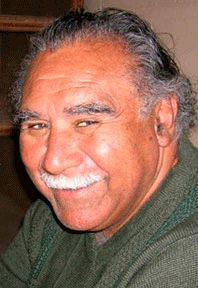
 Perfecting Trickery: Referendum Council #noconsent to Recognition http://www.sovereignunion.mobi/content/perfecting-trickery-referendum-council“On his return from Uluru, Ghillar, Michael Anderson, Convenor of the Sovereign Union, last surviving member of the founding four of the Aboriginal Embassy and Head of State of the Euahlayi Peoples Republic, details the rigged processes of the Referendum Council’s National Convention and the subsequent media:
““I was absolutely shocked and horrified at the disjointed discussion that occurred on ABC TV Q&A last night ( 29 May 2017) from Parliament House, Canberra.
“In my opinion the conclusions that occurred at the Referendum Council’s National convention at Uluru were totally betrayed by the Q&A panel.
“Having been permitted to sit as an observer in the main National Convention of the Referendum Council at Yulara near Uluru, I was privy to observe the proceedings and I sat through the ‘Synthesis’ of the Regional Dialogues and what they called the breakout workshops as well, where the key topics were ‘The Voice’, ‘Treaty’, ‘Strategy’.
“In respect of the Synthesis (summary) of the Dialogues it was very clear that nationally the specially selected people by the Land Councils (invitation-only delegates) independently concluded that is must be made clear that First Nations sovereignty was never ceded.
“The next key point was the fact the people, from around this island continent, who attended these Regional Dialogues, were emphatic that they did not want a minimalist approach to constitutional reform and they did not want it to be symbolic. They wanted something substantive that would effect real and positive change. It was very clear that they did not just want to remove Section 51(26) the Race Power, because they did not want anything in the constitution that could be used in a manner that
would be detrimental to First Nations Peoples exercising their rights and their right to be self-determining.
 “More importantly, the presentation in the Synthesis/Summary does suggest that an overwhelming majority of people, who attended these Regional Dialogues, were determined that, because sovereignty was never ceded, that Treaties should be made with Sovereign First Nations throughout the continent and they determined that our ancient tapestry of languages and cultures cannot be destroyed and lost forever to our future generations. …
“Despite all the rigging and wrongdoings, the consensus that was finalised was:
1) Sovereignty was never ceded;
2) Rejection of being ‘recognised’ in the constitution;
3) No support a minimalist approach to constitutional reform;
4) Agreement that a Treaty/Makaratta Commission be established to develop a national framework going forward
that would permit each Sovereign Nation State to negotiate their own respective Treaty;
5) Removal of section 51 (26) from the constitution;
6) Establishment of Truth and Justice Commission;
7) Resolved also that the constitution of Australia should have a Bill of Rights; and
8) Establishment of an elected Voice to the parliament and to ensure that this Voice has constitutional backing. …
Adani will profit from APPROVAL for coal mine expansion, even if the project does not go ahead
Malcolm Turnbull is considering spending almost $1 billion of his $5 billion Northern Australia Infrastructure Fund on one project: a loan to a company controlled by the Adani family to enable it to build a 400 kilometre railway to get the coal to a deep water port near the Great Barrier Reef. By definition, such a loan wouldn’t be needed if the railway was commercially viable, which raises a disturbing question: if the railway isn’t viable, what about the mines it would rely on for business?
“One of the most profitable activities in Australia is the magical act of getting things rezoned, and that’s just as true for the mining industry.”
If Adani gets environmental approvals and a licence to mine, the value of its asset will have soared whether or not it actually mines. It could even onsell the asset without mining.
Even better, if it did onsell the project, it could maintain ownership of the railway, without which the next owners couldn’t get the coal to port.
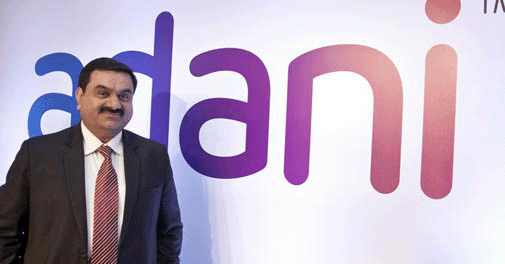 Patriarch Gautam Adani has put ownership of the railway (the one that would be financed by the Commonwealth) into a separate private company owned by the family in the Cayman Islands. Should the publicly listed company that owns the mine go bust and have to sell, the mine’s new owners would still have to keep paying him.
Mine games. Why Adani is banking on the unbankable http://www.brisbanetimes.com.au/comment/mine-games-why-adani-is-banking-on-the-unbankable-20170531-gwgzvb.html Peter Martin 2 June 17,
You would think Adani would have gone away by now.
The giant Indian conglomerate can’t get a loan for its proposed $22 billion Queensland coal mine from an Australian bank, it can’t seem to get one from an Indian bank, the mine would be so big it would depress the world coal price, and the Indian government plans to phase out coal imports altogether.
In documents released to Fairfax Media under freedom of information laws, the Queensland Treasury as good as described the project as “unbankable”.
What is being proposed is breathtaking: a series of coal mines 60 kilometres long. If scrunched together they would be 40 kilometres long and 10 kilometres wide – an area bigger than Paris, much bigger than Sydney Harbour.
It would be the biggest coal mine in Australia and the biggest export coal mine in the world. It and the neighbours in the Galilee Basin that would open up when the railway went through would double our export capacity. It’s more than important enough for the Australian government to take a serious interest in. Continue reading
Ross Garnaut – green energy will be win-win for South Australia
 Ross Garnaut: SA has little choice over green energy and can be a low carbon superpower http://www.adelaidenow.com.au/news/opinion/ross-garnaut-sa-has-little-choice-over-green-energy-and-can-be-a-low-carbon-superpower/news-story/1de5289d11018f29eefa271b913b118f Ross Garnaut, The Advertiser June 1, 2017 OF the many challenges facing South Australia, it’s hard not to look past how the state plans to deal with a more secure electricity supply.
Queensland Land Court recommends scrapping Acland coal mine expansion
 Acland coal mine: Queensland Land Court recommends scrapping expansion, ABC News, By Andrew Kos, 31 May 17, Landholders and farmers in the Darling Downs are claiming a big win following a Land Court decision recommending the $900 million Stage 3 expansion of the New Acland Coal Mine be scrapped.
More than 60 property owners have been fighting the New Hope Group’s proposed project since the State Government indicated support for it in 2012.
The expansion, which would see the mine produce coal for a further decade, was granted Federal Government approval earlier this year.
Opponents took the matter to the Land Court last year arguing the mine expansion would damage groundwater levels, air quality and prime agricultural land.
The case became the longest in Land Court history, with more than 100 days of hearings and 2,000 exhibits.
In a judgment today, the court recommended the Mining Leases and Environmental Authority amendment for Stage 3 not be granted for the proposed expansion…..
Government could still permit project
In a statement to the ASX, the New Hope Group said it remained committed to delivering the project and would actively progress it through the final stages of approval…… The State Government is the final decision maker for the project and will need to decide whether to follow the court’s recommendations or approve it regardless.
A spokeswoman said the Government was examining the court’s judgment. http://www.abc.net.au/news/2017-05-31/acland-mine-expansion-should-be-scrapped,-court-rules/8576886
Adani to make $billions out of rail line, NOT coal mine – Pauline Hanson is right
Pauline Hanson has told the Turnbull government to build the billion-dollar Galilee Basin coal line itself, announcing she would oppose a “foreign multi-national” from owning the crucial infrastructure.The rail corridor, which would run from the central Queensland coal basin to the Abbot Point port on the state’s coast, has been deemed a key feature of Indian mining company Adani moving forward with its project.
But the One Nation leader, who has maintained support for the mining project itself, said she had asked Resources Minister Matt Canavan to build the line “as a piece of national infrastructure”.
“This approved rail corridor will eventually connect to the national line, so it should be owned by the Australian people, not a foreign multi-national,” she said in a statement.
“This railway could make the Australian people hundreds of millions of dollars a year. Adani are here to build a coal mine, not a gold mine.
“This is a railroad that should belong to the people. We should build it, own it, control it and make sure no future government can give it away.”
The rail corridor is seen as a crucial piece of infrastructure in opening the Galilee Basin up to mining, with both GVK Hancock and Clive Palmer’s Waratah Coal having earmarked projects in the region……http://www.theage.com.au/federal-politics/political-news/pauline-hanson-says-no-to-adani-train-line-20170601-gwia3r.html
1 This month
17 October, Free Public Talk on Nuclear Issues in South Australia
David Noonan will speak on public interest concerns over the new Roxby Downs Indenture Act 2026 on BHP copper-uranium mining and ore processing in SA, and on how AUKUS may face SA with a High-Level nuclear waste agenda.
Dr Jim Green will discuss international developments in the field of nuclear power including ‘small modular reactors’ and Generation 4 ‘advanced’ nuclear reactor concepts.


Help Aunty Sue Protect Her Land and Sacred Sites From Destructive Rocket Testing.
.

Australians deserve the truth
about
AUKUS – https://aukuspublicinquiry.com/

PETITION – To: Prime Minister Anthony Albanese and the Australian Labor Government

of the week – Australians for War Powers Reform (AWPR)
To see nuclear-related stories in greater depth and intensity

