NT aboriginal community to get 1MW solar plant, cut reliance on diesel, REneweconomy, By Sophie Vorrath on 1 June 2017 One Step Off The Grid
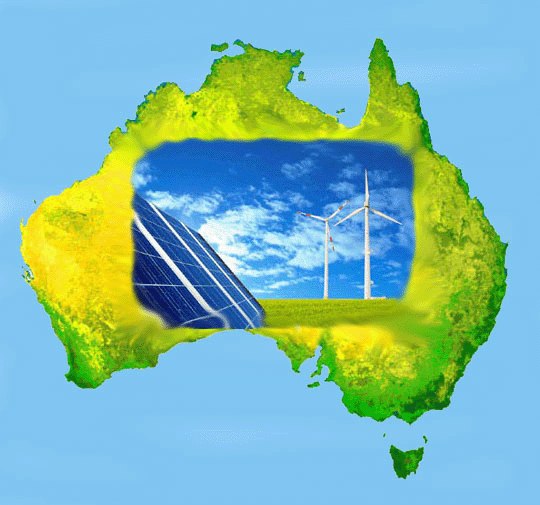
A remote Aboriginal community south of Darwin in the Northern Territory will soon be powered mostly by the sun, thanks to a hybrid solar and diesel generation plant being built as part of the Territory government’s SETuP program.
The Daly River project will see the construction of a 1MW solar facility, that is expected to provide 100 per cent of the local Nauiyu community’s energy needs during the day, relegating the diesel generators for use only at night and as back-up…….
…to read the full story on One Step Off The Grid, click here
Regulators’ wake up call: Fossil fuel majors are gaming markets, REneweconomy, By Giles Parkinson on 1 June 2017 Australian regulators are finally waking up to the grim consequences of Australia’s archaic energy market design, and the fallout from the reckless and self-serving opposition to carbon pricing and renewable energy targets by the industry incumbents.
The Australian Energy Regulator’s latest State of the Energy Market report paints a frightening picture of how prices are controlled, manipulated and thrust into orbit by the cynical bidding practices of the major fossil fuel generators.
Consumers – both households and business – are paying the price, and they are faced with a double whammy, because as the Queensland Competition Regulator notes in its latest pricing report, it is the lack of renewable energy in the state which is allowing the coal and gas generators to set high prices.
This last bit of information is highly ironic, because the QCA, under the then leadership of Malcolm Roberts (not the Senator, but the current head of the main oil and gas lobby APPEA) was among those who used to rail against solar feed in tariffs and the like.
The then Queensland energy minister Mark McArdle argued that renewable energy would cause energy prices to surge. In fact, as anyone who was paying attention would have predicted, the opposite has turned out to be true……..
The market power of major fossil fuel generators and their bidding practices have been highlighted in the AER’s State of the Energy Market report released this week, and is yet more confirmation about the poor design of market rules which leaves the regulator powerless to act.
The report acknowledges that the problem stems largely from the decision to allow generators and retailers to form so-called “gentailers”.
This has helped those big companies protect their own revenues through hedging, but also create an oligopoly that the AER says has posed a “potential barrier to entry” to new generators and retailers.
AGL Energy, Origin Energy and EnergyAustralia, it notes, supply 70 per cent of retail electricity customers in the NEM and have expanded their market share in generation capacity from 15 per cent in 2009 to 48 per cent in 2017. In some states, control of generation lies in the hands of just two or three major players.
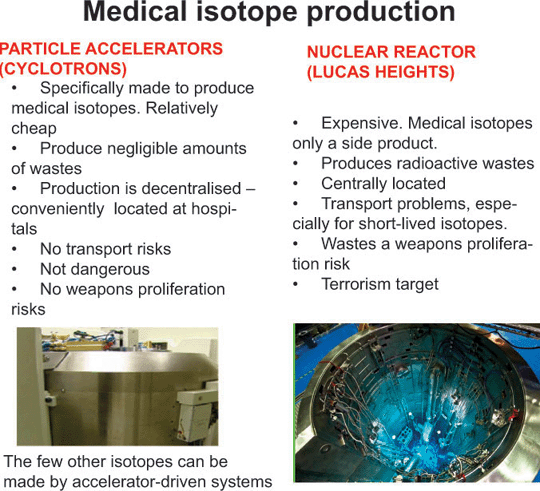
Note – from MAPW – While cyclotron production of technetium is commercially licensed in Canada and undergoing clinical trials, it is still a while (?2years???) before it is a viable option for this particular isotope . And there are issues with the potentially limited and costly supply of the precursor materials. IN addition the heavily subsidised Australian isotopes will probably undercut the market (Similar to subsidising coal against the early phases of renewables-sigh).
But we can urge the government to partner in cyclotron research. And stop ramping up massively subsidised exports of Molybdenum which is used to make technetium isotopes.
Technetium 99 is the principal radioactive diagnostic isotope used in Australian medical procedures (80% IN 2015-16). This is currently supplied by ANSTO through production of Molybdenum 99 at the Lucas heights OPAL reactor – but Te-99 can also be produced by particle accelerators or cyclotrons which ANSTO is also capable of conducting – in fact it does so for other radioactive isotopes such as Fluorine 18, Carbon 15 & Oxygen 11.
Of the Mo 99 produced by the ANSTO OPAL reactor, currently only 28% is used in Australia whilst 72% is exported internationally. With the expansion of the Mo 99 production by a factor of at least 400% by the end of 2018 & Australia’s demand remaining static thru more efficient use of Te 99.
This means that whilst the nuclear waste will quadruple, the percentage of waste resulting from Australian consumption will drop to about 8%.
Proponents of the dump proclaim loudly that the Wallerberdina/Kimba dumps are needed to store Australian medical waste.
WHAT THEY FAIL TO MENTION IS THAT 90% WILL BE FROM INTERNATIONAL WASTE – NOR DO THEY ACKNOWLEDGE THAT THE SAME MEDICAL BENEFIT CAN BE ACHIEVED WITHOUT PRODUCING ANY RADIOACTIVE WASTE AT ALL.
ANSTO barely breaks even with it’s exports, & they are ramping up production whilst global demand is static & new overseas production facilities are about to come on-line.
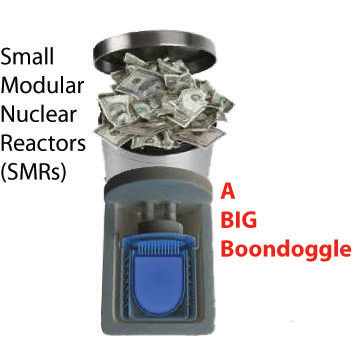
There isn’t the slightest chance that SMRs will fulfil the ambition of making nuclear power “radically cheaper” unless and until a manufacturing supply chain is mass producing SMRs for a mass market.
As things stand, no country, company or utility has any intention of betting billions on building an SMR supply chain. In the absence of a mass supply chain, SMRs will be expensive curiosities.
Ben Heard thinks Australia should take the lead building his preferred version of Generation IV fast neutron reactors.
So Australia ‒ a country with virtually no relevant expertise and even less experience ‒ should take the lead developing Generation IV reactors despite the fact that global nuclear industry giants face crippling debts and possible bankruptcy due to cost overruns building a handful of conventional reactors?
That proposition is beyond stupid and it was even rejected by the (stridently pro-nuclear) SA Nuclear Fuel Cycle Royal Commission last year.
Australia’s nuclear energy debate reaches Peak Idiocy this week with the visit of Jessica Lovering from the U.S. Breakthrough Institute. Lovering has and will be speaking at public events alongside Australian university student Ben Heard.
Both the Breakthrough Institute and Heard’s ‘Bright New World’ present themselves as progressive environment groups but they are single-issue, pro-nuclear lobby groups with little interest in broader environmental issues. Australia’s environment groups ‒ i.e. real environment groups ‒ are united in our opposition to nuclear power.
Real environment groups celebrate the spectacular growth of renewables and the spectacular cost reductions whereas pro-nuclear lobby groups, including Lovering’s Breakthrough Institute and Heard’s Bright New World, are on a never-ending campaign against renewables. Global renewable energy capacity has doubled over the past decade and current renewable capacity of 2,006 gigawatts (GW) is 5.1 times greater than nuclear power capacity of 392 GW (including idle reactors in Japan). Actual electricity generation from renewables (23.5% of global generation) is more than double that from nuclear power (10.7%) and the gap is widening every day.
Lovering’s opinion piece in The Australianon Monday fails to note that her speaking trip is sponsored by the Minerals Council of Australia. Likewise, Heard has also been paid as a uranium industry consultant.
Lovering brings a suitcase full of alternative facts to Australia. The most egregious is that the nuclear industry is in the middle of some sort of renaissance. Even her own institute contradicts this, Continue reading →
Did you wonder why the Australian government chose to buy the much more expensive French submarines, rather than the cheaper and probably more suitable German ones?
Well, what’s $50 billion from the public purse matter, if your government, kow-towing as always, to ANSTO and the nuclear lobby, can arrange to buy submarines that are designed as nuclear submarines, but have them “not nuclear” at the start, and then later transforfm them back to nuclear.
Adani: director on board that will consider $900m loan says project is ‘vital’
Karla Way-McPhail, who runs mining labour and equipment companies, will not say whether she will recuse herself from Carmichael decision, Guardian, Joshua Robertson, 31 May 17, A director of the independent board due to provide recommendations regarding a $900m taxpayer loan to Adani publicly declared she was “very supportive” of its “vital” coal project, a day after she was accused of allowing a perceived conflict of interest to develop.
Karla Way-McPhail, who runs mining labour and equipment hire companies, last week told a central Queensland newspaper that Adani’s Carmichael mine project would be “a huge boost” for the region.
“We’re very supportive and have been in the industry over 20 years and think it’s vital to the economic platform of central Queensland and we think we really need to see the Galilee [basin] opened,” she told the Morning Bulletin in Rockhampton in a story published last Friday.
She is the chief executive of the coalmine labour and machinery supplier Undamine Industries, which says on its website it is well-placed to work with miners in the Galilee. The Adani proposal would open up the Galilee for development.
“Our Central Queensland base allows us to effectively serve areas such as the Galilee Basin and beyond,” it says.
Final approval for a Naif loan rests with the minister for Northern Australia, Matthew Canavan, and Naif has said its board members are aware of their conflict-of-interest obligations. It is unclear whether Way-McPhail plans to recuse herself from any decisions.
The Morning Bulletin article did not refer to Way-McPhail’s $56,150-a-year role on the board.
A day before the article appeared, Environmental Justice Australia had written to Naif raising questions about Way-McPhail’s alleged conflict of interest as the chief executive of Undamine and Coal Train Australia, a mining training company.
“There is a perception that Ms Way-McPhail could gain an advantage if either project were to proceed,” EJA said.
Asked by Guardian Australia if her public support for the Adani mine compromised perceptions of her independence, Way-McPhail said: “Due to confidentiality and privacy obligations I am unable to make comment or respond.”
A Naif official did not answer EJA questions about whether Way-McPhail had received any internal information about the Adani proposal, whether she had been present for board discussions or had been included in other correspondence about them. The same was true for questions about Aurizon, which has also approached Naif with a loan proposal to support the construction of a rail line to open up thermal coalmining in the Galilee basin.
Adani’s proposed $900m Naif loan is to build a line connecting its Abbot Point coal port, near Bowen, to its Carmichael mine, hundreds of kilometres inland. The terms of both proposed loans are unknown.
Naif would not say whether Way-McPhail planned to recuse herself from any decision on Adani or Aurizon.
Many ranger groups welcomed the $15 million towards new IPAs, but it left a question in the air about the funding for existing IPAs.
Patrick O’Leary, from the Pew Charitable Trust, one of the key supporting organisations for the Country Needs People campaign, told local radio that he still had no information about potential funding for existing IPAs.
“What is going to happen to the existing Indigenous Protected Area network of 67 million hectares, 75 of them across the country, and about 20 or 30 million hectares worth in the NT?” he said.
“Because in June next year those contracts for IPAs reach the end of their five-year term.”
Detail about where these new IPAs might be has also not been given.
The myth that Adani coal is boom or bust for Queensland economy, REneweconomy, By Giles Parkinson on 29 May 2017 There are a whole bunch of reasons why the Adani coal mine does not make sense: for the environment, the climate and on basic economics.
The latest results from Adani Power, revealing over the weekend a $US954 million loss ($A1.3 billion) for the last financial year, its fifth loss in a row, and a growing preference for domestic over imported coal, not to mention the endless delays and requests for government support, underline the fact that the project makes no financial sense.
And we know that on environmental and climate grounds, it makes no sense either. Rescuers minister Matt Canavan counts Adani’s benefits on the basis that the mine will last 60 years. That timeframe assumes that the world will not act on climate change.
Another myth that refuses to go away, and seems to be prosecuted by everyone from the Coalition, to the state Labor government and to the local councils, is that the Queensland economy depends on Adani and its Carmichael mine for jobs and investment, and that the region’s economy would be devastated if the mine didn’t go ahead.
It is simply not true. For a start, the inflated figures being pedalled by those state and federal politicians – the claim of 10,000 jobs – have been debunked by Adani itself, and its more modest investment plans now suggest maybe one-tenth of that, at best.
And perhaps those politicians should have a look around and see what else is happening in the region. It is really quite stunning: some 4,200MW of large-scale wind and solar projects, all of them in central to northern Queensland, and billions of dollars worth of other projects in the pipeline, including biofuels and even a battery gigafactory in Townsville.
The list of already committed projects, compiled by a private consortium known as Future North, include world leading solar resources, world leading solar and storage projects, a world-leading solar-wind-storage hybrid project, and a unique solar and pumped hydro plant proposed for the old Kidston gold mine.
Together, they represent investment of more than $7 billion and jobs of more than 3,200. And as a bonus, they will deliver electricity at an average cost of around $80/MWh, possibly less. Already, it is cheaper than the price of the Queensland grid in the first half of the year – and the low price will be locked in for 25 years.
Some are already going ahead, courtesy of some targeted support from the Australian Renewable Energy Agency and the Clean Energy Finance Corp, or in the case of Sun Metals’ 116MW solar plant near Townsville, in a bid to cut electricity costs and underpin the expansion of the local zinc refinery.
Another 3,000 jobs and $4 billion of investment are on the cards from half a dozen of biofuel projects that are also in the pipeline, and another 2,000 direct jobs and 5,000 indirect jobs could emerge if the consortium led by Boston Energy and Innovation, and supported by US giant Eastman Kodak, goes ahead with a battery storage gigafactory in Queensland.
“Townsville and the region are sitting on a gold mine of opportunities,” Oliver Yates, the former head of the Clean Energy Finance Corporation and a spokesman for Future North, told RenewEconomy on Friday in our Energy Insiders podcast.
Yates says the mixture of solar, wind, storage, hydro, biofuels and manufacturing makes the region ideally placed to be “the centre of action” in Australia’s energy transition.
“The opportunities that they have dwarf anything that they could get (from coal) … tese are sunrise industries. That town gets subject to a lot of pork barreling and nothing ever happens. And no one talked much about solar and wind …. and yet it is happening.
“They are siting in the land of opportunity. It’s the only place in Queensland that has got wind, it’s the got best solar resources, and best water resources. Townsville should be the centre of action.”
The projects include the soon-to-be completed Lakeland solar and storage facility, the massive wind, solar and storage facility at the Kennedy Energy park, the Kidston solar and hydro hybrid plant, large wind farms such as Emerald and Forsyth and others, and a host of large-scale solar farms proposed by Pacific Hydro, Esco Pacific, Eco Energy World, FRV, Windlab, Overland, Edify and others.
Future North is proposing a North Queensland Company should be created – with a minimal amount of government seed funding – to ensure that these projects come to pass.
“We believe there is a massive opportunity for North Queensland to become an economic powerhouse across a range of industries,” a new document says, adding that it is not a choice between new and old industries, but recognises the abundant land, water and sun it has for the many future sunrise industries.
Still, many in the Coalition are locked into those sunset industries. …….
as the Adani results over the weekend reveal, the company is now looking at using domestic coal supplies for its massive Mundra mega-coal plant. India is focused on reducing imports of coal, and also encouraging a domestic solar manufacturing base as part of its ambitious renewable energy targets.
Little wonder that Adani is looking for third parties, including governments, to underwrite the cost, and bear the risk, of long-dated infrastructure such as rails and ports.
“It is an admission that (Adani Power) can’t afford expensive imported coal from Carmichael,” IEEFA’s Tim Buckley wrote in an analysis of the results on Monday.
And there are yet more developments that point to a bleak picture for coal in Asia, including the cancellation of 14 coal projects in India, and the announced closure of coal plants in South Korea.
Coalition tries to push CEFC into carbon capture and storage,REneweconomy, By Giles Parkinson on 30 May 2017
In its latest attempt to prop up Australia’s fossil fuel industry, the Turnbull government says it will seek to remove restrictions that prevent the $10 billion Clean Energy Finance Corporation from supporting investment in carbon capture and storage (CCS) technologies.
The move was announced by energy minister Josh Frydenberg on Tuesday, in what he painted as a “technology-neutral, non ideological” approach to national energy policy.
In a statement, Frydenberg said that CCS was cited by both the International Energy Agency and the Intergovernmental Panel on Climate Change as critically important for the world to meet its emission reductions targets.
But both those citations carry heavy caveats – only if the technology works, and only if the costs fall significantly. So far, there has been little evidence of either, with less than a handful of CCS projects actually capturing emissions from power generators and at great expense, despite years of investment.
The Coalition has waged a war against renewable energy since its election in 2013, canning the carbon price, seeking to abolish and then cut the 2020 renewable energy target, and seeking at various points to close both the CEFC and the Australian Renewable Energy Agency, before slashing ARENA’s funding. Continue reading →
Australian renewables head for “boom-time” – led by states, REneweconomy, By Sophie Vorrath on 30 May 2017 [good graphs] Australia’s renewable energy industry is shaping up for a “boom-time” 2017, powered by a rebound in hydro-power generation, ambitious and motivated state and territory governments, the plunging cost of big solar, and a burgeoning national commercial solar sector.
In its latest annual Clean Energy Australia report, the Clean Energy Council says that an “unprecedented program” of renewable energy projects was set to go to construction across course of thise year, totalling 3150MW of new generation capacity – approximately half what is needed to meet theå remainder of RET.
“At least 30 renewable energy projects will be under construction during 2017, in what is shaping up to be the biggest year for the industry since the iconic Snowy Hydro Scheme was built more than half a century ago,” the report says.
The projects are also expected to deliver more than $6.9 billion in investment and create 3725 jobs, much of them in regional Australia.
The CEC said the “ambitious scope” of renewable energy development in 2017 was largely due to the bipartisan support returned to the RET in 2015, continued falls in the cost of RE and strong support from state and territory governments, as well as from ARENA and CEFC – the latter two are credited with pushing the price of large-scale solar down to almost half what it was just a couple of years ago.
The report was particularly keen to note the influence of state and territory policies and targets, which it said had returned stability to a market “badly shaken” by the previous Coalition Abbott government’s extended RET Review, while also acting to “fill the void of robust national energy and climate policy” beyond 2020…….http://reneweconomy.com.au/australian-renewables-head-for-boom-time-led-by-states-85762/
Telstra’s solar contract part of bigger power play, AFR, Angela Macdonald-Smith 30 May 17Telstra has lifted the veil on its highly anticipated new energy strategy, revealing it will underpin the construction of a $100 million solar farm in northern Queensland as part of a wider play to protect itself from soaring power prices. Under a deal struck with renewable energy giant RES Group, Telstra will buy all the power generated by a 70 megawatt solar project to be built near Emerald over “multiple” years.
Head of Telstra’s new energy division Ben Burge also said the telco was gearing up to use its hundreds of megawatts of backup power at exchanges around the country to offer electricity into the wholesale market when ultra-high demand causes prices to surge.
“It’s a highly distributed, highly responsive source of energy which over the coming years we will look to make better use of in order to improve our resilience but also to address extreme wholesale prices in the market,” Mr Burge, the former head of Meridian Energy’s Australian business, said.
Does Queensland really want Adani’s dirty, black lung inducing jobs? Independent Australia David Shearman30 May 2017, On top of ecological destruction and $1 billion in taxpayer subsidies, will the re-emergence of black lung disease, due to government regulatory incompetence, be the final nail in Adani’s Carmichael mine coffin? Dr David Shearman reports.
ON A DAY WHEN a Queensland Parliamentary Inquiryfinds catastrophic administrative failures resulted in the reappearance in pneumoconiosis (black lung disease) – a serious but preventable disease – Queenslanders should be asking themselves some important questions.
In particular, whether their State and Federal governments have the competence to deliver the Adani Carmichael mine with its ephemeral jobs and riches or whether the collateral damage to them and to Queensland is likely to be too great.
The reappearance of black lung disease in our wealthy, advanced country is an indictment of health monitoring in the coal industry, for which the Queensland Government has the ultimate responsibility to set health standards. The Parliamentary ‘Inquiry into the re-identification of Coal Workers’ Pneumoconiosis in Queensland’ identified “major system failures at virtually all levels” and this includes the medical assessments.
Parliamentarians who fondle coal and spruik it as “cheap” need to recognise the true cost of coal lies in the suffering of workers, and the community from air pollution from its mining and combustion. Coal is heavily subsidised by the health services for the cost of care of a significant proportion of the 3,000 Australians who die each year from air pollution.
In promoting this mine, the Queensland and Federal governments have already dismissed the likely demise of the Great Barrier Reef, the significant impact on world greenhouse emissions and the climate of Australia, the increasingly poor image depicted in the international media of Queensland and the concerns of our Pacific Island neighbours about new coal mines. In the face of black lung, the competence of the Queensland Government to regulate and monitor the development and running of this vast mine has to be questioned. It will be difficult to find any reassurance.
Imposed on the Adani mine development are 270 conditions that will need monitoring and supervision by the Queensland Government. Many of these relate to water security, because inland Queensland with its probable drying climate has human and agricultural demands on its water. Unlimited use of water from the Great Artesian Basin is to be allowed in the face of concerns expressed by an eminent scientific committee. These included the impact from possible pressure reduction in bores and impacts on existing settlements.
28 May 2017, Submission by David Noonan, B.Sc., M.Env.St. To:Senator The Hon Matthew CanavanRE: Proposed Federal government imposition onto community in South Australia of an illegal “100 year” Store for ANSTO’s “10 000 year” irradiated Nuclear Fuel Wastes.
Storage of nuclear wastes affects the rights, interests and safety of all South Australians and is prohibited in our State under the Nuclear Waste Storage (Prohibition) Act 2000.
Proposed imposition of ANSTO reactor nuclear wastes is a major public interest concern in SA and detracts from public trust and confidence in the Federal government, in ARPANSA and in ANSTO.
The National Radioactive Waste Management Facility (NRWMF) comprises two co-located waste management facilities: an above ground 100 year Store for wastes that ARPANSA states require isolation for 10 000 years, AND a Disposal Facility for wastes requiring isolation for up to 300 years.
This submission focuses on the proposed imposition of the illegal Store & consequences thereof.
The Store is primarily for ANSTO irradiated Nuclear Fuel Wastes (NFW) and other existing and proposed reactor wastes, with only minor projected future arising’s of Intermediate Level Wastes (ILW) from States & Territories or from other Commonwealth agencies.
ARPANSA’s CEO (May 2015) has formally considered the proposed NRWMF Store and stated:
“This plan will have the provision for ILW storage above ground for approximately 100 years.”
This indefinite storage plan compromises safety in importing nuclear waste to SA without a waste disposal capacity or even a requisite program for disposal of NFW and ILW.
ARPANSA’s Radiation Health and Safety Advisory Council (April 2010) has provided formal advice which concluded: “that Australia’s current policy of indefinite storage for intermediate level waste does not appear to be consistent with International best practice.”
The import, transport, storage and disposal of ANSTO irradiated Nuclear Fuel Wastes is illegal in SA and was prohibited under the leadership of Liberal Premier John Olsen in 2000:
“The Objects of this Act are to protect the health, safety and welfare of the people of South Australia and to protect the environment in which they live by prohibiting the establishment of certain nuclear waste storage facilities in this State”
Since April 2016 the NRWMF project has exclusively targeted community and environment in SA in an attempt to again impose an illegal Store for ANSTO’s irradiated Nuclear Fuel Waste in our State. 2
The Minister’s release “Kimba 90-day consultation begins”(20 March 2017) invited submissions on potential approval under the National Radioactive Waste Management Act 2012 of two nominated sites near Kimba for assessment as potential sites for the proposed NRWM Facility.
This is in-parallel with the Federal government targeting the iconic Flinders Ranges on the country of the Adnyamathanha people in a serious threat to their human rights and cultural interests.
These are fundamentally State level public interest issues and represent a multi-generational threat to community in SA: including intended Federal requisition of an as yet unnamed SA port for imposition of decades of irradiated Nuclear Fuel Wastes imports, along with affected stakeholders on transport routes, in addition to the rights & interests of community around a potential Store site.
The Federal government has unacceptably failed to take up the recent Advice of the ARPANSA Nuclear Safety Committee (4 Nov 2016) for transparency and for the essential “ongoing requirement to clearly and effectively engage all stakeholders, including those along transport routes”.
This Store also exposes SA to unresolved security and potential terrorist risks in shipping, transport and indefinite above ground storage of irradiated Nuclear Fuel Wastes and other reactor wastes.
However, Lucas Heights is Australia’s best placed institution and facility to responsibly manage ANSTO’s Nuclear Fuel Wastes and can do so through-out the operating period of the Opal reactor.
An “Interim Waste Store” built at Lucas Heights in 2015 has a design life of 40 years and an approved purpose to take both the Nuclear Fuel Waste from France (NFW received Dec. 2015) and NFW to be received from the UK in circa 2020. The ARPANSA license for this Store “is not time limited” and has Contingency options to retain these NFW’s at ANSTO “until the availability of a final disposal option”.
The policy agenda to impose a NFW Store in SA is a flawed, unnecessary, contested and unsafe plan.
A broad public interest campaign protected SA rights and interests from prior Federal government attempts to impose nuclear waste facilities onto our State over 1998 to 2004 – and can do so again.
That “National Store Project” was abandoned – just as this NRWMF Store will have to be set aside.
Further, the Federal government’s flawed policy agenda for imposition of nuclear waste effectively precludes a long term resolution to Australia’s “low level” radioactive waste responsibilities.
The Minister has an obligation to learn the lessons from experience in failure of prior projects in Australia and internationally and not to deny or override key public interest community concerns.
My background includes experience as an Australian Conservation Foundation (ACF) Campaigner over 1996 to 2011 based in Adelaide.
Todays’ AUSTRALIAN touts a nuclear promotion by Jessical Lovering:
“Jessica Lovering is director of energy at The Breakthrough Institute, a US environmental and energy think tank. She is visiting Australia to discuss nuclear innovation with energy policy experts, parliamentarians and government agencies.”
Just let’s be clear on who Jessica Lovering represents, and who is paying for her visit.
Well, the visit is paid for by the Minerals Council of Australia, also sponsored by the breakthrough Institute.
The Breakthrough Institute is a pretend-environmental group that propagandises for new nuclear power It’s interesting that Jessica will be speaking in Sydney on May 30th, and in Adelaide on May 31st – coincidentally, just as the Parliamentary Committe is about to give its blessing to Australia signing up to join in developing new :”Generation IV” nuclear reactors
The Breakthrough Institute launched the Breakthrough Energy Coalition at the start of the COP21 climate talks in Paris, with collective wealth of three hundred and fifty billion dollars.
The Breakthrough Institute is a billionaire’s club of “new nuclear” proponents, (to name just a few):
Bill Gates who owns Terra Power LLC, a nuclear design and engineering company
Richard Branson, publicly touts nuclear energy and put his name on Pandora’s Promise as executive producer.
Mukesh Ambani an investor in Terra Power
Jeff Bezos investor in nuclear fusion
Chris Hohn’s TCI hedge fund invested in J-Power, a Japanese utility company whose assets included nuclear power stations.
Vinod Khosla loves nuclear power and is on record blaming environmentalists rather than nuclear energy’s obviously disastrous economics, for its failure.Chinese billionaire
Jack Ma of Alibaba, involved in China’s investment in the UK’s planned Hinkley-C nuclear power plant.
Ratan Tata investing in nuclear energy in India
Last time the Breakthrough Institute send a macho man to spin to Australia. Lately they’ve turned to using trendy young women – a case of handing over the poisoned chalice?
Adani’s coal mine dealt fresh blow as Queensland shunts $1 billion rail loan role, Brisbane Times, Peter Hannam 28 May 17,
Prospects for the controversial Adani coal mine have dimmed further after the Queensland government said it wanted no role in any federal loan to support the project.
In a statement on Saturday, Premier Annastacia Palaszczuk said that “consistent with our election commitments, cabinet has determined that any [Northern Australia Infrastructure Facility] loan needs to be between the federal government and Adani”.
If the NAIF does provide funds for the 388 kilometre, $1 billion-plus rail link to support the proposed Carmichael mine, it will do so without the support of the state government. The NAIF’s guidelines say loans should “align” with a state’s needs.”If [Prime Minister] Malcolm Turnbull wants to spend his money in this way, that’s his decision,” a source said, requesting anonymity.
David Barnden, a lawyer for Environmental Justice Australia, said Queensland’s move appeared to block any NAIF loan to Adani under the current laws.”The Commonwealth’s legal power to fund projects through the NAIF is granted by a constitutional power for the provision of financial assistance to the states,” Mr Barnden said.
“If Queensland is not a part of any agreement for NAIF funding, then, in our view, Adani’s railway line cannot receive NAIF concessional loans under the current legal framework.”The NAIF abstention comes a day after the state government called a snap cabinet meeting to settle on the royalty plan to be offered to the Indian-owned miner. Adani says it will consider the plan.
Fairfax understands the cabinet agreed on a capped payment for the first six years of $5 million annually. Any delayed payments would be made up in later years with interest.While touted as a $16.5 billion project – excluding the railway and port expansion – the mine is looking increasingly less ambitious, if it gets built at all. Rather than 60 million tonnes, annual output is likely to be much less than the “mega” scale promoted, and a price tag is closer to $4 billion at least for the start.Ms Palaszczuk defended the royalty plan on Saturday, saying there was no “holiday” and that Adani would have to pay “every cent … in full”.By avoiding involvement in the NAIF loan, the government will argue it has kept its pre-election promise not to provide financial support for the mine. ……
Environment groups have applauded Queensland’s decision to avoid serving as a go-between for the NAIF funds.”Today Queensland Labor are holding firm to their promise at the last election not to throw taxpayer funds at Adani’s coal rail line, by refusing to hand over money from Senator Canavan’s slush fund,” GetUp national director Paul Oosting said.”The pressure is now on the federal government to put an end to special treatment for the megamine, and stand with Australians to say no to Adani.” http://www.brisbanetimes.com.au/environment/adanis-coal-mine-dealt-fresh-blow-as-queensland-shunts-1-billion-rail-loan-role-20170527-gweiuj.html
David Noonan will speak on public interest concerns over the new Roxby Downs Indenture Act 2026 on BHP copper-uranium mining and ore processing in SA, and on how AUKUS may face SA with a High-Level nuclear waste agenda.
Dr Jim Green will discuss international developments in the field of nuclear power including ‘small modular reactors’ and Generation 4 ‘advanced’ nuclear reactor concepts.