Australia’s big banks scrutinising business customers for exposure to climate change risks
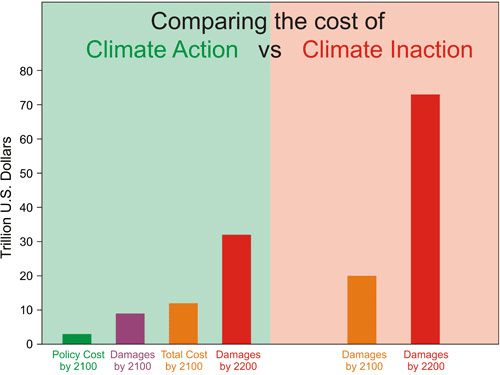 Climate change: three of Australia’s big four banks reviewing exposure to fossil fuels https://www.theguardian.com/australia-news/2017/apr/07/climate-change-three-of-australias-big-four-banks-reviewing-exposure-to-fossil-fuels
Commonwealth, NAB and ANZ are each analysing the financial position of business customers in sectors exposed to climate change, Guardian, Gareth Hutchens, 7 Apr 17, Three of Australia’s big four banks are reviewing their exposure to fossil fuels, including their lending practices to households and farmers, in response to climate change.
The Commonwealth Bank is conducting a “detailed climate policy review” that will be released publicly pending board approval, and NAB has a working group reviewing the risks from global temperatures rising two degrees.
ANZ is conducting portfolio analysis to identify changes in the financial position of business customers in sectors “most exposed” to climate change. It is also working with the Bureau of Meteorology to understand variability in average annual rainfall over recent decades to understand how climate change is affecting Australia’s traditional farming areas.
Executives from the three banks shared this information with the House of Representatives’ standing committee on economics, as part of a review of the four major banks. The revelations, written in response to questions on notice from the committee, were published on the federal parliamentary website on Friday afternoon.
It comes two months after the banking regulator warned climate change posed a material risk to Australia’s financial system, and urged companies to start adapting.
He pointed to the Paris Climate Agreement, ratified by Australia in November, as a significant policy moment for all governments, including Australia’s.
Summerhayes said the Paris Agreement provided an “unmistakable signal” about the future direction of policy and adjustments that companies, markets and economies “will need to make”.
The revelations from CBA and NAB come after ANZ’s chief executive, Shayne Elliott, said last month he was examining the impact of sea level rise and other climate impacts on housing mortgage risk.
Adam Bandt, the Greens’ climate and energy spokesman, has welcomed the revelations. He also questioned why Westpac has not ruled out funding Adani’s giant Carmichael coalmine in Queensland given its competitors’ concerns about climate change.
“Following ANZ’s revelation that sea-level rises might make it tougher to grant a mortgage, CBA and NAB seem to be examining whether to follow suit,” Bandt said. “The penny doesn’t seem to have fully dropped, because banks like Westpac still think they can commit to a two degree target but leave the door open to expanding coal mines.
“Westpac’s refusal to rule out funding Adani is especially concerning; as the bank seems to think it can have its climate cake and eat it too. But the days of dealing with climate change simply by putting a polar bear in your ad are long gone.”
Last year, financial activists Market Forces said Australia’s big four banks could act on their stated ambition to help achieve a 2C warming target simply by giving no new loans to coal projects.
Does Australia REALLY need a radioactive waste facility in outback South Australia?
the biggest unanswered question is whether the planned facility is the best way to manage Australia’s radioactive waste. Extraordinarily, that question has never been asked.
 ANSTO [in Sydney] is better placed than a pastoral station or the back paddock of a wheat farm to house this material.
Advantages of storing it at the ANSTO facility include that
- it enjoys assured tenure there;
- has a secured site with a high-level Australian Federal Police presence;
- is currently building new storage capacity;
- has already received reprocessed spent nuclear fuel returns from Europe;
- has the best radiation monitoring and nuclear response capacity in the nation; and
- the fact that the waste is there now answers double handling and transport concerns.
Importantly, the Federal nuclear regulator – Australian Radiation Protection and Nuclear Safety Agency (ARPANSA) – has confirmed there is no regulatory constraint to the waste continuing to be managed at ANSTO “for decades“.
Picking the postcode for a radioactive wasteland https://independentaustralia.net/environment/environment-display/picking-the-postcode-for-a-radioactive-wasteland,10177 Dave Sweeney 5 April 2017, ‘The Federal focus on finding a postcode for a [nuclear waste] facility has been at the expense of independently testing the assumptions behind the need for one.’
ACCORDING to the fridge magnets and stickers in the shop beside the ageing Big Galah sculpture, the small farming town of Kimba in South Australia’s Eyre Peninsula is the half way point on the east-west journey across Australia.
But right now, the local talk is more about half-lives, following the recent decision by Federal Minister for Resources Matt Canavan to further explore two places in the region as possible sites for a national radioactive waste facility.
The search for a place for Australia’s radioactive waste has been in train – and often off the rails – for more than 20 years. Over that time, successive Federal governments have had multiple fights at multiple sites — mainly across South Australia and the Northern Territory. Currently, there are three South Australian sites under consideration.
For the better part of a year, a site near Hawker in the Flinders Ranges has been under examination. The site, on a pastoral station leased by former Liberal senator and long-time nuclear facility supporter Grant Chapman has been strongly contested by many in the wider community. Critical voices include local Adnyamanthanha Traditional Owners, pastoralists and people concerned about the impacts of the region’s steadily growing tourism sector.
Now the inclusion of two parcels of agricultural land at Kimba has seen new tension in a town that has previously been highly divided over the Federal plan.
Last year, two previously nominated Kimba land options were not taken further by then Minister for Resources Josh Frydenberg because of a lack of community support.
However, supporters of a facility have made a new pitch and have found an ear in the new minister.
The planned facility would be in two parts — a repository for the disposal of low-level radioactive waste (LLW) and an above ground store to hold the more serious and problematic long-lived intermediate level waste (ILW). The store would operate for 100 years, at which time a decision would be made about how and where to future manage this long-lived waste, which needs to be isolated from people and the wider environment for thousands of years.
For a project that has had many configurations over many years, there remains considerable uncertainty about the plan.
Part of the series of unanswered questions include:
- final facility design;
- acceptance criteria;
- employment and governance arrangements; and
- longer term plans for managing Australia’s highest level radioactive waste.
ANSTO admits that Federal waste plan is for reactor generated wastes, and that no longterm disposal plan exists
Who’d want to dump Australia’s nuclear waste here? Well, this guy. At Kimba in the heart of the country, a community is divided – in one case literally so – over a plan to deposit the national stockpile of radioactive waste, Guardian, Max Opray, 4 Apr 17 “…..Hefin Griffiths, chief nuclear officer at the Australian Nuclear Science and Technology Organisation, says the facility is needed for the organisation’s gradually accumulating stockpile of radioactive waste at Lucas Heights, where measures are being rolled out to temporarily increase storage space at the 70-hectare site, which is reaching capacity this year.
According to Griffiths, most the waste earmarked for the new facility would be of low-level radioactivity, such as clothes worn by people working in nuclear medicine, or soil now stored at Woomera.
That would only be hazardous for a “short period”, he says, but the intermediate-level waste needs to be  stored for far longer. “We’ve got reprocessed residues that have come back from France which will remain radioactive for many thousands of years,” he says.
The returned waste consists of 20 canisters containing 170 litres each, generated by the High Flux Australian reactor, which ran for nearly 50 years before being decommissioned in 2007.
Intermediate-level waste will continue to be generated by the Open Pool Australian Lightwater research reactor and the under-development Synroc waste treatment plant.
The proposed nuclear waste management facility would hold this intermediate waste above-ground for a few decades until a longer term solution can be found. Griffiths says another structure along the lines of the $5.3bn deep-storage facility in Finland will eventually need to be built.
As for the facility that would hold the waste in the meantime, Griffiths says only a detailed technical assessment could confirm Kimba’s suitability, but proximity to agricultural land and the 1,700km journey from Lucas Heights would not be insurmountable obstacles.
Craig Wilkins, the chief executive of the Conservation Council of South Australia, argues a study should be undertaken on the prospect of storing the waste at Lucas Heights, close to nuclear experts, rather than “out of sight, out of mind”.
“We also have concerns about how incredibly divisive this process is on communities already doing it tough,” he says. “When you have individual landowners putting it forward to kickstart the local conversation it pits neighbour against neighbour.
“Last time it nearly tore Kimba apart. It is clear from last time there is significant community opposition.”
Successive federal governments over decades have failed to lock down a remote-area site to store nuclear waste because of regional opposition, and in a separate process the SA Labor government has struggled to sell a plan to develop a high-level nuclear waste storage facility, with a citizen’s jury last year resoundingly rejecting the concept.
Kimba was first floated as a potential location by the Liberal federal member for Grey, Rohan Ramsay, who in 2015 volunteered his property near the town before it was rejected owing to perceived conflict of interest………..https://www.theguardian.com/environment/2017/apr/04/whod-want-to-dump-australias-nuclear-waste-here-well-this-guy?CMP=share_btn_tw
South Australian Liberal Party to launch advertising campaign against Nuclear Royal Commission plan to import nuclear wastes

 Off The Record: Orchestra now in baton race to replace young gun, The Advertiser April 1, 2017 “…….Hitting voters with ion fist OUR atomic adventure might be dead and buried, but a series of targeted nuclear strikes are about to be launched by the Liberals.
Having last November torpedoed Premier Jay Weatherill’s half-hearted push for an international nuclear waste dump, the Libs will now attack him for secret plans to put the dump in various sites across the state, Off the Record has learned.
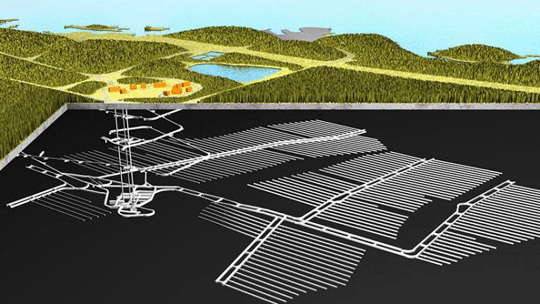
A localised digital and leaflet campaign will accuse Mr Weatherill and his high-level waste dump of risking the destruction of agricultural industry and the environment through toxic nuclear leaks.
The advertising blitz will expand closer to next March’s election.
Regional areas likely to host a dump will be the focus, along with women worried about their children’s futures and those once known as “doctors’ wives” – affluent inner-city Liberal types concerned about the environment and social issues.
Of course, as no site was earmarked by the nuclear royal commission in its final report last May, the Liberals have fertile ground to declare any community could be at risk from the nuclear ogre…… http://www.adelaidenow.com.au/news/opinion/off-the-record-orchestra-now-in-baton-race-to-replace-young-gun/news-story/22c63df9efeb84f31fe3adf21ca65aa9
World Heritage for Finders Ranges? Sounds good, but doesn’t prevent nuclear waste dumping
The potential location of the proposed National Radioactive Waste Management Facility at Wallerberdina Station near Hawker would have no impact on the World Heritage proposal for the Flinders Ranges.
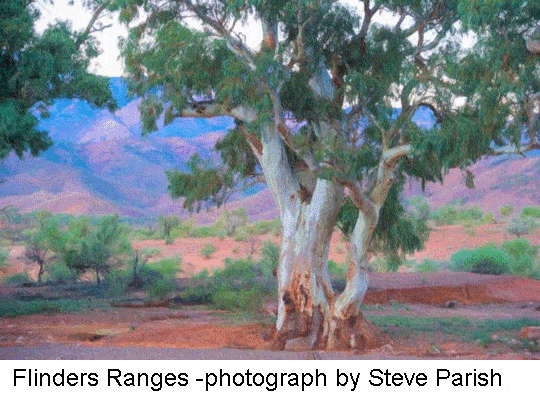
World Heritage for the Flinders Ranges Natural resources, SA Arid lands Over 600 million years old, the Flinders Ranges is one of Australia’s magnificent landscapes. This diverse landscape is world-renowned for its wealth of natural, cultural, historic and scenic values making it an iconic tourism destination with unparalleled visitor experiences.
Particularly extraordinary are the fossils and geology of the Flinders Ranges, which display the history of our planet and the evolution of life on Earth. Some of this critical evidence spans more than 300 million years and includes the world’s finest example of the Ediacaran explosion of life, when the earliest forms of complex multicellular animal life evolved. It is these outstanding geological and palaeontological forms within the Flinders Ranges that make it an important site to pursue for World Heritage Listing.
Pursuing World Heritage Listing for the Flinders Ranges provides an exciting opportunity to recognise this site on a global scale, to celebrate these outstanding values and create economic benefits for the region. Continue reading
Some enthusiasts for nuclear waste dump at Kimba, but many opponents
The couple [ Megan and Matt Lienert]say the federal government consultation process has only tried to sell the positives. “It’s like they’re here to sell a car,” James says. “Oh, you don’t want it? Here’s some free seat covers.”
Jacinta jumps in: “Here’s $2m to go to the next stage.
“[The federal government provides] the facts from one side, that’s all we’ve got since day dot. They don’t bring anybody here so people can make an informed decision.
 Who’d want to dump Australia’s nuclear waste here? Well, this guy At Kimba in the heart of the country, a community is divided – in one case literally so – over a plan to deposit the national stockpile of radioactive waste, Guardian, Max Opray, 4 Apr 17, At a point almost halfway between the east and west coasts of Australia, a mob of emus scamper along the Napandee property fenceline. The mallee scrub out this way appears otherwise deserted, the kind of remote location where one could hide a dead body and get away with it – but what about an entire country’s radioactive waste?
Landowner Jeff Baldock is determined to find out. Speaking in a considered gravelly tone through a bristling grey moustache, the third-generation farmer has an Ian Chappell-esque air about him as he defends the decision to formally nominate his land in Kimba, South Australia, as a site for the federal government’s national radioactive waste management facility. It would serve as a repository for intermediate-level waste from the Lucas Heights nuclear site in New South Wales and low-level waste from across Australia.
“We’ve got five grandkids living here on the properties with us,” he says. “If we thought it was dangerous we wouldn’t do this. If I thought it’d upset our grain or sheep we wouldn’t be doing it.”
If his property is selected, Baldock stands to be paid four times the value of 100 hectares of the land, but he says the real advantage would be providing economic benefit to the thousand or so residents of a struggling agricultural district.
“It’s a once-in-a-lifetime opportunity for our town – sorry, our community,” he says. “The antis talk about farmers versus the townies. To me it’s one community.”
It isn’t the first time Baldock has nominated land for consideration. Last year the federal government ruled out another property of his after the assessment process was abandoned because of local resistance. But Baldock says those against the proposal didn’t give it a chance………
In nominating again along with another landowner, Baldock has reopened wounds that were only just starting to heal in a community tightly bound by the challenges of an isolated life in the northern reaches of the Eyre peninsula. Last year Kimba held two of the six possible locations flagged by the government for the nuclear waste site, with one other in SA, and one each in Queensland, NSW and the Northern Territory.
Only one of those, the Barndioota site in SA’s Flinders Ranges, advanced to stage two, but it is meeting considerable resistance from Adnyamathanha traditional owners owing to its proximity to significant Indigenous cultural sites. The return to Kimba suggests the choices are narrowing – or vanishing. In March the resources minister, Matt Canavan, launched the new consultation on Kimba, …….. Continue reading
While coal mining contributes to climate change, climate change is wiping out coal mining revenue!
Cyclone Debbie could wipe $200m of coal revenue, John McCarthy, The Courier-Mail, April 5, 2017 THE State Government could lose up to $200 million from coal royalty revenue after Cyclone Debbie knocked out crucial rail links to the coast.
Australia’s security, like America’s, is threatened in unexpected ways, by climate change

The internal cohesion of many nations is already under great stress, including in the United States, as a result of both a dramatic rise in migration, and changes in weather patterns and water availability.
Throughout Asia, climate change will increase regional instability.
The economic and social implications will be profound, with a major effect on Australia’s export-dominated economy.
Climate threatens Australia’s security in unexpected ways, Brisbane Times, Sherri Goodman, 6 Apr 17, When President Donald Trump became the commander-in-chief of the US Armed Forces, he accepted the responsibility to protect my country against enemies, foreign and domestic. Prime Minister Malcolm Turnbull shares the same responsibility to protect Australians.
Do these leaders understand that a key component of national security and global stability is climate change and the instability it is already causing around the world? The intersection of these two issues is already striking the world in unexpected ways, as climate change interacts with other pre-existing problems to become an accelerant to instability. The consequences include overwhelming humanitarian crises, forced migrations like those we are witnessing around the Mediterranean, and a breakdown in the human systems that make our societies work. Continue reading
New Queensland homes can have Solar + Tesla battery storage
 Solar + Tesla battery storage offered in new-build Queensland homes http://reneweconomy.com.au/solar-tesla-battery-storage-offered-in-new-build-queensland-homes-64366/ By Sophie Vorrath on 5 April 2017 One Step Off The Grid
Another of Australia’s major housing developers, the Melbourne-Based group Metricon, will offer rooftop solar and storage as an optional extra in a range of its new-build homes in Queensland, via a new partnership with local installer and Tesla battery reseller CSR Bradford.
CSR Bradford – whose NSW-based company started in insulation more than 80 years ago, and has since expanded into energy efficiency and solar and storage through Bradford Solar – is an accredited Tesla Powerwall reseller, and has been watching the growth of the battery storage market closely over the past few years.
The deal with Metricon, announced this week, takes the company one step closer to its vision of solar and battery storage being included as a standard feature in all newly built houses in Australia – something the company’s managing director, Anthony Tannous has predicted will be the norm in just a few years’ time.
According to the Metricon website, Queensland customers who upgrade to the builder’s “luxury living” offer will get CSR Bradford’s a 5-6kW Solar ChargePack, which includes solar panels, a SolarEdge inverter and Tesla’s 14kWh Powerall 2 lihtiu-ion battery pack.
As Tesla has itself claimed, the Metricon 5kW offer promise to give the average house of four up to 90 per cent electricity self sufficiency on an average day, while the 6kW solar offer is said to give the average Australian family “little or no reliance on the grid.”
In financial terms, households choosing the Luxury Living” upgrade – which costs $1,999 for a single story home and $4,999 for a double story home – is expected to save the Metricon households $2,100 a year on energy costs.
CSR Bradford has similar packages being offered in Victoria, through Arden Homes, and in New South Wales with Mojo Homes.
“I have a vision that every house built in a few years time will have a battery installed, it just makes so much sense,” Tannous told One Step Off The Grid in an interview last month. “We’ve been working with most of the major builders across Australia and a lot of them are starting to include storage as standard… while others offer it as an upgrade,” he said. “And that will just gain more momentum.”
With big solar, Australia can meet renewable energy target of 33,000GWh by 2020
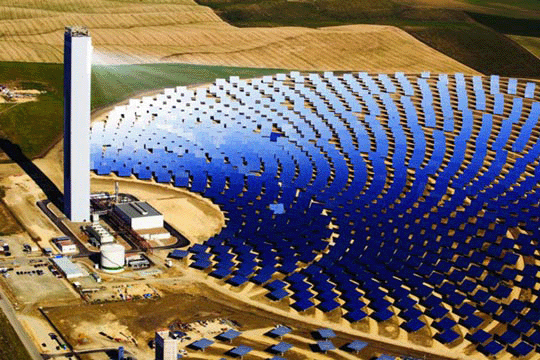 Arrival of big solar puts renewable energy target back on track, REneweconomy, By Sophie Vorrath on 4 April 2017 Australia is now on track to meet its renewable energy target of 33,000GWh by 2020, Australia’s Clean Energy Regulator has said, driven largely by the current burst of growth in the large-scale solar market.
Jay Hender, the Regulator’s general manager of technical assessment and support, said that while building another 6000MW of installed renewable energy capacity between now and 2020 remained a “significant task”, activity in Australia’s renewables sector was mounting by the week.
“We had a very slow start to 2016, which built up to big action in the last quarter, leading into the beginning of (2017),” Hender told the 2017 Large-Scale Solar Conference co-hosted by RenewEconomy and Informa on Monday. He said that 2,000MW of wind and solar had been committed in 2016, and this trend continued into 2017, with another 1GW of commitments.
“We’re tracking pretty well, I would say, for this point in time.”
Hender pointed to the big uptick in large-scale solar activity, that gained momentum at the end of 2016 and was continuing to do so this year, as a big driver of this progress.
Big solar has become a bigger and bigger portion of new installed capacity, and is currently sitting at around 50:50 with wind, Hender said. “That’s a pretty big change over a short period of time,” he added.
And he said the quieter achievements of Australia’s commercial solar sector – big solar’s “poor little cousin” – was also an increasingly important contributor to the 2020 target.
“(Here) you’ve got large, significant energy consumption during the day, and large roof space,” he said, noting the largely untapped potential of the commercial and industrial solar sector.“In essence there’s been a doubling of the capacity of (commercial solar) projects, year on year, year on year.“You don’t have to be a mathematician to know that … amounts to exponential growth. From big things little thing grow,” he said.
Bloomberg New Energy Finance associate Leonard Quong warned that despite this new build, shortfalls could be expected in LGC deliveries in 2018, keeping LGC prices at near penalty prices and maintaining pressure on politicians about the “cost of renewables”, even though the actual cost of the technology continued to fall…….http://reneweconomy.com.au/arrival-of-big-solar-puts-renewable-energy-target-back-on-track-56713/
A cautionary tale about going off grid with solar energy
 The “off-grid” guy is not happy with his off-grid system http://reneweconomy.com.au/the-off-grid-guy-is-not-happy-with-his-off-grid-system-58229/ By Giles Parkinson on 5 April 2017 One Step Off The Grid
Michael Mobbs has been involved in sustainability for more than two decades, leading public discourse with his “sustainable house” blog, cutting his connections to mains water and sewer more than two decades ago, and finally cutting the electricity wires to his inner-Sydney terrace home in March, 2015.
His exploits and determination to lead a self-suficent lifestyle earned him the sobriquet of the “off-grid-guy”. But two years after cutting the link to the electricity grid, Mobbs is deeply frustrated – his off-grid system is not working anywhere near as well as he expected.
For the last few weeks, in cloudy, rainy Sydney, Mobbs has had to turn off the fridge during the day to ensure that the house, which he shares with two others, has enough power for a “civilised life” at night-time. Worse than that, his system has a bug in it that causes it to trip every two days. Flashing digital lights have become part of his life.
“I’m running short of power,” Mobbs complains. He reckons that the system that he has in place is delivering 1kWh a day less than he expected. “I thought this would be a walk in the park, but I appear to have tripped over.”
Mobbs in now looking to replace the system, and has even launched a public ‘invitation” for people to suggest solutions. (Submissions are due on April 13).
But he wants this to be a public discourse, because from his experience he sees a cautionary tale for anyone looking to install battery storage, and particularly those who are looking to go off grid.
“I don’t live off-grid just for myself,” he writes on his blog. “I live off-grid to trial and to show options, create and publish real-life data for others, to give hope through action and accountability. ”
But he admits that his particular journey for going off-grid for electricity is incomplete. “When complete, and the new replacement system is installed soon, the project will show what is feasible.”
Although battery storage has been used for decades, mostly in remote areas that don’t easily connect to the grid, the mass-market is new, and so are many of the products now available to those in the inner city, suburbs, and regional towns.
And battery storage is a complex business – it relies so much on the consumer’s usage pattern, available solar power, local weather, orientation and how it is configured and paired with other hardware and software such as inverters and solar panels. Going off grid requires a bespoke solution.
Some people have the money and can throw surplus dollars and capacity at the solution. Hobbs clearly wants to find a smarter way – and in the inner city, he is restricted by space.
Mobbs says that from his experience it is pretty clear that there is a consumer blind spot. He now emphasises the need to be clear about what is wanted from the system, and for good monitoring and analytics to indicate what is going wrong and when.
So what did go wrong with his system?
Adani coal mine granted UNLIMITED ACCESS TO GROUNDWATER!
 ‘Barbaric’: Farmers rattled as Adani coal mine granted unlimited water access, Brisbane Times, Peter Hannam, 6 Apr 17, The proposed Adani coal mine has been granted unlimited access to groundwater by the Queensland government in a move farmers fear would allow it to drain huge amounts of water from the Great Artesian Basin.
According to a copy of Adani’s water licence obtained by Fairfax Media, the $16 billion Carmichael mine merely needs to monitor and report the amount of water it extracts with a permit that runs until 2077.
The mine, the biggest of nine proposed for the Galilee Basin west of Rockhampton, can conduct its own review of its groundwater model without independent or government oversight.
There are also no impact levels specified that would trigger a halt to mining, with the company able to offset any significant water loss elsewhere, the licence shows.
“It’s bloody-minded and barbaric,” said Bruce Currie, a grazier who lives in the region and has joined legal action against Galilee mines. “This is going to definitely impact on the integrity of [the Great Artesian Basin].”
According to a supplementary environmental impact statement, the mine will draw 26 million litres of water per day from its pits by 2029 as it ramps out annual production to as much as 60 million tonnes. Over its life, the mine’s water tally would reach an estimated 355 billion litres……….
The licence would not be subject to the new Water Act Referral Panel set up to ensure “the sustainable management of water in Queensland”……
Opponents, though, argue the coal is largely poor quality and the basin will require huge subsidies to become viable. Burning the fuel would also release a “carbon bomb” that would contribute to harming the Great Barrier Reef, which is already being hammered by unprecedented coral bleaching blamed on global warming.
Fairfax also sought comment from Adani Mining, the local subsidiary of the Indian company.
Without the water, their businesses are basically finished.
Limited scrutiny Unlike other controversial mines, such as the New Acland coal mine planned for the Darling Downs, Adani’s water usage is not subject to public submissions and appeals, said Jo Bragg, chief executive of Queensland’s Environmental Defenders Office.
Groundwater evidence is often the most controversial feature and public scrutiny is often the most significant aspect of any review, Ms Bragg said. “It’s a matter of grave concern that there’s not that opportunity.”…….http://www.brisbanetimes.com.au/environment/barbaric-farmers-rattled-as-adani-coal-mine-granted-unlimited-water-access-20170404-gvdk5v.html
Despite the blindness of Australian govt and vested interests, the switch from ‘base load’ to smart grid energy is underway
What is so astonishing about the plethora of opportunities is the refusal of the incumbents and other vested interests to see them.
Their regulatory capture of many of the country’s key institutions seems to be complete as well, but could be challenged by the likes of Zibelman and chief scientist Alan Finkel.
“Get used to it”: We’re switching from “baseload” to a smart grid, REneweconomy, By Giles Parkinson on 4 April 2017 “In South Australia, the minister’s right, when the wind stops, you get blackouts.”
Well, no. Fact check please. But so said ABC Q&A host Tony Jones on the program last night in the middle of a discussion about renewable energy between energy minister Josh Frydenberg and the former prime minister of Denmark, Helle Thorning-Schmidt.
Apart from being factually wrong, Jones’ statement highlights the depths of ignorance in mainstream media, and the influence within the ABC of senior commentators who simply do not accept, or understand, the potential of renewable energy. It is a view enthusiastically shared by many conservative politicians and encouraged by an ever desperate fossil fuel industry.
But here’s the thing. The energy mix is changing rapidly and large-scale solar is unstoppable, according to numerous presenters at a major solar conference held in Sydney this week.
Solar and wind will beat new coal and gas on price, and on top of that storage is arriving in a big way, as are all the other different technologies that will usher a dramatic change in our energy mix from a fossil fuelled “baseload” to a flexible system based around wind and solar.
“Get used it”. That was the simple but powerful message to the energy incumbents from Leonard Quong, a lead analyst from Bloomberg New energy Finance, in highlighting the rapidly changing “energy paradigm” in Australia and across the world.
“The best advice that we can give to those that would seek to resist the change, or the increased complexity, is just get used to it,” Quong told the conference on Monday. “The economics of large-scale solar make it an unstoppable force,” he said, reinforcing the point that the power system was moving to a new “control paradigm”, underpinned by any amount of new technologies.
It was a theme taken up by a range of speakers at the conference, from the Clean Energy Finance Corporation, to the Australian Renewable Energy Agency, and to developers such as Goldwind (the world’s biggest wind turbine manufacturer), Genex Power and others.
Indeed, in recent weeks the energy debate in Australia has reached something of an inflexion point. The closure of the dirtiest power station in the country, the giant Hazelwood brown coal generator, was the biggest symbol of this transition.
But other events are happening rapidly. In South Australia, a tender for battery storage attracted an astonishing 90 proposals, the former head of Hazelwood conceded that solar and storage was already cheaper than gas, and the biggest player in the South Australian market tore up its business plan in response to the events around it, and the state’s intervention in the market.
Good, said premier Jay Weatherill. “We’ve been screwed for too long by large power companies, it’s as simple as that,” the premier said on Monday.
Finally, the government has now shown it is prepared to take on the energy oligopolies – given that the regulators and rule makers have shown no interest in doing so. And the solution is to be found in storage and smart solutions that reduce the ability of the incumbents to cause huge price spikes and withhold capacity.
And for the first time, the head of one of the country’s main energy institutions, Audrey Zibelman, the new chief of the Australian Energy Market Operator, is talking of a grid that focuses on “distributed generation” – solar and storage – as a cheaper, faster, cleaner and smarter alternative to what we have now.
Even Malcolm Turnbull, in promoting pumped hydro, is talking of “dispatchable generation” and “variable” rather than “intermittent renewables.”
And his government has promised to throw in an extra $110 million to support a solar tower and storage facility in Port Augusta. Once that technology gets established, with its ability to provide 24-7 power, then the game will surely be up for baseload fossil fuels.
Indeed, this was one of the big themes of the Large Scale Solar 2017 conference being co-hosted by RenewEconomy and Informa in Sydney this week. The long expected and sudden boom in large-scale solar is about to change the energy landscape in this country forever, particularly as storage comes on board as well.
Gloria Chan, the head of large-scale solar for the Clean Energy Finance Corporation, talked of a “changing paradigm” from baseload and peaking fossil fuel plants, to a “smart grid” based around solar and wind, with the gaps being filled by “dispatchable” renewables and storage……
The CEFC’s Chan said the CEFC technology roadmap includes pumped hydro and batteries, along with synchronous condensers and other technologies; “dispatchable” renewables such as solar thermal, geothermal hydrogen and biomass.
Other technologies include transmission upgrades and “behind the meter solutions” – the solar and storage and virtual power plants, and demand management highlighted by Zibelman in the past week.
What is so astonishing about the plethora of opportunities is the refusal of the incumbents and other vested interests to see them.
Their regulatory capture of many of the country’s key institutions seems to be complete as well, but could be challenged by the likes of Zibelman and chief scientist Alan Finkel.
Indeed, a survey released this week by Sven Teske, from the Institute of Sustainable Futures in Sydney, found that 71 per cent of international energy experts thought that 100 per cent renewable energy was obtainable and realistic. To be sure, the responses ranged from the “progressive” to the “conservative” – who simply didn’t believe it could be done.
As the head of China’s state grid has noted, this is not a technology issue, but a cultural one.
And perhaps it is that which causes the media to struggle to move forward, and lazily repeat the mischievous myth-making of the fossil fuel incumbents. Jones’s comments on Q&A are a case in point. Perhaps mainstream media is waiting for the right signals from the mainstream parties. The CEFC’s Chan said the CEFC technology roadmap includes pumped hydro and batteries, along with synchronous condensers and other technologies; “dispatchable” renewables such as solar thermal, geothermal hydrogen and biomass.
Other technologies include transmission upgrades and “behind the meter solutions” – the solar and storage and virtual power plants, and demand management highlighted by Zibelman in the past week.
What is so astonishing about the plethora of opportunities is the refusal of the incumbents and other vested interests to see them.
Their regulatory capture of many of the country’s key institutions seems to be complete as well, but could be challenged by the likes of Zibelman and chief scientist Alan Finkel.
Indeed, a survey released this week by Sven Teske, from the Institute of Sustainable Futures in Sydney, found that 71 per cent of international energy experts thought that 100 per cent renewable energy was obtainable and realistic. To be sure, the responses ranged from the “progressive” to the “conservative” – who simply didn’t believe it could be done.
As the head of China’s state grid has noted, this is not a technology issue, but a cultural one.
And perhaps it is that which causes the media to struggle to move forward, and lazily repeat the mischievous myth-making of the fossil fuel incumbents. Jones’s comments on Q&A are a case in point. Perhaps mainstream media is waiting for the right signals from the mainstream parties. http://reneweconomy.com.au/get-used-to-it-were-switching-from-baseload-to-a-smart-grid-96298/
Adani coal railway line plan in breach of Australian government policy
 Adani mine railway loan would breach government’s policy, says legal group
Complaint lodged over prospect of Northern Australia Infrastructure Facility partially funding 400km rail line, Guardian, Helen Davidson, 6 Apr 17, A $1bn federal loan to builders of a railway line between the proposed Adani coalmine and the coast would be a direct breach of government policy, a legal group has claimed.
Environmental Justice Australia has lodged a formal complaint with the Productivity Commission over the prospect of the Northern Australia Infrastructure Facility partially funding the 400km rail line.
It is believed two companies – an Adani-related entity and the rail company Aurizon – have made rival bids for $1bn in government loans.
But EJA said government funding of the line would be a clear breach of competitive neutrality principles and potentially against the criteria of the “developing the north” white paper.
Competitive neutrality principles require governments not to use their legislative or fiscal powers “to advantage their own businesses over the private sector”, according to government agreements.
“We also submit that the Naif is non-transparent, ineffective, inefficient and has an inadequate governing framework.”
EJA based its complaint on a report by the Productivity Commission into the Export Finance and Insurance Corporation in 2012. It said said the commission found Efic should cease supporting onshore resource projects and related infrastructure because the private sector was already active in that market.
It also suggested the framework of Efic and Naif were similar, in that it had a “market gap” not “market failure” mandate……
Naif’s mandatory criteria also includes the requirement that the funded project be of benefit to the public and “serve or have the capacity to serve multiple users”.
While Adani’s proposal for the rail line is believed to be for its sole use transporting coal between the Carmichael mine in the Galilee basin and the coastline for export, Aurizon’s has reportedly scoped for a multi-use line – albeit with Adani as the sole operator initially.
Barnden said this did not affect the group’s complaint, and suggested Aurizon would have difficulty justifying a proposal for a multi-user line because the Abbot Point terminal on the coast only had capacity for Carmichael.
“I think we’re reasonably confident that the commission will make findings which would lead to recommendations to the minister to not finance or not provide financial support to large private infrastructure projects in Australia.”….. https://www.theguardian.com/environment/2017/apr/06/adani-mine-railway-loan-would-breach-governments-policy-says-legal-group
Adani’s Carmichael coal mine is environmentally reckless and contrary to today’s energy markets
 http://www.smh.com.au/business/mining-and-resources/adanis-carmichael-coal-mine-is-environmentally-reckless-and-contrary-to-todays-energy-markets-20170404-gvdkgh.html
~ Julien Vincent executive director of Market Forces 6 April 2017:
“If at first you don’t stack up economically, make the public pay for it.”
“This could be the mantra that delivers Adani’s Carmichael mega coal mine in the Galilee Basin
at the expense of the environment, culture, our prospects of a stable climate and in defiance of sound economics. …
“Since buying the coal tenements from Linc Energy in 2010, Adani has failed to secure a single private backer for the Carmichael mine.
“In fact, since then, 17 banks have either publicly distanced themselves from Galilee Basin
coal export projects or introduced policies that prevent them lending to the Carmichael mine. …
“In an industry where sentiment and market signals have a huge impact, leadership from private banks like Westpac can do more than just prevent a project like Adani’s Carmichael coal mine, and its impacts on people, the environment and climate. It can help prevent Australians for having to pay for the privilege.”
1 This month
17 October, Free Public Talk on Nuclear Issues in South Australia
David Noonan will speak on public interest concerns over the new Roxby Downs Indenture Act 2026 on BHP copper-uranium mining and ore processing in SA, and on how AUKUS may face SA with a High-Level nuclear waste agenda.
Dr Jim Green will discuss international developments in the field of nuclear power including ‘small modular reactors’ and Generation 4 ‘advanced’ nuclear reactor concepts.


Help Aunty Sue Protect Her Land and Sacred Sites From Destructive Rocket Testing.
.

Australians deserve the truth
about
AUKUS – https://aukuspublicinquiry.com/

PETITION – To: Prime Minister Anthony Albanese and the Australian Labor Government

of the week – Australians for War Powers Reform (AWPR)
To see nuclear-related stories in greater depth and intensity

