Victorian Liberal Party rejects nuclear power, also rejects climate denialism

 Turnbull warns party faithful against drift to the right, Adam Carey, Eryk Bagshaw, The Age, 2 Apr 17,
 Malcolm Turnbull has stared down the right-wing of his own party which has hamstrung his leadership and asserted that the Liberals should be the party of the “sensible centre”…….
The party’s [Victorian] state council passed three motions to adopt new federal policies:…….
Motions to embrace nuclear power and to adopt energy policies that reject “climate alarmism demonising CO2 emissions” were rejected.http://www.theage.com.au/federal-politics/political-news/turnbull-warns-party-faithful-against-drift-to-the-right-20170401-gvbhjf.html
Port Augusta ‘buzzing’ over deal for solar power plant
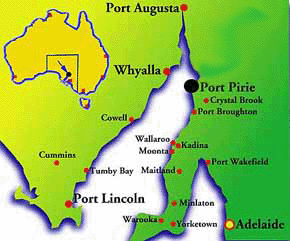 Port Augusta mayor Sam Johnson ‘absolutely ecstatic’ solar power plant will be finally funded Adam Langenberg, Political reporter, Sunday Mail (SA) April 2, 2017 THE city at the centre of South Australia’s power crisis is “buzzing” after a highly anticipated plan to build a 100MW solar thermal plant took one huge leap closer to reality.
Excited locals say the promise of a $110 million concessional loan to proponents is “absolutely huge” and 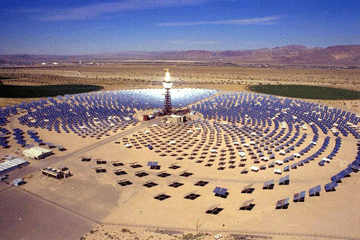 transformative for the city, while project backers say the State Government must award its power supply contract to provide certainty.
Mayor Sam Johnson said he was “absolutely ecstatic” the project was a step closer but he took a shot at the Federal Government for only delivering on its promise as part of a deal with Senator Xenophon to support its company tax cut package.
“There was certainly a buzz around town because it’s no secret we’ve had a few bad shots in the arm in the last 18 months,’’ Mr Johnson said.
“We’re looking for that positivity and we know we can deliver the next chapter.”
Senator Xenophon said Prime Minister Malcolm Turnbull had assured him the project “was a goer” and welcomed the Government’s clear commitment to solar thermal generation at Port Augusta. “It will transform the town and be a beacon of hope. It will also change the way we look at energy, by providing virtual baseload with a molten salt storage,” Senator Xenophon said. “I just want it to happen. I’m happy to work with the Prime Minister………
..Repower Port Augusta Dan Spencer reiterated both proponents, SolarReserve and Solarstor, needed to clinch an electricity supply deal with the State Government before progressing further.
“It puts the ball right in Jay’s (Premier Weatherill) court,” Mr Spencer said.
“They’ve got the guarantee of the federal loan so they can lock it in now by providing the power contract.”
Energy Minister Tom Koutsantonis said applications for the electricity contract were being assessed and the Government had “numerous policies in place to support a potential solar thermal plant.”http://www.adelaidenow.com.au/news/south-australia/port-augusta-mayor-sam-johnson-absolutely-ecstatic-solar-power-plant-will-be-finally-funded/news-story/55acc17df92d7f9cef77b6548aae488c

Climate change is pushing cyclones further South
 Watch out, Gold Coast, climate change is pushing cyclones further South Cyclone the size of Debbie could be catastrophic for Gold Coast, modelling shows, The Age, Eryk Bagshaw, 2 Apr 17,
A cyclone the size of Debbie could have catastrophic consequences on the Gold Coast, new modelling has shown, as climate change pushes cyclones further south and puts tens of billions of dollars worth of infrastructure at risk.
Actuaries, who predict and model scenarios for banks and insurers, have warned properties could become “uninsurable” as premiums rise to meet environmental challenges. Debbie devastated northern Queensland and swept floods into NSW which caused $1 billion in damage, forced 30,000 people to evacuate and took two lives.
Under modelling compiled by Deloitte’s principal actuary Sharanjit Paddam and James Cook University, a shift in the cyclone-prone region of just three degrees would cause winds in excess of 260km/h to hit the Gold Coast and stretch as far as Brisbane, where many homes and towers do not meet cyclonic safety standards.
The “sting in the tail” of ex-Cyclone Debbie battered the Gold Coast this week with winds half as strong as those that hit Bowen and Proserpine, along with torrential downpours. Continue reading
Looking to the future: Australia’s energy supply and demand
 Power games: The quick fix and unanswered questions on electricity, The Age Adam Morton 2 Apr 17,
Let’s assume that at some point in February next year it will reach 45 degrees in south-east Australia.
Let’s assume it will be more than 43 degrees for three days running. Let’s assume you are unlucky and the temperature tops 40 degrees for a week or more……..
As the climate control kicks in, home solar systems are also firing up. At the turn of the decade, rooftop solar panels were a novelty. Now, more than 1.5 million households have them. They provide some relief for the stretched electricity grid.
And the grid needs all the relief it can get. Like most of us, electricity infrastructure performs less well when it is hot. This applies to the ageing equipment in creaking old coal plants and gas-fired turbines. Some break down as the temperature rises. It also applies to solar photovoltaic panels, some of which lose nearly a fifth of their capacity as the temperature goes past 40……..
the extraordinary weather conditions means the annual threat of bushfire – which could knock out transmission lines and possibly affect generators – remains constant………
The scenario above is the picture today, but it will almost certainly have changed again by next summer. The energy industry has been acting as though on fast-forward over the past fortnight, and shows no sign of slowing down.
The Clean Energy Council says there is more than $5.5 billion worth of renewable energy projects under construction this year. On Thursday, Lyon Solar added plans for a $1 billion solar and battery plant in South Australia’s Riverland to be in place by next summer. Billed as the biggest of its type in the world, it includes a 330 megawatt solar farm and 100 megawatt battery system with four hours’ storage – enough, proponents say, to potentially make concerns about South Australia and Victoria’s supply redundant.
This is independent of the Weatherill government’s quick tender for Australia’s first large-scale battery system that could – if Tesla mogul Elon Musk is to be believed – be built in 100 days. It is one of a number of steps planned by the South Australian government. Less headline grabbing, but possibly just as important, is that Premier Jay Weatherill has assured the public there will be 200 megawatts of emergency back-up in place. Almost certainly, it will be met by bringing in cheap, reliable and emissions-intensive diesel generators. This was the path Tasmania took when its hydro dams were running low and the Basslink cable to Victoria was broken last year. It might seem antiquated, but works.
The Victorian government has also promised a battery tender, aiming to have 50 megawatts – enough to power a couple of regional cities for four hours – before Christmas. Another 50 is expected to follow in 2018……..
The ignored opportunity
Perhaps because it has no champion among industry or regulators, the potentially significant scope to quickly reduce electricity demand through smarter use of technology remains little explored.
A paper released last week by the awkwardly named Energy Efficiency Certificate Creators Association makes the case for the savings possible by cutting waste.
Victoria has been a leader in this area with an energy efficiency scheme that, until the Coalition walked away before the last election, had bipartisan support. Ric Brazzale, managing director of Green Energy Markets, estimates the cleaner lights and appliances it helped install last year alone reduced demand by about 120 megawatts – the equivalent of a small power plant.
Advocates want incentives for businesses to reduce production when necessary and to upgrade substandard equipment – think boilers, airconditioners, fridges and insulation. At a household level, the call is for greater support to install better whitegoods and battery packs.
Small steps can make a significant difference. Replacing old lights with LEDs, for example, can cut electricity consumption from that device by up to 80 per cent.
Unanswered questions
Better demand management will help, but it won’t avoid the need for more generation. The big, unaddressed question is what will the response be when the next large coal power plant closes – and the next one after that, and so on.
Australia has 23 remaining coal generators. As the federal government acknowledges, several more may shut over the next decade. According to modelling for the Climate Change Authority, all would need to be gone and replaced by cleaner technology by 2035 if Australia is to play its part under the Paris deal to keep global warming below 2 degrees.
That notional deadline rarely gets a mention in public debate, but a campaign is in full flight for a bipartisan national energy and climate policy to set the pace for the transition to cleaner plants. Businesses are worried that ageing coal plants will otherwise continue to shut abruptly – Hazelwood’s closure was announced just five months out – without there being time to build replacements. The federal government has rejected their preferred model, an emissions intensity scheme, and as has offered no alternative.
Reviews into electricity security (by chief scientist Alan Finkel) and climate policy (by the Environment Department) are under way, but the government is fundamentally divided on the need to do anything. It is hard to see where it lands.
Nationally, the only significant large-scale policy designed to drive energy investment beyond this decade is Victoria’s ambitious and contested renewable energy target, which aims to build enough wind and solar farms to deliver 40 per cent of the state’s electricity needs by 2025. (The ACT has also a renewable target, but in other states the goals are purely aspirational.)
The Andrews government has not said what it thinks the rapid growth in clean energy means for the Latrobe Valley’s three remaining coal plants – Yallourn, Loy Yang A and Loy Yang B. The state opposition plans to abolish the renewable target if it wins power next year, but it hasn’t said what, if anything, it would do in its place. It has hinted it may subsidise coal plants to keep them open.
Meanwhile, anyone hoping for an answer on what will keep the lights on in the longer term is left waiting. http://www.theage.com.au/business/energy/power-games-the-quick-fix-and-unanswered-questions-on-electricity-20170327-gv7w01.html
#StopAdani Alliance
 ‘One of the biggest threats to Australia’s beloved Great Barrier Reef, Adani’s Carmichael coal mine is weeks away from being finalised.
Concerned citizens have no time to lose in opposing it, say activists.’Vaidehi Shah
An alliance of 13 green groups has formed to fight the mine
It comprises the
Bob Brown Foundation, http://www.bobbrown.org.au/
350org, http://350.org/
GetUp, https://www.getup.org.au/
Australian Conservation Foundation, https://www.acf.org.au/
Australian Youth Climate Coalition, http://www.aycc.org.au/
Seed (Australia’s first Indigenous youth climate network), http://www.seedmob.org.au/
Australian Marine Conservation Society, https://www.marineconservation.org.au/
Mackay Conservation Group, http://www.mackayconservationgroup.org.au/
North Queensland Conservation Council, http://nqcc.org.au/
Environment Council of Central Queensland, https://www.facebook.com/Environment-Council-of-Central-Queensland-443059492526187/
Whitsundays Residents Against Dumping, http://wrad.nationbuilder.com/
Market Forces https://www.marketforces.org.au/
& The Sunrise Project. http://sunriseproject.org.au/
Australianb anks, insurance companies, considering the costs of climate change
While those who want to argue whether climate change is real or some sort of Chinese conspiracy, those with real money at risk have moved on. The science is accepted, they have plenty of evidence to back up their own concerns, and now they want to find a way to deal with the financial repercussions.
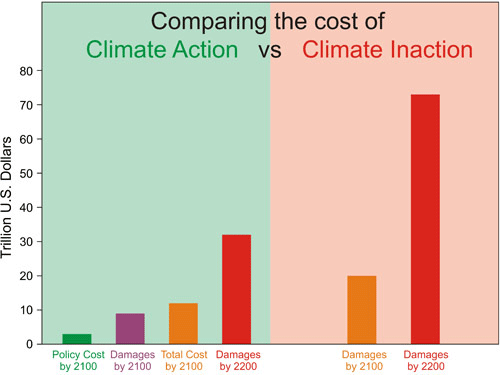 How climate change will affect your mortgage https://thewest.com.au/opinion/shane-wright/climate-change-is-real-and-its-cost-cannot-be-ignored-ng-b88432001z
Shane Wright, Economics Editor, Monday, 3 April 2017 The pictures from the northern Sydney suburb of Collaroy are hard to forget.
Last year, after some extreme weather, a string of houses were left hanging in mid-air. The beach, and backyards, of these homes had simply disappeared.
It grabbed our attention. But it also grabbed the attention of the banks that had lent money to those homeowners and tens of thousands of others who like to live next to the beach.
If you’re a bank, you want to make sure that the people who you lend cash to can repay it.
That means taking into account their income levels as well as the value of the asset they’re purchasing.
There’s not much sense in giving someone a $500,000 mortgage that may be falling in value. In the case of a problem with repayments, and the bank is forced to sell the property, then there’s no chance it will get its money back.
Perfect banking sense. And so it is perfect banking sense to start taking into account the threat posed by climate change.
In the case of the homes on that Sydney beach, if climate change is washing away part of the property then — by definition — the value of that property is falling. Indeed, the property is actually getting smaller as it is swept out to sea.
So you would not be surprised to know that the nation’s banks are starting to look at what climate change might mean to the values of the assets that underpin the best part of $1.5 trillion in mortgages.
There is a growing risk that if your home loses value due to climate change — it’s in a flood-prone area, it’s not very high above sea level, it’s surrounded by increasingly bushfire-prone forests — then how much you can borrow could be curtailed.
You also shouldn’t be surprised that the insurance sector is also looking very closely at what climate change-induced events may mean for its coverage and its fees. Continue reading
Victorian Liberal Party pledges to keep brown coal-fired stations burning

We’ll keep coal burning: Guy
Victorian Liberal leader Matthew Guy has pledged the party would keep brown-coal-fired stations burning. (subscribers only)
http://www.theaustralian.com.au/business/mining-energy/matthew-guy-pledges-to-keep-coal-power-stations/news-story/8f09b2bac4d0d0a31e18c883ea753230
Coal industry affected by climate change: costs of Queensland Cyclone Debbie
Queensland Cyclone Debbie: Economic impact, Courier Mail, April 2, 2017 QUEENSLAND coal exports may have taken a $1.5 billion hit from Cyclone Debbie as more than 22 mines were forced to halt production while roads and ports were shut.
Economists also tip a hit to the state Budget, with a temporary loss of coal royalties and lost agricultural production. But they also warn that negative talk about the impact on resorts could hurt tourism operators unaffected by the weather.
Energy analysts IHS said about 10 million tonnes of coal production was lost as buyers went elsewhere.
Mines will also be affected by impassable roads and flooded pits, but the losses aren’t expected to be anywhere near those incurred by Cyclone Yasi, when about 40 million tonnes of production was lost.
Economist and former Chamber of Commerce and Industry executive Nick Behrens said the economic impact would be substantial for the State Government……http://www.couriermail.com.au/business/queensland-cyclone-debbie-economic-impact/news-story/dabed7d1c567e01f519fd9567ed0a21d
Labor claims Coalition’s proposed native title changes breach deal deal struck between major parties
Coalition’s proposed native title changes a breach of deal struck between major parties, Labor claims, ABC News, 2 Apr 17 By political reporter Dan Conifer Federal Labor has accused the Coalition of bungling native title changes and breaching a deal struck between the major parties.
The Coalition moved to amend the Native Title Act in February soon after a court scuttled a multi-million-dollar deal between the West Australian Government and traditional owners.
The Federal Court rejected the Indigenous Land Use Agreement (ILUA) between the parties because it was not signed by all native title claimants.
Until February’s court decision, ILUAs could be made without the support of all native title applicants.
The court ruling overturned years of established law, throwing doubt over current and future agreements nationwide.
“It is once again clear that these new amendments have not been subjected to any form of consultation with legal experts, Indigenous Australians or industry.
“The repeated breaches of faith by your Attorney-General in this matter, and the clear unwillingness of your Government to properly consult on the significant issues at hand, have meant that Labor remains concerned about some aspects of the bill.”
The correspondence was also signed by shadow attorney-general Mark Dreyfus and shadow assistant minister for Indigenous affairs Pat Dodson.
The letter said Labor wanted the Senate committee’s recommendations enacted “as quickly as possible” and offered to work with the Coalition over coming weeks……..
The amendments have not been debated in the Senate.
Parliament next sits in May. http://www.abc.net.au/news/2017-04-02/native-title-proposal-by-coalition-breaches-deal-labor-says/8407964
The Coalition and Labor agreed on the need to amend the legislation to reverse the effect of the recent court decision, allowing at least 126 ILUAs already proposed or registered to continue with as few as one claimant.
But the Opposition claims Attorney-General George Brandis has proposed changes that go beyond what the major parties agreed during a Senate committee process.
Shorten ‘uncomfortable’ with Government handling of issue In a letter to Prime Minister Malcolm Turnbull on Friday, Opposition Leader Bill Shorten accused the Government of “repeated breaches of faith”.
“These amendments failed to deliver on the prior agreement and were again defective in a number of respects,” the letter said.
Labor supports emissions scheme to reach 50% renewable energy goal
Labor to drop renewable energy target in favour of emissions scheme
RET will come to a natural end as emissions intensity scheme can reach goal of 50% renewable energy by 2030, says Andrew Leigh , Guardian, Paul Karp, 2 Apr 17, Labor will abandon the renewable energy target after 2020 because an emissions intensity scheme will be sufficient to reach the goal of 50% renewable energy by 2030, Andrew Leigh has said.
On Sky News on Sunday the shadow assistant treasurer firmed the opposition’s plan to reach the 50% goal without a hard target in comments that appeared to rule out extending the existing renewable energy target (RET).
“We’ve committed to getting 50% renewables but the mechanism that we’ve used in the past has been a renewable energy target. That comes to an end and we believe an [emissions intensity scheme] EIS can take us to the point of having 50% renewables … without the RET,” Leigh said.
Asked to confirm that meant Labor would not support the RET when it expired in 2020, Leigh responded: “We believe that the emissions intensity scheme does that job … without a RET.”……..
Pressure has been mounting on the Finkel review to recommend a market mechanism. A string of peak bodies have already called for market mechanisms, including the National Farmers’ Federation, the Investor Group on Climate Change and the Business Council of Australia, which explicitly called for an EIS.
Leigh noted that an EIS was supported by experts across the field, including the Business Council of Australia and many energy regulators. He noted renewables account for the majority of new investment in electricity generation in the last decade.
“One of the government’s favourite backers, Bjørn Lomborg, not somebody Labor would usually support, says that every $1 invested in renewables gives you a pay back of $11.”
Leigh said that Nick Xenophon, who abandoned his demand for an EIS in return for support for company tax cuts in favour of a payment to pensioners and a number of energy measures, had been “sold a pup”.
The measures include fast-tracking a solar-thermal plant in South Australia already promised, a study of a gas pipeline connecting the state with the Northern Territory, and a new national energy policy………https://www.theguardian.com/australia-news/2017/apr/02/labor-to-drop-renewable-energy-target-in-favour-of-eis
Australia unprepared for foreign policy making, in this era of America’s “mad king”
The arrival of what many on both sides of the aisle in Washington, now openly describe as the mad  king, has left the foreign policy establishment struggling to even craft a considered response.
This is particularly so in Canberra, where none of this was predicted.
big global issues — large scale immigration, historic disparities between the haves and have nots, massive technology change led by ubiquitous networked platforms, not to mention climate change — are wreaking their consequences at warp speed. All while the US is consumed with its own political civil war, led by none other than the president himself.
 Tom Burton: mokita and the mad king, http://www.themandarin.com.au/77426-tom-burton-mokita-mad-king/ by Tom Burton 31.03.2017 The sudden and rapid collapse of US foreign policy administrative infrastructure has left Australia particularly exposed, leaving our diplomats scratching their heads about what to do.
Mokita is the word the people of the tiny New Guinea island of Kiriwina use to describe the “truth we all know, but agree not to talk about.” Mokita was on display big time this week when all of Australia’s ambassadors met in Canberra to consider the shape of the government’s foreign policy white paper.
The meeting was addressed by Minister Bishop who in a long, wide ranging speech, referenced the new US President Donald Trump and the profound impact of his election, in but a single line: “The United States has a new President, driving an economic nationalist agenda.”
The reference was in the context of the international windback of the global economic liberalism which has served Australia well since the end of World War II. But while the otherwise eloquent speech traversed some of the obvious implications of this shift, there was no further public mention of the sheer madness that has characterised the Trump presidency to date and the fundamental effect this is having on world geopolitical order.
Tyro US Ambassador, Joe Hockey, was in similar Chamberlain appeasement mode as he later advised Australians to not join the chorus of constant criticism of Trump, Continue reading
Australian govt commits $110m for Port Augusta solar towers
 Last year, Australia’s clean energy movement had a major victory, with South Australia’s resounding
  rejection of the plan for nuclear waste importation, (and later for, nuclear power). Some nuclear proponents also looked to Port August as the place for a nuclear power station.
The Liberal Coalition government now supports a solar power station instead. Of course, they were dragged kicking and screaming, into this, by a piece of deft politicking from Senator Nick Xenophon. But – so keen was PM Turnbull, to get new legislation on tax passed, that he had to swallow his aversion to non fossil-fuel energy. We wait to see how well the govt carries out this commitment
Coalition commits $110m for Port Augusta solar towers http://reneweconomy.com.au/coalition-commits-110m-for-port-augusta-solar-towers-11045/ By Giles Parkinson on 31 March 2017 The federal Coalition government has announced that it will provide $110 million in concessional loans to a solar tower and molten salt storage project in Port Augusta, as part of last minute negotiations with the Nick Xenophon Party to pass major tax cuts.
The commitment was announced by finance minister Mathias Cormann as part of a deal with the NXT to approve tax cuts for businesses with revenue of less than $50 million.
Senator Cormann says the Coalition will provide a confessional loan of $110 million in 3 per cent interest rate to an unspecified solar thermal project. He said the government will call for formal proposals via the Australian Renewable Energy Agency and the Clean Energy Finance Corp.
The front runner for the deal is the 110MW solar tower and molten salt storage project proposed by the US company SolarReserve. Other proposals are likely to come from Vast Solar and others.
“We welcome the announcement today from the Senate, and it is critical step in progressing the project – but the key outcome is to obtain a long term power purchase agreement,” said Daniel Thompson, the Australian development manager for SolarReserve.
Earlier, the energy minister Josh Frydenberg announced that the CEFC would invest $80 million in the 113MW Bodangora wind farm near Wellington in NSW.
“This investment in large-scale renewable energy projects such as Bodangora, is part of the Turnbull Government’s technology neutral, non-ideological approach to provide affordable, reliable electricity as we transition to a lower emission future,” he said in a statement.
The $236 million Bodangora wind farm is expected to be operational in the latter half of 2018.
Climate change affecting koalas? They are now seen to be drinking water
Why Koalas Are Suddenly Drinking Extra Water, National Geographic, 30 Mar 17, Koalas usually get the water they need from their food—but hotter, drier weather is making some koalas desperate. March 31, 2017 – Koalas have been showing an uncharacteristic behavior: drinking water. Koalas typically meet most of their daily need for water just by eating leaves. But researchers from the University of Sydney have documented an increase in sightings of koalas looking for water. Cameras near watering spots around the New South Wales, Australia town of Gunnedah showed koalas coming to drink, a cute sight that nonetheless may signal increased pressure from climate change……..http://news.nationalgeographic.com/2017/03/koala-bears-water-eucalyptus-leaves-trees-australia/
Solar-storage hub proposed for Adelaide
 Carnegie teams with Samsung, Lend Lease for battery storage hub http://reneweconomy.com.au/carnegie-teams-with-samsung-lend-lease-for-battery-storage-hub-23948/ By Giles Parkinson on 31 March 2017
In a joint announcement with energy minister Tom Koutsantonis and premier Jay Weatherill in Adelaide on Friday morning, Carnegie CEO Michael Ottaviano said the company has teamed up with Lend Lease Services and South Korea’s Samsung for the proposal.
It proposes to build a 100MW/100MWh lithium-ion battery, using Samsung technology, and wants to do this in Adelaide in a centre that will evolve into a “battery storage” hub, building new battery systems and doing R&D and integration work.
“This is an opportunity to build an industry for the future,” Ottaviano told journalists in Adelaide. “This will be the first 100MW battery, not the last.”
Carnegie’s is just one of a number of proposals for the state government tender, which closed at 12 noon local time on Friday. Others include the $1 billion solar and battery storage project unveiled by Lyon Solar on Thursday, and rival offers from Zen Energy/Greensmith, Tesla, LG Chem, Adelaide-based silicon storage developer 1414 and many more.
Koutsantonis said the tender had elicited an “unprecedented” response with more than 200 downloads from nine different countries. Final numbers will be revealed on Monday. “It has captured international attention for people to see opportunities with our remarkable renewable energy power,” Koutsantonis said. “You can hand around lumps of coal, or you can move forward with new technologies. Storage will become the norm and we will be at the forefront of that.”
Ottaviano says the battery storage hub would be powered by a “multi-megawatt” rooftop solar system – and could employ 300 people to deliver the project, including electricians and engineers from sunset manufacturing industries in South Australia.
He said Carnegie would own the battery storage unit, and use it to trade energy, arbitraging opportunities in the market, and also playing in the FCAS (frequency and ancillary services) market when not being called upon by the government to provide grid support.
But he said such installations would rely on government support until market rules were changed that would level the playing field for battery storage.
“As renewable energy penetration inevitably increases across the country, the need for utility-scale energy storage will grow in lockstep,” Ottaviano said in a later statement.
“The deployment of utility-scale battery systems creates an opportunity for South Australia and Australia to develop a new local industry and export this capability throughout our region.”
Weatherill told journalists that battery storage was exciting because it sourced “free energy” from the wind and the sun, and would create the jobs of the future.
Adani coal project gets major setback as Government fails to pass Native Title Bill
Government fails to pass Native Title Bill: Major setback for Adani http://wanganjagalingou.com.au/govt-fails-to-pass-native-title-bill-major-setback-for-adani/~ Wangan and Jagalingou (W&J) Traditional Owners Council 31 March 2017:
“The Turnbull Government failed to push through its controversial Native Title Bill by the end of the Parliamentary sitting, despite the Labor Opposition’s readiness to negotiate on the amendments.
“The next opportunity for the Federal Senate to consider the Native Title Amendment Bill is the Budget Sitting in early May and, if not then, the next sittings are mid June. …
“Youth spokesperson for the W&J Traditional Owners Council, MsMurrawah Johnson, said,
““The Adani Board is reported to be set to make a decision within the next two weeks on whether to push on with the mine project. But it still faces our court actions. Right now their purported land use agreement is worthless. … “
1 This month
17 October, Free Public Talk on Nuclear Issues in South Australia
David Noonan will speak on public interest concerns over the new Roxby Downs Indenture Act 2026 on BHP copper-uranium mining and ore processing in SA, and on how AUKUS may face SA with a High-Level nuclear waste agenda.
Dr Jim Green will discuss international developments in the field of nuclear power including ‘small modular reactors’ and Generation 4 ‘advanced’ nuclear reactor concepts.


Help Aunty Sue Protect Her Land and Sacred Sites From Destructive Rocket Testing.
.

Australians deserve the truth
about
AUKUS – https://aukuspublicinquiry.com/

PETITION – To: Prime Minister Anthony Albanese and the Australian Labor Government

of the week – Australians for War Powers Reform (AWPR)
To see nuclear-related stories in greater depth and intensity

