Western Australia’s Wave Energy Project is a winner from Labor’s election victory
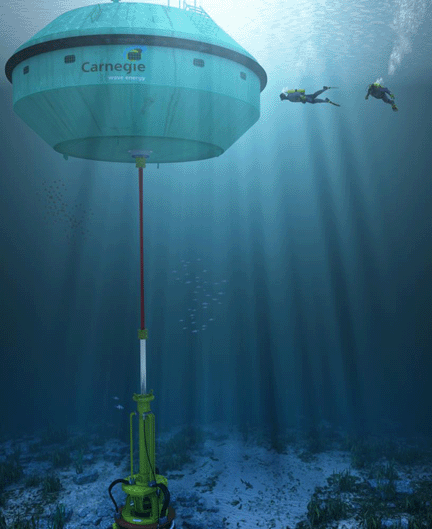 WA election delivers win for Carnegie 20MW Albany Wave Project http://reneweconomy.com.au/wa-election-delivers-win-for-carnegie-20mw-albany-wave-project-97139/ By Sophie Vorrath on 13 March 2017
ASX listed wave power and microgrid specialist Carnegie Clean Energy said on Monday that the election of the Labor McGowan government had confirmed the party’s $19.5 million funding commitment for Carnegie’s Albany Wave Energy Project.
The project, flagged by the company last month as contingent on a Labor Party win, aims to develop a 20MW wave energy farm off the coast of Albany, using its CETO 6 technology, pictured above.
According to Carnegie, Albany has one of the most consistent wave energy resources in the world, experiencing greater than 1 metre swell, 100 per cent of the time.
The project – which would likely have its beginning as a 1MW pilot – would be aligned with the regions existing infrastructure, including an existing wind farm.
At 20MW, the project would be Australia’s first commercial scale wave farm, demonstrating the potential to deliver 24/7 renewable energy into the grid. From there, Carnegie says, the 20MW farm could spin out to a 100MW facility.
All this is not new – Carnegie has been working on plans for a wave farm in Albany for nearly a decade and has spent over $1 million on studies, surveys and designs for the region, including site assessment, wave resource mapping, licensing and site design.
Now, it can also tick off a state government that is committed to back the project, after Western Australia’s Coalition government was convincingly beaten at the polls by the Labor party led by Premier elect, Mark McGowan.
Like other state Labor governments around the country, McGowan’s team promises to be more supportive of renewable energy development than its predecessor – although the party has recently backtracked plans to introduce a 50 per cent renewable energy target for the state.
Having revealed plans to draw at least half of the state’s energy from renewable sources by 2030 at a National Environmental Law Association conference in Perth in October, Labor energy spokesman Bill Johnston now says the party won’t introduce a target, but will have more ambition on renewables than the LNP.
“After the election, we will sit down with industry and the community to see what is achievable and affordable,” Johnston said in early February.
While many have criticised the party for its apparent backflip, Carnegie CEO Michael Ottaviano says his company is delighted to be working with the state’s newly elected government to deliver on the potential of wave energy at Albany.
“Wave energy justifiably demands the sort of investment that other power technologies, whether fossil fuel or renewable, have benefited from and the government’s $19.5million commitment is a strong step towards this,” he said.
Former Minister Macfarlane keen to “protect miners from native title”
 Minister-turned-lobbyist Ian Macfarlane says mines need protection from native title
Macfarlane urges MPs to pass legislation to protect land use agreements as Indigenous leaders call for consultation, Guardian, Gabrielle Chan, 13 Mar 17, The former federal resources minister Ian Macfarlane has said the majority of 126 mining projects under Indigenous land use agreements could be shut down pending renegotiations following a federal court ruling on native title.
His comments come after a federal court ruling in the McGlade native title case found that an Indigenous land use agreement (Ilua) was invalid because not all Indigenous representatives had signed it.
Macfarlane, who heads the Queensland Resources Council (QRC), said the ruling jeopardised mining projects already in operation under Indigenous land use agreements (Iluas) which had been signed by a majority of Indigenous owners but not every owner. This meant those projects – a majority of which are in Queensland – could be shut down pending new agreements.
The ruling could also affect the controversial Adani Carmichael coalmine.
Macfarlane said the implication of the ruling was that mining companies would need to seek the signatures of all Indigenous owners, including deceased people. …….
The legal and constitutional affairs legislation committee is examining a government bill that would amend the native title legislation to confirm the legal status of registered Iluas with a majority but not all the signatures of all claimants. Macfarlane urged the parliament to pass the bill.
But Labor and the Greens have argued that the Coalition is rushing the bill through without proper consultation with Indigenous communities.
Wangan and Jagalingou traditional owners opposed to Adani’s Carmichael mine want the inquiry to be extended to allow proper consultation with Aboriginal communities.
“We are dealing with mining proponents who wish to destroy our country and disrespect our protocols on how we make decisions,” spokesman Adrian Burragubba told the committee.
“If the federal government intends to override the McGlade decision, the federal government would further disenfranchise the Wangan and Jagalingou people and further eliminate the voice of the true rightful traditional owners.”
The Cape York land council has objected to the legislation because it provides blanket validation for all agreements but it did not dispute certainty was required over Iluas……..https://www.theguardian.com/australia-news/2017/mar/13/minister-turned-lobbyist-ian-macfarlane-says-mines-need-protection-from-native-title
Adani to send Coal mine $billions to Cayman Islands

Last year Resources Minister Matt Canavan dismissed the ABC’s investigation into Adani’s web of companies leading to tax havens as “fake news”.
Adani’s planned Carmichael coal mine to shift millions to Cayman Islands controlled company, ABC News 13 Mar 17 by Stephen LongUp to $3 billion from Adani’s planned Carmichael coal mine will be shifted to a subsidiary owned in the Cayman Islands if the controversial project goes ahead, an analysis of company filings shows.
Key points:
- ‘Royalty deed’ gives shell company rights to recieve $2-a-tonne payment beyond first 400K tonnes mined for two decades
- Entitlement owned by company registered in Cayman Islands, controlled by Adani family
- Carmichael coal mine’s production capacity means payment ammounts to about $120 million per year
An “overarching royalty deed” gives a shell company rights to receive a $2-a-tonne payment, rising yearly by the inflation rate, beyond the first 400,000 tonnes mined in each production year for two decades.
The company with this entitlement is ultimately owned by Atulya Resources Limited, a secretive entity registered in the Cayman Islands, and controlled by the Adani family.
“In plain English, the upshot for the Adani family is [that] if the mine goes ahead, they receive a $2-a-tonne payment, so up to $3 billion, via a Cayman Islands company, a company owned in a tax haven,” says Adam Walters, principal researcher and Energy Resource Insights……
“I would describe it as a structure that means that the Adani family enriches themselves if the mine goes ahead but that other shareholders are impoverished,” associate professor Thomas Clarke, director of the Centre for Corporate Governance at UTS told the ABC.
“The worry is that this may be just the beginning.
He said the billions flowing to the Adani private company would come at the expense of minority shareholders in the company listed on the Bombay stock exchange which ultimately owns the Carmichael mine.
Media player: “Space” to play, “M” to mute, “left” and “right” to seek.
How Adani acquired the right to this multi-billion-dollar revenue stream is a tale in itself……..
Last year Resources Minister Matt Canavan dismissed the ABC’s investigation into Adani’s web of companies leading to tax havens as “fake news”.
He rejected concerns about the web of companies and trusts, many owned in tax havens, that Adani had set up for its Australian operations, says resources companies such as Rio Tinto and BHP also had complex company structures.
Dr Clarke said that is nonsense.
“This is a classic third-world pyramid structure, with the Adani family having a controlling interest in all of the different companies, publicly listed, privately listed and the offshore companies which are its private properties,” he told the ABC.
“It can freely move cash or assets between the different entities to the benefit of its own family interests.”
But according to the Minister, the advice from his department is that it is all perfectly legal.
Adani’s spokesman did not respond to a series of questions.http://www.abc.net.au/news/2017-03-14/adani-carmichael-coalmine-to-shift-millions-to-cayman-islands/8350704
Rainbow Bridge to Fukushima
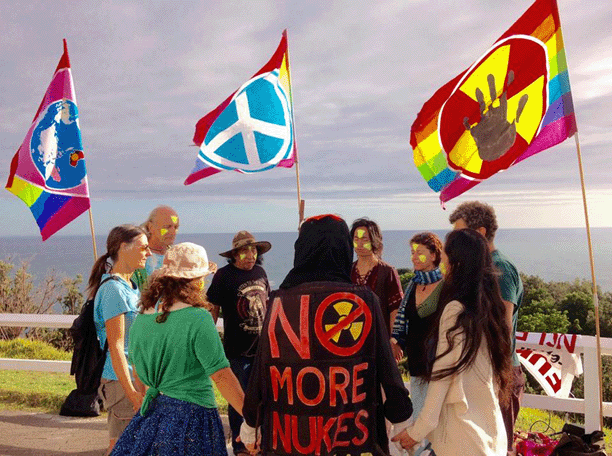
Benny Zable with Chibo Mertineit and 4 others . Sat 11 March 2017 Cape Byron Lighthouse, Byron Bay, Australia
Anti-nuclear activists gathered at Cape Byron Lighthouse today morning to mark the sixth anniversary of the tsunami that crippled the nuclear power reactors in Fukushima and to send a message of solidarity to the people of Japan.
Morning joggers and walkers were greeted by the sound of shakuhachi and Indonesian harp. The Pacific ocean rose in gentle swells; an osprey rode the updrafts.
Local activist Iris Nunn led the group in prayers for the children and families of Fukushima. Nimbin resident Chibo Mertineit spoke of the long peoples’ struggles to stop the spread of nuclear power that started in West Germany in the seventies and is now part of a global movement to draw attention to the perils of the nuclear age.
Activists unfurled a banner that said: Fukushima reminds us that nuclear power is a dead end.
With radioactivity still spilling into the oceans, land and air, activist called for urgent international assistance to resolve the crisis.
Artist and environmentalist Benny Zable said: “Say no to nuclear. Go Green!’ Pic: Harsha Prabhu
UNDEMOCRATIC NUCLEAR WASTE LAW DISEMPOWERS COMMUNITIES AND TRADITIONAL OWNERS

 Friends of the Earth Australia is today releasing a detailed report on the National Radioactive Waste Management Act 2012 (NRWMA). The report ‒ written by Monash University fifth-year law student Amanda Ngo ‒ comes against the backdrop of the federal government’s targeting of a site near Hawker in SA’s Flinders Ranges for a national radioactive waste store and repository.
The NRWMA is heavy-handed, undemocratic legislation that gives the federal government the power to extinguish rights and interests in land targeted for a radioactive waste facility. In so doing the Minister must “take into account any relevant comments by persons with a right or interest in the land” but there is no requirement to secure consent. Traditional Owners, local communities, pastoralists, business owners, local councils and State/Territory Governments are all disadvantaged and disempowered by the NRWMA.
The NRWMA disempowers Traditional Owners ‒ in this case Adnyamathanha Traditional Owners ‒ in multiple ways, including:
- The nomination of a site for a radioactive waste facility is valid even if Aboriginal owners were not consulted and did not give consent.
- The NRWMA has sections which nullify State or Territory laws that protect the archaeological or heritage values of land or objects, including those which relate to Indigenous traditions.
- The NRWMA curtails the application of Commonwealth laws including the Aboriginal and Torres Strait Islander Heritage Protection Act 1984 and the Native Title Act 1993 in the important site-selection stage.
- The Native Title Act 1993 is expressly overridden in relation to land acquisition for a radioactive waste facility.
Adnyamathanha Traditional Owners have been clear in their opposition to the planned radioactive waste facility in the Flinders Ranges. “I call upon the Federal and State Governments to put an end to this volatile position that the Adnyamathanha people are facing,” said Adnyamathanha Traditional Owner Enice Marsh. “Native Title and the Aboriginal Heritage Act are not protecting our land. This needs a complete review or a Royal Commission. The Barndioota site in the Flinders Ranges must be struck off as a potential radioactive waste dump site and the National Radioactive Waste Management Act needs to be amended to give us the right to say ‘no’.”
Adnyamathanha Traditional Owner Regina McKenzie, who lives on Yappala Station near the proposed dump site, said: “The NRWMA is a political attack on Adnyamathanha women’s spiritual beliefs. The destruction of our culture and significant woman’s sites is a form of assimilation and thus breaches Article 8.1 of the UN Declaration on the Rights of Indigenous Peoples. The NRWMA also breaches Article 25 of the UN Declaration which refers to our spiritual relationship with the land and the right to maintain and strengthen our culture. This is a breach of our Aboriginal human rights and our people and amounts to cultural genocide.”
The NRWMA has been criticised in both Senate Inquiries and a Federal Court challenge to an earlier federal government attempt to impose a national radioactive waste facility at Muckaty in the Northern Territory.
The NRWMA also puts the federal government’s radioactive waste agenda above environmental protection as it seeks to curtail the application of the Environment Protection and Biodiversity Conservation Act 1999.
Dr Jim Green, national nuclear campaigner with Friends of the Earth Australia, said: “A senior government official claims the NRWMA is based on ‘world’s best practice’. In fact, the legislation systematically disempowers local communities and Traditional Owners and weakens environmental protections. It needs to be radically amended or replaced with legislation that protects the environment and gives local communities and Traditional Owners the right to say no to nuclear waste dumps.”
Amanda Ngo’s paper, ‘National Radioactive Waste Management Act 2012′, is posted at http://tinyurl.com/nrwma-2017
Labour’s win in Western Australia means more gloom for the uranium industry
 Uranium calls for approved projects to go ahead, Paul Garvey, The Australian, Mining & Energy, March 13, 2017 Resources reporter Perth Labor’s emphatic victory in the West Australian election has cast a shadow over the state’s uranium sector, with the industry urging the incoming government to keep the door open for the most advanced uranium projects.
Tesla batteries to the rescue for South Australia’s electricity system?
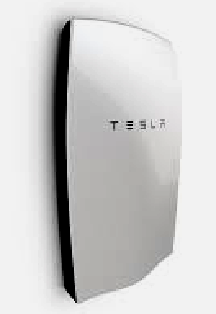 Greens say Elon Musk’s plan is a game changer Australian
  Greens Senator for South Australia Sarah Hanson-Young says Elon Musk’s proposal to solve South Australia’s energy crisis with battery storage is the game changer our state needs to switch back on.
“We live in the perfect state for wind and solar. Battery technology allows us to make hay while the sun shines, storing the power so we can use it when we want and need. While chairing a senate inquiry into battery storage, I’ve heard evidence that if 20,000 homes with solar panels had a battery as well, the load shedding that cut off the air conditioning when we needed it most last month wouldn’t have happened.
“This is the innovation Malcolm Turnbull promised when he declared he would be the ‘Innovation Prime Minister’
Elon Musk says his Tesla battery company could solve South Australia’s energy crisis in 100 days Luke Griffiths, Lauren Novak, The Advertiser March 11, 2017 TECH billionaire Elon Musk on Saturday confirmed he’s spoken personally with Jay Weatherill to discuss his company’s plans to build a battery farm to help SA solve its power woes – amid support from the Australian Greens, who say his plan to build a batter farm could be “game changer”.
Michio Kaku – Musk & Game Changing Tesla Powerwall Battery
Elon Musk in talks with Malcolm Turnbull on energy storage
 Elon Musk, Malcolm Turnbull in talks on renewables after billionaire’s ‘100 days or it’s free’ pledge http://www.abc.net.au/news/2017-03-12/elon-musk-malcolm-turnbull-in-talks-on-renewables/8347554 Prime Minister Malcolm Turnbull says he has held a “great, in-depth discussion” with Elon Musk, after the billionaire tech entrepreneur offered to fix South Australia’s energy problems within 100 days.
On Friday, Mr Musk said energy storage could solve the state’s electricity problems with a Tesla battery farm, and work could be completed within 100 days, or it would be free.
He followed that up in talks with South Australia’s Premier Jay Weatherill, later tweeting that he was impressed by the State Government’s commitment to a “smart, quick solution”.
Twitter was again the preferred medium of communication on Sunday, with Mr Musk and Mr Turnbull swapping appreciative tweets after speaking for nearly an hour.
Tesla’s energy storage could be the answer to South Australia’s electricity problems
Tesla’s offer: How SA’s power network could benefit from energy storage, ABC News, By Michael Collett 11 Mar 17 South Australia’s energy network has been struggling of late — there were forced blackouts for tens of thousands of homes during a heatwave last month because there wasn’t enough power to meet demand.
But Tesla thinks it has a solution. The company’s billionaire boss Elon Musk says he could install a battery farm capable of fixing the system within 100 days of signing a contract.
It’s a suggestion that the Grattan Institute’s energy expert Tony Wood says should be taken seriously, but it’s not the only electricity storage option that’s available.
What’s the advantage of electricity storage? The idea is that energy storage technologies can take power during off-peak hours and put it back into the grid when it’s needed.
As well, wind and solar are intermittent sources of electricity generation, so this power needs to be stored if the grid is to rely entirely on renewables. (Keep in mind that South Australia already gets about 50 per cent of its energy from renewables, mostly wind and solar.)
One storage technology that’s getting a lot of press is Tesla’s Powerpack.
Tesla says this battery is “infinitely scalable” — that means a business could buy a single Powerpack so that it still has power during a blackout, while a city, state or country could install hundreds, thousands or even millions of them in order to support an entire grid.
In 2015, Musk said you’d be able to transition the United States to renewable energy with 160 million of them, and the entire world with 900 million……
Big rise in solar panel installations in South Australia
 Installation of solar energy panels surge after SA blackouts http://www.adelaidenow.com.au/news/south-australia/installation-of-solar-energy-panels-surge-after-sa-blackouts/news-story/81095cb24712a2509971378a92c19cb6 Daniel Wills, State Political Editor, The Advertiser March 12, 2017
INSTALLATION of solar panels have surged in the wake of SA’s statewide blackout, despite a cutback in customer tariffs, as homes and businesses take power security into their own hands.
Figures released by Solar Citizens shows SA spent about $23 million on panels in the final quarter of last year, a more-than 17 per cent jump compared with the same period in 2015.
In the second half of 2016, after an incident in July when volatile prices almost forced the temporary closure of some of SA’s biggest employers, 6424 solar systems were installed in the state.
That lifted the overall number of solar systems in SA to a huge 205,068.
At the same time, diesel generator sellers are reporting a huge surge in interest.
Solar Citizens SA campaigner Dan Spencer said households were clearly looking to panels as a technology that could bring down prices as well as add some backup to the grid.
“While politicians attacked SA’s clean energy leadership, South Australians took action at home,” he said. “With solar and storage becoming cheaper and more affordable every day it’s no surprise that ordinary South Australians have looked to clean energy.”
The top five suburbs for solar installation since the blackout were located in regional or outer suburban areas with incomes below the SA average. The regional suburb of Waitpinga led the way and was followed by Smithfield Plains, Salisbury North, Angas Plains and Morphett Vale.
Clean Energy fund puts $130m into affordable housing
(subscribers only)
http://www.afr.com/real-estate/residential/nsw/clean-energy-fund-puts-130m-into-green-affordable-housing-20170312-guw87k
South Australian Liberal Party condemns the plan to import nuclear wastes
 Fight To Stop Nuclear Waste Dump In Flinders Ranges , 11 Mar 17 SA Response of the office of South Australian State Liberal leader Steven Marshall, to query about Liberal opinion on the plan to import nuclear waste.
The State Liberal Team is united in its decision not to proceed with a nuclear waste dump.We have carefully considered the Royal Commission Report. We have taken note of the outcomes of the community consultation. We have actively participated in the parliamentary committee process. We have visited Finland, France and the United States to consider the technical aspects and financial risks.
It is clear that Premier Jay Weatherill’s plan to make South Australia the world’s nuclear dumping ground exposes taxpayers to unacceptable financial risks without knowing whether the project will even proceed.
For 70 years the State Liberal Party has demonstrated its commitment to creating realistic opportunities in the nuclear industry with the establishment of the Radium Hill mine and later the Olympic Dam Mine under Liberal Premiers Playford and Tonkin respectively……
The Premier, lacking support from his own Cabinet, had to establish a Citizen’s Jury at taxpayers’ expense, to progress his own agenda and with access to a wide range of advice, two-thirds of that jury has determined that this venture should not be pursued ‘under any circumstances’.
Appointed by the Premier, Royal Commissioner Kevin Scarce has acknowledged that it could take up to 10 years to secure vital public support and another 28 years to establish such a facility.
The advice to State Parliament shows it will cost taxpayers $600 million to continue the consultation and select a site without any guarantee of eventually securing investors or customers for the facility……The Weatherill Labor government is playing poker with your money and our state will be forced to place a blind bet of $600 million just to stay in the game…..
Nuclear Waste storage is a responsibility for those nations using nuclear power. It is not the instant fix for the South Australian economy as promised by the Premier. https://www.facebook.com/groups/344452605899556/

Murdoch media’s unfounded criticism of Queensland’s renewable energy plan

 Queensland govt slaps down LNP, Murdoch over renewable scareshttp://reneweconomy.com.au/queensland-govt-slaps-lnp-murdoch-renewable-scares-43765/ By Giles Parkinson on 8 March 2017
The conservative LNP has been getting a big run in the Murdoch press with a new anti-renewables campaign, which has wound up significantly since the start of the year with a host of new solar projects that will add 1GW of solar power to the state’s grid.
But Bailey wondered why the LNP hadn’t even bothered to make a submission to the government’s renewable energy review that it attacks so much. In total, 2,300 submissions were received, but none from the LNP or any of its MPs.
“Once again, all we’re hearing is anti-renewables doom and gloom, but of the 2023 submissions received by the Independent Panel following their public forums across the state, not one of them was from the LNP,” he said.
“On the leash of their Canberra mates, they run around the state, scaremongering and threatening to scrap Queensland’s RET if elected, but they were too lazy to do the work – to make a submission where it actually counts.
The LNP, in recent days, have been trying to make much of a report in The Australian which breathlessly announced in an “exclusive” story on its front page on Monday that it had acquired a “leaked” copy of an Australian Energy Market Operator submission into the Queensland government plans.
And while AEMO had warned that coal generators in Queensland may close earlier than expected, a line that the Murdoch media was keen to play up (it even wrote a follow-up story and an editorial the following day), Bailey pointed out that these generators were young, and most importantly, mostly government-owned.
That means that the Queensland government will not be in the same position as South Australia, which has had to watch with growing frustration as the private owners of the biggest gas plants in the state decide not to switch on during high demand periods, claiming they can find no economic incentive to help keep the lights on for their customers.
On the subject of South Australia, premier Jay Weatherill said the state had no intention of rowing back on its 2025 target of 50 per cent renewables, saying to do so it would have to effectively “physically prevent” developments in their tracks.
That much is true, because the build-out of the Hornsdale wind farm and the Tailem Bend solar project will take the state to 50 per cent wind and solar by the end of this year.
Weatherill says the biggest threat to power prices in South Australia is the lack of competition among generators, something that can addressed by having more renewable energy and other technologies such as battery storage.
Weatherill says the state will “soon” release” its planned intervention to ensure that no more rolling stoppages occur – as they did last month – while some gas generators sit idle. From that point of view, he must envy Queensland’s ownership of power generators.
Back in Queensland, Bailey also said Queensland has a high amount of (mostly government-owned) flexible gas-fired generation, which enables the system to ramp up quickly.
He said the government had confidence in the modelling, and in its conclusions that it would be broadly cost neutral to electricity consumers, and would not affect reliability.
Bailey also said the Palaszczuk Government is committed to transitioning to a clean energy future gradually and sustainably, while keeping affordability and network reliability front and centre.
“We’ve kick-started a renewable energy boom with more than 1GW of privately funded renewable energy projects currently in the works delivering more than $2 billion of new investment to Queensland and more than 1900 direct jobs, mostly in our regions,” he said.
“Energy is undergoing a transformational change in the way it is generated, transported and used – the former LNP government did nothing to prepare for this.
“Importantly, the benefits of the RET to the Queensland economy, particularly in regional areas will be largely driven by the additional $6 billion investment in renewable energy, and a projected increase of around 6,400-6,700 jobs per year on average between 2020 and 2030.
“The anti-renewables LNP have no credibility on energy policy. They oversaw the loss of 1300 renewable industry jobs while in government and inflicted 43 per cent electricity price hikes on consumers.”
Australia has already 43% increase in solar rooftop installations, in 2017
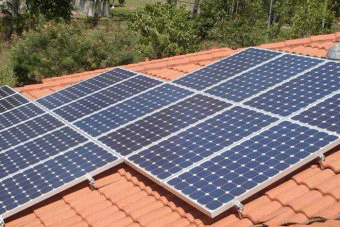 Rooftop solar installs up 43% in 2017, on back of power market woes, REneweconomyBy Sophie Vorrath on 10 March 2017
According to the latest monthly insights report from SunWiz – based on data from Solar Choice – February was an excellent month for solar PV growth, and registrations have been clocked at 43 per cent better than 2016 YTD, driven largely by residential installs.
The February rebound marks the second best month for solar PV installs in Australia since 2013 – the best month since 2013 being December 2016……..http://reneweconomy.com.au/rooftop-solar-installs-43-2017-back-power-market-woes-61166/
Australian Prudential Regulation Authority (Apra) could require financial institutions to test climate risks
Finance sector could face climate-risk testing, says Australian watchdog
Regulator says it may add climate change to the list of scenarios it asks institutions to run to check economic resilience, Guardian, Gabrielle Chan, 9 Mar 17, Australia’s financial institutions could be required to test climate-risk scenarios as international regulators continue to warn of the economic dangers posed by climate change.
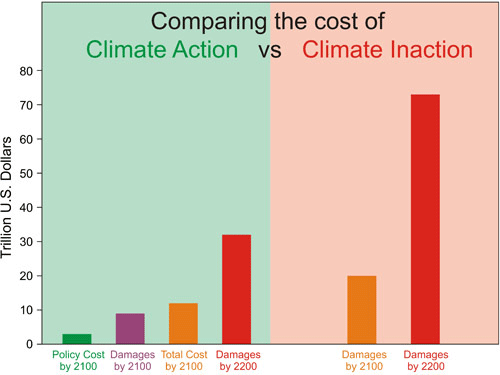
Geoff Summerhayes, executive board member of the Australian Prudential Regulation Authority (Apra), told a Senate committee that climate scenario testing could be added to the other common scenarios Apra requires financial institutions to face to ensure their systems are robust.
It’s been more than a year since the COP21 Paris climate change conference, when the former New York City mayor Michael Bloomberg was appointed to head a taskforce to provide investors, insurers, banks and consumers with more information. The move was part of plans for a voluntary industry-led code announced by the Financial Stability Board (FSB), the G20 body that monitors and makes recommendations about the financial system.
Last month Summerhayes warned climate change posed a material risk to the entire financial system and urged companies to start adapting. Apra is the regulator that oversees the $6tn industry made up of banks, building societies, superannuation, insurance companies and other financial institutions.
Summerhayes said Apra already sent out common scenarios for institutions to test. These scenarios have an economic factor, including an asset price shock and, in the case of the insurance industry, a potential liabilities scenario as well.
He acknowledged the Bank of England’s Prudential Regulatory Authority (PRA) had been very active on climate change. The bank’s governor, Mark Carney, has warned of financial crises and falling living standards unless corporations faced up to the risks. “Apra is not first prudential regulator to make statements about climate,” he said.
Emma Herd, the chief executive of Investor Group on Climate Change, told the committee the political debate in recent years had stopped companies speaking publicly about their strategic response to climate change…….
The Senate inquiry, initiated by Greens senator Peter Whish-Wilson and restarted after the federal election, is looking into carbon risk and disclosure in corporate Australia.https://www.theguardian.com/business/2017/mar/08/finance-sector-could-face-climate-risk-testing-says-australian-watchdog
1 This month
17 October, Free Public Talk on Nuclear Issues in South Australia
David Noonan will speak on public interest concerns over the new Roxby Downs Indenture Act 2026 on BHP copper-uranium mining and ore processing in SA, and on how AUKUS may face SA with a High-Level nuclear waste agenda.
Dr Jim Green will discuss international developments in the field of nuclear power including ‘small modular reactors’ and Generation 4 ‘advanced’ nuclear reactor concepts.


Help Aunty Sue Protect Her Land and Sacred Sites From Destructive Rocket Testing.
.

Australians deserve the truth
about
AUKUS – https://aukuspublicinquiry.com/

PETITION – To: Prime Minister Anthony Albanese and the Australian Labor Government

of the week – Australians for War Powers Reform (AWPR)
To see nuclear-related stories in greater depth and intensity

