Temps Rising: Greens Plan To Ban Coal Within 10 Years Amid Record Heat Wave, New Matilda, By Justin Fieldon March 8, 2017 Climate change is already a reality, as recent weather on the east coast proves, writes Justin Field.
This summer saw record-breaking temperatures across New South Wales and most of eastern Australia. January 2017 recorded the highest monthly mean temperatures on record for Sydney.
The Bureau of Meteorology has confirmed the 2017 heatwave was the most severe since 1939, and since that time the frequency of such intense large-scale heatwaves has increased across spring, summer and autumn, and especially over the past 20 years. The maximum temperatures from the February 2017 heatwave now make up eight of the top 10 highest February temperatures for NSW ever.
What set this heatwave apart was the prolonged period of sweltering days and nights which impacted over one-third of the state. The people out at Moree suffered the most with 54 days in a row over 35 degrees. Walgett had 48 days above 35 degrees.
The heatwave contributed to almost 100 fires across NSW in February. Homes, stock and agricultural assets were lost.
NSW Health issued an air pollution alert and warning to those with asthma or respiratory problems on January 10, with ozone pollution made worse by the hot, still conditions. In Victoria, the heatwave was blamed for a large spike in deaths.
On the NSW South Coast, dairy farmers reported cattle dropping dead in the heat and humidity. Piles of dead turtle hatchlings were found on Queensland’s Mon Repos beach amid a heatwave which pushed the sand’s temperature to 75 degrees. This important breeding site for the Loggerhead turtle was turned into a baby turtle graveyard overnight.
Sydney Harbour suffered its first ever recorded coral bleaching last year and scientists predict more this year, with water temperatures exceeding 26 degrees at times.
Water temperatures have been more than 3 degrees warmer than average off parts of the NSW South Coast. It doesn’t sound like much when you’re enjoying mid 20s water on a 35 degree day, but marine life aren’t used to these spikes – these are signs that the ecological balance is at risk.
Of course, these heatwaves, fires, warming oceans and coral bleaching fit the predictions of climate change science about the impact of greenhouse gas emissions primarily by human activity.
New research released in February concluded that human activity was changing the climate 170 times faster than natural forces.
We are already seeing some key tipping points start to flip. In February, sea ice in Antarctica hit a record low. The melting permafrost in Siberia is causing craters to form on an ever-larger scale with the resulting methane release driving further global warming.
Before our very eyes the warnings of scientists are being realised. Climate change is not something off in the future – it is here and now – and given science has been right so far, their predictions about what happens next without action to drastically reduce emissions are truly frightening……..
The Greens, under Energy and Resources spokesperson Jeremy Buckingham have launched its ‘climate not coal’ policy. It sets out a 10-year framework for the phase out of thermal coal mining in NSW. This is a managed transition that calls for a 1 billion tonne cap on the amount of thermal coal that can be mined during the phase-out period while a supported exit of the industry occurs.
A $7 billion fund to assist impacted workers and communities would be created through the auctioning of permits to access the remaining coal allowance.
There’s no such thing as clean coal, says West Australian premier Colin Barnett, placing him at odds with his federal Liberal counterparts.
Mr Barnett dismissed the notion of clean coal when outlining the balance of energy production in WA, saying more than half of the state’s energy came from natural gas, which he described as a clean technology.
“I mean, all this stuff about clean coal, no such thing as clean coal,” Mr Barnett said. “Natural gas is cleaner, produces less than half of the emissions of a coal power station so it’s a good technology to use.”
Mr Barnett said if re-elected his Liberal government would move to balance energy production between gas, renewable and coal.
Mr Barnett’s comments on clean coal differ with those of his federal counterparts, who are working to finance new coal-fired power.
The federal government is exploring how it can allow the Clean Energy Finance Corporation to invest in the so-called ultra-supercritical coal-fired power plants and carbon capture and storage.
Prime Minister Malcolm Turnbull, who is currently in Indonesia, was unavailable for comment.
LG Chem, the South Korean battery storage maker that has so far claimed the biggest share of the nascent Australian market, says that solar and battery storage is already beating grid power in most states.
The assessment by LG Chem follows similar analysis by private energy consultants, and suggests that the market for battery storage could be about to take off, even with looming threats of restrictions.
According to Jamie Allen, the marketing head in Australia for LG Chem, a 5kW rooftop solar system and a 10kWh battery storage device (such as LG Chem’s own 9.8kWh offering) can be purchased and installed for around $15,000.
Based on the assumed output of around 22kWh a day from the solar array, that makes the cost per kWh of solar power at around 22c/kWh over 10 years.
Given that most flat rate per kWh tariffs start at around 23c/kWh or 24c/kWh – even in NSW where there are high fixed network charges on top of that – the solar power is still on the money, although the battery storage is essential to ensure that much of that output is used directly, or stored for later use at night.
Of course, the actual cost per kWh of the solar output would be less than half the 22c/kWh cited here, because the panels would last well beyond 20 years.
But the 10 year time frame is used because that is the warranty period for most battery storage and it is the “combo” package that is being promoted. And without storage, then much of the output would have to be exported, with tariffs in NSW as low as 6c/kWh or non-existent for some.
What does this tell us? Allen says it is that storage is crucial to maximize the value of that solar output. Every kWh that can be consumed on site will beat the cost of production.
Of course, this is not the only benefit. Allen notes that the solar system will likely last at least another decade, possibly two, and the cost of battery storage to replace the current system will also be cheaper, while grid costs are likely to rise.
More than 200 weather records were broken during the intense, “angry summer” just finished, putting stress on Australians and the ageing energy system.
A report from the Climate Council, released on Wednesday, says the summer was characterised by intense heatwaves, hot days and bushfires in central and eastern Australia but heavy rainfall and flooding in the country’s west.
Climate scientist Will Steffen said the effects of climate change could be seen in the 200 records broken in 90 days.
“We’re experiencing unprecedented extreme heat and setting new records at an alarming rate, with every part of Australia feeling the impact,” he said.
“Extreme weather will continue to intensify through this century if we continue to sit on our hands and fail to move rapidly to get fossil fuels out of our economy.”
Extreme weather events have dominated a wetter-than-average year in Australia, with the country also clocking its fourth-warmest year on record in 2016.
Fellow climate councillor and energy expert Andrew Stock said the “ageing, inefficient and polluting” energy system already struggled to cope with heatwaves and extreme weather and would come under even more pressure as these intensified.
The energy system is under scrutiny after blackouts in South Australia and load shedding in NSW during hot days.
“It’s time for Australia to power our economy with a 21st century energy system, one which deploys proven renewable technology and storage solutions instead of relying on high greenhouse emitting fossil fuels,” Mr Stock said.
“These fossil fuels are the very culprits feeding the extreme weather cycle. We have to stop backing the wrong horse.”
The federal government is facing increasing calls – including from big business and electricity generators – to give certainty to the energy sector and put in place some kind of carbon price, such as an emissions intensity scheme.
Records broken over the 2016-17 summer include:
Hottest summer on record for Sydney, NSW as a whole, Brisbane, and Canberra
Hottest Adelaide Christmas day in 70 years at 41.3 degrees
NSW town Moree had 54 consecutive days with temperatures reaching 35 degrees or higher
Canberra had 18 days with temperatures 35 degrees or higher (previously predictions said this wouldn’t happen until after 2030)
Highest summer rainfall for Perth at 192.8mm
Wettest December on record for parts of the Kimberley
Highest daily January rainfall in the east Kimberley
REneweconomy, By Giles Parkinson on 6 March 2017, It didn’t take long after the failure of South Australia’s two biggest gas plants late on Friday afternoon for the abuse to start flowing. “Renewables, absolute frigging BS,” wrote one correspondent in an email to RenewEconomy within a few hours of the sudden loss of 600MW of gas-fired generation. “What a lot of crap this renewable story is.”
It happens all the time.
+ When a storm knocks down three power lines in September, the immediate reaction is to blame renewables;
+ when a condenser in Victoria hits the ground and takes out the main inter-connector, forcing rolling stoppages in South Australia, the immediate reaction is to blame renewables;
+ when more storms take down power lines after Christmas, causing more outages in South Australia, the blame is put on wind and solar;
+ and when the market operators turn out to be the only people in South Australia unaware of a pending heat wave, forcing them to miscalculate a demand surge and impose rolling stoppages, it was once again the fault of renewable energy.
Friday’s events, however, took this blame game to a new level. Some sort of explosion occurred at the Torrens Island gas plant, starting fires and causing three units (totalling 400MW) to suddenly trip off and lose power, and causing the Pelican Point gas generator (210MW) to do the same.
In response, the market operator asked some other gas generators to fire up, and it and the government asked consumers to reduce their power load where they could, particularly with air conditioning.
The very same approach had been taken by the NSW government with their coal-fired grid a few weeks earlier when two units at one of the state’s biggest coal generators packed up and the two biggest gas generators either tripped or failed to start when needed.
And, as occurred in NSW, solar and wind played a critical role in keeping the power on. Energy minister Tom Koutsantonis said that if it wasn’t for wind and solar then the lights would have gone out on Friday. Indeed, rooftop solar PV was providing 13.5 per cent of the state’s electricity demand when the gas plants tripped.
Apparently, though, it’s all the fault of renewables, a conclusion drawn from the same twisted logic that supports the gun lobby in the US. As Don Russell wrote in The Monthly, guns killed 301,797 people in the US between 2005, and 2015 (and terrorists killed 95), but it wasn’t guns but restrictions on guns that was cited as being the fourth greatest fear in the US.
And the most worrying part of this reaction is that it is not just the province of the unhinged and uninformed individual. Were this the response of an isolated few, it could be safely ignored. But it hasn’t been, and many people are under the same myths and misapprehensions.
Indeed, the campaign against renewables has been led by the federal government, from prime minister Malcolm Turnbull all the way down, and reached new levels of stupidity on the weekend when the Coalition repeated its desire to build a new coal-fired power station in Queensland because, wait for it, the current coal-fired power station was not cheap enough………
the spot wholesale price of electricity has averaged more than $200/MWh in Queensland this year. The state’s future prices for 2018 is around $110-120/MWh. That’s more than the cost of a new solar plant.
So, perhaps it could take a leaf out of another major power user in Queensland, the Sun Metals zinc refinery near Townsville, which has also been struggling to deal with high power prices in the huge coal dependent state.
Sun Metals has taken matters into its own hands. Not only has it led the push for a change in market rules to try dilute the power of the fossil fuel generators, whose dominance of the market allows them to set high prices without censure, it has also decided to build its own solar farm.
That project, now a 116MW facility, will provide not only cheaper power than Sun Metals can source from the coal-fired grid, it will lock in costs for at least 20 years. That will give the company the certainty to upgrade and expand its refining operations. Don’t expect to read about this in mainstream media though.
Canavan, meanwhile, continues to push his crazy idea of adding new coal. “We would not be building a new coal-fired power station because we like looking at smoke stacks on the horizon, but I do find power stations inspiring,” he told The Australian newspaper, before confirming that taxpayer funds could be used for such a project.
As the CEFC chief executive Oliver Yates has made abundantly clear, it would not just require taxpayer subsidies and finance to build a coal-fired power station, but billions of dollars in indemnities and guarantees on the off-chance that an Australian government might one day get serious about climate change and impose a carbon price and/or a meaningful emissions reduction target. http://reneweconomy.com.au/fear-and-ignorance-gas-plant-explodes-renewables-blamed-11917/
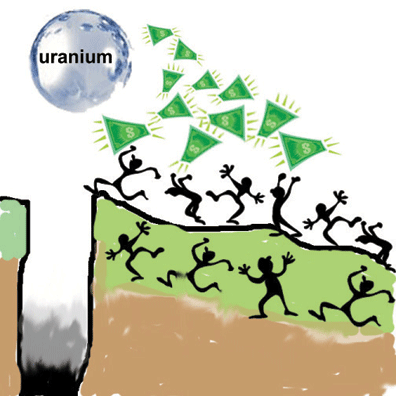
The Federal Environment Minister Josh Frydenberg has given environmental approval to the Mulga Rock uranium mine in WA this week, just days ahead of the election, despite the lack of cross-party support for this toxic industry, the Australian Greens said.
Australian Greens Co-Deputy Leader and Nuclear Issues spokesperson Senator Scott Ludlam said, “This week’s federal environmental approval for the Mulga Rock uranium project is premature and deeply deficient.”
“This decision is a real departure from the norm with virtually no conditions for the environment, for mine closure and rehabilitation or for the management of radioactive mine waste.
“Frydenberg has set a dangerously low precedent for one of Australia’s most dangerous and toxic industries.
“The Mulga Rock uranium project is in a pristine environment, a Priority Ecological Community and home to many rare and endangered species. The project would use 15 million litres of water a day in one of Australia’s most arid regions, and turn that water into radioactive waste. The threat of radioactive mine waste in the environment will remain for thousands of years.
“With the uranium price sitting at $25 / lb, half the amount needed for the project to break even, there is certainly no immediate prospects for this mine to begin construction.
“This fast tracked approval seems to be driven by the politics of the WA State election rather than evidence and good process” concluded Senator Ludlam..
Climate change impact on Australia may be irreversible, five-yearly report says State of the Environment report says heritage and economic activity are being affected and the disadvantaged will be worst hit, Guardian, Katherine Murphy, 7 Mar 17, An independent review of the state of Australia’s environment has found the impacts of climate change are increasing and some of the changes could be irreversible.
The latest State of the Environment report, a scientific snapshot across nine areas released by the federal government every five years, says climate change is altering the structure and function of natural ecosystems in Australia, and is affecting heritage, economic activity and human wellbeing.
It warns climate change will result in “location specific vulnerabilities” and says the most severe impacts will be felt by people who are socially and economically disadvantaged.
Record high water temperatures caused “widespread coral bleaching, habitat destruction and species mortality” in the marine environment between 2011 and 2016, it says.
The minister for energy and the environment, Josh Frydenberg, was due to release the report card on Tuesday morning……
Australia’s heavily populated coastal areas are under pressure, as are “growth areas within urban environments, where human pressure is greatest”, the report finds.
Grazing and invasive species continue to pose a significant threat to biodiversity.
“The main pressures facing the Australian environment today are the same as in 2011: climate change, land use change, habitat fragmentation and degradation, and invasive species,” the report’s summary says. “In addition, the interactions between these and other pressures are resulting in cumulative impacts, amplifying the threats faced by the Australian environment……
The report criticises the lack of “an overarching national policy that establishes a clear vision for the protection and sustainable management of Australia’s environment to the year 2050”.
It points to poor collaboration, gaps in knowledge, data and monitoring and a lack of follow-though from policy to action.
“Providing for a sustainable environment both now and in the future is a national issue requiring leadership and action across all levels of government, business and the community,” it says. “The first step is recognising the importance and value of ecosystem services to our economy and society…….
Farmers back emissions trading scheme, THE AUSTRALIAN, SARAH MARTIN, 7 Mar 17, Australia’s peak farming group has thrown its support behind a carbon price to fix the country’s energy woes, calling on the government to reconsider its opposition to an emissions intensity scheme in the electricity sector.
In its submission to the Finkel review of the Australian energy market, the National Farmers Federation has warned the agriculture sector is struggling without “secure, reliable and affordable” power supply and urges a bipartisan approach to energy policy.
NFF president Fiona Simson said the sector believed the cheapest path to a low-emissions future was “some form of market-based approach”, which could include an emissions intensity scheme.
“For us it is about having everything on the table; we certainly want security of supply, we want affordable power, we are technology neutral and we know we’re moving towards lower emissions,” Ms Simson said.
“It is just how we can actually put everything on the table to guarantee a long-term national plan facilitating a smooth, reliable transition to lower emissions generation.”……
The federal government has ruled out adopting an EIS.
The Australian Institute of Architects has told the review government needs to focus on the demand side of the energy equation, arguing that making changes to energy efficiency of buildings could deliver up to 28 per cent of the 2030 emissions reduction target and achieve $20 billion in energy savings.
“Buildings contribute to nearly half of the country’s electricity consumption and the building sector offers a great opportunity for more energy productivity gains,” said institute president Ken Maher.
The tragedy is that all this could have been avoided if we had seized the opportunity in the 1990s to build a unified national grid, with a single authority running transmission networks and the interconnectors between them. This would still allow competition in generation, but would abandon the idea of market incentives in the provision of network services.
The question has been addressed by pollsters in Britain, which provided the model for Australia’s energy reforms. The results show overwhelming public support for renationalisation, even though the electricity industry has been in private ownership for decades. Even a majority of Conservative voters support public ownership.
The issue will have its next electoral test in Western Australia, where the Barnett government is proposing to sell its majority interest in its electricity distribution enterprise Western Power. While nothing is ever certain in politics, current polls suggest the government is headed for defeat.
The case for renationalising Australia’s electricity grid https://theconversation.com/the-case-for-renationalising-australias-electricity-grid-73951John QuigginProfessor, School of Economics, The University of Queensland March 6, 2017The public debate over the problems of electricity supply displays a curious disconnect. On the one hand, there is virtually universal agreement that the system is in crisis. After 25 years, the promised outcomes of reform – cheaper and more reliable electricity, competitive markets and rational investment decisions – are further away than ever.
On the other hand, proposals to change the situation range from marginal tweaks to politically motivated mischief-making. The preliminary report of the Independent Review into the Future Security of the National Electricity Market, released last year, canvasses such options as the introduction of capacity markets for reserve power, which have done little to resolve problems overseas.
Meanwhile, the Turnbull government has used recent failures to score points against renewable energy (hated, for obscure historical-cultural reasons, by its right-wing base) and to promote the absurd idea of new coal-fired power stations.
A sorry state
This debate might make sense if the system had worked well in the past. In reality, however, the National Electricity Market (NEM) never produced lower prices or more reliable power for households. Continue reading →
Energy executives say gas market – not windfarms – to blame for South Australia’s woes
Main problem afflicting country’s grid is the lack of clear policy direction from Canberra, witnesses tell Senate inquiry, Guardian, Katherine Murphy, 7 Mar 17, Senior executives from AGL Energy have given evidence that the main issue causing problems with reliable energy supply in South Australia is “dysfunction” in the gas market – not too many windfarms making the grid unreliable.Executives from AGL told a Senate inquiry in Melbourne on Tuesday they would like to build a new gas-fired power station in South Australia to increase base load capacity in the state, but gas supply was chronically unreliable in the eastern states.
Richard Wrightson, AGL’s general manager of wholesale markets, told Tuesday’s hearing the problem was so dire the company was contemplating building its own LNG hub in Queensland to help secure reliable supply downstream.
“Dysfunction in the gas market is causing most of the systemic problems we are seeing in South Australia,” Wrightson told the Senate select committee into resilience of electricity infrastructure in a warming world.
“We would love to be able to contract more in that marketplace but the main restriction on being able to do that is access to flexible gas contracts that we are able to trade in an out of.”
The Turnbull government has argued that ambitious state-based renewable energy targets are driving too large a share of low-emissions technologies, such as wind power, into the grid, and that is a significant factor behind the unreliable conditions in South Australia.
But a number of witnesses appearing before the Senate committee on Tuesday said the main problem afflicting Australia’s energy grid was not proliferating renewables, but a lack of a clear policy direction from Canberra. The policy vacuum had created a damaging investment strike in new assets at a time when old coal-fired power generators had reached their natural age of retirement.
Ross Garnaut, the economics professor who led the climate change policy review for the Rudd government and was the independent expert adviser to the multi-party climate change committee that developed the carbon pricing scheme subsequently repealed by Tony Abbott, said the political debate about climate and energy policy in Australia was “incoherent”……
The chief scientist, Alan Finkel – the official leading the energy review – has already provided implicit support for an emissions intensity scheme in his preliminary report to the government, saying it would integrate best “with the electricity market’s pricing and risk management framework” and “had the lowest economic costs and the lowest impact on electricity prices”.
SA power: Taxpayers should buy gas-fired electricity generator, top economic advisor says, ABC News 8 Mar 17 By political reporter Nick Harmsen The South Australian Government should consider buying or leasing a gas-fired electricity generator to help stabilise the state’s expensive and unreliable power supply, South Australia’s influential Economic Development Board says.
The recommendation was made to the Government late last month, according to evidence given to the SA Parliament’s Statutory Authorities Review Committee.
Board member Goran Roos told the committee in the absence of progress on energy policy at a national level, South Australia should consider going it alone.
“In the medium term, which is one to two years, the South Australian Government should consider direct control of electrical generation facilities either through acquisition or leasing arrangements coupled with long-term back-to-back take-or-pay contracts with end users,” Professor Roos told the committee.
“A suitable facility could be the second … Pelican Point gas turbine.”
The second unit at Pelican Point was mothballed in 2013, and was seldom used until the second half of last year.
“ENGIE has argued that the second Pelican Point gas turbine cannot compete with cheaper wind energy and it is commercially unviable to occasionally switch on the gas-fired power plant to meet requirements for a few high-demand days across the year,” Professor Roos said.
“As such, the acquisition costs or lease costs for the second gas turbine should be minimal on an NPD basis, should the Government choose to acquire or lease this facility.
This Alliance initiative is directed at ensuring remote and isolated communities are sufficiently catered for in respect to their energy needs …
“Grassroots energy enterprises, which numbered more than 80 people nation-wide formed an alliance to harness the power of communities to increase local energy security, bolster regional development partnerships, enhance community cohesion, reduce carbon emissions and
work towards a just energy transition. … ”
First Nations Renewable Energy Alliance
“Ghillar, Michael Anderson, Convenor of the Sovereign Union, last surviving member of the founding four of the Aboriginal Embassy and Head of State of the Euahlayi Peoples Republic said from Melbourne:
““Members from First Nations across the continent successfully participated in the Coalition for Community Energy held in Melbourne Town Hall on 27 – 28 February 2017 …
““This Alliance initiative is directed at ensuring remote and isolated communities are sufficiently catered for in respect to their energy needs. The current Australian corrupt system of energy delivery is controlled at the top level by government officials and politicians, who gain a lot of private funding for their political campaigns, in other words:
‘You scratch our backs and we’ll scratch yours.’ The level of corruption in Australian politics is so entrenched that the equity in engagement in respect of sustainable energy strategies is not possible under the current regime.
“We will direct our energies now and in the future to ensure that this corruption does not continue
and thereby give direction to secure certainly for those who seek to partner with us to provide for the development of sustainable communities.” … ”
The record-breaking heat seen across southeast Australia in the last few months was made 50 times more likely by climate change, according to new analysis that links the heat directly to global warming.
Southeast Australia was struck by three major heatwaves in January and February, with temperatures climbing as high as 113°F (45°C) in some places.
On February 10, Sydney Airport recorded its hottest February day on record, with temperatures hitting 109°F (42°C).
The heat was also uncharacteristically persistent — Observatory Hill in Sydney saw temperatures reach above 95°F (35°C) for nine consecutive days in January, breaking a 120-year old record.
Elsewhere, the consistent heat was even more extreme: in Moore, New South Wales, there were 52 consecutive days with temperatures above 95°F (35°C).
The study, conducted by the World Weather Attribution Program at Climate Central, used climate model simulations and observational data analysis to understand how climate change, caused by an increase in greenhouse gases in the atmosphere, might have made these heat events more likely.
They found that climate change made the average temperatures seen this summer in Australia 50 times more likely, and made the maximum summer temperatures 10 times more likely.
“In the past, a summer as hot as 2016–2017 was a roughly 1 in 500-year event,” the researchers wrote. “Today, climate change has increased the odds to roughly 1 in 50 years — a 10-fold increase in frequency.”
The analysis also warns that heat events like these — both punctuated heatwaves and long stretches of above-average temperatures — are likely to become more frequent as climate change continues.
In the future, according to the study, heat events like the one this summer could happen as frequently as every five years — and will likely be more intense, with temperatures averaging at least 1.8ºF (1°C) warmer than they were in the past.
The connection between heat waves and climate change has strong scientific support. In 2015, eight papers published in the Bulletin of the American Meteorological Society’s attribution report — an annual report that explains extreme weather events from a climate perspective — all linked climate change to heatwaves, showing that climate change clearly made heatwaves either more likely, more intense, or both.
According to data from NASA and NOAA, 2016 was the hottest year on record.
Before that, both 2015 and 2014 held that distinction.
In fact, 16 of the 17 hottest years on record have occurred since 2001.
The banks provided a combined $10bn to projects around the world that expanded non-renewable energy, according to finance group Market Forces.
ANZ and the Commonwealth Bank were the worst offenders, investing over $3bn each in fossil fuels. In the same period, ANZ only lent $225m to renewables, giving it a 14:1 ratio. Continue reading →
David Noonan will speak on public interest concerns over the new Roxby Downs Indenture Act 2026 on BHP copper-uranium mining and ore processing in SA, and on how AUKUS may face SA with a High-Level nuclear waste agenda.
Dr Jim Green will discuss international developments in the field of nuclear power including ‘small modular reactors’ and Generation 4 ‘advanced’ nuclear reactor concepts.