Push for coal-fired power Malcolm Turnbull has formed a new, powerful cabinet committee to oversee national energy policy.
Turnbull taskforce to push coal-fired power for north The Australian February 4, 2017 DENNIS SHANAHAN Political Editor Canberra MICHAEL OWEN, Malcolm Turnbull has formed a new, powerful cabinet committee to oversee national energy policy as the government proposes to use some of the $5 billion Northern Australia Fund to help build a new, commercially viable coal-fired power station in northern Queensland……
As parliament resumes next week the Prime Minister is putting energy security and lower power prices at the heart of the Coalition’s policy and political campaign with the new cabinet sub-committee — including Mr Turnbull, Barnaby Joyce, Julie Bishop, Scott Morrison, Mathias Cormann, Josh Frydenberg, Matt Canavan and Arthur Sinodinos — starting to co-ordinate and develop a national energy policy…….
Mr Turnbull and the Treasurer have flagged using funds from the Clean Energy Development Fund for modern coal-powered generators the government has convinced the $100 billion Asia Infrastructure Investment Bank to lend for coal-fired electricity generation in Asia. Senator Canavan, the Minister for Northern Australia, yesterday suggested the government help fund a coal-fired power station in the Galilee Basin in Queensland……
“We back clean-coal options in the north and I want to make clear that we will back investment in clean coal through our $5bn Northern Australia Infrastructure Facility. We set up that facility to build infrastructure in the north, to build specific infrastructure like power stations,” Senator Canavan said….
Defence told to look elsewhere as plan to seize Queensland cattle country sparks outcry
PM tells defence to find other sites to train foreign troops amid anger at plan to expand Shoalwater Bay training area, Guardian, Joshua Robertson, 2 Feb 17, Malcolm Turnbull has ordered the Department of Defence to find alternative sites for foreign military training in Queensland after uproar over plans to take over as many as 60 grazing properties in prime cattle country.
The state opposition leader, Tim Nicholls, on Thursday said the prime minister intervened after a growing backlash over the prospect of compulsory acquisitions, revealed months after an election campaign in which the federal government trumpeted a $2.2bn training deal with Singapore.
The controversy prompted Nicholls to write to Turnbull imploring him to step in after what he said was defence’s mishandling of the proposed training site expansion at Shoalwater Bay and near Townsville.
The federal opposition leader, Bill Shorten, wrote to Turnbull on Wednesday calling for him to urgently review the matter and explain what “alternatives to acquiring prime grazing land” had been considered.
Nicholls’ statement raised doubts about what other options defence, which has compulsory land acquisition powers, had explored to date for expanding training bases to host 14,000 Singapore troops a year………
The parties all warned the loss of drought-resistant grazing land in areas that contain up to 100,000 head of cattle would have a dramatic and harmful impact on the beef industry.
In November landholders in the Marlborough and Charters Towers regions first learned of the possibility their properties would be acquired in letters from defence, which had planned an expansion of about 170,000 hectares.
Defence is yet to decide which properties it will target but the defence minister, Marise Payne, recently ordered the process be sped up with those plans to be revealed next month.
Shell plans Australian solar plants that can switch to gas The Anglo-Dutch oil giant is looking to invest in Australian solar plants that can switch to gas when needed. THE AUSTRALIAN, MATT CHAMBERS, 4 Feb 17
Anglo-Dutch oil giant Shell is looking to invest in Australian solar plants that can switch to gas when needed to deliver baseload power supply as debate rages over renewable energy security in the wake of South Australia’s crippling power outages.
Shell, which is Australia’s biggest LNG exporter and one of the world’s largest oil companies, has revealed that Australia was one of three global locations, along with Oman and Brunei, where it was studying pairing renewable energy with gas, after last year flagging “new energies” would be a potential major source of growth for the fossil fuel company beyond 2020.
“We believe we are in the middle of an energy transition that is unstoppable and we want to be in the vanguard of that,” Shell’s global chief Ben van Beurden said after the company’s fourth-quarter earnings release in Britain on Thursday.
He said renewables alone would not be enough to provide the world with cleaner power.
“An integrated offering of gas and renewables, which cannot only deal with interruptibility and everything else of renewables but also give that second leg that a growing economy needs, is a sensible offering,” Mr van Beurden said.
Chief financial officer Simon Henry confirmed Australia was one of the regions where combined gas and renewables were being studied……..
Shell’s plan, to develop economically viable renewable power stations where a gas switch could be flicked when needed, could reduce the need for both coal-baseload power and expensive gas-only peaking plants…….
Kimba wants to take nuke waste, Peter Jean, The Advertiser. p.6 of print version. “…….Kimba mayor Dean Johnson said a referendum of residents should be held before a final decision was made to build a waste dump in the district ….”
The nomination of the previous sites caused significant divisions within the Kimba community, but two other local landowners have since offered up their properties, called Napandee and Lyndhurst.
Bruce Wilson from the federal resources department said Industry Minister Matt Canavan had not decided on whether to take the proposals forward. “By no means has there been any decision to accept the nominations at this point,” Mr Wilson said. “We are hopeful that in the next few weeks there will be a decision made.”
Mr Wilson said a French nuclear delegation would visit the region, as well as the Flinders Ranges, next week to discuss storage of radioactive waste with locals.
“The French delegation has been invited by the Kimba Council to come down,” he said.”It’s an opportunity for them to ask questions about the issues they’re concerned about.”
Napandee is about 25 kilometres west of Kimba, while Lyndhurst is about 20km north-east of the town.
Kimba mayor Dean Johnson said he was not surprised other local landowners had nominated their properties for nuclear waste storage, and welcomed the chance to meet with the delegation.
“The more information we can get the better, so hopefully this will provide some real answers,” he said.
“The entire question remains around community consent.”
In his latest pro nuclear spiel, on his front group “Bright New World” Ben Heard attacks South Australia’s Liberal Party. He attacks them for ignoring the evidence of (so-called) “Independent” experts.
Those experts are in fact, highly biased pro nuclear lobbyists. Dr Tim Johnson of Jacob Consulting, a leading advocate for underground nuclear storage in S.A. Jim Voss the ex-MD of Pangea Resources – a failed joint venture attempt to bring High Level nuclear waste to Australia in the late 1990s. Voss has global links in the nuclear industry at the highest level. Through UCL he lectured South Australians on the glories of nuclear.
French nuclear delegation to visit Port Augusta, The Transcontinental Matt Carcich@MattCarcich1 Feb 2017 Port Augusta will host French radioactive waste experts and those who have lived next to a radioactive waste management facility to share their experiences.
The discussion will be held at the Standpipe Golf Motor Inn on Wednesday February 8, from 11am – 12pm (presentation) and 12pm – 2pm (lunch).
The group will also visit Hawker, Quorn and Kimba.
The delegation from France’s radioactive waste management organisation, Andra, and surrounds, was organised after discussions with the Hawker community and after a specific invitation from Working for Kimba’s Future, who are supporting new land nominations from their area.
The four person delegation will comprise of the following:
Mayor of Fresnay and champagne producer, Pierre Jobard.
Mayor of Soulaines and local tourism board member, Philippe Dallemagne.
Director of the Aube Disposal Facility, Patrice Torres.
Andra International Business Manager, Jelena Bolia.
The group will hold a number of community presentations that are open to the public.
Staff from the Department of Industry, Innovation and Science, the Australian Nuclear Science and Technology Organisation (ANSTO) and Geoscience Australia will also be available for questions.
Head of the Resources Division in the Department of Industry, Innovation and Science Bruce Wilson, said the group will be spending a number of days within the area, including visiting the nominated site at Barndioota………
The proposed site,160 kilometres north of Port Augusta, will store low-level and some intermediate-level nuclear waste.
The low level purpose-built repository would be about the size of four Olympic size swimming pools with a 60 hectare buffer on the 25,000 hectare property.
Designs have not been prepared for the national repository but it will be modelled on above-ground storage and disposal facilities overseas.
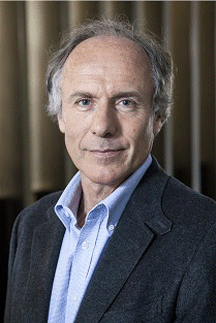
Our electricity grid looks likely to progress more systematically to a cleaner more secure future thanks to Australia’s Chief Scientist Dr Alan Finkel being brought in – to lead the analysis and policy recommendations. For those who could not make Tuesday night’s 2.5 hour session in Adelaide with him, here are some of the key comments made by him and his team:
1. Dr Finkel and SA’s Chief Scientist Leanna Read both see the grid becoming 100% renewable powered as the end point. Continue reading →
“The stranded asset risks of investing in new coal-fired power plants are clear to almost all,” Buckley said. “At some point a carbon tax or ETS is inevitable and would need to be priced in.”
Buckley said if that happened, the CEFC could well be stranded with any loan it’s given to coal power stations.
How Malcolm Turnbull could ignore the facts and fund the myth of ‘clean’ coal, Guardian, Michael Slezak 2 Feb 17 The Coalition could use the Clean Energy Finance Corporation to finance new coal power stations but it wouldn’t be cheaper than renewables Just a few months ago, the idea that a new coal power station would ever be built in Australia seemed laughable. Banks, energy companies and even the Turnbull government seemed to accept the inevitable decline of the coal industry.
But, since then, the Turnbull government has been furiously talking up the idea of “clean” coal. And while no bank is likely to finance the building of a new coal-fired power station here, Turnbull and his ministers have been indicating the government might themselves fund them.
There’s been a lot of spin in this debate, so here are some facts……..
The Clean Energy Finance Corporation cannot currently fund coal (but the government could change the rules) Continue reading →
SA in ‘pivotal position’ to harness sun and wind to stabilise our energy system, says expert. Tory Shepherd, Political Editor, The Advertiser,February 2, 2017 A SUPERGRID connecting South Australia to the west and the east to harness and transport sun and wind could stabilise our energy system, one of the nation’s top experts says.
And because the sun is shining in Western Australia after it has gone dark in SA, and its rays hit SA when it is still dark in WA, supply and demand would be evened out.
Professor Andrew Blakers from the Australian National University is working on supergrids and ideas for energy storage in SA. He said there were no financial figures yet, but that SA was in a “pivotal position”.
“An HVDC (high-voltage, direct-current) cable across the desert west to Perth would stabilise the SA system and allow time-shifting … WA is two or three hours behind,” he said. “That would reduce the storage.
“The idea would be you run west. There’s great sun and wind all the way from the head of (Spencer) Gulf to Perth. You’d pick up wind and solar farms along the way.”
The interconnector could then be connected to a new interconnector to the east coast, an option currently under discussion.
Prof Blakers, a professor of engineering, is also talking to the State Government about energy storage through pumped hydro. He says the technology – where water is pumped up to a small reservoir when energy is cheap then released when demand is high – could see SA powered by renewables alone.
Federal opposition energy spokesman Mark Butler has described pumped hydro as one of a number of “exciting” technologies that could transform the market. “There’s a really exciting race on between different technologies that are all being supported at different stages here in Australia and all around the world,” he said.
State Energy Minister Tom Koutsantonis said any extra interconnector would need approval, but that the Government was in favour of the east coast leg.
At Woomera, I go to look at the grave monuments in the cemetery on the hill outside the town. There are multiple still births and infant deaths, often in the same family. People don’t like to talk about it, but there are stories of women wailing in the streets, driven by unassuagable grief. A local urban myth held that if a pregnant woman stood on the hill facing Maralinga during a bomb test, the sex of the foetus would be revealed in x-ray silhouette……….
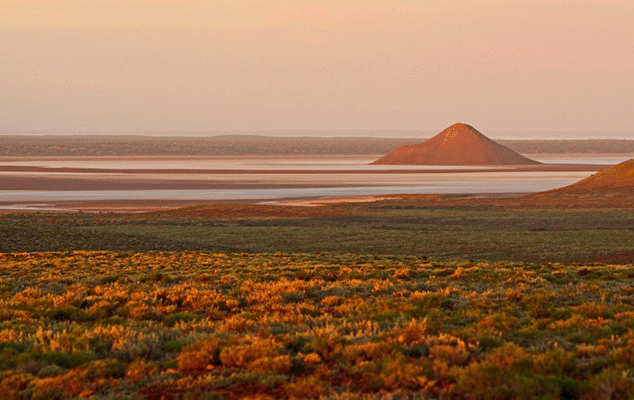
This land is already a nuclear waste dump. The locations and proposals change, but the same apparent “emptiness” that brought rockets, nuclear tests and detention centres now attracts commercial interest in storing nuclear waste from other nations. It’s the end of a cycle that starts with the mining and export of Australian uranium. The redistribution of uranium is a very Anthropocene process, part of the dismantling and reassembling of the planet.
Friday essay: trace fossils – the silence of Ediacara, the shadow of uranium, The Conversation, Alice Gorman, Senior Lecturer in archaeology and space studies, Flinders University , February 3, 2017 As an archaeologist working in the remote areas around Woomera and the Nullarbor Plain, my understanding of South Australia was first informed by rocks and soil. This was a landscape of fossils and trace fossils – the preserved impressions left by the passage of a living body through sediment – jostling for attention. On this land surface, SA presents an arc extending from the “death mask” fossils of early multicellular life to the human leap into the solar system. Sure, you might say, this could be said of other locations on Earth. But here it seems laid bare for any who can read the distinctive pattern of signs.
This was once a shoreline in a silent world. ……..
The fossilised fronds and pancake worms of the fauna from theEdiacaran geological period (635–542 million years ago) are now on display at the South Australian Museum. ……..
Aboriginal people would have noted but passed over the sedimentary rocks that preserved the Ediacara fauna. Instead, they searched for chalcedony, chert, and silcrete. With an understanding of how these stones fracture, you can make a cutting edge sharper and more sterile than a metal surgical blade. Glassy veins of such stone, nacreous in their own way, occur throughout the Nullarbor plain…….
New coal plants wouldn’t be clean, and would cost billions in taxpayer subsidies, The Conversation, Frank Jotzo, Director, Centre for Climate Economics and Policy, Australian National University February 2, 2017Following a campaign by the coal industry, Prime Minister Malcolm Turnbull has argued for new coal-fired power stations in Australia. But these plants would be more expensive than renewables and carry a huge liability through the carbon emissions they produce.
Major Australian energy companies have ruled out building new coal plants. The Australian Energy Council sees them as “uninvestable”. Banks and investment funds would not touch them with a barge pole. Only government subsidies could do it.
It may seem absurd to spend large amounts of taxpayers’ money on last century’s technology that will be more costly than renewable power and would lock Australia into a high-carbon trajectory.
But the government is raising the possibility of government funding for new coal plants, with statements by Deputy Prime Minister Barnaby Joyce, Treasurer Scott Morrison and Environment and Energy Minister Josh Frydenberg. The suggestion is to use funding from the Clean Energy Finance Corporation. For this to happen, presumably the CEFC’s investment mandate would need to be changed, or the meaning of “low-emissions technologies” interpreted in a radical way.
It should come to nothing, if minimum standards of sensible policy prevailed.
But an ill wind is blowing in Australia’s energy and climate policy debate. The situation in parliament is difficult, and the Trump presidency is giving the right wing in the Coalition a boost.
By Stephen Long“Clean coal” has been the holy grail of the fossil fuel industry for decades: the concept of creating commercially-viable ways of stopping the carbon emissions from coal-fired electricity plants which contribute to global warming.
Advocates use the phrase to describe two different technologies: carbon capture and storage; and highly efficient, lower emissions coal-fired power stations.
Carbon capture and storage is based on the principle of catching the carbon emissions, or CO2, from burning coal before they are released into the atmosphere.
It works by forcing the exhaust from a coal-fired power plant through a liquid solvent that absorbs the carbon dioxide, heating the solvent to liberate the gas, then compressing it and sending it away for storage underground.
Great in principle, but the technology faces big hurdles in practice.
One is the huge cost and logistical challenge of transporting all the captured carbon dioxide and burying it.
It would require a vast network of pipelines and storage sites. As one doubter observed: “Collectively, America’s coal-fired power plants generate 1.5 billion tons per year. Capturing that would mean filling 30 million barrels with liquid CO2 every single day — about one-and-a-half times the volume of crude oil the country consumes.”
The cost of building the required infrastructure would be enormous and the time periods involved may be too long to prevent the risk, identified by the consensus of expert scientists, of potentially catastrophic climate change.
The International Energy Agency (IEA) has found that the world would need to capture and store almost 4 billion tonnes per annum of CO2 in 2040 to keep global warming to 2 degrees Celsius above pre-industrial levels.
Yet current carbon capture capacity for projects in operation or under construction sits at approximately 40 million tonnes per annum.
We also don’t know if all gas would stay buried. While scientists are confident that there are geologically stable areas that could keep the carbon underground for very long periods, there is a risk of carbon seeping into the atmosphere.
To date, the technology is not commercially viable.
‘Cleaner coal’ sometimes mislabelled ‘clean coal’ http://www.abc.net.au/news/2017-02-02/clean-coal-explained/8235210High efficiency, low-emission power stations, also known as ultracritical or supercritical coal-fired power plants, are sometimes also labelled as “clean coal”.
How Malcolm Turnbull could ignore the facts and fund the myth of ‘clean’ coal, Guardian, Michael Slezak 2 Feb 17 “….. Turnbull said in his National Press Club speech on Wednesday that “it’s security and cost that matter most, not how you deliver it”.
But new coal technology is not cheaper than renewable energy.
The US Energy Information Agency recently compared the cost of energy from various types of coal power plants and renewable energy plants.
They found that ultra supercritical coal power plants were about twice as expensive to build per unit of energy, compared to wind farms, and almost 40% more expensive than solar farms. Then coal power stations have higher ongoing maintenance costs, as well as significant fuel costs, compared with the wind and solar where the fuel is free.
Dylan McConnell from the Melbourne Energy Institute at the University of Melbourne said if those costs were recovered through energy prices, that would push energy prices up.
Tennant Reed from the Australian Industry Group recently pointed outthat wholesale electricity prices that are currently worrying big energy consumers have been sitting at about $75 per MWh. But recent projections by the CSIRO suggest the ultra supercritical coal generators would produce electricity at a cost of about $80 per MWh.
“To build a coal plant with such costs, investors would need to expect wholesale prices to rise even above looming levels and stay there for decades,” Reed wrote.
Reed also pointed out that the $80 per MWh projection was optimistic, since it was assuming that the power plants were being used at about 80% of their capacity, which was much higher than was generally the case.
Meanwhile, new wind and solar will produce electricity at about $75-85/MWh today and that price will decrease in coming years.
Victoria steps up climate ambition. Turnbull takes two steps back, REneweconomy, By Sophie Vorrath on 30 January 2017
As an increasingly divided Turnbull government rules out any new policy tools to cut power sector emissions or boost renewable energy development, Victoria’s Labor government has upped the ante on climate action, pledging to cut state emissions by up to 20 per cent within three years on the road to its ultimate target of zero net emissions by 2050.
The new interim target, announced by Victoria’s energy and climate minister Lily D’Ambrosio on Sunday, aims to cut the state’s greenhouse gas emissions by between 15-20 per cent from 2005 levels by 2020.
Details on how the Andrews government aims to meet that target were released alongside the party’s Climate Change Framework, which maps out a plan to 2020 to put it on track for its 2050 goal.
Adding to Victoria’s emissions reduction momentum will be the TAKE2 program – Australia’s first state government-led climate change pledging program, which calls on local governments, schools and businesses to take action to reduce emissions.
As part of the program, the Andrews government has pledged to reduce its reported emissions from government operations by 30 per cent below 2015 levels by 2020.
However it winds up being reached, the new target puts Victoria at the front of the pack on government climate ambition, further highlights the disconnect between the states and Canberra, and tightens the screws on a PM faced with renewed internal discord on climate and renewables.
In a speech at a Young Liberals conference in Adelaide on Sunday, former PM Tony Abbott called on Turnbull to scrap the RET – an electoral promise he himself was never able to fulfil – and said that the party’s “first big fight this year must be to stop any further mandatory use of renewable power.”
Frequent assurances from both Turnbull and Frydenberg that the national RET will not be increased, and the complete absence of any renewables target beyond 2020, suggest Abbott & Co have little to worry about on that count.
David Noonan will speak on public interest concerns over the new Roxby Downs Indenture Act 2026 on BHP copper-uranium mining and ore processing in SA, and on how AUKUS may face SA with a High-Level nuclear waste agenda.
Dr Jim Green will discuss international developments in the field of nuclear power including ‘small modular reactors’ and Generation 4 ‘advanced’ nuclear reactor concepts.