No surrender – Traditional Owners move to defeat Adani’s ‘fake ILUA’ Wangan & Jagalingo http://wanganjagalingou.com.au/no-surrender-traditional-owners-move-to-defeat-adanis-fake-ilua/ 7 February 2017 Traditional Owners act to defeat Adani’s invalid Indigenous Land Use Agreement in the wake of Noongar ruling
W&J Council will seek a declaration to knock out ‘fake ILUA’
“Lawyers for the Wangan and Jagalingou (W&J) Traditional Owners Councilhave today written to Adani
demanding it withdraw its application to have an Indigenous Land Use Agreement (ILUA)
for its proposed Carmichael mine registered by the National Native Title Tribunal (NNTT).
Should Adani refuse, a declaration will be sought in the Federal Court to have the ILUA struck out.
See the Letter. http://wanganjagalingou.com.au/wj-council-acts-on-adanis-invalid-indigenous-land-use-agreement/
“Members of the W&J Council lodged a formal objection last year to the purported ILUA.
The NNTT was due to make its decision this Friday, however the Federal Court in the matter of
McGlade v Native Title Registrar [2017] throws doubt on whether Adani’s agreement is a valid ILUA.
“Leading Aboriginal rights advocate, a primary W&J Traditional Owner and Council spokesperson, Mr. Adrian Burragubba, says,
“We make it plain to the Queensland and Federal Governments that we will not surrender our ancestral homelands for Adani’s mine of mass destruction.
We will defeat this company’s attempts to divide and conquer us and continue our legal battles to remove the leases issued by the Queensland Government.
““Our fight is far from over.
Anyone who wants to bankroll Adani, and the Queensland and Commonwealth Governments,
are on notice that we will not stand by if attempts are made, in response to the Noongar decision,
to put our rights and interests, and our laws and customs, on the chopping block for the mining lobby,” he said. …
W&J youth leader and Council spokesperson, Ms. Murrawah Johnson, says,
“We have maintained all along that Adani does not have the consent of the rightful Traditional Owners.
Our Traditional Owners group have rejected an ILUA with Adani three times.
We will defeat Adani’s fake ILUA and continue to fight for our land and culture until the company
and Governments respect our rights and abandon this disastrous proposal”.
“In seeking Adani’s withdrawal, W&J Council has not removed its objection to the registration of the Adani ILUA by the NNTT. … “
February 8, 2017
Posted by Christina Macpherson |
aboriginal issues, AUSTRALIA - NATIONAL, climate change - global warming, Queensland |
Leave a comment
No new coal-fired power stations planned for Queensland, Australian Financial Review, by Mark Ludlow, 7 Feb 17 The Palaszczuk Labor government said it had no plans to back any new coal-fired power stations in Queensland, despite the Turnbull government planning to use the $5 billion Northern Australia Infrastructure Fund to help bankroll new base-load power in the state’s far north.
Energy Minister Mark Bailey – who is attempting to transform the state’s power mix from 7 per cent to 50 per cent renewables in the next 13 years – said new “clean coal” power stations were too expensive and there was more than enough wind, solar and hydro projects about to come online in the state.
“There is simply no need for new coal-fired base load generation in North Queensland,” Mr Bailey said.
“With the start of a large scale renewable industry under the Palaszczuk government, North Queensland is getting its own power stations, with twenty-first century producing affordable, clean energy.”
It comes as Mr Bailey has written to federal Energy Minister Josh Frydenberg to accuse him of using flawed modelling to criticise the state Labor governments and their ambitious renewable energy targets.
These include Queensland (50 per cent by 2030), South Australia (50 per cent by 2025), Victoria (40 per cent by 2025) and the ACT (100 per cent by 2020).
In the letter, obtained by The Australian Financial Review, Mr Bailey questioned the $27 billion figure Mr Frydenberg has repeatedly claimed would be the cost of the state renewable programs, asking since late last year to publicly release the modelling to back up the figure.
“I am disappointed by the lack of detail provided in your response in which you simply outlined some of the data sources used in your department’s analysis,” Mr Bailey said in the letter.
“As a consequence, your response leaves me no clearer as to how the capital cost estimate of $27 billion was calculated. It confirms my concerns, however, about your use of this figure which even with limited visibility of your modelling is clearly flawed.”
Mr Bailey said the Turnbull government was continuing to “demonise renewable energy” and undermine Queensland’s consumer confidence by attacking the state renewable targets. He said the state was committed to moving away from fossil fuels, with more than 680 megawatts of new renewable projects, worth $1.5 billion, in the pipeline.
Last week Chief Scientist Alan Finkel – who is conducting a review for the Turnbull government on energy security – said taxpayer money should not be used to subsidise high-efficiency, low-emission coal plants, such as those used in Japan………
Meanwhile, the Clean Energy Regulator has warned electricity retailers that they have until the deadline of February 14 to meet their obligations under the Renewable Energy Target. It follows ERM Power, one of Australia’s largest electricity retailers, choosing to pay a $123 million penalty rather than their RET liabilities.
“Paying a shortfall charge does not support generation to meet the 2020 target [of 23.5 per cent],” the Clean Energy Regulator said. “The intentional failure to surrender certificates will be viewed as a failure to comply with the spirit of the law and an undermining of the objectives and integrity of the scheme.” http://www.afr.com/news/politics/no-new-coalfired-power-stations-planned-for-queensland-20170206-gu69z8#ixzz4Y4ELrTUX
February 8, 2017
Posted by Christina Macpherson |
energy, Queensland |
Leave a comment
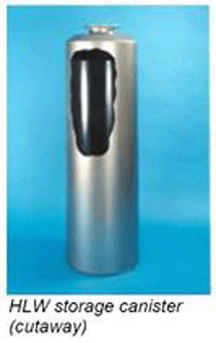
Fight To Stop Nuclear Waste Dump In Flinders Ranges, 6 Feb 17, Inside the massively shielded “intermediate level waste container that returned to Australia from France” are multiple stainless steel containers of vitrified reprocessed waste (pictured) – and this would be called “High Level Waste” (HLW) in France, USA, Canada, Japan and the UK.
Accepting the first container of this HLW anywhere into South Australia opens the door to South Australia becoming the vitrified HLW dump for Sellafield and France. https://www.facebook.com/groups/344452605899556/
February 6, 2017
Posted by Christina Macpherson |
Federal nuclear waste dump, South Australia |
Leave a comment
The State Government has agreed to fund the reburial of the skeletal remains of the child — which a respected Aboriginal elder says died following the Maralinga atomic testing more than 50 years ago.
Coroner Mark Johns has ordered a comprehensive report from police, which will likely determine if an inquest will be held.
Traditional owners of the APY Lands, who are devastated that the remains were disturbed, have engaged a barrister to push for the inquiry and to seek changes to state and federal legislation to ensure such sites are better protected.
Aboriginal Affairs Minister Kyam Maher has also written to police and Coroner Mark Johns, asking both to ensure “appropriate policies are in place and followed’’ to avoid future incidents……..
The bizarre case has created tensions within the APY community, with traditional owners and elders upset the remains were removed from the burial cave, near Mimili, in the Sandy Bore indigenous Protected Area.
Traditional owner Rex Tjami, who is also a director of APY corporation, has engaged barrister Rosanne McInnes, a former magistrate, to seek further protection for burial sites from such action………
Mr Tjami’s affidavit states when he went to the cave region near Sandy Bore — after being alerted to the discovery — he recognised the area and recalled the story his mother had told him about the burial cave.
“The child and the parents of the child died a long time ago. They were related to my mother and my uncle and other families. They came from the area where there was nuclear testing,’’ he states.
“My mother and my uncle told me the parents were staying in the large cave. They and the child became sick. The child died. The parents cut their hair, wrapped it around the child and wrapped the child in special plants. They put the child’s body in a smaller cave opening into the wall of the large cave to protect it. They used sticks from a special plant to fence out predators. After they buried the child, the parents left the cave. Before they died, the parents told their relatives — our family — about the cave in the hill where the child was buried.’’……….
“We want protection for our heritage. Not people from Adelaide digging up old graves and taking away the bodies of our people without telling us.’’
February 6, 2017
Posted by Christina Macpherson |
aboriginal issues, South Australia, weapons and war |
Leave a comment
Paul Waldon Fight To Stop Nuclear Waste Dump In Flinders Ranges SA, 5 Feb 17 The governments sluggish piecemeal approach to nuclear responsibilities that betrays all South Australians safety, needs to be addressed. Also I would like the issues of classification of high grade waste dealt with promptly, as this could open the door to Frances high grade waste being dumped in SA under the guise of intermediate waste.
I believe that the French delegate are here to feather their own nest. A professional, when brokering a deal will kick ass out of the price of their second option knowing it will be rejected, then move in on their intended target, “Their first option.”
With the agenda of a nuclear waste abandonment program I believe Kimba to be their first option. Can anyone tell me with previous such programs, was there more than one site proposed per sortie, or is this a new strategy that may pay dividends to the French? https://www.facebook.com/groups/344452605899556/
February 6, 2017
Posted by Christina Macpherson |
Federal nuclear waste dump, South Australia |
Leave a comment
 They talk of ‘showing the group how we safely manage waste here at ANSTO’. If it’s all that safe why not keep it there at Lucas Heights? Why transport it 1000s of miles to outback South Australia?
They are lying about “intermediate waste” . the waste returned from Franc e is classified as “high level” by the French waste management authority ANDRA
 ANSTO WELCOMES TRADITIONAL OWNERS TO LUCAS HEIGHTS The Australian Nuclear Science and Technology Organisation (ANSTO) last week welcomed members of the Adnyamathanha community in South Australia.
Barndioota, which is in their area, is a potential site for a National Radioactive Waste Management Facility.
Les Bursill, an elder of the Dharawal community, gave the welcome to country and shared insights about some of the rich traditional heritage surrounding ANSTO.
The Sutherland Shire Mayor, Carmelo Pesce, was on hand to welcome guests, and discuss some of the benefits of having a nuclear facility in his areas, in terms of jobs, growth and community participation.
The group were at ANSTO at the invitation of the Department of Industry, Innovation and Science, which is extending invitations for such tours to all community members near potential sites of the facility.
“It was our pleasure to the welcome visitors, to show the group how we safely manage waste here at ANSTO, and to answer any questions they had,” said ANSTO’s Chief Nuclear Officer, Hef Griffiths.
“The group toured our campus, saw how the low level radioactive waste is packaged and stored, and stood beside the intermediate level waste container that returned to Australia from France in December 2015.
Throughout the year, ANSTO staff and experts will continue to make visits to Barndioota as part of technical studies, and ANSTO will continue to receive guests looking to get facts on radioactive waste management.
February 6, 2017
Posted by Christina Macpherson |
aboriginal issues, AUSTRALIA - NATIONAL, Federal nuclear waste dump, spinbuster |
Leave a comment
Australia urgently needs to re-evaluate its American bases and promote steps that defuse rather than intensify regional tensions. Having senior Australian defence personnel integrated into the US defence force hinders Australia acting independently. Do we want Australia to be capable of making strategic decisions in the national interest? New Zealand clearly acts in its own interest and remains an ally.
With Trump now the new US Commander-in-Chief, is it wise that we allow ourselves to be so automatically tied to American foreign policy? War in our region would be a humanitarian catastrophe for all involved.
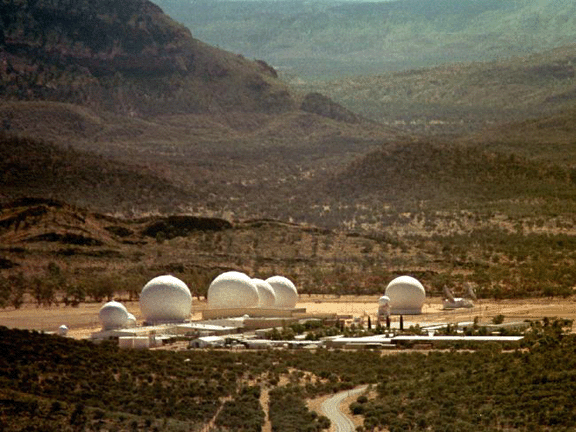
With Donald Trump in power, Australia urgently needs to re-evaluate its US bases http://www.smh.com.au/comment/with-donald-trump-in-power-australia-urgently-needs-to-reevaluate-its-us-bases-20170131-gu2qph.html, Margaret Beavis
Recent changes to the US National Security Council should be ringing loud alarm bells in Canberra.
By demoting the highest-ranking military officer and the highest-ranking intelligence officer, and appointing political adviser Stephen Bannon as a permanent member of the NSC, Donald Trump has seriously escalated the risk of the US launching into ill-advised conflicts. Bannon comes from a role as chairman of the racist, Islamophobic website Breitbart.com, and is reported as having been in charge of writing the recent executive order that has banned US entry for refugees and citizens from seven Muslim-majority nations.
It is no secret that Australian foreign policy and defence forces are closely enmeshed with the US. Since Trump has taken office he has loudly proclaimed an “America first” foreign policy, and his Secretary of State, Rex Tillerson, talks of denying China access to artificial islands in the South China Sea. Any such blockade is likely to be seen by the Chinese as an act of war. Continue reading →
February 6, 2017
Posted by Christina Macpherson |
AUSTRALIA - NATIONAL, politics international, weapons and war |
Leave a comment
Fading Eyre Peninsula town looks to nuclear waste dump for a future http://www.theaustralian.com.au/news/nation/fading-eyre-peninsula-town-looks-to-nuclear-waste-dump-for-a-future/news-story/d02dd60bc73cab2b8ee3a3f5efb3bdc3 The Australian February 6, 2017 VERITY EDWARDS Reporter Adelaide Jeff Baldock, a third-generation farmer at Kimba, watches the Eyre Peninsula town 460km west of Adelaide declining as families move for work and schooling, but believes that if his land was chosen for an intermediate-level nuclear waste dump it would mean economic salvation.
“It would basically guarantee Kimba’s future, it’s a 300-year program the federal government will be here for,” Mr Baldock said.
“If we don’t do something, I’m worried the school won’t be going to Year 12 by the time my grandchildren get there, and the hospital might be closed by the time we need it. We’ve only just secured a doctor; we don’t want to lose any more services.”
The federal government earmarked a cattle station at Barndioota in the Flinders Ranges as its preferred site last April, but Bruce Wilson, the head of the Industry Department’s resources division, said other sites would be considered until a final decision, which could be made late this year. Construction of the facility is likely to be completed in the early 2020s.
A second Kimba farmer also put his property forward last week, and both submitted formal applications ahead of a French delegation visiting Kimba and Barndioota from Wednesday.
Among the delegation will be two mayors whose towns are near the Aube Disposal Facility in Champagne, the facility’s director and a representative of the French national radioactive waste agency. They will discuss safety concerns with residents, who have not previously supported the proposal.
“The facility we are proposing is for Australian low- and intermediate-level waste only, [REALLY?] and we will answer as many questions from as many perspectives as we can at these sessions,” Mr Wilson said.
Mr Baldock, whose family farms three properties, suggested a different site last year but neighbours were opposed. This time, all the adjacent property owners are supportive.
Mr Baldock said selecting a Kimba property would mean the federal government injected at least $10 million into the community and created 30 fulltime jobs. His own payment would be equivalent to a year’s worth of fertiliser costs, with the community benefiting more than his family.
Local funding could be used to boost services for the community’s ageing population, fix the pool which has been closed this year because of disrepair, and create jobs, agricultural research projects and economic opportunities.
Kimba Mayor Dean Johnson said there had been some opposition to hosting a dump last year, but an information campaign on the low risk involved was turning the tide. His council would also ask the Australian Electoral Commission to run a referendum for the 700 voters after a 60-day community consultation period ended.
“Certainly there is a group that is solidly opposed and that hasn’t changed, but the important thing to remember is this is a chance to get more information about the benefits to the community,” Mr Johnson said.
February 6, 2017
Posted by Christina Macpherson |
Federal nuclear waste dump, South Australia |
Leave a comment
 Adani mine leases and national parks in doubt after native title court decision https://www.theguardian.com/australia-news/2017/feb/05/adani-mine-leases-and-national-parks-in-doubt-after-native-title-court-decision
Ruling in favour of challenge against Noongar Indigenous land use agreement may lead to amendment of Native Title Act, Guardian, Helen Davidson, Resources projects including the Adani coalmine, pastoral leases and a number of national parks across the country are potentially in doubt following a shock federal court decision striking out a native title deal in Western Australia.
The ruling by a full bench of the federal court on Thursday has prompted speculation the Native Title Act will be amended in response. Continue reading →
February 6, 2017
Posted by Christina Macpherson |
aboriginal issues, AUSTRALIA - NATIONAL |
Leave a comment
 Derek Abbott No High Level International Nuclear Waste Dump in South Australia, 4 Feb 17, Here’s the American DOE report on repositories. Notice it’s much more truthful than our Royal Commission report. For starters it:
(a) compares the disadvantages of different types of rock for a repository and there are many openly listed, and
(b) it openly mentions the tens of $billions needed in repackaging costs for the fuel. Our Royal Commission totally side stepped these points. https://www.energy.gov/sites/prod/files/2014/04/f15/DOE%20DispOptions%20R1%20Volume1%20Apr15.pdf
the repackaging and even the technical details about the casks was missing from the RC report. Wonder what they were hiding
February 6, 2017
Posted by Christina Macpherson |
NUCLEAR ROYAL COMMISSION 2016, wastes |
Leave a comment
We all need to divest from fossil fuels now – especially Australian universities, Guardian
John Quiggin, 2 Feb 17 The end of coal is inevitable but divestment will help accelerate the process, especially as we can’t rely on government to stabilise the environment. T
The movement to divest from the fossil fuel industry has grown rapidly over recent years in tandem with the urgent need to decarbonise the global economy. In Australia, divestment commitments have been made by local councils, charitable trusts, super funds and the Australian Capital Territory.
Universities have been a central focus of the campaign. Leading global universities such as Yale, Stanford and Stockholm have undertaken partial or complete divestment. In Australia, La Trobe and the Queensland University of Technology have made comprehensive divestment commitments, while others including the Australian National University, Monash and Sydney have taken substantial steps towards this goal. Continue reading →
February 6, 2017
Posted by Christina Macpherson |
AUSTRALIA - NATIONAL, climate change - global warming |
Leave a comment
 The only way to avoid gambling hundreds of millions or billions of SA taxpayers’ dollars would be in the wildly improbable scenario that potential client countries would take that gamble.
Taipower clearly states that it would not consider sending waste to another country unless and until that country has developed a repository. Yet the economic case developed by Jacobs and MCM collapses if revenue (and waste) is not received before construction of a repository.
Finally, Mr Heard’s promotion of fast breeder reactors is beyond stupid….. Most of the countries that invested in fast breeder reactors have given up, deciding not to throw good money after bad. Last year, Japan decided to give up on the Monju fast breeder reactor, a fiasco that will cost Japanese taxpayers A$17.3 billion in construction, operation and decommissioning costs despite the fact that the reactor rarely operated.
The Royal Commission completely rejected proposals advanced by Heard and others for ‘advanced fast reactors’, noting in its final report that such reactors are unlikely to be feasible or viable in the foreseeable future; that the development of such a first-of-a-kind project would have high commercial and technical risk
Friends of the Earth Australia has today written to all Members of the SA House of Assembly and Legislative Council, and SA political representatives in the Federal Parliament, responding to the latest round of misinformation from those proposing to turn SA into the world’s high-level nuclear waste dump.
——————————————————————————–
To: Members of the SA House of Assembly and Legislative Council
From: Jim Green
National nuclear campaigner
Friends of the Earth, Australia Feb. 3, 2017
EXPOSING THE LATEST MISINFORMATION FROM THE NUCLEAR WASTE DUMP LOBBY
Dear Members of the SA House of Assembly and Legislative Council,
 The Advertiser has today run an article including false claims from nuclear lobbyist / uranium industry consultant / PhD student Ben Heard that Jay Weatherill’s plan to turn SA into the world’s high-level nuclear waste dump could be pursued without the need to gamble hundreds of millions or billions of dollars with no guarantee of any return on the investment.
Mr Heard is quoted saying that the “notion of high upfront cost to South Australia is a persistent and deliberate lie first peddled by deceitful environmental groups and now, sadly, taken up by the Liberal Party.”
In fact, the necessity of gambling hundreds of millions or billions of dollars ‒ without the slightest guarantee of any return on the investment ‒ is clearly spelt out by Jacobs, the economics consulting firm commissioned by the Nuclear Fuel Cycle Royal Commission.
Jacobs Project Manager / Consultant Tim Johnson told the SA Joint Select Committee that “total expenditure prior to the decision to proceed” is likely to be from around A$300 million to in excess of A$600 million, depending on the timing of the decision to proceed. (Letter to Joint Standing Committee, 5 July 2016.)
Dr Johnson told the Joint Select Committee that the project entails very significant economic risks: “It isn’t a risk-free process to go into this. There is a very significant risk.” Yet the nuclear waste dump lobby persist with the fabrication that the project can be pursued without economic risks. Continue reading →
February 4, 2017
Posted by Christina Macpherson |
AUSTRALIA - NATIONAL, South Australia, spinbuster, wastes |
3 Comments
Resources Minister Matt Canavan opens $5 billion infrastructure fund for clean-coal power stations, ABC News, 3 Feb 17 By political reporter Henry Belot Resources Minister Matt Canavan has opened the $5 billion Northern Australia Infrastructure Fund to fund new so-called clean-coal power stations.
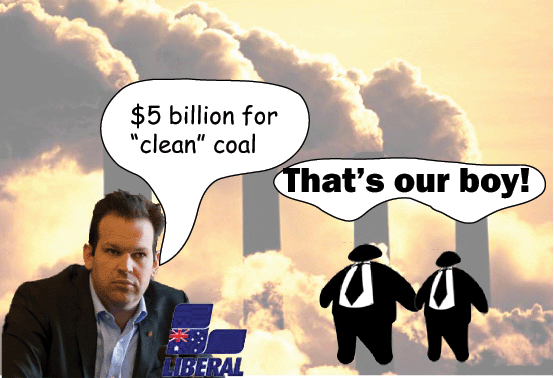
Key points:
- The Federal Government has invested close to $590 million in clean-coal technology since 2009
- Australia does not have a high-efficiency, low-emission power station
- Prime Minister Turnbull announced the push for more clean-coal technology earlier this week
Senator Canavan’s comments come days after Prime Minister Malcolm Turnbull said Australian industry had an obligation to be at the forefront of coal technology.
Treasurer Scott Morrison has also not ruled out using money set aside in the Clean Energy Finance Corporation to pay for new generation power stations.
Mr Canavan said he had received interest from energy generators to tap into the billion-dollar investment fund and explore North Queensland. “I’ve received some interest over the past week associated with our commitment to build base load power stations, including to support clean coal options,” he told ABC AM. Mr Canavan would not say which companies had expressed interest but said there were viable options near the Galilee Basin and other parts of the state’s north.
The Federal Government has invested close to $590 million in clean-coal technology since 2009 but Australia does not have a high-efficiency, low-emission power station. The Resources Minister cited a 2012 report by industry consultants GHD, which indicated clean-coal power stations could be commercially viable in Australia’s north.
Mr Canavan dismissed comments by some Australia’s energy generators — including AGL and Energy Australia — saying new power stations would be expensive to build and require significant public funds……
Bloomberg New Energy finance researcher Leonard Quong said new coal would be the most expensive form of energy supply. “New coal is made particularly expensive due to the substantial carbon, reputation, trading and construction risks the technology presents to an investor,” he said.
The renewed focus on clean-coal has drawn criticism from Labor and the Greens, who have accused the Government of trying to protect “the coal club”.
Opposition spokesman for climate change and energy Mark Butler said a preference for coal over renewables would mean higher power bills for Australians. Greens leader Richard Di Natale said the cleanest form of electricity would remain wind and solar, while raising concerns about the cost of new base-load coal plants. http://www.abc.net.au/news/2017-02-03/infrastructure-fund-opened-for-clean-coal-power-stations/8237866
February 4, 2017
Posted by Christina Macpherson |
AUSTRALIA - NATIONAL, climate change - global warming, politics, Queensland |
Leave a comment
 Flinders Local Action Group ( FLAG ) Community Survey Results Do You Want a National Radioactive Waste Management Facility established at Wallerberdina Station / Barndioota ? December 2016
A survey of residents living within a 50km radius of the proposed National Radioactive Waste Management Facility of Barndioota, and the remainder of the Flinders Ranges Council Area, South Australia……….
Conclusion FLAG employed two separate survey methodologies to gauge community support for the proposed waste facility.
The first opportunistically sampled interested &/or concerned community members attending the Quorn Town Hall Meeting of 21st September 2016 and the Quorn Agricultural Show on 25th September 2016. Respondents elected to fill out a questionnaire at the FLAG booth.
Whilst there is a possibility of some response bias the method does offer a measure of community support or opposition to the development.
The second mail out/postal survey represents a more systematic attempt to survey the entire towns of Quorn, Hawker and Craddock. Although there is still the possibility of some response bias (as in any survey), these methods provide an improved estimate of regional community sentiment.
Both surveys indicate considerable community opposition to the waste facility and when taken together demonstrate that Department of Industry, Innovation & Science does not have the majority community support it requires.
In both surveys, a clear majority voted “no” to the establishment of a National Radioactive Waste Management Facility in the area, with 92% voting against it in Survey 1 and 79% in Survey 2.
In the Hawker/Cradock region, which is closer to the proposed site, the support for the proposal was slightly higher, presumably due to the perceived economic benefits. Further away in Quorn, support for the proposal was lower, as the benefits would be minimal and outweighed by loss to other industries such as tourism.
Both surveys indicate majority disapproval for the proposal.
February 4, 2017
Posted by Christina Macpherson |
Federal nuclear waste dump, opposition to nuclear, South Australia |
Leave a comment
 Nuclear Fuel Cycle Watch South Australia, 4 Feb 17 Seems like Australia put a lot of effort to get other nations to call “High Level Waste” intermediate level. It didn’t work. USA, Canada, France, Japan and UK still call Vitrified reprocessed waste “High Level”.
 From Hansard: “Mrs CROSIO – If we have international definitions, why in evidence we have received do they keep on saying that ANSTO refer to their waste at one level as intermediate waste where America would classify that same waste as high level waste? Why are we different?
February 4, 2017
Posted by Christina Macpherson |
AUSTRALIA - NATIONAL, Federal nuclear waste dump, politics |
Leave a comment
 , NT News