Australian conservative MPs, Cory Bernardi etc, urge Turnbull to scrap the Renewable Energy Target
 ‘Dump RET when America walks away from Paris’ The
  Australian, January 23, 2017, A growing number of government MPs, including some on Malcolm Turnbull’s front bench, say Australia should dump the Renewable Energy Target and its carbon emissions reduction commitments under the Paris climate agreement if Donald Trump walks away from the deal.
Conservative MPs have told The Australian they believe there is no point in remaining committed to the Paris accord without the US locked into action on climate change, a phenomenon the new President has previously labelled a Chinese “hoax”.
Former prime minister Tony Abbott and South Australian senator Cory Bernardi have both publicly argued for the scrapping of renewable energy targets, saying that would allow the government to campaign more forcefully against Labor on energy policy.
One conservative MP said the view was “getting a lot of traction very quickly”, while another said that opinion was already “widespread” within the Coalition partyroom. The push comes as many MPs express frustration that the government has made little political mileage out of Labor’s policy to lift the renewable target to 50 per cent by 2030……
But MPs said Mr Abbott’s opinion piece published in The Weekend Australian this month advocating a shift in policy was “not helpful”, saying it would make it more difficult to convince the Prime Minister of the merits of the political strategy.
Another said that regardless of the RET target, the government would seek to incentivise the building of new coal-fired power stations…… http://www.theaustralian.com.au/news/nation/dump-ret-when-america-walks-away-from-paris/news-story/c6863739afb25e205d67a321ce70b954
CIA feared that Australian govt would close Pine Gap
 CIA documents reveal Pine Gap fears http://www.dailytelegraph.com.au/news/cia-documents-reveal-pine-gap-fears/news-
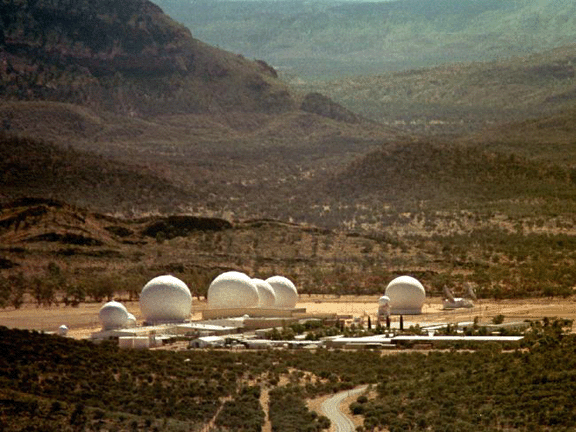 story/78dd781a58fe89fd6b7d455a662c8596 22 Jan 17 TENSION over world wheat prices led to fears by the US Government that Australia could shut the secret spy facility at Pine Gap.
A memo prepared by the Central Intelligence Agency’s Office of East Asian Analysis shows the Americans were nervous Australia could lash out and use US-Australian joint facilities as a “bargaining chip” during the wheat prices stand-off in 1986.
It is among more than 900,000 documents, some of which were previously top secret, released by the CIA this week.
The briefing document says then-prime minister Bob Hawke was under political pressure from “militant farmers” to stand up for their interests as the US prepared to extend its “export enhancement program” to include the Soviet Union and China, which was expected to drive down wheat prices worldwide.
According to the memorandum, the Americans did not take the threats to close joint facilities seriously “but if the Senate proposal becomes law, tensions will be high and thoughts of making such threats will remain just below the surface”. “Our worst case scenario, on the other hand, would have the Australians refusing to negotiate a new ten-year agreement for the Joint Defense Space Research Facility at Pine Gap near Alice Springs in the Northern Territory (thus the facility would be subject to closure after October 1987 with a year’s notice),” the document read.
It said wheat farmers were the most vocal primary producers “and protest most often in Canberra”.
“Hawke undoubtably believes he cannot afford to ignore wheat farmers’ pleas to use his claimed ‘special relationship’ with the US administration to win them relief,” the memorandum read.
With an election looming, domestic pressure was on the prime minister to prove he could exert influence with the Americans. “In our judgment, the current US Senate proposal, if it becomes law, would confirm Australian farmers’ suspicions that Hawke is powerless to win relief from the US government and that Australia’s faithfulness to its responsibilities in the ANZUS alliance is meaningless to the US administration,” the document said.
So-called “Environment Minister” Josh Frydenberg approves coal mine expansion
 New Hope passes federal hurdle
Federal Environment Minister Josh Frydenberg approving New Hope Group’s planned $900m New Acland coal mine expansion. (subscribers only)
http://www.theaustralian.com.au/business/mining-energy/new-hope-passes-federal-hurdle/news-story/a2ca363a24f18a86bd10e512bad4761c
The nuclear industry- economic disaster for Australia – theme for February 2016

Any economic argument for the nuclear industry was blown out of the water by the absolute discrediting of South Australia’s shonky Nuclear Royal Commission (NFCRC)’s push for importing nuclear wastes.
Australia’s nuclear lobby knew that the industry is not healthy, nor safe, nor clean, and is a disaster for the Aboriginal people. But, they didn’t care – saying that importing nuclear waste would make $billions. All thorough economic research said otherwise. Far from saving South Australia’s struggling economy, expanding the nuclear industry would most likely bring that State to bankruptcy.
Now the nuclear lobbyists are at it again – touting “new nukes” – small thorium nuclear reactors, (which would require importing enriched uranium or plutonium to get them working.) Even the pro nuclear NFCRC concluded that these would not be economic for South Australia.
 The push for “new nukes” is driven partly by the vanity of a few would-be-famous young men, partly by the nuclear enthusiasts within the defence lobby, and partly by the general desperation of the global nuclear industry to make it look as if they’re succeeding.
Whichever way it is, South Australia will be the loser if nuclear lobbyists win. South Australia has the opportunity to lead in 21st Century renewable energy technologies. With no help from the climate-denying, anti-renewables, Turnbull government, South Australia is up against it.
The uranium market is in continual gloom. Any expansion of the nuclear industry in Australia is a recipe for economic disaster – and a ludicrous contrast to Australia’s wonderful opportunities in renewable energy and clean agriculture.
Turnbull government is not convincing Australians in its attack on renewable energy
 Why the public is not buying Coalition attack on wind and solar, REneweconomy By Jonathan Gifford on 20 January 2017 What is it that the general public appears knows about renewables and electricity prices that much in the conservative side of politics, and the federal energy minister Josh Frydenberg, do not?
2017 has kicked off with another round of attacks on renewable energy targets, both state and federal. They display fundamental misunderstandings of renewable energy, its deployment capabilities, costs and impacts on electricity prices. The good news: the public isn’t buying it.
As working life, business and the public debate gets back into full swing after the holiday period, attacks on renewable energy and targets have, unfortunately, also resumed. The Australian, unsurprisingly, is leading the charge, and elected officials have added their voices to the unrelenting campaign of misinformation.
Most worryingly Energy and Environment Minister Josh Frydenberg is playing a prominent role. On Wednesday he penned an OpEd in the Australian Financial Review in which he got stuck into the Victorian and Queensland state governments’ RETs.
On Friday, The Australian gave him a platform to attack renewable energy by way of a rebuttal to the Labor opposition climate change spokesman Mark Butler’s arguments for a 50 per cent by 2030 RET.
While Frydenberg’s argumentation in today’s Australian specifically addresses the Labor 50% RET, it is riddled with direct attacks on renewable energy itself.
Frydenberg argues that RETs lead to higher power prices. To support this he says that power prices rose rapidly under Labor, that a 50% RET will drive out coal generation – implicitly increasing prices – and that it will require $48 billion in new investment in generation capacity.
The Energy Minister then cites AEMC findings that the RET will have “the highest cost of abatement,” that it does not encourage emissions reductions beyond renewable generation.
(RenewEconomy editor Giles Parkinson has already pointed out that the AEMC modelling actually shows the opposite, that the RET is actually a cheaper option, even given the AEMC modelling’s ridiculously expensive costing of wind and solar).
Despite this and other lines of argument, it appears that the Australian public is just not buying it. There continues to be evidence that renewable energy remains widely popular with Australians, to which their continued adoption of rooftop solar and increasingly battery storage attests. And polling continues to confirm this.
GetUp released the findings of a ReachTEL poll it conducted on January 12 today, in which it asked 2,126 householders what they believe are behind rising power prices.
The leading response, with 58%, was that “privatization and the lack of competition between the big energy companies” were behind the price hikes. The next response was “undecided,” with 24.2% and renewable energy in third place, with 17.7%.
“The owners of the poles and wires have been gold-plating the grid, spending billions of their customers’ money building far more grid infrastructure than we needed.”
Taking the RET in isolation, as a policy to drive the shift towards less emission intensive electricity generation as Frydenburg does, is also mischevious.
In combination with overdue electricity market reforms and the pricing of externalities, such as carbon pricing, in combination with renewable targets has repeatedly been shown to deliver a lower-cost energy transition……..
GetUp’s Miriam Lyons weighs in on the South Australia debate, saying that it is indeed “an example of what’s wrong with the current system” with its botched electric utility privatisation and the lack of competition.
“The Liberal Olsen government didn’t break up the generators when it privatized electricity – they chose to make as much from the sell-off as possible in the short term, rather than creating a genuinely competitive market,” says Lyons. “The price-gouging by gas companies that we saw in South Australia last year is a direct result of that.”
GetUp notes that it is encouraging to see public support for renewables and RETs hold fast, but that the battle against the demonization of renewables on the basis that they leads to higher electricity prices is far from over.
“This polling shows that the fossil fuel lobby’s campaign isn’t convincing most Australians – yet.” http://reneweconomy.com.au/public-not-buying-coalition-attack-wind-solar-36457/
Energy Minister Frydenberg ignores rapid price developments of large scale solar and wind
Why the public is not buying Coalition attack on wind and solar, REneweconomy By Jonathan Gifford on 20 January 2017 “…….The Energy Minister is clearly also ignoring the rapid price developments of large scale solar and wind, in his advocacy for “supercritical coal and gas” generation. Whether these lowe(er) emission generation sources can compete in the coming years given current large scale renewable cost trajectories is highly debateable.
Frydenberg, in his Australian opinion piece, then turns his attention to South Australia. He argues that the “forced” closure of coal in South Australia is behind high electricity prices and then says that low-income households are bearing the brunt of additional costs.
Strangely, Frydenberg didn’t mention Queensland. He should have, because then he would have understood that the issue is not about renewable energy, but market rules and market competition.
Queensland is similar to South Australia in that the wholesale electricity market is dominated by just a few companies who control some two thirds of the generation. In Queensland, the owners are government owned, and it has not yet got any large scale renewables to provide competition.
So the predictions for this summer was that prices in South Australia would soar, proving that renewables were a dangerous and costly diversion.
But wholesale prices in January in South Australia have been less than NSW, little more than in Victoria and Tasmania, and less than half what they have been in Queensland, where the lack of competition to the coal and gas generators (apart from rooftop solar) has meant prices have average more than $200/MWh.
There have been numerous spikes above $13,000MWh, which the regulator is to investigate, and days when the price has average near $500/MWh. The smelter in Gladstone is so appalled it has flagged possible downsizing.
There is a lot more to be written about Queensland, and its focus on LNG exports, the extra 1GW of demand that that is sucking from the grid.
The Labor government is trying to address that issue by encouraging 5,000MW of wind and solar in its own 50 per cent renewable target, a move it says will result in lower costs to consumers.
And while the Coalition carps on about the high cost of wind and solar, with the wholesale prices at their current levels, there is really no argument, which is why the likes of Sun Metals have decided to built their own large scale solar plants.….. ” http://reneweconomy.com.au/public-not-buying-coalition-attack-wind-solar-36457/
Utility scale investment marks the surge in wind and solar power in Australia
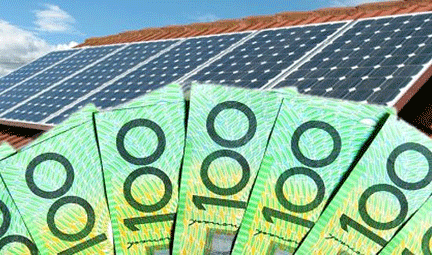 Wind, solar investment surge “the start of bigger things to come” REneweconomy By Jonathan Gifford on 18 January 2017 The strong growth in large scale renewable project financing in Australia in 2016 could be just the beginning of a major wave of investment.
This is the prognosis of Bloomberg New Energy Finance associate Leonard Quong, who adds that if key policy settings remain in place the $2.5 billion in annual large scale project investment required for Australia to meet its Renewable Energy Target could be achieved through to 2020.
“We have seen a new sense of momentum and energy in the market,” Quong told RenewEconomy, speaking of the latter stages of 2016. “If some of the fundamentals looking forward are to be believed, this is the start of bigger things to come.”
Quong explains that the stage is set for a large number of utility scale wind and solar PV projects to attract financing and get off the ground in 2017.
This is due in a large part to the “paralysis” the large scale renewable market experienced in 2014 and 2015, itself brought on by the Abbott Government’s Renewable Energy Target (RET) review. This paralysis is the primary cause of the large scale generation certificates (LGCs) shortfall likely to eventuate in 2018.
The BNEF analyst notes that the RET reduction agreed to by the major political parties, a position advocated by the Clean Energy Council aimed at breaking the paralyzing deadlock, laid the groundwork behind the recent growth in project financing.
The significant factor being that as it was achieved in a bipartisan fashion, investors gained confidence that the policy will be in place over the mid-to- long term.
As to whether Australia can achieve the reduced RET, Quong is quietly optimistic…….
A major trend set to emerge strongly in 2017, according to BNEF analysis, is the rise of utility scale solar. While wind project investments far exceeded utility scale solar in Australia in 2016, rapid price declines and solar PV’s inherent advantages in terms of project execution should see large scale solar take off.
“Given the shortfall in certificates now expected to happen in 2018, it gives quite an incentive for investors to look at solar,” says Quong. “With the shorter build times, potentially shorter development times, and with certificate prices now above $80/MWh, it certainly makes it quite attractive.” ……http://reneweconomy.com.au/wind-solar-investment-surge-start-bigger-things-come-57167/
Renewables tide will leave Trump and Turnbull behind
Neither Trump nor Turnbull can turn back the tide on renewables, Guardian, Blair  Palese, 18 Jan 17 The argument for renewable energy is now a purely economic one – and the move away from coal will only pick up speed The inauguration of President Trump this Saturday (Australian time) marks a radical change in the world as we know it. It ushers in the beginning of four years where progressive issues as far reaching as race equality, women’s health, nuclear and foreign policy, and of course climate change will be under sustained attack.
Less than a year after the world agreed a historic climate pact in Paris, the US – the world’s second-largest greenhouse gas polluter – elected a man who wants to revive the glory days of coal, oil and gas.
To less fanfare here at home, the Turnbull government is pursuing a similar trajectory. Ploughing through the headwinds is our resources minister, Matt Canavan, who is seeking a $100bn investment in coal and is the biggest campaigner for a new mega-coalmine in Queensland’s Galilee basin run by the Indian company Adani.
The truth is that try as they might, neither Trump nor the Australian government can turn the tide on renewable energy, nor resuscitate an ailing coal industry with a clear expiration date. This is not a moral or political case, but a purely economical one.
This is why I remain quietly optimistic about the continued global transition away from fossil fuels despite the hostile political climate.
Renewable energy is rapidly becoming the cheapest and easiest way of producing energy in countries around the world. Investors everywhere are watching these changes and the market is responding rapidly.
China has recently announced that it will invest US$361bn into renewable energy over the next four years, creating 13m jobs in the process. This is as much as the entire globe spent on renewables over the past four years. This makes good financial sense as well, since the cost of building large-scale solar has decreased by about 40% since 2010, making it cheaper than coal…….
While the Turnbull government’s bungling of federal energy policy is stifling some of the potential for clean energy developments, many Australian business leaders are steaming ahead regardless.
Australia is the best country on the planet for solar energy and the former BHP executive Phil Galloway is looking to capitalise on that.
He has plans to roll out 220,000 solar panels across the empty space on an almond farm in regional Victoria, generating enough electricity to power about 30,000 homes. Inspired by the model adopted in the US by companies such as Google and Apple, Galloway would look to negotiate power-supply agreements directly with large local companies rather than energy retailers.
This is just the sort of project that is not only becoming more viable but, with a bit of clever government incentivisation, could transform Australia’s energy future and create a clean energy transformation that would create countless new, sustainable jobs across the country.
A similar project is under way in the sleepy Victorian town of Yackandandah. Residents there have come together under the banner of 100% renewable energy and energy sovereignty to pursue a transformation of their own.
Working with AusNet, which runs the Victorian grid, the town will trial new storage technology along with setting up a renewable energy farm to power it, with profits from the energy generated being ploughed back into their community. This is one of dozens of community renewable energy projects that are quietly driving Australia away from polluting energy.
Likewise, in the northern rivers region of New South Wales, a community-owned energy company is seeking to offer a clean alternative to the dirty energy produced by Australia’s big three energy retailers: AGL, Origin Energy and EnergyAustralia.
Our governments may now be held hostage by visionless representatives more determined on prosecuting their narrow ideological agenda than helping Australia find solutions to its most pressing issues but, elsewhere, leaders in other fields are transforming the way we generate, share and manage our energy needs and addressing climate change.Enova Energy is making inroads not only to kickstart renewable energy but also to empower energy consumers. Headed by former executive heavyweights disillusioned by the government’s inaction on renewables, including Alison Crook, a former Monash University deputy chancellor and Qantas businesswoman of the year, Enova’s mission is to offer the country’s highest feed-in tariffs and lowest GreenPower price while working with social welfare groups to tackle energy poverty in the region.
Bellicose political rhetoric can’t hide the economic fact: renewable energy is the future. My advice for Donald Trump and Malcolm Turnbull is this: find an economic reason to justify being part of the clean energy revolution to the deniers around you or watch as investors, businesses and communities steamroll right over you. https://www.theguardian.com/sustainable-business/2017/jan/18/neither-trump-nor-turnbull-can-turn-back-the-tide-on-renewables
The nuclear lobby’s spurious argument about the dangers of solar power
 Derek Abbott No High Level International Nuclear Waste Dump in South Australia Thought for the day: Nuke lobbyists love to state that more people die falling off roofs whist tinkering with their solar panels that people have died from nuclear power stations.
If we take the USA, for example, there are about 1 million (in 2016) domestic rooftops with panels. And yes, unqualified people do silly things on roofs when they shouldn’t be there.
By contrast there are about 60 commercial nuke power plants in the USA run under a strict set of guidelines. The waste from those plants is kept indefinitely above ground in dry casks that corrode and have a lifetime of ~50yrs. So when it comes time to start handling those dry casks and repackaging that fuel, on ever increasingly tight budgets, there is going to be a major safety problem.
The alpha particles emitted from the spent fuel in the casks create helium bubbles inside the fuel pellets. The fuel pellets crack. So repackaging the fuel is not simple, given one is dealing with fragments, dust, and particulate matter. This will lead to enormous escalating costs that have not been budgeted by governments. Repackaging runs into many tens of billions of dollars.
The dangers of falling off roofs are immediate, whereas the dangers of spent fuel management have been deferred into the future with dry cask storage that has not yet been taken to the next step. So the qualification of the danger of nuclear has not yet seen full practice.
Question to nuke advocates: given the choice would you ride a horse or a stroke a venomous spider? The statistics are zero deaths per year due to spiders, but 70-80 horse per year by horses. The facts are the raw statistics are not the whole story. Would you prefer to live in a world proliferated with horses, or would you prefer a proliferation of venomous spiders?
Aboriginal Traditional Owners speak out against Yeelirrie uranium mining approval

17 Jan 17 The West Australia Nuclear Free Alliance and Traditional Owners of the Yeelirrie area have spoken out against the Environment Minister decision to approve the Yeelirrie uranium mine.
Kado Muir, Chairperson of the West Australia Nuclear Free Alliance said, “I’m disappointed, but it’s not over, we’ll keep fighting against the Yeelirrie uranium mine proposal. The project doesn’t add up and the risks for the environment as well cultural heritage are far too great.”
“The Ministers decision to make many species extinct against the advice of experts and the EPA shows how little our environmental laws mean to this Government.”
Richard Evan Koara Elder said “Cameco and the Government have no respect for our heritage or for life.”
“The Minister who gave approval to mine Yeelirrie, he does not own the land. He does not have the right to destroy our cultural heritage or the subterranean fauna. He’s supposed to protect the environment not approve its destruction.”
“This is our sovereign land and we do not want Cameco to mine here. We’ve fought against this mine for 40 years, our old people said not to touch that area, we have to listen to them. We will continue to say no to Yeelirrie. We will keep fighting, our country is too important.” https://nuclearfree.wordpress.com/media/

Ben Heard and Barry Brook spruik for nuclear reprocessing at Port Augusta
These two nuclear spruikers have been at it for decades – promoting the nuclear industry under the cover of pretending to be environmentalists.
 Now they’re at least ‘coming out’ about being nuclear lobbyists. It is surprising that the Australian National University is publishing (in the Asia and the Pacific Policy Studies journal) their claims about recycling nuclear waste as a multi $billion windfall for South Australia. They even claim that nuclear waste reprocessing for South Australia would have ‘significant environmental benefits’!
Ben Heard enthuses that South Australia can ‘commercialise leading technology’ Ben Heard worked on this with former Liberal Senator Sean Edwards.
They’re trying to make a mark on the international scene with their new project “Bright New [Nuclear] World”. But this is their new project’s first foray into the Australian scene.
Melbourne trams to be powered by solar energy by end of 2018
Melbourne tram network to use solar energy by end of 2018, Government says http://www.abc.net.au/news/2017-01-19/melbourne-tram-network-to-use-solar-energy-by-end-of-2018/8194642 A new solar energy plant to be built in regional Victoria will run Melbourne’s entire tram network by the end of 2018, the State Government has said.
The Government said it would run a tender to build 75 megawatts of new solar farms — most likely in the state’s north-west — by the end of next year.
About half of the energy produced by the farms will offset the amount of electricity needed to run 401 trams on Melbourne’s network.
Energy Minister Lily D’Ambrosio said the plan was a world first.
“The world is moving to clean energy, we made a commitment as a Government, we continue to uphold that commitment to grow renewable energy,” she said.
“The world is moving to clean energy, we made a commitment as a Government, we continue to uphold that commitment to grow renewable energy,” she said.
But Ms D’Ambrosio would not say how much extra the solar energy would cost.
“We won’t be disclosing that figure,” she said.
“We know that [the] cost of solar plant is coming down every single day and we know that we will drive a very competitive process.”
The Government said the project would create 300 new jobs.
It last year approved a $650-million wind farm near Dundonnell, in south-west Victoria, the state’s largest.
YEELIRRIE URANIUM APPROVAL SETS DANGEROUS EXTINCTION PRECEDENT

State and national environment groups condemn yesterday’s decision by the Environment Minister to approve the Yeelirrie uranium mine, which the EPA recommended be rejected in August 2016.
Conservation Council of WA Director Piers Verstegen said, “The approval goes against the advice of the EPA, against the wishes of the local community, and against the economic reality that this project is not feasible.
“This decision sets a shocking new precedent for WA environmental law – a decision which clearly and knowingly breaches one of the core objectives of the Environmental Protection Act, the Precautionary Principle. This decision allows the extinction of multiple unique wildlife species which exist nowhere else on Earth, which raises some serious legal questions.
“The EPA has made it clear that this project threatens the extinction of unique wildlife. If the Minister allows wildlife of any sort to become extinct for the sake of an unwanted and uneconomic uranium mine, then all of our wildlife is at risk everywhere.
“Minister Jacob and the Barnett Government has long held an ideological position that uranium should be mined – against the wishes of the community, against market reality, and now against the recommendations of the State’s independent environment umpire and the future of unique species.
“In the last few months, the decision to go ahead with the Roe 8 project in known breach of environmental policy, and now to reject EPA advice for the sake of an unviable uranium mine, demonstrates that the Government is willing to put their ideology ahead of their responsibility to protect the environment, and ahead of public interest.”
CCWA Nuclear Free Campaigner Mia Pepper said, “Despite the Minister’s recent rush to see uranium mined in WA, and after two terms of a pro-uranium Government, not one of the WA uranium proposals will have final approvals granted before the State election in March – and none will be economically viable.
“This project and the Minister’s approval will continue to be strongly contested by state and national conservation groups and the local community, and will continue to struggle to attract investors.”
Australian Resources Minister Matt Canavan’s fantasy about “low emission” coal
 No Minister, Australia doesn’t need last century’s expensive, outdated energy http://reneweconomy.com.au/no-minister-australia-doesnt-need-last-centurys-expensive-outdated-energy-19673/ By Matthew Rose on 17 January 2017Resources Minister Matt Canavan’s suggestion that Australia could meet its climate targets by replacing ageing power stations with emerging ‘low emission’ coal-fired technology is an unrealistic fantasy that would cost billions and set back genuine efforts to tackle global warming, the Australian Conservation Foundation said today.
The Australian reports today that research commissioned by Senator Canavan estimates Australia’s climate pollution could be cut by ‘up to 27 per cent’ if the country’s coal-based power stations ran on ‘ultra-super-critical’ coal technology.
There is not a single so-called ultra-super-critical coal fired power station in Australia. The vast majority of Australia’s coal fired power stations use old sub-critical technology and most are well past their use-by dates, being more than 30 years old, on average.
Senator Canavan is proposing that Australia builds a whole new fleet of coal-fired power stations at unknown cost (likely to be in the hundreds of billions of dollars) at a time when the rest of the world is moving away from coal fired power.
It is hard to imagine a company that would be prepared to build these huge white elephants, just waiting to become stranded assets.
French company Engie has pulled out of Hazelwood and two of Australia’s biggest electricity generators, AGL and Origin, have set timetables for the exit of their coal fired power stations and have been clear they won’t be making any more investments in coal.
Even if finance for these fantasy plants was found, the costs would never be recouped over the lifetime of the assets, considering Australia’s Paris climate commitments.
In contrast, investments in new renewable energy, which has zero fuel cost, will still be useful and productive in decades to come.
Research released by ACF in December shows strong clean energy policies would generate an additional 90,700 jobs across Queensland by 2030.
If Senator Canavan cares about jobs and a healthy future he would stop spruiking last century’s dirty energy and start securingthe tens of thousands of new jobs that flow from strong clean energy policies.
Matthew Rose is an economist with the Australian Conservation Foundation.
In an act of ?religious faith, Western Australian govt backs uneconomic uranium industry
 Yeelirrie uranium mine approval defended by Albert Jacob amid environmental fears, ABC News 18 JAN 17 By Briana Shepherd and Sam Tomlin Western Australia’s Environment Minister has defended his decision to back Canadian mining company Cameco’s Yeelirrie uranium project, despite the environmental watchdog advising against it. The Barnett Government has granted approval for the Yeelirrie mine in the Goldfields subject to 17 “strict conditions”, five months after the Environmental Protection Authority knocked back the proposal.
It is the third WA uranium mine proposal approved in the past month, and WA Labor Leader Mark McGowan said it was a clear sign the Government was in a hurry.
“The Government obviously has an ideological addiction to uranium mining — they’re putting their approvals through now before the state election,” he said.
The EPA advised against the Yeelirrie project based on what it said was a risk to tiny stygofauna — a microscopic underground shrimp-like species……….
Uranium market soft, production unlikely anytime soon
Price remains the largest challenge for the state’s would-be uranium miners, with the global spot sitting at just over $US21 per pound.
The collapse from highs of $US137 per pound came in the wake of the Fukushima Nuclear disaster in 2011.
Minelife.com.au senior analyst Gavin Wendt said the historically low price meant progress would be challenging for any of WA’s four proposed mines.
“I think it’s highly unlikely Cameco will bring this mine on stream anytime soon,” Mr Wendt said.
“There’s a big difference between having environmental approval and the economics of the operation being clear and justified — I don’t think we have a situation like that at the present time.”
Mr Reilly conceded price remained the key concern for Cameco.
“The market is oversupplied, and like any commodity [uranium] goes through its cycles,” he said.
“We’re optimistic that down the track we will see better and stronger prices, but right now the uranium market is soft so we’re working with the objective to get the projects ready.” http://www.abc.net.au/news/2017-01-17/yeelirrie-uranium-mine-approval-defended-by-albert-jacob/8189108
1 This month
17 October, Free Public Talk on Nuclear Issues in South Australia
David Noonan will speak on public interest concerns over the new Roxby Downs Indenture Act 2026 on BHP copper-uranium mining and ore processing in SA, and on how AUKUS may face SA with a High-Level nuclear waste agenda.
Dr Jim Green will discuss international developments in the field of nuclear power including ‘small modular reactors’ and Generation 4 ‘advanced’ nuclear reactor concepts.


Help Aunty Sue Protect Her Land and Sacred Sites From Destructive Rocket Testing.
.

Australians deserve the truth
about
AUKUS – https://aukuspublicinquiry.com/

PETITION – To: Prime Minister Anthony Albanese and the Australian Labor Government

of the week – Australians for War Powers Reform (AWPR)
To see nuclear-related stories in greater depth and intensity

