Way back, Ron Walker, a former federal Liberal Party treasurer, set up a company called Australian Nuclear Energy, with a plan for a nuclear power plant near Portland in western Victoria. Now he’s advocating nuclear energy for South Australia.
Along with former Western Mining boss Hugh Morgan, and dear old has-been Bob Hawke, they plan to lobby Australian federal and state governments, arguing, (of all cases!) that nuclear power would bring cheaper electricity. Source- The Australian 17 Jan 17
January 20, 2017
Posted by Christina Macpherson |
AUSTRALIA - NATIONAL, politics |
Leave a comment
Climate sceptic a top Hanson pick, The West Australian, Gary Adshead and Daniel Mercer Thursday, January 19, 2017 Geologist and climate change sceptic David Archibald will be named as One Nation’s highest-profile candidate when Pauline Hanson launches the party’s WA election campaign in Perth today.
Mr Archibald, who has written many books and papers trying to debunk global warming science, will attempt to win the Nationals-held electorate of Kalgoorlie.
Mr Archibald and the names of more than 40 other Upper and Lower House candidates will be revealed by Senator Hanson at a campaign launch on the steps of Parliament House.
Claiming that the heating effect of carbon dioxide in the atmosphere is minuscule forms part of his argument against scientists who say the planet is warming. Three years ago he wrote a paper arguing the world was actually cooling…….https://thewest.com.au/politics/state-politics/climate-sceptic-a-top-hanson-pick-ng-b88358823z
January 20, 2017
Posted by Christina Macpherson |
politics, Western Australia |
Leave a comment
 Australian solar farm capital intensity halves, due to smarter, cheaper plants, REneweconomy By Jonathan Gifford on 19 January 2017
The capital intensity per watt of the utility scale solar plants in the current development pipeline in Australia is about half that of those that are already operational.
The stark and rapid improvement in the economics of big solar in the country is due to global declines in component costs, but also importantly declining EPC (construction) costs and the deployment of yield-boosting technology like tracking.
With the pipeline of utility scale PV projects growing seemingly on a daily basis, Sustainable Energy Research Analytics (SERA) believes that solar’s increasing competitiveness is due to a large part to a more competitive and efficiency EPC landscape…….http://reneweconomy.com.au/australian-solar-farm-capital-intensity-halves-due-smarter-cheaper-plants-43781/
January 20, 2017
Posted by Christina Macpherson |
AUSTRALIA - NATIONAL, solar |
Leave a comment
 Solar closing cost gap with wind, conventional power, AFR, Angela
  Macdonald-Smith, 16 Jan 17 The latest batch of large-scale solar projects have revealed a “new cost paradigm” for the technology in Australia, although costs remain more than double the lowest-cost projects overseas, experts say. Construction contracts awarded to Downer EDI for the Clare solar project and to RCR Tomlinson for the Sun Metals Solar project, both in Queensland, demonstrate a further decline in costs per unit of power produced that makes the projects markedly cheaper than the first utility-scale solar projects built here, said Gero Farruggio at Sustainable Energy Research Analytics (SERA).
“The costs are half of what the the capital intensity was of the ones that are on stream and were built over 2015 and 2016,” Mr Farruggio said. “It’s a huge step forward for the industry and for the future of solar in Australia.”
The progress on costs has been more rapid than expected, and large-scale solar projects are now becoming competitive with wind power and getting “very close” to wholesale electricity prices excluding large-scale generation certificates (LGCs), said SERA director Ben Willacy.
“It really won’t be long before solar projects can compete in Australia without a subsidy and without necessarily relying on LGC revenue,” Mr Willacy said.
Mr Farruggio said that while the cost of solar panels was falling worldwide, increased competition among contractors was also helping improve the economics of local solar projects, with about 15 EPC [engineering, procurement and construction] contractors now fighting it out for work as opposed to just one a few years ago. Work has also slowed in other areas such as mining and energy, helping soften construction costs, while expertise in the area has grown.
Solar developer Fotowatio Renewable Ventures late last month awarded a $190 million construction and operations contract for the 100 megawatt Clare project near Ayr to Downer, after striking a deal last May to sell power from the plant to Origin Energy.
RCR Tomlinson said late December it won a contract worth more than $155 million from Korea Zinc’s Sun Metals subsidiary to build a 98.5MW solar project at a zinc operation in Townsville. RCR previously worked on AGL Energy’s Broken Hill solar farm.
A wave of further announcements on construction contracts is expected by the end of the month as the projects that were selected for funding under the Australian Renewable Energy Agency’s large-scale solar funding round move towards financial close. Those 12 projects, spread across Queensland, NSW and Western Australia, are expected to unlock almost $1 billion of commercial investment……..
The solar power projects will contribute to rising investment in clean energy in Australia thanks to the 2020 Renewable Energy Target. Investment in the sector surged 49 per cent last year to $US3.44 billion, bouncing back after two weak years thanks to renewed confidence in the large-scale RET, Bloomberg New Energy Finance said in a report on Friday.
January 16, 2017
Posted by Christina Macpherson |
AUSTRALIA - NATIONAL, solar |
2 Comments
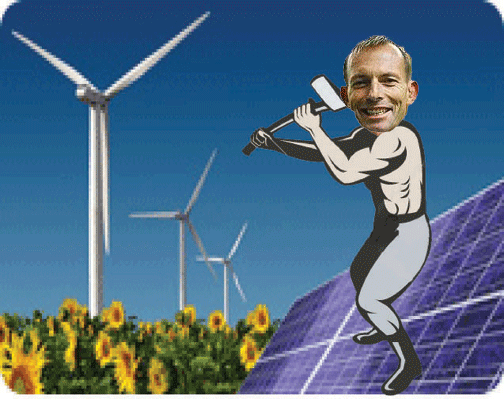
Tony Abbott slapped down as Malcolm Turnbull opts for ‘minimalist’  reshuffle, The Age Michael Gordon, 16 Jan 17 The Turnbull government has slapped down Tony Abbott’s call for it to ditch its renewable energy target for 2020, declaring there are “no plans” to change the policy that was settled when Mr Abbott was prime minister.
Environment and Energy Minister, Josh Frydenberg, told Fairfax Media the government’s intention was to stick with its policy and contrast it with Labor’s commitment to a more ambitious target.
In a direct repudiation of Mr Abbott’s assertion that the existing policy would increase prices, reduce reliability and threaten heavy industries, Mr Frydenberg said: “The government has no plans to change the 2020 RET which was settled just 18 months ago providing investor certainty.”
Mr Abbott delivered a scathing critique of the government on Saturday,……… He said the government’s first move this year should be to introduce legislation to protect existing renewable generation “but to remove all further mandatory use requirements”.
Mr Abbott said the existing policy would almost double renewable energy supplies in the next four years, increasing power costs and reducing reliability…….http://www.theage.com.au/federal-politics/political-news/abbott-slapped-down-as-turnbull-opts-for-minimalist-reshuffle-20170115-gtrtgh.html
January 16, 2017
Posted by Christina Macpherson |
AUSTRALIA - NATIONAL, politics |
Leave a comment
 FREE trips to Sydney’s nuclear reactor are being offered to residents near the South Australian property where the Federal Government hopes to build a radioactive waste dump.
Cabinet is due to make a final decision by the end of the year on whether to build the national low-level radioactive waste management facility at Barndioota, 35km northwest of Hawker.
No other communities have come forward with rival proposals to host the centre since Barndioota was chosen at the preferred location last year.
As part of a community consultation process, a dozen people from the Barndioota area have visited the Lucas Heights Nuclear reactor in Sydney and another nine are due to visit by the end of January.
The Sydney trips were designed to teach community representatives about how the Australian Nuclear Science and Technology Organisation’s OPAL reactor creates medicine and industrial products.
Participants were also provided with information about the storage of radioactive waste at Lucas Heights and how the waste would be packaged for transport to Barndioota.
If regulatory approvals were granted, trucks would begin delivering low and intermediate-level radioactive waste to the new waste dump in 2020.
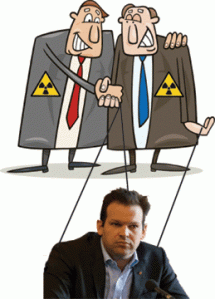 Federal Resources Minister Matt Canavan said the Government wanted to give the community as much information as possible about the production and use of nuclear material and the storage of radioactive waste.
“The waste comes mainly from medical procedures,’’ Senator Canavan said. [ed. Antinuclear That’s a lie]
“Visiting the ANSTO facility takes away the air of mystery about the production of nuclear materials and the size and storage of the waste.”
Senator Canavan said the Barndioota community was approaching the issue in good faith.
“I visited the region late last year and met with local landholders, business operators and traditional owners to talk with them about the next steps and to further explain the importance of the facility,’’ he said.
“The next steps will be to complete a heritage survey of the site, working with traditional owners. That will begin in the coming…weeks.”
A survey found 59 per cent of local residents had no serious concerns about the radioactive waste dump proposal. But there was still strong opposition from some locals, including traditional landowners.
Indigenous leader Regina McKenzie said she was pleased the Government had agreed to undertake an Aboriginal cultural heritage assessment but remained extremely sceptical about the waste dump proposal.
“We’re very concerned about protecting ecosystems,” she said
January 16, 2017
Posted by Christina Macpherson |
AUSTRALIA - NATIONAL, Federal nuclear waste dump, South Australia |
Leave a comment
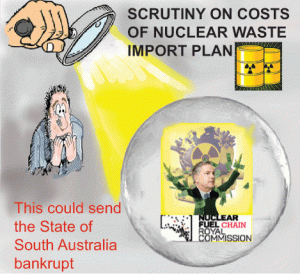 “ there was nothing in the analysis that we did post the royal commission report being tabled down that gave us any form of comfort that there wasn’t huge economic risk associated with this proposal.”
Marshall: Nothing’s off the table – except nuclear, INDaily, Adelaide Monday January 16, 2017
Liberal leader Steven Marshall says he has an open mind on policy solutions, today declaring South Australia “can’t afford to take one single solitary thing off the table” – only minutes after launching a strident defence of his unilateral move to take nuclear waste storage off the table.
In an interview on ABC Adelaide, Marshall was asked about the Liberals’ policy agenda, with little more  than a year before he leads the party to another state election……
The Liberals were put in the spotlight last week when former senator Sean Edwards mused about a push by business supporters to see him installed into state parliament, and possibly to replace Marshall as leader. Edwards refused to rule out either scenario, repeating earlier disenchantment over his party’s decision to withdraw support for a broad discussion over a proposed nuclear waste dump…….
Marshall said of the party room’s decision to withdraw support for further nuclear debate: “A lot of people are out there saying it’s a political decision by Steven Marshall and the Liberal Party; nothing could be further from the truth.”
“We welcomed the royal commission in the first place, in fact we were the only party that was talking about the nuclear opportunity for South Australia before the last election,” he said.
“But there was nothing in the analysis that we did post the royal commission report being tabled down that gave us any form of comfort that there wasn’t huge economic risk associated with this proposal.”…… http://indaily.com.au/news/politics/2017/01/16/marshall-nothings-off-the-table-except-nuclear/
January 16, 2017
Posted by Christina Macpherson |
NUCLEAR ROYAL COMMISSION 2016, politics, South Australia |
Leave a comment
 Derek Abbott No High Level International Nuclear Waste Dump in South Australia, 15 Jan 17
Thought for the day: The Royal Commission proposal for a South Australian dump allowed for 138,000 tonnes of high level waste. But the world produces about 10,000 tonnes every year. Therefore in the time it takes to build the dump, the world has already produced twice the amount waste that the dump can take. Then on top of this there’s the existing 370,000 tonnes of global high level waste to-date with nowhere to go.
So talk of Ben-Hur proportions that a dump will stimulate expansion of the nuclear industry, allowing power for countries in poverty, meeting power needs for growing populations, and that it fills a moral obligation is invalidated by the fact the dump can’t even keep pace with such visions.
So if we peel away all this hollow rhetoric the only real justification for the dump is to make a fast buck, and the ‘noble’ talk of how the dump will save the world is trumped-up sales hype.
And as we know, the goal of making a profit is highly questionable given considerable economic risks and uncertainties involved.https://www.facebook.com/groups/1314655315214929/
January 16, 2017
Posted by Christina Macpherson |
NUCLEAR ROYAL COMMISSION 2016, wastes |
Leave a comment
 Climate change: 90% of rural Australians say their lives are already affected, Guardian, Calla Wahlquist, 15 Jan 17
Overwhelming majority believe they are living with the effects of warming and 46% say coal-fired power should be phased out. Ninety per cent of people living in rural and regional Australia believe they are already experiencing the impacts of climate change and 46% believe coal-fired power stations should be phased out, according to a new study.
A poll of 2,000 people conducted by the Climate Institute found that 82% of respondents in rural and regional Australia and 81% of those in capital cities were concerned about increased droughts, flooding and destruction of the Great Barrier Reef due to climate change, and 78% of all respondents were concerned there would be more bushfires.
About three quarters of all respondents – 76% in capital cities and 74% in rural or regional areas – said ignoring climate change would make the situation worse and about two-thirds said they believed the federal government should take a leading role……..
The majority of people – 59% in capital cities and 53% in regional areas – said solar was their preferred energy source, followed by wind and hydro.
Only 3% of respondents in the city and 4% in regional areas said coal was their preferred energy source.
Nicky Ison, the director of the Community Power Agency, which represents 80 grassroots groups, said the results showed that concern about climate change was not limited to inner-city suburbs.
“I think there’s a misconception that concern is mainly held in the city and I think there are some strong voices, particularly in rural and regional Australia, that have exaggerated or stoked that misconception,” Ison said.
“A vocal minority gets a lot of traction, probably because they have a greater access to megaphones.”
Matthew Charles-Jones is a co-president of Totally Renewable Yackandandah, a community-run initiative that aims to make the small town, 300km north-east of Melbourne, entirely run on renewable power by 2022.
Charles-Jones said the group was motivated by energy security and rising electricity costs but members were also concerned about the effects of climate change.
“We have been threatened by bushfire roughly every three years for the last decade,” he said.
The last bushfire was in December 2015. “It’s very real for us in Yackandandah,” Charles-Jones said. https://www.theguardian.com/environment/2017/jan/16/climate-change-90-of-rural-australians-say-their-lives-are-already-affected
January 16, 2017
Posted by Christina Macpherson |
AUSTRALIA - NATIONAL, climate change - global warming |
Leave a comment
Early skirmishes point to a war over renewable energy lasting well into 2017, The Age, Peter Hannam, 15 Jan 17 “……Trenches are now being dug for what looms as a political battle that will probably last through 2017. On one side lie the Turnbull government, fossil fuel suppliers and right-wing pundits, who say the priority has to be affordable and reliable power.
 On the other, Labor and the Greens and clean-energy backers who argue ageing coal-fired power stations need to prepare for an orderly if not accelerated exit to meet Australia’s commitments agreed in the Paris climate treaty.
Josh Frydenberg, environment and energy minister, ended holidays early on Thursday to rail against states for curbing unconventional gas exploration, which also feeds into higher  electricity prices. That’s especially true in SA where gas provides all the power that’s not from wind or the sun.
He took particular aim at Queensland, where the Labor government under  Annastacia Palaszczuk is aiming for a 50 per cent share of renewable by 2030, up from 4.4 per cent in 2015………
Frydenberg’s Labor counterpart, Mark Butler, though, says the Coalition’s energy policy was “being dictated by the hard right of the party with the likes of Tony Abbott and Cory Bernardi”.
“The culture-war element starts to blind people to pretty clear policy,” he says, noting three-quarters of Australia’s fleet of power stations were operating beyond the end of their design life and needed to be replaced.
“The Turnbull government leaves a policy vacuum at the federal level, the states will fill the void,” he says.
Federal Labor remains committed to a 50 per cent renewable share by 2030, he said, noting the Turnbull government has no target beyond 2020 nor is a target among the terms of reference for its 2017 climate policy review. NSW Labor shares the party’s national goal……
Abbott, as if on cue, weighed into the renewables debate on Saturday……
What is certain is that energy bills are on the rise – although the causes are highly debated…….
Bruce Mountain, an energy economist with CME Australia, says rising energy prices will prompt more people to add solar panels and also batteries as prices continue to tumble – much faster than regulators predict.
Tesla’s new 13.5-kilowatt-hour Powerwall 2, costing about $8800 before installation, already offers a lower battery price than AEMO had predicted for 2040, he says
An average household in Adelaide, where power prices have doubled in the past eight years to be among the highest in Australia, would now be better off with panels and storage.
While panels alone typically slash demand for electricity from the grid by a third, adding a battery will reduce grid purchases by about 95 per cent, he said.
‘Existential threat’
Dylan McConnell, a research fellow at the Melbourne Energy Institute, notes AEMO is predicting 15.5 gigawatts of coal-fired power plants will be shut by 2030. That’s about half of such stations and equivalent to 10 Hazelwoods.
Importantly, AEMO is betting 12GW of new gas-fired power will come on stream “assuming no alternative technologies come to fruition”, Mr McConnell said.
However, the open-cycle gas plants that can provide peaking power to complement variable suppliers such as wind and solar farms “face an existential threat from batteries”, he said……..
Without clear signals, investors won’t have the confidence to invest the billions needed to bring new, more efficient capacity online.
RET challenges
Bloomberg New Energy Finance underscored the scale of the challenge even meeting the 2020 Renewable Energy Target of supplying 33,000 gigawatt-hours from clean energy annually from 2020.
Last year, investment in large scale renewables under the RET bounced back from a meagre $US10 million in 2014 and 2015 after the Abbott government’s review of the sector threw it into a panic. In 2016, it recovered to $US1.1 billion ($1.45 billion).
“However it is still well below the $US2.9 billion per annum now needed to satisfy the notional 20 per cent target by 2020,” Bloomberg said.
Greens energy spokesman Adam Bandt says the Coalition will be tempted to stir up fears of rising electricity prices “in the hope that they can repeat 2013”, when Tony Abbott swept to power in part because of the carbon tax issue.
“They’ll try to beat the electricity bill drums but the prices are going up on their watch,” he says……… http://www.theage.com.au/environment/climate-change/early-skirmishes-point-to-a-war-over-renewable-energy-lasting-well-into-2017-20170111-gtpsd9.html
January 15, 2017
Posted by Christina Macpherson |
AUSTRALIA - NATIONAL, energy, politics, solar, storage |
Leave a comment
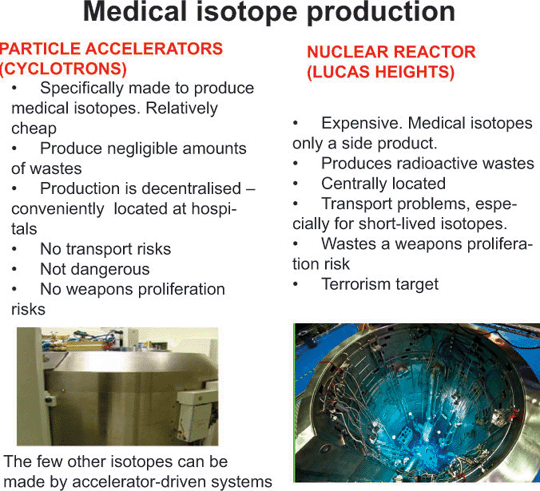
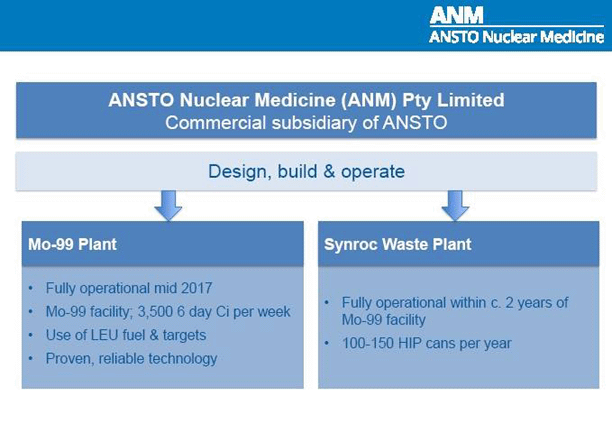
ANSTO’s link http://www.nuclearaustralia.org.au/ansto-nuclear-medicine-project/ This is a slide from the above link. ANSTO Nuclear Medicine (ANM) Pty Ltd is a commercial subsidiary of ANSTO.
So a company is going to cream off the profits while Australian taxpayers subsidise the reactor and the waste disposal – and communities have to deal with the costs of a nuclear waste dump. Another slide says “Full Cost Recovery Model” – the full cost can never be recovered when you are dealing with nuclear waste.
January 14, 2017
Posted by Christina Macpherson |
AUSTRALIA - NATIONAL, politics, secrets and lies |
Leave a comment
Steve Dale Fight To Stop Nuclear Waste Dump In Flinders Ranges SA., 14 Jan 17, Canada is moving towards clean Cyclotrons for Molybdenum-99 production – yet Australia decides it wants to undermine worldwide Cyclotron development by subsidising Mo-99 for the world. Waste taxpayer’s money to produce unnecessary nuclear waste.
“The ANSTO Nuclear Medicine (ANM) Project will enable ANSTO to triple production of Molybdenum-99 (Mo-99). The increased capacity will enable Australia to meet domestic demand, as well as being able to supply up to 25-30% of global demand.”

January 14, 2017
Posted by Christina Macpherson |
AUSTRALIA - NATIONAL, health, politics |
1 Comment
US ‘threatens to involve Australia in war with China’: Paul Keating condemns US secretary of state nominee’s comments, The Age, Fergus Hunter, 14 Jan 17

Former prime minister Paul Keating has rounded on President-elect Donald Trump’s secretary of state nominee, accusing him of threatening to bring on war with China and making “ludicrous” comments on the tense South China Sea dispute.
In a statement released on Friday, Mr Keating warned the Australian government to reject Rex Tillerson’s declaration this week that a “signal” needed to be sent to Beijing that the construction of artificial islands in the contested region must stop and “access to those islands also is not going to be allowed”. The remarks from the former chief of Exxon Mobil, in which he also called for regional allies “to show backup”, have set the stage for sharply increased tensions between the US and China as the Asian superpower builds up its military presence on the islands to defend against competing territorial claims from neighbouring countries.
According to Mr Keating, Mr Tillerson’s testimony to his US Senate confirmation hearing “threatens to involve Australia in war with China”. And he has urged the Australian people to “take note” and recommended the government tell the Trump administration, which will take over on January 20, “that Australia will not be part of such adventurism, just as we should have done in Iraq 15 years ago”. “That means no naval commitment to joint operations in the South China Sea and no enhanced US military facilitation of such operations,” the former Labor prime minister said.
“Tillerson’s claim that China’s control of access to the waters would be a threat to ‘the entire global economy’ is simply ludicrous. No country would be more badly affected than China if it moved to impede navigation. On the other hand, Australia’s prosperity and the security of the world would be devastated by war.”……… http://www.theage.com.au/federal-politics/political-news/us-threatens-to-involve-australia-in-war-with-china-paul-keating-condemns-us-secretary-of-state-nominees-comments-20170113-gtqy0k.html
January 14, 2017
Posted by Christina Macpherson |
AUSTRALIA - NATIONAL, politics, politics international |
Leave a comment
 Adani coalmine activists gear up to fight: ‘This will dwarf the Franklin blockade’
As the protest against the Carmichael project – Australia’s largest proposed coalmine – moves beyond the courts and into the realm of civil disobedience, activists have a clear warning: ‘If you’re in bed with Adani, you’re a target’, Guardian, Joshua Robertson, 14 Jan 17, Across Australia a secretive network of activists are laying the groundwork for what they expect will be the biggest environmental protest movement in the country’s history.
Of course this won’t materialise if Adani and the rest of the miners proposing to open up one of the world’s biggest coalfields walk away from Queensland’s Galilee basin first.
But standing idly by on the assumption that the economics of the massive coal projects won’t stack up – at a time the world is trying to reduce carbon emissionsto limit global warming to under 2C – is not a choice these activists are willing to make.
And so the campaign to take the fight against Australia’s largest proposed coalmine, Adani’s Carmichael project, to another level, beyond the courts and into the realm of civil disobedience, is under way………https://www.theguardian.com/environment/2017/jan/14/adani-coalmine-activists-gear-up-to-fight-this-will-dwarf-the-franklin-blockade
January 14, 2017
Posted by Christina Macpherson |
AUSTRALIA - NATIONAL, climate change - global warming, Queensland |
Leave a comment