No, Mr Turnbull, coal is NOT our future: renewables with energy storage, are here
 Why Coal Is Not Our Future, Skeptical Science 15 December 2016 by Riduna
Coal Problems
Australian Prime Minister, Malcolm Turnbull, has repeatedly asserted that coal will remain in use for electricity generation for ‘many, many decades to come’. He argues that moving to renewable energy would reduce production and use of coal resulting in unacceptable loss of mining and transport jobs, particularly in rural areas. However, the threat of larger job losses did not stop his predecessor from withdrawing subsidies for the car industry, resulting in its closure nationwide – action supported by the present Prime Minister.
Recently, Energy Minister Friedenberg asked Australia’s Chief Scientist, Dr Finkel, to prepare a Discussion Paper on electricity security during the transition to renewable energy. The Paper, presented to the Prime Minister and Premiers on 9 December, 2016 recommended that an energy intensity scheme be applied to the electricity generating sector. This would see the highest emitters leave electricity generation and promote orderly replacement of coal by gas and, increasingly, renewable energy generators.
The Paper reported that existing policies lacked clarity and certainty for investors and would not achieve Australia’s commitment to reduce greenhouse gas emission by 26-28% below 2005 levels by 2030, given under the Paris Agreement. Even before recipients of the paper had time to consider it, the Prime Minister rejected its main conclusions.
In declaring coal Australia’s present and future energy source, Turnbull has chosen to ignore the dangers of coal production and use to public health or, more accurately, public death. Clear evidence shows that coal mining in Australia not only causes respiratory problems through inhalation of airborne particles but that this results in the incurable ‘black lung disease’ resulting in a slow and painful death. Its combustion in power stations results in emissions which increase the incidence and severity of health problems among populations living up to 100 km away.
As the Prime Minister knows, coal has to compete with renewable clean energy sources, particularly solar and wind. It’s a no brainer of course. Continue reading
Solar energy park is seeking co-operative venture with sheep farming!
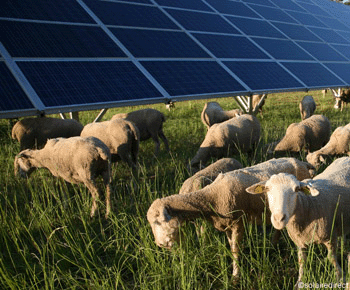
Maoneng Group, who started building the solar farm in March after winning a tender in the ACT government’s first large-scale renewables reverse auction, has this week launched its own, rather unusual, tender – for a flock of sheep. The company is seeking expressions of interest for a farmer or community group to graze 100-150 head of sheep within the Mugga Lane Solar Park – an area of around 46 hectares at the intersection of Mugga Lane and Monaro Highway in the ACT.
“Applicants must maintain the livestock inclusive of drenching, crutching, shearing, veterinarian costs and portable pens,” the tender says, adding that “weathers or non-lambing ewes are preferred.”
The owners of the solar park, which began generating power in mid-November, will provide and maintain fencing, two water troughs and a small holding paddock with all-weather accessibility.
Maoneng’s Shaun Curran said the deal, which would be a quid pro quo “cost neutral” affair, would provide a local farmer or community group with free and secure grazing, while for the Solar Farm, it would provide free lawn mowing and reduce the site’s fire risk…….
Curran also noted that sheep, while preferred, were possibly not the only livestock option.
“There was a large mob of kangaroos on site when it was first being developed,” he said. “So they could work too. They’re similar to sheep; not too destructive. They don’t want to rub up against the panels.”…… http://reneweconomy.com.au/act-solar-farm-announces-new-tender-sheep-19044/
Comments on Australian Energy Market Operator (AEMO)’ s “Black System” report
 Dennis Matthews, December 2016 BLACK SYSTEM, SOUTH AUSTRALIA, 28 SEPTEMBER 2016.
3rd Preliminary Report, December 2016 Australian Energy Market Operator (AEMO)
Introduction
The “Black System” referred to by AEMO is what is more commonly known as the South Australian state-wide blackout. AEMO also refers to it as “the event”. The AEMO report contains considerable technical jargon and use of acronyms. Constant referral to a list of terms and abbreviations at the beginning of the report is necessary.
AEMO Executive Summary
According to the executive summary, the SA blackout was “initiated by the loss of three transmission lines involving a sequence of faults in quick succession”. These electricity transmission lines are the high voltage power lines that feed into the low voltage distribution system that services homes and many small to medium businesses.
The damaged transmission lines were in the mid-north of SA.
The sequence of faults led to many wind turbine electricity generators in the mid-north initially trying to continue to generate. Within 7 seconds, these initial attempts to “ride through” the problems caused by transmission line damage were followed by wind turbines deliberately shutting down (tripping), or decreasing their output, in order to protect them from serious damage. This caused a decrease of power generation by about 460 megawatts (MW). Prior to the transmission line damage, the total generated grid power available to SA was about 1830 MW. Domestic, off-grid, solar photovoltaic power was about 50 MW.
Although it seems reasonable that wind turbines should have an ability to shut down to protect against serious damage, according to the report “AEMO was not aware of the protective feature of these generating units”. Consequently, AEMO had not taken steps to replace the lost power in such a situation.
The loss of about 460 MW of generating capacity resulted in an attempt to import extra power through the Heywood, high voltage, alternating current (AC), connector with Victoria. Such connectors between states are essential for the operating of an electricity market. Without interconnectors there would be no National Electricity Market (NEM). Continue reading
EXPOSED: NUCLEAR WASTE DUMP PROPAGANDA
 Documents released by Friends of the Earth today reveal that:
- Taiwan will not pay SA to accept high-level nuclear waste if that requires investing in waste storage and disposal infrastructure.
- Taiwan would not send nuclear waste to Australia unless and until a repository is built and operating.
- Taiwan would not send nuclear waste to Australia in the face of widespread public opposition.
Dr Jim Green, national nuclear campaigner with Friends of the Earth Australia, said: “Taiwan’s power utility Taipower states clearly and repeatedly that Taiwan will not pay for nuclear waste storage and disposal infrastructure in SA. Yet foreign investment in that infrastructure is central to the state Labor Government’s plans. Preliminary and exploratory studies could cost up to $2.4 billion and Premier Jay Weatherill must now come clean on whether he intends to gamble billions of dollars of taxpayers’ money on this project.”
Taipower’s statements are directly at odds with statements made by Martin Hamilton-Smith. Opposition treasury spokesman Rob Lucas is quoted in this morning’s Advertiser saying that Hamilton-Smith “stands condemned for misleading everyone” about Taiwan’s views.
Dr Green continued: “Taiwan would not send nuclear waste to Australia unless and until a repository is built and operating. Yet the Final Report of the Royal Commission clearly states that unless nuclear waste is imported prior to the establishment of a repository, the project would not be profitable.” [See p.300 of the Royal Commission’s Final Report.]
“Taiwan will not send nuclear waste to Australia in the face of widespread public opposition. A clear majority of South Australians oppose the nuclear waste dump plan. A statewide consultation process found 53% opposition compared to just 31% support. A recent poll commissioned by the Sunday Mail found just 35% support. Two-thirds of the Citizen Jurors rejected the dump plan ‘under any circumstances’. The Premier himself has acknowledged the ‘overwhelming opposition of Aboriginal people’.
“It is unlikely that any country would send nuclear waste to SA in the face of widespread public opposition and overwhelming opposition from Aboriginal people. It is unlikely that any country would pay for waste storage and disposal infrastructure in SA. It is unlikely that any country would send waste to SA in the absence of a built, operating repository. The Labor Government’s plan fails on all three counts.
“South Australians opposed to the dump will be spoilt for choice at the March 2018 election with the Liberal Party, the Nick Xenophon Team and the SA Greens all opposed to the Labor Government’s plan to turn SA into the world’s high-level nuclear waste dump. The Premier should have the good sense to swallow his pride and to dump the dump before he puts the Labor Party in an unwinnable position leading up to the state election,” Dr Green concluded.
Taiwan rejects claim that it would help South Australia to set up a nuclear waste dump
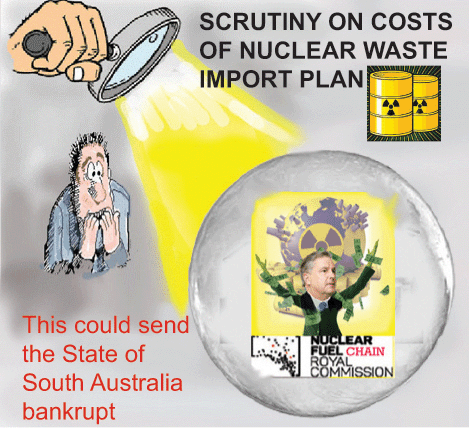 One of the major criticisms of the SA nuclear proposal by the SA Liberals and green groups has been the risk of spending state taxpayer money up front with no certainty of future revenue.
Opposition treasury spokesman Rob Lucas said Mr Hamilton-Smith “stands condemned for misleading everyone” about Taiwan’s views
Taiwanese energy firm rejects Martin Hamilton-Smith’s claim it would help set up SA nuclear waste dump Daniel Wills, State political editor, The Advertiser 14 Dec 2016
TAIWAN’S state-owned energy company has bluntly rejected Investment and Trade Minister Martin Hamilton-Smith’s claim the country would consider paying to help set up a nuclear waste dump in SA, saying in a letter that it “hereby declares this is a false information”.
Just days after Premier Jay Weatherill’s citizens’ jury last month overwhelmingly dumped on plans for nuclear storage in SA, amid concerns about trust, Mr Hamilton-Smith insisted he had met with Taiwanese officials who expressed a “clear message” of interest in investment.
“There’s clearly a demand and our neighbours may be in a position to put hundreds of millions, if not billions, into infrastructure and then paying to dump waste on an ongoing basis,” he said.
However, correspondence from state-owned power company Taipower and the country’s Atomic Energy Council to government party MP Su Chih-Feng rejects Mr Hamilton-Smith’s claim.
While they note there was a meeting with Mr Hamilton-Smith on November 10, Taipower says his spin of the events in Adelaide three days later was “a false information”.
The translation from Mandarin to English was done by a Taiwanese NGO and provided to The Advertiser by antinuclear activists Friends of the Earth Australia. It states Taipower was interested in using a dump which had been established, but not paying to help set one up. Continue reading
Greens urge Queensland government to reject $1 billion taxpayer-funded loan for Adani coal rail line
 NAIF funding: Greens call for Queensland government to put stop to Adani loan, SMH. Felicity Caldwell, 12 Dec 16. Premier Annastacia Palaszczuk should reject a $1 billion taxpayer-funded concessional loan for the Adani Carmichael mine’s rail line, the Queensland Greens say.
The Greens say the Premier has the power to reject funding under the federal government’s Northern Australia Infrastructure Facility………Last week, Ms Palaszczuk met with Mr Adani and announced Townsville would be home to the Carmichael mine’s regional headquarters.
The Greens’ statewide campaign calling on the government to reject the NAIF loan and protect the reef will start in the electorate of Mount Coot-tha, targeting Environment Minister Steven Miles’ seat.
Billboards will be erected in the electorate and will be accompanied with online videos and a doorknocking campaign. http://www.smh.com.au/business/mining-and-resources/naif-funding-greens-call-for-queensland-government-to-put-stop-to-adani-loan-20161212-gt9erv.html
Sydney Lord mayor Clover Moore orders decisive action on climate change
 Sydney mayor Clover Moore orders urgent action on climate change http://www.smh.com.au/nsw/sydney-mayor-clover-moore-orders-urgent-action-on-climate-change-20161212-gt98ly.html Lisa Visentin
 The Paris Agreement commits signatories, including Australia, to “hold average temperature increase to well below 2 degrees and pursue efforts to keep warming below 1.5 degrees above pre-industrial levels”.
“It was clear from the conference that we need bolder action at a faster rate if we are to play our part in meeting the Paris Agreement,” Cr Moore stated in her report from the summit, which was tabled at Monday night’s council meeting.
At the meeting, she called on council staff to come back to council in February “with actions to accelerate our emissions reductions over the next four years”.
Fast-tracking the city’s move towards zero-carbon buildings, including developing a clear target date by which building standards should be in place, were key priorities, she said. She also called on City of Sydney chief executive Monica Barone to bring forward the city’s Draft Environmental Action Plan to the council’s first meeting in 2017 with a clear list of priorities in line with the C40 Summit.
Cr Moore said research presented at the summit provided cities with clear targets which, if adopted, would deliver 40 per cent of the savings need to achieve the ambition of the Paris Agreement.
Cr Moore’s report and recommendations were adopted unanimously by council.
The focus of Monday night’s council meeting on climate change policy comes after the Turnbull government’s beleaguered week in the policy arena, which culminated in a fractious meeting with state premiers at Friday’s Council of Australian Government meeting.
The week was dominated by Coalition intransigence on climate change, even as a report by chief scientist Alan Finkel warned Australia had no clear path to meeting the 2030 emissions target taken to the Paris climate deal under existing policies.
This report was preceded by a policy capitulation by Environment Minister Josh Frydenberg, who promptly dumped plans for a review of the Coalition’s direct action policy to examine whether to introduce an emissions intensity scheme for the electricity industry – a form of carbon pricing – after vocal opposition from the Coalition backbench.
Fairfax Media then revealed the Turnbull government had been sitting on advice that an emissions intensity scheme would save households and businesses up to $15 billion in electricity bills over a decade. The Paris Agreement commits signatories, including Australia, to “hold average temperature increase to well below 2 degrees and pursue efforts to keep warming below 1.5 degrees above pre-industrial levels”.
A month ahead of schedule, Queensland’s huge new solar farm is up and running
 Queensland’s largest solar farm plugs into the grid a month early The 20 megawatt plant in Barcaldine is one of first in the country to be funded by Australian Renewable Energy Agency, Guardian, Joshua Robertson, 14 Dec 16, Queensland’s largest operating solar farm has plugged into the national electricity grid and is set to generate enough power for almost 10,000 households by the end of 2016.
The Barcaldine remote community solar farm, in the state’s central west outback, connected to the national electricity market on Wednesday, more than a month ahead of schedule.
The early delivery of the 20 megawatt plant, one of the first in the country to be funded by the Australian Renewable Energy Agency, was evidence of the growing speed and proficiency of big solar developers, said Arena’s chief executive, Ivor Frischknecht.
It is to be followed by a dozen new large-scale solar farms to be built across Australia by the end of 2017, which would ramp up national solar capacity to enough power for 150,000 average homes.
Those plants – six in Queensland, five in New South Wales and one in Western Australia – would be the fruits of an Arena funding program expected to “unlock almost $1bn in commercial investment and boost regional economies”, Frischknecht said.
The Barcaldine plant developer, Elecnor – one of a number of Spanish companies invested in Australian solar – is a transnational corporation with interests from gas and rail to aerospace. Elecnor was backed by $22.8m in funding commitments by Arena and $20m in loans from the federal government’s “green bank”, the Clean Energy Finance Corporation.
Barcaldine’s mayor, Rob Chandler said the project, which features 78,000 solar panels, had “enthusiastic supporters” in a local community that saw “the great benefits it can bring to outback communities like ours”.
“If it’s one thing we have a lot of it’s sun so it’s great to see it being harnessed to power the electricity grid.”
Frischknecht said: “As well as generating clean energy, the project is demonstrating how project developers can monetise network benefits and ultimately how solar farms can improve network efficiency and reliability at the edge of the grid.”…… https://www.theguardian.com/environment/2016/dec/14/queenslands-largest-solar-farm-plugs-into-the-grid-a-month-early
Treaty discussions between Aboriginal nations and South Australian government
 South Australian Government enters historic discussions with Aboriginal nations The World Today By Caroline Winter http://www.abc.net.au/news/2016-12-14/south-australia-enters-historic-treaty-discussions/8120162
“South Australia is making history, with the State Government entering treaty discussions with Aboriginal nations to help address past injustices.
“The Government has set aside $4.4 million over five years to support the treaty process and the appointment of an independent commissioner for treaty.
“At this stage it is unclear what the treaties will cover or whether compensation will be included,
but South Australian Indigenous leaders said the process would set a positive course for the future. … ”
SA set for Indigenous treaty talks ‘South Australia could have up to 40 treaties after
an announcement was made in Adelaide on Tuesday morning.’https://www.sbs.com.au/nitv/article/2016/12/14/sa-set-indigenous-treaty-talks?cid=inbody:challenges-ahead-for-victorian-treaty-negotiations Madeline Hayman-Reber Source: NITV News 14 December 2016:
““Treaty is an important step towards addressing the wrongs of the past.
The fact that so many Aboriginal people to this day face such significant disadvantage remains the greatest stain on our society,” Mr Maher said. “This marks the first time that a state has committed to individualised treaties for Aboriginal communities, and comes off the back of yesterday’s announcement in Victoria of plans for a statewide treaty. … “
Western Australia: Cameco’s Yeelirrie uranium project halted due to risk to 12 species of subterranean fauna.
 14 Dec 16 The Conservation Council of Western Australia appealed to the Minister for Environmnent against the EPA’s approval of Cameco’s planned Yeelirrie uranium project.
The Appeals Convenor and the Minister for Environment have released the findings of the Appeals process. The Minister will continue to deliberate and make a decision soon. He has been clear to say that the EPA report will be considered along with economic considerations.
There is still every chance the Minister will approve the mine – but at this stage he has rejected Cameco’s appeal in regards to subterranean fauna:
In relation to subterranean fauna, the EPA’s report concluded that there remained too great a chance of a loss of 12 species that may be restricted to the impact area and therefore concluded that the proposal could not meet its objectives for this factor
Report finds 100% renewable grid “reliable, robust and stable”
100% renewable grid not just feasible, but “reliable, robust and stable” http://reneweconomy.com.au/100-renewable-grid-not-just-feasible-reliable-robust-stable-12185/?utm_source=RE+Daily+Newsletter&utm_campaign=dd172b60b8-EMAIL_CAMPAIGN_2016_12_09&utm_medium=email&utm_term=0_46a1943223-dd172b60b8-15634933 By Sophie Vorrath on 9 December 2016
The discussion paper, released on Friday by not-for-profit group the Alternative Technology Association, found that a fully renewable electricity grid would provide long-term economic and social benefits for Australia, while also playing an important part in its commitments to fight climate change.
The publication of the paper coincides with Friday’s meeting of COAG, to discuss the preliminary report of the Finkel Review into the security and stability of the national electricity market.
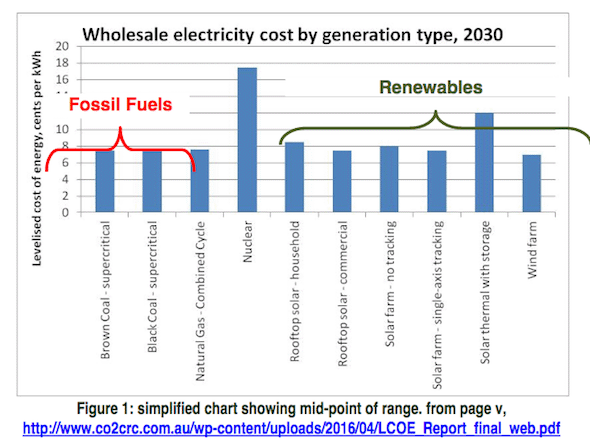
The ATA report, 100% Renewable Grid – Feasible?, reviewed evidence from recent developments in Australia and overseas, as well as previous studies including those by the Australian Energy Market Operator.
“We found all experts agree that a 100% renewable grid will be reliable and stable, as long as it uses an appropriate mix of renewable generation sources, energy storage and upgraded infrastructure,” said Andrew Reddaway, the paper’s author and ATA energy analyst.
During periods of calm, cloudy weather electricity could be sourced from sunny or windy parts of the country and supplemented with energy stores such as hydroelectric dams, molten salt heat storage, batteries, renewable gas and stockpiles of pelletised woody waste, the report found.
“This grid would be robust, with smarter renewable generators and batteries automatically injecting extra electricity when required for grid stability,” Reddaway said.
“Similarly, smart appliances would detect disturbances in the grid and independently adjust their power level to compensate.”
The ATA report also found that the cost of such a smart and diverse grid would be manageable, and compared it to a “21st century version of the Snowy Mountains Scheme.”
The Snowy hydro scheme, said Reddaway, cost the equivalent of 16 per cent of Australia’s Gross Domestic Product in its commencement year, but these costs were spread over the project’s duration, and were balanced by the creation of many local industry jobs.
“During the transition energy costs are likely to be slightly higher than ‘business as usual’, but in the longer term it would place downward pressure on electricity bills because renewable energy generation is cheap to run,” Reddaway said.
“Widespread energy efficiency measures would further offset costs.”
On the technical side of things, the report noted that there were “many possible solutions to maintain grid stability as levels of wind and solar generation increase.”
For example, to maintain inertia in the grid, the report recommends retaining the steam turbines of decommissioned fossil fuel power plants, keeping them connected to the grid, and allowing them to continue to rotate in synch with grid frequency, without burning fuel.
For wind farms, the report notes, when a slowdown in grid frequency is detected, the wind turbine’s controller could immediately increase its power output by temporarily sacrificing some blade speed – an app roach known as synthetic inertia that ATA says is already required in part of Canada.
As for rooftop solar, the report says this is already evolving to help keep the future grid stable.
“As of October 2016, all new grid-connected inverters must be capable of reducing their generation or export, in response to a signal from the grid operator,” it says.
“Known as Demand Response Mode (DRM), this feature allows solar generation to be curtailed when it exceeds overall demand – although this is not expected to be implemented for many years, the ATA notes, and requires and additional device known as a Demand Response Enabling Device (DRED) to be plugged into the inverter.
And, like other reports released recently on this subject, the ATA notes that battery storage will play a big role in future renewables-heavy grids.
“Batteries are especially well suited to support grid stability,” the report says, “as they can discharge electricity into the grid with zero start-up time.
“Large batteries have already been installed in the grid for such purposes overseas,” it says, adding that household batteries can also provide this service, while also delivering savings and other benefits to consumers.
Australia’s nuclear industry – a history of crude racism against Aborigines

 Dumping on Traditional Owners: the ugly face of Australian racism The Drum, 29 March 12 The nuclear industry has been responsible for some of the crudest racism in Australia’s history.
This racism dates from the British nuclear bomb tests in the 1950s but it can still be seen today.
The British government conducted 12 nuclear bomb tests in Australia in the 1950s, most of them at Maralinga in South Australia. Permission was not sought from affected Aboriginal groups such as the Pitjantjatjara, Yankunytjatjara, Tjarutja and Kokatha. Thousands of people were adversely affected and the impact on Aboriginal people was particularly profound.
Many Aboriginal people suffered from radiological poisoning. There are tragic accounts of families sleeping in the bomb craters. So-called ‘Native Patrol Officers’ patrolled thousands of square kilometres to try to ensure that Aboriginal people were removed before nuclear tests took place. Signs were erected in some places – written in English, which few in the affected Indigenous communities could understand. The 1985 Royal Commission found that regard for Aboriginal safety was characterised by “ignorance, incompetence and cynicism”. Many Aboriginal people were forcibly removed from their homelands and taken to places such as the Yalata mission in South Australia, which was effectively a prison camp.
In the late-1990s, the Australian government carried out a clean-up of the Maralinga nuclear test site. It was done on the cheap and many tonnes of debris contaminated with kilograms of plutonium remain buried in shallow, unlined pits in totally unsuitable geology. As nuclear engineer and whistleblower Alan Parkinson said of the ‘clean-up’ on ABC radio in August 2002:
“What was done at Maralinga was a cheap and nasty solution that wouldn’t be adopted on white-fellas land.”
Despite the residual contamination, the Federal Government has off-loaded responsibility for the land onto the Maralinga Tjarutja Traditional Owners. The Government portrays this land transfer as an act of reconciliation, but the real agenda was spelt out in a 1996 government document which states that the clean-up was “aimed at reducing Commonwealth liability arising from residual contamination.”….. http://www.abc.net.au/unleashed/3919296.html
The Australian tax-payer is the sole investor in Adani’s coal export plans.
Aside from the culture, environment and cost, is Adani a good investment?, The Age, Julien Vincent , 13 Dec 16,
The Australian public is the sole investor in Adani’s coal export plans.
Adani is an Indian conglomerate that wants to build the largest thermal coal mine in Australia, a rail line of almost 400 kilometres connecting it to the coast, and a coal export terminal in the Great Barrier Reef World Heritage Area. The coal would be shipped out through the reef, giving it a perfect view of the bleaching and mortality that has been decimating our valuable natural icon recently before being burned in power stations overseas, only to further contribute to climate change and ocean acidification, considered the greatest long-term risks to the reef.
Given that the reef sustains 60,000 jobs and provides $6 billion per year of economic benefit to Australia, investors may want to consider conflicts of interest before moving ahead.
Some other niggling environmental risks investors might want to consider is the drainage of 12 billion litres per year of water from the Great Artesian Basin and the impacts of coal dust on people’s health along the transport corridor, along with particulate matter from the power stations as the coal is burned.
We’d also want to be content with supporting a mine that has not received free, prior and informed consent from traditional owners, potentially making this a major human rights issue.
But enough of the existential threats posed to culture, people, sites of natural World Heritage and the climate.
Let’s look at the numbers. Last week’s proposal by the Australian government of a $1 billion loan from the Northern Australia Infrastructure Fund means as investors we need to understand the business case.
First of all, don’t be put off by Adani’s corporate debt, which is two-and-a-half times the size of the company. Or the fact that Adani’s share price is down 20 per cent this year. This loan would actually be going to Adani’s private family company, based in Singapore and ultimately owned by Atulya Resources in the Cayman Islands, where we can be sure the money will be totally secure.
The mine will supply new coal power stations in India, whose power minister said yesterday would not be required until 2022, and who wants to get India off imported coal within the next few years. The power will only cost twice that of new renewable energy, and so an exciting market has been identified among those living in energy poverty.
Should the India option fail, the coal could be sold onto the seaborne market, which has declined by 10 per cent in recent years, Goldman Sachs, Deutsche Bank, Bernstein and others declaring it in structural decline.
Conditions like these have frightened off a few more faint-hearted commentators, such as the Queensland Treasury under the Newman government, which described the project as unbankable. Or Wood Mackenzie, which still considers the project as having a negative net present value.
Should the India option fail, the coal could be sold onto the seaborne market, which has declined by 10 per cent in recent years, Goldman Sachs, Deutsche Bank, Bernstein and others declaring it in structural decline.
Conditions like these have frightened off a few more faint-hearted commentators, such as the Queensland Treasury under the Newman government, which described the project as unbankable. Or Wood Mackenzie, which still considers the project as having a negative net present value…….
It’s clear that our investment is going to make a major difference. But will it be enough? $1 billion is a huge lifeline but depending on what assumptions you make about the scale of the project or who you’re prepared to believe, this project is going to cost anywhere from $7 billion to $21 billion……http://www.theage.com.au/business/mining-and-resources/aside-from-the-culture-environment-and-cost-is-adani-a-good-investment-20161213-gta0nq.html
Heatwaves are killers – and they are getting worse
 Heatwaves are more deadly than bushfires and they’re going to get worse, Canberra Times, Karl Kruszelnicki , 13 Dec 16 In 2009, the terrible Black Saturday bushfires killed 173 people. What most Australians don’t realise is that the crippling heat around the horrendous bushfires killed 374 people.
In the European heatwave of 2003, 50,000-70,000 people died between June and August. The Russian heatwave of 2010 killed about 55,000 people.
A bushfire leaves obvious signs of the cause of death (burns, blisters, etc), but a heatwave does not. Deaths from heatwaves are revealed indirectly. In Victoria in 2009, the first sign that the heatwaves were killing people was the morgues filling up. The unexpected extra corpses had to be stored in universities, mortuaries, funeral parlours and the like.
There are many definitions of a heatwave. The one from the World Meteorological Organisation (WMO) is widely accepted. According to the WMO, a heatwave happens when you have five days in a row, each with a daily maximum temperature five-or-more degrees higher than the average maximum temperature……..
The science is quite clear that climate change (which has been accepted as real since in 1988, and yes, we caused it) is worsening heatwaves. Dr Thomas Knutson and colleagues from the US Geophysical Fluids Dynamics Laboratory in Princeton University wrote a paper showing that (with a very high degree of confidence) climate change caused the extreme heat Australia experienced in 2013.
In Australia, heatwaves now arrive earlier, are hotter, and last longer……http://www.canberratimes.com.au/comment/heatwaves-are-more-deadly-than-bushfires-and-theyre-going-to-get-worse-20161212-gt9fyl.html
Australian Capital Territory (ACT) – jobs growth with renewable energy
 Renewable jobs grow as ACT drives down emissions from government operations by 17 per cent in three years, Canberra Times, Katie Burgess, 13 Dec 16, Jobs growth in the ACT renewable energy sector in the past six years was 12 times faster than the national average, a report into the territory government’s action on climate change has revealed.
The Minister’s Report into Climate Change and Greenhouse Gas Reduction also showed the rate of job growth in the ACT’s renewables sector was six times higher than any other state and territory, as the government invested $12 million into a renewable energy industry development strategy.
Ahead of the COAG Energy Council meeting on Wednesday, climate change minister Shane Rattenbury said he would push other states and territories to take up their own renewable energy targets.
“We must not allow the federal government’s inaction to limit what we can achieve at a state and territory level. The ACT is a great example of what subnational governments can achieve. We are on track to meet our 100 per cent renewable electricity target by 2020 and to become Australia’s first zero emission jurisdiction by 2050,” Mr Rattenbury said.
Emissions from government operations have fallen 17 per cent since 2012-2013, the report also revealed. The ACT government is aiming to be carbon neutral in its own operations by 2020……http://www.canberratimes.com.au/environment/climate-change/renewable-jobs-grow-as-act-drives-down-emissions-from-government-operations-by-17-per-cent-in-three-years-20161213-gta1ha.html
1 This month
17 October, Free Public Talk on Nuclear Issues in South Australia
David Noonan will speak on public interest concerns over the new Roxby Downs Indenture Act 2026 on BHP copper-uranium mining and ore processing in SA, and on how AUKUS may face SA with a High-Level nuclear waste agenda.
Dr Jim Green will discuss international developments in the field of nuclear power including ‘small modular reactors’ and Generation 4 ‘advanced’ nuclear reactor concepts.


Help Aunty Sue Protect Her Land and Sacred Sites From Destructive Rocket Testing.
.

Australians deserve the truth
about
AUKUS – https://aukuspublicinquiry.com/

PETITION – To: Prime Minister Anthony Albanese and the Australian Labor Government

of the week – Australians for War Powers Reform (AWPR)
To see nuclear-related stories in greater depth and intensity

