Conflict of interest as Northern Australia Infrastructure Fund (NAIF) board members approve $1bn to Adani coal project
five of the seven Northern Australia Infrastructure Fund (NAIF) board members have what it calls “strong ties” to the mining industry.
Adani’s Carmichael coalmine doesn’t meet infrastructure fund criteria, says Greenpeace https://www.theguardian.com/business/2016/dec/21/adanis-carmichael-coalmine-doesnt-meet-infrastructure-fund-criteria-says-greenpeace
Analysis says $1bn of commonwealth funding would amount to paying $683,000 for each job generated, Guardian, Michael Slezak, 21 Dec 16, Adani’s coal infrastructure should not be given money from the Northern Australia Infrastructure Fund since it does not meet at least two of the mandatory criteria, according to analysis by Greenpeace. Continue reading
Resources Minister Matt Canavan attacks Australian Broadcasting Corporation (ABC)
 Federal resources minister accuses ABC of ‘fake news’ over Adani coalmine Matt Canavan attacks the broadcaster for being one-sided and says Australia’s biggest coalmine would improve the environment, Guardian, Gabrielle Chan, 22 Dec 16, The federal resources minister has accused the ABC of reporting fake news and thrown his weight behind the energy giant Adani, amid Indian finance ministry investigations into the company.
Matt Canavan attacked the ABC for what he described as one-sided coverage of Adani’s plans to build Australia’s biggest coalmine and accused the national broadcaster of having a massive blindspot when it came to the project.
The Liberal National party senator from Queensland also said the Adani Carmichael coalmine would improve the environment in central Queensland by setting aside land for birdlife and returning water to the Great Artesian basin……..
The Greens leader, Richard Di Natale, said Canavan’s comments showed the “lunatic fringe” was in power.
“For Matt Canavan to suggest that Adani’s Carmichael coalmine will be good for the environment, in contrast to all scientific evidence, shows that the lunatic fringe of the Turnbull government is running the show,” Di Natale said.
“Matt Canavan’s comments are an embarrassment and if [the prime minister] Malcolm Turnbull is serious about tackling dangerous climate change he will give Australia an early Christmas present by stopping the Adani coalmine from opening and stopping Matt Canavan from opening his mouth.”…… https://www.theguardian.com/environment/2016/dec/22/federal-resources-minister-accuses-abc-of-fake-news-over-adani-coalmine
Turnbull govt agreed to grant $640,000 to climate denialist centre
Federal grant to Bjørn Lomborg centre made in Turnbull era, documents show
Department agreement to provide $640,000 grant dates from March 2016, according to documents obtained under freedom of information, Guardian, Paul Karp, 23 Dec 16, The Turnbull government signed an agreement to make a $640,000 grant to Bjørn Lomborg’s Copenhagen Consensus Centre nine months after plans to establish the centre had been abandoned.
The education department may have been under no legal obligation to make the grant, documents suggest.
The funding was used to support the centre’s post-2015 UN development goals project that found limiting global temperature rises to 2C was a poor investment.
A breakdown of costs released on Thursday shows that $482,000 of the Australian funding was spent on professional fees and services including research, “outreach” and forums.
About $146,000 was spent on travel in an ambitious global project convening seminars to discuss the UN development goals in Bangladesh, Brazil, Colombia, India, Indonesia, Kenya, Mexico, Nigeria, South Africa and New York.
The project formed the basis of Lomborg’s book The Nobel Laureates’ Guide to the Smartest Targets for the World, which is not widely available in Australian shops.
Documents released under freedom of information show the department only entered a formal agreement to fund the project as late as 21 March 2016. Based on those documents and answers provided by the education department it appears the government did not have any ongoing commitment to the project when the Australian Consensus Centre was canned in June 2015……..
Labor’s innovation, industry, science and research shadow minister, Kim Carr, called on the government to provide a full explanation of the grant.
“The government must explain how and why this grant was still awarded, even after it had terminated the agreement with the university for the Australian Consensus Centre following pressure from the opposition and the research community,” Carr said.
“Malcolm Turnbull cannot hide behind a prior deal made by Tony Abbott – his government signed a fresh contract on 21 March 2016.”
“This use of taxpayers’ money to promote an anti-science conservative agenda shows that Malcolm Turnbull is still beholden to the right wing of the Liberal party.”
At Senate estimates on 20 October, Birmingham said the government had made a “special purpose” decision to allocate funding to the consensus centre, a process that was “terminated”……. https://www.theguardian.com/australia-news/2016/dec/23/federal-grant-to-bjrn-lomborg-centre-made-in-turnbull-era-documents-show?CMP=share_btn_tw
Australian government about to subsidise shady coal corporation Adani Enterprises
 Adani’s Galilee Basin complex corporate web spreads to tax havens, ABC News 21 Dec 16 Stephen Long It is an intriguing corporate web that spreads from North Queensland, across Asia to the Caribbean.
Giant Indian conglomerate Adani, which plans to build one of the world’s largest coal mines in Queensland’s Galilee Basin, has set up a complex network of companies and trusts in Australia which are owned in one of the world’s major tax havens, the Cayman Islands.
The Adani Group is also attempting to shift ownership of the existing Abbot Point coal port — which it bought for $1.8 billion — to a Singaporean company ultimately owned in the Cayman Islands.
An exhaustive search of company filings and documents across the globe has cast light on this opaque structure of ownership and control.
It has alarmed environmental activists and legal experts, who fear it could make it harder to gain compensation from Adani in the event of an environmental disaster from Adani’s planned mine and port expansion on the edge of the Great Barrier Reef.
“I’ve been a businessman for most of my life, as well as an environmental activist, and the risks are great,” said Geoff Cousins, former Optus CEO and chairman of the George Paterson advertising agency, now a board member of the Australian Conservation Foundation.
“With these kinds of approvals of big mining operations or port operations, you always get a set of conditions that the Government puts on.
“But those conditions aren’t worth anything if, when something goes wrong, you try to find the company responsible and either it has no money or if it has money it’s in a tax haven and you can’t reach it.”
It is a view echoed by David Chaikin, a professor of business law at the University of Sydney.
“The advantage of having the money in tax havens is that you are able to conceal the source of money, the use of money, and also to minimise tax,” he said.
Coal infrastructure owned through opaque structures
As well as building Australia’s biggest coal mine in north Queensland, Adani is planning a huge expansion of the existing coal terminal at Abbot Point, near Bowen, to ship coal across the Great Barrier Reef to India — turning it into one of the world’s biggest coal ports.
It also wants to build a new railway linking the mine, about 400 kilometres inland, to the port.
All the planned developments are based on corporate structures involving tax havens.
Control of the railway — which the Federal Government is preparing to support with a $1 billion publicly subsidised loan — ultimately resides in the Cayman Islands, one of the world’s most notorious and secretive tax havens………
Transferring ownership of the critical port infrastructure to a Caymans Islands’ company “means it will be unregulated, unaccountable,” Tim Buckley, director of the Institute for Energy Economics and Financial Analytics told the ABC.
“It will be non-transparent to the Australian Government as to what is going on, who owns it, who are the directors. To me it is a matter of national security.”
Companies and trusts created by Adani for the proposed Carmichael mine are ultimately owned by Adani Enterprises, a publicly-listed company in India, but the control flows via a company registered in the tax haven of Mauritius, Adani Global Ltd.
A $5 billion fund the Federal Government set up for the development of northern Australia, the Northern Australia Infrastructure Facility or NAIF, is considering a request from Adani for a $1 billion subsidised loan for its rail development.
The NAIF refused to disclose which Adani entity had applied for the finance when approached by the ABC.http://www.abc.net.au/news/2016-12-21/adani-corporate-web-spreads-to-tax-havens/8135700
Evidence that Maralinga soldiers were radiation guinea pigs
The press release was drafted ahead of Operation Buffalo at Maralinga, during which
troops were ordered to crawl through areas hit by fallout. It was not meant to be made public

Top secret document reveals British troops were knowingly revealed to radiation during nuclear fallout tests – mirror.co.uk, by Susie Boniface, 2 Jan 2011, British troops WERE knowingly exposed to radiation during nuclear fallout tests, a top-secret document has finally proved.
For five decades, successive governments have denied any harm was caused to the 22,000 servicemen ordered to witness nuclear bomb tests in the Fifties and Sixties – saying the explosions were to test the weapons, not their effects on humans, and the men were at a safe distance.
But a draft Press release written before tests in Australia in 1956, now uncovered in the National Archives, reads: “The possible effects of the ingestion of radioactive fallout (by men and animals) will be among the subjects studied.”
It has the words “by men and animals” crossed out in pencil, and the version that was actually released mentions only sheep and small animals.
The document blows apart official claims that the tests were not harmful to the troops who witnessed test blasts in Australia, the US and the South Pacific.
It also backs the test veterans’ claims that they were used as “guinea pigs” by the MoD in its race to build an atomic bomb.
Since the tests they say they have suffered high rates of cancers and other illnesses. More than 1,000 vets and widows have won the right to sue the MoD.
The top-secret Press release was unearthed by veteran David Wilson, 74, from Shropshire, who served as an RAF clerk at Christmas Island in the South Pacific during two bomb blasts.
Mr Wilson, who is one of the vets suing over illnesses he has suffered, said: “We were ordered there purely and simply to witness those tests, as guinea pigs.”
The press release was drafted ahead of Operation Buffalo at Maralinga, during which troops were ordered to crawl through areas hit by fallout. It was not meant to be made public until..
Queensland giant Carmichael coal project in doubt: Adani announces move away from new coal mines

Key points:
- The plan says no need for additional coal fired energy capacity in next decade
- Six-fold rise in energy from renewable sources key part of national electricity plan
- Josh Frydenberg said the Adani mine had to go ahead because India desperately needed it for energy
The new national electricity plan says India will not need any additional coal-fired energy capacity in the next decade.
India’s Energy Minister Piyush Goyal alluded to a renewables pivot when he spoke to Four Corners last year.
“I hope in the years to come we can see an explosion of renewable energy on the back of cheaper storage,” Mr Goyal said.
Media player: “Space” to play, “M” to mute, “left” and “right” to seek.
Tim Buckley from the Institute for Energy Economics and Financial Analytics told AM the development was bad news for the Australian coal industry.
“They [India] say that they have 50 gigawatts of coal-fired power plants under construction already, so it’s far better to complete those than write them off as stranded assets,” he said.
“But no new coal-fired plants in India in the next decade.”
Mr Buckley said the plan had left the Adani proposal “totally stranded”.
“It is a white elephant, and it is six years past it’s use by date,” he said………
However, Adani rejects Mr Buckley’s argument, saying it needs to coal for itself.
“What happens to the market has no implication for Adani because we are supplying our own power stations with our own coal,” an Adani spokesman told the ABC.
Plans to fund billion-dollar railway to mineDespite these doubts, the Australian Government plans to give a $1 billion subsidised loan to Adani to build a railway to the planned mine.
When the then Minister for Resources Josh Frydenberg approved the Adani mine in north Queensland 14 months ago, he argued it had to go ahead because India desperately needed it for energy.
“I think there is a strong moral case here, it will help lift hundreds and millions of people out of energy poverty, not just in India but right across the world,” Mr Frydenberg said.
Mr Buckley said the International Energy Agency (IEA) had forecast that hundreds of gigawatts of new coal-fired power plants would be built in India in the next few decades.
“The Indian Energy Ministry is saying that is absolutely wrong,” he said.
“He instead articulates a plan that involves building 215 gigawatts of renewable energy, building another 20 gigawatts of hydro, building five gigawatts of nuclear, building a bit more gas, and dramatically elevating the importance of energy efficiency and grid efficiency in order to diversify India rapidly away from coal.”
Solar cooling systems in Echuca and Ballarat, Victoria
 Solar cooling systems take heat out of summer’s hottest days https://www.theguardian.com/sustainable-business/2016/dec/20/solar-cooling-systems-take-heat-out-of-summers-hottest-days
A few Australian businesses are exploiting the searing heat of summer to create purpose-designed solar cooling systems whose benefits extend far beyond electricity savings, Guardian, Dyani Lewis, 20 December 16,
As Australia settles in for another long hot summer, the demand for air-conditioning is set to surge. In fact, with the World Meteorological Organisation stating that 2016 is likely to be the hottest year on record, it’s no surprise an estimated 1.6bn new air conditioners are likely to be installed globally by 2050.
Powering all these units will be a challenge, especially on summer’s hottest days. In Australia, peak demand days can drive electricity usage to almost double and upgrading infrastructure to meet the increased demand can cost more than four times what each additional air-conditioning unit costs.
Yet an emerging sector of the solar industry is turning the searing heat of summer into cooling by using solar heat or electricity. For those developing the technology, the benefits of solar cooling are obvious: the days when cooling is needed the most are also the days when solar works best.
Nevertheless, several solar cooling technologies are making their way to market. While off-the-shelf systems for most are still years away, a handful of businesses have already opted for purpose-designed solar cooling systems, which experts hope will convince others to follow their lead.
Echuca regional hospital in rural Victoria was one of the first to take the leap into solar cooling. In 2010, with support from Sustainability Victoria, the hospital designed and installed a solar heat–driven absorption chiller with engineering firm WSP consultants.
A 300 sq m roof-mounted evacuated tube solar field feeds hot water to a 500 kW chiller that was set to save the hospital $60,000 on energy bills and reduce greenhouse gas emissions by around 1,400 tonnes of carbon dioxide equivalent per year.
The system was not designed to run entirely off solar (a gas-fired boiler takes up the slack on hot days), but “we have had days where we run 100% solar” for both cooling and hot water, says Echuca regional health executive project manager Mark Hooper.
The benefits of solar were clear enough that a larger 1,500 kW chiller, connected to a field of trough-shaped solar collectors that track the sun during the day, was installed during the hospital’s recent expansion and redevelopment. This second chiller started operating in November and an analysis of the resulting energy and emissions savings will be assessed in conjunction with CSIRO.
Meanwhile, Stockland Wendouree shopping centre in Ballarat, Victoria, is trialling a CSIRO-designed solar cooling system with funding from the Australian Renewable Energy Agency (Arena). Trough-shaped metal collectors on the centre’s rooftop collect solar heat that is used to dry out a desiccant matrix (much like the silica gel sachets in your shoebox) that dehumidifies air brought in from outside. The hot, dry air is then directed to an indirect evaporative cooler, which delivers cool, dry air into the shopping centre.
The yearlong trial is still under way and hasn’t yet seen a full summer to calculate energy savings, but “it’s going very well,” says CSIRO’s Stephen White. The system is 50% more efficient than an earlier iteration of the design – an important improvement given many buildings don’t have the sprawling rooftop spaces of a shopping centre to mount large solar collector arrays.
With photovoltaic cells more affordable than ever, cooling systems that run off solar electricity are already commercially available. But solar thermal systems could still find a place in the market, according to Guthrie, especially for larger commercial buildings. “There’s no single solution,” he says.
Like any solar technology, solar cooling doesn’t work 24/7. Storing the solar energy collected during the day for use overnight is possible. Stockland’s system uses thermal oil storage, for example, and Echuca regional hospital has insulated its firewater tanks to store chilled water. But there are also efforts to store heat or cooling from one season to the next using underground storage tanks.
Whichever systems a building adopts, White says the benefits of solar cooling extend beyond electricity savings. “It’s not just about the cents per kilowatt hour avoided, but it’s also about the value of the asset itself,” he says.
For Hooper, the motivation was even simpler: “We did it to ensure that our children have a future.”
Giles Parkinson exposes misinformation on rooftop solar and battery storage
 Some analysts kid themselves about future of solar + storage, REneweconomy, By Giles Parkinson on 19 December 2016
It is an analysis by investment bank CLSA – partly informed by Frontier Economics, the consultancy behind the other notable analyses we reported on last week, here and here – and argues why rooftop solar and battery storage will never take off in Australia and why no one in their right mind would ever leave the grid. Or even install solar modules.
We wouldn’t normally bother with it, but it got some serious air-time in the AFR, and in other Fairfax media, and may just be cited by others.
So it’s worth looking at and pointing out that it is based on some extraordinary assumptions – not just about the cost of solar and storage, but also about the way people would use the technology.
Let’s take its assumptions on going off-grid for instance. It cites as an example an energy hungry, four-bedroom house, the sort of consumer that would likely be the last to choose to go off grid.
No matter. It assumes that such households would want to use all of their appliances at the same time (the oven, the microwave, the dishwasher, the washing machine, the iron, the kettle, the air-con, the drier, the TV, and every light in the house as well as laptops) and would therefore need 19kW of continuous power to supply all that. [good table here on original]
This, concludes analyst Baden Moore, would require 3 Tesla Powerwall 2 batteries or three Redflow ZCells, just to manage two hours of that demand – not to mention the 3-7 days of backup. Just the cost of meeting this peak, he says, would be prohibitive and cost more than $50,000 for the battery storage alone.
There are myriad problems with this calculation. The first is that many houses simply can’t download that amount of power anyway even from the coal-powered grid. In Victoria, for instance, new households have a “capacity” limit of around 10kW.
And then there is something called the “diversity factor,” which, as SolarQuip’s Glen Morris – a leading authority on solar and storage – explains, means it is almost impossible to reach such peak demand at the same time.
One appliance might go for a few seconds at maximum demand then ease off. “I’ve got 10kW (of maximum demand) just in my kitchen but I’ve never been able to turn them on all at the same time and trip the 5kW inverter,” says Morris, who lives off grid.
If a household was going to consider going off grid, would they choose to pay more than $50,000 for batteries that would not be needed most of the time, or would they pay $1,000 or less for smart controls to ensure that most of these appliances are used in off-peak?
But Moore doesn’t seem to see a problem here. He argues that the grid has been built and paid for, and that the energy networks should use any means possible to recover their costs.
“The Australian Energy Markets Commission (AEMC), the key regulator of Australian energy markets, highlights the networks will be allowed to vary the price of grid connection to ensure the cost of capital on the network is recovered,” Moore writes.
“On this basis, the cost of the network will be recovered from all consumers regardless of their usage of battery and solar energy.”
Even the networks know how crazy this attitude is. In the report they prepared with the CSIRO, and in their advice to the Finkel report, they say that millions of households will be driven, economically, to take up solar and storage.
And unless the industry gets its act together and offers them a decent and competitive service, then many will choose to leave the grid, leaving the economics of the industry in a complete mess.
Part of the problem is what Moore and Frontier Economics are comparing the price of solar and storage to. Instead of the full grid price, Moore and Frontier compare solar and storage to the retail and wholesale component of people’s bills. But then they come up with some extraordinary estimates of those prices……
[good charts on original] ….The CLSA report even highlight an analysis on South Australia’s recent blackout by Russell Skelton, a former head of the two biggest coal generators in NSW. Needless to say, Skelton says the high level of wind energy was at fault for the blackout and will cause similar problems elsewhere.
This is in direct contrast to the AEMO report, which said that the nature of wind energy had nothing to do with the outage, and of the Finkel review, which pointed out there are plenty of technology alternatives to coal and gas to ensure grid security and reliability as renewables grow.
It also contradicts the CSIRO and the network owners, who see no problem incorporating more than 90 per cent wind and solar over time, and more than 80 per cent in South Australia in the same time frame that other states are aiming for 50 per cent.
CLSA’s principal point out of all this is to argue that the incumbent utilities are in the box seat when it comes to (slowly) migrating the energy system from black to green.
It is true that these utilities, and the networks, wield enormous influence at political and regulatory level on policies. But simply wishing away the cost competitiveness of new technologies is no strategy to protect the incumbents, or the consumer. http://reneweconomy.com.au/analysts-kid-future-solar-storage-33799/
How the Australian Federal Government fakes community consent for radioactive waste dump
 Ellenor Ziggy Day-Lutz , Fight to Stop Nuclear Waste Dump in Flinders Ranges, 19 Dec 16, Just shared this info in another group and thought some of you might be interested – it’s about the Australian government’s sample size that they used to make the statement that “The nomination at Barndioota in South Australia demonstrated strong overall support (65 per cent of those surveyed) for moving ahead to Phase 2” (in their Phase 1 Summary Report released earlier this year).
Any people interested in reading the full results of the government’s consultations can find the info here: http://www.radioactivewaste.gov.au/…/NRWMF%20Community%20Se…
They phoned 228 people, 59 refused to be surveyed and contact couldn’t be made with a further 56. So 113 households were surveyed, and in total 146 responses were received. Yep, 146 survey responses out of the 1702 population of the Flinders Ranges Council area to come up with that statistic of 65% supposedly demonstrating strong support for the waste dump. This included 38 people from Hawker and 106 from Quorn (and 2 from other areas around Barndioota). They also surveyed Neighbours, Indigenous people and Businesses, but these were reported separately and aren’t included in the 65% statistic I’m talking about.
In their own document the government said there is a high margin of error for consultations around the Barndioota site. Even they got confused, because on page 68 they say it was +/-10% and on page 100 they said it was +/-9%.
Brenton Barnes The study was outsourced to Orima research and is nothing special. But what’s important is how the government interprets and uses this information. They cherry picked data excluding Aboriginal and neighbours. One small section of this group 35% opposed therefore 65% didn’t oppose. But to use this small sample size and cherry picked data to then go and promote this as “strong overall general community support” is just simply dishonest and misleading. A few of us did petitions around Hawker and Quorn and got about 40% of these two towns physically signing no, just done by me and a couple of others. This latest survey was hardly supporting the dump. Ramsey offering his land in Kimba was a conflict of interest, yet Chapman* is not?
*Grant Chapman Former Liberal Senator https://antinuclear.net/2016/04/29/nice-little-bonanza-for-former-sa-liberal-senator-grant-chapman-in-choice-of-nuclear-waste-dump-site/
America’s secret military facility at Pine Gap makes Australia a nuclear target

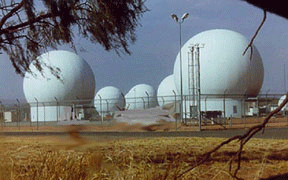 VIDEOS http://reanimatedresidue.wordpress.com/2012/04/08/pine-gap-waihopai-the-southern-echelon/ here comprise a three part interview with Donna Mulhearn, from Christians Against War, formerly a media adviser with the NSW Government. The
  interview details the role of Pine Gap as a secret US spy base. Donna discusses action (2007) she and other activists from Christians Against War attempted to carry out a citizen’s inspection of the secret US Pine Gap base, and the subsequent arrest and charging of these activists. She also exposes the utilisation of Pine Gap in triangulation of missle targets during the Afghan and Iraq wars.

PINE GAP & WAIHOPAI – THE SOUTHERN ECHELON by reanimatedresidue April 8, 2012 Pine Gap is a satellite tracking station located near Alice Springs in Central Australia. It hosts the largest CIA facility outside America. In the late 1960s, the then prime minister, Harold Holt, entered into an agreement with the Americans that led to the establishment of Pine Gap. Holt disappeared in December 1967 while swimming at Cheviot Beach near Portsea, Victoria, and was presumed drowned. Pine Gap is officially called the Joint Defence Facility Pine Gap since 1988, previously it was known as Joint Defence Space Research Facility. Continue reading
LABOR ENVIRONMENT ACTION NETWORK LEAN position on Nuclear waste
 LABOR ENVIRONMENT ACTION NETWORK LEAN position on Nuclear waste
http://www.lean.net.au/nuclear?utm_campaign=xmas2016wholeli&utm_medium=email&utm_source=lean
Adopted at national conference, 27 November 2016
1.LEAN supports the current ALP national policy on this matter, and sees no evidence or reason to change that policy. The policy states that Labor will:
“Remain strongly opposed to the importation and storage of nuclear waste that is sourced from overseas in Australia.”
2.No State or Commonwealth ALP government should take legislative or executive actions to advance any proposals to store and dispose of nuclear waste from other countries until:
- After well-informed, evidence-based, ALP policy platform decisions at the National and State levels allow such actions; and
- There is sufficient well-informed community consent for such actions.
URANIUM PLANS AT MULGA FACE A ROCKY FUTURE
 19 Dec 16, Environment groups and Aboriginal Community member will step up their efforts against Vimy Resources’ proposed Mulga Rock uranium mine, 240 kilometres north-east of Kalgoorlie, following the decision by the WA Environment Minister to provide conditional approval for the operation
“Like other uranium mining projects in WA, this proposal does not have bipartisan support” said ACF campaigner Dave Sweeney. “Environment groups will continue to work with local communities to fully explore all options to ensure this mine does not proceed. This task is made easier by the depressed uranium price and deep uncertainty surrounding the project’s viability”.
Concerns about lack of consultation as well as environmental impacts from the proposed operation are casting a shadow over the controversial plan.
“A particularly disappointing aspect of this decision is that Government agencies and the Minister have ignored the Anangu Spinifex people’s cultural and historical connection to this area,” said Conservation Council nuclear free campaigner Mia Pepper.
“This failure has unacceptably allowed Vimy Resources to avoid any consultation with this group.
The Mulga Rock area is also ecologically sensitive and part of the Yellow Sandplain Priority Ecological Community. This pristine desert environment is home to many threatened and endangered species,”
“Vimy plans to take 87,600 million litres of water a day and leave behind 32 million tonnes of radioactive mine waste. The long-term risks for the community far outweigh any inflated short-term rewards for the company” Ms Pepper said.
Sunday Mail changes the meaning of a letter, thus removing climate change statements
 GUTTED by the SUNDAY MAIL
WHAT I SENT
The Editor
Sunday Mail
I totally agree with Chris Kenny (Sunday Mail, 11/12/16) when he writes “Climate change has dumbed down the public debate. Otherwise intelligent people are reduced to incoherent slogans” and some people “are too busy with emotional outbursts and virtue signalling to consider the basics.”
Using derogatory adjectives to describe policies and outcomes does little to further intelligent debate. Some facts would be helpful, especially if they are correct.
Three events in 2016 contributed to what Kenny emotively describes as an “energy basket case”. None of these events can be attributed to ensuring that 40 percent of SA’s electricity is “clean and green” yet Kenny leaves us in no doubt that he thinks being clean and green is part of the nasty “tunnel vision” that is “leading SA into a dark place”.
Rather than “clean and green” being the culprit, the three events were directly related to the privatisation of the electricity industry in SA and Victoria and to the formation of a national electricity market.
Dennis Matthews
WHAT THEY PRINTED
The Editor
Sunday Mail
SEVERAL events this year contributed to what Chris Kenny emotionally describes in his column as an “energy basket case”. None of these can be attributed, as he says, to ensuring that 40 percent of SA’s electricity is “clean and green”.
Rather than “clean and green” being the culprit, the events were directly related to the privatisation of the electricity industry in SA and Victoria and to the formation of a national electricity market.
Dennis Matthews
My attempt to reply to Kenny’s extensive accusation that climate change activists are only being emotional was totally lost in the Sunday Mail’s edited version of my letter.
Comments on Preliminary Report SOUTH AUSTRALIAN SEPARATION EVENT, Australian Energy Market Operator (AEMO)
Dennis Matthews, 18 Dec 16 , 1 DECEMBER 2016.
The “separation event” was the disconnection of the Heywood interconnector into South Australia.
The following uses the same headings as the AEMO preliminary report.
1. Overview
A short-circuit in a Victorian 500 kV (kilovolt), alternating current (AC) transmission line connected to the Heywood Victorian-SA interconnector resulted in the SA electricity network being disconnected from the Heywood interconnector.
At the time of the “incident” the Victorian electricity network was highly vulnerable to disruption. One of the two circuits served by the Heywood interconnector had been taken out of operation for maintenance. To make matters worse, one of the circuits supplying the Alcoa aluminium smelter at Portland was also out of service. Like all aluminium smelters, the Portland smelter had a very heavy electricity demand (about 480 MW).
The vulnerability of the Victorian electricity network meant that the SA network was also vulnerable to an abrupt loss of 230 MW. Nevertheless, no measures had been put in place to immediately replace power supply from Victoria in the event of disconnection from the Haywood interconnector. As with the SA state-wide blackout two months earlier, there was more than sufficient generating capacity available in SA but it was not on standby.
A short circuit in the remaining transmission line in Victoria to the Heywood interconnector resulted in SA and the Portland smelter being disconnected and the shutdown of two wind farms in Victoria.
The “incident” in Victoria, together with inadequate contingency plans resulted in the loss of 230 MW to SA, BHP’s Olympic Dam project losing 100 of its 170 MW for 3 hours, Portland smelter being disconnected for 4½ hours and disconnection of two wind farms (Portland generating 3MW, and Macarthur generating 4MW) in Victoria.
2. Pre-event Conditions
“Immediately prior to the incident there were two planned outages.”
Use of terms such as “incident” and “event” is reminiscent of the nuclear industry’s avoidance of terms such as “failure” , “accident”, and “meltdown”.
“Planned outage” refers to deliberate disconnection of parts of the system for maintenance or repairs. Such deliberate disconnections should be permitted only if they do not expose the system to serious disruption and only if there is sufficient backup in case of a fault developing in the remaining parts of the system. For SA no backup was put on standby in the case of SA being disconnected to the Heywood interconnector.
One of the “outages” referred to was that one half of the Heywood supply to SA (a 500 kV busbar) was out of service. This left SA and Victoria vulnerable to a fault developing in the remaining half of the Heywood supply. The other “outage” was the Heywood to Portland 500 kV transmission line servicing the Alcoa aluminium smelter.
Both outages were given permission by the Australian Energy Market Operator (AEMO).
These two decisions left the aluminium smelter vulnerable to a fault developing in the remaining half of the Heywood transmission line in Victoria. There was no backup plan for maintaining supply to the smelter in this contingency.
At the time, SA was importing about 240 MW from Heywood in Victoria.
3. Event
“A single phase to earth fault occurred on the Morabool-Tarrone 500 kV transmission line causing the line to trip out of service.” In other words, there was a short circuit in the only remaining transmission line in Victoria to the Heywood interconnector.
“It is believed that the line tripped as a normal response to this type of fault”. The short circuit caused the transmission line to Heywood to be disconnected (trip).
The short circuit was caused by the breaking of an electrical cable. The reason for the cable breaking was not known to the Australian Energy Market Operator (AEMO).
The “trip” of the transmission line left the Portland smelter still connected to SA, the power flow reversed so that instead of 240 MW into SA from Victoria there was 480 MW from SA to Victoria to supply the Portland smelter. A control scheme then disconnected the smelter from SA.
5 Operation of SA when Islanded
Islanded means that SA was on its own as far as power supply was concerned, in particular, it means that it was not receiving power from Victoria. In fact, SA was still receiving about 220 MW through the high voltage, direct current (DC), Victoria-SA, Murraylink interconnector.
Warning from UNESCO on Great Barrier Reef
 UNESCO says Great Barrier Reef is back in the danger zone
 (includes videos)
 1 This month
17 October, Free Public Talk on Nuclear Issues in South Australia
David Noonan will speak on public interest concerns over the new Roxby Downs Indenture Act 2026 on BHP copper-uranium mining and ore processing in SA, and on how AUKUS may face SA with a High-Level nuclear waste agenda.
Dr Jim Green will discuss international developments in the field of nuclear power including ‘small modular reactors’ and Generation 4 ‘advanced’ nuclear reactor concepts.


Help Aunty Sue Protect Her Land and Sacred Sites From Destructive Rocket Testing.
.

Australians deserve the truth
about
AUKUS – https://aukuspublicinquiry.com/

PETITION – To: Prime Minister Anthony Albanese and the Australian Labor Government

of the week – Australians for War Powers Reform (AWPR)
To see nuclear-related stories in greater depth and intensity

