Premier Weatherill’s vague promise of a nuclear waste “referendum”
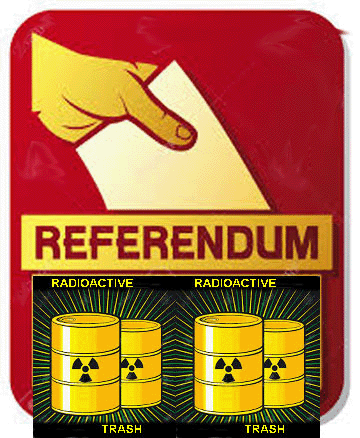 Premier Jay Weatherill effectively buries nuclear waste dump proposal with vague promise of statewide referendum
 , Adelaide Now Adam Langenberg, Political Reporter, The Advertiser, 14 Nov 16 PREMIER Jay Weatherill has effectively mothballed his plan to establish a high-level nuclear waste storage facility in the state, announcing nothing would happen without bipartisan support.
Nuclear enthusiast Jay Weatherill angry with Liberal Opposition, calls for referendum
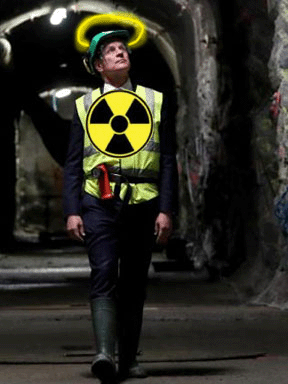 Nuclear dump in SA still on the cards as Premier calls for referendum, ABC News 14 Nov 16 The nuclear debate is not over yet in South Australia, with Premier Jay Weatherill saying he wants to hold a statewide referendum on the issue.
Mr Weatherill said the only path forward was through the restoration of bipartisanship “and a broad social consent secured through a statewide referendum”.
“Ultimately this is a matter for people to decide, not politicians,” he said.
“If broad social consent were to be achieved through a referendum, a local Aboriginal community would also be given a final right of veto on any future facility on their land…….
Mr Weatherill accused Opposition Leader Steven Marshall of withdrawing his support for a nuclear waste dump before the consultation process had been completed.
“The royal commission was clear bipartisanship is essential,” Mr Weatherill said…….http://www.abc.net.au/news/2016-11-14/sa-government-announces-nuclear-waste-dump-future-decision/8022924
Premier Weatherill persists in his pro nuclear dream
Nuclear referendum as Jay stares down dissent InDaily, Tom Richards , 14 Nov 16 Jay Weatherill has dramatically stared down his cabinet waverers and laid down the gauntlet to the Liberal Opposition, vowing to continue down the nuclear path – with the question to be determined by a referendum. Weatherill told media a short time ago the Government had determined “that discussion should continue” on the divisive question of high-level nuclear storage, which was dramatically rejected last week by a citizens’ jury before Opposition Leader Steven Marshall withdrew Liberal support.
However, the Premier said, “the only path forward is the restoration of bipartisanship and broad social consent”, which he hopes to achieve through a referendum at an unspecified future date.
Weatherill was widely expected to drop any further pursuit of the nuclear option in the face of significant opposition – including within his own party. However, as forecast in InDaily today, he has opted to forge ahead in a move that will put his leadership – and his party’s re-election hopes – dramatically on the line.
“I believe continued public debate about SA’s role in the nuclear fuel cycle is important and ultimately it is a matter that the people should decide, not political parties,” he said………
The move effectively returns serve to Marshall, whose Liberals expected Labor to be backed into a corner by the public reaction to the divisive waste dump proposal.
However, it also means Weatherill will now become a key advocate, having resisted the overwhelming pressure to remove the issue from the political agenda altogether.
Crucially, he said local indigenous groups would be given a “right of veto” over any proposed dump – a key factor in the citizens’ jury’s rejection……His gambit will be met with incredulity from conservation campaigners who had all-but declared the dump a dead issue.
“Most of State Parliament have said ‘no’, the Citizens’ Jury have said ‘no’, economists have said ‘no’, ordinary South Australians have said ‘no’, and most importantly, Traditional Owners have very clearly said ‘no’,” Conservation SA chief Craig Wilkins said today.
“There is clearly no support or consent for this investigation to continue.” http://indaily.com.au/news/local/2016/11/14/breaking-nuclear-referendum-as-jay-stares-down-dissent/
South Australia’s ‘Community Views Report’ reinforces a resounding “NO” to nuclear waste storage
Regarding plans to import nuclear waste to South Australia, Friends of the Earth Australia notes that the Community Views Report released today is overwhelmingly negative and calls on SA Premier Jay Weatherill to abandon the proposal.
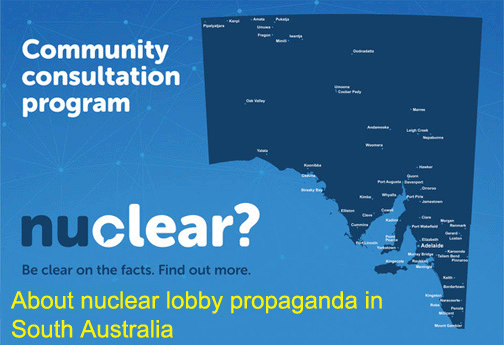
The Community Views Report follows major developments over the past week:
- Two-thirds of the members of the Citizens’ Jury concluded that the proposal should not be pursued “under any circumstances”.
- SA Liberal Leader Steven Marshall has clearly stated his opposition to the proposal and said it will be the “defining issue for the 2018 state election” if the Premier refuses to dump the dump.
- Business SA chief Nigel McBride acknowledges that the proposal is “dead”.
- Aboriginal communities across the state have repeatedly voiced their strong opposition to the proposed nuclear dump and their views are clearly reflected both in the Citizens’ Jury report and in the Community Views Report released today.
Dr Jim Green, national nuclear campaigner with Friends of the Earth Australia, said: “The Community Views report reinforces the deep scepticism and opposition revealed by the Citizens’ Jury process. The 53 percent opposed to importing nuclear waste far outnumber the 31 percent supportive of the proposal. Far more people oppose further consideration of the proposal than support further consideration. Opposition from Aboriginal people is overwhelming. Only 20 percent are confident that nuclear waste can be transported and stored safely. An overwhelming majority of people lack confidence in the SA government’s ability to regulate any new nuclear industry activities. Sixty-six percent are not confident that a nuclear waste dump would bring significant economic benefits to SA.”
“The people of South Australia have spoken. Aboriginal Traditional Owners ‒ who have always borne the brunt of the nuclear industry ‒ have spoken. Opposition Leader Steven Marshall has spoken. The Citizens’ Jury has spoken. Jay Weatherill must listen. It is time to dump the dump,” Dr Green concluded.
Community Views Report released by Nuclear Fuel Cycle Royal Commission Consultation and Response Agency
Key Findings of the ‘Community Views Report’.
Nuclear Fuel Cycle Royal Commission Consultation and Response Agency, November 2016, ‘Community Views Report’.
Jim Green, 13 Nov 16 Page 19: The report states: “Over thirty per cent (31%) of South Australians interviewed in the three rounds of telephone surveys supported the storage and disposal of nuclear waste from other countries in the state, while 53% opposed the proposal and 16% were unsure or didn’t know enough.”
Page 18: The report distinguishes ‘representative feedback’ (participation in telephone surveys and focus groups by random selection) from self-selected feedback (feedback forms, online survey, conversation kit). In the representative feedback (4016 people), 43% of people supported or strongly supported continuing to explore the nuclear waste dump proposal, while 37% were opposed or strongly opposed. In the self-selected feedback (4499 people), 64% of people opposed or strongly opposed continuation, more than double the 29% who supported or strongly supported continuation.
Adding the figures together (which the report does not do):
1727 + 1305= 3032 people support continuing to explore the proposal
1486 + 2879 = 4365 people oppose continuing to explore the proposal
Page 34: Within the structured channels of feedback forms and telephone and online surveys, 198 people who identified as Aboriginal or Torres Strait Islander provided feedback. In terms of support for continuing to explore the establishment of a nuclear storage facility for international waste in SA, 34% of Aboriginal people in the representative sample (total 56 people) were supportive and 50% were opposed, compared to 16% supportive and 73% opposed in the self-selected feedback (total 138 people).
Combining the figures (which the report does not do):
Support continuing to explore the proposal: 19 + 22 = 41 people
Oppose continuing to explore the proposal: 28 + 101 = 129 people
The report states (page 9): “Many [Aboriginal] participants expressed concern about the potential negative impacts on their culture and the long-term, generational consequences of increasing the state’s participation in the nuclear fuel cycle. There was a significant lack of support for the government to continue pursuing any form of nuclear storage and disposal facilities. Some Aboriginal people indicated that they are interested in learning more and continuing the conversation, but these were few in number.”
Page 22: How confident are you that nuclear waste can be transported and stored safely?
Confident or very confident 20%
Not confident or not at all confident 70%
In four places the report produces survey results regarding what the next steps should be. In all cases the most common response was that the nuclear waste dump proposal should be stopped. In three of the four cases, stopping the proposal was vastly more popular than the second most common response:
p.23: 28% stop the proposal vs next most common response 7%
p.26: 18% stop the proposal vs next most common response 17%
p.29: 25% stop the proposal vs next most common response 8%
p.31: 28% stop the proposal vs next most common response 8%
Page 24: Self-selected feedback channels showed that confidence that the government would consider community views in its decision was low at 20%, with 70% not confident.
Page 28: Asked about confidence in government’s ability to regulate any new nuclear industry activities in South Australia, 43% of the representative sample (total 4016 people) said they were not confident, compared with 38% who were confident. Of the self-selected feedback (total 3330 people), 74% were not confident and 18% were confident.
Combining the figures (which the report does not do):
Confident: 1526 + 599 = 2125
Not confident: 1726 + 2464 = 4190
Page 30: On the question of confidence that a nuclear waste disposal facility would bring significant economic benefits to SA, 66% of the people who submitted online surveys, feedback forms and conversation kits (self-selected feedback) were not confident.
Senator Nick Xenophon- nuclear waste dump “a stinker of an idea” – bury it forever.
 Nuclear waste storage industry in SA ‘dead for eternity’, Senator Nick Xenophon says
 , Adelaide Now State Political Editor Daniel Wills, The Advertiser November 13 INDEPENDENT Senator Nick Xenophon has declared nuclear waste storage in SA “a stinker of an idea” which should be “buried for eternity” as political support for the project collapses.
Queensland government gives Adani coal mine special privileges
Qld Labor exempts Adani mine from public submission and appeals on groundwater http://www.edoqld.org.au/news/qld-labor-exempts-adani-mine-from-public-submission-and-appeals-on-groundwater/ Environmental Defenders Office (EDO) 9 November 2016:
“The Queensland Labor government last night passed the Environmental Protection (Underground Water Management) and
Other Legislation Amendment Bill 2016 (EPOLA Bill) and Water Legislation Amendment Bill 2015 (WLA Bill).

““The Queensland Parliament has passed last minute amendments to the Labor Government’s groundwater protection laws.
The effect is that the public, be they conservation groups or local landholders, won’t have any submission or appeal rights
on groundwater licences relating to the Adani Carmichael mine,” said Jo Bragg, CEO of Environmental Defenders Office (EDO) Queensland.
“Adani will still be required to obtain an associated water licence, introduced through the EPOLA Bill.
However, an exemption has been explicitly carved out for Adani
which removes the public and the Court’s power to undertake normal scrutiny of this licence. … ”
Water reforms passed
– exemption from public scrutiny for Adani and retrospective dewatering approval
demonstrate regulatory capture by mining industry
http://www.edoqld.org.au/news/water-reforms-passed-exemption-from-public-scrutiny-for-adani-and-retrospective-dewatering-approval-demonstrate-regulatory-capture-by-mining-industry/ Environmental Defenders Office (EDO) 10 November 2016:
” … two last minute amendments are highly concerning as to their impact on proper management of our water resources
in Queensland from mining impacts, and suggest regulatory capture:
“X Exemption for Adani from public and Court scrutiny of groundwater impacts of Carmichael coal mine …
“X Retrospective approval of dewatering activities for many mines in Qld! … ”
Green groups fume over Adani’s water licence exemption
http://www.dailymercury.com.au/news/green-groups-fume-over-adanis-water-licence-exempt/3110429/
http://www.qt.com.au/news/green-groups-fume-over-adanis-water-licence-exempt/3110429/
Urgent need for public education and action on fluoridation of Queensland’s water
 http://www.couriermail.com.au/news/queensland/disappearing-fluoridation-schemes-take-toll-on-childrens-dental-health/news-story/42ba0a46d78f96e5bbdd92f01e9657cc

New Queensland Health data shows 3223 children aged 10 and under required hospital treatment in 2013-14 for dental caries (the scientific term for tooth decay or cavities).
More than 51 per cent of Queensland five to 10-year- olds who attended public dental clinics in 2014-15 had decay in their baby teeth. On average, four teeth were affected.
Decay in Queensland children aged five to 10 was 20 per cent higher than national averages to 2012-14 and 33 per cent higher in the permanent teeth of nine to 14-year-olds.
Queensland’s Chief Dentist Dr Mark Brown said he was concerned by the “high level of tooth decay” in children, describing it as “a significant problem”.
In terms of population, about three-quarters of the state has water fluoridation – up from less than 5 per cent before the Bligh government made fluoridated water supplies mandatory for communities of more than 1000 people in 2008.
But since 2012, changes made under former premier Campbell Newman have allowed councils to pull out of fluoridating water supplies.
“My concern is for the quarter of the population in regional and rural Queensland who don’t have access to fluoridation,” Dr Brown said. “That community is being left behind when most Australians now have access to water fluoridation.”.
Australian Dental Association state fluoride spokesman Dr Michael Foley said there was no doubt water fluoridation reduced the risk of decay.
Dr Foley said he would like to see the State Government take control of fluoridating drinking water, rather than local councils. Continue reading
SOUTH AUSTRALIA’s RENEWABLE ENERGY IS UNDER ATTACK!
 Victoria’s Yes2Renewables campaign is expanding to South Australia. Individuals and renewables campaign groups such as Friends of the Earth Adelaide’s Clean Futures Collective, Solar Citizens, Climate Emergency Action Network, and Australian Youth Climate Coalition are joining together to defend renewables in SA.
South Australia is a renewable energy success story. The state is fast approaching 50% renewables and has booming solar, energy storage, and wind power sectors.
This success has made South Australia public enemy #1 for the fossil fuel lobby, who will do anything to stop our transition to 100% renewables.
In July, the fossil fuel lobby and their boosters in the media blamed renewable energy for price spikes caused by big coal and gas copanies gaming the market. And in September they blamed a blackout on renewables rather than the obvious cause: a one-in-fifty-year storm.
The fossil fuel lobby is prepared to sacrifice South Australian jobs, investment in regional communities, and our climate to protect their own interests.
In Novermber, community members met up at The Joinery in Adelaide to kick off a grassroots campaign to defend South Australia’s renewable energy leadeship. For more info, visit https://yes2renewables.org/
Taiwan will NOT be sending its nuclear waste to South Australia

 Today’s Advertiser (South Australia’s mouthpiece for the nuclear lobby) has an article promoting the idea of Taiwan sending its nuclear wastes to Australia.
But here’s what’s really happening
Taiwan organising to dump its nuclear wastes on Orchid Island https://nuclear-news.net/2016/08/14/tawian-organising-to-dump-its-nuclear-wastes-on-orchid-island/
Transpacific Partnership now as good as dead
 TPP: Trans-Pacific Partnership dead, before Trump even takes office, http://www.theage.com.au/federal-politics/political-news/transpacific-partnership-dead-before-trump-even-takes-office-20161113-gso9kn.html The Age, Peter Martin , 14 Nov 16, Eight years in the making, the giant Trans-Pacific Partnership trade deal between Australia, the US and 10 other regional powers is as good as dead after the Obama administration walked away from its plan to put it before the “lame duck” Congress ahead of Donald Trump’s inauguration as president.
Controversial in Australia because it would allow US-headquartered corporations to sue Australian governments in extraterritorial tribunals and entrench pharmaceutical monopolies and copyright rules, the TPP was the subject of a last-minute plea by Prime Minister Malcolm Turnbull to president-elect Donald Trump in their 15-minute phone conversation on Thursday.
It has been signed by each of the member countries – Australia, the US, Japan, Canada, New Zealand, Malaysia, Brunei, Singapore, Chile, Mexico, Peru and Vietnam – but ratified by none.
Other members including Australia were waiting for a decision from the US because the rules require ratification by members accounting for 85 per cent of the the agreement’s gross domestic product, meaning it can’t come into force without the US as the other members combined have only 43 per cent.
Over the weekend the Senate’s top Democrat Charles Schumer told union leaders the deal would not be ratified. House of Representatives Republican speaker Paul Ryan, who has in the past supported the TPP, said the “votes aren’t there” to pass it.
Mr Trump made opposing the TPP a key part of his campaign, saying America did “not need to enter into another massive international agreement that ties us up and binds us down”. Democrats members of Congress were never keen, opposing by a wide margin President Barack Obama’s negotiating mandate which only passed into law with the support of Republicans.
On Sunday Australia’s trade minister Steven Ciobo questioned whether it would be worthwhile concluding the agreement without the US, even if it was possible.
“In theory, yes,” he told the ABC’s Insiders. “but is there enough merit to look at a trade deal among the 11 of us? It changes the metrics substantially.”
Mr Ciobo will hold discussions about the future of the agreement at the APEC leaders summit in Lima, Peru on Thursday which will be attended by Mr Turnbull on Sunday.
The US decision leaves two Australian parliamentary inquiries in limbo. The joint standing committee on treaties finished hearing evidence just before Mr Trump’s election and has not yet produced a report. The Senate inquiry has yet to call witnesses.
Now, focus on the unnecessarily large, and unnecessary, Flinders nuclear dump proposal.
 — Steve Dale Nuclear Fuel Cycle Watch South Australia, Good news …., but don’t lose the momentum. People need to focus the blow torch on the Flinder’s dump proposal. It is much bigger than needed for just Lucas Height’s waste and will be used as a Trojan Horse for any future international dump attempt. Lucas Heights should be able to store the small amount of waste it produces on it’s own site or somewhere in NSW.
 NO FURTHER PUBLIC MONEY should be spent on nuclear industry, by the South Australian taxpayer.
South Australian ‘citizens’ jury’ rejects nuclear dump, Green Left RENFREY CLARKE. Adelaide, November 11, 2016 “………Lack of confidence Also striking is the complete lack of confidence voiced by the jurors in the ability or willingness of the state’s politicians to manage radioactive materials responsibly. “No evidence of regulatory bodies … to act independently and to be funded properly to adequately regulate an industry,” the report observes. As evidence, the report cites examples that include a radioactive tailings site at Port Pirie on which children were allowed to play for decades, and which was prone to flooding by high tides.
Dealt with brusquely is an issue that promises to be highly contentious in coming months. “There was agreement that … NO FURTHER PUBLIC MONEY should be spent by the South Australian taxpayer.”
Weatherill, however, shows signs of planning to do exactly that.
The jury’s verdict is not binding on the government. After months of implying that the jury’s recommendation would be viewed as definitive, the Premier has now switched to stressing the “fifty thousand” South Australians whose views his “roadshow” supposedly canvassed.
The dump process, Weatherill made clear in his address to the jury on receiving its report, is not yet dead.
“Mr Weatherill said the ‘very clear position’ of the jury would be combined with other government research about the state-wide views of the nuclear industry, as Cabinet considers whether to push ahead,” the Advertiserreported on November 7.
“All of those perspectives need to be weighed up,” Weatherill said. “We don’t expect that this is a debate that will be concluded any time soon.” Weatherill is now due to present a formal position to parliament on the dump proposal, probably around the end of November. But if he tries to force the scheme through as he has suggested, the political costs for his government will be dire.
On the question of the dump, South Australians seem overwhelmingly to accept the verdict of their Citizens’ Jury peers. On November 7 an informal Channel 7 poll asked: “Should the state government now abandon its nuclear storage plans?” The response was: Yes 86%, No 14%.
Charged with legitimising the dump, the jury has very likely ended the scheme. But anti-dump activists would be foolish to quit their campaigning just yet. https://www.greenleft.org.au/content/south-australian-%E2%80%98citizens%E2%80%99-jury%E2%80%99-rejects-nuclear-dump
Time for Premier Weatherill to listen to the jury on radioactive waste -Traditional Owners
Traditional Owners and members of the Aboriginal-led Australian Nuclear Free Alliance (ANFA) have welcomed the Citizen’s Jury’s recommendation to reject an international high level radioactive waste dump for South Australia.
Throughout both the Royal Commission and Citizens Jury processes concerns of potential bias have been raised. The consultancy firm hired by the Royal Commission, Jacobs MCM, has clear links to the nuclear industry. The economic report was written by Charles McCombie and Neil Chapman, the president and vice president of the Association for Regional and International Underground Storage (ARIUS). A further example of bias was that the Citizen Jurors were asked to nominate ‘witnesses’ they wished to speak to, but DemocracyCo added three people to the witness list ‒ all of them pro-nuclear ‒ without the Jurors’ knowledge or consent.
ANFA members are concerned by SA premier Jay Weatherill’s suggestion that he may not heed the jury’s recommendations: “This jury doesn’t believe the present proposal should be taken forward but we need to take into account a whole range of other broad community views[1]“.
Kokatha-Mula woman Sue Coleman-Haseldine is a co-chair of the Australian Nuclear Free Alliance, in response to Premier Weatherill’s comments she said “The jury has listened to us, it’s time for the premier to listen to the jury. We don’t want this waste in South Australia. Not here, not anywhere”.
Aboriginal people travelled to Adelaide from across the state to share their concerns with the 350 jurors at the Indigenous session held on Saturday 5th November. Many others who would have liked to have been there were unable to attend but those present were able to convey their heartfelt concerns for protecting country and culture.
Vivienne McKenzie, Adnyamantha elder who has been campaigning to protect her traditional lands from radioactive waste told the jury “If you make the decision to let a waste dump be in this state, you will go down in history and have this on your conscience. What are you going to tell your children? ‘I was a juror, I gave the decision to have a waste dump.’ We will be history in the making. Really think about it, think from your heart, don’t think about money, there is no money in this. They are tricking everybody.”
In its recommendation, the jury stated “There is a lack of Aboriginal consent. We believe that the government should accept that the Elders have said no and stop ignoring their opinions. The Aboriginal people of South Australia (and Australia) continue to be neglected and ignored by all levels of government instead of being respected and treated as equals.”
Sue Coleman-Haseldine concluded:” ANFA members are pleased that the Jurors listened to the voices heard at the Indigenous session. Now it’s time for the Premier to listen too.”
Today’s statement is also on the ANFA website http://www.anfa.org.au/time-for-premier-weatherill-to-listen-to-jury-on-radioactive-waste
Nuclear dump now South Australia 2018 election issue
 Nuclear fuel cycle: Opposition says Jay Weatherill’s dream of SA nuclear dump ‘is now dead’, ABC News, 11 Nov 16 By Leah MacLennan Opposition Leader Steven Marshall has announced he will not support the building of a high-level nuclear waste facility in South Australia, saying there is too much at risk…….
1 This month
17 October, Free Public Talk on Nuclear Issues in South Australia
David Noonan will speak on public interest concerns over the new Roxby Downs Indenture Act 2026 on BHP copper-uranium mining and ore processing in SA, and on how AUKUS may face SA with a High-Level nuclear waste agenda.
Dr Jim Green will discuss international developments in the field of nuclear power including ‘small modular reactors’ and Generation 4 ‘advanced’ nuclear reactor concepts.


Help Aunty Sue Protect Her Land and Sacred Sites From Destructive Rocket Testing.
.

Australians deserve the truth
about
AUKUS – https://aukuspublicinquiry.com/

PETITION – To: Prime Minister Anthony Albanese and the Australian Labor Government

of the week – Australians for War Powers Reform (AWPR)
To see nuclear-related stories in greater depth and intensity

