The US shooting down a Chinese spy balloon is a risk for Australia’s tired submarine fleet
Michael West Media, by Rex Patrick | Feb 6, 2023 |
For many Australians watching the events over the past week, where the United States Air Force tracked a Chinese balloon overflying US territory and then shot it down, might seem to be of indirect significance to our security. Former senator and submariner, Rex Patrick suggests that it is of direct significance to Australia, increasing the risk we might be drawn into war in South East Asia.
Over the weekend the US Air Force shot down a Chinese balloon. The United States have said that the balloon was carrying out intelligence gathering. The Chinese Government has said it wasn’t. They claim it was just a wandering weather balloon. That’s important for reasons I’ll come back to, but I first need to provide some background – not about balloons, but about another surveillance platform.
What submarines do
Submarines can perform a whole range of different tasks in time of war……………………….
In preparing for war they train, they engage in tactical development and they conduct intelligence gathering. It is the latter which is their most important and challenging tasks………………….
Balloons and ballast tanks
…. Imagine a South Korean, Japanese or Australian submarine operating very close to (or perhaps inside) China’s territorial waters conducting intelligence gathering. China might now be inclined to treat that submarine the same way the United States treated a balloon purported to be conducting intelligence collection.
If detected, even if just outside of their territorial waters, the Chinese will just say they were inside their waters when, or in the minutes before, they were engaged. We’ll say, just as the US has for the balloon, that we weren’t spying and they’ll say we were.
And getting detected in our newest Australian submarine, the 20 year old HMAS Rankin, is far more likely than is the case for South Korea’s newest submarine, the 1 year old ROKS Dosan Ahn Changho, or Japan’s newest submarine, the 1 year old Tōryū.
The stakes are greater for us because Australian governments of various political flavours have left us with ageing Collins Class submarines to carry out this most serious and complex of peace time tasks.
One option would be to eventually withdraw our ageing Collins class submarines from surveillance operations anywhere close to Chinese waters, but that’s unlikely. Our Navy and our government will be anxious to continue to do all they can to assist the United States Navy in the Northern Pacific, in the Sea of Japan and the South China Sea.
Alliances are not just pieces of paper, they are dynamic relationships in which there’s a strong obligation to contribute and share risk.
The China risk
The risks are likely to increase in the years ahead, as China continues to ramp up military tensions in an effort to coerce Taiwan into some form of political subordination to Beijing.
The possibility that China will choose a vessel of a US ally to make an example of cannot be dismissed.
And that risk will be disproportionately carried by our Navy as it operates a submarine force with decreasing relative capability across the next two decades or longer. Thanks to government spending $170bn pursuing a distant nuclear-powered capability, our submariners will be at greater risk in less capable vessels than our so-called ‘great and powerful’ friend.
For a long time, we’ve been able to see Defence procurement failures and kick ourselves on account of cost to the taxpayer. Now, as the balloon goes up in the South China Sea, the lack of capability may well cost us many lives.
It’s not just about a war before the arrival of new submarines in 2040, its all the peace time intelligence operations between now and then. https://michaelwest.com.au/the-us-shooting-down-a-chinese-spy-balloon-is-a-risk-for-australias-tired-submarine-fleet/—
‘Save the only planet we have’: Tony Abbott joins climate-sceptic think tank
EMMA ELSWORTHY, FEB 07, 2023 https://www.theguardian.com/australia-news/2023/feb/07/former-australian-pm-tony-abbott-joins-board-climate-sceptic-thinktank-global-warming-policy-foundation
The former Australian PM says he has joined the Global Warming Policy Foundation, a UK think tank founded by a ‘climate denier-in-chief’.
Former prime minister Tony Abbott, who once compared taking action on climate change with killing goats “to appease volcano gods”, has joined the board of a UK climate-sceptic think tank founded by a politician dubbed “the climate denier-in-chief”.
Abbott said he was pleased to join the Global Warming Policy Foundation (GWPF), which “consistently injected a note of realism into the climate debate”, despite the charity spearheading the backlash against the UK government’s net-zero goal.
“All of us want to save the only planet we have, but this should not be by means which impoverish poorer people in richer countries and hold poorer countries back,” Abbott said of his appointment.
“Right now, in countries like Australia, the impact of climate policy is to make electricity less affordable and less reliable rather than perceptibly to cool the planet.
“We need more genuine science and less groupthink in this debate. That’s where the GWPF has been a commendably consistent if lonely voice.”
The GWPF was founded in 2009 by Thatcher-era chancellor Nigel Lawson, who reportedly resigned from the House of Lords last month. Described by UK Green Party co-leader Adrian Ramsay as the “climate denier-in-chief”, Lawson claimed that “global warming is not a problem” in a 2021 article written for The Spectator during the COP26 in Glasgow.
The foundation’s director, Benny Peiser, also made headlines for spurious statements, including that he found it “extraordinary that anyone should think there is a climate crisis” and that climate “alarmism” was driven by “scientists’ computer modelling rather than observational evidence”.
Despite Lawson’s apparent departure from politics, his foundation continues to cause a headache for UK Prime Minister Rishi Sunak. There has been outrage after a UK register of interests disclosure revealed Conservative MP Steve Baker accepted a £10,000 (A$17,464) donation from the chair of GWPF’s Net Zero Watch.
The campaign arm has urged the UK government to recommit to fossil fuels, commission a fleet of coal-fired power plants, and wind down wind and solar completely, while its alleged breaches of charity law were the subject of a complaint from three British MPs in October.
This isn’t Abbott’s first brush with the foundation. In 2017 he delivered an eyebrow-raising annual lecture that suggested climate change was “probably doing good; or at least, more good than harm”.
Abbott also claimed that photos from his electorate showed the sea level hadn’t risen. (The Bureau of Meteorology found last year that the rates of sea level rise to the north and south-east of Australia have been “significantly higher” than the global average for the past 30 years.)
“Contrary to the breathless assertions that climate change is behind every weather event, in Australia the floods are not bigger, the bushfires are not worse, the droughts are not deeper or longer, and the cyclones are not more severe than they were in the 1800s,” Abbott said at the time.
In an echo of Lawson’s claim that rising temperatures are “no bad thing: many more people die each year from cold-related illnesses than from heat-related ones”, Abbott suggested in 2017 that sweltering heatwaves are good, actually.
“There’s the evidence that higher concentrations of carbon dioxide (which is a plant food after all) are actually greening the planet and helping to lift agricultural yields,” he said. “In most countries, far more people die in cold snaps than in heatwaves, so a gradual lift in global temperatures, especially if it’s accompanied by more prosperity and more capacity to adapt to change, might even be beneficial.”
Heat is the biggest natural killer in Australia (and in the US) and has been for the past 200 years, with fatalities outstripping all other natural killers including bushfires, cyclones and floods. Research has found there were 36,000 deaths associated with heat in Australia between 2006 and 2017.
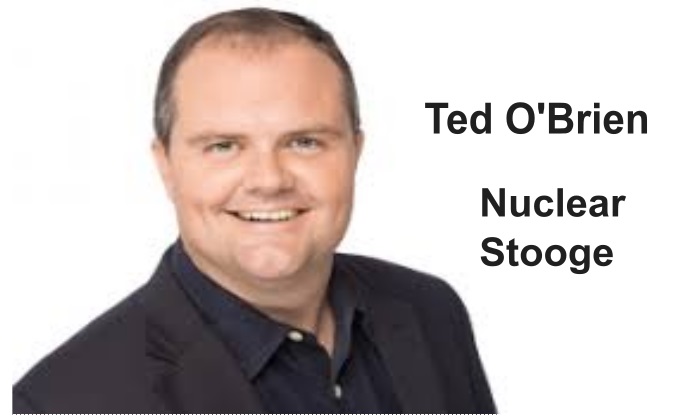
Labor criticises Coalition energy spokesman Ted )’Brien for filming nuclear power videos at Hiroshima
Guardian, Josh Butler, Tue 7 Feb 2023
A Labor government MP has accused Coalition energy spokesperson Ted O’Brien of “bizarre and disrespectful” behaviour after filming videos discussing Australia’s potential for nuclear energy at the site of the Hiroshima atomic blast and the Fukushima power plant in Japan.
The prime minister, Anthony Albanese, accused O’Brien of a “frolic” on advocating for nuclear power, but the Liberal MP said he had sought to be respectful on his privately funded trip to study the technology………….
O’Brien, the member for the Queensland seat of Fairfax, recently posted two videos from a trip to Japan on YouTube titled “Time to Talk Nuclear: What can Australia learn from Japan?” and “Time to Talk Nuclear: What can we learn from Hiroshima?”
Guardian Australia previously revealed O’Brien’s “Time To Talk Nuclear” campaign, which he described as a “grassroots” community engagement program, was using a website registered by a business that helps an American small modular reactor company.
he Coalition opposition has consistently advocated for the government to investigate nuclear energy, despite not building such options during its previous nine years in federal office.
O’Brien wrote alongside the videos that he visited Japan as part of “an in-depth analysis into the possibility of including advanced nuclear technology in Australia’s future energy mix”.
“No people have a more complicated relationship with nuclear technology than the Japanese,” he wrote in a caption, saying he had visited Tokyo, Hiroshima, Fukushima and Rokkasho to meet business owners, government officials, nuclear experts and locals.
“We all know the tragedy of war and we all know how Japan certainly suffered at the end of World War II. In some ways, it’s had the ability to turn what has been a tragedy for the nation into a message of hope,” O’Brien said in one video.
“Despite actually having two atomic bombs land on it, it’s firing on all cylinders on nuclear energy.”
O’Brien said Australia should “have the humility to learn from those nations that know about [nuclear] technology far greater than us”. That video says he also visited Fukushima, the region where an earthquake and tsunami in March 2011 led to a nuclear disaster at a power plant.
In another video filmed last week, O’Brien went to Hiroshima’s Peace Park, overlooking the famous dome which was devastated when American forces dropped an atomic bomb on the city in August 1945. Up to 140,000 people were estimated to have died from the blast and related radiation effects.
“If we are going to talk about the potential for advanced nuclear energy to be used in Australia, we’ve got to understand the full range of implications of the technology,” O’Brien wrote.
The shadow minister interviewed a man he said was a tour guide from the Hiroshima Museum, named Yukio Yokohama, about how Japanese people viewed nuclear energy. Yokohama answered that nuclear was used for cheap energy to support industry.
O’Brien has been absent from parliament this week as he is in Canada on a study tour.
Labor senator Catryna Bilyk, chair of the Australia-Japan Parliamentary Friendship Group, criticised O’Brien for filming the videos at Hiroshima.
“It’s up to the shadow minister to explain why he chose to travel to Japan, stand at the Hiroshima Peace Memorial Park and spruik nuclear energy,” she told Guardian Australia.
“Using the site of the deaths of tens of thousands of people to cynically push a domestic ideological obsession is bizarre and frankly disrespectful behaviour.”
O’Brien’s spokesperson said the MP’s trip to Japan “was privately funded, not taxpayer funded” and rebuffed those criticisms from Labor…………………………………………
Albanese, in parliament’s question time on Tuesday, noted O’Brien’s absence.
“He’s been researching his solution on a YouTube video that he put up,” Albanese said, to laughter from government benches.
“The shadow minister is off on this frolic of nuclear energy, even though we know it’s the most expensive form possible for Australia.” ………… https://www.theguardian.com/australia-news/2023/feb/07/labor-criticises-coalition-energy-spokesman-for-filming-nuclear-power-videos-at-hiroshima
Kiwis firmly remain anti-nuclear as AUKUS submarines draw near
Andrew Tillett, Political correspondent, Financial Review, 7 Feb 23
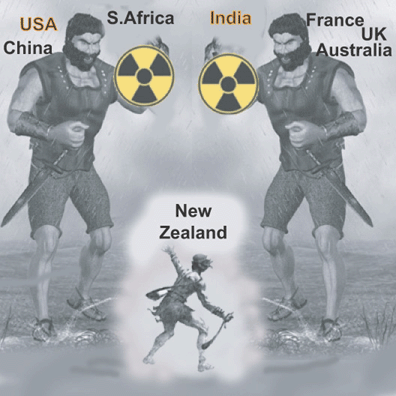
Canberra | New Zealand’s new prime minister, Chris Hipkins, has indicated no watering down of his country’s anti-nuclear stance just weeks out from Australia unveiling its AUKUS submarine plan and says China remains an “incredibly important partner” following talks with Prime Minister Anthony Albanese.
But Mr Hipkins promised he would speak out when disagreeing with China as needed in response to questions over whether he would follow the approach of his predecessor Jacinda Ardern, who often took a softer line on Beijing’s behaviour in the region.
Mr Albanese hosted Mr Hipkins, making his first overseas trip since succeeding Ms Ardern last month, at Parliament House on Tuesday, with the two leaders discussing the impact of the deteriorating global economy on their respective countries, climate change, security and Pacific co-operation.
“Many other countries don’t have the same closeness as New Zealand and Australia, and that’s something that we will never take for granted in New Zealand. We’re able to tackle issues together in ways that other countries can’t,” Mr Hipkins said.
Despite the declaration of closeness, Mr Hipkins maintained Australia’s plan to acquire nuclear-powered submarines with American and British help would not change New Zealand’s nuclear-free status.
“Our foreign policy position hasn’t changed just because there’s a change of prime minister, the government’s foreign policy is the same as it was under prime minister Ardern,” Mr Hipkins said.
“Australia, the US and the UK are incredibly important security partners for New Zealand, but our nuclear-free policy hasn’t changed either.”
The AUKUS members are poised to unveil within weeks the so-called optimal pathway to acquire nuclear submarines………………………….. https://www.afr.com/politics/federal/kiwis-firmly-remain-anti-nuclear-as-aukus-submarines-draw-near-20230207-p5cih6
Medical Association for Prevention of War recommends that Australia keep its nuclear prohibitions.

Environment and Other Legislation Amendment (Removing Nuclear Energy Prohibitions) Bill 2022
Submission 28
The Medical Association for Prevention of War (Australia) is an association of medical and
other health professionals who work for the elimination of all weapons of mass destruction
and the prevention of armed conflict. Nuclear weapons abolition is our primary focus. We
promote peace through research, advocacy and education. MAPW is affiliated with IPPNW,
the International Physicians for the Prevention of Nuclear War (Nobel Peace Prize 1985),
and was the founder of ICAN, the International Campaign to Abolish Nuclear Weapons
(Nobel Peace Prize 2017).
Principal author: Dr Sue Wareham OAM
President, MAPW Australia
RECOMMENDATIONS
The existing legal prohibitions against nuclear power for Australia should remain.
Australia should not acquire naval nuclear reactors, and legislated prohibitions on nuclear energy should not be compromised to allow for the acquisition of naval nuclear reactors. Their proposed acquisition should be separately and publicly scrutinised with regard to the Nuclear Energy Prohibitions Bill, and to longstandingpublic opposition to nuclear energy.
Australia must sign and ratify the Treaty on the Prohibition of Nuclear Weapons.
INTRODUCTION AND SUMMARY
Climate change is already having devastating ecological and health consequences, with worse to come. It demands urgent responses to transform global energy production to zerocarbon emissions. Nuclear power proponents, including those associated with uranium mining interests, have again called for the consideration of nuclear power for Australia as part of this response. Their calls paint an idealised and simplistic picture of an industry
which has a long list of mostly insurmountable problems.
It:
is inextricably linked with producing the world’s worst weapons,
is carbon-intensive in nearly all stages of its operation,
produces intractable highly toxic waste which remains a global problem,
is far too slow to implement, even as part of a response to climate change,
is vulnerable to disastrous accidents and sabotage,
requires huge amounts of our most precious resource – water,
has major health implications for populations living near its facilities,
Is prohibitively expensive,
Is unnecessary, given the rapid expansion of renewable energy sources.
Nuclear power is a time-wasting distraction from the real work of tackling climate change, when we don’t have such time to waste.
This submission will examine most of the above problems, but will first address the current context of this inquiry, specifically the government’s deliberations on naval nuclear power for Australia. This is highly relevant for two reasons.
Firstly, the nuclear reactors on board nuclear submarines share nearly all of the problems of reactors on land, as listed above.
Naval nuclear power should in no way provide a foothold for the nuclear industry in Australia.
Secondly, it is unclear how the current prohibitions on nuclear power in Australia – prohibitions which would extend to naval reactors – will be managed if the naval nuclear power proposal proceeds. There is grave risk that they will be weakened in order to pave the way for technology which has been consistently rejected by a majority of Australians.
Australia radioactive capsule: Missing material more common than you think

By Antoinette Radford, BBC News, 5 Feb 23
The world watched as Australia scrambled to find a radioactive capsule in late January.
Many asked how it could have been lost – but radioactive material goes missing more often than you might think.
In 2021, one “orphan source” – self-contained radioactive material – went missing every three days, according to the International Atomic Energy Agency (IAEA).
The not-for-profit Nuclear Threat Initiative (NTI) lists lost and found nuclear and radiological material, and its records include a person in Idaho who stumbled across a radioactive gauge lying in the middle of a road.
The organisation also listed a package containing radioactive material falling off the back of a truck onto a nearby lawn in an undisclosed location – the resident who found it then delivered it to its intended recipient later that day.
And, in 2019, a tourist was detected in St Petersburg airport wearing a radioactive watch, according to the list.
Of the nearly 4,000 radioactive sources that have gone missing since the International Atomic Energy Agency started tracking them in 1993, 8% are believed to have been taken for malicious reasons, and 65% were lost accidentally. It is unclear what happened to the rest.
When properly maintained and handled, radioactive material does not pose a significant threat to humans.
But if a person is directly exposed to the radiation without protection, they can fall severely ill – or even die.
For example, four people died after a canister containing radioactive material was stolen from an abandoned hospital in the Brazilian city of Goiânia in 1987.
A group of men took the canister that contained Caesium-137 (Cs-137) – a radioactive material commonly used in medical settings – thinking it may have some value as scrap metal. As they took it apart, they ruptured the Cs-137 capsule, spilling its radioactive contents onto the rest of the metal.
A junkyard owner who bought the contaminated metal then exposed dozens of friends and family to the radiation after he brought them to see it glow blue in the dark. This included a six-year-old who ate the radioactive powder.
Dozens required urgent medical attention and two nearby towns were evacuated once doctors established their sudden illness was caused by radiation exposure.
The incident was described by the IAEA as among “the most serious radiological accidents to have occurred”.
In 2020, radioactive waste was also found at the home of a former nuclear energy agency employee in Indonesia.
And in 2013, six men were arrested – apparently unharmed – in Mexico for stealing radioactive material from a cancer treatment machine……………………………… https://www.bbc.com/news/world-64512297
Combined Environmental Non Government Organisations submission to the Australian Senate recommends keeping the existing and prudent federal nuclear prohibitions.
FROM:
Friends of the Earth Australia
Australian Conservation Foundation
Greenpeace Australia Pacific
The Wilderness Society
Conservation Council of WA
Conservation SA
Nature Conservation Council (NSW)
Environment Victoria
Queensland Conservation Council
Environment Centre NT
Environs Kimberley
Submission to the Senate Environment and Communications Legislation Committee
Inquiry into the Environment and Other Legislation Amendment (Removing Nuclear Energy Prohibitions) Bill 2022 Submission 14 January 2023.
EXECUTIVE SUMMARY
Our groups maintain that federal and state legal prohibitions against the construction of nuclear power reactors have served Australia well. We strongly support the retention of these prudent, long-standing protections.
Proponents of the Environment and Other Legislation Amendment (Removing Nuclear Energy Prohibitions) Bill 2022 (The Bill) are seeking to remove these prohibitions, claiming this is needed to address climate change. However nuclear power is – at best ‒ a distraction to effective climate action.
It is important to note that promoters of nuclear power in Australia are not suggesting we build the nuclear technology that currently exists in the commercial world. The reactors that exist today are increasingly seen as a high cost and high-risk way to make electricity. They are also directly linked to high-level radioactive waste and nuclear security, weapons and terrorism concerns.
Nuclear promoters are staking their hopes – and Australia’s energy future – on technology which is uncertain and unproven. At the time of the 2021 Glasgow COP26, the UN Secretary General’s Special Advisor on Climate Change Selwin Hart stated that nations seeking to base their climate response on technologies that have not yet been developed are “reckless and irresponsible.”1
The good news about the renewed nuclear discussion is that it highlights that business as usual with fossil fuels is not an option. The bad news is the very real risk of delay, distraction and a failure to advance a just energy transition.
In response to the 2019 federal inquiry by the Standing Committee on Environment and Energy into the pre-requisites for nuclear power, over 60 Australian organisations representing millions of Australians, and including trade unions,
Indigenous, environment, health, faith and peace groups, signed a joint statement opposing nuclear power:
“Our nation faces urgent energy challenges. Against a backdrop of increasing climate impacts and scientific evidence the need for a clean and renewable energy transition is clear and irrefutable. All levels of government need to actively facilitate and manage Australia’s accelerated transition from reliance on fossil fuels to low carbon electricity generation.
The transition to clean, safe, renewable energy should also re-power the national economy. The development and commercialisation of manufacturing, infrastructure and new energy thinking is already generating employment and opportunity. This should be grown to provide skilled and sustainable jobs and economic activity, particularly in regional Australia.
There should be no debate about the need for this energy transition, or that it is already occurring. However, choices and decisions are needed to make sure that the transition best meets the interests of workers, affected communities and the broader Australian society.
Against this context the federal government has initiated an Inquiry into whether domestic nuclear power has a role in this necessary energy transition. Our organisations, representing a diverse cross section of the Australian community, strongly maintain that nuclear power has no role to play in Australia’s energy future.
Nuclear power is a dangerous distraction from real movement on the pressing energy decisions and climate actions we need. We maintain this for a range of factors, including:
Waste: Nuclear reactors produce long-lived radioactive wastes that pose a direct human and environmental threat for many thousands of years and impose a profound inter-generational burden. Radioactive waste management is costly, complex, contested and unresolved, globally and in the current Australian context. Nuclear power cannot be considered a clean source of energy given its intractable legacy of nuclear waste.
Water: Nuclear power is a thirsty industry that consumes large volumes of water, from uranium mining and processing through to reactor cooling. Australia is a dry nation where water is an important resource and supply is often uncertain.
Time: Nuclear power is a slow response to a pressing problem. Nuclear reactors are slow to build and license. Globally, reactors routinely take ten years or more to construct and time over-runs are common. Construction and commercialisation of nuclear reactors in Australia would be further delayed by the lack of nuclear engineers, a specialised workforce, and a licensing, regulatory and insurance framework.
Cost: Nuclear power is highly capital intensive and a very expensive way to produce electricity. The 2016 South Australian Nuclear Fuel Cycle Royal Commission concluded nuclear power was not economically viable. The controversial Hinkley reactors being constructed in the UK will cost more than $35 billion and lock in high cost power for consumers for decades. Cost estimates of other reactors under construction in Europe and the US range from $17 billion upwards and all are many billions of dollars over-budget and many years behind schedule. Renewable energy is simply the cheapest form of new generation electricity as the CSIRO and the Australian Energy Market Operator concluded in their December 2018 report.
Security: Nuclear power plants have been described as pre-deployed terrorist targets and pose a major security threat. This in turn would likely see an increase in policing and security operations and costs and a commensurate impact on civil liberties and public access to information. Other nations in our region may view Australian nuclear aspirations with suspicion and concern given that many aspects of the technology and knowledge base are the same as those required for nuclear weapons. On many levels nuclear is a power source that undermines confidence.
Safety: All human made systems fail. When nuclear power fails it does so on a massive scale. The human, environmental and economic costs of nuclear accidents like Chernobyl and Fukushima have been massive and continue. Decommissioning and cleaning up old reactors and nuclear sites, even in the absence of any accidents, is technically challenging and very costly. Unlawful and unpopular: Nuclear power and nuclear reactors are prohibited under existing federal, state and territory laws. The nuclear sector is highly contested and does not enjoy broad political, stakeholder or community support. A 2015 IPSOS poll found that support among Australians for solar power (78‒87%) and wind power (72%) is far higher than support for coal (23%) and nuclear (26%).
Disproportionate impacts: The nuclear industry has a history of adverse impacts on Aboriginal communities, lands and waters. This began in the 1950s with British atomic testing and continues today with uranium mining and proposed nuclear waste dumps. These problems would be magnified if Australia ever advanced domestic nuclear power.
Better alternatives: If Australia’s energy future was solely a choice between coal and nuclear then a nuclear debate would be needed. But it is not. Our nation has extensive renewable energy options and resources and Australians have shown clear support for increased use of renewable and genuinely clean energy sources.
The path ahead: Australia can do better than fuel higher carbon emissions and unnecessary radioactive risk. We need to embrace the fastest growing global energy sector and become a driver of clean energy thinking and technology and a world leader in renewable energy technology.
We can grow the jobs of the future here today. This will provide a just transition for energy sector workers, their families and communities and the certainty to ensure vibrant regional economies and secure sustainable and skilled jobs into the future.
Renewable energy is affordable, low risk, clean and popular. Nuclear is simply not. Our shared energy future is renewable, not radioactive.”
There is now a consensus or near-consensus that, in the words of Dr. Ziggy Switkowski at the 2019 federal nuclear inquiry, “the window is now closed for gigawatt-scale nuclear” in Australia. Dr. Switkowski further noted that “nuclear power has got more expensive, rather than less expensive”, that there is “no coherent business case to finance an Australian nuclear industry”, and that no-one knows how a network of small modular reactors (SMRs) might work in Australia because no such network exists “anywhere in the world at the moment”.
The 2019 federal nuclear inquiry2 included Coalition MPs who were, in principle, enthusiastic about nuclear power. However, the Committee’s report argued that the government should retain legal bans prohibiting the development of conventional, large nuclear power reactors (“Generation I, Generation II and Generation III”).3 Committee chair Ted O’Brien said, “Australia should say a definite ‘no’ to old nuclear technologies.”4
The Committee’s report called for a partial repeal of legal bans to permit the development of “new and emerging nuclear technologies” including SMRs, a call that was ruled out by the Morrison government.5 The current Labor federal government and the Australian Greens (among others) support the legal prohibitions.
The Labor dissenting report to the 2019 federal nuclear inquiry argued for retaining the prohibition:
“There is no basis for lifting the legislative prohibition on nuclear energy (Recommendation 3). There is no need for additional work or specific investigations into the science or economics of nuclear energy (Recommendation 2) as Australia already has significant expertise and engagement in this space through the Australian Nuclear Science and Technology Organisation (ANSTO), the Australian Radiation Protection and Nuclear Safety Agency (ARPANSA), the Australian Energy Market Operator (AEMO), the Commonwealth Scientific and Industrial Research Organisation (CSIRO), and through our nuclear-related international treaty-based collaborations. Devoting resources to a nuclear wish-fulfilment exercise, including what sounds like a nuclear propaganda exercise (e.g., ‘manage a community engagement program that would educate and inform Australians’) would be a costly and wasteful distraction.”
We wholeheartedly agree.
A January 2019 statement issued by the Climate Council, comprising Australia’s leading climate scientists and other policy experts6 argued that nuclear power reactors “are not appropriate for Australia and probably never will be” and further stated:
“Nuclear power stations are highly controversial, can’t be built under existing law in any Australian state or territory, are a more expensive source of power than renewable energy, and present significant challenges in terms of the storage and transport of nuclear waste, and use of water”
The pressing climate and energy crisis would be exacerbated by opening the door to nuclear power which would complicate and delay the much-needed transition away from fossil fuels. The opportunity cost of investing time and money in Gen IV nuclear power concepts and SMRs would be high and would distract from far more effective climate responses, especially as novel nuclear technology is unproven, not commercially available, and retains many of the same problems and risks as conventional, large-scale nuclear power.
SMRs do not have any meaningful existence. Some small reactors exist but currently there is no such SMR mass manufacturing capacity, and no company, consortium, utility or national government is seriously considering betting billions building an SMR mass manufacturing capacity. The only two operating SMRs ‒ one each in Russia and China ‒ could only loosely be described as SMRs (lacking serial factory construction of reactor components or ‘modules’). Both were long delayed and subject to large cost increases.
Instead, we should embrace a diverse suite of renewable energy options. Australia is well placed to be a global leader in this sector and to grow and enjoy the clear environmental, energy security and economic benefits.
Further, we maintain that the prohibitions on nuclear power should be retained because:
- Nuclear power could not possibly pass any reasonable economic test. It could not be introduced or maintained without huge taxpayer subsidies and would undoubtedly result in higher electricity prices.
- There is no clear social license to introduce nuclear power to Australia. Opinion polls indicate that Australians are strongly opposed to a nuclear power reactor being built in their local vicinity (10‒28% support, 55‒73% opposition); and opinion polls find that support for renewable energy sources far exceeds support for nuclear power (for example a 2015 IPSOS poll found 72‒87% support for solar and wind power but just 26% support for nuclear power).
- The pursuit of a nuclear power industry would almost certainly worsen patterns of disempowerment and dispossession that Australia’s First Nations communities have and continue to experience from uranium, nuclear and radioactive waste projects.
- The issue of the long-term management of low, intermediate and high-level nuclear waste resulting from a nuclear power should preclude further consideration nuclear power as an energy option. This unresolved inter-generational waste issue highlights that nuclear is not a ‘clean’ energy source.
- The introduction of nuclear power would delay and undermine the development of effective and cost-effective energy and climate policies based on renewable energy sources and energy efficiency.
- Introducing nuclear power to Australia would necessitate 10 years for planning and approvals, 10 years for construction, and an estimated 6.5 years7 to repay the energy and carbon debts from construction. Thus, nuclear power could only begin to contribute to reducing greenhouse emissions around 2050 even in the unlikely event that legal prohibitions were repealed in the near future. If we assume 10 years for the repeal of current legal prohibitions, nuclear power could only begin to contribute to reducing greenhouse emissions around 2060.
- Nuclear reactors are increasingly vulnerable to climatic changes and extreme weather conditions.
- Significant security and safety considerations, including the potential for infrastructure weaponisation and the vulnerability of civilian nuclear reactors in conflict zones as highlighted in the Ukraine war.
It is important to note that the impact of the nuclear industry on First Nations communities in Australia and globally has been disproportionate and discriminatory. In Australia this can be seen in many cases, including long standing concerns and tensions over radioactive waste management.
Decades-long efforts to establish a repository and store for Australia’s low and intermediate-level radioactive wastes continue to flounder. The federal Labor government has inherited and is currently progressing the previous government’s plans for a national nuclear waste facility near Kimba in regional South Australia. This is despite the opposition of many local farmers and the unanimous opposition of the Barngarla Traditional Owners. A legal challenge initiated by Barngarla Traditional Owners is currently underway and contest around the waste plan is growing.
Our groups believe there is a pressing need for the federal government to pause the current National Radioactive Waste Management Facility process pending the findings of a dedicated inquiry that explores all available options for the management of Australia’s existing holdings of radioactive waste.
The policy calcification and community division around the management of our existing national radioactive waste inventory should sound a cautionary note over any moves to take Australia further down a nuclear path.
Indeed, former Resources Minister Matt Canavan stated in June 2019 that “if we can’t find a permanent home for low-level radioactive waste associated with nuclear medicines, we’ve got a pretty big challenge dealing with the high-level waste that would be produced by any energy facilities”.
Fortunately, we are not faced with the limited energy options of coal, gas or nuclear.
A growing number of expert studies have mapped out viable, affordable scenarios for 100% renewable electricity generation in Australia8, while numerous studies demonstrate the significant and widening cost advantage enjoyed by renewables compared to nuclear power. Moreover, CSIRO/AEMO research shows that even when transmission and storage costs are factored in, renewables are still far cheaper than nuclear power.
Australia cannot afford to lose more time on energy ‘culture-wars’ or on the false promise of unproven and non-commercial technology.
The former Chair of the US Nuclear Regulatory Commission, Professor Allison Macfarlane, provided a further reality check in 2021 stating, “when it comes to averting the imminent effects of climate change, even the cutting edge of nuclear technology will prove to be too little, too late.”9
Wishful thinking is no substitute for real world evidence and action, or for effective climate action.
Renewable energy exists in the real world and this is the crucial decade when real climate action is urgently needed to make the required transition to a low carbon future.
It is our considered view that the pursuit of nuclear power would delay and undermine efforts to reduce Australia’s greenhouse emissions and address the challenges and opportunities of climate change.
Our shared energy future is renewable, not radioactive.
Recommendation:
Our groups call on the Committee to support effective climate action by recommending against the proposed Bill and reaffirming support for the existing and prudent federal nuclear prohibitions.
Aukus: Biden urged to fast-track research into submarines using non-weapons grade uranium
US lawmakers are concerned that if Australia’s new nuclear submarines use enriched fuel it could undermine global non-proliferation system
Guardian Daniel Hurst 4 Feb 23
The Biden administration is being urged to fast-track research into submarines that do not use weapons-grade uranium, as four Democratic politicians warn the Aukus deal with Australia makes the task “even more pressing”.
Australia’s deputy prime minister, Richard Marles, arrived in the United States for crucial talks with the defense secretary, Lloyd Austin, on Friday (US time), amid renewed congressional concerns about aspects of the flagship Aukus project.
With March looming as the deadline for key decisions on how Australia acquires at least eight nuclear-powered submarines with help from the US and the UK, all three countries maintain the work remains on track.
But in the latest sign of congressional jitters, four politicians from Joe Biden’s party have sounded the alarm about broader risks to the global nuclear non-proliferation system.
A newly published letter coordinated by Bill Foster, a physicist serving as US representative for an Illinois congressional district, asks the Biden administration to ramp up research into alternatives to using weapons-grade uranium to power submarines.
It adds to concerns already raised by experts that if the Australian submarines are powered by highly enriched uranium (HEU), other countries may seek to follow the precedent – even though they will not be armed with nuclear weapons…………………….
in a letter to the administrator of the NNSA and the navy secretary, the politicians formally requested a detailed report on “the feasibility and performance impact of a Virginia-Class replacement SSN(X) nuclear-powered attack submarine” that is fuelled by a low-enriched uranium (LEU) reactor with a life-of-the-ship core.
They said previous reports indicated it “may be feasible for the navy to use LEU fuel for naval nuclear propulsion, as France and China already do”……………….
“Minimizing the global presence of HEU by reducing its use in military applications would reduce the risks associated with making and transporting HEU and demonstrate significant leadership on nonproliferation,” the letter said…………….
James Acton, a co-director of the Nuclear Policy Program at the Carnegie Endowment for International Peace, has previously argued that Aukus depends on “a glaring and worrying loophole in IAEA safeguards” that could be exploited by others.
This loophole allows non-nuclear weapon countries to remove the fissile material they need for the submarine reactors from the stockpile monitored by the IAEA………………………………………………..
In the National Defense Authorization Act for Fiscal Year 2023, which was signed by Biden in late December, the US Congress requested Austin to order an independent assessment of the “challenges” to implementing Aukus……….. https://www.theguardian.com/australia-news/2023/feb/03/aukus-biden-urged-to-fast-track-research-into-submarines-using-non-weapons-grade-uranium
The American Colony of Australia
19 Feb 2021Western media portrays Australia as a beautiful nation with independent people and a close ally of the United States. But the American Empire has no allies, only vassal states. Australia became a colony of the American empire in 1975 after an Anglo-American coup. Australians noticed nothing since Australia had been an British colony since its inception and dispatches military forces when ordered to fight empire wars.
Bill Gates’ profitable involvement in the nuclear industry, even in radiation detection equipment
Did You Know? Paul Waldon. Fight to stop a nuclear waste dump in South Australia 3 Feb 23.
- The radiation detection equipment manufacturing company ThermoFisher is a Fortune 500 corporation that posted revenues of over $11 billion for the last quarter of 2022.
- Bill Gates is the biggest shareholder with 108million+ shares in Republic Services, and he more than doubled his profits ($3Bil.) in a few short years “not” by spending money to clean up his mess but by letting the community of St Louis sit on it. St. Louis a town where cancer clusters are common, and Bill doesn’t live.
Should never have been lost’: Big questions after miracle radioactive find
The New Daily 2 Feb 23,
Relieved Western Australian authorities are fending off more questions, after the success of their “needle-in-a-haystack” search for a tiny radioactive capsule.
Search crews defied the odds to find a tiny “Tic-Tac-sized” capsule after it – quite literally – fell off a truck in remote Western Australia.
Emergency Services Minister Stephen Dawson said the discovery was extraordinary considering the scope of the search area.
“Locating this object was a monumental challenge,” he said.
“The search groups have quite literally found the needle in the haystack.”
But questions remain about how the tiny but dangerous object went missing in the first place.
The 8-millimetre by 6-millimetre item fell out of a density gauge while being trucked 1400 kilometres from a Rio Tinto mine in the Pilbara to Perth just over a fortnight ago.
Authorities sprang into action, mobilising specialist crews to look for the tiny capsule. Firefighters were diverted from their usual activities and on Tuesday the Australian Radiation Protection and Nuclear Safety Agency said it had sent a team with specialised car-mounted and portable detection equipment to join the search.
On Wednesday, WA government officials said the dangerous capsule had been found just south of Newman – about 200 kilometres from the mine site – on the Great Northern Highway………………………………………….
A government investigation has been launched into the incident and a report will be provided to WA Health Minister Amber-Jade Sanderson.
Rio Tinto has previously apologised and ordered its own review into what went wrong during the haul, which was carried out by a contractor.,,,,,,,,,,,,,,
The truck arrived in the Perth suburb of Malaga on January 16. But it wasn’t until nine days later that a technician realised the capsule was missing.
Under WA laws, the maximum fine for failing to safely store or transport radioactive material is just $1000 – a penalty described by Prime Minister Anthony Albanese as “ridiculously low”……………. more https://thenewdaily.com.au/news/state/wa/2023/02/02/miracle-radioactive-find-wa/?fbclid=IwAR114yynm86K-eK1epkD-DNJj_Kgr0YNuvyyLQo7VwTy43s8aBubwi5KWrw
China objects to more nuclear sub talks among UK, U.S, Australia
BEIJING, Feb 3 (Reuters) – China “firmly objects” to further cooperation between Britain, U.S. and Australia on nuclear submarines, its foreign ministry said in a regular briefing on Friday.
Chinese foreign ministry spokesperson Mao Ning said, “China is gravely concerned about this and firmly objects to it,” in response to a question that cited a media report saying British Prime Minister Rishi Sunak’s visit to the United States in March may yield announcements on more nuclear submarine cooperation…………. Reporting by Yew Lun Tian and Joe Cash ; Writing by Liz Lee; Editing by Christian Schmollinger https://www.reuters.com/world/china-objects-more-nuclear-sub-talks-among-uk-us-australia-2023-02-03/
US makes diplomatic move targeting China
Washington sends diplomats to Solomon Islands after 30-year absence
https://www.rt.com/news/570836-us-embassy-solomon-islands/ 2 Feb 23
The US embassy in the Solomon Islands reopened on Thursday, decades after being shut down as redundant, amid concerns in Washington about the South Pacific archipelago’s overtures to Beijing.
The mission in Honiara will consist of a charge d’affaires, a “couple” of State Department employees and a “handful” of locals, according to Associated Press, which described the reopening as part of an effort to “counter China’s push into the Pacific.”
In a pre-recorded statement, US Secretary of State Antony Blinken said that through its new embassy, Washington will be “better positioned” to advance democracy and “tackle shared challenges.”
Located about 1,800 kilometers northeast of Australia, the Solomons last hosted a US diplomatic mission in 1993, when the State Department decided to downsize due to the end of the Cold War. The US had played a key role in liberating the archipelago from Japanese occupation during the Second World War, in the bloody Guadalcanal campaign.
In 2019, however, Honiara decided to transfer its diplomatic relations with China from the nationalist exiles in Taiwan to the Communist government in Beijing. The decision touched off riots in Guadalcanal, with protesters targeting Chinese businesses and setting fire to the prime minister’s residence.
In 2022, Honiara signed a security agreement with China, causing further alarm in the US and Australia. The State Department informed Congress that reopening the embassy was a priority given China’s “growing influence” and fears of a military build-up in the Solomons.
The US had told the Solomons that Washington would have “significant concerns and respond accordingly” to any “permanent military presence, power-projection capabilities, or a military installation” by China.
The Australian government said any kind of Chinese naval base in the archipelago would be a “red line” for Canberra, while some commentators even called for invading the islands.
In response to those concerns, Solomon Islands Prime Minister Manasseh Sogavare said that Australia remains the “security partner of choice,” and issued assurances that there would be no Chinese military base, insisting the security pact with Beijing “had solely domestic applications.”
Kimba’s “brand” – up till now – praised as Agricultural – but could change to The Nuclear Dump – if the government’s planned facility goes ahead.

Greg Bannon, InDaily, 1 Feb 23, It seems ironic to read that the Kimba District Council is searching for a new brand beyond nuclear waste.
Anyone who has followed this issue of a National Radioactive Waste Management Facility (NRWMF) over the last seven years would know that Kimba has nominated a total of four sites. The first two, along with 23 others Australia-wide, were put up as part of a national invitation to landholders in 2015. Those two were abandoned in 2016, after the Kimba community voted against the proposal.
Members of the community, led by the Council who were unhappy with that decision, applied to the Department of Industry, Innovation and Science (DIIS) for another chance to get the dump, and two new sites were nominated under the Department’s revised guidelines. One of those sites, Napandee, was announced by two previous Coalition Ministers responsible for the decision. DIIS set tight, restrictive guidelines to better control who was considered eligible to in favour of or against the NRWMF. The guidelines were different for the two communities, Flinders Ranges and Kimba, originally vying to be chosen as “host” site.
Minister Matt Canavan originally named Napandee the national winner before resigning to the back bench ahead of the 2019 federal elections. His successor, Keith Pitt, tried to expedite the process by relinquishing Ministerial discretion in favour of having Napandee named in the legislation. If passed, this would have extinguished any legal challenge to the decision. The Bill passed the Lower House but stalled in the Senate due to the Government’s lack of numbers, after which Minister Pitt reverted to the original Ministerial decision to let the Napandee site progress.
Court action by the Barngarla Determination Aboriginal Corporation (BDAC) caused a 12 month halt to the process. A major point of their grievance is that their voice was excluded from the community voting process. A higher court ruling, due in March, is still pending but meanwhile the Adelaide-based Australian Radioactive Waste Agency is pressing ahead with “site characterisation” work. This seems quite a contradiction considering that the new federal Labor Government is committed to legislating a First Australians’ voice nationally, but using its legal powers to fight the Barngarla’s.
Among the reams of propaganda material in support of this nuclear waste facility has been the claim that it would provide a new “industry” for the district. It would be totally unrelated to and independent from agriculture. Originally it promised 15 jobs, before this promise was tripled to 45 including associated tourism and security.
It has never been convincingly explained how 15 jobs became 45 apart, from the fact that the site will temporarily house Australia’s most toxic nuclear waste, intermediate level (needing 10,000 years management), alongside permanent disposal of low level material, which will only need to be managed for 300 years.
It is not hard to see why there is call for the town to be seen as something beyond nuclear. The community has been and still is seriously divided by this issue. If this dump goes ahead there, Kimba will be known forever as the home of Australia’s first national radioactive waste facility. How can something that requires security and management for so long be separated or covered up?
The Kimba district does have many other attractions. The recent harvest has been one of the best, producing high quality grain for the local market and for export. There are such huge areas of Australia that are not suitable for this type of agriculture. https://indaily.com.au/opinion/reader-contributions/2023/02/01/your-views-on-a-sa-towns-non-nuclear-image-and-more/?fbclid=IwAR0tmjuuJuyxrjR8ZP85mfegUCBRxCirHAOg1VPH8faccPAyUBdHwEfp
Missing radioactive capsule found
Authorities in Australia say they have found a tiny radioactive capsule
which went missing last week. Emergency services had “literally found the
needle in the haystack”, authorities in Western Australia said. A huge
search was triggered when the object was lost while being transported along
a 1,400km (870-mile) route across the state.
Mining giant Rio Tinto
apologised for losing the device, which could have posed a serious danger
if handled. The capsule – which is 6mm (0.24 inches) in diameter and 8mm
long – contains a small quantity of Caesium-137, which could cause skin
damage, burns or radiation sickness.
Emergency services used specialised
equipment including radiation detectors during their hunt. Announcing their
find on Wednesday, the state emergency services paid tribute to
“inter-agency teamwork in the face of seemingly insurmountable odds”. The
capsule was found when a vehicle equipped with specialist equipment, which
was travelling at 70 km/h, detected radiation, officials said. Portable
detection equipment was then used to locate the capsule, which was found
about 2 metres from the side of the road, they added.
BBC 1st Feb 2023
https://www.bbc.co.uk/news/world-australia-64481317
Times 1st Feb 2023
https://www.thetimes.co.uk/article/missing-radioactive-capsule-found-australia-search-vk5crqk03
1 This month
17 October, Free Public Talk on Nuclear Issues in South Australia
David Noonan will speak on public interest concerns over the new Roxby Downs Indenture Act 2026 on BHP copper-uranium mining and ore processing in SA, and on how AUKUS may face SA with a High-Level nuclear waste agenda.
Dr Jim Green will discuss international developments in the field of nuclear power including ‘small modular reactors’ and Generation 4 ‘advanced’ nuclear reactor concepts.


Help Aunty Sue Protect Her Land and Sacred Sites From Destructive Rocket Testing.
.

Australians deserve the truth
about
AUKUS – https://aukuspublicinquiry.com/

PETITION – To: Prime Minister Anthony Albanese and the Australian Labor Government

of the week – Australians for War Powers Reform (AWPR)
To see nuclear-related stories in greater depth and intensity

