Anthony Albanese supports the AUKUS menage a trois – USA, UK, Australia – despite criticism, and the incompetence in the industry
| CAUCUS ON AUKUS Prime Minister Anthony Albanese says he would’ve signed up to AUKUS had he been leader at the time, Guardian Australia reports, despite calls from former Labor PM Paul Keating to walk away. The diplomatic menage a trois is not just about nuclear submarines, Albo continued — it’s a defence pact between “friends” in an “insecure world”. Incidentally, Defence Minister Richard Marles and Foreign Affairs Minister Penny Wong will meet with their British counterparts today before Marles heads to the US — it’s prep work for the revelations next month about how exactly we will get to own at least eight subs. It comes as the British navy is urgently investigating whether someone repaired one of its nuclear submarines with superglue, the BBC reports, which honestly sounds like a Monty Python skit. |
Australian Radiation Protection and Nuclear Safety Agency (ARPANSA) sends specialist team to Western Australia in search for missing radioactive capsule
Nuclear safety agency joins radioactive capsule hunt
By Michael Ramsey, January 31 2023 https://www.canberratimes.com.au/story/8067912/nuclear-safety-agency-joins-radioactive-capsule-hunt/
Federal authorities are set to join the massive search for a dangerous radioactive capsule missing in Western Australia.
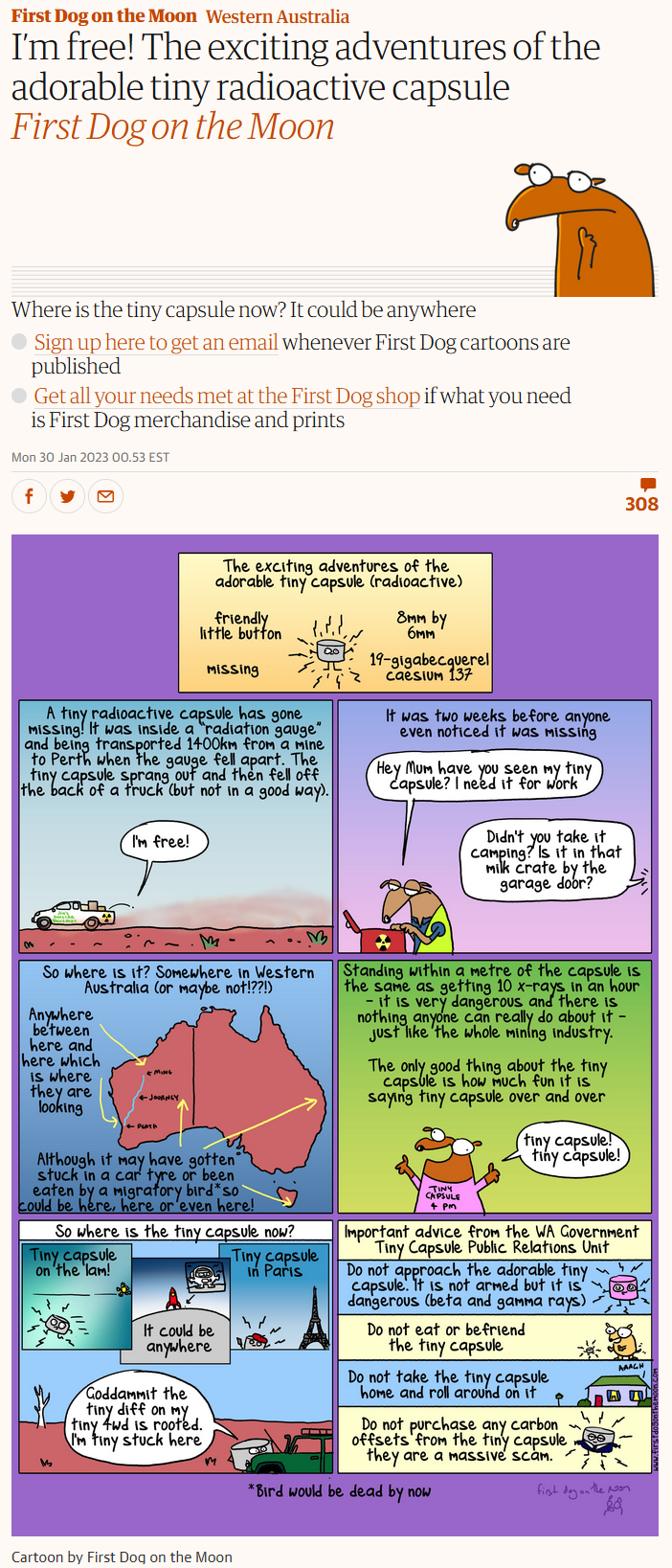
The 8mm by 6mm item fell out of a density gauge while being trucked from a Rio Tinto mine in the Pilbara to Perth.
Emergency services are searching a 1400km route amid warnings the Caesium-137 in the capsule could cause radiation burns or sickness if handled and potentially dangerous levels of radiation with prolonged exposure.
The Australian Radiation Protection and Nuclear Safety Agency (ARPANSA) on Tuesday said it had sent a deployment team with specialised car-mounted and portable detection equipment to join the search.
Led by WA’s Department of Fire and Emergency Services, the hunt is expected to take five days with vehicles travelling at 50km/h.
Radiation services specialists and detection and imaging equipment are also being sent to WA by the Australian Nuclear Science and Technology Organisation.
Rio Tinto has apologised and ordered an investigation into what went wrong during the haul, which was carried out by a contractor.
Emergency Services Minister Stephen Dawson flagged the WA government was likely to also probe the incident.
“How these are transported does need to be looked at,” he told ABC radio.
“It does puzzle me how such a thing can fall off the back of a truck.”
Rio said a bolt that secured the capsule within the gauge appeared to have sheared off, creating a hole just big enough for the item to escape.
The truck arrived in the Perth suburb of Malaga on January 16 but it wasn’t until nine days later that a technician realised the capsule was missing.
The capsule is smaller than a 10 cent coin but the amount of radiation it emits is equivalent to receiving 10 X-rays in an hour.
Drivers have been warned it could have become lodged in their car’s tyres.
Julian Assange’s Biggest Fight in Notorious Prison Isn’t Over Extradition
NewsWeek, BY SHAUN WATERMAN ON 01/27/23 “…………………………………………….. Assange’s physical and mental health have declined severely during more than a decade in confinement — first sheltering from U.S. authorities in the Ecuadorian embassy in London from 2012-2019, where he lived in two rooms and never left the building, and for the last almost four years, since he was dragged from the embassy by British police in April 2019, in Belmarsh fighting extradition.
…………………… The proceedings in London continue to drag on. It has been more than a year since the High Court cleared the way for his extradition and his appeal was filed in August. But the court continues to weigh it, with no deadline to reach a decision. Even if he loses, there remains the possibility of an appeal to the British Supreme Court, or to the European Court of Human Rights. Assange could be in the U.S. within months, but he might remain in Britain for years.
His family says that with uncertainty about his extradition hanging over him like the sword of Damocles, he has lost weight and become depressed and anxious.
A confinement of uncertain duration
The worst part about the confinement is having no idea when or how he would be able to leave, Stella Assange said. “It is the uncertain duration that makes it so hard to bear … It’s a kind of torture.”…………..
The uncertainty has exacerbated Assange’s physical and mental deterioration, his wife said. In October 2021, during a High Court hearing about his extradition, Assange, attending via video link from Belmarsh, suffered a “transient ischaemic attack” — a mini-stroke. He has been diagnosed with nerve damage and memory problems and prescribed blood thinners.
“He might not survive this,” she said.
As a remand prisoner, not convicted or sentenced, and facing extradition, not prosecution, Assange is an anomaly in Britain’s most secure prison — designed to hold “Category A” inmates such as IRA militants, jihadis and murderers. One of a tiny handful of unconvicted prisoners, prison regulations require him to be treated differently, his wife said.
“He’s supposed to be able to get visits every day, he’s supposed to be able to work on his case,” she said, “But that’s only on paper. The way the prison system works, it is more efficient to treat everyone like a Cat A prisoner rather than to try to adapt the rules for individuals. In reality, that just doesn’t translate at all.” She said Assange is allowed one or two legal visits, and one or two social visits each week.
In between visits, time can stretch. And the isolation has been hard on him……………………………..
Phone calls, his half-brother Gabriel Shipton told Newsweek from Assange’s native Australia, are limited to 10 minutes. “You’ll just be getting into it and click, it’s over.”
Neither the governor’s office at Belmarsh, nor the press office for the British Prison Service, responded to emails requesting responses to detailed questions.
A source of inspiration and power
Assange gets thousands of letters and parcels from all over the world, Stella Assange said, but the authorities interdict banned items, such as books about national security, paintings and other forbidden objects.
His father, John Shipton, told Newsweek from Australia that Assange draws a lot of inspiration and power from the letters that people write to him. During their phone conversations, he will often read snippets or recall memorable letters, Shipton said. “He loves getting them … You can hear him light up a bit” when he talks about them………………………………………… more https://www.newsweek.com/2023/02/10/julian-assanges-biggest-fight-notorious-prison-isnt-over-extradition-1774197.html
The Belmarsh Tribunals Demand Justice for Julian Assange

Never before has a publisher been charged under the U.S. Espionage Act. The Assange prosecution poses a fundamental threat to the freedom of speech and a free press.
President Biden, currently embroiled in his own classified document scandal, knows this, and should immediately drop the charges against Julian Assange
JANUARY 26, 2023, By Amy Goodman & Denis Moynihan https://www.democracynow.org/2023/1/26/the_belmarsh_tribunals_demand_justice_for
“The first casualty when war comes is truth,” U.S. Senator Hiram W. Johnson of California said in 1929, debating ratification of the Kellogg-Briand Pact, a noble but ultimately failed attempt to ban war. Reflecting on World War I, which ended a decade earlier, he continued, “it begins what we were so familiar with only a brief period ago, this mode of propaganda whereby…people become war hungry in their patriotism and are lied into a desire to fight. We have seen it in the past; it will happen again in the future.”
Time and again, Hiram Johnson has been proven right. Our government’s impulse to control information and manipulate public opinion to support war is deeply ingrained. The past twenty years, dominated by the so-called War on Terror, are no exception. Sophisticated PR campaigns, a compliant mass media and the Pentagon’s pervasive propaganda machine all work together, as public intellectual Noam Chomsky and the late Prof. Ed Herman defined it in the title of their groundbreaking book, “Manufacturing Consent,” borrowing a phrase from Walter Lippman, considered the father of public relations.
One publisher consistently challenging the pro-war narrative pushed by the U.S. government, under both Republican and Democratic presidents, has been the whistleblower website Wikileaks. Wikileaks gained international attention in 2010 after publishing a trove of classified documents leaked from the U.S. military. Included were numerous accounts of war crimes in Iraq and Afghanistan, the killing of civilians, and shocking footage of a helicopter gunship in Baghdad slaughtering a dozen civilians, including a Reuters journalist and his driver, on the ground below. Wikileaks titled that video, “Collateral Murder.”
The New York Times and other newspapers partnered with Wikileaks to publish stories based on the leaks. This brought increased attention to the founder and editor-in-chief of Wikileaks, Julian Assange. In December, 2010, two months after release of the Collateral Murder video, then-Vice President Joe Biden, appearing on NBC, said Assange was “closer to being a hi-tech terrorist than the Pentagon papers.” Biden was referring to the 1971 classified document release by Daniel Ellsberg, which revealed years of Pentagon lies about U.S. involvement in the war in Vietnam.
With a secret grand jury empanelled in Virginia, Assange, then in London, feared being arrested and extradited to the United States. Ecuador granted Assange political asylum. Unable to make it to Latin America, he sought refuge in the Ecuadorian embassy in London. He lived inside the small, apartment-sized embassy for almost seven years. In April 2019, after a new Ecuadorian president revoked Assange’s asylum, British authorities arrested him and locked him up in London’s notorious Belmarsh Prison, often called “Britain’s Guantánamo.” He has been held there, in harsh conditions and in failing health, for almost four years, as the U.S. government seeks his extradition to face espionage and other charges. If extradited and convicted in the U.S., Assange faces 175 years in a maximum-security prison.
While the Conservative-led UK government seems poised to extradite Assange, a global movement has grown demanding his release. The Progressive International, a global pro-democracy umbrella group, has convened four assemblies since 2020 called The Belmarsh Tribunals. Named after the 1966 Russell-Sartre Tribunal on the Vietnam War, convened by philosophers Bertrand Russell and Jean-Paul Sarte, The Belmarsh Tribunal has assembled some of the world’s most prominent, progressive activists, artists, politicians, dissidents, human rights attorneys and whistleblowers, all speaking in defense of Julian Assange and Wikileaks.
We are bearing witness to a travesty of justice,” Jeremy Corbyn, a British Member of Parliament and a former leader of the Labour Party, said at the tribunal. “To an abuse of human rights, to a denial of freedom of somebody who bravely put himself on the line that we all might know that the innocent died in Abu Ghraib, the innocent died in Afghanistan, the innocent are dying in the Mediterranean, and innocents die all over the world, where unwatched, unaccountable powers decide it’s expedient and convenient to kill people who get in the way of whatever grand scheme they’ve got. We say no. That’s why we are demanding justice for Julian Assange.”
Corbyn is joined in his call by The New York Times, the Guardian, Le Monde, El Pais and Der Spiegel–major newspapers that published articles based on the leaked documents. “Publishing is not a crime,” the newspapers declared.
Never before has a publisher been charged under the U.S. Espionage Act. The Assange prosecution poses a fundamental threat to the freedom of speech and a free press. President Biden, currently embroiled in his own classified document scandal, knows this, and should immediately drop the charges against Julian Assange.
Missing radioactive capsule: WA officials admit it was weeks before anyone realised it was lost
Fire and Emergency Services official says capsule left Rio Tinto mine site on 10 January but was not found missing for 15 days
Guardian, Mostafa Rachwani, 28 Jan 23
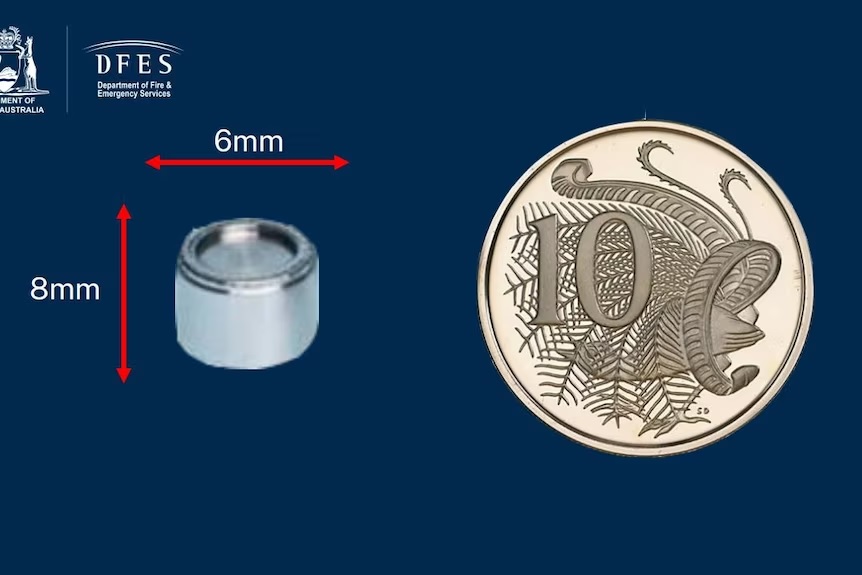
Western Australian authorities are scrambling to find a missing radioactive capsule that is a fraction of the size of a 10c coin, conceding it was not found missing until more than two weeks after it left a Rio Tinto mine site.
The 8mm by 6mm capsule is a 19-gigabecquerel caesium 137 ceramic source, commonly used in radiation gauges, and was supposed to be contained in a secure device which had been “damaged” on a truck which travelled from the mine site north of Newman in the Pilbara to a depot in Perth.
Authorities are now searching along the 1,400km stretch of the Great Northern Highway for the capsule, which they warn can cause skin burns, radiation sickness and cancer.
At a news conference on Saturday, Darryl Ray, the acting superintendent for Western Australia’s Department of Fire and Emergency Services, said authorities were largely searching for the capsule at “strategic sites”.
He said an incident management team including the Department of Health and police had been formed.
“We have continued the search on strategic sites along the route that the vehicle had taken, concentrating on sites close to high-population areas within the metropolitan suburbs,” he said. “The search involves the use of radiation survey meters to detect the radiation levels which will help us locate the small device.
“What we are not doing is trying to find a tiny little device by eyesight. We are using the radiation detectors to locate the gamma rays, using the meters, that will help us then locate the small device.
“We have secured the GPS data from the trucking company to determine the exact route and stops that the vehicle has taken on its journey.
“We will continue to use specialist equipment to help us search the remaining known locations … in particular, the Great Northern Highway between Perth and Newman.”
The WA chief health officer, Andrew Robertson, said there were screws missing from the protective gauge holding the capsule when it was discovered missing.
“These gauges are designed to be robust and to be used in industrial settings where they may be exposed to weather and vibration, so it is unusual for a gauge to come apart like this one has,” Robertson said.
“We are conducting an investigation on all of the circumstances from when it was originally transported from the mine site, the whole of the transport route, and then its handling on arrival in Perth.”
Robertson urged anyone who found the capsule not to handle it.
“People could end up developing redness of the skin and eventually burns of the skin from the beta radiation,” he said. “If it were kept long enough and they were exposed long enough, they could also have some acute effects, including impacts on their immune system and the gastrointestinal system.”
Robertson said the capsule was “most dangerous if it is handled or if it is close to the body”.
“If you are further than five metres away from the source, certainly if you are more than 20 metres away from the source, it will pose no danger to you,” he said. “If it is closer than that, and we strongly discourage people from picking it up, certainly don’t put it in your pocket or put it in your car, don’t put it on your sideboard, it will continue to radiate.
“While you may not have immediate health effects, they can occur relatively rapidly over a short period of time if it is close to the body………………
Robertson said officials did not know the date the capsule fell off the truck.
Ray said the capsule was placed on to the pallet on 10 January at the mine site, transited and arrived at the radiation service company in Malaga on 16 January.
“It was not until the 25th, late morning, when they opened it up to reveal that the device had fallen apart, was damaged in transit, and that the actual capsule was discovered missing, which is when authorities were first notified.” ………… more https://www.theguardian.com/australia-news/2023/jan/28/missing-radioactive-capsule-wa-officials-admit-it-was-weeks-before-anyone-realised-it-was-lost
Urgent public health warning issued over lost radioactive capsule in Western Australia
“It emits both beta rays and gamma rays so if you have it close to you, you could either end up with skin damage including skin burns,” .
“And if you have it long enough near you, it could cause acute radiation sickness.
DFES have issued a warning for people to stay at least five metres away from it if they see something that resembles the capsule.
https://www.abc.net.au/news/2023-01-27/radioactive-capsule-lost-in-wa-emergency-public-health-warning/101901472 By Cason Ho 28 Jan 23
A missing radioactive capsule lost somewhere between Perth and a Pilbara mine site over an area of 1,400 kilometres has sparked an urgent health warning.
Key points:
- A capsule containing a radioactive substance has been lost
- The capsule is 6mm in diameter and 8mm wide
- People are being urged not to get close to the capsule
In an emergency press conference on Friday afternoon, WA’s chief health officer urged people to stay away from the capsule if they see it because of its radioactive properties.
The capsule is tiny – 6mm diameter by 8mm high.
The radioactive gauges are commonly used in mining. It went missing from a truck sometime after January 10.
WA radioactive substance risk alert
The radioactive capsule could be anywhere along the more than 1,400 km journey between Malaga, in Perth and Newman in WA’s remote north
Any motorists who have travelled along the Great Northern Highway between Newman and Perth since January 10 should check their tyres, in case the capsule has become lodged in them.
Chief Health Officer Andy Robertson said the capsule was lost while it was being transported, somewhere between a mine site north of Newman and Malaga, north east of Perth.
It is believed the capsule fell through the gap left by a bolt hole, after the bolt was dislodged when a container collapsed as a result of vibrations during the trip.
Authorities are searching Great Northern Highway in a desperate effort to find the capsule, which is smaller than a 10-cent piece.
DFES said the capsule “cannot be weaponised” but are still urging caution due to potentially serious health consequences.
Radiation equivalent to 10 X-rays an hour
Mr Robertson said it does emit a “reasonable” amount of radiation.
He says the radiation emitted is equivalent to receiving 10 X-rays in one hour, if you were within one metre of it, or the amount of natural radiation a body is exposed to over a year.
The half-life of the substance is 30 years.
“It emits both beta rays and gamma rays so if you have it close to you, you could either end up with skin damage including skin burns,” he said.
“And if you have it long enough near you, it could cause acute radiation sickness.
“Now that will take a period of time but obviously we are recommending people not be close to it or hang on to it.”
Mr Robertson advised anyone who finds the capsule not to go near it, and to rather call DFES on 133 337.
The Department of Fire and Emergency Services is leading search efforts, coordinating a team involving the Department of Health, WA Police, and other subject matter experts.
DFES Country North chief superintendent David Gill said there would be “challenges” in locating such a small object.
“The start and finish of the transportation from the mine site north of Newman, and the transport depot in Perth, are among some of the locations that are searched, and being searched yesterday, but the capsule remains unfound,” he said.
“There are challenges here. It is 1,400 kilometres between the mine site … to the north of Newman, and Perth.”
DFES have issued a warning for people to stay at least five metres away from it if they see something that resembles the capsule.
People are urged to avoid coming into contact with it, and immediately contact DFES.
Documents show no sign Albanese government lobbied the US to bring Julian Assange home

https://michaelwest.com.au/documents-show-no-sign-albanese-government-lobbied-the-us-to-bring-julian-assange-home/, by Rex Patrick | Jan 24, 2023
The government is hosting a media freedom roundtable yet Freedom of Information inquiries show no evidence of entreaties to the Biden administration to free Australia’s number one victim of political and media persecution, Julian Assange. Actions speak louder than words, writes Rex Patrick.
When Independent MP Monique Ryan stood up in the Parliament in late November and asked Prime Minister Anthony Albanese if his Government would intervene to bring Australian journalist Julian Assange home, those in the community that care about freedom of the press were provided with a glimmer of hope.
The PM answered: “I, some time ago, made my point that enough is enough. It is time for this matter to be brought to a conclusion. In that, I don’t express any personal sympathy with some of the actions of Mr Assange. I do say though that this issue has gone on for many years now, and when you look at the issue of Mr Assange and compare that with the person responsible for leaking the information, Bradley Manning, now Chelsea Manning, she is now able to participate freely in US society.”
He went on to say:
The government will continue to act in a diplomatic way, but can I assure the member for Kooyong that I have raised this personally with representatives of the United States government. My position is clear and has been made clear to the US administration that it is time that this matter be brought to a close.
Press protections or press protection?
When the Attorney General, Mark Dreyfus MP, KC announced on the 19th of this month that he was calling together media organisations to discuss improved protections for press freedom, Assange supporters could also reasonably crack a smile. Dreyfus pronounced:
“The Albanese Government believes a strong and independent media is vital to democracy and holding governments to account. Journalists should never face the prospect of being charged or even jailed just for doing their jobs.”
But it’s now clear there’s a big difference between saying, and doing. A set of Freedom of Information (FOI) requests has bought the Government’s Assange façade crumbling to the ground.
In response to a Freedom of Information request to the Prime Minister for all correspondence or other records of communication sent after 23 May 2022 by or on behalf of the Prime Minister, the Hon Anthony Albanese MP, to United States President Joe Biden that related to Julian Paul Assange, his office has come up with nothing.

In response to a Freedom of Information request to the Attorney General for correspondence or records of communication between him and his US counterpart Merrick Garland that relates to Assange his office also came up bare.
FOI Response from Houston Ash, Senior Adviser to the Attorney-General
It’s a response that’s left independent MP Monique Ryan disturbed.
“The US Government’s prosecution of Australian journalist and publisher Julian Assange poses a major threat to press freedom around the world. Unfortunately, the evidence now available shows that, contrary to their statements, Prime Minister Albanese and his Ministers have done little to secure Mr Assange’s freedom. None of them has written to their US counterparts to press for the espionage prosecution to be dropped”, said Ms Ryan.
She’s now rightly called on the government to disclose exactly what they have done, and will do, to secure Assange’s release.
In media statements she referred also to a further request made to Foreign Minister Penny Wong’s office for Assange related correspondence between her and United States Secretary of State Antony J Blinken. It also drew a blank.

Ms Ryan observed:
“If the Albanese Government was serious about working to secure an end to the US prosecution and Mr Assange’s release, then he and his Ministers would have raised the matter formally, in writing, with their counterparts at the top levels of the US Government”, It is now confirmed that they have not done so via any formal means.”
Ms Ryan went on to highlight the Attorney’s duplicitous stand. “Last week, in announcing a forthcoming national media roundtable, Attorney-General Dreyfus declared that ‘Journalists should never face the prospect of being charged or even jailed just for doing their jobs‘.” Julian Assange is an Australian journalist who faces lifelong imprisonment for doing his job.”
The Independent MP for Kooyong has signalled her intent to take the matter further. “When the Federal Parliament reconvenes in February, the Government will need to explain – in much more detail – when we can expect to see Mr Assange return to Australia”
The Albanese Government has been caught out saying something but not meaning it. They just want to appear that they’re doing something, when behind the scenes they’re doing very little, if anything much at all.
Nothing is to be gained by the continuing prosecution of Julian Assange. The US espionage prosecution sends precisely the wrong message at a time when freedom of the press is under threat in many countries worldwide.
The Albanese Government serve the United States better, and promotes a solid position itself, in pressing for the attack on Assange and media freedom to stop.
Julian Assange and the US government’s war on whistleblowers
Chris Hedges, The Real News Network, Fri, 20 Jan 2023
Thirteen years ago, WikiLeaks published extensive leaked US government documents detailing a range of criminal and unethical acts, from the slaughter of civilians in the “War on Terror” to acts of espionage against foreign heads of state. Since then, the persecution of Julian Assange has not ceased. This year, Assange is expected to stand trial in the US for violations of the Espionage Act. Journalist Kevin Gosztola joins The Chris Hedges Report to review the cases of Julian Assange and Chelsea Manning, and discuss Washington’s wider war against whistleblowers and the truth itself.
Kevin Gosztola is the managing editor of Shadowproof, where he writes The Dissenter. He is the author of Guilty of Journalism: The Political Case Against Julian Assange.
TRANSCRIPT
Chris Hedges: The long persecution of Julian Assange, the publisher of WikiLeaks, is set to culminate in its final act: a trial in the United States, probably this year. Kevin Gosztola has spent the last decade reporting on Assange, WikiLeaks, and the wider war on whistleblowers. His new book, Guilty of Journalism: The Political Case against Julian Assange, methodically lays out the complex issues surrounding the case, the gross distortions to the legal system used to facilitate the extradition of Julian, now in a high security prison in London, the abuses of power by the FBI and the CIA, including spying on Julian’s meetings when he sought refuge in the Ecuadorian embassy in London with his family, doctors, and attorneys, and the dire consequences, should Julian be convicted, for the press.
Joining me to discuss his new book is Kevin Gosztola. So Kevin, you do a very… I think your book and Nils Melzer are the two books I would recommend for people who don’t understand the case. I use this show in this interview to really lay out for people who are unfamiliar with the long persecution of Julian and the legal anomalies that have been used against him. You know, what those are. So let’s just start with what are the charges, what are the allegations, which is where you begin your book.
Kevin Gosztola: Yeah. And the intention was to look ahead and say, Julian Assange is likely to be brought to the US by the end of 2023, maybe 2024. We need something out there for the general public so they can wrap their head around the unprecedented nature of what’s unfolding. And so the charges against Julian Assange, he was first indicted back in April of 2019. Or sorry, that was when it was unveiled. He was charged first with a computer crime offense. They alleged, essentially, a password cracking conspiracy. And that was of intrusion, of essentially agreeing to help Chelsea Manning anonymously access military computers.
And then the other charges were 17 espionage act offenses. ………………………………………………………… https://therealnews.com/julian-assange-and-the-us-governments-war-on-whistleblowers

Media keeps mum about earthquake near planned nuclear waste dump.
Kazzi Jai, Fight to stop a nuclear waste dump in South Australia 20 Jan 23
Port Augusta had a magnitude 3.2 earth tremor Sunday morning with epicentre near Port Paterson and not a peep in the media!
It was just below 4.0 (and above)which is considered an earthquake …
Only Geoscience Australia officially recorded it.
So, surely there should have been noise about it in the media….or is it just “selective” news these days?
Port Augusta isn’t that far from Kimba…and we’ll remember the greedy landowner commenting once that the nuclear dump would only “bounce up and down” in the event of SEISMIC ACTIVITY!!
Don’t know about anyone else…but concrete and steel drums bouncing up and down results in cracking of concrete and possible breaching of steel drums (steel and concrete interfaces results in concrete corrosion …not to mention the corrosion caused by interaction of radiation emissions contained within)!
Not SAFE AT ALL considering this dump is meant to FULLY CONTAIN this nuclear waste from the environment FOR 300 YEARS!!!
….IN A FLOOD PRONE AREA!!!!
ASIO spied on Pine Gap military base protesters in the 1980s, declassified documents reveal
ABC Alice Springs / By Lee Robinson, Sat 21 Jan 2023
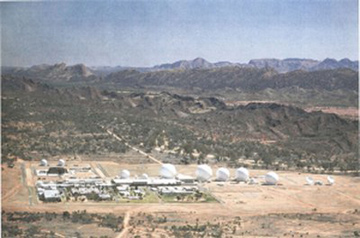
Declassified ASIO files have revealed the national security agency planted spies among a group protesting against the Pine Gap military base in Alice Springs during the 1980s.
The 1987 documents, released last year by the National Archives of Australia, show intelligence about peace activists and their protest plans were being fed to ASIO’s central office by one or more covert operatives who surreptitiously attended the group’s meetings.
The peace movement had gained momentum in the political landscape during the Cold War era, as concerns ran high over the threat posed by the Soviet Union and the possibility of nuclear warfare.
Pine Gap, the top-secret defence facility that had begun operating during the previous decade on the outskirts of town, was feared to be a target due its strategic importance to the United States Department of Defense and the Australian government.
Surveillance of peace group no surprise
Russell Goldflam was a bright-eyed idealist and vocal member of the Alice Springs Peace Group (ASPG) in the late 1980s.
Now a semi-retired lawyer still living in Alice Springs, he was not surprised to learn that ASIO had been surveilling the group’s activities.
“I would have been amazed if there hadn’t been a spy amongst our ranks,” Mr Goldflam said.
“We were campaigning against the largest spy base run by the United States outside the continental US.
“It would have been absolutely extraordinary if [ASIO] — or somebody in the security establishment — didn’t go to some trouble to try and make sure that there was no threat to that base from local people who were publicly saying, ‘We want to get it closed down’.”
Protest meetings documented
There are hundreds of files, with some revealing nothing more than bland meeting minutes, while others contain heavy redactions and delve into the perceived threats posed by peace activists……
Covert operatives remain a mystery
Mr Goldflam, who was arrested several times for trespassing at the military base during demonstrations, said he was never able to confirm the identity of any covert operatives…………………………………………………………..
A ‘great privilege’
Mr Goldflam has provided legal assistance throughout his career to a number of peace activists who had broken the law at Pine Gap and faced serious charges.
“It was a great privilege to be able to work as a lawyer for those people fighting for what are pretty fundamental rights, and that’s the right to be able to express an opposing point of view,” he said.
He believed the documents also painted the national security agency as holding grave concerns about the peace movement having a “malign influence” on local Aboriginal people, which Mr Goldflam said “couldn’t be further from the truth”.
“Our concern is where opinions tip into the promotion of violence, or actual acts of violence.” https://www.abc.net.au/news/2023-01-21/asio-spies-1980-pine-gap-peace-protesters-declassified-documents/101815740
Push in US Congress to exempt Australia from International Traffic in Arms Regulations, so that it can import nuclear submarines.

Democrat push to grant Australia a waiver to import nuclear subs earlier than expected
SMH, ByFarrah Tomazin, January 21, 2023 —
Washington: A maze of US regulations and export control laws stand between Australia and the multibillion-dollar AUKUS submarine agreement, prompting a key ally of the pact in Congress to propose a blanket exemption to accelerate delivery of the nuclear-powered fleet.
Democratic congressman Joe Courtney, who recently spearheaded a bipartisan defence of the Australia-UK-US pact amid jitters from some of his Washington colleagues, wants Australia to be given a waiver from strict US export controls that could otherwise derail the agreement.
The International Traffic in Arms Regulations is one set of rules which could delay for years the transfer of crucial technologies at a time when Australia is racing to bolster its submarine capacity before the retirement of its Collins-class fleet.
Defence Minister Richard Marles has said the government will announce by March which type of submarine it will acquire, after receiving a recommendation from Jonathan Mead, the head of the Nuclear Powered Submarine Taskforce.
The announcement is expected to provide the first concrete insights into the cost, timing and procurement of the AUKUS deal. The modelling so far has suggested that if the submarines are produced in Australia, as the government has suggested, the earliest possible delivery date would be 2055.
While President Joe Biden supports AUKUS, he needs the backing of a divided Congress to make good on his promise to share American submarine secrets with Australia.
Courtney, who co-chairs the bipartisan “AUKUS caucus” and is regarded as one of Congress’ top navy experts, said a potential solution to the difficulties posed by US law would be to pass an exemption, with the support of the Pentagon, allowing Australia to bypass rules such as the International Traffic in Arms Regulations and related nuclear submarine laws, for the strict purpose of advancing AUKUS……………………………….
Australian officials have for years been pushing their US counterparts to reform their treatment under arms regulations, and the issue was front and centre of the December Australian-US Ministerial consultations between Marles and US Secretary of Defence Lloyd Austin…………
In response to questions from this masthead, a spokesman for the Australian Department of Defence said it was anticipating that export arrangements would need to change “to ensure technology and expertise could be transferred seamlessly and effectively among AUKUS partners, as well as their respective industrial bases, within a suitably designed protective framework”…………
At a seminar last week, Democratic congressman Adam Smith, a ranking member of the House of Representatives armed services committee, also warned that while AUKUS was “a great idea, with a lot of promise” it “could also go bloop” unless some regulatory restrictions were eased.
And Mark Watson, the director of the Australian Strategic Policy Institute’s Washington office, suggested that “an AUKUS express lane is what we need” to avoid delaying or derailing the project due to the maze of red tape and complex US laws surrounding it.
But the regulatory hurdles are not the only difficulty the alliance faces.
One of the concessions Republican congressman Kevin McCarthy made this month to secure the speakership of the House of Representatives was a vote on a framework that caps discretionary spending at fiscal 2022 levels. Some fear that this could result in the US defence budget being cut in real terms, which Courtney warned “could have a very negative effect on AUKUS”.
Helping Australia acquire nuclear submarines will also test America’s submarine manufacturing industry, which has already been strained by the COVID pandemic. https://www.smh.com.au/world/north-america/democrat-push-to-grant-australia-a-waiver-to-import-nuclear-subs-earlier-than-expected-20230120-p5ce4e.html
Nuclear submarines are not going to have ‘any effect’ at all
The Australian’s Foreign Editor Greg Sheridan says there is “no way” Australia can have a fleet of eight nuclear submarines “before probably 2050”.
“The current strategic problem is going to be resolved long, long before these nuclear subs,” Mr Sheridan told Sky News Political Editor Andrew Clennell.
“Nuclear subs are very sexy, but they are not going to have any effect at all.
“I still think the government should go ahead with a new conventional submarine because we’re… going to end up with no submarines at all.”
Greens Senator Barbara Pocock ‘s reminder that the Kimba nuclear waste storage has no longterm plan for removal of that waste to permanent disposal
Yesterday’s visit to Kimba by Federal Resources Minister Madeleine King failed to acknowledge the fact that the proposed radioactive waste dump at Kimba includes temporary storage of intermediate level waste which must await a long term solution.
We Greens are standing with the Barngarla Native Title holders in their legal battle to halt the waste dump and with farmers in the region who don’t want to jeopardise the export of their crops to European markets.
Living With Our Expensive AUKUS Nuclear Submarines

More public discussion of this complex issue might assist in modifying the worst excesses of the AUKUS deal with its enormous financial consequences and more dependency on those powerful friends abroad which have been such a feature of the federal LNP’s foreign policies for decades past.
Will we all continue to live with those dark AUKUS nuclear submarines? Australian Independent Media, By Denis Bright 13 Jan 23,
The Christmas edition of The Australian (24-25 December 2022) released a quote from the head of Australia’s nuclear task force Vice Admiral Jonathan Mead. It described the AUKUS submarines as the gold standard of our new security blanket. Spies worldwide wanted to know so much more as the consultative processes surrounding the details were always in the hands of political, military and intel insiders. The wider public would always be left with future payments to cover the financial costs and fall-out from lost trading and investment opportunities between Australia and China.
Writing in The Guardian (8 June 2022), Daniel Hurst estimated that the still undefined AUKUS deal would be an additional $90 billion over the French diesel-powered submarines negotiated by the Turnbull Government.
Yet, Australians seemed to welcome the dark submarines which had a popularity rating of 62 per cent despite an acknowledgment that the deal would inflame relations with China and our future commercial ties according to Katherine Murphy of The Guardian (28 September 2021).
The Albanese Government has already made a goodwill payment to France of $835 million for our breach of contract over the cancelled submarine deal (ABC News 11 June 2022). These costs will fade into insignificance when the full costs of the AUKUS Submarine deal evolve.
The French Government tried hard to promote its contribution to the US Global Alliance after gaining its contract with the Turnbull Government for the sale of the diesel-powered submarines to Australia. French Navy Rubis-class nuclear powered submarine (SSN) Emeraude and Loire-Class support & assistance vessel (BSAM type) Seine reached RAN Fleet Base West in Perth on 9 November 2020 (Naval News 10 November 2020). Prior to the maintenance and logistics visit, Australian Defence Force elements, including the Frigate HMAS Anzac, and Collins-class submarine HMAS Sheean and a P-8A Poseidon aircraft exercised with the French Navy units off the coast of Fremantle.
The ageing nuclear submarine Emeraude was commissioned in 1988. Ten crew members were killed in an accidental explosion off Toulon, France in 1994. Reporters from Vingt Heures (Channel 2 in Paris) were invited on board to film the missiles on the attack class submarine after its triumphal return after a six-month voyage to Australia, the South China Sea and the Taiwan Straits in early 2021. Naval News in Paris were unable to comply with my request for a detailed map of the navigation route which was flicked across the television screen by reports from Vingt Heures. Were the French vessels welcomed into the naval installations at the US installation on Diego Garcia on their merry jaunt from the Red Sea to Western Australia I wondered?
Up north in the South China Sea, both China and Taiwan of course have rival claims over specific islands and reefs across the South China Sea, so the Emeraude had to be on guard as it moved in stealth mode through troubled waters.
Perhaps more commercial globalization is the only recipe for the new wave of security fears about an emergent China. While China remains dependent on mineral and energy resources from Africa, the Middle East, Australia and energy rich Indonesia for its national economy, it can hardly cut off its supply network with shipping embargoes as claimed by advocates of Freedom of Navigation. The AUKUS submarine deal did not canvass such issues and were to be a trump card in giving a khaki hue to the federal LNP’s plans to win the 2022 election for Scott Morrison. Having won the election, the Albanese government was soon caught up in positive political spin that was deemed to come with the AUKUS deal which required no background briefings to balance references to gold standard security advantages for Australia.
It was a bit late for the Chinese Embassy’s goodwill event on 10 January 2023, to change the tide of Australian public opinion (ABC News, 10 January 2023):
The ambassador made both remarks during a wide-ranging and largely upbeat press conference in Canberra held to mark the New Year.
He declared relations between China and Australia had reached a period of “stability”, saying the Chinese Year of the Rabbit offered an opportunity to “jump over obstacles” that had emerged in recent times.
But there are still deep doubts in Canberra about China’s trajectory and the limits to the rapprochement in the wake of high-level meetings between Prime Minister Anthony Albanese and President Xi Jinping, as well as Foreign Minister Penny Wong and her then-Chinese counterpart Wang Yi in Beijing.
Jumping over obstacles to goodwill demands a cooling of tensions over access to the South China Sea, ironclad guarantees about the special status of Hong Kong and an end to saber-rattling over Taiwan which is largely integrated into the economy of China in trade and capital flows. Ambassador Xiao Qian of the Chinese Embassy in Canberra proposed a similar lifeline for Australia to minimize the costs of the AUKUS submarine deal (The Guardian 10 January 2023)………………………………………….
Taiwan still retains some island outposts in the South China Sea including the island of Taiping where the military airport is indeed the main feature of the entire island as covered in the Italian-based PIME AsiaNews (12 March 2022)…………
The ASEAN Forum opposes the return of great power rivalry between nuclear weapons states in the region. Writing in The Interpreter (13 September 2022), Melissa Conley Tyler noted the reservations from regional leaders about the AUKUS submarine deal:
When Australia, the United Kingdom and the United States announced the AUKUS trilateral security cooperation agreement a year ago, it didn’t get a uniformly positive reception in Southeast Asia.
Indonesia’s Ministry of Foreign Affairs said it was “deeply concerned” over an arms race in the region. Malaysia expressed concerns at multiple levels, with both the prime minister and foreign minister raising concerns that it could “potentially spark tension among the world superpowers and aggravate aggression between them in the region”. Malaysia’s Minister for Defence Hishammuddin Hussein went as far as saying he would consult with Beijing on its views on AUKUS.
With commitment to the AUKUS deal still at a consultative stage, favourable guarantees from China might yet modify those gun-ho commitments from the Morrison Government to the re-militarization of our region.
Former Prime Minister Malcolm Turnbull has also revived concerns over the AUKUS submarine deal as covered by Ellen Ransley (news.com.au 9 January 2023):……………………….
More public discussion of this complex issue might assist in modifying the worst excesses of the AUKUS deal with its enormous financial consequences and more dependency on those powerful friends abroad which have been such a feature of the federal LNP’s foreign policies for decades past.
This nostalgia for a return to Cold War solutions will hardly bring progress in reducing regional tensions. While waiting for the arrival of the AUKUS submarines, China continues with its development of land and sea based nuclear weapons. Perhaps some eleventh-hour deals are still possible to reduce future tensions, but change is difficult because of bipartisan agreement in Australia on this issue which seems to have strong electoral support in the absence of public discussion on the economic consequences….. more https://theaimn.com/living-with-our-expensive-aukus-nuclear-submarines/
Population growth is not a good thing, it’s a bad thing.

All this enthusiasm for Australia to grow its population! Hasn’t anybody noticed that vast swathes of this continent are getting flooded? Then there have been vast swathes on fire – with hitherto unknown soaring fire temperatures.
And these events are happening in the green fringe around this vast land. With global heating, the centre, the most of this huge land will become too hot, too dry, for human habitation .
We’ll be flat out trying to sustain the population that we already have.
What catastrophes will it have to take, before homo-not-very-sapiens-at-all abandons the suicidal philosophy of endless growth?
SMH January 16, 2023
Growth of both population and the economy is the cause of most of Australia’s problems, not a solution, and does not align with majority Australian opinion (“Big Australia? Dream on”, January 14). Per capita, Australians already consume resources at a rate which, if extended to the whole world, would require four Earths to fulfil that demand, yet Michael Koziol, together with the political parties and most economists, seeks to grow our resource demand into an unsustainable and increasingly inequitable future. We need to curb our demands on nature, not expand them. The economy we must build is a very different one, in which we seek to satisfy real need, not an avalanche of artificially stimulated wants. John Coulter, Bradbury (SA)
Do we value ecological and economic sustainability and the wellbeing of future generations and ecosystems, or do we prioritise the short-term gains of rapid resource exploitation, consumption and waste disposal? The latter are not sustainable on a planet where the human ecological footprint far exceeds Earth’s renewable biocapacity and whose life-support functions are failing. Indeed, we have an extinction and ecosystem crisis in Australia that has prompted 240 leading scientists to call on the government to take strong protective action. Further, our State of the Environment Report named population growth as a factor causing this environmental destruction. A second criterion is surely human wellbeing. Is it enhanced by population growth? In Australia, it appears that wellbeing as measured by the Genuine Progress Indicator was greatest in about 1970 when the population was 15 million but has fallen since as the population has increased. We have to decide to halt the damage to our life-supporting ecosystems and our own wellbeing. Increasing the population will make it harder. Alan Jones, Narraweena
The State of Environment Report 2021 would be a good starting point for Michael Koziol and other Big Australia proponents, as it details the decline in our natural world, and lists population growth as one of the major causes. Immigration may have been beneficial 50 or more years ago, when our population was less than half of now, but in the current global environment, with 8 billion people, it would be foolish for Australia to increase our population – either through immigration or fertility programs – and still expect our remaining natural environment and quality of life to survive. The increasing costs of dealing with climate change disasters should also be factored in to any population discussion. Karen Joynes, Bermagui
Why do we have this obsession with increasing the population of Australia? Admittedly, we live in a large country, but it is mostly arid with a fragile ecosystem that has been badly treated by our sojourn here over the last 234 years. It is time we demanded that our land be protected from greed and stupidity. We do not need an excessively large population, apparently to keep the economy growing, we need a thoughtful government to ensure we have a country that is sustainable, a country which is nourished by care, responsibility and respect. And it had better be soon. Nola Tucker, Kiama https://www.smh.com.au/national/nsw/population-growth-is-not-a-good-thing-it-s-a-bad-thing-20230115-p5ccl7.html
1 This month
17 October, Free Public Talk on Nuclear Issues in South Australia
David Noonan will speak on public interest concerns over the new Roxby Downs Indenture Act 2026 on BHP copper-uranium mining and ore processing in SA, and on how AUKUS may face SA with a High-Level nuclear waste agenda.
Dr Jim Green will discuss international developments in the field of nuclear power including ‘small modular reactors’ and Generation 4 ‘advanced’ nuclear reactor concepts.


Help Aunty Sue Protect Her Land and Sacred Sites From Destructive Rocket Testing.
.

Australians deserve the truth
about
AUKUS – https://aukuspublicinquiry.com/

PETITION – To: Prime Minister Anthony Albanese and the Australian Labor Government

of the week – Australians for War Powers Reform (AWPR)
To see nuclear-related stories in greater depth and intensity

