A second intellectual contortion concerns the cancer risks associated with radiation exposure. Russell’s view is that long-term exposure to low levels of radiation “does sweet fa”. Russell and science are at odds on the question of the cancer risks associated with low-level radiation exposure. For example, the 2006 report of the Committee on the Biological Effects of Ionising Radiation (BEIR) of the US National Academy of Sciences states that “the risk of cancer proceeds in a linear fashion at lower doses without a threshold and … the smallest dose has the potential to cause a small increase in risk to humans.”
A Nuclear Conspiracy: Jim Green Responds To Geoff Russell, New Matilda, By Jim Greenon October 20, 2016
As part of an ongoing debate over the capacity of nuclear energy to tackle climate change, Friends of the Earth’s Jim Green responds to New Matilda’s recent coverage.
New Matilda editor Chris Graham writes in an October 13 editorial that those responding to Geoff Russell’s pro-nuclear articles “never seek to punch holes in a single fact or claim”. In this article I’ll take up the challenge to respond substantively to some of Russell’s pro-nuclear claims.
But first, some passing comments on the other nuclear advocates mentioned in Chris’s editorial. Chrislinks to a video of Dr James Hansen ‒ a response is posted here. Chris links to an open letter to environmentalists from 65 scientists ‒ a response is posted here. Chris links to George Monbiot ‒ a response is posted here. And Chris promotes the Pandora’s Promise film ‒ responses are posted here.
Back to Russell. One of his themes in recent years has been to downplay the Fukushima disaster. And he goes much further, arguing that nuclear critics are responsible for all of the death and suffering resulting from the Fukushima nuclear disaster and much else besides.
How does he arrive at those conclusions? One part of the intellectual contortion concerns the role of environmental groups such as Friends of the Earth. To the limited extent that environment groups influence energy policy around the world, the result is a greater role for renewables, less nuclear power and less fossil fuel usage. But for Russell, being anti-nuclear means an implicit endorsement and acceptance of fossil fuels and responsibility for everything wrong with fossil fuel burning.
That contorted logic will come as a surprise to Friends of the Earth (FoE) campaigners risking life, limb and heavy penalties in their efforts to shut down coal mines and ports; and to everyone else engaged in the fossil fuel and climate problems in many different ways. And it will come as a surprise to FoE campaigners who worked tirelessly and creatively for many years ‒ with literally zero support from nuclear lobbyists including the self-styled pro-nuclear environmentalists ‒ to achieve a recently-announced ban on unconventional gas in Victoria. Continue reading →
Adani coal mine would wipe out Direct Action gains within a year, estimates show, The Age, Peter Hannam, 20 Oct 16,
Carbon cuts made by the federal government’s Direct Action climate change plan by 2020 would be wiped out by pollution from a single coal mine in just over a year, new data revealed at a Senate estimates hearing shows.
Officials from the Clean Energy Regulator said that projects paid for from the first three auctions of the Emissions Reduction Fund – the backbone of Direct Action – would trim pollution by just 42 million tonnes of carbon-dioxide equivalent by 2020.
Even if all the remaining funds were spent – with a fourth auction planned for November 16 – emissions reductions are projected to total only 92 million tonnes by the year 2020, officials told senators.
Tim Bickmore, Nuclear Citizens Jury Watch South Australia, 20 Oct 16
A player in this scene currently flying under the radar is Geordan Graetz, DPC Community Engagement Advisor.
In the past he has published opinions not only about Fukushima, but also regarding indigenous people & uranium mining: “Representatives of the Martu and Adnyamathanha communities in Western Australia and South Australia respectively have expressed confidence in the companies that have approached them with plans to develop deposits on their lands (Graetz and Manning 2011)” p3, IAIA, 2012.
As recently as 2014 he published material orientated toward removing indigenous people as an impediment to the expansion of uranium mining, albeit it thru application of inclusion under the auspices of international human rights conventions. [Journal of Cleaner production xxx 2014 1-9]
He appears to be an advocate of a ‘Nuclear Renaissance’ – or rather identifies indigenous peoples as a potential roadblock for such.
The NFCRC Final Report cites him & co-author Manning Ch6 Land Rights Section p130 notes ref 8 & again ref 11 (3 mentions).
His partner in a number of publications, Haydn Manning, is a well known pro-nuke spruiker.
There is a linkage between Graetz & the farcical Schools Nuclear Lockdown … probably instigated under his &/or Manning’s social engagement strategy…. more to come.
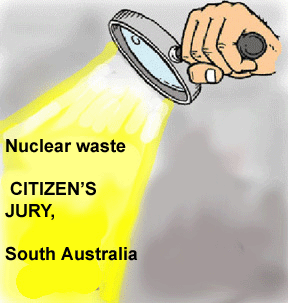
Tim BickmoreNuclear Citizens Jury Watch South Australia, 20 Oct 16 My gut feeling is that whilst there is a high apathy coefficient within the wider community, the Nuclear Citizens’ Jury (CJ) make-up does display the polarity that is also evident in the public sphere & which, at least in general expressions, appears to be mostly against the proposal.
At this stage of proceedings, I find it hard to see a consensus being reached.
I also think that South Australian Premier Jay Weatherill is aware of this: hence whilst previously he would have crowed about a ‘positive’ or even ‘maybe’ outcome, now the game plan diversifies. e.g. last night I had a South Australian Govt sponsored survey cold call regarding the Nuclear Fuel Chain Royal Commission (NFCRC) – but was excluded coz they had already reached my ‘age bracket quota’.
I wondered if that ‘quota’ was valid – are they now targeting younger folk under some misguided notion that this cohort would be more amenable to the idea? – and the quota, did that include the already received on-line & Nuclear Roadshow data? I also did not get to hear the questions – which are usually loaded in these types of things.
Also in the mix is the Senate Parliamentary Joint Committee, & my feeling there is that, too, is not a bed of roses for Jay Weatherill.
I am still crossing my fingers that the CJ will return RED coz AMBER allows Jay a small window to change legislation – tho methinks he would need a lot more oomph other than just a CJ-AMBER outcome to really justify doing that.
Tim Bickmore , Nuclear Citizens Jury Watch South Australia, 19 Oct 16 Apparently, the ‘traffic light’ question was not provided/created by the Weatherill Govt – but by NewDeMocracy XD Ian Walker – who has also now been inserted into the jury to witness their deliberations.
There are still rumblings about the question being loaded.
“I asked Ian Walker who was responsible for the question at lunch on the second day. I asked him if any other options had been proposed and he said others had been considered but it was his choice as to the final question and the wording of same. I asked him if the Premier had approved the question and he began to become vague (or so it seemed to me) I was unable to establish if the Premier had approved the final wording of the question. Ian claimed the final wording was his,
With Royal Commissions the wording of the question is critically important and is framed to achieve the outcome that the instigator of the Commission desires………” [from Basecamp Blog 18/10/16] ra ra https://www.facebook.com/groups/1172938779440750/
Ultimately, this dump is about helping the global nuclear industry. The current build-up of site-by-site waste acts as a brake on investment. They want somewhere to dump it forever so they can go on producing more of it.
South Australia to become global nuclear waste capitalhttps://redflag.org.au/node/5521Sixty years ago, Maralinga went up in a mushroom cloud. The British government had been given permission to test atomic weaponry in South Australia.
That is to say, they had been given permission by the right wing Menzies government. The local Maralinga Tjarutja people had no say in it at all. Many of them were not even forewarned of the first blast. Thunderous black clouds condemned them to radiation exposure, illness and death, the survivors being driven from their homeland during the long years of British testing and fallout.
South Australia has a dark history with the nuclear industry. Maralinga remains contaminated, despite cheap clean-up efforts. Uranium tailings have leaked from BHP’s Olympic Dam mine at Roxby Downs. Fukushima’s reactors held South Australian uranium when catastrophe struck in 2011.
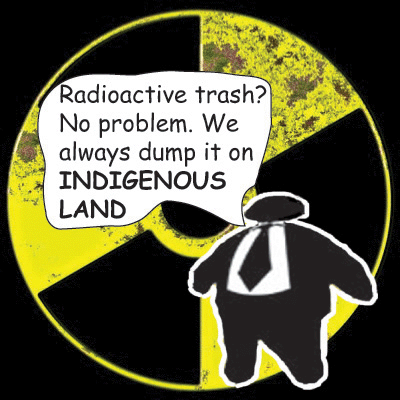
Today, Jay Weatherill’s state Labor government is trying to open a new radioactive chapter. He wants South Australia to construct the world’s first international high-level nuclear waste dump. This would mean no fewer than 138,000 tonnes of waste (one-third of the world’s total) being shipped from the world’s reactors into South Australian ports, to be permanently buried in Aboriginal land.
This would be history’s largest nuclear dumping operation, and make South Australia the hazardous waste capital of the world. Continue reading →
Australian Government must re-build trust of civil society – UN human rights expert, CANBERRA / GENEVA (18 October 2016) – United Nations independent expert Michel Forst today called on the Government of Australia to urgently dispel civil society’s growing concerns about the combined ‘chilling effect’ of its recent laws, policies and actions constraining the rights of human rights defenders.
“I was astonished to observe mounting evidence of a range of cumulative measures that have concurrently levied enormous pressure on Australian civil society,” said the UN Special Rapporteur on the situation of human rights defenders at the end of his first fact-finding visit* to the country.
Recognizing Australia’s traditional safeguards of constitutional democracy, rule of law and free media, Mr Forst noted that his initial expectation from his official visit was to “encounter only laudable implementation of the State’s obligations under international human rights laws, aimed at ensuring a safe and enabling environment for human rights defenders.”
Instead, the expert found a number of detrimental measures which include a growing body of statutory laws, both at the federal and state levels, constraining the rights of defenders. “They have ranged from intensifying secrecy laws to proliferating anti-protest laws, from the stifling Border Force Act to the ‘Standing’ bill shrinking environmental access to courts,” Mr. Forst specified.
“Those laws have not only accentuated the disparity between Government’s declared commitments at the international forums and their implementation within the country,” he noted. “They have also aggravated the situation following the drastic defunding of peak bodies by the Government, following their advocacy or litigation on such topical issues as immigration, security, environment and land rights protection.” Continue reading →
Peter Mahoney Your Say 17 Oct 2016It is difficult to believe that a citizens jury will be presented with anything other than a highly controlled version of the arguments for and against these proposals. This is truly a cynically manufactured form of consent of the most Orwellian nature.
Citizens are also more likely to respond favourably to the government’s proposals when they are given special treatment in this way. I doubt that the citizens jury have heard presentations from the Australia Institute, Mark Parnell (Greens MLC) or Ian Lowe, or images and stories of accidents happenning monthly around the world.
The cooperation of the Murdoch press in this one-newspaper town makes it also very difficult for citizens to remain untouched by a sense of momentum and support that doesn’t actually exist. Governments are becoming masters of “consultation”, which are basically exercises to keep the masses busy while they get on with the planning and the deals in the background.
henry francis Your Say site 17 Oct 2016 Can someone please inform me why high grade nuclear waste will have to be stored ABOVE GROUND in an interim facility for about 40 years after arriving on our shores?
Surely this is when it is at it’s most dangerous levels.
Why then cannot it go straight into the presumably “safe” method of storage deep underground that is promoted as “best practice” for storage of nuclear waste?
Claire Catt > henry francis Your Say site 17 Oct 2016 We won’t have the money to built the facility until we have imported thousands of tonnes of waste for a price unknown and untested anywhere in the world.
We plan to built this repository without any idea how to actually do this since it has never been done before, not anywhere including Finland. There they have spent billions of dollars for a dump still unfinished, for waste produced by them requiring no transport to speak of. If it will work and for how long is unknown.
It is my guess this underground pipe dream will never be built and we will be left with mountains of toxic waste in the open, possibly covered with concrete, like in Chernobyl. We’ll have to keep it from all life, protect it from terror attacks, climate change threats and leakage into the environment.
But hey, we probably won’t have to worry about it just yet, more likely our children and grandchildren and a thousand generations after them.
Peter Mahoney, Your Say site, 17 Oct 2016 It is very difficult to trust a Royal Commission conducted by a former military officer and a large commercial consultant to the nuclear industry. It seems to me a bit like getting Coles or Woolworths to run a Royal Commission into milk pricing. The military culture is one traditionally based on loyalty and obedience, and is not recognised for its objective and dispassionate consideration of all angles. Our former Governor may be a very upright and affable chap, but it is difficult to believe he would hold an opinion contrary to what he has been told is in the best interests of his beloved State. You can’t blame him for this, but it does not engender trust.
The implausibility of the arguments for the proposals also do not engender trust. The long time-frames, massive up-front investments, and projected revenues are so incredibly speculative and unlikely that they are insulting. You cannot keep telling people that their problem is lack of education. The problem is the Royal Commission’s absolute gall in presenting these as anything resembling even a distant relationship to facts.
Peter Mahoney, Your Say site 17 Oct 2016 The Royal Commission report appears to be silent on the details of how these radioactive materials would be transported to South Australia, and what sort of defence force support would be required to ensure that they are not the subject of terrorist attack. Who would be responsible for ensuring that they are correctly and securely sealed in their containers in the country of origin, say India or Pakistan? How would an SA facility ensure that proper standards are being followed at every step. The consequences of undetected, small or slow leaks would be enormous if they occur all the way from the country of origin, across the oceans and then across the land to SA.
Malgo Schmidt, from Your Say site 16 Oct 2016 “……..There is no independent Nuclear Regulator in Australia and SA has a conflict of interest
The nuclear dump plan proposes sitting a Nuclear port and an above ground high level nuclear waste storage facility in Project Year 5 – before potential nuclear waste contracts in Year 6′ This depends on assessment and approval by an lndependent Nuclear Regulator- that does not exist in Australia’
The current Federal nuclear regulator would requiré legislative amendments before it could claim to ‘regulate’ lnternational nuclear wastes. SA is disqualified from doing so by clear conflict of interest’
This senate can block any nuclear dump legislation up to the next Federal Election ALP, Greens and the Xenophon team can together block any pro-dump legislation in the senate
Four key themes in community concern over international nuclear waste dumping:
It is quite clear that there are 4 key concerns that have to be dealt with collectively. Failure to pass any of these tests should stop further consideration of a Nuclear Dump. They are:
1. safety of workers and community throughout the nuclear waste supply chain.
2. Flawed Economic assumptions
3. Aboriginal veto
4. Environmental and inter-generational concerns, risks and impacts
Safety is compromised by import of nuclear waste long before any disposal capacity
The Nuclear Commission proposed import of nuclear waste in Project Year 11′ four years ahead of an agreed licensed disposal site and some 16 years ahead of any potential waste disposal capacity
SA faces the threat of a Nuclear port receiving nuclear waste ships every month for decades
Reality check analysis shows there is No Profit in Nuclear waste
South Australians are being misled by inflated revenue claims, untenable assumptions including globally unprecedented scale of dump plans and under reported nuclear waste costs & liabilities’
Nuclear dump plans are prone to fail- like Yucca Mountain in the USA, and end in debt not profit.
Future generations – importing international nuclear waste is an irrevocable decision
The nuclear waste would be here forever and remain dangerous for hundreds of thousands of years’ our children will have no say in this decision hgt be left with this liability into the future ‘
The Campaign needs to mobilise mainstream community to oppose nuclear waste dumps
Countering the Premier’s nuclear waste agenda requires mobilising SA community’ working through the steps in who? when? where? and How? to engage groups across society on these issues’
We can all contribute to protect SA from nuclear dumping and build strength in our community’ For further info see: www.foe.org.au/import-waste & http://www.nodumpalliance.org.au/
Farms that grow food in arid deserts, without groundwater or fossil fuels, could be the future of agriculture. BRYAN NELSON October 10, 2016, No soil, no pesticides, no fossil fuels, and no groundwater. And yet, a thriving farm in the heart of the arid Australian desert. How is this possible?
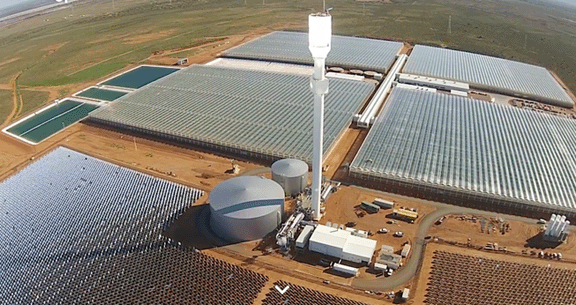
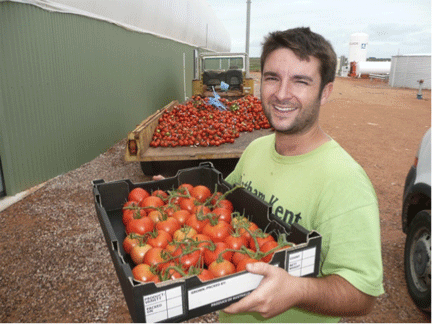
An international team of scientists has spent the last six years fine-tuning a system that pipes seawater in from the ocean and desalinates it using a state-of-the-art concentrated solar energy plant. The water is then used to irrigate 180,000 tomato plants grown in coconut husks instead of soil, kept in a network of greenhouses.
The result is Sundrop Farms, a commercial-scale facility located just off the Spencer Gulf in South Australia that began construction in 2014. Today it’s producing an estimated 17,000 tons of tomatoes per year to be sold in Australian supermarkets.
Given the increasing demand for fresh water around the world — a problem that’s particularly apparent in the sunburned landscape of South Australia — this might just represent future of large-scale farming, especially in coastal desert regions that have previously been non-arable.
The heart of the farm is the 23,000 mirrors that reflect sunlight towards a 115-meter high receiver tower. All of that concentrated sunlight produces an immense amount of power, up to 39 megawatts. That’s more than enough to cover the desalination needs of the farm and supply all the electricity needs of the greenhouses.
The seawater, too, has other purposes besides just irrigation. During scorching hot summers, seawater-soaked cardboard lines the greenhouses to help keep the plants at optimal temperature. Seawater also has the remarkable effect of sterilizing the air, meaning that chemical pesticides are unnecessary.
All in all, the facility cost around 200 million dollars to get up and running. That might sound excessive, but in the long run the facility should save money compared to the costs of conventional greenhouses that require fossil fuels for power. It’s a self-sustaining, cost-efficient design so long as the initial investment can be provided. Facilities similar to the Australian one are already being planned for Portugal and the U.S., as well as another in Australia. Desert areas like those seen in Oman, Qatar and the United Arab Emirates could be next in line.
“These closed production systems are very clever,” said Robert Park of the University of Sydney, Australia, to New Scientist. “I believe that systems using renewable energy sources will become better and better and increase in the future, contributing even more of some of our foods.”
David Noonan will speak on public interest concerns over the new Roxby Downs Indenture Act 2026 on BHP copper-uranium mining and ore processing in SA, and on how AUKUS may face SA with a High-Level nuclear waste agenda.
Dr Jim Green will discuss international developments in the field of nuclear power including ‘small modular reactors’ and Generation 4 ‘advanced’ nuclear reactor concepts.














Citizens are also more likely to respond favourably to the government’s proposals when they are given special treatment in this way. I doubt that the citizens jury have heard presentations from the Australia Institute, Mark Parnell (Greens MLC) or Ian Lowe, or images and stories of accidents happenning monthly around the world.
The cooperation of the Murdoch press in this one-newspaper town makes it also very difficult for citizens to remain untouched by a sense of momentum and support that doesn’t actually exist. Governments are becoming masters of “consultation”, which are basically exercises to keep the masses busy while they get on with the planning and the deals in the background.