 The question has been worded in two different ways in the Juror’s materials. The two versions were:
(1) Under what circumstances, if any, should SA pursue the storage and disposal of high level nuclear waste from other countries?
(2) Under what circumstances, if any, should South Australia pursue the opportunity to store and dispose of nuclear waste from other countries?
Differences are (1) inclusion of the word “opportunity” in second version and (2) removal of the words “high level” in the second version.
October 25, 2016
Posted by Christina Macpherson |
Nuclear Citizens Jury |
Leave a comment
 The Witness list for the 29 -30 Nuclear Citizens’ Jury in Adelaide is posted here on Antinuclear . This list is shown with indications of which witnesses are pro nuclear waste import and which are not.
It is interesting to observe that the pronuke and nuclear free witnesses are not always balanced evenly.
On “ECONOMICS” there is, oddly, a clear majority of nuclear-free opinions. It looks as if no-one in the nuclear lobby was game to face questioning on this topic! DemocracyCo was forced to step in and find a pro nuclear speaker!
On “SAFETY” (includes general safety, siting and transport) there are just two witnesses who appear to be neutral. The remaining four including the facilitator are pro nuclear.
“CONSENT” is a dodgy one, with only one nuclear-free opinion – three pro nuclear (including the facilitator, and two neutral.
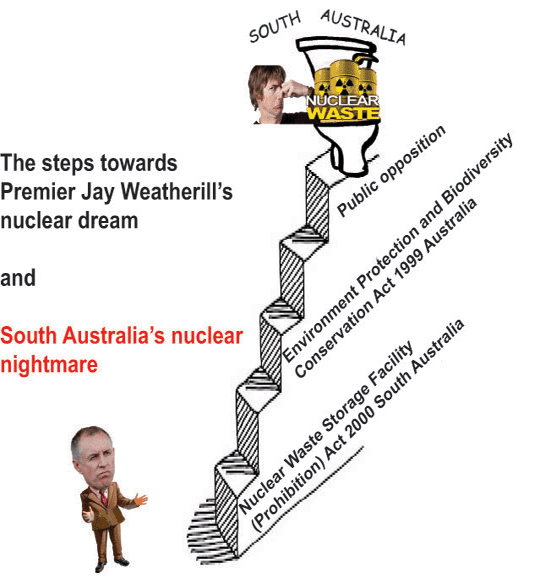
Meanwhile – this Citizens Jury will probably go on under the media radar, as the South Australian Labor Party National Conference is happening at the same time – where the ALP will be debating changing their nuclear policy, and overturning or weakening the Nuclear Waste Storage Facility Prohibition Act 2000
October 24, 2016
Posted by Christina Macpherson |
Nuclear Citizens Jury, politics, South Australia, wastes |
Leave a comment
One wonders if the interests of a ‘handful of natives’ might on some future occasion again be deemed subordinate to those of the dominant culture.
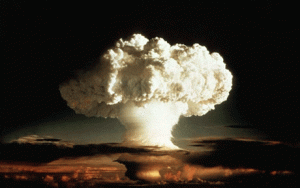
Each of these explosions generated considerable radioactivity, by means of the initial nuclear reaction and the through dispersion of radioactive particulate colloquially known as ‘fallout’. In addition to British scientific and military personnel, thousands of Australians were exposed to radiation produced by the tests. These included not only those involved in supporting the British testing program, but also Aboriginal people living downwind of the test sites, and other Australians more distant who came into contact with airborne radioactivity.
While less spectacular than the major detonations, the minor trials were more numerous. They also contributed to the lasting contamination of the Maralinga area. As a result of the nearly 600 minor trials, some 830 tons of debris contaminated by about 20 kg of plutonium were deposited in pits which graced the South Australian landscape. An additional 2 kg of plutonium was dispersed over the area. Such an outcome was unfortunate indeed, as plutonium is one of the most toxic substances known; it dissipates more slowly than most radioactive elements. The half-life of plutonium is 24,000 years. At this rate of decay, the Maralinga lands would be contaminated for the next half-million years.
Perhaps most significant was the secrecy surrounding the testing program. The decision to make the Monte Bello Islands available to the British for their first nuclear test appears to have been made by the Prime Minister alone, without reference to Cabinet, much less Parliament or the Australian public.
 Chapter 16: A toxic legacy : British nuclear weapons testing in Australia Published in: Wayward governance : illegality and its control in the public sector / P N Grabosky Canberra : Australian Institute of Criminology, 1989 ISBN 0 642 14605 5(Australian studies in law, crime and justice series); pp. 235-253 “……..In 1950, Labor Prime Minister Clement Atlee sent a top secret personal message to Australian Prime Minister Menzies asking if the Australian government might agree to the testing of a British nuclear weapon at the Monte Bello Islands off Western Australia. Menzies agreed in principle, immediately; there is no record of his having consulted any of his Cabinet colleagues on the matter. A preliminary assessment of the suitability of the proposed test site was conducted in October-November 1950.
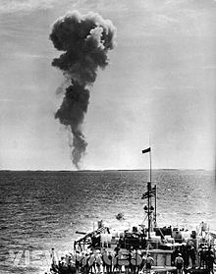 The Monte Bello site was deemed suitable by British authorities, and in a message to Menzies dated 26 March 1951 Atlee sought formal agreement to conduct the test. Atlee’s letter did not discuss the nature of the proposed test in minute detail. He did, however, see fit to mention the risk of radiation hazards:
6. There is one further aspect which I should mention. The effect of exploding an atomic weapon in the Monte Bello Islands will be to contaminate with radio activity the north-east group and this contamination may spread to others of the islands. The area is not likely to be entirely free from contamination for about three years and we would hope for continuing Australian help in investigating the decay of contamination. During this time the area will be unsafe for human occupation or even for visits by e.g. pearl fishermen who, we understand, at present go there from time to time and suitable measures will need to be taken to keep them away. We should not like the Australian Government to take a decision on the matter without having this aspect of it in their minds (quoted in Australia 1985, p. 13).
Menzies was only too pleased to assist the ‘motherland’, but deferred a response until after the 195 1 federal elections. With the return of his government, preparations for the test, code-named ‘Hurricane’, proceeded. Yet it was not until 19 February 1952 that the Australian public was informed that atomic weapons were to be tested on Australian soil.
Continue reading →
October 24, 2016
Posted by Christina Macpherson |
aboriginal issues, AUSTRALIA - NATIONAL, history, reference, South Australia, weapons and war |
Leave a comment
 Chapter 16: A toxic legacy : British nuclear weapons testing in Australia Published in: Wayward governance : illegality and its control in the public sector / P N Grabosky Canberra : Australian Institute of Criminology, 1989 ISBN 0 642 14605 5(Australian studies in law, crime and justice series); pp. 235-253 “…….The security measures taken to restrict access to the testing site were not without flaws. One morning in May 1957, four Aboriginal people, the Milpuddie family, were found by range authorities near the crater formed by the ‘Buffalo 2’ explosion the previous October. ‘Me man, woman, two children and two dogs had set out on foot from the Everard Ranges in the northwest of South Australia, and were unaware that the Aboriginal inhabitants of the Maralinga area had been removed. When authorities discovered them, the family was immediately taken to a decontamination centre at the site, and were required to shower. After this experience, which must have been frightening enough, the family was driven to Yalata.
As one of the site personnel described the experience:
It was a shocking trip down as they had never ridden in a vehicle before and vomited everywhere (Australia 1985, p. 320).
On instructions from the Secretary of the Commonwealth Department of Supply, the dogs were shot. ‘ne woman was pregnant at the time the family was taken into custody; subsequently, her baby was born dead. Australian authorities went to great lengths to keep the incident secret, but they appear to have been less concerned with the family’s subsequent health. Commenting upon the fact that no-one appears to have taken the time to explain the experience to which the hapless Aborigines were subjected, a team of anthropologists was to comment:
[T]he three remaining members of the family have been subjected to a high degree of stress and unhappiness about the events of twenty-eight years ago (Australia 1985, p. 323)…….http://aic.gov.au/publications/previous%20series/lcj/1-20/wayward/ch16.html
October 24, 2016
Posted by Christina Macpherson |
aboriginal issues, history, personal stories, South Australia, weapons and war |
Leave a comment
 Adelaide City Council ‘leads the way’ with rollout of 40 electric car charging stations in 2017, ABC News, 23 Oct 16 By Candice Prosser Electric cars are the way of the future and Adelaide will lead the nation in developing infrastructure to encourage more of them, Adelaide’s Lord Mayor says.
The Adelaide City Council has announced it will roll out 40 electric charging stations throughout the city in 2017 in addition to the four charging points it currently has in two CBD car parks.
Speaking at the Electric Vehicle Expo at Elder Park, Lord Mayor Martin Haese said the infrastructure would be free to all users. “At this point in time the council needs to show leadership — we are very much in a changing environment whereby we’re forecasting the growth and sales of electric vehicles over the next few years is just going to grow exponentially,” he said. “Adelaide has a goal to become the world’s first carbon neutral city by 2025 and electric vehicles are an important part of that story.
“We want to be a smart city, we want to send a very clear signal to everyone that technology and the knowledge economy is important to our future. “We believe electric vehicles do both.”
The Lord Mayor said he expected electric vehicles to become increasingly more popular.
“Electric vehicles are very important, they are going to become incredibly commonplace much sooner than what we think,” he said.
“We’ve currently got about 700 electric vehicles registered in South Australia, we’ve got some 22,000 hybrid vehicles registered in South Australia and those numbers are going to grow exponentially.”
The council is also offering residents and businesses $5,000 to install their own charging points and will consider installing faster super chargers around the city in the future……..http://www.abc.net.au/news/2016-10-23/adelaide-city-council-rollout-40-electric-car-charging-stations/7958074
October 23, 2016
Posted by Christina Macpherson |
energy, South Australia |
Leave a comment
Chapter 16: A toxic legacy : British nuclear weapons testing in Australia Published in: Wayward governance : illegality and its control in the public sector / P N Grabosky Canberra : Australian Institute of Criminology, 1989 ISBN 0 642 14605 5(Australian studies in law, crime and justice series); pp. 235-253
“……….Another factor which underlay Australian deference during the course of the testing program was the role of Sir Ernest Titterton. A British physicist, Titterton had worked in the United States on the Manhattan Project, which developed the first nuclear weapon.
After the war, he held a position at the British Atomic Energy Research Establishment, and in 1950 he was appointed to the Chair of Nuclear Physics at the Australian National University. Among Titterton’s earliest tasks in Australia was that of an adviser to the British scientific team at the first Monte Bello tests. In 1956, the Australian government established an Atomic Weapons Tests Safety Committee (AWTSC) responsible for monitoring the British testing program to ensure that the safety of the Australian environment and population were not jeopardised. To this end, it was to review British test proposals, provide expert advice to the Australian government, and to monitor the outcome of tests. Titterton was a foundation member of the Committee and later, its Chairman.
While Menzies had envisaged that the Committee would act as an independent, objective body, evidence suggests that it was more sensitive to the needs of the British testing program than to its Australian constituents.
Members tended to be drawn from the nuclear weapons fraternity, as was Titterton; from the Defence establishment, from the Commonwealth Department of Supply, from the Commonwealth X-Ray and Radium Laboratory, and from the Australian Atomic Energy Commission. Although the expertise of these individuals is beyond dispute, one wonders if they may have been too closely identified with the ‘atomic establishment’ to provide independent critical advice. The nuclear weapons fraternity have often been criticised as a rather cavalier lot; no less a person than General Leslie Groves, who headed the Manhattan Project which developed the first atomic bomb, has been quoted as having said ‘Radiation death is a very pleasant way to die’ (Ball 1986, p. 8). In retrospect, the Australian safety committee suffered from the absence of biologists and environmental scientists in its ranks……..
In 1960, the British advised the AWTSC that ‘long lived fissile elements’ and ‘a toxic material’ would be used in the ‘Vixen B’ tests. Titterton requested that the materials be named, and later announced ‘They have answered everything we asked.’ The substances in question were not disclosed (Australia 1985, p. 414). In recommending that the Australian government agree to the tests, he appears to have been either insufficiently informed of the hazards at hand, or to have failed to communicate those hazards to the Safety Committee, and through it, to the Australian government. Earlier, before the Totem tests, he had reassured the Australian Prime Minister that
the time of firing will be chosen so that any risk to health due to radioactive contamination in our cities, or in fact to any human beings, is impossible. . . . [N]o habitations or living beings will suffer injury to health from the effects of the atomic explosions proposed for the trials (quoted in Australia 1985, p. 467).
There were other examples of Titterton’s role in filtering information to the Australian authorities, a role which has been described as ‘pivotal’ (Australia 1985, p. 513). He proposed that he be advised informally of certain details of proposed experiments. In one instance, he advised the British that ‘It would perhaps be wise to make it quite clear that the fission yield in all cases is zero’, knowing that this would be a misrepresentation of fact (Australia 1985, p. 519). Years later, the Royal Commission suggested that Titterton may have been more a de facto member of the British Atomic Weapons Research Establishment than a custodian of the Australian public interest.
The Royal Commission’s indictment of Titterton would be damning:
Titterton played a political as well as a safety role in the testing program, especially in the minor trials. He was prepared to conceal information from the Australian Government and his fellow Committee members if he believed to do so would suit the interests of the United Kingdom Government and the testing program (Australia 1985, p. 526)……… http://aic.gov.au/publications/previous%20series/lcj/1-20/wayward/ch16.html
October 23, 2016
Posted by Christina Macpherson |
AUSTRALIA - NATIONAL, history, secrets and lies, weapons and war |
Leave a comment
Pro nuclear waste import witnesses in RED. Probably Leaning to pro – orange Neutral (or I don’t know) in Yellow Leaning to nuclear free – light green Nuclear free -GREEN
It is not clear exactly which individuals are to be the facilitators.
| Safety (1)
(includes overview and focus on impact on human health)
Location: |
Dr Paul Degman
Dr Sami Hautakangas (alternate for Timo Äikäs) |
| Dr Margaret Beavis |
| Dr Robert Hall (alternate for Professor Tilman Ruff) |
| Dr Stephan Bayer (alternate for John Carlson) |
| Dr Tony Hooker (added by democracyCo from Fact Check queries) |
|
| Dr Jim Green |
| Safety (2)
(includes general safety, siting and transport)
Location: |
Dean Summers (alternate for Paddy Crumlin)
Dr John Loy (alternate for Carl-Magnus Larsson) |
| Frank Boulton |
| Dr Andrew Herczeg |
| Ian Hore-Lacy |
| Professor David Giles |
| Dr Dirk Mallants (alternate for Dr Ian Chessell) |
| Professor Sandy Steacy |
| Trust
(includes role of Government, legislation, regulation, trust in Government)
Location |
Steve McIntosh |
| Hon. Mark Parnell, MLC |
| Dr Benito Cao |
| Keith Baldry (added by democracyCo from Fact Check queries) |
| Professor Haydon Manning |
| Judy Hughes Attorney General/Crown Solicitors Office |
| Economics
Location |
Richard Dennis |
| Adjunct Professor Richard Blandy |
| Professor Barbara Pocock |
| Assoc. Professor Mark Diesendorf (via Skype) |
| Tim Johnson (added by democracyCo from Fact Check queries) |
| Consent
Location |
Dan Spencer |
| Professor Bob Watts (via Skype) |
| Gerald Ouzounian |
| Ross Womersley |
| Dr Simon Longstaff |
| Cathy O’Loughlin (alternate Gill McFadyen)
Dave Sweeney |
October 22, 2016
Posted by Christina Macpherson |
Nuclear Citizens Jury, South Australia |
Leave a comment
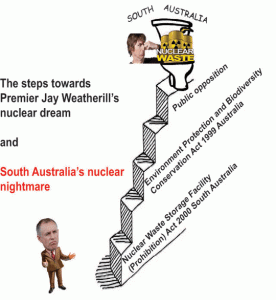 David Noonan, 22 Oct 16 In mid-late November Premier Weatherill intends to announce his SA gov decision and go to the SA Parliament to amend the Nuclear Waste Storage Facility Prohibition Act 2000 – at a minimum: to repeal the prohibition on spending public monies on nuclear waste plans (as per the likely ‘amber light’ Citizen Jury outcome over the first weekend in Nov).
This has to follow on from release of the SA Parliamentary Inquiry Report, likely in the week of Parliamentary sittings 15th to 17th Nov. The SA Liberals have privately said they will not give their position while the Citizen’s Jury is on, and will not do so until after this Inquiry reports.
The Premier will likely go to Parliament in the final scheduled sitting week of 29th Nov to 1st Dec (with an ‘optional sitting week’ in early Dec – which is very rarely ever used). The Premier requires the SA Liberals to agree to his proposed changes.
Appears unlikely the SA Liberals will agree to repeal the key prohibitions on import, transport, storage and disposal of International nuclear waste (at this time) BUT likely agree to repeal the prohibition on spending public funds – in a ‘further information’ style approach.
The Premier will then formally ask the Federal government to jointly work up the Inter dump plan along-side the SA gov through-out 2017 and in the lead up to the March 2018 State election. The Premier would then have to return to Parliament to repeal the key prohibitions on import, transport, storage and disposal of nuclear waste – potentially late in 2017 OR after the State Election.
Note: Shadow Treasurer Rob Lucas MLC (the lead Liberal on the Parliamentary Inquiry) has made media statements (as an individual) that the extent of public funds required to be spent before SA knows if this plan could go ahead – “is a potential deal breaker”;
And has also cast doubt on the potential economic benefits: warning it was not possible to verify “some of the financial estimates in terms of what the state might earn from this facility”.
see:“SA nuclear dump dreams just fool’s gold: senior Lib” The Australian 29 Sept 2016:http://www.theaustralian.com.au/national-affairs/state-politics/sa-nuclear-dump-dreams-just-fools-gold-senior-lib/news-story/a595649777c14703159a462c5d9cb34f
see: “SA would have to spend up to $600 million to plan a nuclear waste repository” The Advertiser 11 September 2016:http://www.adelaidenow.com.au/subscribe/news/1/index.html?sourceCode=AAWEB_WRE170_a&mode=premium&dest=http://www.adelaidenow.com.au/news/south-australia/sa-would-have-to-spend-up-to-600-million-to-plan-a-nuclear-waste-repository/news-story/9287ad32b2717574afdeb29e0cf90f5c&memtype=registered
October 22, 2016
Posted by Christina Macpherson |
politics, South Australia, wastes |
Leave a comment
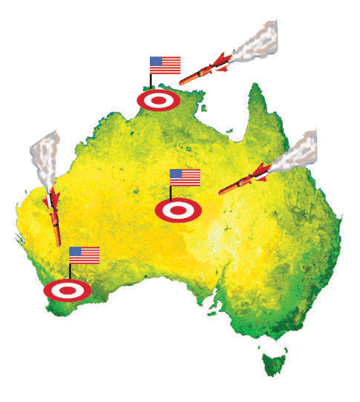
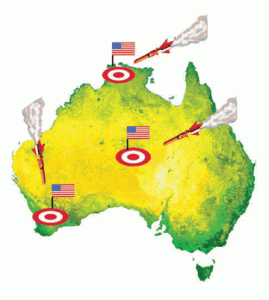 when China looks at Australia, it will see Australia as an American base
“I think fundamentally we have to ask is that really the way we want to go. The signal we’re sending to Americans is that if they go to war with China, sure, we’ll be part of that.”
“It is embedding us in global military operations for which there is little strategic benefit for Australia.”
We are told mass surveillance makes us safer and in our fear we accept growing militarisation….. these facilities most likely don’t protect us, but put us at greater risk….These are the questions we don’t discuss.
October 22, 2016
Posted by Christina Macpherson |
AUSTRALIA - NATIONAL, reference, weapons and war |
Leave a comment
Australia digs itself deeper into nuclear disarmament policy hole, The Interpreter
20 October 2016
Later this month, the First Committee of the United Nations General Assembly will vote on a draft resolution that will ‘convene a UN conference in 2017, to negotiate a legally-binding instrument to prohibit nuclear weapons, leading towards their total elimination’. The resolution is expected to be adopted with a substantial majority. But the Australian government, in an unprecedented departure from a decades-long bipartisan commitment to nuclear disarmament, plans to vote no.
As reported in The Interpreter in August, Australian diplomats have been fighting an increasingly desperate rearguard action against the move by more than 100 other countries to negotiate a new treaty that prohibits nuclear weapons, with or without the participation of nuclear-armed states. Such a treaty would put Australia in an awkward spot. As a non-nuclear-weapon state party to the Nuclear Non-proliferation Treaty (NPT), there is no prima facie legal reason Australia could not support and join such an instrument. Indeed, it is not obvious why any state that is legally obliged by Article VI of the NPT to ‘pursue negotiations in good faith’ on effective measures relating to nuclear disarmament could not vote to ‘convene a United Nations conference in 2017, to negotiate a legally-binding instrument to prohibit nuclear weapons’. But Australia’s reliance on extended nuclear deterrence evidently poses a problem.
Australia has been curiously reluctant to engage honestly with other governments about its true objection to the ban treaty. Instead of frankly expressing their concerns about the implications that an absolute prohibition of nuclear weapons might have for Australia’s defence doctrine, Australian officials have continued to trot out one flimsy and transparent pretext after another. Ambassador John Quinn told the First Committee that a ban treaty ‘would not rid us of one nuclear weapon. It would not change the realities we all face in a nuclear-armed DPRK’. This is a ludicrous criticism from a country that supports the ‘step-by-step’ or ‘building blocks’ approach to nuclear disarmament. A fissile material cut-off treaty would also ‘not rid us of one nuclear weapon’, but Australia (rightly) supports it as one of a range of measures needed to move closer to a world without nuclear weapons…….
Australia has also joined the US and other opponents of the ban treaty in incorrectly and disingenuously portraying it as ‘abandoning’ their preferred ‘step-by-step’ approach. Proponents of the ban treaty have been careful to emphasise that it is not a replacement for existing measures (such as pursuing a fissile material treaty, entry into force of the Comprehensive Nuclear Test-ban Treaty, further bilateral stockpile reductions, etc), but, rather, is intended to support and reinvigorate them. There is no choice to be made: any country that supports, negotiates and joins the ban treaty can and will continue to work cooperatively with all states to strengthen the NPT and pursue the ‘practical, realistic’ measures that Australia advocates……
Contrast this with other countries that share some of Australia’s concerns. Sweden’s decision to vote yes came after months of careful deliberation by a commission specially established by the government to examine the implications of the ban treaty for Sweden. Japan’s government commissioned an extensive study by the Japan Institute of International Affairs. The Clingendael foreign policy institute produced a study back in May 2015 on the implications of a ban treaty for the Netherlands, and the Friedrich Ebert Foundation produced a similar study for Germany.
However Australia casts its vote in the First Committee, negotiations on the ban treaty will commence at the UN next year. Australia is manifestly unprepared for this. It would be totally unprecedented (and unconscionable) for Australia to fail to participate in a UN-mandated negotiation of a multilateral disarmament treaty. But if Australia does choose to participate, its record of disingenuous and at times dishonest opposition to the ban, coupled with a dire lack of substantive policy analysis, will leave it poorly placed to steer the negotiations in its national interest. http://www.lowyinterpreter.org/post/2016/10/20/Australia-digs-itself-deeper-into-nuclear-disarmament-policy-hole.aspx
October 22, 2016
Posted by Christina Macpherson |
AUSTRALIA - NATIONAL, politics international, weapons and war |
Leave a comment
 Trisha Dee Nuclear Fuel Cycle Watch South Australia, 22 Oct 16 Leading international nuclear industry executives have descended on Adelaide. James Voss has global links in the nuclear industry at the highest level. Through UCL he is lecturing South Australians on the glories of nuclear. Voss is the ex-MD of Pangea Resources – a failed joint venture attempt to bring High Level nuclear waste to Australia in the late 1990s. We need community driven, not industry driven initatives.
James ‘Jim’ Wilson Voss is an American senior nuclear engineer who has managed nuclear materials and radioactive waste since graduating from Arizona University in the 1970s. Voss became known to Australians through his managing directorship of Pangea Resources, a consortium which planned to establis…
October 22, 2016
Posted by Christina Macpherson |
NUCLEAR ROYAL COMMISSION 2016, South Australia, wastes |
Leave a comment
Environment regulator questioned over its measuring of how it protects public health, ABC News By Rebecca Turner, 20 Oct 16, The environmental regulator has been questioned why it is using the speed at which it issues environmental approvals to measure its effectiveness at protecting public health and the environment.
Between the lines of the department’s 2015-16 annual report lies a simmering disagreement between the public sector watchdog, auditor-general Colin Murphy, and the director-general of the Department of Environmental Regulation, Jason Banks.
Mr Murphy has taken the Department of Environment Regulation (DER) to task for choosing to monitor how effectively it fulfils one of its key roles — ensuring pollution and land clearing do not put the health of Western Australians or their environment at risk — by measuring how quickly it finalises environmental approvals, permits and investigations……..
While the disagreement is being played out in the most bureaucratic of language in a document which is likely to gather dust on departmental shelves, it is an interesting insight into how policy debates are conducted among public servants.
For example, Mr Murphy chose to issue a qualified opinion on the department’s annual report, a serious matter in the world of auditing.
He was critical of how the department used four Key Performance Indicators (KPIs) which focused on the timeliness of regulatory activities — including the percentage of major resource projects work approvals decided within 60 days — to measure how it was avoiding risks to public health and the environment.
He called the KPIs to assess its effectiveness as a regulator “not relevant”…….
While the nature of this new KPI is unknown, this year’s annual report marked the first time the department has not published KPIs which show how many times environmental pollution exceeded safe guidelines.
It has prompted Greens MP Lynn Maclaren to call on the WA Government to reinstate vigorous environmental health and air quality measuring in the annual report.
Ms Maclaren said she agreed with the auditor-general, who had raised a serious issue with a department which she claimed was shifting its focus away from ensuring a healthy environment and towards speedy development approvals.
“Who else is going to challenge the director-general in this way?” she said.”It shows that he is taking his job very seriously.” http://www.abc.net.au/news/2016-10-20/auditor-general-in-public-spat-with-agency-der-environment/7947734
October 22, 2016
Posted by Christina Macpherson |
AUSTRALIA - NATIONAL, health |
Leave a comment
‘No-brainer’: Calls for CSIRO to make its CSG gas research more independent , The Age, Peter Hannam, 19 Oct 16 The CSIRO needs to ensure its research into coal seam gas remains independent of industry if it’s to win over opponents worried about environmental and social impacts, The Australia Institute (TAI) argues in a new paper.
The report highlighted how the original research advisory committee of the CSIRO-led body – known as the Gas Industry Social & Environmental Research Alliance (GISERA) – had been dominated by industry representatives and the CSIRO.
While this committee have since been split into NSW and Queenslandones, industry continues to have a significant presence that raised doubts about how arm’s length the research work could be, said Matt Grudnoff, a researcher with the TAI.
“It’s not just the industry is sponsoring this research,” Mr Grudnoff said. “Industry also sits at the table that decides the questions, and decides what projects get funded.” “It’s a no-brainer that they should get gas executives off these research committees” if the industry wanted to be accepted by communities worried about interference and possible contamination of aquifers from CSG wells, he said.
The industry also wants to convince the public that gas is cleaner than coal as part of efforts to gain “social licence”, Mr Grudnoff said. CSIRO executives will face a fresh grilling at Senate estimates on Thursday.
Emails released earlier this year revealed the nation’s premier research agency was looking to shift its emphasis away from “science for science sake”.
“Public good is not enough, needs to be linked to jobs and growth, but science that leads to SLO [social licence to operate] is OK,” Andreas Schiller, an executive in the Oceans and Atmosphere division, said in one email.
According to CSIRO, GISERA funding totalled $13.05 million for the 2014-15 to 2016-17 years. Industry chipped in about half, or $6.65 million, with governments and CSIRO providing the rest…….http://www.theage.com.au/environment/nobrainer-calls-for-csiro-to-make-its-csg-gas-research-more-independent-20161019-gs5vvg.html
October 22, 2016
Posted by Christina Macpherson |
AUSTRALIA - NATIONAL, climate change - global warming, secrets and lies |
Leave a comment
 Australia will not support negotiations to outlaw nuclear weapons Senate estimates to question foreign affairs department officials on Thursday on nuclear disarmament stance, Guardian, Ben Doherty 20 Oct 16, Australia will not support a resolution to begin negotiations to outlaw nuclear weapons, as it grows increasingly isolated from a global disarmament push.
A resolution is before the United Nations general assembly to “convene a United Nations conference in 2017, to negotiate a legally binding instrument to prohibit nuclear weapons”.
The resolution has 39 co-sponsoring nations and will be voted on by the general assembly later this month, or next. The conference is slated for March next year.
Officials from the Department of Foreign Affairs and Trade will appear before Senate estimates on Thursday to face questioning on Australia’s nuclear disarmament position.
Support for a ban treaty has been growing steadily over months of negotiations, but it has no support from the nine known nuclear states – the US, China, France, Britain, Russia, India, Pakistan, Israel, and North Korea – which includes the veto-wielding permanent five members of the security council.
Australia has spent months in negotiations over the proposed negotiations, seeking to stymie the push for a ban on nuclear weapons, and has sought to press the case for what it describes as a “building blocks” approach of engaging with nuclear powers to reduce the global stockpile of 15,000 weapons.
Australia has consistently maintained that while nuclear weapons exist, it must rely on the protection of the deterrent effect of the US’s nuclear arsenal, the second largest in the world.
In August, with nations at a UN disarmament meeting set to unanimously pass a report recommending negotiations on a ban start in 2017, Australia forced a vote on the issue, which it lost 68 to 22.
The move upset opponents and allies alike, resulting in the adoption of a report with stronger language in favour of a ban. Australia was marked as the most strident opponent of a ban treaty.
But diplomatic cables obtained under freedom of information laws now show that Australia, despite its resolute opposition, is increasingly pessimistic about stopping ban treaty negotiations progressing.
“We are concerned that the [open-ended working] group [on nuclear disarmament] is tracking towards recommendations supporting a nuclear weapons ‘ban treaty’ which we do not support,” a cable sent to Canberra from Geneva in June this year said.
A so-called “humanitarian pledge” to eliminate nuclear weapons has been signed by 127 states around the world. Australia is particularly isolated in the Asia-Pacific region – ASEAN nations, New Zealand, and almost all Pacific Island states, support a ban treaty……….
Associate professor Tilman Ruff, co-president of International Physicians for the Prevention of Nuclear War, said that with a ban treaty likely to be concluded next year, the world stood at an historic turning point.
A ban would, he argued, “fill the existing legal gap which currently makes the most heinously destructive of all weapons the last weapon of mass destruction not explicitly outlawed by international treaty”.
“For other indiscriminate and inhumane weapons … the world has first established a clear moral and legal norm of prohibition. For biological and chemical weapons, antipersonnel land-mines and cluster munitions, establishing an unequivocal norm of prohibition has … been the basis for subsequent progress towards their elimination.
“Prohibit, then eliminate. That is the proven, logical path. For nuclear weapons it is also the only feasible, practical option at this time.”
The Australian government’s position, he said, was becoming increasingly untenable globally, and falling further out of step with Australian public opinion.
Politically, support for Australian reliance on America’s extended nuclear deterrence, is no longer bipartisan. At its national conference in 2015, Labor formally adopted a policy of “firm support” for an outright ban on nuclear weapons.
Lisa Singh spoke at a UN side event in New York last week – in her capacity as a Labor Senator, not as a representative of the Australian government – arguing the “doctrine of nuclear deterrence … is based on a willingness to inflict violence indiscriminately and on a massive scale”……… https://www.theguardian.com/world/2016/oct/20/australia-will-not-support-negotiations-to-outlaw-nuclear-weapons
October 20, 2016
Posted by Christina Macpherson |
AUSTRALIA - NATIONAL, politics international, weapons and war |
Leave a comment
Dennis Matthews, 21 Oct 16 I have just read the Australian Energy Market Operator (AEMO) Update Report on the state-wide blackout.
The collapse of more than twenty transmission line towers initiated a sequence of domino-like events that ended with the loss of grid-power to the entire state. When I came to the end of the report I was mystified by the lack of attention to the first domino to fall – the transmission-line towers. The final chapter of the report, Next Steps, makes no mention of the towers, including the fact that they have been replaced by temporary structures.
I went back to the beginning of the report and was amazed to find the transmission line faults (caused by the tower collapses) classed as “pre event”.
What on earth is AEMO doing? Do we have to wait six months to find out whether the transmission-line towers are strong enough? Will there be another disruption to the electricity transmission system in the meantime? Your guess is as good as mine.
October 20, 2016
Posted by Christina Macpherson |
energy, South Australia |
Leave a comment