 Officials admit no modelling shows how Australia will meet Paris climate pledge, Guardian, Michael Slezak, 29Sept 16 Environment officials tell parliamentary inquiry there is no modelling on how current policies will affect emissions beyond 2020, or when emissions will peak
 Government officials have acknowledged that Australia’s 2030 greenhouse gas emissions reductions pledged at Paris in 2015 were made without any modelling to show whether existing policies could achieve those targets.They also admitted the government did not have any modelling revealing when Australia’s emissions would peak.
The admissions, made in a parliamentary committee under questioning from Labor Senator for New South Wales Jenny McAllister, fly in the face of advice from the Department of Foreign Affairs and Trade, telling the government it had “existing legislation, policies and measures to enable it to achieve” the the reductions.
They also follow a string of independent modelling exercises showing current policies will not achieve the emissions reductions committed to in Paris. Last week energy advisory firm RepuTex released modelling showing Australia’s emissions wouldn’t fall much at all between now and 2030, under current policies……….
McAllister told Guardian Australia the Turnbull government needed to “own up and admit that their climate policies just aren’t credible”.
“These officials have confirmed Australia’s worst kept secret – that the Turnbull government has no idea how it will meet our 2030 emission reduction targets,” she said.
“They can’t say when Australia’s emissions will peak and begin to decline, and they wouldn’t confirm that the government’s current policy settings will see us meet the target without adjustment.” https://www.theguardian.com/environment/2016/sep/29/officials-admit-no-modelling-shows-how-australia-will-meet-paris-climate-pledge
September 30, 2016
Posted by Christina Macpherson |
AUSTRALIA - NATIONAL, climate change - global warming |
Leave a comment
 Climate change stealing rain from Australia by shifting winds towards Antarctica, Canberra Times, Clare Sibthorpe, 29 Sept 16 When much of southeast Australia faced abnormally hot and dry weather last summer, forecasters put it down to a high-pressure system blocking clouds from forming.
But rising greenhouse gases were also to blame, researchers have found.
A new study by the ANU and 16 other institutions revealed human-caused climate change is already harming parts of Australia by robbing vital rain and pushing south westerly winds towards Antarctica.
The ANU’s lead researcher associate professor Nerilie Abram said the hijacking of rain combined with 2015 being Australia’s fifth-warmest year on record and 2016 on track to be the hottest was an ominous mix.
“The findings confirm that climate change is already having an impact on parts of Australia.”……..
Professor Abram said the study, published in Nature Climate Change, showed southwest Australia was hurting the most from the change, where it had lost one fifth of its rainfall since the 1970s.
A 2015 study between CSIRO and Bureau of Meteorology found climate change would hit Australia harder than other countries, predicting a rise in temperature of more than five degrees within 80 years.
They forecast reduced rain in southern Australia over the next few decades as well as harsher fire seasons for southern and eastern parts of the country.
This August, Germany-based researchers Climate Analytics found the difference between 1.5 and 2 degrees of warming – the two goals included in the Paris climate deal – would be much greater in terms of extreme events and disasters than previously believed.
It found that within just 10 – 20 years, southern Australia would face heatwaves on average 13 days longer at 1.5 degrees and 20 days longer at 2 degrees, while dry spells would be 3.5 days longer at 1.5 degrees and six days at 2 degrees. http://www.canberratimes.com.au/act-news/climate-change-stealing-rain-from-australia-by-shifting-winds-towards-antarctica-20160927-grpyq3.html
September 30, 2016
Posted by Christina Macpherson |
AUSTRALIA - NATIONAL, climate change - global warming |
Leave a comment
 Digging Deeper: How energy company executives are remunerated to expand fossil fuel reserves, and how Australia’s major super funds support them, http://apo.org.au/resource/digging-deeper-how-energy-company-executives-are-remunerated-expand-fossil-fuel-reserves Market Forces 29 September 2016 Australian-listed fossil fuel companies are continuing to search for more unburnable carbon, with $12.69 billion spent on fossil fuel exploration by just fifteen companies since July 2012. Another $14.62 billion has been spent by just ten foreign companies on fossil fuel exploration in Australia between 2013-2015.
In many cases, exploration is encouraged through executive remuneration packages. Seven companies in the S&P ASX300 explicitly refer to reserve replacement or exploration targets in their executives’ bonus structures, as do six international companies with major Australian fossil fuel operations.
Senior executives at the seven Australian companies stand to make a combined $2.02 million in additional bonuses each year if their reserve targets are met.
Australia’s super funds are failing to effectively challenge this business model, despite their stated belief in engagement as a strategy for changing the behaviour of companies. In the last year, only three Australian energy companies incurred a significant vote against their remuneration packages, none of which were an explicit protest against reserves-based incentives.
Only eighteen of Australia’s 50 largest super funds disclose their complete proxy voting record, making it difficult to determine which funds are genuine ‘active owners.’ Our analysis of twelve funds’ voting records shows only three voted against any Australian-listed energy company’s remuneration package in the last year. Major funds including AustralianSuper, First State Super, MLC and ANZ OnePath supported the remuneration packages of every Australian energy company they held shares in.
Australia’s super funds must have effective engagement policies and practices, and demonstrate how these are being implemented to ensure companies they invest in are compatible with a low carbon future. An obvious step to demonstrate alignment with the goals agreed to in Paris is for funds to reject fossil fuel exploration incentives.
September 30, 2016
Posted by Christina Macpherson |
AUSTRALIA - NATIONAL, business, climate change - global warming |
Leave a comment
 Is this a new low: politicians using a natural disaster to push a fact-free agenda?, Guardian, Matt Grudnoff, 29 Sept 16
Unburdened by evidence, anti-wind campaigners used the South Australian blackout to kick off a debate about renewables while others waited for facts Normally natural disasters are off limits to politicking, at least in the period straight after the event. So it was pretty awful watching politicians and commentators pushing their anti-renewables message on the back of aonce in 50 year storm that hit South Australia and knocked out the electricity grid.
These baseless claims led bulletins despite energy industry experts, upon actual analysis of the situation, reporting that there was no evidence that renewables are in any way linked to the power outage.
The outage is more likely to have something to do with the 80,000 lightning strikes and the winds that knocked over 22 transmission poles. Who knew violent storms could knock the power out?
It’s hard to imagine how coal fired power would have remained on without a grid for the electricity to flow through.
Just before the grid shut down, renewables were not offline. Wind energy was busy producing almost 1,000 Megawatts of electricity. The problem was not a lack of renewable power but a storm-ravaged grid that couldn’t get it to the consumers…….
Resilient renewables
The real irony is that an electricity system that has decentralised renewable energy with battery storage would be more resilient to these kinds of storms. Houses and businesses with their own batteries could have kept the lights on even when the grid went down.
In the past, renewables were more expensive – but those days are over.Renewable energy has fallen in price and battery storage is close behind. Change in how we produce electricity is coming and an anti-renewables campaign will only slow it and make the transition more difficult.
Rather than attack renewables, the government should be putting in place policies that help with the transition. The economics of renewable energy and the reality of climate change mean that it is inevitable that we will leave fossil fuel electricity generation behind. The question is how can we move to the new energy future in the smoothest way possible?
Renewable energy targets, system changes that make it easier to install battery storage, and a moratorium on new coal mines will all help.
Attacking renewables in the wake of a massive storm might help some people’s political agenda but it will do nothing to help South Australians build a reliable and resilient energy system.
Matt Grudnoff is the Senior Economist for The Australia Institute. https://www.theguardian.com/commentisfree/2016/sep/29/is-this-a-new-low-politicians-using-a-natural-disaster-to-push-a-fact-free-agenda?CMP=soc_568
September 30, 2016
Posted by Christina Macpherson |
AUSTRALIA - NATIONAL, energy, politics, South Australia, wind |
1 Comment
Black Mist Burnt Country asks: what remains after the mushroom cloud? The Conversation, Joanna Mendelssohn Joanna Mendelssohn is a Friend of The Conversation. September 28, 2016 Two drawings by Judy Watson make sense of it all. Bomb Drawing 1 and Bomb Drawing 5 are small shadows of light ash on the pages of a sketchbook. They seem so fragile, so small, so empty. Yet their very stillness in what is an often crowded and confused display gives them a sense of authority.
Black Mist Burnt Country is a national touring exhibition devised to commemorate one of the great crimes against this country – the wilful poisoning of the land and its people by the British Government with the active collusion of the Australian Government. The full extent of the British experiments with atomic weapons on Australian soil took decades to be fully exposed.
The nuclear tests took place over a number of years – starting at Monte Bello in 1952, rolling on to Emu Field and then Maralinga 60 years ago – yet it was not until the 1980s that a Royal Commission headed by James McClelland finally revealed the full extent of the poisoning of both land and people……..
Jessie Boylan’s photographs show both sides to the consequences of this crime. In one, Avon Hudson, the former RAAF officer who publicly exposed the extent of British culpability and Australian complicity, sits in his study, surrounded by cardboard boxes. In the other Yami Lester, who as a child was blinded by the mist, stands staring into the sun with his sightless eyes. Lester also appears in Belinda Mason’s Maralinga, an alarming 3D lenticular holographic photograph, that focuses on Lester’s open unseeing eye.
Trevor Nickolls’ painting Revenge of the Stormboy shows the little children caught in the wild chaos of nuclear devastation, and the sense of anger the wider Aboriginal community feels about what happened to the Anangu people, whose land was so lightly taken away from them.
Some of the most moving paintings are by Jonathan Kumintjarra Brown, who was born at the Ooldea Mission but stolen and raised in Melbourne and Sydney. When he was an adult he found his family at Yalata, where the Anangu people had been moved because of the tests. His painting Maralinga has the truth of the land partly obliterated by the bombs while a lizard’s skeleton represents the loss of life…….https://theconversation.com/black-mist-burnt-country-asks-what-remains-after-the-mushroom-cloud-66135
September 30, 2016
Posted by Christina Macpherson |
AUSTRALIA - NATIONAL, culture |
Leave a comment
The combination of Antarctica’s dynamic climate system, its short observational records, and its potential to cause costly heatwaves, drought and sea-level rise in Australia, mean that we can’t afford to stifle fundamental research in our own backyard.
Record high to record low: what on earth is happening to Antarctica’s sea ice? https://theconversation.com/record-high-to-record-low-what-on-earth-is-happening-to-antarcticas-sea-ice-66114September 29, 2016 2016 continues to be a momentous year for Australia’s climate, on track to be the new hottest year on record.
To our south, Antarctica has also just broken a new climate record, with record low winter sea ice. After a peak of 18.5 million square kilometres in late August, sea ice began retreating about a month ahead of schedule and has been setting daily low records through most of September.
It may not seem unusual in a warming world to hear that Antarctica’s sea ice – the ice that forms each winter as the surface layer of the ocean freezes – is reducing. But this year’s record low comes hot on the heels ofrecord high sea ice just two years ago. Overall, Antarctica’s sea ice has been growing, not shrinking.
So how should we interpret this apparent backflip? In our paper published today in Nature Climate Change we review the latest science on Antarctica’s climate, and why it seems so confusing.
Antarctic surprises
First up, Antarctic climate records are seriously short.
The International Geophysical Year in 1957/58 marked the start of many sustained scientific efforts in Antarctica, including regular weather readings at research bases. These bases are mostly found on the more accessible parts of Antarctica’s coast, and so the network – while incredibly valuable – leaves vast areas of the continent and surrounding oceans without any data.
In the end, it took the arrival of satellite monitoring in the 1979 to deliver surface climate information covering all of Antarctica and the Southern Ocean. What scientists have observed since has been surprising.
Overall, Antarctica’s sea ice zone has expanded. This is most notable in the Ross Sea, and has brought increasing challenges for ship-based access to Antarctica’s coastal research stations. Even with the record low in Antarctic sea ice this year, the overall trend since 1979 is still towards sea ice expansion.
The surface ocean around Antarctica has also mostly been cooling. This cooling masks a much more ominous change deeper down in the ocean, particularly near the West Antarctic Ice Sheet and the Totten glacier in East Antarctica. In these regions, worrying rates of subsurface ocean warming have been detected up against the base of ice sheets. There are real fears that subsurface melting could destabilise ice sheets, accelerating future global sea level rise.
In the atmosphere we see that some parts of the Antarctic Peninsula and West Antarctica are experiencing rapid warming, despite average Antarctic temperatures not changing that much yet.
In a rapidly warming world these Antarctic climate trends are – at face value – counterintuitive. They also go against many of our climate model simulations, which, for example, predict that Antarctica’s sea ice should be in decline.
Winds of change
The problem we face in Antarctica is that the climate varies hugely from year to year, as typified by the enormous swing in Antarctica sea ice over the past two years.
This means 37 years of Antarctic surface measurements are simply not enough to detect the signal of human-caused climate change. Climate models tell us we may need to monitor Antarctica closely until 2100 before we can confidently identify the expected long-term decline of Antarctica’s sea ice.
In short, Antarctica’s climate remains a puzzle, and we are currently trying to see the picture with most of the pieces still missing.
But one piece of the puzzle is clear. Across all lines of evidence a picture of dramatically changing Southern Ocean westerly winds has emerged. Rising greenhouse gases and ozone depletion are forcing the westerlies closer to Antarctica, and robbing southern parts of Australia of vital winter rain.
The changing westerlies may also help explain the seemingly unusual changes happening elsewhere in Antarctica.
The expansion of sea ice, particularly in the Ross Sea, may be due to the strengthened westerlies pushing colder Antarctic surface water northwards. And stronger westerlies may isolate Antarctica from the warmer subtropics, inhibiting continent-scale warming. These plausible explanations remain difficult to prove with the records currently available to scientists.
Australia’s unique climate position
The combination of Antarctica’s dynamic climate system, its short observational records, and its potential to cause costly heatwaves, drought and sea-level rise in Australia, mean that we can’t afford to stifle fundamental research in our own backyard.
Our efforts to better understand, measure and predict Antarctic climate were threatened this year by funding cuts to Australia’s iconic climate research facilities at the CSIRO. CSIRO has provided the backbone of Australia’s Southern Ocean measurements. As our new paper shows, the job is far from done.
A recent move to close Macquarie Island research station to year-round personnel would also have seriously impacted the continuity of weather observations in a region where our records are still far too short. Thankfully, this decision has since been reversed.
But it isn’t all bad news. In 2016, the federal government announced new long-term funding in Antarctic logistics, arresting the persistent decline in funding of Antarctic and Southern Ocean research.
The nearly A$2 billion in new investment includes a new Australian icebreaking ship to replace the ageing Aurora Australis. This will bring a greater capacity for Southern Ocean research and the capability to push further into Antarctica’s sea ice zone.
Whatever the long-term trends in sea ice hold it is certain that the large year-to-year swings of Antarctica’s climate will continue to make this a challenging but critical environment for research.
September 30, 2016
Posted by Christina Macpherson |
AUSTRALIA - NATIONAL, climate change - global warming |
Leave a comment
Finland’s false hope for Australia’s nuclear future Independent Australia, 26 September 2016 Premier Weatherill is using Finland’s nuclear waste dump model as a benchmark for Australia but they are not comparable, says Noel Wauchope.
SOUTH AUSTRALIAN PREMIERJay Weatherill has gone to Finland to study their nuclear waste storage project.
With the premier are three stalwarts of the mining and nuclear lobbies: marketing man Bill Muirhead, chief executive of the Nuclear Fuel Cycle Consultation and Response Agency (CARA) Advisory Board Madeleine Richardson and chair of CARA John Mansfield.
Unsurprisingly, they all seemed to have no anxieties about nuclear waste disposal.
 Premier Weatherill waxed lyrical in The Advertiser about the Finland waste disposal site, describing it in operation:
There, spent nuclear fuel is placed in eight metre long iron canisters, encased in copper tubes … Inside the underground tunnels, the canisters are placed in deep holes.
Reading this, you would think that is actually happening in Finland. But no — that’s just the plan. The facility, in fact, has no nuclear wastes yet disposed of there. In fact, no wastes will be placed there until 2020, at the earliest.
Weatherill’s comments imply that the Finland project and the South Australian plan are pretty much the same kind of thing. Well, apart from some rather obvious differences in climate, which might matter, the whole plan is different.
South Australia’s nuclear waste import plan would need a dump substiantially larger than Finland’s waste dump:……..
Just for high level nuclear waste alone, it will require a waste dump 14 to 28 times the size of Onkalo (69,000 high level nuclear waste canisters). And for decades, half of the high level nuclear waste will be stored above ground in a temporary facility.
A perhaps even bigger deception is in Weatherill’s main theme, praising Finland for its transparency and community consent, since that is a subject of considerable dispute. ……
Sweden has the Swedish NGO Office for Nuclear Waste Review. It is a coalition comprising five NGOs working with nuclear and radiation safety issues, advising the Government and informing the public. The coalition is financed by the Government’s Swedish Nuclear Waste Fund.
Finland has no such agency. That might account for the relative ease with which the Finnish nuclear industry gained public acceptance for the plan with no substantial criticism from the public. In Sweden, the nuclear waste burial project has not gone ahead, as there is much debate and opposition from some scientists and from a well-informed public.
Representatives from municipalities near the Finland repository construction site, Johanna Huhtala and Raija Lehtorinne, explained:
‘ … the locals trust the nuclear industry completely.’
I guess that the Finnish model for community consent is more to Weatherill’s liking than the Swedish one. I can’t see him setting up a South Australian NGO office for nuclear waste review. https://independentaustralia.net/politics/politics-display/finlands-false-hope-for-australias-nuclear-future,9518
September 28, 2016
Posted by Christina Macpherson |
politics, secrets and lies, South Australia, wastes |
Leave a comment
Weatherill hints at following suit on nuclear waste, MICHAEL OWEN, THE AUSTRALIAN September 20, 2016
Talks with countries looking to export their nuclear waste to Australia for permanent storage will begin next year if the South Australian Labor government decides to proceed with a bold plan to build a dump in the state to house high-level spent nuclear fuel.
Premier Jay Weatherill yesterday toured the site of the world’s first permanent disposal facility for nuclear waste in the Eurajoki region of southern Finland and gave every indication South Australia’s government would give the green light to follow suit…….
Under Finnish law, all nuclear waste the country generates must be handled and permanently stored in Finland.
However, its parliament has ruled out taking waste from other countries.
Mr Weatherill acknowledged Finland’s facility was a direct response to the problem of its own high-level waste, a problem his state did not have. However, he said, there was an economic opportunity for South Australia, which could safely store the world’s most toxic nuclear waste deep underground……..
“One thing that is really clear is that this is a long journey and that there will be a series of steps that the community will have to take before any final decision is taken,” Mr Weatherill said, noting it could be at least 10 to 20 years before construction started on a facility.
Mr Weatherill said Posiva was prepared to license its expertise to countries such as Australia…
The state government is conducting a final round of community consultation before cabinet decides in November if to move forward with plans for a facility.
Mr Weatherill indicated a facility for high-level international nuclear waste would be an election issue in March 2018.
“It needs bipartisan support and a state government that is prepared to advance it,” he said. http://www.theaustralian.com.au/national-affairs/state-politics/weatherill-hints-at-following-suit-on-nuclear-waste/news-story/05a36a8bb24610eec0e4ec0c2138b222?from=public_rss
September 28, 2016
Posted by Christina Macpherson |
politics, South Australia |
Leave a comment
Fallout from British atomic tests at Maralinga continues, Liz Tynan – The West Australian on September 27, 2016 “……… the most damaging chapter in the history of British nuclear weapons testing in Australia. The British had carried out atomic tests in 1952 and 1956 at the Montebello Islands off WA and in 1953 at Emu Field north of Maralinga.
The British had requested and were granted a huge chunk of South Australia to create a “permanent” atomic weapons test site, after finding the conditions at Montebello and Emu Field too remote and unworkable.
Australia’s then prime minister, Robert Menzies, was all too happy to oblige. Back in September 1950 in a phone call with his British counterpart, Clement Attlee, he had said yes to nuclear testing without even referring the issue to his Cabinet…… Continue reading →
September 28, 2016
Posted by Christina Macpherson |
AUSTRALIA - NATIONAL, history, weapons and war |
Leave a comment
Derek Abbott, No High Level Nuclear Waste Dump in South Australia, 27 Sept 16, To fulfil the economic analysis of the Royal Commission report, SA’s dump will have to receive a shipload of
 waste once every THREE weeks for the life time of the dump.
Hmmmm…..
I think the Commission hasn’t thought through how unrealistic that workflow will be to manage and how many double hulled ships will have to be purpose built for this. They haven’t thought through how many contract guarantees they are going to need to get that kind of volume. They haven’t thought through the tendency of the nuclear industry to defer costs, and possibly renege on those contracts.
September 28, 2016
Posted by Christina Macpherson |
NUCLEAR ROYAL COMMISSION 2016, South Australia, wastes |
Leave a comment
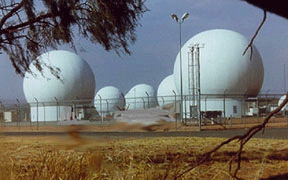 Pine Gap: 50 years as Australia’s prime nuclear target ICAN Australia 26 September – 2 October 2016:
A week of activities will expose the role of Pine Gap in war, surveillance and nuclear targeting. Beginning on the International Day for the Total Elimination of Nuclear Weapons, 26th September, hundreds of people are gathering at the Pine Gap Joint Defence Facility, just 20km from Alice Springs, NT.
A protest camp and conference will discuss the role of the highly secretive facility in drone targeting, mass citizen surveillance and in preparations for nuclear war. The facility is the most likely Australian target in the event of a nuclear war involving the US, immediately jeopardizing the 25,000 residents of Alice Springs, and others in the path of radioactive fallout. “Pine Gap makes critical contributions to planning for nuclear war.
In the fragile world of nuclear deterrence, efforts should be directed at total nuclear disarmament,” said Professor Richard Tanter, University of Melbourne. A UN working group on nuclear disarmament has issued a breakthrough recommendation for the General Assembly to convene a conference in 2017 to negotiate “a legally binding instrument to prohibit nuclear weapons, leading towards their total elimination”. Austrian Foreign Minister Kurz announced last Wednesday that Austria, along with other UN members states, will table a resolution at the General Assembly First Committee in October, seeking a mandate for negotiations to begin next year.
 “For 71 years the majority of countries have experienced the injustice and insecurity that nuclear weapons represent,” said Ray Acheson of the Women’s International League for Peace and Freedom, a steering group member of ICAN. “With negotiations of a ban treaty on the horizon, we are as close as we have ever been to effectively challenging the continued possession of these weapons of mass destruction.”
“When a treaty banning nuclear weapons is negotiated, Australia will be expected to sign it, as it has signed treaties to outlaw other abhorrent weapons. To enable Australia to sign on, the functions of Pine Gap should exclude preparations for nuclear war. This facility has served to implicate Australia in nuclear aggression and as a prime nuclear target for 50 years too long,” said Gem Romuld, ICAN Australia. ICAN Australia will be speaking at the IPAN Conference and participating in the protest camp this week. More information: Disarm protest camp, 26-30 September www.closepinegap.org Independent and Peaceful Australia Network Conference, 1-2 October www.ipan.org.au
September 28, 2016
Posted by Christina Macpherson |
Northern Territory, opposition to nuclear |
1 Comment
MAGALI MCDUFFIE http://www.magalimcduffie.com/travels/2016/9/26/south-australia-no-nuclear-dump Over two years ago, my partner Alexander Hayes met Bruce Hammond, of the Tanganekald & Western Arrente people, South Australia, who brought to his awareness the ongoing struggles and challenges that his people and other Aboriginal communities face, particularly in light of the South Australian proposal for a nuclear waste dump in the Flinders Ranges. With over three months of logistics and planning, and at Bruce’s invitation, Alex and myself will be travelling through many different communities in South Australia, listening to the voices of people on country, who have not been consulted by the government in an appropriate manner.
So on September 24th we started our journey from Canberra to South Australia.
Our road trip took us through Wagga-Wagga, the Hay Plains, Benanee Lake, Balranald, Mildura, finally arriving in Adelaide on the morning of the 26th. On 26 September, 2016 we had the pleasure of meeting  and interviewing Karina Lester, Co-Manager and Aboriginal Language Worker at Mobile-Language Team, at the University of Adelaide. Karina is the daughter of well-known Yankunytjatjara Elder and Activist Yami Lester, who was blinded by the ‘black mist’ from the first Atomic Test Bomb at Emu Junction, South Australia.
Karina told us that the idea of a nuclear waste dump in South Australia is not new – her grand-mother and her family successfully fought against it back in the 1990s. But now it is on the agenda again, and Aboriginal communities whose land the nuclear dump would be built on are not being properly consulted. Even though the South Australian government is sending representatives to a hundred different communities, under the guise of consultation (Get to Know Nuclear), they are not engaging language experts and interpreters to communicate directly and effectively with these communities. Aboriginal people are therefore not getting all the information on the nuclear waste project, thereby contravening the United Nations Declaration on the Rights of Indigenous Peoples on Free, Prior and Informed Consent. Continue reading →
September 28, 2016
Posted by Christina Macpherson |
aboriginal issues, South Australia, wastes |
Leave a comment
http://www.robinchapple.com/crisis-confidence-over-epa-uranium-mine-push 27 September
WA Greens Senator Scott Ludlam and Robin Chapple MLC have today questioned the EPA’s approval for preparatory works at the proposed Mulga Rock uranium mine, which is yet to be approved and currently subject to an appeal.
“Today’s approval for preparatory works at Mulga Rocks exposes the sham of the assessment and appeals process; the EPAs decision today is at odds with the intention of the Environmental Protection Act 1986,” Mr Chapple said.
“There has been serious public backlash against the project reflected in numerous appeals being lodged against the project, including from Traditional Owners and people in the local community.
“There is a race on in WA to get uranium mines approved before the State election. This ambition is ridiculous given the widespread opposition to the industry and the market conditions which are prohibitive to new mines.”
“World-wide we’re seeing uranium mines close and others put in to care and maintenance. Vimy Resources may have some political influence and big benefactors like Andrew Forrest, but none of these things will make this mine profitable or socially acceptable,” Senator Ludlam said.
“The EPA’s response to Vimy’s aggressive approach to starting this mine is not just a demonstration of a poor and non-transparent process, it is a slap in the face for the public and local community that have engaged in good faith in a process which is in essence a fait accompli.
“While the process is broken, the resolve of communities to fight this project is very much alive and well.”
September 28, 2016
Posted by Christina Macpherson |
politics, uranium, Western Australia |
Leave a comment
“Perhaps the barrage of pro-nuclear forces/strategies explains why there’s no explosion of outrage either in South Australian society or in church and faith groups against this extraordinarily destructive scheme.”
 The normalisation of destruction in SA nuclear plan, Eureka Street. Michele Madigan | 22 September 2016 On Friday 26 August in Adelaide, Yankunyjatjara Elder Edie Nyimpula King was awarded the 2016 Perpetual Trophy of the prestigious Gladys Elphick Awards for her decades of work ‘in standing up for culture, country and community’.
On Saturday 3 September, in Port Augusta, Edie was keeping up the struggle, singing again the Seven Sisters inma, strong in its demands for a clean country and protection for the future generations.
Unable then to stop the flow of tears, she paid tribute to her former companions’ heroic struggles. ‘Ivy Makinti Stewart, Kampakuta — Eileen Brown, Eileen Unkari Crombie’ amid all the other heroes — the brave fighters for country and the future generations against the nuclear industry and its proponents in South Australia; women who had immortalised that inma in the same obedient re-enactment of the Seven Sisters and their demands to care for country.
Its cry: Irati Wanti — leave the poison! Have nothing to do with it! No radioactive waste dump in our country!
But why is such responsibility for country and the health of its people — forever — so hard? And ongoing! Why is the destruction of country — its lands and waters and huge risks to the future generations — forever allowed to be normalised?
Indeed how to explain the current normalisation of the new threat — of importing high-level radioactive waste across the Southern Hemisphere oceans and its dumping onto the lands of South Australia. And this with the seemingly full permission of a government and perhaps a peoples, both of whom will be long gone in the ‘hundreds of thousands of years’ which the nuclear royal commission itself admits such material must be isolated.
Poll results during the third week of September revealed that 50 per cent of those polled agree to welcome such waste with 35 per cent against and 15 per cent undecided.
Of course the full throttled media campaign must take credit for much of this.
Recently the Adelaide Advertiser had a front page story entitled ‘Nuke fear for kids’. The heading would surely lead one to believe that (surprisingly) SA’s only daily paper had a front page article about the substantial risk that the proposed importation of international high-level radioactive waste will be for the present and future generations of South Australian children.
But no — further reading made clear that the ‘fear’ was the effect ‘noisy protestors’ would have on the 150 high school children who had been chosen to meet with the former nuclear Royal Commissioner Scarce. Hence the venue was to be secret.
There seems little expense spared either at the importation of experts like Geraldine Thomas, who spoke  at the Hawke Institute at the University of South Australia on 16 September on the risks of radiation. Were many of her audience relieved to hear that, well, no, there is actually little risk? In that jolly English way reminiscent of one of the English experts in the government ‘consultations’ also being conducted across the state, she explained that the problems of the people of Fukushima were mainly psychological.
Proposed is a forever risk-laden project of ships travelling to a yet unnamed Australian port every 24 to 30 days with the world’s highest level nuclear waste. Then dumping/storing the casks perhaps five or ten kilometres away for some decades until funds are available to build a ‘safe’ depository — something that has not yet been possible anywhere in the world including countries with decades of nuclear expertise.
Perhaps the barrage of pro-nuclear forces/strategies explains why there’s no explosion of outrage either in South Australian society or in church and faith groups against this extraordinarily destructive scheme. Much less in Australian society in general.
Or perhaps theologian Brendan Lovettt names it.
‘If there is a typically bourgeois virtue it must be the cult of moderation. The extreme is to be abhorred; it is a matter of unseemly exaggeration. We cannot bear too much reality. the world is to be thought of as a place where comfortable mediocrity rules, where everything is under control and there is nothing to be horrified about, either in ourselves or in the world. This is our necessary lie. What we deny under our veneer of a smoothly reasonable world are the real dimensions of life and history. Understandably we project a God who will be compatible with this comforting view of life and history.’
What we are resisting, he concludes, is our own responsibility for the world.
On 3 September, the 25 year old Kumana Karen Crombie, now herself mother of two, danced with veterans, Betty Ngangala Muffler and Dianne Pinku Edwards, to Edie Nyimpula’s singing, to herald the new generation taking up responsibility for country and its peoples.
What will it take for the rest of us to take up our own responsibility.
Michele Madigan is a Sister of St Joseph who has spent the past 38 years working with Aboriginal people in remote areas of South Australia and in Adelaide. Her work has included advocacy and support for senior Aboriginal women of Coober Pedy in their campaign against the proposed national radioactive dump. https://www.eurekastreet.com.au/article.aspx?aeid=49962#.V-9UG4h97Gg
September 26, 2016
Posted by Christina Macpherson |
South Australia, spinbuster |
Leave a comment
 I knew that The Advertiser was the mouthpiece of the nuclear lobby, anyway, but their latest effort was really sick-making.
 A rave which portrays Premier Weatherill as some kind of democratic champion, and which is pushing the soft sell that the decision on nuclear waste importing will not happen soon, but be dragged on for years. (They don’t say this, but in the interim, the nuke lobby has time to get secret arrangements made – and money lent to South Australia, so that ultimately, it might all be just too committed to turn back.)
A Premier with any spine might make a decision, a soon decision, and a wise one, to say no to the whole noxious scheme, – send home the business lobbyists and the propaganda spruikers like Geraldine Thomas, put the lid on the shonky Nuclear Royal Commission’s biased report, stop the silly nuke spinning Forums, and get on with running South Australia properly. Such an opportunity that State has, as a world leader in renewable energy!
Lack of trust more toxic than nuclear dump notion: Daniel Wills, The Advertiser September 23, 2016 “South Australia is still at the stage where it needs reassurance about the science, as well as the competency and motivations of a government that would oversee its administration.
No site has been selected to house the world’s high-level international waste for profit, should the state choose to build one, nor any explanation of how one would be picked. The State Government is yet to overturn laws that ban public money being spent on investigating the establishment of a nuclear dump or even to pick up the phone to ask places like Japan what they would pay…….
 The Finnish operators say they would jump at the chance to form an alliance with SA to build a dump here…..
Mr Weatherill is likely to confirm before Christmas that the Government will begin the serious work of developing a robust business case…….
Expect the Government to seek money from overseas to undertake a major geological survey that rules out places too unsafe for disposal to occur. At a cost of up to $1 billion, this is too expensive for SA to fund itself, but could have the benefit of doubling as a discovery tool for new mining deposits.
From there, it is likely the offer will be thrown open to communities to show an interest, and estimates made of what they could receive. Even on the most extremely rapid timeline, that point is unlikely to have been reached by the time voters head to the polls in March 2018.
This project is multi-generational, with a point of no return years away. But it is a doubtful and open question as to whether our politics are up to the job…….Mr Weatherill has framed this as a great test of our democracy’s ability to consider difficult questions and come to wise solutions. … http://www.adelaidenow.com.au/news/opinion/lack-of-trust-more-toxic-than-nuclear-dump-notion-daniel-wills/news-story/e927e455e6f244f35a8b6743bc791adb
September 24, 2016
Posted by Christina Macpherson |
Christina reviews, media, politics, South Australia, wastes |
Leave a comment