Your Say: Immoral and illegal for Jay Weatherill to spend taxpayer money to promote nuclear waste dump
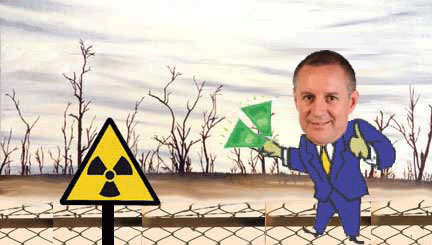 Peter Lazic 12 Sep 2016 What consent does Jay Weatherill have to spend $600 million dollars of taxpayer money to plan a nuclear waste dump, when the proposed dump may never get approved. This and the money spent to date on the Royal Commission, the road show, now TV advertisements, etc, is obscene and immoral
Ed note : Especially as the SA Law says:
13—No public money to be used to encourage or finance construction or
operation of nuclear waste storage facility Nuclear Waste Storage Facility (Prohibition) Act 2000https://www.legislation.sa.gov.au/LZ/C/A/NUCLEAR%20WASTE%20STORAGE%20FACILITY%20(PROHIBITION)%20ACT%202000/CURRENT/2000.68.UN.PDF
http://nuclear.yoursay.sa.gov.au/get-invol…/statewide-survey
Australian company exporting lithium
 Why mine lithium?
Lithium is essential for wind turbines, as well as for so many 21st Century  technologies. However, it is another potentially toxic extractive industry. There’s so much of it dumped in discarded devices. Design should be the answer, so that lithium can be recycled.
MinRes beats Galaxy in lithium export race Jarrod Lucas – The West Australian on September 16, 2016 The first shipment of spodumene concentrate from the Mt Marion mine, 40km south-west of Kalgoorlie-Boulder, is set to depart Fremantle next month bound for lithium processing plants in China.
The product, the equivalent of about 6 per cent lithium, will be delivered to Mt Marion co-owners Ganfeng Lithium (43.1 per cent), which builds batteries out of Jiangxi province and recently branched out into manufacturing electric cars.
Mt Marion, jointly owned by Chris Ellison’s Mineral Resources (43.1 per cent), and Neometals (13.8 per cent), will beat Galaxy Resources to market after its first shipment via Esperance from the revamped Mt Cattlin mine near Ravensthorpe was delayed until December.
It comes as Mt Marion’s neighbours Maximus Resources yesterday trumpeted a “new lithium discovery” on the doorstep of the mine……..https://au.news.yahoo.com/thewest/wa/a/32629967/lithium-set-for-export/#page1
Nearly half of all Australians would consider switching banks, due to climate change concern
 Switching banks: nearly half of all Australians would consider move over climate change
Poll findings released as prominent Australians call on big four to withdraw backing for fossil fuel industry, Guardian, Michael Slezak, 14 Sept 16, About half of all Australians would be likely to switch banks if they found out their bank was lending money to projects that contribute to climate change, according to polling commissioned by the financial activist group Market Forces.
The findings came as more than 100 prominent Australian individuals and organisations signed a letter demanding that the big four banks stop supporting projects that expand the fossil fuel industry. Among the signatories are JM Coetzee, Charlotte Wood, James Bradley, Missy Higgins, Peter Singer and Jack Mundey, as well as unions, religious orders and conservation groups.
Asked how important it was that their bank invest in companies and projects that don’t harm the environment and contribute to climate change, 74% of the poll’s respondents who were with the big four banks said it was at least “somewhat important”, according to the Essential Research poll of 1,017 people.
Forty-eight per cent of respondents said they would be more likely to switch banks if they learned their bank was lending to projects that harmed the environment or contributed to climate change.
When the researchers drilled down into specific types of projects, respondents appeared very concerned. Forty-seven per cent said they were likely to switch banks if they found out their bank was lending to coal and gas export projects in the Great Barrier Reef world heritage area. And 48% said they were likely to switch if they found out theirs was lending to coal seam gas projects near agricultural communities.
Respondents also overwhelmingly supported the big four banks’ decisions to support the goal to limit warming to “well below” 2C. But 65% of people agreed that given their support of that goal, the banks should no longer lend to projects that expand the fossil fuel industry.
In August Market Forces conducted research that found the big four banks had lent $5.6bn to fossil fuel projects and companies since they expressed support for the target.
In the open letter, released at the same time as the poll findings, the signatoreis outline a number of actions that the banks must commit to in light of their support for the Paris agreement goal……..https://www.theguardian.com/environment/2016/sep/15/switching-banks-nearly-half-of-all-australians-would-consider-move-over-climate-change
When will Premier Weatherill admit that the nuclear bonanza is a really bad idea.
an illusion http://www.adelaidenow.com.au/news/opinion/margaret-beavis-claims-south-australia-will-make-a-fortune-out-of-nuclear-waste-are-just-an-illusion/news-story/de432ce34d9deac7cfbfab406ec32c71 Margaret Beavis, The Advertiser September 13, 2016 THE acclaim around the pot of gold to be made importing nuclear waste into South Australia increasingly feels more like an illusion.There are so many invisible parts making up this story, it is probably only a matter of time before Premier Jay Weatherill finds the courage to say the nuclear bonanza is a really bad idea.
So what are these invisible items?
Firstly, there are no high level nuclear waste facilities anywhere in the world. None. Anywhere.
Both Germany’s efforts have leaked radiation into the water table, and they are currently spending billions pulling the waste out again.
 In Nevada, the US government has spent over US$10 billion building a site, only to find multiple problems including deliberately falsified data about the water table, and massive community opposition. It will never open. The Waste Isolation Pilot Plant in New Mexico closed two years ago after a fire and later an explosion exposed 22 workers and contaminated the whole site. Official investigation found cost cutting, corner cutting and human error was to blame, with a “loss of safety culture”.
The high level nuclear sites in Sweden and Finland were described by the recent Nuclear Fuel Cycle Royal Commission in South Australia as “successful”.
These locations have been researched for 40 years, and will not even start taking waste for at least another six years and, in the Swedish case, well over a decade. It is easy to succeed when there is no radioactive stuff to actually deal with.
 For the last forty years we have counselled pregnant women to avoid X-rays as we know their babies have much higher rates of leukemia.
Evidence from Hiroshima and Nagasaki, from vast human trials literally involving hundreds of thousands of nuclear workers to research about Cat scans and nuclear heart scans, all point to significant harms with additional radiation.
There is no evidence of a safe lower dose; the higher the exposure the higher the risk.
And recent large research trial found rates of stroke and heart attack are also increased.
There is a good reason why countries want so badly to be rid of this material, which is toxic for over 100,000 years.
Thirdly, we have nowhere to put it.
The plan is to import it, and then find some poor remote community to take it.
The problem with that theory is that for almost twenty years the government has been looking for a site for Australia’s own intermediate level waste, without success.
 Aboriginal communities have been disproportionately targeted. We clearly already have more nuclear waste than we know what to do with.
Finally the promised billions, so pivotal to the whole proposal, are risky.
They have been modelled by a firm that works in this area and has potentially a strong vested interest in this venture going ahead
They have not allowed for potential competition, which would massively reduce the prices paid. They have included countries like Ukraine as clients, when Ukraine is looking into building its own facility at Chernobyl.
They have included countries like Bangladesh, which does not even have a reactor yet.
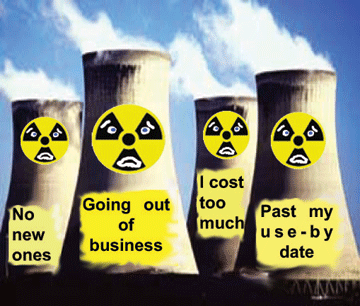 And it has made assumptions about the viability of the nuclear power industry, when plants in places like the US are closing down as they cannot compete financially.
Nuclear waste facilities are very expensive to build, and historically costs inevitably blow out. For example, in the current French waste construction project costs have doubled in the last decade.
There has been no independent financial modelling done by the government, which is extraordinary given the enormous financial risks and the extraordinary time frames.
And the income to cover the clean up — decommissioning and other costs — does not start until 2042.
In essence, this proposal is startling in its optimism.
The likely outcome if it goes ahead is a whole lot of highly toxic radioactive waste lasting for 100,000 years in South Australia, and billions of taxpayers’ money spent trying to find a way that works to get rid of it.
If it is such a financial bonanza, many countries would be racing to do it.
The reality is that a royal commission, lots of clever marketing, 100 consultation sites and a couple of citizens’ juries still don’t make this a smart idea.
Margaret Beavis is president of the Medical Association for Prevention of War
Is Australina government secretly planning nuclear submarines?
 Dick Smith questions submarine project, says plans are ‘ludicrous’ and ‘we’re being conned’ 891 ABC Adelaide, 14 Sept 16
French company DCNS won the $50 billion contract to build Australia’s next fleet of 12 submarines in Adelaide, which will replace the current Collins Class fleet. The company won the contract to build a modified version of its nuclear submarine, called the Shortfin Barracuda.
The Australian Government stipulated that the winning contract would need to use conventional power, ruling out larger, nuclear-powered submarines. The lead up to the submarine contract has involved election promises, business and political campaigns and lots of speculation.
Mr Smith said the re-designed version of the submarine would have to be converted to a diesel engine.
But he told 891 ABC Adelaide that was a ludicrous plan and he believed it would never happen.
“So the plan is for us to buy a nuclear submarine design and then convert it to a piston submarine,” he said. “Now no-one has ever done that in the world and in fact when I talk to submarine experts they say it is so ridiculous, so we’re being conned.”
Mr Smith said if the Government’s real agenda was to use nuclear technology, it should be up front about it……….
More details on subs project needed: Xenophon South Australia Senator Nick Xenophon said more detail about the submarines project was needed…..Senator Xenophon said he was concerned about the lack of certainty surrounding the project. http://www.abc.net.au/news/2016-09-13/dick-smith-questions-submarines-project-over-nuclear-power/7837946
South Australian govrenment sucked in by the Small Modular Nuclear Reactor lobby?
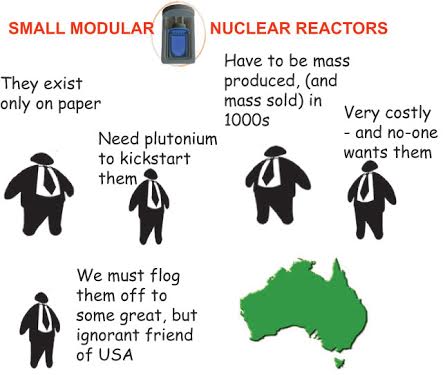 The SA Government’s “Energy Market Transition Plan”, obtained by Freedom of Information request, has revealed that prospects for small modular nuclear reactor deployment in South Australia have been explored.
SA government probes nuclear option as Premier Jay Weatherill promises cheaper power https://au.news.yahoo.com/video/watch/32558838/sa-government-probes-nuclear-option-as-premier-jay-weatherill-promises-cheaper-power/#page2
7News Adelaide September 7th, 7 News can reveal a top level report clearly indicates small scale nuclear reactors have been on the short term radar. Mike Smithson reports
An expert witness to the Nuclear Citizens Jury – sceptical of the “economic bonanza”
 The price is a guess; there is no market price for accepting dumped waste at the present time.
The cost of shipping the waste to South Australia seems also to be a notional allowance in Appendix J ($0.20m/tonne heavy metal). Where this comes from is not obvious.
far from being a financial bonanza, as proposed by the Royal Commission, the project could make minimal returns, and be a real distraction from alternative paths to the economic future of the state
The SA economy, the nuclear waste dump and democracy Richard Blandy INDaily, 12 Sept 16 ANALYSIS As TV messages encourage South Australians to become informed about a proposed nuclear waste dump, Richard Blandy argues the project could prove a distraction from exploring alternative solutions to the state’s economic challenges.
Several times in recent days I have seen a brief message on our TV in which a South Australian mother advises her small daughter that everyone must become informed about the proposed high-level nuclear waste dump in the state. Her daughter looks suitably mystified.
No doubt this is part of the exercise in citizens’ democracy that is currently underway to determine whether there is a “social licence” to proceed with such a dump. Other elements in this process include two meetings of citizens’ juries (one of which has already been held), as well as citizens’ information meetings.
The TV message could have come from the satirical 1970 movie The Rise and Rise of Michael Rimmer, in which conman Rimmer (Peter Cook) eventually becomes British Prime Minister. …….
my experience of the first citizens’ jury, which I attended as an expert witness on July 9, was very positive. I was invited principally as a result of my InDaily articles opposing the dump.
There was one other expert economics witness present questioning the economics of the dump: Rod Campbell, research director of the Australia Institute in Canberra.
Several of the expert witnesses present who supported the economics of the dump had been involved in undertaking the economic/financial analysis for the Nuclear Fuel Cycle Royal Commission.
The citizens’ jury operated as a free-flowing discussion rather than with set pieces presented by the witnesses followed by questions from the jurors. The issues are difficult and technical, but the jurors were great. They made me think that if I am ever in deep trouble with the law, I will always opt for trial by jury.
The 54 South Australian citizens on the jury were sensible, common-sense people who asked pertinent questions. They quite properly insisted that the business case for the dump should be made watertight – or the dump abandoned. Continue reading
Discord in nuclear submarine lobby
Businessmen lobby for nuclear subs, news.com.au SEPTEMBER 13, 2016 Australian Associated Press A group of Australian businessmen is lobbying for Australia’s next fleet of submarines to be nuclear-powered and supplied by another country, warning the current deal to build the vessels in Australia will “condemn our sailors to their graves”.
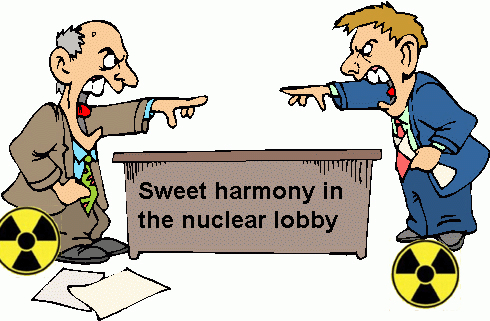
The group says it can’t understand the federal government’s decision to award a multi-billion deal to French supplier DCNS, which will be required to deliver 12 diesel-powered submarines for which there are no drawings and no plans…….
The businessmen, including Dick Smith, Gary Johnston of Jaycar Electronics and ad man John Singleton took out a full-page advertisement in The Australian slamming the move to go with French producer DCNS, suggesting buying off-the-shelf nuclear subs would be a better option……
It also questioned the economics of the decision, saying it would be cheaper to subsidise car industry jobs, if creating jobs was the desired outcome.
Mr Johnston said DCNS was being asked to build a diesel-powered version of what is essentially a nuclear-powered sub.
“They haven’t got a drawing, they haven’t got a plan. Their current nuclear submarine, the Barracuda, is sitting on a slipway…..http://www.news.com.au/national/breaking-news/sa-premier-hits-back-at-sub-criticism/news-story/b8dd63476f1a4552c6685d3533163cd1
Turnbull govt slashes half-a-billion dollars from the Australian Renewable Energy Agency,but doesn’t actually kill it
 Australian Renewable Energy Agency saved but with reduced funding – experts react, The Conversation, September 13, 2016 The Australian Renewable Energy Agency (ARENA) has been granted a funding lifeline of A$800 million over the next five years, after the federal government and opposition came to an agreement that will save the agency.
ARENA had faced being wound down as a result of the government’s earlier proposal to strip A$1.3 billion from the agency. This was part of a wider package of measures designed to save the federal budget more than A$6 billion.
Renewable energy researchers had reacted with dismay to that proposal. An open letter to the government in defence of the agency attracted 190 signatures.
Below, our experts react to the news.
Nicky Ison, Senior Research Consultant, Institute for Sustainable Futures, University of Technology Sydney
Today the Coalition government and the Labor Party struck a deal to:
- slash half-a-billion dollars from the Australian Renewable Energy Agency; and
- save the Australian Renewable Energy Agency (ARENA).
These statements seem like a contradiction, but both are true. However, it is also true that the need to save ARENA exists because of the Coalition government’s efforts over the past three years to dismantle Australia’s renewable energy policy. If the benchmark is that we keep our existing renewable energy institutions, today was a win. However, if the benchmark is that we have institutions and policies that have sufficient funding and scope to tackle the policy challenges of climate change, our changing energy system and driving innovation, then today was a loss.
Andrew Blakers, Professor of Engineering, Australian National University
The Australian research community is pleased that the government’s proposal to debilitate ARENA by removing A$1.3 billion and ending its granting function will not go ahead. At the same time, we are disappointed that yet again ARENA is subject to huge funding cuts.
The fastest and surest way to reduce greenhouse gas emissions is to accelerate the introduction of renewable energy into the electricity system. ARENA has focused heavily in this area (among others), covering the full gamut from support for early-stage research, through grants to young renewable energy companies, to acceleration of deployment of large-scale solar photovoltaic systems.
ARENA will need to heavily prune its activities to cope with a A$500 million budget cut. We look forward to restoration of ARENA funding, and to a concerted effort at the national level to move rapidly to 50-100% renewable electricity……https://theconversation.com/australian-renewable-energy-agency-saved-but-with-reduced-funding-experts-react-65334
Taxpayers up for huge costs in South Australia – just for the PLANNING for nuclear waste importing
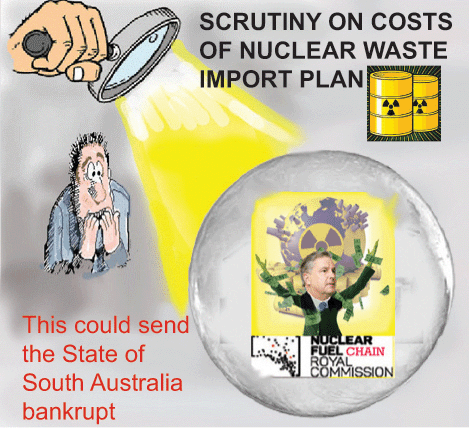
 Political Reporter Sheradyn Holderhead, The Advertiser September 11, 2016 THE State Government will need to find up to $600 million to plan a nuclear waste dump even if the project never gets off the ground, a consultant working on the Royal Commission has revealed.
Jacobs Engineering Group project manager Tim Johnson told a parliamentary committee investigating the project that the total cost prior to the decision to proceed and sign contracts with client countries would likely be $300 million to $600 million.
Premier Jay Weatherill said precommitment from participating countries could reduce the risk for taxpayers.
But Dr Johnson questioned the likelihood of doing that earlier than year six of the project, at which time up to $600 million would already have been spent.
Late last week, the committee visited a dump site in Nevada where more than $10 billion has been spent by US government. The project has stalled for years as the state and federal governments fight over approvals.
Liberal MLC and committee member Rob Lucas said the large costs were “a potential deal breaker”.
“I don’t speak for the committee or my party at this stage. Personally, I would find it very hard to support any proposal which meant we could spend $600 million and then decide we wouldn’t proceed with the project,” he said.
“That would simply mean taxpayers had wasted $600 million for nothing.” Continue reading
South Australia, Australia’s most secretive state
 Daniel Wills: Welcome to South Australia, the nation’s most secretive state
IT crept up with such stealth that few people noticed it was even happening, but South Australia can now make fair claim to being the most secretive state in the country.
The Advertiser revealed two stories this week that should deeply concern lovers of open debate and informed democracy, and leave them demanding big changes.
After a period of welcome sunlight as court suppression orders sank to relative lows, they’ve spiked in the past two years and are running at their highest rate in a decade.
On top of that, a Monash University study admonished our Freedom of Information laws as the worst in the country and found the system was “designed to block, delay and obfuscate”.
But this viscous culture of secrecy isn’t isolated to those two important areas.
It seeped so far into the foundations of our Independent Commission Against Corruption that even the man running it has complained to lawmakers that the public is shielded from important information………
SA also trails other states in the protections offered to whistleblowers and any journalists they contact in an honest bid to get important stories of public interest into the light of day. This has a chilling affect on political debate, and makes it more likely that bad practices will survive.There are a few decent theories that help explain why SA stands out so darkly in the crowd………
When the ICAC legislation was drawn up the balance fell on the side of minimising the risk that people of standing would have their reputations unfairly smeared, rather than a bias towards ensuring the public had maximum access to information about what they were up to………. http://www.adelaidenow.com.au/news/opinion/daniel-wills/news-story/10735e85a9e26eeea142501aa6985f25
Australia’s environmental laws are too weak – as shown by the Adani coalmine case
The groups are calling for a new generation of environmental laws that protect critical habitats for threatened species, that halt projects until information about the scale of the impacts is known, and that explicitly deal with impacts on the climate.
They have also called for laws that allow environmental approvals to be challenged in court on their merits. Currently, they can only be challenged by claiming the minister didn’t follow the correct legal processes.
 Adani’s Carmichael coalmine proves environment laws ‘too weak’ – report
No consequences for the company if its mine causes greater environmental damage to threatened habitats than expected, says study, Guardian, Michael Slezak, 12 Sept 16, Australia’s environmental laws are too weak, a new report argues, citing the Carmichael coalmine as an example. Even what the environment minister has described as the “strictest” environmental conditions on the development allow the destruction of endangered species habitats, the degradation of ecologically and culturally significant water bodies, as well as the production of fossil fuels for burning, it says.
When the federal environment minister gave the most recent approval for Adani’s huge coalmine in 2014, he said it was done on the basis of “36 of the strictest conditions in Australian history”.
Taking those conditions as the “high-water mark” for environmental protections offered by current laws, a report by the Australian Conservation Foundation and the Environmental Defenders Office of Australia examined whether they protected the environment in the way they were intended to. Continue reading
Community Power Agency urges Victorian govt to establish “clean energy community hubs”
 Everybody needs good neighbours … to produce renewable energy, Benjamin Preiss The Age, 12 Sept 16 Linda Parlane got more than energy from the sun when she installed solar panels on her roof. She harnessed the power of her community. Ms Parlane bought her solar panels back in 2009 through a bulk-buy community scheme in Coburg………
She is now a board member of the Moreland Community Solar co-operative and wants to see more local projects, including ventures established through community investment. But she fears community energy projects have come unstuck in recent years after running into legal and administrative hurdles.
Moreland Community Solar is among a collection of environment, energy and lobby groups calling on the state government to ensure small to medium-scale community projects play a bigger role in reducing carbon emissions.
A submission to the government prepared by the Community Power Agency is urging it to establish “clean energy community hubs” that can provide advice to local groups and help them strike up relationships with renewable energy developers. It also recommends financial support for community-produced energy.
The state government has called for submissions as part of its plan to have 40 per cent renewable energy by 2025. NSW has a 20 per cent target by 2020-21. The government will use a “competitive auction process” in which renewable energy developers can bid for contracts to run their projects. The Community Power Agency wants community energy projects to account for up to 10 per cent of the overall renewable energy target.
Community energy projects take many different forms. Several years ago residents in Daylesford and Hepburn set up a community co-operative to establish a two-turbine wind farm that now produces enough energy to power more than 2000 homes.
In Bendigo a crowdfunding campaign was launched to buy solar panels for a local library.
Community Power Agency director Nicky Ison said many Victorians wanted to produce renewable energy at a local level. “Community groups have great ideas,” she said. “Once they’ve turned those ideas into something financially viable there are so many people who want to invest in these projects.”Ms Ison said community energy projects also resulted in stronger relationships within communities. “It’s bringing neighbours together.”
The groups supporting the submission include progressive lobby group Getup, Solar Citizens, Yarra Community Solar, Moreland Community Solar co-operative and the Central Victoria Greenhouse Alliance. http://www.theage.com.au/victoria/everybody-needs-good-neighbours–to-produce-renewable-energy-20160911-grdp6z.html
Nick Xenophon Team will block cuts to Australian Renewable Energy Agency: What About Labor?
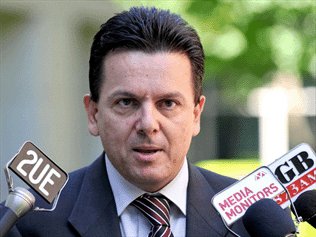 Nick Xenophon Team’s decision to block ARENA cuts puts pressure on Labor http://www.abc.net.au/news/2016-09-10/labor-under-pressure-amid-renewable-energy-funding-cuts/7832656 AM By political reporter Naomi Woodley The fate of future funding for the Australian Renewable Energy Agency (ARENA) now rests firmly with the Federal Opposition, after the Nick Xenophon Team (NXT) confirmed it would block the Government’s proposed budget cut.
Key points:
- $1.3bn cut is contained in Government’s omnibus savings bill
- Passing of bill to devastate renewable energy industry, Nick Xenophon says
- Labor caucus expected to consider funding cut on Tuesday
The $1.3 billion cut is contained in the Government’s omnibus savings bill, which is currently before Parliament.
Senator Xenophon said if the bill was passed it would devastate the renewable energy industry in Australia.
The real risk of the Government’s slashing of the renewable energy fund, ARENA, is that we will see a brain drain of our best and brightest leaving this country,” he said.
The Government wants to cut ARENA’s funding as part of plans to set up a Clean Energy Innovation Fund that would hand out loans instead of direct grants.
Senator Xenophon said while his team would not support the funding cut, there was scope to change the way ARENA worked.
“There ought to be a change in the funding mechanism to ensure that if a renewable energy technology has commercial success then the grant ought to be repaid, and there ought to be the ability for ARENA to take an equity in that project so it can reap the benefit of that,” he said.
He will ask Labor to support such an amendment when the bill reaches the Senate.
‘Acid is now on Labor’
The NXT’s decision to block the funding cut puts more pressure on Labor to decide how it will vote. Continue reading
Banks ready to back big solar projects: renewable energy jobs on the rise

 Banks looking even closer at backing big solar projects: Clean Energy Council, Brisbane Times, Tony Moore , 8 Sept 16, Australian banks will invest more heavily in solar energy projects within the next 12 months, Clean Energy Council chief executive Kane Thornton said after Thursday’s announcement that 12 new solar farms Australia-wide had been backed by $100 million from the federal government.
The federal government’s Australian Renewable Energy Agency on Thursday announced 12 large-scale solar projects – six in Queensland – had received federal support.
ARENA chief executive Ivor Frischknecht said improved efficiencies had meant solar energy producers were getting much more bang for their funding buck than they were even two years ago. “In 2014, the grant funding needed for large-scale solar projects was $1.60 a watt,” Mr Frischknecht said.”In 2015, this dropped to 43 cents at the EOI stage of ARENA’s $100 million large-scale solar funding round; and to an average of 28 cents in June 2016 when full applications were submitted,” he said.
“The average requirement of the projects we are taking forward today is an incredible 19 cents a watt.”
Mr Thornton said solar projects would soon begin to rely less on federal government for funding to begin operations. “We really at the threshold of saying that once we see another round of these of these projects we are going to see the costs decline to the point when they are built on their own, without the government support,” he said. “I think it is months, if not maybe a year or so, before we can expect them to go ahead without further funding.”
Mr Thornton said banks were now closely examining the viability of investing more heavily in solar and renewable energy projects in Australia.
The first major investment in solar energy by Australian banks came in 2013 when NAB and ANZ invested in a 20 megawatt solar plant in Canberra. More investment in solar plants followed, while banks have questioned some large new coal projects……….
Mr Thornton said scale of new solar farm plants was lowering production costs to the point where it was “cost comparative’ with coal and gas.
Mr Thornton said it was now time to begin training workforces that worked in traditional energy supply companies to work in renewable energy. http://www.brisbanetimes.com.au/queensland/banks-looking-even-closer-at-backing-big-solar-projects-clean-energy-council-20160908-grc5ol.html
1 This month
17 October, Free Public Talk on Nuclear Issues in South Australia
David Noonan will speak on public interest concerns over the new Roxby Downs Indenture Act 2026 on BHP copper-uranium mining and ore processing in SA, and on how AUKUS may face SA with a High-Level nuclear waste agenda.
Dr Jim Green will discuss international developments in the field of nuclear power including ‘small modular reactors’ and Generation 4 ‘advanced’ nuclear reactor concepts.


Help Aunty Sue Protect Her Land and Sacred Sites From Destructive Rocket Testing.
.

Australians deserve the truth
about
AUKUS – https://aukuspublicinquiry.com/

PETITION – To: Prime Minister Anthony Albanese and the Australian Labor Government

of the week – Australians for War Powers Reform (AWPR)
To see nuclear-related stories in greater depth and intensity

