Stockholm Environment Institute very critical of Australia’s high rate of carbon emissions
 Australia’s carbon budget to be exhausted in six years, Stockholm group says http://www.smh.com.au/environment/climate-change/australias-carbon-budget-to-be-exhausted-in-six-years-stockholm-group-says-20160908-grbql4.html Peter Hannam
Australia will burn through its “fair share” of carbon within six years if the more-ambitious end of the global warming goals agreed to at the Paris climate summit is to be achieved, a respected European think-tank says.
Restricting warming to 1.5 degrees above pre-industrial times implies a global carbon budget of less than 250 billion tonnes of carbon-dioxide equivalent from 2015, the Stockholm Environment Institute said in a new study. The planet has warmed about 1 degree in the past century alone.
Taking Australia’s share of this budget to be 1 per cent – arguably a generous measure as the nation makes up just 0.3 per cent of the world’s population – the country will emit that 2.5 billion-tonne portion within six years at present polluting rates.
“[Australia’s] transformation to a post-carbon era must be rapid and comprehensive, and include diversification away from fossil extraction for energy and export,” Sivan Kartha, the author of the report, said.
Among the world’s largest polluters on a per-capita basis, Australia had “a high level of responsibility for the greenhouse gases that have caused the climate problem”. Its wealth and technical capabilities, though, also gave Australia “a level of capacity to help solve it”, the report says.
Geoffrey Cousins, president of the Australian Conservation Foundation, said the Turnbull government “had made new commitments in Paris, talked them up when they came back but not a single policy has changed since then”.
“There is no great urgency, things will just roll nicely on, and we continue to approve new coal mines,” Mr Cousins said, adding the Stockholm report revealed how little time was left to take serious steps to cut emissions.
Two developments on Thursday offered conflicting signals of government action on climate.
As revealed by Fairfax Media, $92 million in grant funding by the Australian Renewable Energy Agency had sparked almost as much as $1 billion in private funding that will triple the size of large-scale solar in the country.
The government also announced $30.05 million to fund a new ARC Centre for Excellence for Climate Extremes. The seven-year funding will mean the existing centre, based at the University of NSW, can morph into a group study on why rising temperatures are triggering a disproportionate increase in extremes such as heatwaves.
According to the Stockholm report, a large fraction of the world’s proved fossil fuel reserves will have to stay in the ground for any “plausible budget” to keep global warming the “well-below 2 degrees” goal agreed in Paris.
That means the market for Australia’s fossil fuel exports will need to “rapidly reduce and ultimately disappear”.
“Action taken to increase Australia’s capacity for fossil fuel production – such as increasing export capacity or commissioning new coal mines – is difficult to reconcile with the goals of the Paris Agreement,” the report says.
Australia is the world’s second-biggest coal exporter and also the second-largest exporter of liquefied natural gas.
Michael Anderson on the question of a Treaty with Aboriginal people
 Our people today are signing Indigenous Land Use Agreements, ILUAs, without truly understanding what they are surrendering to the oppressor colonial state and no-one fully informs them of the consequences. Will a treaty be the same?
Justice Willis [in R v Bonjon, Supreme Court of New South Wales 1841] adds: “I repeat that I am not aware of any express enactment or treaty subjecting the Aborigines of this colony to the English colonial law, and I have shown that the Aborigines cannot be considered as Foreigners in a Kingdom which is their own”.
Justice Willis then reasoned that: “Aboriginal people remained ‘unconquered and free, entitled to be regarded as ‘self-governing communities’. Their rights ‘as distinct people’ could not be considered to have been ‘tacitly surrendered’. As they were ‘by no means devoid of legal capacity’ and had ‘laws and usages of their own’, ‘treaties should be made with them’. The colonists were ‘uninvited intruders’, the Aborigines ‘the native sovereigns of the soil’ “
We are under occupation by a foreign power, which keeps us in our place by superior force Ghillar, Michael Anderson https://linksunten.indymedia.org/en/node/190003 by: Ghillar, Michael Anderson (Account: Nuclear Worrier)09. September 2016. Bathurst, Put clearly, Australia does not have its own sovereignty. Under its British constitution all governments in Australia are caretakers in occupation and govern for the non-Aboriginal people who call themselves Australians. In point of fact federal, state and territory governments govern in right of the crown of Britain. Former prime ministers John Howard and Tony Abbott appear demented when opposing treaties.
By Ghillar, Michael Anderson, Convenor of the Sovereign Union, last surviving member of the founding four of the Aboriginal Embassyand Head of state of the Euahlayi People’s Republic
Former prime ministers John Howard and Tony Abbott confirmed yesterday (8/9/16) that they vigorously oppose any ideas of a treaty between the Commonwealth of Australia and First Nations peoples in Australia: ‘John Howard has described talk of a treaty as “appalling” ….”I’m appalled at talk about treaty, that will be so divisive and will fail,” Mr Howard said and Tony Abbott says he has never supported the idea. …”A treaty is something that two nations make with each other, and obviously Aboriginal people are the first Australians, but in the end we’re all Australians together, so I don’t support a treaty.” [ http://www.abc.net.au/news/2016-09-08/conservatives-lock-in-against-treaty-with-indigenous-australians/7825298 ] Continue reading
Traditional Owners fight on: appeal Carmichael mine Federal Court decision
 http://wanganjagalingou.com.au/traditional-owners-fight-on-appeal-carmichael-mine-federal-court-decision/ 8 September 2016
“An appeal to the full bench of the Federal Court of Australia was filed today by -senior Traditional Owner and spokesperson for the Wangan and Jagalingou (W&J) family council, Mr Adrian Burragubba, challenging a decision of Justice Reeves in relation to the Queensland government’s issuing of mining leases for Adani’s Carmichael coal mine, handed down on 19th August 2016.
“Mr Burragubba said: “We said ‘no means no’ and so we will continue to resist this damaging coal mine that will tear the heart out of our Country. The stakes are huge.In the spirit of our ancestors, we will continue to fight for justice until the project falls over.
““The decision of the Native Title Tribunal in April 2015 to allow the issuing of the mining leases by the Queensland government took away our right to free, prior and informed consent.
It effectively allowed the government to override the decision that we made nearly two years ago to reject Adani’s ‘deal’,” Mr Burragubba said. … “
Australian Conservation Foundation ordered to pay costs for Adani case
September 8, 2016. ENVIRONMENTALISTS have been hit with a massive bill after a Federal Court ruling in just one of many cases against the Adani coal project, while a second group has launched yet another attempt to derail the project….. (subscribers only)
http://www.couriermail.com.au/news/queensland/crime-and-justice/australian-conservation-foundation-ordered-to-pay-costs-for-adani-case/news-story/20a030d675a2edb873a9888fd1e152ea
Hawker in the middle of the earthquake hazard zone south Australia
 Greg Wurn to Nuclear Fuel Cycle Watch South Australia Earthquake Hazard Zones of South Australia. Hawker in the middle of the earthquake hazard zone, well the proposed nuclear fuel waste dump is just a little to the west of Hawker at a place called Wallerberdina, a station near Barndioota, this property just happens to be under a long term lease to ex SA liberal senator Grant Chapman, he also while in politics served on several Senate Select Committees to do with uranium mining and milling, and another on the Lucas Heights Reactor.I will never know if he acquired that property with some sort of insider knowledge, but I do know the land is not geologicaly stable, and it also appears to drain into lake Torrens, which seams to drain south towards Port August and the Spencer Gulf.
David Noonan bad siting for national waste dump and shows that proposed Inter waste dump will be sited somewhere west of Port Augusta… https://www.facebook.com/groups/1021186047913052/
Australian uranium companies notorious for exploitation of African communities
Paladin Energy’scontaminating uranium operations, controversy over Anvil and state repression in Congo, MRC’s exit from its Xolobeni titanium project on South Africa’s Wild Coast following the murder of anti-mining advocateBazooka Rhadebe earlier this year.
The list goes ever on and the details – some of which are documented in a powerful report by the International Consortium of Independent Journalists – are deeply disturbing.
The absence of a robust regulatory regime in many African countries can see situations where Australian companies are engaged in activities that would not be acceptable practise at home
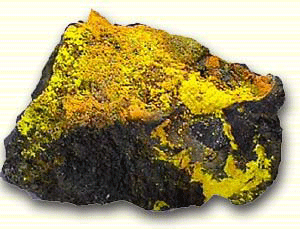 Africa Down Under: Tales Of Australian Woe On The ‘Dark Continent’, New Matilda, By Dave Sweeney on September 7, 2016 A mining conference underway in Perth states its aim is to help boost the fortunes of one of the poorest regions on earth. But boost the fortunes for whom, asks Dave Sweeney from ACF.
Stories of corruption, dirty dealing and corner cutting are not uncommon in the world of mining and resource extraction, especially in the developing or majority world. It is a tough trade where the high-visibility clothing is often in stark contrast to the lack of transparency surrounding payments and practises.
But as a major industry gathering takes place this week in Perth it is time for a genuine look at whether Australian resource companies are supporting the growth of fledgling democracies or literally undermining them.
No doubt the tall tales will flow along with the cocktails at the Africa Down Under mining conference, an annual event that sees Australian politicians join their African counterparts alongside a melange of miners, merchants and media. Continue reading
South Australian govt makes a change- to purchase 75 per cent of its long-term electricity needs
 SA Government to purchase 75 per cent of its long-term electricity needs, ABC News, 7 Sept 16 By Nick Harmsen and staff The South Australian Government says it will launch a tender to buy 75 per cent of its long-term electricity needs in an effort to increase competition.
SA has been hit hard by spiralling electricity costs over recent years and the Government wants to introduce a new competitor to the market.
Premier Jay Weatherill said current rules allowed private electricity companies to drive “prices higher by withholding supply”. “A small number of energy suppliers in South Australia have too much power,” he said. “If we increase competition, we will put the power back into the hands of consumers.”
South Australia’s electricity provider, the Electricity Trust of South Australia, was privatised in 1999.It changed its name to SA Power Networks in 2012……..
Carbon emissions scheme on the cards The SA Government also wants to “explore” an Emissions Intensity Scheme (EIS) that would trade credits between energy companies at a national level…….
“[This] means no coal-fired power generation and the only way you’re going to do that is through an emissions trading scheme or an emissions intensity scheme,” he said.
Independent senator for SA Nick Xenophon said an EIS was a “breakthrough” that would increase power reliability, reduce costs and bring about good environmental outcomes. He said that under an EIS, “dirty generators” that emit above a baseline emission rate would have to pay for the pollution while those below it would be credited.
Senator Xenophon said he proposed it at a federal level with the then opposition leader Malcolm Turnbull in 2009. “It seems that after seven long years of skyrocketing power prices that the ‘mongrel scheme’ that I proposed with Malcolm Turnbull has now become the ‘top dog’,” he said.
Yesterday, Port Augusta residents lobbied Mr Weatherill to commit to purchase the power from a proposed solar thermal project in the state’s north.
Mr Weatherill said the tender would not specify which power plant technology should be used…….http://www.abc.net.au/news/2016-09-08/sa-government-to-purchase-75pc-of-electricity-needs/7825852
Sharp falls predicted for Australia’s thermal coal exports
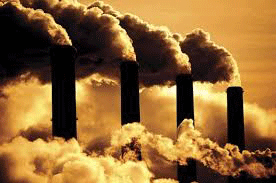 Australia’s thermal coal exports face 20 years of sharp falls, The Australian, September 8, 2016, BARRY FITZGERALD
Australia’s thermal coal exports are facing a sharp reduction over the next 20 years as the world steps up its attack on carbon emissions.
Leading industry consultancy Wood Mackenzie estimates Australia’s exports of the power generating fuel could slump from 210 million tonnes this year to 135 million tonnes by 2035
Key markets in Asia, Europe, and the Americas are all expected to record sharp falls in demand as the switch to meeting energy demand through energy efficiencies, nuclear power and a growth in renewables/battery storage alternatives steps up.
the next 20 years as the world steps up its attack on carbon emissions…….http://www.theaustralian.com.au/business/mining-energy/australias-thermal-coal-exports-face-20-years-of-sharp-falls/news-story/e059ac40237ef59ccc2889a61d68284b
Australia’s nuclear lobby wants waste dump as a prelude to setting up ‘new nuclear’ in South Asia
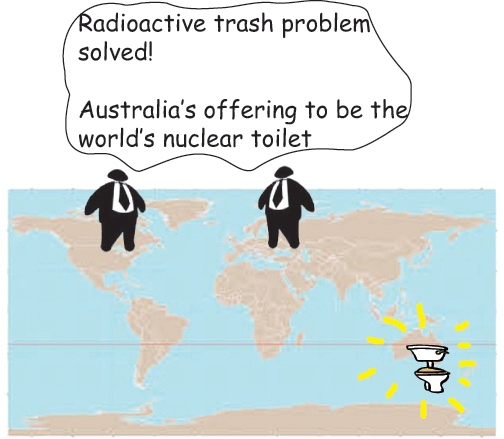 The global nuclear lobby is keenly interested in the South Australian government’s plan to import nuclear waste, because it would solve the waste problem for nuclear companies wanting to sell reactors and particularly, new types of nuclear reactors, to Asian countries.
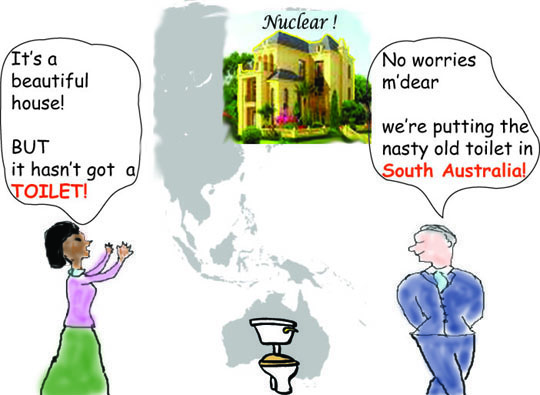
despite the NFCRC’s distinct lack of enthusiasm for new nuclear technology, three of the only five pro nuclear submissions were focussed, not on waste importing, but on new nuclear reactors.
Ben Heard‘s whole argument is directed at new reactors:
Our research indicates that South Australia could make a significant contribution in this technology development beginning at a modest reinvestment of revenues from used fuel.
Many nations in this region already exploit nuclear technology however this use is constrained by lack of a back-end solution…… The availability of a multinational solution for the back end of the nuclear fuel cycle could change these investment decisions profoundly.
Heard backs up his argument by playing the climate card of nuclear being “low carbon” and so on.
Dayne Eckermann writes:
‘The main motivation for myself and others to embrace and openly support this technology is its immense power output from a relative small facility.’
And the South Australia Chamber of Mines and Energy’s (SACOME‘s) view:
Australia’s well-equipped political, legal and educational structures mean that a reactor program could – with the support of experienced international partners – be started swiftly
SACOME strongly believes that the advances in small modular reactors and advanced reactor designs will provide the necessary facilities…..
I understand that, for the Parliamentary Committee, all submissions were actually published. This is in contrast to the NFCRC process, in which submissions from interested parties such as foreign nuclear companies were kept confidential……..
Like Oscar Archer, at the beginning of the NFCRC saga, the Australian nuclear lobby is primarily keen for “new nuclear”, with the waste import as a necessary prelude……
French anti-nuclear activists force Australian delegation to leave National Radioactive Waste Management Agency (ANDRA)

 Australian Delegation to France Blockaded By Anti-Nuclear Activists http://earthfirstjournal.org/newswire/2016/09/05/australian-delegation-to-france-blockaded-by-anti-nuclear-activists/#more-51943 from Earth First! Newswire On the morning of September 1st an Australian delegation on a parliamentary inquiry into the management of nuclear waste, was blockaded in North-East France by anti-nuclear activists.
The delegation was visiting the National Radioactive Waste Management Agency (ANDRA) facilities in the municipality of Bure, where an anti-nuclear movement under the banner of Bure Zone Libre (Bure Liberated Zone, BZL) has been burgeoning in recent years.
A group of about twenty masked activists dressed in white overalls and armed with water guns, drums and a sound system blocked the Australian delegation from entering the ANDRA laboratory, forcing the delegation to turn around and leave.
“We’re here in solidarity with indigenous resistance to the planned nuclear facility in Australia,” said one activist with a red clown nose. “Nuclear industry endangers life itself, and we will resist it everywhere.”
The BZL movement recently got national headlines in France for toppling a three kilometer long wall which ANDRA has erected around the forest near Bure. The wall was intended to stop the group from reoccupying the forest which ANDRA aims to uproot for the construction of a controversial nuclear waste facility.
“Wherever they’ll build walls, we’ll turn them into wall jam,” the activist laughed, explaining the French wordplay confiture de mur, as mur means both blackberry and wall.
About twenty gendarmes (French military police) patrolled Bure after the action had already ended. The area has been increasingly militarized recently, with activists facing trumped legal charges.
The BZL activists sent the Australian delegates a letter explaining their actions, presented below.
Letter to Australian delegation: Continue reading
Australia the Pacific Pariah as it idolises coal
It is the world’s largest coal exporter, and both major political parties are financially backed by the coal lobby. Rather than move away from coal, the government is seeking to expand exports dramatically, with public subsidies and taxpayer-funded infrastructure.
The contrast could not be starker. While Pacific leaders are praised for their efforts to develop global climate solutions, Australia faces ignominy. Unless Australia changes direction, it will continue to be seen as an irresponsible middle power – a rogue state undermining global efforts to tackle climate change.
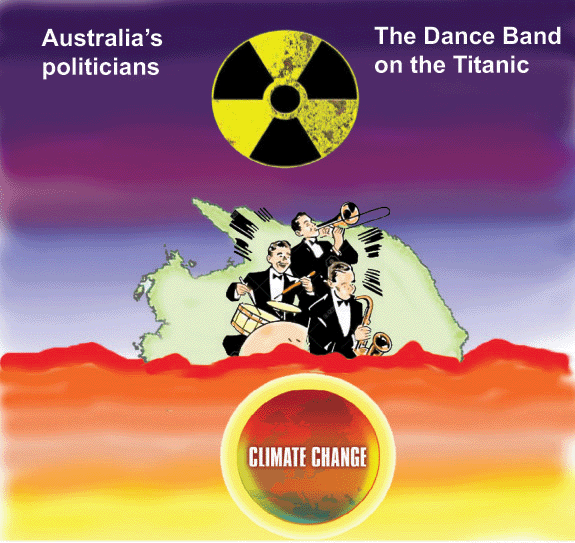 Pacific pariah: how Australia’s love of coal has left it out in the diplomatic cold, https://theconversation.com/pacific-pariah-how-australias-love-of-coal-has-left-it-out-in-the-diplomatic-cold-64963 The Conversation, Wesley Morgan, 7 Sept 16, Australia’s Prime Minister Malcolm Turnbull will have some explaining to do when he attends the Pacific Islands Forum leaders’ meeting in Pohnpei, Micronesia, this week.
Australia’s continued determination to dig up coal, while refusing to dig deep to tackle climate change, has put it increasingly at odds with world opinion. Nowhere is this more evident than when Australian politicians meet with their Pacific island counterparts.
It is widely acknowledged that Pacific island states are at the front line of climate change. It is perhaps less well known that, for a quarter of a century, Australia has attempted to undermine their demands in climate negotiations at the United Nations.
The Pacific Islands Forum (PIF) – organised around an annual meeting between island leaders and their counterparts from Australia and New Zealand – is the Pacific region’s premier political forum. But island nations have been denied the chance to use it to press hard for their shared climate goals, because Australia has used the PIF to weaken the regional declarations put forward by Pacific nations at each key milestone in the global climate negotiation process. Continue reading
Australia an international pariah? as other nations ratify Paris Climate Agreement
 US-China ratification of Paris Agreement ramps up the pressure on Australia, The Conversation, Peter Christoff September 5, 2016, When President Barack Obama and President Xi Jinping announced their countries’ ratification of the Paris climate agreement ahead of last weekend’s G20 meeting in Hangzhou, they boosted its chances of coming into force by the end of this year, some 12 months after the deal was brokered last December.
To enter into force, the Paris Agreement requires ratification by at least 55 nations which together account for at least 55% of global greenhouse emissions. It will then become legally binding on those parties that have both signed and ratified it. These thresholds ensure that the deal has broad legitimacy among states, but are also low enough to limit the opportunities for blocking by states that may oppose its progress.
Aside from China and the United States – the world’s two largest emitters, which together produce 39% of the world’s emissions – another 24 countries have ratified the agreement.
To get over the threshold, it now only needs the support of a handful of major emitters like the European Union (a bloc of 27 countries producing some 10% of global emissions), India, Russia or Brazil. Ratification by countries such as Australia, South Africa and the United Kingdom (each of which contributes about 1.5% of emissions) would also contribute significantly to this momentum………
Australia left as a laggard
The US-China announcement not only increases the momentum for ratification, but also increases pressure on Australia. With the Kyoto Protocol, Australia loyally supported the United States and refused to ratify until 2007. This time, similar recalcitrance is likely to be met with strong international disapproval.
However, ratification is only the beginning. Australia will then be required to revise and toughen its targets for 2030 and beyond. Its weak 2030 mitigation target is accompanied by policies inadequate to meet this goal.
The Paris Agreement, once in force, will require a more robust Australian target to be announced by 2023 at the latest. This in turn will further highlight the gap between current and sufficient implementation measures.
The US-China ratification announcement is the next step along a path that must see Australia climb – or be dragged – out of its current climate policy torpor. https://theconversation.com/us-china-ratification-of-paris-agreement-ramps-up-the-pressure-on-australia-64821
Australian Renewable Energy Agency (ARENA) funding 12 large scale solar projects
 12 large scale solar projects to get ARENA funding. And the winners
  are … REneweconomy, By Giles Parkinson on 7 September 2016 All eyes are on the Pullman Hotel in Sydney, where on Thursday, 12 out of the 20 large-scale solar projects shortlisted for the Australian Renewable Energy Agency’s $100 million funding round are expected to be announced as winners of federal government grants.
The announcements are expected to trigger the biggest single investment surge in any renewable energy technology in Australia to date, even outpacing investment in rooftop solar at the height of the premium feed-in tariffs.
Apart from the projects set to go ahead directly from the ARENA tender, the results are also expected to trigger financing commitments for other large-scale solar projects, many of which are keen to cash in on high prices for renewable energy certificates, surging interest in financing from local and international funders, as well as another big slump in the cost of solar modules on international markets.
RenewEconomy understands that 12 of the 20 projects that made the final short list (out of 77 initial inquiries) will get some sort of funding.
The fact that more than half the projects will be helped by ARENA is not unexpected, given the huge reduction in the project costs elicited during the tendering process. It will mean that the ARENA funding round will produce around double the 200MW of large-scale solar capacity that it originally targeted.
It is thought that nine of these 12 projects will be using single axis tracking technology, which a recent study suggests – see our article Solar does work, and a lot better than we thought – provides the best outcome in terms of output and returns on investment.
The tender result is also expected to show that the levellised cost of energy for large-scale solar has fallen to around $100/MWh for the best projects, well below the $135/MWh targeted by ARENA when it started the process.
A lot of this cost reduction is credited to the competitive nature of the bidding process. Last week ARENA chairman Martijn Wilder told ABC Radio the process had knocked down the amount of assistance needed to 10 per cent of project costs from the near 50 per cent needed to get the Nyngan and Broken Hill solar farms built.
It also appears that large energy retailers – under pressure to meet their renewable energy targets,but lately on a capital strike – are prepared to offer around $80-$85/MWh for long-term contracts………..http://reneweconomy.com.au/2016/12-large-scale-solar-projects-to-get-arena-funding-and-the-winners-are-23169
Australian Renewable Energy Agency negotiating with govt, trying to save its funding
ARENA board seeks compromise on funding with government, REneweconomy By Giles Parkinson on 7 September 2016 The board of the Australian Renewable Energy Agency is believed to have proposed a compromise on its funding position, in an effort to continue its support of critical research and early stage development in new renewable energy and storage technologies.
The Coalition government is seeking to strip $1 billion in funds from ARENA, which was created by the Labor government in 2012, but the conservatives need the support of parliament, and Labor in particular, to pass legislation to do that.
ARENA currently has $1.3 billion in legislated funding in future years and would be left with just $300 million or so after the current $100 million funding round for large-scale solar, the results of which will be announced tomorrow.
The funding move has been included as part of the Turnbull government’s budget repair “omnibus package” that has attempted to wedge Labor by including initiatives that the opposition supported during the recent election campaign.
Labor has found itself in a tricky position on ARENA, having abandoned support of the agency in a fit of pique over the nature of NGO press releases that responded to Malcolm Turnbull’s announcement of a new clean energy innovation fund, which was really nothing more than a trick.
Labor has since tried to row back, but unless it refuses the whole package then ARENA appears doomed.
Current and former board members are apparently lobbying the Coalition government to abandon the proposed cuts, but in an attempt at compromise are suggesting that the scale of the funding cuts could be reduced.
They have outlined several scenarios where the cuts are reduced to $300 million or $500 million, and what that would mean for new projects, investments and jobs (remember the jobs and growth mantra).
It has also been suggested that ARENA funding could come from the so-called “penalty” prices that will be paid if large energy retailers fail to meet their obligations under the renewable energy target.
Currently, there is no penalty imposed on retailers if they fail to build or contract enough renewable energy to meet their obligations. The “penalty price” is paid by the consumer, and the money passed through to government coffers……….
What will be impacted by the savage ARENA cuts will be funding to the next generation of technologies, such as large-scale solar towers and storage, which attracted a response from the South Australian Labor government this week.
Storage technologies are seen as critical to supporting increased use of wind and solar in the grid, particularly with the cost of gas rising and the market controlled by just a few dominant players who have been allowed to exploit their market power and push prices higher.
ARENA funding has also been critical to development of battery storage technologies and discovering their use and value in the electricity network, either in homes and in peer-to-peer trading, or at grid level. It is also supporting many off-grid and edge-of-grid projects to use renewables and storage to slash the cost of diesel.
And, of course, there are hundreds of researchers whose jobs are at risk. It is believed the ARENA submission has made it clear to the government exactly what is at risk under the various funding cut scenarios. http://reneweconomy.com.au/2016/arena-board-seeks-compromise-on-funding-with-government-31836
Queensland University of Technology to divest its fossil fuel shares
Queensland University of Technology commits to divesting its fossil fuel shares, ABC News by Nick Kilvert, 5 Sep 16, Student activists and academics at the Queensland University of Technology (QUT) are celebrating after learning the university has committed to divesting its shares in fossil fuels.
The decision comes after an ongoing campaign by Fossil Free QUT, which included an open letter signed by more than 120 academics, calling for the university to join the global movement, following the success of similar campaigns at universities across Australia.
Vice-chancellor Professor Peter Coaldrake sent a statement via email on Friday informing staff of the decision to steer investments away from coal, oil, and gas companies.
“We have reviewed QUT’s investments relative to climate risk and instituted changes to the university’s investment strategy,” the statement said.
“QUT is committed to an orderly and considered transition away from investment in fossil fuel companies.”…….
The move makes QUT the first university in Queensland and the second largest in Australia to withdraw investment in fossil fuel companies, and comes despite a strong focus on geological science (earth science) at the university’s Gardens Point campus…….http://www.abc.net.au/news/2016-09-05/qut-to-divest-fossil-fuel-investments/7816016
1 This month
17 October, Free Public Talk on Nuclear Issues in South Australia
David Noonan will speak on public interest concerns over the new Roxby Downs Indenture Act 2026 on BHP copper-uranium mining and ore processing in SA, and on how AUKUS may face SA with a High-Level nuclear waste agenda.
Dr Jim Green will discuss international developments in the field of nuclear power including ‘small modular reactors’ and Generation 4 ‘advanced’ nuclear reactor concepts.


Help Aunty Sue Protect Her Land and Sacred Sites From Destructive Rocket Testing.
.

Australians deserve the truth
about
AUKUS – https://aukuspublicinquiry.com/

PETITION – To: Prime Minister Anthony Albanese and the Australian Labor Government

of the week – Australians for War Powers Reform (AWPR)
To see nuclear-related stories in greater depth and intensity

