Australian govt uses out-dated terminology, to disguise reality of High Level Nuclear waste
 Steve Dale, Nuclear Fuel Cycle Watch South Australia, 6 Sept 16 When exactly did Australia start calling what should be “High Level Waste” – “Intermediate Level Waste”? The following extract shows they had the correct definitions in 1985 : “The two categories of high level waste are unreprocessed spent fuel and the fission product/actinide residue generated from spent fuel reprocessing. Spent fuel is routinely stored in water-cooled ponds and HLW solution is stored for limited periods in water cooled tanks. HLW solution is being vitrified and stored in air-cooled vaults in France and India…. No country has yet disposed of either spent fuel or vitrified HLW.” from STORAGE AND DISPOSAL OF RADIOACTIVE WASTES by K.D. Reeve, Australian Atomic Energy Commission, 1985http://www.iaea.org/…/NCLCollec…/_Public/17/000/17000568.pdf
Steve Dale Date Found. Australia has based its definition of High Level Waste on an obsolete and superseded version of the IAEA “Classification of Radioactive Waste” 1994, (Safety Series 111-G-1.1). The latest version of the document defines HLW as “HLW typically has levels of activity concentration in the range of 104-106 TBq/m3”. The definition now is based purely on radioactivity and not thermal output. Time for Australia to get honest and start calling Spent Fuel and vitrified reprocessed waste what it is – High Level Waste. https://www.facebook.com/groups/1021186047913052/
Confusion about the two South Australian nuclear waste dump plans
 Are these 2 proposals really so separate, or is the Federal dump choice of South Australia planned so as to soften up South Australians and Australia at large, to view South Australia as a suitable radioactive trash toilet? South Australian Liberals, and the Federal Liberal and Labor are all staying quiet about the Scarce Nuclear Commission plan – but are they secretly in support of it?
Two nuclear proposals ‘confusing discussion’ about potential waste dumps in South Australia, ABC News 2 Sept 16 By Lauren Waldhuter Two separate proposals for storing nuclear waste in South Australia have caused widespread confusion in communities and the Premier has conceded public consultation was badly timed.
The State Government has launched a state-wide public consultation program on royal commission recommendations to store the world’s high-grade nuclear waste in SA.
But at the same time the Federal Government hasshort-listed Wallerberdina station, near Hawker in the Flinders Ranges, as a preferred site for Australia’s first storage facility for low-to-intermediate level radioactive waste.
Hawker Community Development Board chairperson Janice McInnis said SA’s public consultation was clouding discussion about the federal plan.
“I’ve had phone calls from friends in Adelaide who said, ‘what’s this about a waste dump at Hawker?’, thinking it was the state one and they hadn’t heard about the federal one at all,” she said.
| March 2015 | Nuclear Fuel Cycle Royal Commission established. |
May 2015 |
Landholder nominations to host Australia’s Radioactive Waste Management Facility close. |
| May 2015 |
Royal commission releases four issues papers. Public consultation period begins. |
November 2015 |
Six sites around Australia identified for further assessment, including three in SA. Consultation period begins. |
| February 2016 |
Royal commission releases tentative findings. It suggests SA builds a dump for the world’s high-level nuclear waste. |
April 2016 |
Federal Government announces Wallerberdina station as its preferred site. |
| May 2016 | Final report released and consultation continues. | Present | Consultation continues until next year. |
Premier Jay Weatherill admitted the timing could have been better.
“Certainly we would’ve preferred if the federal process had have waited until our process had been underway,” he said.
“There’s no doubt there’s been confusion between the federal process and the South Australian Government process.
“We’ve detected that as we’ve gone out and spoken to people.
“I think the Commonwealth support the approach that we’ve taken but we’re going to have to find a way to bring those two decision-making processes together.”……..
Two sets of conversations ‘insulting’ Despite disagreeing with both government plans to pursue a nuclear future for SA, environmental groups agree the issue has become too confusing.
The Conservation Council of SA held an expo in Port Augusta on Friday to highlight concerns about both proposals as well as their differences.
“It’s actually insulting to have two sets of governments having two sets of conversations on two different proposals at the same time,” chief executive Craig Wilkins said.
“No wonder the community is confused. “It’s incredibly important that these two plans are kept separate because the impacts are very, very different.” http://www.abc.net.au/news/2016-09-04/nuclear-proposals-confusing-discussion-in-sa/7812646?pfmredir=sm
High Profile Members of Climate Change Authority slam ‘Untrue and dangerous’ report
 ‘Untrue and dangerous’: Climate Change Authority board at war over own advice, The Age, 5 Sept 16 Adam Morton High-profile members of the federal government’s Climate Change Authority have launched a stinging critique of their colleagues, accusing them of giving “untrue and dangerous” advice that ignores what science demands.
Board members David Karoly, an internationally recognised scientist, and Clive Hamilton, an academic and author, have published a dissenting report criticising the authority’s advice to the government released last week.
The split is over whether the authority’s role is to give unflinching science-based advice or, after years of policy failure in Canberra, recommend what is politically achievable.
It follows then environment minister Greg Hunt’s appointment of five new board members last year, including former Coalition politicians.
The dissenting pair accuse the authority of failing to give independent guidance, and instead basing its report on “a reading from a political crystal ball”……..
Professor Karoly said the authority’s report failed to meet its terms of reference and was a recipe for further delay.
“It makes recommendations that are not soundly based on climate science,” he said.
Professor Hamilton, a former Greens candidate, said it gave the impression Australia had plenty of time to introduce measures that could bring down emissions sharply.
- “This is untrue and dangerous. Given this, we felt we had no choice but to write our own report,” he said…….
Climate Change Authority Special Review: Minority Report
 BY CLIMATE COUNCIL 05.09.2016 Last week, the Climate Change Authority (CCA) published its report on how Australia should deliver on its international climate commitments.
Meaningless climate weasel words from Environment Minister Josh Frydenberg
 Gaping chasm between Coalition’s climate mantra and the real debate, Guardian, Lenore Taylor, 3 Sept 16 Like the emperor with no clothes, Josh Frydenberg is continuing the grand parade, insisting that Australia is making a successful transition.
Amost every group with a financial, intellectual or ethical interest in salvaging a workable climate policy is now deep in an urgent debate about how Australia can break a decade of policy paralysis. Everyone except the Turnbull government, that is.
The debate, involving big business, small business, investors, the government’s own independent climate advisers, academics, environmentalists, the welfare lobby and the unions, is predicated on the obvious conclusion that our policy – as it stands – cannot deliver the cuts to greenhouse emissions that are domestically necessary and which Australia has promised internationally.
But like the emperor with no clothes, continuing with the grand parade even after the whole crowd has finally declared him naked, the new environment and energy minister, Josh Frydenberg, still insists Australia is “transitioning successfully with the policies we already have in place”. Continue reading
Farmers get economic safety net, thanks to wind farms
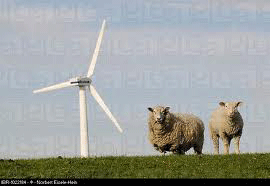 How wind farms provide a safety net for farmers, communities http://www.examiner.com.au/story/4136408/wind-turbines-can-power-a-bright-new-era-for-rural-areas/?cs=97 Charlie Prell 5 Sep 2016, In the 1950s, Australia “rode on the sheep’s back”. Wool was commanding obscene amounts of money, and farmers experienced a period of prosperity that hasn’t been seen since. It helped make Australia one of the wealthiest countries in the world.
Renewable energy promises to create a new “wool boom”. But, unlike the 1950s, the boost from the clean energy revolution will last decades, possibly generations.
Farmers, large and small, can grasp this once-in-a-lifetime opportunity that will breathe new life into struggling rural communities. That’s why I’ve signed up to host wind turbines on my sheep farm.
Wind farms offer both environmental and financial benefits. Turbines quietly produce clean, renewable electricity, replacing power from ageing, inefficient coal-fired generators that are driving climate change.
Each turbine generates a steady income of tens of thousands of dollars a year for the farmers who host them, as well as their neighbours. The community doesn’t miss out, with wind proponents promising thousands of dollars a year to projects like supporting local sporting teams, rejuvenating halls and providing community transport. This is on top of locals being employed to manage and maintain the turbines.
Despite record commodity prices, farmers are still doing it tough. As droughts and floods become more common, the stable income generated by turbines can make the difference between floating into sustainability or drowning in debt.
Instead of needing financial support from governments, farmers can become self sufficient for decades and generations. Wind turbines do more than change the landscape – they reinvigorate the economic and social fabric of rural communities for the better. Charlie Prell is a fourth-generation farmer from Crookwell, NSW and organiser for the Australian Wind Alliance.
Poll shows broad support for green groups using ‘lawfare’ to challenge mining ventures
 Majority support green groups using ‘lawfare’ to challenge mining ventures: poll, The Age, Peter Hannam 4 Sept 16 The Turnbull government should make saving the Great Barrier Reef “an absolute priority”, and green groups should be able to use existing laws to protect the environment, new polling has found.
The ReachTEL survey of 2636 respondents commissioned by the Australian Conservation Foundation found broadbased backing for the reef and the use of the courts to challenge new mines, even among self-described as Liberal-National Party supporters.
The poll was taken Tuesday, a day after an ACF challenge failed in the Federal Court against the federal government’s approval of the giant Adani coal mine in Queensland. Some conservative politicians have accused green groups of using “lawfare” to delay major projects by testing approvals in court………Larissa Waters, the deputy Greens leaders, said the poll’s findings underscored the political risks for the Coalition.
“Last time the Coalition government tried to roll back our national environment laws, attack the voices of our environment and stop ordinary Australians from enforcing them in the courts, they got walloped,” Senator Waters said. “I’d be surprised if the government was out of touch enough to try the same attacks again.”
Sean Ryan, principal solicitor for the Environmental Defenders Office Queensland, said there already exists “a massive disparity” in financial resources available to the community compared with the mining sector……..http://www.theage.com.au/environment/majority-support-green-groups-using-lawfare-to-challenge-mining-ventures-poll-20160902-gr74v3.html
Solar power in Australia working better than expected
 Solar Power Does Work, Even Better Than Expected, Clean Technica, September 2nd, 2016 by Giles Parkinson Originally published on RenewEconomy. [excellent graphs]
One of the prices we have to pay for our ideological divide on renewable energy is that we have to read headlines like this, particularly in the Murdoch media: “Solar and wind power simply don’t work, not here, not anywhere”. It was written by the former chairman of a coal mining company, in case you were wondering.
Solar doesn’t work? New analysis of Australia’s first large-scale solar farms shows that solar actually does work, and rather better than expected. And the findings should make it a lot easier for future projects to get the backing of equity investors and bankers, if not the owners of coal fired generators desperately protecting their turf.
The research has been produced by US-based solar module manufacturer First Solar, whose panels have been used for around three quarters of the large-scale solar projects built in Australia to date, by capacity.
Its study shows that at all the solar farms built by First Solar – in western NSW, north Queensland and Western Australia – the output has been higher than forecast. Collectively, the Australian solar plants using First Solar thin-film PV modules are performing above expectations by an average of 3.2 per cent.
The best result has been produced by Broken Hill, the 53MW plant built near the iconic mining town in western NSW, which is so far delivering 4.2 per cent above expectations.
(Spectral advantage, btw, is a measure that First Solar uses to show how much better their panels work in humid conditions than silicon-based rivals).
Now, this might not sound like ground-breaking news – forecast production broken by a few percentage points.
But people in suits are very conservative types, and investment in renewable energy in Australia, both in wind and solar, has been hampered by the fact that bankers won’t finance investments unless they can actually touch, feel and watch the technology, and have proof that it actually works.
This data, Curtis says, is proof that the projects are, indeed, bankable. And that’s more important than it might sound.
Curtis says that even though large-scale solar has been proved in many international locations, local investors still wanted proof that it would work in Australia, even though it does have some of the best solar conditions in the world. Such, perhaps, is the insular nature and/or inherent conservatism of Australia’s banking system.
But Curtis is reassured, not just by the release of the production statistics, but also by the attitude of equity investors and financiers in the local market………
……Dylan McConnell, from the Melbourne Energy Institute, emailed through a production chart from the 102MW Nyngan solar farm, which also used First Solar technology.
McConnell pointed out that, indeed, Nyngan was producing at a capacity factor of 25 to 26 per cent. This, he said, was far higher than official forecasts relied upon for the Australian Power generation Technologies Report, which estimated the average capacity factor of large-scale solar PV at 19-22 per cent.
That, says McConnell, suggests that the forecasts relied upon by the federal government underestimate the output of solar farms by between 15 and 35 per cent.
Little wonder that the government can’t make any sensible decisions about large-scale solar, and why it insists on defunding the agency that has brought about most of the cost reductions in the past year, ARENA. https://cleantechnica.com/2016/09/02/solar-power-work-even-better-expected/
South Australia’s Premier Weatherill is proud that his nuclear waste import plan is RISKY!
 Voters will reward my courage, Weatherill insists, INDaily, 1 Sept 16 Tom Richardson
 Tom Richardson “……….the Premier believes the South Australian public will reward his own Government at the 2018 election for courting “political risk” with contentious changes to the state’s healthcare system and a royal commission into the nuclear fuel cycle………
I think ultimately people will give credit to people that are taking on the big decisions,” he insisted.
“There will always be complaints around the edges, but in their heart of hearts they understand somebody’s got to tackle these big questions.”……
On the nuclear issue, acting Liberal leader, Vickie Chapman said: “Weatherill scans the world and tries to find an idea, then thinks, ‘I’ll be bold and brash about this’ – but he’s years late, so it just becomes a sideshow.”……http://indaily.com.au/news/politics/2016/09/01/voters-will-reward-my-courage-weatherill-insists/
Geothermal energy – not necessarily renewable, nor environmentally benign.
Dennis Matthews, 3 Sept 16 It’s important to understand that what companies such as Geodynamics, and organisations like the SA Centre for Geothermal Energy Research at Adelaide Uni have been trying to do is a special sort of geothermal energy, commonly known as “Hot Rocks”. This type of geothermal energy is not renewable in the normal sense of the word, and it is not environmentally benign.
Hot Rocks geothermal requires the expenditure of large amounts of energy to drill 5km underground and to pump liquid under pressure in order to fracture rocks (fracking) 5 km underground. for which it uses a large amount of water to do this.
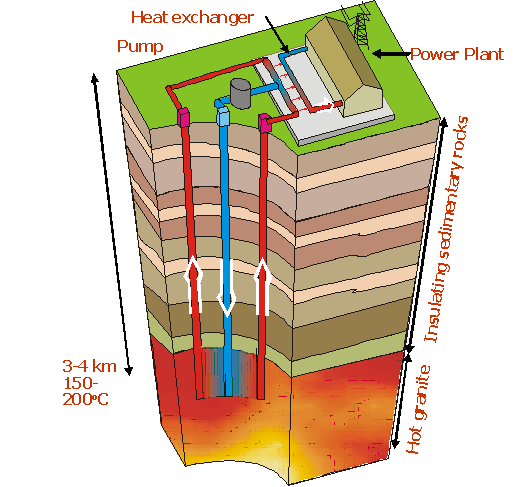
In SA, where most of the hot rocks projects were being pursued, the eventual market for the electricity would have been mining companies especially uranium mines such as Roxby Downs and Beverley. This is no coincidence. The rocks are hot, not because of heat from the earths interior, but because they are radioactive.
By fracking the radioactive rocks and pumping water through them, radioactive radon gas is released and the water becomes radioactive through a host of radioactive isotopes that have built up over millions of years. In principle, during operation the water is not released to the environment but this is the ideal scenario. Accidents and maintenance work is highly likely to rel;lease radioactive water. The water used in fracking is not recycled. I assume it is put into tailings dams and allowed to evaporate leaving behind a concentrated radioactive waste. Often this occurs in areas, such as near the Cooper, which are subject to flash flooding.
Each hot rocks site has a very limited life (approx 20 years), because the rate of heat replacement is much less than the rate of extraction. This means that the project has to constantly move from one set of 5km holes and the exhausted holes will not be viable for “many hundreds of years”. This is not renewable energy. Growing trees for biomass is quicker. Solar is instantaneous in the sense that the sun is essentially an infinite source of energy; using solar energy in no way diminishes the amount available.
Despite several attempts, I was never able to get an answer on the energy payback time, or on greenhouse gas emissions and payback time, or water consumption. For the last 20 years these projects have been powered by govt subsidised diesel and have received very generous Govt funding, both State and Federal, including for the Centre for Geothermal Energy Research. Up to April 2010, public funding totalled approx $300 million.
When these projects were first proposed with backing from the SA mines and energy dept I publicly stated that they were economically and environmentally risky. I see no reason to now change that position.
Unions ready to oppose South Australian Premier Jay Weatherill on nuclear waste dump plans
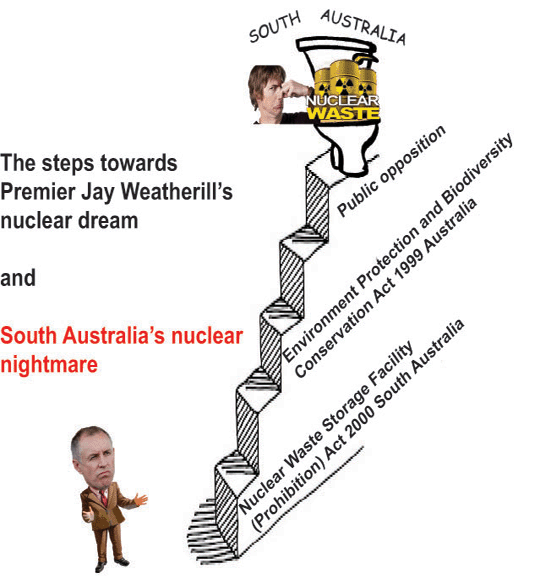 Unions ready to dump on Jay Off the Record: SA’s home of political, business and legal gossip http://www.adelaidenow.com.au/news/opinion/off-the-record-sas-home-of-political-business-and-legal-gossip/news-story/d4d7206f85a8cf5ff5a628158157ef66The Advertiser September 2, 2016 POWERFUL forces within the Labor movement are bracing for an intense union campaign against Premier Jay Weatherill if he goes ahead with plans for a high-level nuclear waste dump.
Off the Record can reveal some are talking about a repeat of the union campaign against Mike Rann, which boiled over in 2010 when he needed a police escort through protesters at Labor’s state conference.
Labor figures have drawn our attention to Maritime Union of Australia state secretary Jamie Newlyn’s public backing of the No Dump Alliance, a broad coalition of environmentalists, indigenous groups and academics.
Newlyn, also SA Unions president, says on the group’s website that the MUA has “a long history of opposing expansion of the nuclear industry including nuclear waste dumps”.
“We fear that the economic assumptions pale in insignificance to the unknown safety and environmental implications of such plans,” says Newlyn.
Wharfies clearly would be required to unload any imported high-level waste, so the union’s support would be critical.
SA Unions vice-president (women) and nurses’ union state secretary Elizabeth Dabars also is backing the anti-dump campaigners, ambiguously declaring her union is pleased “to join the No Dump Alliance to actively participate in community debate on this very important issue for the South Australian community”.
Rann discovered, to his peril, the risks of putting off-side powerful union leaders, such as Australian Workers’ Union state secretary (now president)Wayne Hanson. The AWU, however, is said to be more onside with the dump, because of the potential for jobs and investment.
Perhaps Weatherill will have to worry about his hitherto smooth relations with the union movement being disrupted when he delivers, by the end of the year, the government’s response to the nuclear royal commission.
Carbon neutral plan for Adelaide transport would supply 20,000 jobs
20,000 jobs tipped if Adelaide spends big on tram network, plug-in hybrid cars to be carbon-neutral city http://www.adelaidenow.com.au/news/south-australia/20000-jobs-tipped-if-adelaide-spends-big-on-tram-network-plugin-hybrid-cars-to-be-carbonneutral-city/news-story/0a9e113ba2c052a5167ab24a9b6d1c49 September 2, 2016 A RADICAL plan to make Adelaide the world’s first carbon-neutral city could create more than 20,000 jobs, a State Government-commissioned report says.Engineering company Siemens has presented a range of options that could help Adelaide reduce its net carbon emissions to zero by 2025, including heavy investment in public transport to reduce private car use.
The report, released on Friday, says spending $4.9 billion on public transport infrastructure, including six new tram lines, could create 21,000 full-time equivalent jobs and reduce car use as a share of annual passenger kilometres by 20 per cent.
A less expensive option would be to create incentives for more drivers to use low-emission vehicles, including plug-in hybrid cars.
A $1.4 billion outlay would create 5600 full-time equivalent jobs but would provide a greater return on investment, reducing Adelaide’s transport-related emissions by up to 47 per cent.
“From a 50-50 split in 2015, emissions in the building sector will drop to 33 per cent, with 67 per cent of emissions accruing from transportation,” the report says. “The city will increasingly need to tackle its transport emissions to meet its targets.”
Incentives to encourage greater use of electric cars could include free public parking, exemptions from one-off purchase fees and the freedom to use dedicated bus lanes, all of which have been implemented in Norway. Electric car owners could also receive grants and streamlined permits to install their own charging stations or a reimbursement of energy recharging costs.
Premier Jay Weatherill said the report would add to the debate on ways to reduce emissions, adding that previous efforts to green the state had not constrained economic growth. “We’ve demonstrated that you can cut your emissions and at the same time grow your economy,” he told a Committee for Economic Development of Australia briefing. “These two things are not mutually exclusive.”
G20: Which country is worst on climate change action? Oh it’s Australia, AGAIN!
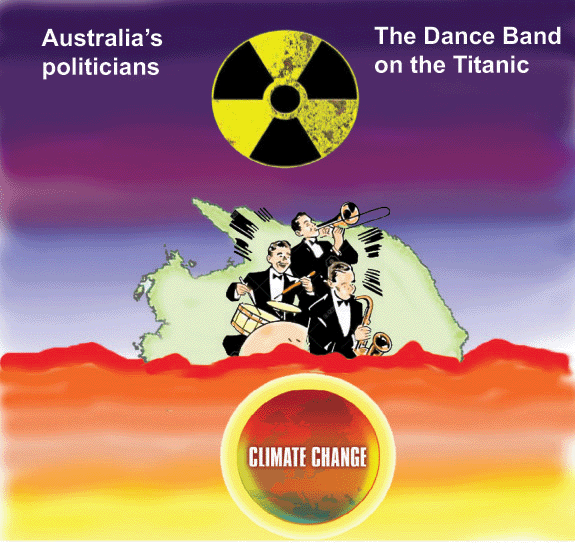 The report notes that if every country emulated Australia’s level of ambition, global warming would likely exceed 4C.
It also said that Australia’s currently implemented policy measures were not set to achieve even those inadequate targets and instead would rise to about 27% above 2005 levels by 2030, rather than the targeted 26 to 28% below 2005 levels.
Australia worst among G20 when it comes to action on climate change, report finds
Australia the only country to receive a rating of ‘very poor’ in a majority of categories in Climate Transparency scorecard, Guardian, Michael Slezak, 1 Sept 16, Australia is the worst country among the G20 when it comes to action on climate change, according to a comprehensive assessment before the G20 summit in China.
Under China’s leadership, this weekend’s G20 in the eastern city of Hangzhou has had a strong focus on climate-related issues.
By analysing the policies and actions of each of the 20 countries, which together produce 75% of the world’s greenhouse gas emissions, Climate Transparency produced a report, scorecard and series of country profiles detailing their findings, revealing Australia was not pulling its weight.
On the scorecard, Australia was the only country to receive a rating of “very poor” in a majority of categories.
Australia was given the worst possible rating of “very poor” for its performance on emissions trends, carbon intensity, share of renewables in its energy supply and overall climate policy.
It was rated as “poor” in every other category: for its energy intensity, share of coal in energy supply and electricity emissions intensity. Continue reading
Appeal lodged against Western Australia’s Mulga Rock uranium mine project
Appeal against WA Mulga Rock uranium mine Sky News, Tuesday, 30 August 2016 An appeal has been lodged against the Environmental Protection Authority’s recommendation to approve the proposed Mulga Rock uranium mine in Western Australia’s Goldfields region.
The appeal was lodged on Monday by the Conservation Council of WA, the Australian Conservation Foundation, The Wilderness Society, Friends of the Earth Australia and the Anti Nuclear Alliance of WA.
The grounds for appeal include environmental factors for flora and fauna, mine closure, tailings management and impacts to water……
Following the EPA’s recommendation with 14 conditions, including having environmental and Aboriginal heritage management plans in place, it is now up to state and federal environment ministers to decide if the project will go ahead.
But CCWA campaigner Mia Pepper says the proposed mine sits in the Yellow Sand Plain Priority Community, which supports rare and endangered species.
‘If this mine were to proceed it would take 15 million litres of water a day from the environment and clear over 3000 hectares of native bushland and important habitat for 93 reptile species, 28 bird species and 10 mammal/marsupial species,’ she said.
‘This uranium mine would leave behind a legacy of 30 million tonnes of radioactive tailings and mine waste that would pose a threat to the environment for thousands of years.’
Earlier this month, the EPA rejected Cameco’s plan to mine uranium at its Yeelirrie project, 70km southeast of Wiluna, because the project posed unacceptable risks to subterranean fauna. – See more at:http://www.skynews.com.au/business/business/company/2016/08/30/appeal-against-wa-mulga-rock-uranium-mine.html#sthash.qqOmAFyx.dpuf
Australian govt’s cuts to clean energy will mean loss of many CSIRO jobs
 120 CSIRO jobs face the axe if clean energy cuts go through, http://www.canberratimes.com.au/national/public-service/120-csiro-jobs-face-the-axe-if-clean-energy-cuts-go-through-20160831-gr5hxc.html Noel Towell, 31 Aug 16
More than 120 research jobs at the CSIRO face the axe if the Coalition’s proposed cuts to the clean energy research agency are approved by Parliament.
The threatened jobs come on top of scores of university science positions on the chopping block if the Australian Renewable Energy Agency is de-funded as part of the government’s “budget repair” omnibus bill currently before the Parliament.
The new threat to CSIRO research comes less than a month after Science Minister Greg Hunt instructed the organisation to renew its focus on climate science, claiming it would be a “bedrock function” of the agency’s activities.
Fairfax reported on Wednesday that Australia’s leading renewables researchers were warning the nation was heading towards the “clean energy valley of death” if the ARENA cuts are passed. Continue reading
1 This month
17 October, Free Public Talk on Nuclear Issues in South Australia
David Noonan will speak on public interest concerns over the new Roxby Downs Indenture Act 2026 on BHP copper-uranium mining and ore processing in SA, and on how AUKUS may face SA with a High-Level nuclear waste agenda.
Dr Jim Green will discuss international developments in the field of nuclear power including ‘small modular reactors’ and Generation 4 ‘advanced’ nuclear reactor concepts.


Help Aunty Sue Protect Her Land and Sacred Sites From Destructive Rocket Testing.
.

Australians deserve the truth
about
AUKUS – https://aukuspublicinquiry.com/

PETITION – To: Prime Minister Anthony Albanese and the Australian Labor Government

of the week – Australians for War Powers Reform (AWPR)
To see nuclear-related stories in greater depth and intensity

