Another dumb Resources Minister supports ‘clean coal’ myth
 Coalition climate numbskulls back again flogging CCS at a cost of $209 billion Lachlan Barker, Independent Australia 25 August 2016, The Coalition’s latest brainsnap of flogging Carbon Capture and Storage (CCS) as a solution to CO2 emissions from coal-fired power stations will set the taxpayer back an eye-watering $209 billion, says Lachlan Barker. “…… the utterly ludicrous notion of Carbon Capture and Storage (CCS), as a solution to CO2 emissions from coal fired power stations has raised its idiot head once more.
The CCS process involves capturing the CO2 emitted from the burner chamber, compressing it, and sequestering it underground.
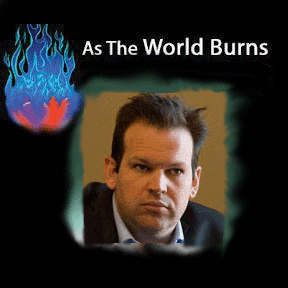 Resources Minister Matt Canavan recently handed out $23.7 million to various bodies around the country to (once more) discover CCS can never work. So I can tell you right here, right now, CCS is not feasible in any way — financially, ecologically or in an engineering sense.
However since Canavan has done this thing, once more we are all forced to go through the mill of showing why CCS is an utterly fallacious idea.
The Massachusetts Institute of Technology (MIT) has an excellent reference page for CCS, so I’ve distilled the Power Plants CCS Projects page down for you here: [excellent charts and graphs on original]……..https://independentaustralia.net/politics/politics-display/coalition-climate-numbskulls-back-again-flogging-ccs-at-a-cost-of-209-billion,9394
Australia makes itself unpopular at Geneva with unintelligent nuclear weapons diplomacy
 Australia writes itself out of nuclear disarmament diplomacy http://www.
 lowyinterpreter.org/post/2016/08/23/Australia-writes-itself-out-of-nuclear-disarmament-diplomacy.aspx, Richard Lennane 23 August 2016
 On Friday at the United Nations in Geneva, Australian diplomats called a vote they knew they would lose, split their already modest support base in half, and enraged more than 100 other countries that had been ready to agree to a painstakingly negotiated compromise. For its trouble, Australia gained precisely nothing, and seriously damaged its credibility and influence. If it sounds like a diplomatic train wreck, it was. What on earth was going on?
The drama unfolded on the final day of the UN Open-ended Working Group on taking forward multilateral nuclear disarmament negotiations. This group has met intermittently throughout 2016; the principal goal for Australia and around 28 other countries in nuclear alliances (also known as ‘umbrella states’ or, more colourfully, ‘nuclear weasel states’) was to ensure that the group did not recommend the negotiation of a new treaty prohibiting nuclear weapons (Tim Wright covered the ban treaty proposal and the associated dilemmas for Australia in The Interpreter in June).
Australia’s manoeuvres on Friday were merely the latest in a series of ill-conceived efforts to try to stop the ban treaty, but which have only fuelled support for it. Continue reading
Australia’s weasel words at United Nations Nuclear Disarmament Conference
Australia has steadily retreated from the push for universal nuclear disarmament that Bill Hayden, notably, inserted into policy when he was foreign minister in the Hawke government to provide moral balance to the alliance with the US.
 As we’ve noticed before, the new Defence White Paper this year dropped all that. “Australia’s security is underpinned by the ANZUS Treaty, United States extended deterrence and access to advanced United States technology and information,” it stated. “Only the nuclear and conventional military capabilities of the United States can offer effective deterrence against the possibility of nuclear threats against Australia.”
Julie Bishop is all for nuclear weapons, gushing that “the horrendous humanitarian consequences of nuclear weapons are precisely why deterrence has worked”. In Geneva, her diplomats have been hard at work trying to derail efforts for a United Nations ban on nuclear weapons.
…..much bad will towards Australia. But Bishop can be sure of brownie points in Washington, no doubt.
Weasel words at UN working group Malcolm Turnbull is getting accused of many things as he heads towards the first anniversary of his snafu-prone prime ministership. But aiding and abetting the planning of genocide, ecocide and even omnicide (that is, the destruction of everyone and all living things)?
Well, yes. The University of Sydney was recently the venue for an international people’s tribunal, a kind of volunteer court, in which the leaders of the nine nuclear powers were on trial for planning the above crimes through their explicit threats to use their weapons. Turnbull, as our current leader, was up for facilitating the use of American weapons. The judges were New Zealand’s former disarmament minister Matthew Robson and Sydney politics academic Keith Suter, who duly found the accused guilty, in absentia of course.
They ruled that nuclear weapons violate the accepted principles of international humanitarian law in wartime because they cannot discriminate between military and civilian targets; go far beyond proportional response and military objectives; don’t protect non-combatants; cause unnecessary suffering by spreading poison, disease and genetic damage; cause massive environmental damage; threaten future generations; threaten death on a scale amounting to genocide; and involve massive collateral damage to neutral countries.
The United States, France, Russia, Pakistan and Britain refuse to rule out first use of their nuclear weapons, “but all indicted leaders have military plans and exercises that demonstrate that they are ready to use nuclear weapons if they deem it necessary”, the tribunal found. …….
The gesture comes as nuclear powers are expanding or modernising their arsenals. India and Pakistan are in a nuclear arms race: even use of 100 Hiroshima sized-bombs in that theatre would plunge the Earth into its coldest climate for a thousand years, University of Missouri expert Steven Starr told the tribunal. An exchange between the big powers would, aside from the immediate casualties, create a new Ice Age and result in most surviving humans and large animals dying of starvation……
Nuclear ‘weasels’ Continue reading
Time that Australia ended its reliance on Extended Nuclear Deterrence (END)
The revival of concern about the humanitarian impacts of these weapons is shifting old assumptions.
Australia’s reliance on END keeps us on the wrong side of history. And it has led previous governments and the current government to actively oppose the growing calls for a ban on nuclear weapons.
Instead of blindly following US nuclear policies into whatever a future president might envisage, Australia should carefully consider its non-nuclear defence and challenge all claims, surrogate or otherwise, to nuclear weapons.
 Australia’s stance on nuclear deterrence http://www.swinburne.edu.au/news/latest-news/2016/08/australias-stance-on-nuclear-deterrence-.php 26 August 2016
IN SUMMARY Analysis for The Conversation by Swinburne PhD candidate Dimity Hawkins and Swinburne senior lecturer Julie Kimber.CONTACT Lea Kivivali +61 3 9214 5428 lkivivali@swin.edu.au
For Australia, the US election should provide an opportunity to rethink defence relationships, especially as they relate to nuclear weapons.
There has been much hand-wringing at the thought of Donald Trump becoming US president. If, by some miracle, Trump succeeds in November, he will have his hand on the nuclear trigger.
But this concern, while great political fodder, is dangerously simplistic. It presupposes there are “safe hands” when it comes to nuclear weapons. There are not.
The US has around 7,000 nuclear weapons. Hundreds of these can be launched within minutes. While the global community has outlawed other indiscriminate weapons of mass destruction, nuclear weapons are yet to be banned.
The Cold War’s MAD (Mutually Assured Destruction) doctrine has morphed over the years into a framework of nuclear deterrence. Many governments globally have played a double game: supporting nuclear disarmament on the one hand, while relying on a nuclear defence on the other.
One such government is Australia’s. Despite consecutive governments insisting they support nuclear disarmament, Australia’s reliance on Extended Nuclear Deterrence (END) means it is frustrating attempts at a total ban.
- When defence conflicts with deterrence Continue reading
Indigenous people oppose Australian company’s plan for massive uranium mine in Greenland
 Greenland Inuit oppose open-pit uranium mine on Arctic mountain-top http://www.theecologist.org/News/news_analysis/2988016/greenland_inuit_oppose_openpit_uranium_mine_on_arctic_mountaintop.html, Bill Williams ,17th August 2016
A collapse in the price of uranium has not yet stopped Australian mining company GME from trying to press ahead with a massive open-pit uranium mine on an Arctic mountain in southern Greenland, writes Bill Williams – just returned from the small coastal town of Narsaq where local people and Inuit campaigners are driving the growing resistance to the ruinous project.
Recently I was invited to assess an old Danish uranium exploration site in Kvanefjeld in southern Greenland.
Inuit Ataqatigiit – the opposition party in the national parliament – had asked me to talk to local people about the health implications of re-opening the defunct mine.
An Australian firm called Greenland Minerals and Energy (GME) has big plans to extract uranium and rare earth minerals here. It would be a world first: an open-pit uranium mine on an Arctic mountain-top.
From the top of the range above the mine site I looked down across rolling green farmland to the small fishing village of Narsaq. Colourful timber houses rested at the edge of a deep blue strait that the Viking Eric the Red navigated a thousand years ago. Hundreds of icebergs bobbed on its mirror-like surface. To the east, half way up the valley, a small creek tumbled into a deep rock pool.
Behind that saddle lies Lake Tesaq, a pristine Arctic lake that GME plans to fill with nearly a billion tonnes of waste rock. This part of the mine waste would not be the most radioactive, because the company plans to dump this material in a nearby natural basin, with the promise that an ‘impervious’ layer would prevent leaching into the surrounding habitat.
Left behind – all the toxic products of radioactive decay
These mine tailings would contain the majority of the original radioactivity – about 85% in fact – because the miners only want the uranium and the rare earth elements. They would mine and then leave the now highly mobile radioactive contaminants, the progeny from the uranium decay behind: thorium, radium, radon gas, polonium and a horde of other toxins.
Even at very low levels of exposure ionising radiation is recognised as poisonous: responsible for cancer and non-cancer diseases in humans over vast timespans.
This is why my own profession is under growing pressure to reduce exposure of our patients to X-Rays and CT scans in particular – making sure benefit outweighs risk. It’s also why ERA, the proprietors of the Ranger mine in Kakadu, Australia, are legally obliged to isolate the tailings for at least 10,000 years.
While this is hardly possible, the mere fact that it is required highlights the severity and longevity of the risk. My Inuit audience in Narsaq was particularly interested to hear the messages I brought from traditional owners in Australia like Yvonne Margarula, of the Mirarr people:
“The problems always last, but the promises never do.”
And Jeffrey Lee from Koongara:
“I will fight to the end and we will stop it, then it won’t continue on for more uranium here in Kakadu.”
So far in 2016, not a single new nuclear reactor has opened
When GME started touting this project a decade ago the price of uranium was over $120 per pound and everybody in the extractive industry was breaking open the bubbly in anticipation of the ‘nuclear renaissance’.
We were told that nuclear power would save the world from anthropogenic carbon-carnage and uranium was a stock-market wunderkind. Then came the global financial crisis of 2007/2008 and the spot-price halved. And then the nuclear reactors at Fukushima melted down, and the price halved again.
And so the ‘renaissance’ failed to materialize: the real news today is that there has not been one reactor construction start-up so far this year. Not one. Not even in China, the only place where one could honestly claim there has been significant build in the past decade. Consequently, the uranium price has collapsed down to about $25 a pound at present.
GME’s share price trajectory has amplified the fall in the uranium price – from $65 a share in 2007 to less than 3 cents today. Despite this reality GME continues to wax lyrical about the company’s prospects.
A small nation divided
Two years ago the newly elected Greenland national government rescinded a 30-year ban on mining and exporting uranium – but their majority of just one seat in the 31-seat parliament makes this a fragile promise. Inuit Ataqatigiit holds the other 15 seats and is strongly committed to preventing any mine.
Similar division exists in the region where the ore-body is located. The small town of Narsaq deep in the southern fjords has seen much conflict and distress ever since the Aussie miners came to town. While some locals believe the mine would mean jobs and dollars, many of their neighbours are profoundly suspicious and resistant.
When I reached the mine site I was reminded of Tolkien and of Orcs and Goblins. The Danes who first dug down deep into the mountain side 40 years ago left a great grey door fastened tightly into the mine entrance to deter any curious future visitors. And behind the door lies the booty – the fuel for the world’s most dangerous weapons and long lived industrial waste, buried in the mountain top.
If allowed to the Antipodean treasure hunters would dump a billion tonnes of waste rock in a sapphire lake and hundreds of thousands of gallons of liquid radioactive waste in a shallow ditch at the head of a primeval watershed. Then they would pack up and leave within a few decades.
But the wastes and risks they would have generated would not. Some of uranium’s radioactive byproducts would be a contamination threat to the surrounding region for tens of thousands of years.
And as the Inuit Party and a lot of folks in Narsaq have been trying to tell GME, keeping the door open for a truly green Greenland means keeping the great grey door in the mountain firmly shut on uranium mining. Bill Williams MBBS is Chair of the International Campaign to Abolish Nuclear Weapons(ICAN) – Australia.
Climate Change Adaptation – South Australia in the lead
National Climate Adaptation Conference 2016, Day Three – Sean Kidney
SOUTH AUSTRALIA: LEADING ON CLIMATE CHANGE ADAPTATION The Climate group, August 2016. Sandy Pitcher, Chief Executive of South Australia’s Department of Environment, Water and Natural Resources, reflects on the achievements of Australia’s preeminent climate change forum, the Climate Adaptation 2016 conference, which took place in Adelaide in July.
The Climate Adaptation 2016 conference provided an unprecedented opportunity for South Australia to highlight the important progress being made on climate change adaptation in our state, and learn from others in Australia and around the world.
The conference was presented by the National Climate Change Adaptation Research Facility and the Commonwealth Scientific and Industrial Research Organisation, with the South Australian Government – a member of The Climate Group’s States & Regions Alliance, the platinum sponsor. It attracted around 490 policy makers, researchers and practitioners and the debate focused on the challenges and opportunities presented by climate change adaptation.
The innovation that we’re seeing mainly happens at the local level, and can be shared at conferences like this. It is a crucial way, for us in South Australia and beyond, to share ideas, catalyze local action, and bring key influencers together.
ADAPTATION IS A VERY KEY TENANT TO ANY FUTURE STRATEGY – THERE ARE MANY PEOPLE WHO ARE GOING TO BE IMPACTED BY A CHANGING CLIMATE
South Australia has long been recognized as a global leader on climate action, and our work in climate change adaptation is central to our efforts.
Our award-winning adaptation framework is based on a collaborative, regional approach involving partnerships between local government, regional development committees and natural resources management boards, who are working together to develop well-informed adaptation solutions for their communities.
Currently, in each of the State’s regions, five climate adaptation plans have been completed with the remainder due to be finalized by the end of the year….https://www.theclimategroup.org/news/south-australia-leading-climate-change-adaptation
South Australia’s nuclear waste dump plan not economically viable? The nuclear lobby doesn’t care
The global nuclear lobby surely does not care about whether or not the South Australian nuclear waste importing scheme is economically viable. Their fairly desperate need is to sell nuclear reactors to those countries that don’t already have them. In particular, the ‘small nuclear” lobby sees an urgency now, with ‘big nuclear’ failing, to get their industry happening.
A commitment by an Australian State to take in nuclear waste could do the trick for them – as Oscar Archer put it – by unblocking the back end of the nuclear fuel cycle.
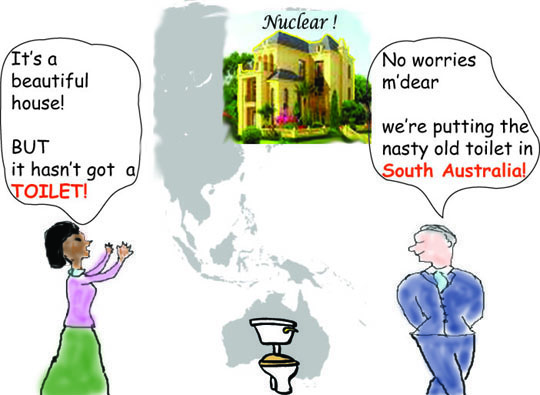
Mixed motives in South Australia’s nuclear waste import plan. Online Opinion, Noel Wauchope, 23 Aug 16 In South Australia the continued nuclear push focusses solely on a nuclear waste importing industry. Yet that might not be economically viable. Behind the scenes, another agenda is being pursued – that of developing new generation nuclear reactors.
First, let’s look at the message. The message from the Nuclear Fuel Cycle Royal Commission (NFCRC) is clearly a plan to make South Australia rich, by importing foreign nuclear wastes. …..This theme has been repeated ad nauseam by the NFCRC’s publicity, by politicians, and the mainstream media.…..
Whereas other countries are compelled to develop nuclear waste facilities, to deal with their waste production from civil and military reactors,that is not a necessity for Australia, (with the exception of relatively tiny amounts derived from the Lucas Heights research reactor).
So, the only reason for South Australia to develop a massive nuclear waste management business is to make money.
If it’s not profitable, then it shouldn’t be done.
Or so it would seem.
There is another, quieter, message. When you read the Royal Commission’s reports, you find that, while the major aim is for a nuclear waste business, in fact, the door is kept open for other parts of the nuclear fuel chain……… Continue reading
154 scientists press Australian government for urgent action on climate change
 154 Australian scientists demand climate policy that matches the science https://theconversation.com/154-australian-scientists-demand-climate-policy-that-matches-the-science-64359
- James WhitmoreEditor, Environment & Energy, The Conversation
Interviewed
- Andrew Glikson Earth and paleo-climate scientist, Australian National University
- Andrew Blakers Professor of Engineering, Australian National University
- Lesley Hughes Professor, Department of Biological Sciences, Macquarie University
August 25, 2016 154 Australian experts have signed on open letter to Prime Minister Malcolm Turnbull demanding urgent action on climate change that matches the dire warnings coming from climate scientists.
The letter, organised by Australian National University climatologist Andrew Glikson, calls on the federal government to make “meaningful reductions of Australia’s peak carbon emissions and coal exports, while there is still time”.
Signatories include leading climate and environmental scientists such as the Climate Council’s Tim Flannery, Will Steffen, and Lesley Hughes, as well as reef scientists Ove Hoegh-Guldberg and Charlie Veron.
They point out that July 2016 was the hottest month ever recorded, and followed a nine-month streak of record-breaking months. Average carbon dioxide concentrations in the atmosphere reached 400 parts per million (ppm) in 2015, and are rising at a rate of nearly 3 ppm each year.
The world is already witnessing the effects of climate change, the letter argues, including an increase in extreme weather events, melting of the polar ice sheets, and ocean acidification.
Australia, along with 179 other nations, has signed the climate treatybrokered in Paris last year, aiming to limit average global warming to “well below 2℃ above pre-industrial levels and to pursue efforts to limit the temperature increase to 1.5℃”.
However Glikson warned that “the Paris Agreement, being non-binding, is in danger of not being fulfilled by many of the signatories”. The deal will not enter into force until it is ratified by 55 nations accounting for at least 55% of the world’s greenhouse emissions.
Glikson called for action to “transition from carbon-emitting technologies to alternative clean energy as fast as possible, and focus technology on draw-down (sequestration) of greenhouse gases from the atmosphere”.
Australia’s current greenhouse gas target, which it took to December’s Paris climate summit, calls for emissions to be reduced by 26-28% below 2005 levels by 2030. It has been widely criticised by experts as not ambitious enough.
Andrew Blakers, professor of engineering at the Australian National University, said Australia could reduce emissions by two-thirds by 2030 “at negligible cost”.
He said the falling cost of renewable energy, particularly solar and wind, the replacement of gas with electricity for heating, and the advent of electric vehicles would eliminate most emissions. Solar and wind installation, currently at 1 gigawatt each year, would need to be increased to 2.5 gigawatts each year to reach 100% renewable energy by 2030.
Remaining emissions, from shipping, aviation, and industry, could be eliminated after 2030 at slightly higher costs.
Lesley Hughes, a member of the Climate Council and professor at Macquarie University, said there were a number of factors causing the gap between science and policy, including vested interests, perception of economic downsides of climate action, ideological biases, and inertia in the system from current investment in fossil fuels. But she said the “most important issue” was the difficulty in convincing people to act to reduce risk decades in the future.
The Climate Change Authority, which advises the government on climate policy, in 2014 recommended Australia adopt a target of 40-60% below 2000 levels by 2030.
In a report released yesterday, The Climate Institute highlighted that aiming for 1.5℃ instead of 2℃ would avoid longer heatwaves and droughts, and give the Great Barrier Reef a better chance of survival.
The institute recommended that Australia adopt an emissions reduction target of 65% below 2005 levels by 2030 and phase out coal power by 2035.
Suppression of native title for the Mirarr people- extinguishment of rights?
Timber Creek Aboriginal custodians win historic $3.3 million payout for native title rights loss, ABC News, By Avani Dias and Jessicah Mendes 25 Aug 16 “………Extinguishment principle ‘hard to accept’
In a separate decision, the Federal Court has partially recognised the rights of the Mirarr people to one of the longest-running native title claims in the Territory.
The court has recognised the Mirarr’s rights over sections of the township of Jabiru that have been subleased to government entities. But those rights only apply if and when the leases expire — a move described as the “suppression” of native title.
The ruling also rejected or ‘extinguished’ the Mirarr’s rights over areas of the town subleased to private companies such as Energy Resources Australia — the operators of the Ranger uranium mine.
Mr Morrison said the case had been a complicated one.
“I think it was a very difficult case but I think it also sets an important precedent to partially recognise, through suppression, native title in parts of Jabiru,” he said.
But he said the concept of a native title claim being rejected or “extinguished” could be very difficult for Aboriginal people to accept.
“Aboriginal people right around the country have said it’s an abhorrent feature of the Native Title Act, this extinguishment principle.”http://www.abc.net.au/news/2016-08-24/timber-creek-custodians-payout-for-native-titles-rights-loss/7779532
South Australia: Future Business Council calls for National smart energy grid
Tom Quinn: South Australian business is paying high price for ‘dumb’ national electricity grid http://www.adelaidenow.com.au/news/opinion/tom-quinn-south-australian-business-is-paying-high-price-for-dumb-national-electricity-grid/news-story/97918e65518213082303ddd011421d3f
Last week’s meeting of energy ministers fumbled their first chance to do so, leaving business hamstrung. Nowhere is that as painfully clear than in South Australia.
The state has led the country in tapping into rich, renewable resources but when it comes to accessing the benefits business is still missing out. The problem? South Australia must operate within a larger national system that’s designed for a different age.
The wholesale electricity price spikes seen in July, claims of gas market manipulation and barriers preventing the rapid shift to 100 per cent renewable electricity have highlighted the many systematic flaws. At the heart of all this, though, sits an outdated grid that is based on last century’s centralised generation model.
This obsolete system has served us well but is now holding back the state and business community.
The sand is rapidly shifting under the traditional energy market’s feet driven by households and businesses that are no longer just consumers of energy but also producers, particularly through domestic solar panels Continue reading
Turnbull’s plan to defund Australian Renewable Energy Agency will cause loss of 100s of solar energy jobs in Queensland
 Queensland solar projects that could create 2,600 jobs at risk in federal cuts
Many schemes may not go ahead if the Australian Renewable Energy Agency is defunded in the government’s omnibus bill, ACF warns, Guardian, Michael Slezak, 25 Aug 16, Thousands of jobs could be created in Queensland if 10 large-scale solar projects were to receive funding, according to analysis by the Australian Conservation Foundation.
The projects, earmarked for funding by the Australian Renewable Energy Agency (Arena), would create around 2,695 jobs according to the study.

The figure compared favourably with the 1,400 jobs which the Indian conglomerate Adani estimates its $16bn Carmichael coalmine would bring to the state if it obtains approval for the controversial project, the study claimed.
However, the findings comes as Arena faces defunding by the federal government, placing the projects in jeopardy. Continue reading
Landmark payout for Aboriginal custidians who have lost their native title rights.
Timber Creek Aboriginal custodians win historic $3.3 million payout for native title rights loss, ABC News, By Avani Dias and Jessicah Mendes 25 Aug 16 More than 20 years after the landmark Mabo decision, the Federal Court has for the first time determined how to award compensation to traditional owners who have lost their native title rights.
Key points:
- First time court has quantified loss of cultural attachment to land
- Decision expected to trigger new cases
- NLC ‘very happy’ with outcome of decision
Aboriginal custodians of Timber Creek, 600km south-west of Darwin, have been awarded $3.3 million in compensation for the loss of their native title rights. Continue reading
Australia in grave danger if global warming exceeds 2 C
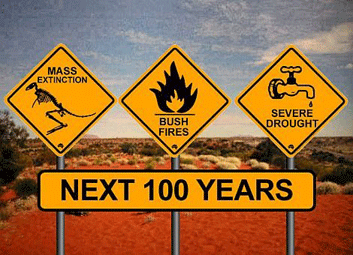 Keeping global warming to 1.5C, not 2C, will make a crucial difference to Australia, report says, The Conversation, James Whitmore, August 24, 2016 , Australia could avoid punishingly long heatwaves and boost the Great Barrier Reef’s chances of survival by helping to limit global warming to 1.5℃ rather than 2℃, according to a report released by the Climate Institute today.
Australia, along with 179 other countries, has formally signed the Paris climate agreement. The deal, which has not yet come into force, commits nations to limit Earth’s warming to “well below 2℃” and to aim for 1.5℃ beyond pre-industrial temperatures.
The new research, compiled by the international agency Climate Analytics, suggests that limiting global warming to 1.5℃ rather than letting it reach 2℃ could make a significant difference to the severity of extreme weather events in Australia. Heatwaves in southern Australia would be an average of five days shorter, and the hottest days a degree cooler. In the north, hot spells would be 20-30 days shorter than the 60-day heatwaves potentially in store if warming hits 2℃……..
University of Melbourne researcher Andrew King, who studies climate extremes, said the report “paints a grim picture for the future”, given that Australia is already experiencing climate-driven events such as this year’sunprecedented bleaching on the Great Barrier Reef.
“There are many benefits if warming could be limited to 1.5℃, with less frequent and intense extreme weather. On the other hand, we are entering the unknown if we allow warming to surpass 2℃, as tipping points in the Earth’s climate system make accurate predictions difficult to make,” Dr King said.
The report predicts that half of the world’s identified tipping points – such as the collapse of polar ice sheets and the drying out of the Amazon rainforest – would be crossed under 2℃ warming, compared with 20% of them at 1.5℃………
Stronger targets
In a separate report, the Climate Institute recommends that Australia adopt greenhouse gas targets of 45% below 2005 levels by 2025, and 65% by 2030, if it is to do its fair share in achieving the Paris Agreement’s goals.
The institute also recommended that Australia phase out coal-fired electricity generation by 2025, increase renewable generation to 50% by 2030, and double energy productivity by 2030.
It argues for a carbon price, and urges politicians to factor the costs and benefits of climate change and climate action formally into all policy decisions.
Australia’s current climate target under the Paris Agreement is 26-28% below 2005 levels by 2030. Labor has proposed a 45% target, and the Greens zero or negative emissions within a generation.
Australia will review its climate policies in 2017, ahead of the first global stocktake of nations’ Paris Agreement targets in 2018…….https://theconversation.com/keeping-global-warming-to-1-5c-not-2c-will-make-a-crucial-difference-to-australia-report-says-64287
Canberra heads to 100% renewable energy, helped by wind power from South Australia
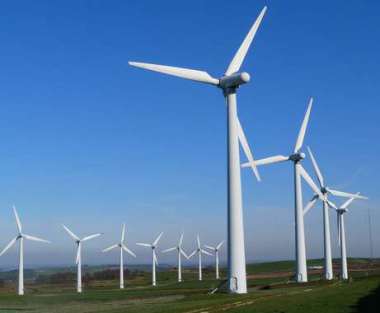 Wind farms in Crookwell, South Australia ‘final piece’ in ACT’s renewable plan http://www.canberratimes.com.au/act-news/wind-farms-in-crookwell-south-australia-final-piece-in-acts-renewable-plan-20160823-gqys5x.html Christopher Knaus, 23 Aug 16 A local wind farm has won a bid to supply 41,600 ACT homes with energy, while a third successful bid from a South Australian project means it will provide a major chunk of Canberra’s renewable power by 2020.
Environment Minister Simon Corbell on Tuesday announced what he described as the “final piece” in the government’s plan for 100 per cent renewable energy by 2020. A 91MW $200 million Crookwell wind farm, to be built by Spanish-owned company Union Fenosa Wind Australia, has won the right to be paid feed-in tariff grants under the government’s reverse auction process.
The project, due to be completed in September 2018, will build 28 turbines able to power 41,600 Canberra homes.
Mr Corbell said the Crookwell farm would be paid $86.60/MWh for the energy it feeds into the grid, which he said was a record low for a NSW wind farm. The other successful bidder was the Hornsdale Wind Farm, being built by Neoen International SAS and Megawatt Capital north of Adelaide.
The Hornsdale project has already been successful in the first and second rounds of ACT wind auctions, and is building the capacity for 309MW in total. That means the South Australian project will provide a large chunk of the ACT’s renewable energy by 2020. Continue reading
Community solar fund shares sold out in nine minutes!
 “Although this is only a particularly small project, what it is is it represents the first community solar lease product in Australia, it represents the first community solar cooperative fund and it represents the first crowdfunded equity community solar project,”
Community Solar Co-Op Shares Sells Out in Minutes https://probonoaustralia.com.au/news/2016/08/community-solar-co-op-shares-sells-minutes/ Renewable energy organisation Pingala sold out of shares in nine minutes for its first community solar fund. Pingala partnered with the environmentally-conscious Young Henrys brewery in Newtown, Sydney to build a solar farm on its roof, which will save an estimated 127 tonnes of greenhouse gas emissions a year.
The newly launched Pingala Cooperative, which sits alongside the Pingala Not for Profit, allows the organisation to raise funds from member investors to install solar panels on its partner businesses.
“We then lease the solar to the business, so they pay us a fee to be able to use the equipment as though it were their own, and through that we get a revenue stream that allows us to pay our costs and generate a small profit,” Pingala secretary Tom Nockolds told Pro Bono Australia News.
“So we’re offering our investors between 5 and 8 per cent… return on investment. But they’re investing in Pingala on an ongoing basis, so there’s no predetermined timeline for when investors get their money back, it’s totally up to the investors themselves to decide when they want to sell their shares, it’s much like buying shares in a company. Continue reading
1 This month
17 October, Free Public Talk on Nuclear Issues in South Australia
David Noonan will speak on public interest concerns over the new Roxby Downs Indenture Act 2026 on BHP copper-uranium mining and ore processing in SA, and on how AUKUS may face SA with a High-Level nuclear waste agenda.
Dr Jim Green will discuss international developments in the field of nuclear power including ‘small modular reactors’ and Generation 4 ‘advanced’ nuclear reactor concepts.


Help Aunty Sue Protect Her Land and Sacred Sites From Destructive Rocket Testing.
.

Australians deserve the truth
about
AUKUS – https://aukuspublicinquiry.com/

PETITION – To: Prime Minister Anthony Albanese and the Australian Labor Government

of the week – Australians for War Powers Reform (AWPR)
To see nuclear-related stories in greater depth and intensity

