Landmark solar powered apartment tower for Melbourne
 First solar-powered apartment skyscraper to rise in Melbourne, The Age, Simon Johanson and Marc Pallisco , 24 Aug 16
A landmark high-rise apartment tower in Southbank whose glass exterior is wrapped in solar cells will provide its residents with “off-the-grid” power stored in Tesla-like batteries, its designers say.
The 60-level building will be the first skyscraper in Australia environmentally engineered to include solar cells in the facade, creating a far greater surface area for catching the sun’s rays.
“We get an enormous area of solar panels by comparison to running them across the roof,” said Peter Brook from Peddle Thorp, the architects behind the design.
The curved exterior of the building has been orientated to deliberately capture the sun’s movement from east to west throughout the day, a feature that had created an “elegant tower”……..http://www.theage.com.au/business/property/first-solarpowered-apartment-skyscraper-to-rise-in-melbourne-20160819-gqwv76.html
Nuclear waste plan for South Australia not economically viable? Global nuclear lobby doesn’t care
The global nuclear lobby surely does not care about whether or not the South Australian nuclear waste importing scheme is economically viable.
A commitment by an Australian State to take in nuclear waste could do the trick for them – as Oscar Archer put it – by unblocking the back end of the nuclear fuel cycle. The NFCRC plan also promises the chance of a market in Australia for the mini nuclear reactors.
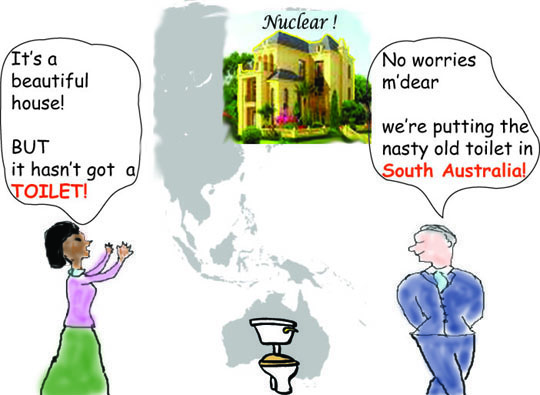
Mixed motives in South Australia’s nuclear waste import plan, Noel Wauchope, Online Opinion, 23 Aug 16, In South Australia the continued nuclear push focusses solely on a nuclear waste importing industry. Yet that might not be economically viable. Behind the scenes, another agenda is being pursued – that of developing new generation nuclear reactors.
First, let’s look at the message. The message from the Nuclear Fuel Cycle Royal Commission (NFCRC) is clearly a plan to make South Australia rich, by importing foreign nuclear wastes……This theme has been repeated ad nauseam by the NFCRC’s publicity, by politicians, and the mainstream media.…..
Meanwhile, the South Australian Parliament is holding a Committee Inquiry into the NFCRC’s recommendations. This Committee asked witnesses about various aspects of the plan. However, an intense focus in questioning Royal Commissioner Kevin Scarce, and Dr Tim Johnson from Jacob Engineering (financial reporter to the NFCRC) was directed at the economic question. It was clear that the politicians were concerned that there’s a possibility of the State spending a significant amount of money on the project, which might then not go ahead. And, indeed, Dr Johnson acknowledged that, financially,” there is a very significant risk”
Whereas other countries are compelled to develop nuclear waste facilities, to deal with their waste production from civil and military reactors,that is not a necessity for Australia, (with the exception of relatively tiny amounts derived from the Lucas Heights research reactor).
So, the only reason for South Australia to develop a massive nuclear waste management business is to make money.
If it’s not profitable, then it shouldn’t be done.
Or so it would seem.
There is another, quieter, message. When you read the Royal Commission’s reports, you find that, while the major aim is for a nuclear waste business, in fact, the door is kept open for other parts of the nuclear fuel chain…….
The clearest explanation of this came early in 2015, just as the NFCRC was starting, in an ABC Radio National talk by Oscar Archer…….
Archer’s plan is significant because it illustrates a very important point about South Australia’s nuclear waste plan – IT SOLVES A GLOBAL NUCLEAR INDUSTRY PROBLEM. Both in ‘already nuclear’ countries, especially America, and in the so far non nuclear counties, such as in South Asia, the nuclear industry is stalled because of its nuclear waste problem. In America, the “new small nuclear”, such as the PRISM, technologies (Power Reactor Innnovative Small Module) cannot even be tested, without a definite waste disposal solution. But, if South Australia provided not only the solution, but also the first setting up of new small reactors, that would give the industry the necessary boost……..
Once Australia has set up a nuclear waste importing industry, the nuclear reactor salesmen of USA, Canada, South Korea, will have an excellent marketing pitch for South Asia, as the nuclear waste problem has been removed from their shores.. And South Asia is exactly the market that the NCRC has in its sights. The NFCRC eliminated most of the EU, Russia, China, North America as customers. This was explained by Dr Tim Jacobs, of Jacobs Engineering, (financial reporters to the NFCRC), at the recent hearing of the South Australian Parliamentary Joint Committee on Findings of the Nuclear Fuel Cycle Royal Commission ………
South Australia’s government is influenced by a strong nuclear lobby push and the Royal Commission advocacy for solving that State’s present financial problems by a futuristic nuclear waste repository bonanza scheme…….
The global nuclear lobby surely does not care about whether or not the South Australian nuclear waste importing scheme is economically viable. Their fairly desperate need is to sell nuclear reactors to those countries that don’t already have them. In particular, the ‘small nuclear” lobby sees an urgency now, with ‘big nuclear’ failing, to get their industry happening.
A commitment by an Australian State to take in nuclear waste could do the trick for them – as Oscar Archer put it – by unblocking the back end of the nuclear fuel cycle. The NFCRC plan also promises the chance of a market in Australia for the mini nuclear reactors. http://www.onlineopinion.com.au/view.asp?article=18465&page=1
Australia sabotages international nuclear disarmament effort
Tim Wright, Asia-Pacific director of the International Campaign to Abolish Nuclear Weapons (Ican), said it was thought that Australia’s foreign minister, Julie Bishop, instructed her diplomats to disrupt the international gathering late on Friday afternoon by forcing a vote. While others then joined Australia to vote against the report, Australia was alone in forcing the vote to happen.
 Australia attempts to derail UN plan to ban nuclear weapons Diplomats force a vote
  on a report to begin negotiations on a ban in 2017 that had been expected to pass unanimously, Guardian, Michael Slezak, 21 Aug 16, Australia has attempted to derail a ban on nuclear weapons at a UN meeting on disarmament, by single-handedly forcing a vote on a report that had been expected to pass unanimously.
The report, which recommended negotiations begin in 2017 to ban nuclear weapons, was eventually passed by 68 votes to 22. An Austrian-led push for the treaty had reached a milestone on Friday, when the report was presented to representatives of 103 nations in Geneva.
Moves towards a ban have been pursued because many saw little progress under the existing non-proliferation treaty, which obliges the five declared nuclear states to “pursue negotiations in good faith” towards “cessation of the nuclear arms race … and nuclear disarmament”.
The proposal recommended a conference be held next year to negotiate “a legally binding instrument to prohibit nuclear weapons, leading towards their total elimination”.
The text was carefully negotiated, and compromise was attempted on contentious paragraphs.
Anti-nuclear campaigners involved in the process expected the report would pass without objection. But Australia surprised observers by objecting and forcing a vote.
The vote was accepted by an overwhelming majority, with 68 voting in favour, 22 against and 13 abstaining.
The next step will be for the proposal for negotiations to begin in 2017 will be tabled at the United Nations general assembly, after which it is likely formal negotiations will begin.
In an opening statement the Australian diplomat Ian McConville told the meeting: “A simple Ban Treaty would not facilitate the reduction in one nuclear weapon. It might even harden the resolve of those possessing nuclear weapons not to reduce their arsenals.”
The Department of Foreign Affairs and Trade said on its website that it opposed a ban on nuclear weapons because although it “might seem to be a straightforward and emotionally appealing way to de-legitimise and eradicate nuclear weapons,” it would actually “divert attention from the sustained, practical steps needed for effective disarmament”.
But in 2015, documents obtained under Freedom of Information revealed Australia opposed the ban on nuclear weapons, since it believed it relied on US nuclear weapons as a deterrent.
“As long as the threat of nuclear attack or coercion exists, and countries like the DPRK [North Korea] seek these weapons and threaten others, Australia and many other countries will continue to rely on US extended nuclear deterrence,” said one of the briefing notes for government ministers.
The documents revealed however that Australia and the US were worried about the momentum gathering behind the Austrian-led push for a ban nuclear weapons, which diplomats said was “fast becoming a galvanising focus for those pushing the ban treaty option”.
Japan’s ambassador to the UN conference on disarmament expressed disappointment that a vote was required.
“We are deeply concerned that the adoption by voting will further divide the international disarmament community and undermine the momentum of nuclear disarmament for the international community as a whole,” he said.
Tim Wright, Asia-Pacific director of the International Campaign to Abolish Nuclear Weapons (Ican), said it was thought that Australia’s foreign minister, Julie Bishop, instructed her diplomats to disrupt the international gathering late on Friday afternoon by forcing a vote. While others then joined Australia to vote against the report, Australia was alone in forcing the vote to happen.
“Australia is resisting the tide of history. A majority of nations believe that nuclear weapons are unacceptable and must be prohibited. And now they are ready to negotiate a ban,” Wright said.
“Australia’s attempt to derail these important disarmament talks was shameful and outrageous. It provoked strong criticism from some of our nearest neighbours in Asia and the Pacific, who believe that the world should be rid of all weapons of mass destruction,” he said.
The acceptance of the report was seen as a major milestone by anti-nuclear campaigners.
“This is a significant moment in the seven-decade-long global struggle to rid the world of the worst weapons of mass destruction,” said Beatrice Fihn, executive director Ican. “The UN working group achieved a breakthrough today.”
“There can be no doubt that a majority of UN members intend to pursue negotiations next year on a treaty banning nuclear weapons,” said Fihn.
“We expect that, based on the recommendations of the working group, the UN general assembly will adopt a resolution this autumn to establish the mandate for negotiations on a ban on nuclear weapons in 2017.”
A Department of Foreign Affairs spokesman said: “Australia called for a vote on the report as it was the most effective way to register our opposition to a recommendation to start negotiations on a ban treaty. A consensus report was not possible in the circumstances…..https://www.theguardian.com/world/2016/aug/21/australia-attempts-to-derail-un-plan-to-ban-nuclear-weapons
Roger Cross: Reasons to Reject a Medium and High Level Radioactive Waste Dump in South Australia
Roger Cross Submission to Joint Committee on Nuclear Royal Commission South Australian Parliament, August 2016 Some Reasons for rejecting the proposal to build a Medium and High Level Radioactive Waste Dump in South Australia. By Roger Cross (Author of Fallout: Hedley Marston and the British Bomb Tests in Australia, co-author of Beyond Belief The British Bomb Tests: Australia’s Veterans Speak Out)
Preamble:
The risks to the future health and security to all Australians, and South Australians in particular are many. A risk-benefit analysis is almost certainly impossible given a time-frame that extends for centuries (probably for the rest of human existence on the Planet). Benefits, in terms of financial gain to the State. and some employment must be secondary to the multitude of risks involved. These risks are worth restating so that the “golden egg” of a large financial windfall do not cloud the realities of such a decision.
Risks:
- Health Risks: The existence or otherwise of a threshold below which exposure to ionising
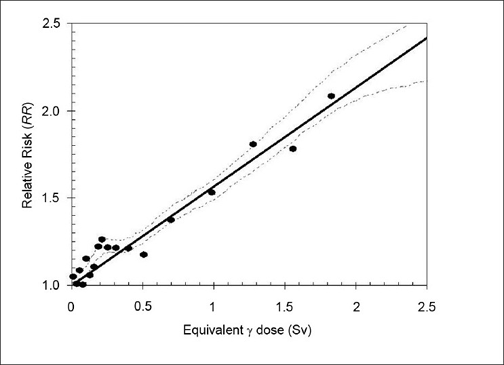
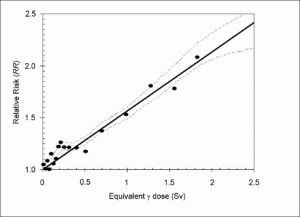 radiation is harmless has been a matter of continuous debate among nuclear scientists for decades. The statistical analysis of John Gofman (l,W, Gofman, 1981. Radiation and Human Health, Sierra Club, San Francisco, 1981, and 1990 RadiationInduced Cancer Fom Low-Dose Exposure: An Independent Analysis. Committee or Nuclear Responsibility Inc., San Francisco) shows there is no safe radioactive dose. Therefore, at any point in the chain of receiving, from overseas, transporting within S.A. and storage even small mishaps leading to only low-level contamination are not risk free. Naturally any large scale mishap would be catastrophic for the State.
- Historical Episode of radioactive contamination in South Australia: It is not feasible to claim that mishaps would not occur, that is, the risks are non-existent The radioactive contamination of Adelaide on the 12 October. 1956 due to an unfortunate change in the wind
 direction at the 11 October Maralinga Bomb Test is a case in point, This mishap caused the population of Adelaide and much of the rest of the State to be contaminated with ionising radiation from one of the Buffalo Bomh explosions (See Cross, R. 2001, Fallout: Hedley Marston and the British Bomb Tests in Australia, Wakefield Press, Adelaide, for information about this event).
- Transportation Risks: While these are impossible to quantify they are not
 negligible.Transportation of medium or high level radioactive waste in particular would require a
high degree of security and infrastructure. The former, in particular would challenge the well-being of South Australians through a system of near military style command and control intrusion into the lives of all South Australians. Such is the consequence of having to secure such a commodity.

- The Uranium back to source Argument: An argument has been mounted that because SA
 exports Uranium, and may one day become a world leading exporter of themineral, we should take back the highly radioactive waste from the user of our Uranium. This argument is entirely false, as in no other exported mineral has it been suggested that we have such an obligation. For example, do coal and iron ore producing States receive back the waste slag and ash. This can be applied to almost any raw material exported. Waste is an inevitable consequence of industrial processing and is the end-users responsibility.
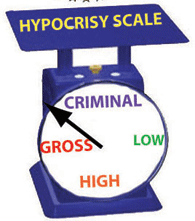
- South Australia’s future World image: The risks are not confined to technical issues but are
 also present in the image we wish to present to the rest of the world. This will become increasingly important in our push to attract more overseas visitors. Tourism is and can play and ever greater part in our economy as the State is currently seen as fl safe, clean and green place to visit. This advantage we have would naturally disappear in the minds of prospective visitors if we went ahead with the storage of medium and high level radioactive waste from around the World.

Taken from research by the pre-eminent researcher into the health effects of low-dose ionizing radiation, Emeritus Professor John W. Gofman. See for example:- Radiation Induced Cancer from Low-Dose Exposure. An Independent Analysis, 1990, and Synapse article
Disproof of any Safe Dose: The Threshold Question In Chapters 18 through 21 it is proved beyond reasonable doubt that no safe dose or dose rate exists. His analysis of the absence of a threshold below which no harm will be done from a dose of ionizing radiation is based on human evidence. The data analysed rules out the idea of a threshold with regard to radiation-induction human cancer.
The practical implications for these findings are obvious for the establishment of any storage facility of ionising radiation material, and especially the concern here, medium to high level material. There cannot be any doubt that any exposure to radiation as a result of the multiple handling steps that are required even to reach a storage facility would have human health consequences forthose exposed, and may have, even, heritable consequences.
It should be noted that possible exposures do not end with the material reaching the storage facility but continue at that facility virtually in perpetuity. Consider the following:-
“How would a safe level of radiation come about? It could come about in theory jf the biological repair 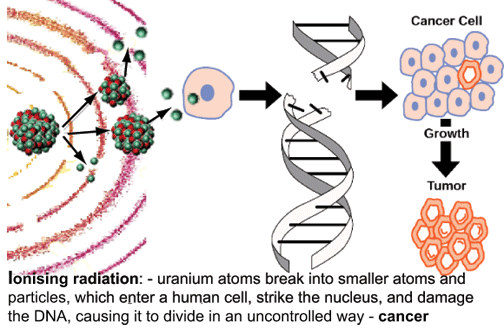 mechanisms – which exist and will repair DNA and chromosomes – work perfectly. Then a low dose of radiation might be totally repaired. The problem, though, is that repair mechanisms don’t work perfectly. There are lesions in DNA and chromosomes that are unrepairable. There are those where the repair mechanisms don’t get to the site and so they go unrepaired. . .. The evidence that the repair mechanism is not perfect is very solid today…. Ionizing radiation is not like a poison out of a bottle where you can dilute it and dilute it. The lowest dose of ionizing radiation is one nuclear track through the cell- you cannot halve it.”
1 Quotation from Gofman on Health Effects of nuclear Radiation, Synapse, Vol 38, No 16, 1994. http://www.parliament.sa.gov.au/Committees/Pages/Committees.aspx?CTId=2&CId=333

South Australian Parliamentary Inquiry asks inconvenient questions about nuclear waste import costs
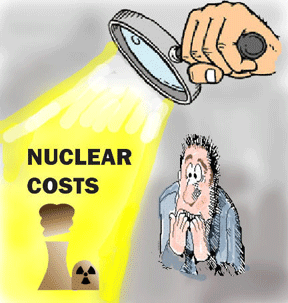 SA parliamentary committee questions economics of importing nuclear waste, Independent Australia, 19 August 2016, The economic benefits of SA’s push for a global nuclear waste dump took a negative turn during the current parliamentary committee inquiry. Noel Wauchope reports.
THE SOUTH Australian Parliament is holdinga Joint Committee on Findings of the Nuclear Fuel Cycle Royal Commission (NFCRC).
The five committee members, with one exception, the Greens Mark Parnell, have pro-nuclear opinions. I thought that it was going to be just a rubber stamp for the NFCRC. Now I am not so sure. The committee gave the NFCRC a grilling on the economics of the plan to develop a nuclear waste import industry in South Australia.
Answers indicated that the NFCRC is keen to have discussions with other countries before the matter is resolved at the political level…….
Trawling through the 173 pages transcript of hearings of this committee, I was surprised at the rigour of the questioning of witnesses by the politicians. They did ask hard questions about the arrangements for contracts from overseas countries, customers sending radioactive wastes to South Australia. They asked questions about who pays and when, and for what aspects of the process.
The most intensive questioning of witnesses was certainly on that subject of economics. After all, the plan is to make a financial bonanza for the state. There is no other reason for it. I sensed that the parliamentary committee was indeed focussed on this one basic question:
If it’s not going to make money, why do it?……
Dr Johnson went on to rather confusing statements about the contractual arrangements, and particularly about at what stage revenue would come to South Australia. I don’t think that the committee was inspired with confidence as Johnson discussed this. It was a very lengthy discussion. A few extracts illustrate the economic problems that were revealed in this discussion:
(Transcript p.24) Dr JOHNSON:
We recognised that, once waste got to South Australia, it was very unlikely to leave South Australia. It was very unlikely that there would be anywhere else you could move it on to, so the liability and the responsibility for that waste would be transferred to South Australia. What was a realistic value of that willingness to pay number? We looked at that in a number of different ways because there is no market for it……
a rare mention of the probability of a serious nuclear accident happening – who knows when? It raised the spectre of the expected nuclear waste bonanza suddenly fizzling out, after South Australia had committed to building the nuclear waste repository …..
Dr Johnson seemed to get a bit rattled:
Dr JOHNSON:
In essence we are spending money up until we start signing the contracts, and at this stage on the 28-year timeline that occurs at year six-ish, but if it’s a 40-year timeline and there are delays, then it may well be that you keep spending money and you don’t get the precommitments until later than year six. : I am not an economist; I am a chemist. Quite clearly, we were not looking at this from an economic perspective. Our remit was to look at it from a financial perspective…….
Kristen Jelk asks:
Who is talking about “Brand South Australia”? ……….If SA is pitching safe products to an international market, and it becomes known that this Australian state has established a dump for nuclear waste, then the damage to brand SA will be immeasurable….It will not matter that the dump is in a desert, nor will it matter if the dump is a distance from prime agricultural land, nor will it matter if experts assure of safety standards. The perception that would prevail is that SA will be a dumping ground for nuclear waste. Perception is everything….
China is our largest trading partner. At present, Australia has clear marketing opportunities in China, and for our other nearer neighbours. In assessing the so called golden coin to be gained for bringing in radioactive trash, South Australia needs to also consider the other side of that coin —the economic opportunities that could be lost, along with the risk of a poor or no return on the waste facility investment. https://independentaustralia.net/environment/environment-display/sa-parliamentary-committee-questions-economics-of-importing-nuclear-waste,9371
Government quietly removes Clive Hamilton’s page that listed climate deniers
 Plimer rebuttals disappear https://www.crikey.com.au/2016/08/19/plimer-rebuttals-disappear/ We predicted the government would delete this document, and guess what, they did.
Back in 2014, Crikey published a piece by Clive Hamilton on the 12 people doing the most to block action on climate change in Australia, including Ian Plimer. Hamilton included this paragraph on Plimer’s book How to Get Expelled From School: “Plimer’s 2011 book — How to Get Expelled From School (launched by John Howard and mailed by the IPA to hundreds of schools) — listed 101 questions for sceptical students to ask their “warmist” teachers, i.e. those who respect science. The federal Department of Climate Change (abolished by Abbott) prepared a responsethat thoroughly debunked his claims in words a child can understand. How long before Environment Minister Greg Hunt is instructed to have this demolition of Plimer taken down?”
A Sydney blogger checked back with the department’s website at regular intervals over 2014, and stopped by this week to see if the PDF was still up — but now it’s nowhere to be found. We knew it would happen eventually.
Secretive Pine Gap remains an integral part of USA’s nuclear ‘star wars’ plans
Strategic US Military Intel Base in Pine Gap, Australia, By Richard Neville Global Research, April 30, 2008 PINE GAP MIND GAP: A TERROR CELL THAT NEVER SLEEPS. “…..This is Pine Gap, a US military base built on the traditional land of the indigenous Arrernte people, which started life in 1966. Australians were told the facility was to be a weather station. Later the official cover was a “Space Research Centre”. Our citizens remained in the dark until 1975, when Prime Minister Whitlam revealed that Pine Gap’s boss, Richard Stallings, was an agent of the CIA.
Up till then, according to former Minister Clyde Cameron, politicians had regarded the base as “a pretty harmless sort of operation”. Whitlam demanded a list of all CIA agents in the country. This infuriated US spy masters, who put pressure on the Australian Security Intelligence Organisation (ASIO) to shut him up. CIA fears over the leaking of Pine Gaps’ secret activities helped to trigger the murky events that toppled the Whitlam government.

Pine Gap’s first generation of satellites was designed to monitor Soviet missile developments and for espionage in South East Asia, especially Vietnam, and later to spy on China. Since then, both its mission and capabilities have expanded dramatically. The base is believed to have provided targeting information for Israel’s 2006 bombing of Lebanon.
Pine Gap is one of largest and most sophisticated satellite ground stations in the world. Its 26 antennas suck information from the sky and distribute it to US commanders in the field, including in Iraq and Afghanistan, where it is used to co-ordinate air strikes…….
If Australia wishes to regain its reputation as a fair minded nation, the government will need to take a closer look at this secretive installation, an integral part of the US National Missile Defense scheme, or Star Wars.
It aims to put satellite based weapons in space to shoot down any incoming missiles. New radomes (radar + dome) to accommodate the system have already been installed.
The majority of Pine Gap’s 1000 staff are Americans drawn from branches of the US military, including the National Security Agency, Army and Navy Information Operations Command, US Navy and Combined Support Group, Air Intelligence Agency, US Air Force, 704th Military Intelligence Brigade, 743rd Military Intelligence Battalion, Marine Cryptologic Support Command, etc. The base is described as a “joint facility”, although key areas are out of bounds to Australians. While visiting US lawmakers are taken on tours of Pine Gap, Federal MP’s are denied entry. (Members of Congress have collectively invested up to $US196 million in companies with Defense Department contracts, earning millions since the onset of the Iraq invasion. Until May 2007, Hillary Clinton held holdings in Honeywell, Boeing and – yes – Raytheon).
In 2000, the Howard Government rejected calls by Parliament’s Joint Committee on Treaties for a classified briefing on its operations. There is no public debate on the role of Pine Gap, despite its unbending support of all US military actions, regardless of legality or morality. As for the media, they’re asleep at the wheel……..http://www.globalresearch.ca/strategic-us-military-intel-base-in-pine-gap-australia/8858
Adani court decision: Traditional Owners say fight to stop QLD’s Carmichael mine continues
19 August 2016
 Court decision:
Traditional Owners say govt acted shamefully,
fight to stop Adani’s Carmichael mine continues
Defence of rights and country still has a long way to run
“Senior Traditional Owner and spokesperson for the Wangan and Jagalingou (W&J) traditional owners family council, Mr Adrian Burragubba, says he is not surprised by the decision handed down in the Federal Court in Brisbane today, while reiterating that they stand strong together and will continue to defend their human rights, and protect their traditional lands from Adani’s destructive Carmichael mine.
““The issuing by the Palaszczuk government of the mining leases, in support of Adani running roughshod over our right to say ‘no’ to this mine, was a shameful episode. We will continue to pursue all legal avenues, Australian and international, to defend our rights and stop this massive coal mine going ahead,” Mr Burragubba said.
“Wangan and Jagalingou council representatives, including Mr Burragubba, are currently challenging the leasesthat have been issued by the Palaszczuk government for the Adani Carmichael coal mine ina Judicial Review in the Queensland Supreme Court. The matter will be heard in November; and further legal actions are underway. …
“Lawyer for Mr Burragubba, Mr Benedict Coyne said: “My client will take some time to review the reasons for judgment, and consider his appeal options in the context of numerous other legal avenues he is pursuing for justice for his people, both domestically and internationally.” …
Indigenous challenge to Adani Carmichael coal mine dismissed by Federal Court
 http://www.abc.net.au/news/2016-08-19/indigenous-challenge-to-adani-carmichael-coal-mine-dismissed/7765466~ Andrew Kos 19 August 2016
“The Federal Court has dismissed a challenge from a Queensland traditional owner to mining leases for Adani’s Carmichael coal mine.
“A member of the Wangan and Jagalingou people was trying to put a stop to the multi-billion-dollar Galilee basin project.
“Senior traditional owner for the Wangan and Jagalingou traditional owners, Adrian Burragubba argued that a determination made in April 2015 by the National Native Title Tribunal, relating to the proposed granting of two mining leases, was made incorrectly.
“He argued the approval of mining leases would extinguish native title over parts of the group’s lands.
“Mr Burragubba made the application for judicial review against the Queensland Government, Adani and the National Native Title Tribunal. …
“In his judgement, Justice John Reeves concluded that none of Mr Burragubba’s grounds of review had merit. “Justice Reeves said the tribunal did not fail to observe the rules of natural justice or constructively fail to exercise its jurisdiction. …
“While I respect the judgement of Justice Reeves, we will seek advice from our legal team on an appeal,” Mr Burragubba said. … “
Victorians, including Liberals, want urgent shift to renewable energy
 Majority of Victorians support urgent shift to renewable energy, poll finds https://www.theguardian.com/australia-news/2016/aug/18/majority-of-victorians-support-urgent-shift-to-renewable-energy-poll-finds
A ReachTEL poll commissioned by Friends of the Earth shows 68% of the state, including a majority of Liberal voters, want to see an end to reliance on coal, Guardian, Michael Slezak, 18 Aug 16, The vast majority of people in Victoria – and even a majority of Liberal voters – support the state moving towards 100% renewable energy “as a matter of urgency,” a new poll has found.
The polling comes as the state government works to rewrite the Climate Change Act, including pre-2050 emissions reduction targets.
More than 68% of Victorians said they agreed or strongly agreed that “Victoria needs to transition its energy use from coal to 100% renewables as a matter of urgency”, according to the ReachTEL poll of 1,137 people conducted on 4 August and commissioned by Friends of the Earth.
That was in line with previous national polls. But when the researchers drilled down to the views of people who supported different political parties, they found consistent support for an ambitious state-based renewable energy target. Continue reading
South Australia, Victoria – set up electricity trading scheme – says Xenophon
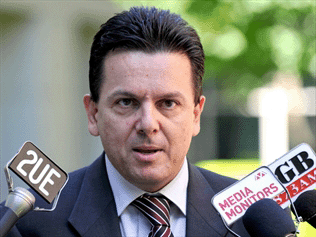 Xenophon calls for SA and Victoria to set up their own electricity emissions trading scheme, ABC News, By Nick Harmsen , 18 Aug 16, The Victorian and South Australian governments should establish their own joint electricity emissions trading scheme if the Federal Government refuses to put a price on carbon, Senator Nick Xenophon says.
The South Australian senator told an industry conference in Port Pirie that such a scheme would drive down prices.
“The sooner that COAG acts, or alternatively the Victorian and South Australian governments, the sooner consumers and businesses will have real relief in power prices with enhanced reliability,” he said.
“It could and should happen this year.”
Senator Xenophon said he had discussed the proposal with South Australian Energy Minister Tom Koutsantonis, and had written to the federal Minister Josh Frydenberg, urging the issue be discussed at a national meeting of energy ministers this Friday.
Proposal first discussed seven years ago
Rather than advocating a nationwide carbon pricing scheme, Senator Xenophon said the Federal Government should resurrect a scheme first put forward in 2009, during Prime Minister Malcolm Turnbull’s time as opposition leader.
“We, as in Malcolm and me, jointly commissioned Frontier Economics to come up with an alternative emissions trading scheme to [then prime minister Kevin Rudd’s] carbon pollution reduction scheme,” he said.
That scheme would effectively see dirty power generators pay cleaner generators to run more……..
South Australian Energy Minister Tom Koutsantonis said Senator Xenophon’s proposal had already been considered by numerous bodies, including COAG. “I am sure this idea is one of the many things we will discuss on Friday at what is an incredibly important COAG meeting,” he said.
“The main point I agree with Mr Xenophon on is that this is an urgent issue that requires the ministers to take back power in decision making, form a consensus and agree to a reform of the energy market.” http://www.abc.net.au/news/2016-08-17/electricity-emissions-trading-scheme-plan-for-sa-and-victoria/7751324
South Australia’s electricity price spike manipulated by fossil fuel generators
Energy companies withholding supply to blame for July price spike, report finds
Analysis of temporary jump in prices in South Australia showed generation capacity far exceeded demand, pointing to market manipulation, Guardian, Michael Slezak, 17 Aug 16 Fossil fuel electricity generators in South Australia withheld their supply to push up prices and reap bigger profits, according to an analysis of the causes behind the extremely high prices there in early July.
The findings suggested some solutions proposed ahead of this week’s Coag energy council meeting for the so-called “energy crisis” like increasing the supply of gas in Australia won’t help the situation at all.
The three things often pointed to as possible causes of the price spikes, especially on 7 July, have been the closure of the Northern power station, the main Victoria-SA interconnector being down and wind farms not producing much power.
But in a report commissioned by GetUp, energy analyst Bruce Mountain showed the generation capacity that was available in the market still far exceeded the demand. However, besides those owned by Origin, all other fossil fuel generators continued to operate far below their capacity, only offering electricity to the market for a very high cost.
In addition, Mountain showed the Australian Energy Market Operator (Aemo) forecasted that low wind and the interconnector maintenance would create high prices, which the generators could have responded to by ramping up supply and making solid profits.
“Yet, they did not respond to that information by making more of their production available to the market,” Mountain said in the report.
“Had this capacity been made available to the market at more reasonable prices, even prices far above production cost, those extreme prices would not have occurred.”
Mountain said Snowy Hydro, Engie, AGL and Energy Australia were exploiting their market power to push up prices. He said they weren’t doing anything illegal, but they were taking advantage of a market that wasn’t functioning properly.
“I think there’s a question of social license –and we’re seeing this in many other industries, where people are expected not just by the letter of the law but by the spirit of the law and maybe there’s scope for some of that to find its way into how we think about these things,” said Mountain.
Miriam Lyons from GetUp said the market is failing to deliver the competition needed to protect consumers’ interests.
“This shows that the answer to South Australia’s problems is not more gas, but more competition. Supporting cleaner suppliers of on-demand energy – like concentrating solar thermal in Port Augusta – would be far better for consumers, and for the planet……..https://www.theguardian.com/australia-news/2016/aug/17/energy-companies-withholding-supply-to-blame-for-july-price-spike-report-finds
Conflict of interest in selection of site for federal nuclear waste dump
Indigenous Australians Fight Planned Nuclear Dump On Sacred Lands, Huffington Post, Timothy Large, 18 Aug “……..CONFLICT OF INTEREST?
Opponents say the government’s process for selecting the site was tainted from the start.
Wallerberdina is co-leased by Grant Chapman, a retired Liberal Party lawmaker who in 1995 chaired a Senate committee that called for a central repository for nuclear waste.
Last year, the government asked for volunteers to accept the dump. Wallerberdina was among 28 nominations nationwide. In May, the government chose it from a final shortlist of six.
“Chapman should understand that that’s not his land to make that bid,” said Tauto Sansbury, chair of the Aboriginal Congress of South Australia. “He should have negotiated with the traditional owners.”
In his home office in Adelaide, Chapman denied there was any conflict of interest in offering up his land.
“It just happened that I think that country, being isolated, and the nature of the topography and geology and so on, is a suitable spot. So that’s why we put it up,” he said.
He declined to say how much he could profit from the sale. Media reports have said he could make four times the market value of the land.
Asked about the possible desecration of sacred sites, he said: “I think it’s quite a wild claim to assert that the whole of the property has cultural significance.”
Back at Yappala, traditional owner Regina McKenzie was dangling her feet in Hookina Creek, whose underground aquifer is so ancient that she says its waters “rained on dinosaurs.”
“It’s racism towards our culture. This is our belief system … It’s like me and my sisters going to the Vatican and saying we want to put a waste dump right under the pillar where they say St. Peter is buried.” http://www.huffingtonpost.com/entry/indigenous-australians-fight-planned-nuclear-dump-on-sacred-lands_us_57b5f8c9e4b00d9c3a161db9
Safety concerns about Lucas Heights Nuclear Wastes repatriated from France
 Fight To Stop Nuclear Waste In The Flinders Ranges Paul Levai https://www.facebook.com/groups/941313402573199/ 16 Aug
 16
16
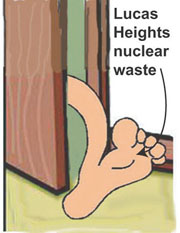
Paul Levai Interesting trip to ANSTO. A few concerns that I will post as some stage soon but the main one is that the intermediate waste that they propose to store here is our spent fuel rod waste from the old Lucas Heights HIFAR reactor that has been sent to France for reprocessing and must be returned to us as intermediate waste.
BUT the scary part is that rather than design and build a new container system for the ILW ( that would be easily identifiable) they decided to use an existing design container for HLW (high level waste) because its cheaper and easier and they think it will alleviate safety concerns (better and stronger).
Australia completes first phase of its waste repatriation project ANSTO :The The shipment of repatriated waste left France on 15 October, arrived in Port Kembla on 5 December, and was safely transported to the interim storage facility at Lucas Heights the following day (6 December, 2015).
Earthquake near Port Pirie
Earthquake Details Issued by © Commonwealth of Australia (Geoscience Australia) 2016
Date and Time UTC: 13 August 2016 @ 19:49:39
Location NE of Port Pirie, SA. Magnitude ML: 2.0
Coordinates: -32.811, 138.228 Depth: 1 km
Potentially Tsunamigenic No http://www.ga.gov.au/earthquakes/getQuakeDetails.do?quakeId=3856247
1 This month
17 October, Free Public Talk on Nuclear Issues in South Australia
David Noonan will speak on public interest concerns over the new Roxby Downs Indenture Act 2026 on BHP copper-uranium mining and ore processing in SA, and on how AUKUS may face SA with a High-Level nuclear waste agenda.
Dr Jim Green will discuss international developments in the field of nuclear power including ‘small modular reactors’ and Generation 4 ‘advanced’ nuclear reactor concepts.


Help Aunty Sue Protect Her Land and Sacred Sites From Destructive Rocket Testing.
.

Australians deserve the truth
about
AUKUS – https://aukuspublicinquiry.com/

PETITION – To: Prime Minister Anthony Albanese and the Australian Labor Government

of the week – Australians for War Powers Reform (AWPR)
To see nuclear-related stories in greater depth and intensity

