New Climate Denialist One Nation Senator warns on United Nations Climate Plot

Malcolm Roberts: One Nation senator-elect says UN trying to impose global government through climate chance policy, ABC News, By political reporters Stephanie Anderson and Matthew Doran, 4 Aug 16 New One Nation senator-elect Malcolm Roberts has argued the United Nations is trying to impose global government through climate change policy.
Mr Roberts is one of three One Nation senators joining party leader Pauline Hanson in the new-look Upper House, after the final vote count was finalised today.
In an interview on ABC local radio, Mr Roberts said there were a number of movements undermining Australian sovereignty.
“Do you think the UN’s trying to impose some sort of global government through climate change policy?” 774 ABC Melbourne host Rafael Epstein asked.
“Definitely,” replied Mr Roberts……….
United Nations ‘driving’ climate scienceMr Roberts, a prominent climate change sceptic with the Galileo Movement, also renewed calls for an inquiry into CSIRO’s climate change research.
Mr Roberts, whose latest press release stated that he “spent the last nine years working pro bono checking alarmist climate claims”, said he wanted to repeal any legislation put in place “as a result of the claim that humans affect global climate as a result of our use of hydrocarbons fuels, coal, oil, natural gas”.
Describing himself as a scientist, he said “we need to stop these ridiculous lies based on climate”.
“I went looking into the agencies that have been spreading the climate science,” he said.
“I started finding out things about the CSIRO and Bureau of Meteorology.
“That led me then to the UN, which has been driving this.
“Then I started following the money trails. It’s important to understand the motives.”……..http://www.abc.net.au/news/2016-08-04/final-senate-make-up-confirmed-with-11-crossbenchers/7689788
To the ‘Minister for Adani’ — Matthew Canavan — “No Still Means No”
~ Wangan & Jagalingou People http://wanganjagalingou.com.au/qa-correction-to-the-minister-for-adani-matthew-canavan-no-still-means-no/ 2 August 2016
“On ABC’s Q&A last night, National Party Senator, Matthew Canavan – the ‘Minister for Adani’– made a vague reference to “native title” groups’ near unanimous support for the proposed Carmichael mine.
He complained that the media doesn’t cover such supposed ‘good news’, as though his Government’s interests are not constantly boosted in the press. …
“What the Minister failed to mention, or referred to only obliquely, is that we have several legal cases running to demonstrate that Adani does not have our free, prior, informed consent, they have engaged in conduct ‘analogous to fraud’ and that, along with the State and some statutory representatives,manipulated the native title process to override our rights and interests and divide our people. … “
Renewed focus on CSIRO and climate change will not reverse damage done by Turnbull govt
CSIRO’s renewed climate change focus will not reverse damage done by job cuts: scientists, ABC News, PM , 4 Aug 16 By Felicity Ogilvie and staff Some of Australia’s top climate scientists say new instructions given to the CSIRO to renew its focus on climate science will not be enough to reverse the damage done by previous jobs cuts.
The Federal Government’s new Science Minister Greg Hunt has instructed the CSIRO to renew its focus on climate science.
Climate scientists from around the country, meeting in Hobart to discuss how climate change will affect Australia’s future, say they are having a hard time keeping up with the changes in how climate science at the CSIRO is being run.
CSIRO Fellow Dr John Church, an expert in estimating and understanding global and regional sea-level rise, is one of the 275 CSIRO scientists who are losing their jobs.
“This is only a step in the right direction, it certainly doesn’t recover all the positions that have been lost,” Dr Church told PM.
University of Tasmania polar scientist Matt King said Dr Church was irreplaceable, and said he was finding it hard to digest the directive given by Mr Hunt…….
Dr Rintoul said damage had been done to Australia’s international reputation as a result of the CSIRO job cuts…….he also agreed that CSIRO staff losses would have a major negative impact on Australian research.
“In short, John Church is irreplaceable and some of our staff are similarly irreplaceable. So there are areas of science that Australia used to be strong in that we will no longer be as strong in and we’ll need to rebuild,” he said…….http://www.abc.net.au/news/2016-08-04/csiro-climate-focus-wont-reverse-job-cut-damages-say-scientists/7691928
Josh Frydenberg, the Minister for Gas, er, I mean Environment
 http://www.weeklytimesnow.com.au/news/politics/josh-frydenberg-out-of-step-on-gas/news-story/992e76062fe5e3a14c28a745548d4779
The Victorian MP maintained his stance against the moratorium this week, leading environmental critics to say he was out of step with the rest of the state — and his Victorian Coalition colleagues.
The State Government is preparing to release its gas policy, expected before parliament resumes on August 16. The Victorian Coalition has already said it wants the moratorium extended until 2020.
Mr Frydenberg first flagged his concern about Victoria‘s moratorium in February when he was resources and energy minister.
This week he said the shift away from coal was not a bad thing, but the South Australian energy crisis proved there was a need for a reliable base power source, which should be gas.
“We shouldn’t have blanket moratoriums on unconventional gas like we have in Victoria and NSW because you need more gas and gas suppliers,” he told the Australian Financial Review.
Friends of the Earth’s Cam Walker said this was “profoundly out of step” with Victoria, where 73 communities have declared themselves gas field-free, many in Coalition-held seats. “The argument that gas is a bridging and back-up fuel is outdated,” he said.
Festering doubts on impartiality of Nuclear Royal Commissioner Kevin Scarce
Kevin Scarce, head of SA’s Nuclear Fuel Cycle RC, also has a conflict of interest, 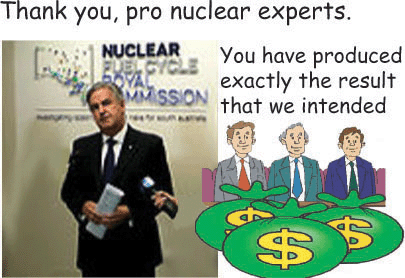 Independent Australia, 4 August 2016, Given the public outcry over Brian Martin’s conflict of interest as head of the Royal Commission into Juvenile Justice in the NT, Noel Wauchope asks why Kevin Scarce’s suitability as head of SA’s Nuclear Fuel Cycle RC wasn’t questioned……..
Brian Martin did not think that he had a conflict of interest in relation to his previous role as a Northern Territory judge. He did not doubt his “capacity to be both independent and competent in the role of the commissioner”. However, he recognised that a community perception of his having a conflict of interest would compromise the Royal Commission and its results.
As Mark Kenny wrote in The Age on 2 August 2016:
‘Indeed, Martin acknowledged this [public confidence] was the crucial factor — irrespective of the facts. He observed if any public doubts about the impartiality or commitment to the unvarnished truth were allowed to “fester” during the commission’s long months, its outcomes would be compromised.’
Why no outcry about the conflict of interest in appointing Kevin Scarce as head of SA’s Nuclear Fuel Cycle RC?
Apparently, while it’s not OK to have a conflict of interest in a National Royal Commissioner, this has not yet been a problem for a State one…….
Unlike the situation with Brian Martin, this is not a case of a perception of conflict of interest by some special sections of the community. It looks more like a choice of a royal commissioner that is unusual and inappropriate and involving a much more obvious conflict of interest.
The general practice in royal commissions is to appoint a serving or retired judge, due to the quasi-legal nature of the process…….Kevin Scarce with no legal background, was a most unusual choice as royal commissioner for South Australia’s Nuclear Fuel Cycle Royal Commission. Furthermore, his military career and close involvement with defence agencies, raises questions about his impartiality…….
There is a strong defence lobby pushing for Australia to acquire nuclear powered submarines. Kevin Scarce was previously the head of Maritime Systems at the Defence Materiel Organisation.
Kevin Scarce is a shareholder in Rio Tinto Group, the owner and operator of Ranger and Rossing uranium mines in Australia and Namibia
Prior to his appointment as Royal Commissioner, Kevin Scarce advocated a nuclear industry for South Australia. Speaking in November 2014 at a Flinders University guest lecture, Scarce acknowledged being “an advocate for a nuclear industry”. ……
2014 Investigator Lecture – Rear Admiral the Honourable Kevin Scarce AC CSC RAN Rtd
Will the outcome of the SA nuclear RC be compromised, given the criticisms so far?…..
The selection of pro nuclear advisers and speakers continued through the Royal Commission’s year-long proceedings and subsequent Citizens’ Jury sessions, as Independent Australia has shown in recent articles. ..
Numerous well researched criticisms sent to this Royal Commission seem to have been ignored. Kevin Scarce has dismissed opposition as based on emotion or opinion, rather than on facts,saying: “The debate has been formed upon fear…”
in South Australia, the outcome of its Nuclear Royal Commission may well be compromised, as public confidence in Kevin Scarce might fester amongst Australians in general, and even amongst South Australians, despite that State’s government now bombarding them with pro nuclear propaganda. https://independentaustralia.net/environment/environment-display/kevin-scarce-head-of-sas-nuclear-fuel-cycle-rc-also-has-a-conflict-of-interest,9310
Western Australia’s Environmental Protection Agency rejects Cameco’s Yeelirrie Uranium project
 Cameco’s Yeerrilie uranium mine proposal knocked back in WA Goldfields http://www.abc.net.au/news/2016-08-03/uranium-mine-proposal-knocked-back-in-wa/7685538 Western Australia’s environmental watchdog has knocked back a proposed uranium mine in the state’s Goldfields, at the site of Australia’s largest uranium deposit.The Environmental Protection Agency said Cameco Australia’s Yeelirrie Uranium project could not meet one of the nine key environmental factors.
The Canadian company sought to mine up to 7,500 tonnes of uranium oxide concentrate per year from the Yeelirrie deposit, about 420 kilometres north of Kalgoorlie-Boulder and 70km south-west of Wiluna.
The facility was to include two open pits, processing facilities, roads, accommodation, stockpile and laydown areas.
It would have transported the uranium oxide by road for export through the Port of Adelaide.
The authority’s chairman, Dr Tom Hatton, said the assessment process was extensive and involved public consultation and a site visit. He said the proposal would threaten more than 70 species of underground fauna, known as “stygofauna”.
 The proposal had attracted protests, including from traditional owner Kado Muir, who argued there was no broad community support for uranium mining in Western Australia.
The EPA put the proposal up for public comment for 12 weeks, attracting 169 responses and a further 2,946 pro forma submissions.
The EPA gave a proposal for Western Australia’s first uranium mine the green light in 2012, the first to be approved since the lifting of a state ban on uranium mining in 2008. But the project, put forward by South Australian mining company Toro Energy, has stalled on the back of falling demand and global prices for the commodity.
Environment groups welcome EPA recommendation to reject Yeelirrie uranium proposal
 The Conservation Council of WA and the Australian Conservation Foundation have welcomed the WA EPA’s recommendation not to approve the proposed Yeelirrie uranium mine.
The decision was based on the unacceptable risks the plan posed to subterranean fauna and also addresses wider environmental and community concerns.
“This is an important decision that prioritises the survival of a number of different species and the health and wellbeing of the local community,” said CCWA nuclear free campaigner Mia Pepper.
“CCWA’s submission to the EPA identified the likely extinction of several species of underground fauna, known as stygofauna and troglofauna if the proposal were approved and it is pleasing to see the EPA has considered that evidence.
“The EPA recommendation has been met with great relief among pastoralists, Aboriginal communities and environment groups who continue to campaign against uranium mining in WA. “The former proponent of the Yeelirrie uranium mine, BHP Billiton, conducted extensive and systematic surveys of subterranean fauna.
“This is an important decision that highlights the importance of extensive surveying for subterranean fauna and acting to prevent extinctions.”
 National environment groups have joined their state counterparts in welcoming the EPA’s call.“We congratulate the EPA for making this important, clear and strongly evidence based recommendation,” said the Australian Conservation Foundation’s Dave Sweeney.
“ACF expects and looks forward to the Environment Minister upholding the EPA’s recommendation.”
Quite secretively organised, the plan for a federal nuclear waste dump at Hawker, Flinders Ranges, South Australia
 https://www.facebook.com/groups/941313402573199/ This secrecy is outrageous. It would not happen in America. The whole bs about “medical wastes” is one big cover-up for the transport of a tiny amount of intermediate to high level nuclear wastes returning from France. The plan is to continue to take in such returning nuclear wastes, so that Lucas Hieights’ reactor can continue to produce them. After that, how convenient for the global nuclear lobby, if South Australia is already taking in ‘Australian’ high level wastes. What a lovely precedent for the global nuclear waste import plan.
Australia’s Secret Shipment of Radioactive Nuclear Waste Arrives !
This will be the tick the box and no-one is concerned b.s.
Gavin Smith Joy Engelman It is a national project and we should all be given a fair go . It is not in the Council Region but Outback Lands . My blood is near boiling point about this.
Goodbye and good riddance to nuclear stooge Senator Sean Edwards
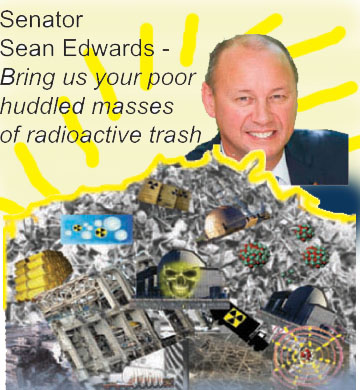 Outgoing senator Edwards lost his seat after winning the fifth spot on the Liberal ticket.
“I’ve lobbied heavily for South Australia’s expanded involvement in the nuclear fuel cycle, producing a substantial submission to the SA Nuclear Fuel Cycle Royal Commission in the process, and it now appears the state will do just that. This will deliver hundreds of billions of dollars in sovereign wealth to South Australia.”– http://www.adelaidenow.com.au/news/south-australia/bob-day-wins-12th-senate-spot-for-south-australia-labor-and-liberal-senators-out/news-story/ab561f14c51aebce726b9852fb7b52b6
Manufacturing social licence – South Australia’s Nuclear Fuel Chain Royal Commission
 The concerns that this approach is focussed more on manufacturing social license or acceptance of the dump plan, rather than forensically and objectively analysing the full range of risks and opportunities, have increased following news that a key adviser to the nuclear Royal Commission was an industry “true believer” linked to a failed attempt to open a global radioactive waste dump in Australia in the 1990s.
In the late 1990s, public outrage forced Pangea to abandon its dumping plan. Today, a pro-nuclear Royal Commission is using public funds to facilitate Pangea’s inheritors to rewrite the proposal.
Big bucks, radioactive waste and a biased SA Royal Commission https://independentaustralia.net/environment/environment-display/big-bucks-radioactive-waste-and-a-biased-sa-royal-commission,9304 1 August 2016 Following SA’s nuclear fuel cycle Royal Commission, a publicly-funded PR campaign is attempting to make the largest ever radioactive waste dump in the world, a tepid topic, writes Dave Sweeney.
A STATE-BASED Royal Commission unleashed a plan with massive national implications when it recommended, in May, that South Australia should move to import, store and bury around a third of the globe’s high level radioactive waste ‘as soon as possible’.
The Royal Commission, initiated by PremierJay Weatherill in 2015 and presided over by former governor and self-proclaimed state salesman Kevin Scarce, has unsurprisingly generated column inches, congratulations and critics.
With its pro-nuclear terms of reference and advisory panel, and its often oblique process, the exercise has been a case study in issue management. Radioactive waste may be hot but a well-funded series of rolling roadshows, a citizens’ jury, and a social media initiative are all part of a state campaign working to make the topic tepid and the “conversation” constrained. Continue reading
New Minister for Resources, Matt Canavan , a climate change denier
 One of their [climate denialists] cheerleaders is Frydenberg’s successor in the resources portfolio, Queensland senator Matt Canavan.
Canavan has form as a climate science doubter. A fortnight ago he told Sky News that the impact of carbon emissions had been “overhyped” by “certain interest groups” — in line with an earlier newspaper article in which he advocated funding “scientists who take a different view”.
 , PETER BOYER, Mercury
“I absolutely accept that man is contributing to climate change,” he declared. But that is not really how it is. Saying we are contributing to climate change is like saying the sun contributes to a warm day, or Hawthorn contributed to winning last year’s AFL premiership.
In the cautious words of the Intergovernmental Panel on Climate Change, there’s a 95 to 100 per cent chance that human activities have been the dominant cause of observed warming since the mid-20th century. We have not just contributed to climate change — we have caused it.
In the same Lateline interview, Frydenberg said Australia’s 2030 target — emissions 26 to 28 per cent lower than in 2005 — was “very ambitious” and among the highest in the world on a per-capita basis.
We have already heard the same from Abbott, Hunt and Turnbull.
All have failed to acknowledge our unhappy record of long being the G20’s highest per-capita emitter, skated over much tougher European targets, and ignored completely the all-important target of zero emissions.
He is playing to the many holdouts in the Coalition who still do not accept the real and present danger of climate change and the rising urgency to address it. Continue reading
Garma festival: Indigenous leaders call for land ownership settlement, slam land rights ‘failures’
http://www.abc.net.au/news/2016-07-31/garma-festival:-indigenous-leaders-call-for-land/7675658
Indigenous leaders at the Garma festival in northeast Arnhem Land have called for land ownership settlement, slamming the ‘failures’ of the Land Rights Act and Native Title Act that have allowed mining companies access to indigenous land.
Combination of solar and wind, with smart analytics and “big data” could cause electricity costs to plummet
Could big data soon make renewable energy storage free?, Independent Australia 2 August 2016, A new report explores the democratising of renewable energies through the advancement of “big data”.RenewEconomy‘s Giles Parkinson reports.
GLOBAL investment bank Citi is predicting that the combination of near zero-variable cost energy sources such as solar and wind, along with smart analytics and “big data”, may deliver what the nuclear industry promised nearly half a century ago — free energy……
Citi is not the only research institution making such forecasts but it is in sharp contrast to the general public discussion in Australia, which is dominated by those who insist that the old centralised energy system – slow, inefficient and expensive – will not and cannot be replaced by new technologies.
South Australia is now the focus of that debate, and the push-back against wind and solar by conservatives and, of course, vested interests, seeking to protect their sunk assets is striking.
But Australia is already well down the path to this transformation, given its high level of rooftop solar and the fact that it is considered to be the world-leading market for household battery storage and smart software. Continue reading
Melbourne’s first Tesla-town to be built in mega Alphington development
The Age, Simon Johanson, 2 Aug 16, The first stage of the massive 2500-dwelling, mixed-use commercial redevelopment of the former Amcor paper mill site in Fairfield will be built with 60 homes fitted with Tesla battery packs, inverters and solar panels. The full-line energy installation will not be an optional extra for home buyers but a standard inclusion in all three- to five-bedroom homes, Glenvill development director Travers Nuttall said…….http://www.theage.com.au/business/property/melbournes-first-teslatown-to-be-built-in-mega-alphington-development-20160729-gqgr0w.html
Credibility of South Australia’s Nuclear Royal Commission in tatters?
Today’s Age discusses the planned Australian Royal Commission into Juvenile Justice in the Northern Territory. The appointed Commissioner, Brian Martin, has resigned because he recognised a perception of bias by the community, however well qualified he might be for the position.
The South Australian Royal Commissioner, Kevin Scarce, was not only not qualified, with no legal background, but IS clearly perceived as biased.
Kevin Scarce has a conflict of interest, as a shareholder in Rio Tinto, and as a member of CEDA (the Committee for Economic Development In Australia). CEDA’s Policy Perspectives of Nov 2011 clearly supports and promotes the growth of South Australia’s nuclear industry. The Royal Commissioner selected predominantly pro-nuclear experts for the Commission’s Advisory Committee.
Speaking in November 2014 at a Flinders University guest lecture, Scarce acknowledged being an “an advocate for a nuclear industry”.
Mark Kenny, writing in The Age today says:
Indeed, Martin acknowledged this [public confidence] was the crucial factor – irrespective of the facts. He observed if any public doubts about the impartiality or commitment to the unvarnished truth were allowed to “fester” during the commission’s long months, its outcomes would be compromised.
1 This month
17 October, Free Public Talk on Nuclear Issues in South Australia
David Noonan will speak on public interest concerns over the new Roxby Downs Indenture Act 2026 on BHP copper-uranium mining and ore processing in SA, and on how AUKUS may face SA with a High-Level nuclear waste agenda.
Dr Jim Green will discuss international developments in the field of nuclear power including ‘small modular reactors’ and Generation 4 ‘advanced’ nuclear reactor concepts.


Help Aunty Sue Protect Her Land and Sacred Sites From Destructive Rocket Testing.
.

Australians deserve the truth
about
AUKUS – https://aukuspublicinquiry.com/

PETITION – To: Prime Minister Anthony Albanese and the Australian Labor Government

of the week – Australians for War Powers Reform (AWPR)
To see nuclear-related stories in greater depth and intensity

