South Korea eyes nuclear weapons over North Korea bomb fears, SMH, Peter Hartcher , 9 Aug 16 South Korea will arm itself with nuclear weapons if its rogue neighbour, North Korea, continues to develop the bomb.
This would be a revolutionary step, overturning half a century of opposition to nuclear capability. South Korea has committed to the Nuclear Non-Proliferation Treaty. “It will become a domino effect and even South Korea will become concerned and develop nuclear weapons, and maybe Japan as well,” according to a senior official in the Seoul government.
“This will all lead to a big security threat,” the director-general for reunification policy in the Ministry of Unification, Lee Duk-haeng, told Fairfax Media……..
The policy of the South Korean government is opposed to the development of nuclear arms, but the matter is now under lively debate as North Korea persists in its illegal plans.
Like other US allies including Japan and Australia, South Korea enjoys the protection of the US nuclear arsenal, so-called extended nuclear deterrent.
But the US Republican presidential candidate Donald Trump has called this into question.
Mr Trump has said that he is prepared to walk away from the long-standing US alliances with Tokyo and Seoul unless they pay more towards the cost of the US bases on their soil.
He has also said that it might not be a bad thing for South Korea and Japan to develop the bomb, directly contradicting half a century of US non-proliferation policy………
Mr Lee called on all regional governments, including Australia’s, to take a “stern” approach to isolate North Korea over its nuclear development.
Australia has taken recent new sanctions against Pyongyang. And the acting Foreign Affairs Minister, George Brandis, this week announced that “Australia stands ready to list additional individuals and entities associated with the regime’s weapons and missile technology activities”.
In February, South Korea responded to the persistent North Korean nuclear development by opening discussions with the US to install an American missile interception system.
Climate Council urges bigger push towards renewables as community energy projects take off, ABC Radio AM By regional affairs reporter Lucy BarbourThe Climate Council says a growing trend of rural communities setting up their own wind and solar farms could generate thousands of jobs in regional Australia.
Key points:
Community projects will benefit local investors
Twenty community energy projects are already operating in Australia
Many communities are working towards 100 per cent renewable energy
The council’s latest report, on the impact of climate change on rural Australia, says rural communities will continue to be affected by worsening extreme weather events such as bushfires and drought.
But the report’s co-author, Will Steffen, said community-owned energy was one way to adapt.
“You have to have some leaders in your community that can actually get on top of the issue and say, ‘look, forget about federal politics or whatever side you’re on, this is good for our community’,” he said.
There are currently 20 community energy projects operating across the country, but Peter Fraser from Goulburn in southern New South Wales, said there was the potential for many more.
Mr Fraser is part of a group trying to build a $2.6 million community solar farm which, he said, would provide investors with a 5 per cent return on investment.
“It will be 1.2 MW. It will have about 4,000 panels of solar voltaic and it will generate enough electricity to power perhaps 300 to 400 homes in Goulburn,” he said.
Mr Fraser said investors would buy the solar equipment, pay for the connections to the grid and then sell the electricity to those who want it……….
The Climate Council’s report points out that many regional communities are working towards 100 per cent renewable energy goals, and estimates 28,000 jobs could be created if half of Australia’s energy came from renewables by 2030.
South Australia signalling the death of base-load generation, REneweconomy,By Giles Parkinson on 8 August 2016 Tuesday marks the three-month anniversary of the closure of the last coal-fired “base-load generator” in the South Australia electricity market, and despite the best efforts of many in the Coalition and the Murdoch media, there is nothing to suggest that other states will not follow suit, in time.
The fossil fuel industry predicted – and possibly hoped for – “armageddon” from the closure of the last coal plant. But all it got was a big jump in wholesale electricity prices, caused not by renewable energy, as federal and local energy ministers have made clear, but by the soaring cost of gas and constraints on the interconnecter.
If anything, the events of the last few weeks have reinforced the point that the electricity market is in the early stages of an unstoppable transition. Coal-fired plants will soon be a thing of the past, and the role of gas-fired generators may all diminish as battery storage and other renewables take more central roles.
The announcement by AGL on Friday of its plans – supported by the South Australian government and the Australian Renewable Energy Agency – for an array of 1,000 batteries in homes and businesses to create a “virtual power plant” to address demand peaks and grid stability, is a foretaste of what is to come.
Indeed, South Australia’s experiment – as premier Jay Weatherill has described it – in pursuing the world’ highest level of wind and solar generation is rapidly evolving into a whole bunch of world-leading projects.
These include AGL’s (described the world’s biggest virtual power plant), South Australia Power Networks’ commitment to a second “world leading” battery storage project that will likely reduce the need for grid investment, and various proposals for large-scale solar with storage (from SolarReserve,Lyon Infrastructure and others) and the creation of suburban and remote town micro-grids that will reduce the need for centralised power and distribution.
The withdrawal of base-load coal generation from the South Australian grid has sparked predictions of economic collapse and soaring prices, but these have simply replicated what used to happen when the state relied entirely on gas for the balance on power, even before the arrival of wind and solar. Continue reading →
What’s happening in Whyalla? These articles come From February. I hope that Council and the newspaper editor have done their homework on nuclear waste, since then
Acting Whyalla mayor Tom Antonio has said that he is “positive” about nuclear energy’s future in South Australia ahead of his visit to the Lucas Heights nuclear reactor in Sydney next week.
The trip on February 9 will be made by a delegation from the Upper Spencer Gulf Common Purpose Group pending the findings of the Nuclear Fuel Cycle Royal Commission in South Australia….
Huge income and many jobs hinge on a proposal for a nuclear-waste repository in Whyalla in the wake of devastating news about the future of the Arrium steelworks.
Meanwhile, in an exclusive report, The Whyalla News can reveal that Whyalla City Council is close to declaring an interest in hosting a low-level nuclear waste repository…..
The notion that climate science denial is no longer a part of Australian politics was swept away yesterday by One Nation Senator-Elect Malcolm Roberts.
In his inaugural press conference, Roberts claimed that “[t]here’s not one piece of empirical evidence anywhere, anywhere, showing that humans cause, through CO₂ production, climate change”.
He also promoted conspiracy theories that the CSIRO and Bureau of Meteorology are corrupt accomplices in climate conspiracy driven by the United Nations.
His claims conflict with many independent lines of evidence for human-caused global warming. Coincidentally, the University of Queensland is releasing a free online coursethis month examining the psychology and techniques of climate science denial. The very first video lecture addresses Roberts’ central claim, summarising the empirical evidence that humans are causing climate change.
UQx DENIAL101x 1.2.1.1 Consensus of Evidence
Scientists have observed various human fingerprints in recent climate change, documented in many peer-reviewed scientific papers.
Not only do these unique fingerprints confirm humanity’s role in recent climate change, they also rule out other potential natural contributors. If the Sun caused global warming, we would expect to see days warming faster than nights, and summers warming faster than winters.
Instead we observe the opposite: nights are warming faster than days, and winters are warming faster than summers, which is a greenhouse pattern predicted by John Tyndallas long ago as 1859.
Similarly, if global warming were caused by internal variability, we would expect to seeheat shuffling around the climate system with no net build-up. Instead, scientists observe our climate system accumulating heat at a rate of more than four atomic bombs per second.
The scientific consensus on climate change has also been endorsed by many scientific organisations all over the world, including the national science academies of 80 countries
Is it a conspiracy?
How does one dismiss a global scientific consensus built on a robust body of empirical evidence?
There are five characteristics of science denial. These common traits are seen when people reject climate science, the benefits of vaccination, or the research linking smoking to cancer.
The techniques of denial are: fake experts; logical fallacies; impossible expectations; cherrypicking; and conspiracy theories. This is summarised in the acronym FLICC.
UQx DENIAL101x 1.4.3.1 Five Characteristics of Science Denial
Climate science denial and conspiratorial thinking are often found together. A well-known example is that of Donald Trump, who has dismissed climate change by blaming it on a Chinese conspiracy.
Several studies have linked climate science denial and conspiratorial thinking. If a person disagrees with a global scientific consensus, they’ll typically believe that the scientists are all engaging in a conspiracy to deceive them.
Malcolm Roberts’ conspiracy theories have been well documented and were once again on offer in yesterday’s speech. He espouses a conspiracy that encompasses the CSIRO, Bureau of Meteorology, international banking families, the United Nations and Al Gore.
Unfortunately, I am not optimistic that the evidence for human-caused global warming will persuade Malcolm Roberts. The scientific evidence from psychology tells us that scientific evidence is largely ineffective on those who dismiss climate science with conspiracy theories.
My own research found that communicating the science of climate change to those who exhibit conspiratorial thinking can even be counterproductive, activating their distrust of scientists and strengthening their denial of the evidence.
Furthermore, conspiratorial thinking is self-sealing. When conspiracy theorists are presented evidence that there is no conspiracy, they often respond by broadening the conspiracy to include that evidence. In other words, they interpret evidence against a conspiracy as evidence for the conspiracy.
Our course on climate science denial will be much more useful to those who are open to scientific evidence and curious about the research into the causes and impacts of climate change and the psychology of climate science denial.
Join in the solar chorus, says council, as North Melbourne gets on the ball http://www.theage.com.au/victoria/join-in-the-solar-chorus-says-council-as-north-melbourne-gets-on-the-ball-20160807-gqmtz2.html, Clay Lucas Councillor Arron Wood can understand why more businesses don’t put solar panels on their roof.
It’s not because they don’t want to save money. And it’s not because they don’t want to do the right thing. “The biggest barrier to wider uptake [of solar power] is the complexity of going through the process,” says Cr Wood, the chairman of Melbourne City Council’s environment committee.
Which is why, he says, opening North Melbourne Football Club’s new solar panel bank – 800 panels set across the club’s roof and that of the neighbouring council-run recreation centre – is a major breakthrough.
“There’s this sense that footy speaks to all parts of life in Melbourne, so partnering with … North Melbourne footy club might drive others to think ‘Maybe this is something we can do’,” he says.
The panels on the club’s roof will produce enough electricity per year to run 70 average Melbourne homes. North Melbourne’s chief executive Carl Dilena said the club expected to cut its energy use by almost a quarter as a result of installing the solar panels.
But as many Melbourne home owners know, solar does not always come cheap, at least initially. The system cost almost half a million dollars to install, and was partly financed by the council, via the Clean Energy Finance Corporation. The club contributed about $67,000 of the funding, with the rest coming from the city council.
It is the first partnership the council has undertaken with an outside party – all other installations it has done have been on council-owned building rooftops.
The council is working with Sustainability Victoria to find businesses interested in reducing either emissions or energy bills that have previously considered going solar.
“The driver for a lot of businesses isn’t saving the environment, it’s to save dollars and that’s completely fine,” says Cr Wood.
Solar could be game changer for rural communities going off the grid, ABC News By Kathryn Diss , 7 Aug 16 For decades, farmers in Western Australia’s south have put up with the most unreliable electricity supply in the state, now they are about to find out if they can live off-grid, surviving on solar power instead.
Key points:
Farmers in Western Australia are investigating using stand-alone solar power systems
Solar battery technology is making this more easily achieved, and the State Government will pay for it
Power-supply to south west WA has been unreliable, a problem in other regional areas
Ros and Bernie Giles are part of a handful of farming families giving the technology a crack after living through years of frustration at their farm in West River, 500 kilometres south of Perth.
“Summer is our worst time, we seem to have more fluctuations then,” Ms Giles said……
Power problems span farmland across nation
WA’s south west grid spans more than 250,000 square kilometres, an area the size of the United Kingdom, yet it only services a 50th of the population, making it unreliable and expensive to maintain.
But the power problems faced by the people of West River are hardly unique.
Matthew Warren heads up the Australian Energy Council, which formed earlier this year to respond to the world’s rapidly changing energy market.
He said most edge-of-grid communities around the nation suffered the same problems……….
Renewable energy reaches tipping point
The move by WA’s Liberal-National Government to invest in the technology is seen as a step towards a greener future.
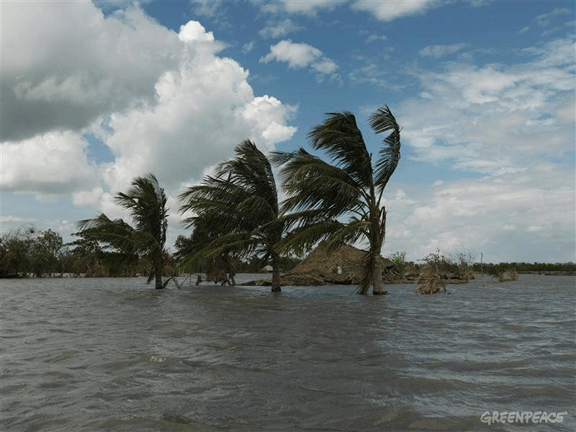
Carteret climate refugees seek homeA grassroots group in Bougainville is scrambling to relocate the Carteret Islanders before rising sea levels swallow their land forever. ABC News 7 Aug 16 By Lauren Beldi for Pacific BeatAt only 1.5 metres above sea level at their highest point, the Carteret Islands are some of the first to succumb to the rising ocean tides.
The grassroots Tulele Peisa group, which means “sailing the waves on our own” in the local Halia language, is hoping to relocate more than half of the population by 2020. They have secured land for new homes on the main island of the Autonomous Region of Bougainville, to the east of mainland Papua New Guinea.
Tulele Peisa formed in late 2006 after the Council of Elders on the islands decided to establish their own relocation program. The group’s chief executive, Ursula Rakova, says the encroaching tides on the islands have a major impact on people’s health. “We’re beginning to get more requests for people wanting to move because of the situation and the dire need for food,” she says.
The storm surges not only wash away houses, but also vegetable gardens, which are critical for the islanders’ survival.
With no cash economy on the Carterets, the only source of food is what people are able to grow for themselves……
Tulele Peisa has also provided thousands of mangrove seedlings to prevent the erosion of the coastline, and helped to build raised garden beds. But this will only stave off the inevitable for so long.
“Those are adaptation strategies, they aren’t really long-term solutions to containing the islands, because we know the islands are going, but we are looking at supporting our families,” Ms Rakova says.
She says the islanders want to maintain their independent way of living but that the international community should provide more support.
“The islanders on the Carterets are victims of what other people have caused and the international community needs to aid and support the work that we are doing,” she says.
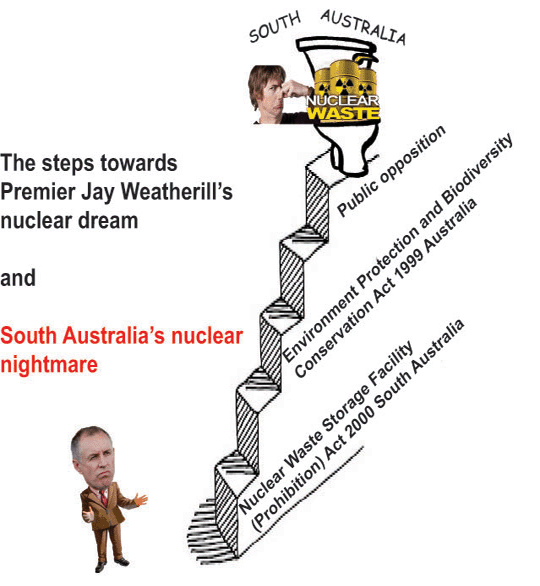
Will the SA legislative prohibitions on nuclear waste dumps be included?
“SIMPLIFY DAY
The Premier has announced that the first ‘Simplify Day’ will be held on 15 November, 2016 to repeal out-dated and redundant legislation that impacts on the Government’s ability to deliver on its 10 Economic Priorities.
In the lead-up to Simplify Day a consultation process is being held to seek the views of businesses and the community on how red tape can be removed for businesses, including any legislation that may be outdated or unnecessary.
Should you wish to know more about this initiative or make a submission visit the YourSAY website at www.yoursay.sa.gov.au. The consultation period is open until 13 August, 2016.”
Cindy K. HoskinFight To Stop Nuclear Waste In The Flinders Ranges https://www.facebook.com/groups/941313402573199/August 2 Here is the latest from port pirie. Tonight there is a paid invited meeting for nuclear in port pirie. A business man was rang on his moble and offered payment to attend, they asked his age which is 48, their reply was that they had enough over the 45 age limit and were seeking people under that age. Has any one else heard this? I have the number that this call came from if any one is interested.
Kim Mavromatis yeh, I had a phone call yesterday as well – they were going to pay $75 for my attendance – meeting in pirie tonoght or tomorrow? – but i didn’t quality cause they wanted someone under 45 – next time i’ll lie about my age – sneaky, underhanded, worms
Brenton Barnes If they want to pay young people to attend a community meeting maybe they should round up high school students. They would gladly take the money and not put up any fight.
Adelaide charges ahead with world’s largest ‘virtual power plant’ AGL project to roll out 1,000 battery systems to homes and businesses will operate like a 5MW plant, and optimise energy produced from solar panels, Guardian, Michael Slezak, 5 Aug 16, Adelaide will be home to the world’s largest “virtual power plant” – AGL is rolling out 1,000 battery systems to homes and businesses, with backing from the Australian Renewable Energy Agency (Arena).
AGL and Arena say the project will improve network security and dampen a volatile wholesale electricity price in South Australia. However, an energy expert says that at the current size, the system will have a minimal impact on network security or wholesale prices, but might pose a challenge to the revenues of companies that own the poles and wires.
Offered to homes and businesses with solar systems, the $20m AGL project, backed with $5m from Arena, will operate like a 5MW peaking power plant, providing power to homes and businesses during periods at optimal times.
The chief executive of AGL, Andy Vesey, told Guardian Australia: “The beauty of the project is it’s being done over 1,000 batteries, and that’s how we deliver an aggregate benefit to the grid itself.
“But for the consumer, it will have the value of the battery. And it’s being priced at a way that a good investment decision could be made. We’re viewing that the average savings for someone who has rooftop solar right now would be $500 a year. It’s really a way of optimising the energy produced out of their solar panel.”
The system will cost $3,500, and AGL estimates it will take about seven years for solar customers to recover the costs.
Arena’s chief executive, Ivor Frischknecht, said the project would boost grid stability, reduce power price volatility and support the expansion of renewable energy……..
As a demonstration of something that could be bigger, McConnell said one of the biggest impacts of the business model could be on how the networks recover the costs of the poles and wires.
About half the cost of a home energy bill is linked to the network’s cost recovery of its poles and wires. McConnell said that meant a lot of the money being saved by consumers was actually done by avoiding paying the network costs. And that’s what AGL is relying on for its business model.
Rio Tinto snubbed by Pilbara’s Aboriginal elder, The Australian, s Andrew Burrell The Australian Business Review. August 6, 2016
“Unfortunately, we cannot stand here today and welcome you to country when our people are worse off than when no mining existed,” the elders said.
Aboriginal elders refused to perform a “welcome to country” ceremony at a Rio Tinto (RIO) function to mark the company’s 50-year anniversary of mining in the Pilbara in a protest over what they say is a failure to pay royalties and create jobs for indigenous communities.
In an embarrassing snub, the Eastern Guruma native title holders instead took to the stage at the event in Tom Price to attack Rio’s record in the Pilbara.
Rio has long touted its credentials on indigenous issues, describing itself as one of the largest private sector employers of indigenous Australians.
The company has no legal obligation to pay mining royalties to the native title holders on six of its Pilbara mines because they were established before the Native Title Act came into effect in 1994.
At the recent function, three of the Eastern Guruma elders — Sue Boyd, July Hicks and Judith Hughes — refused to perform a “welcome to country” ceremony that is commonly used by traditional owners to welcome visitors to their land.
“Unfortunately, we cannot stand here today and welcome you to country when our people are worse off than when no mining existed,” the elders said.
“We are not being paid compensation for three Rio Tinto mines operating on our country. We are not being employed. We are not getting the contracts and business opportunities that the mining industry prides itself on.
“Outcomes for the Eastern Guruma people have been poor.
“Traditional Owners at Yeelirrie have fought against uranium mining for over 40 years.
The decision from the EPA comes as welcome relief but Traditional Owners remain wary.
“Richard Evans Koara elder and co-founder of the West Australian Nuclear Free Alliance has said “The EPA decision to protect subterranean fauna is a good decision and the right decision and we are happy with the outcome.
But we believe the EPA has underestimated the risk to bush foods, public health and water and most importantly our cultural heritage and our community’s opposition to the mine.”
“I invite the Minister (who has never spoken to us before) to come and meet with us the Traditional Owners of Yeelirrie before making a decision about our country. No Minister has come to talk to us about that country.
Yeelirrie is an important place in our culture, it is a dreaming site it important to us and other tribes around us.
In the short time since WA was colonised there have been drastic changes to the ecosystem and the country.” …
“It’s not just about protecting this country for us – but uranium threatens communities and country from the cradle to the grave, at home and overseas.
This is our responsibility and we take that responsibility seriously. We have to leave this poison where it is.” … “
The Greens have urged WA Environment minister Albert Jacobs to uphold the EPA’s advice to reject the controversial Yeelirrie uranium in the Goldfields of WA.
“The Yeelirrie uranium mine was first proposed in the 1970’s and has faced strong local and state wide community opposition for decades,” said Greens nuclear spokesperson Scott Ludlam.
“Today’s decision by the EPA should be the final nail in a proposal that should never have seen the light of day.
“The onus is now on Albert Jacobs to score a rare win for the WA environment and shut this proposal down once and for all.”
Senator Ludlam congratulated pastoralists, anti-nuclear campaigners and local Traditional Owners for their tireless work to oppose a project that would have been an environmental disaster.
David Noonan will speak on public interest concerns over the new Roxby Downs Indenture Act 2026 on BHP copper-uranium mining and ore processing in SA, and on how AUKUS may face SA with a High-Level nuclear waste agenda.
Dr Jim Green will discuss international developments in the field of nuclear power including ‘small modular reactors’ and Generation 4 ‘advanced’ nuclear reactor concepts.