Dr Helen Caldicott – a prophet With Honour outside her own country

the Smithsonian has named Dr. Caldicott one of the most influential women of the 20th century.
(Now why isn’t Dr Caldicott being asked as a witness in the South Australian Nuclear Citizens jury?)
#WomanCrushWednesday: Dr. Helen Caldicott http://www.wand.org/2016/06/29/womancrushwednesday-dr-helen-caldicott/ by Honora Gibbons, WAND Intern, Arlington, MA Dr. Helen Caldicott holds a special place in our hearts and history at WAND as our founder. Over her long career, she has demonstrated tremendous passion, skill, and dedication for consistently raising and calling citizens to action on the pressing nuclear and environmental issues of our time.
Caldicott was born in Melbourne, Australia. She earned her medical degree from the University of Adelaide Medical School. Her anti-nuclear stance is rooted in her identity as a physician and as a mother. As Caldicott spoke publicly on the health hazards of radiation, she rose to prominence as an activist for nuclear disarmament.
In the 1970s, Dr. Caldicott moved to the United States, joining Boston’s Children’s Hospital and briefly teaching pediatrics at Harvard Medical School. In 1979, the Three Mile Island nuclear disaster occurred, the worst nuclear power accident in U.S. history. Following this, in 1980, Caldicott resigned from her medical career in order to dedicate herself fully to the prevention of nuclear warfare and dependency on nuclear power. From then on, she worked to call attention to the world’s growing reliance on nuclear power and the dangers of the nuclear arms race. Continue reading
Australians Saving $1 Billion Per Year through Solar Energy
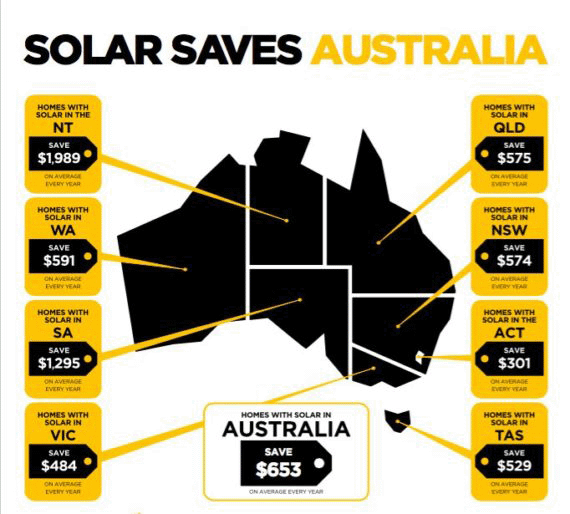
Solar In Australia Saving $1 Billion Per Year http://cleantechnica.com/2016/06/28/solar-australia-saving-1-billion-per-year/ June 28th, 2016 by Joshua S Hill Australia can now boast of over 23.2 million solar PV panels saving citizens $1 billion on their power bills each year.
According to a new report from Solar Citizens, “an  independent community based organisation,” Australia reached 23.2 million solar PV panels installed earlier this year — the equivalent of one per person in the country.
Solar Citizens also calculated the savings currently being made by solar owners on their regular electricity bills, analysing average electricity retail rates across all State and Territories over the past 8 financial years, revealing that solar households have saved $4.4 billion on their power bills since FY 2007–2008, and have been saving around $1 billion every year over the past three years.
“The pace of rooftop solar installation in Australia has been nothing short of phenomenal in recent years,” said Claire O’Rourke, National Director of Solar Citizens. “Solar panels are now a regular and normalised part of Australian life. In fact, Australians spend as much on their solar as they do on tea and coffee.”
In terms of investment, the report shows that 1.5 million Australian households and small businesses have invested more than $8 billion into rooftop solar PV. In fact, the investment figures reported in The State of Solar: Australia’s Solar Rooftop Boom are the highlight of the Solar Citizen’s research. During the 2014–2015 financial year, Australians invested $1.23 billion in rooftop solar — compared to only $118 millioninvested in large-scale solar projects in the calendar year 2014. So far, it is the hard-earned cash of Australian homeowners and small business owners that is driving the renewable energy transformation in Australia.
“Australians are leading the renewables charge and this new set of data plainly reveals that investment in solar PV has been the backbone of the renewables revolution in Australia,” said O’Rourke.
So far in 2016, Australia’s rooftop solar PV installation base has generated over 6.5 TWh, preventing 6.3 million tonnes of greenhouse gas emissions.
And with Australia about to go to the polls this weekend in the country’s federal election, this goes a long way to showing what Australians want from their politicians.
“Australian political leaders need to understand just how much the average Australian themselves have committed of their own money to play a part in the transition of our power system,” added O’Rourke. “With 5 million Australians (or 1 in 5 voters) living under a solar roof, this is potent political constituency.”
A solar energy revolution in mining
The next solar revolution could replace fossil fuels in mining, The Conversation, Geoffrey Brooks Pro-Vice Chancellor (Future Manufacturing), Swinburne University of Technology, June 29, 2016 Recently Sandfire Resources, a gold and copper producer based in Western Australia, announced its new solar power plant will soon start powering its DeGrussa mine. By replacing diesel power, the 10-megawatt power station, with 34,000 panels and lithium storage batteries, is expected to reduce the mine’s carbon emissions by 15%.
This is an exciting development because it realises an important potential that has long been recognised but not exploited. Two of Australia’s greatest resources – solar energy and minerals – are, as luck would have it, both highly concentrated in the same parts of Australia.
In this case, solar energy is being used to power the mine, but there is also great potential for solar energy to be used to convert the minerals to chemicals and metals……..
The next revolution
Currently, Australia’s use of solar energy is largely limited to homes, for hot water and solar-powered electricity. But solar energy has great potential for regional Australia too.
Mines are often isolated. There is typically limited natural gas and electricity supply, and in remote areas energy supply is limited to liquid fossil fuels. This is exactly the potential being exploited by Sandfire Resources at its mine facility 900km north of Perth.
Recent studies by CSIRO have identified the potential to use solar in high-temperature processing of ores such as bauxite, copper and iron ore. This process would use concentrated solar thermal (CST) energy as a heat supply. This heat can also be converted to electricity, known as concentrated solar power (CSP).
This is different to the solar photovoltaic technology used in Sandfire’s solar power plant (and rooftop solar panels), which converts sunlight directly to electricity……..
Concentrated solar energy is still relatively expensive. The Australian Solar Institute estimated in 2012 that the cost of electricity from concentrated solar was approximately double the current cost for conventional energy, reflecting largely the high capital cost of solar systems.
This gap can reasonably be expected to close with increases in the scale of operations (lowering manufacturing costs) and in regulatory pressure on conventional power sources.
It may be a way off, but the small step by Sandfire Resources could be the start of a revolution in the Australian minerals industry. https://theconversation.com/the-next-solar-revolution-could-replace-fossil-fuels-in-mining-61153
Indigenous Australians versus the nuclear industry – a story of successes – theme for July 16
The Kungkas wrote in an open letter: “People said that you can’t win against the Government. Just a few women. We just kept talking and telling them to get their ears out of their pockets and listen. We never said we were going to give up. Government has big money to buy their way out but we never gave up.”
In 1963, Aboriginal people of East Arhem Land created ochre-framed bark petitions adorned with the clan designs of all that was threatened by mining – from the snakes to the sand dunes. These petitions against mining paved the way for the Indigenous land rights movement. These were the first traditional documents to be recognised by the Australian Parliament.

In 1966 Vincent Lingiari led the walk-off of Gurindji people from Wave Hill station , leading to l Whitlam’s historic land rights declaration in 1975. The indigenous people’s struggle for their land has never ceased. The focus for this fight for over 40 years was the Tent Embassy, established in Canberra in 1972, to protest against a court decision over mining operations on Aboriginal land.
Without financial resources, but with clear determination, Aboriginal people have fought and won many battles, especially against mining , with protests, and legal action.
On the nuclear front, outstanding victories include the Cape York Olkola people’s three-decade struggle against uranium mining, the Mirrarr people’s success in preventing further uranium mining at Ranger, in Northern Territory, and Jeffrey Lee’s remarkable action in preventing AREVA from further uranium mining in Kakadu National Park
In stopping nuclear waste dump plans for South Australia, in 2004 the battle was led by the Kupa Piti Kungka Tjuta, a council of senior Aboriginal women from northern SA. Aboriginal women led the 7 year battle to prevent nuclear waste dumping at Muckaty, Northern Territory.
I hope that White Australia will gather strength in opposition to the latest onslaught from the nuclear lobby – the nefarious Nuclear Fuel Chain Royal Commission’s plan for South Australia as the global radioactive trash toilet. Very few indigenous people will be taken in by the slick spin and bribery of the nuclear lobby. Those strong, intelligent indigenous people who continue their determined fight, need all the support they can get from the rest of us.
Nigel Carney analyses intrinsic flaws in the Nuclear Royal Commission
 SA NUCLEAR BRIEFING Nigel Carney, June 16, 2016 Coober Pedy Regional Times “…… the issue South Australians are currently facing in the low level waste site selection process has always been a state and federal alliance, no mere coincidence of need…….
The Commission has been criticized widely as being a political stunt, not an independent Commission but rather a rubber stamp. The findings of the Commission released in May 2016 tend to support this view. The report itself presents evidence against its own findings. We are reminded that the Radium Hill mine and Port Pirie treatment plant remain as unresolved radioactive sites. The Commission finds:
‘The failure to consider the environment in the planning, operating and decommissioning of these facilities has resulted in ongoing management challenges….Although subsequent assessments of both sites show they do not pose a serious radiological risk to the health of visitors to the sites the state government is required to continue to monitor and manage potential environmental contamination’ (Nuclear Fuel Cycle Royal Commission Findings May 2016)
Why then, the public may ask, would a Commission which acknowledges the failure of government to manage the legacy of the nuclear fuel cycle suggest the state has the capability of managing the world’s nuclear waste? Continue reading
Politics and the Nuclear Waste Importing Plan
Risks, ethics and consent: Australia shouldn’t become the world’s nuclear wasteland, The Conversation, Mark Diesendorf, Associate Professor, Interdisciplinary Environmental Studies, UNSW Australia, June 28, 2016
In a country that is divided about nuclear power and where the annual economic value of uranium exports is a modest A$622 million (roughly equal to Australia’s cheese exports), the origin of the nuclear waste proposal is puzzling and inevitably involves speculation.
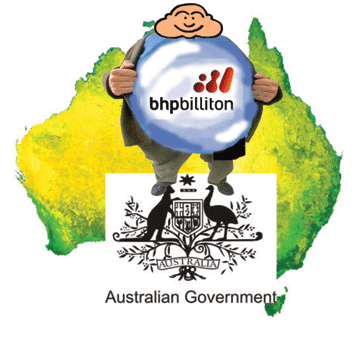 However, one could suggest the political influence of BHP-Billiton, owner of Olympic Dam in South Australia, Australia’s largest uranium mine and the second-largest in the world, and Rio Tinto, owner of the Ranger uranium mine in the Northern Territory.
A global nuclear waste site would lock future generations of Australians into an industry that is dangerous and very expensive. It’s unlikely to gain social consent from Indigenous Australians, or indeed the majority of all Australians. Given the risks, it would be wise not to proceed. https://theconversation.com/risks-ethics-and-consent-australia-shouldnt-become-the-worlds-nuclear-wasteland-61380
The (anti-nuclear) Lizard dances in Adelaide
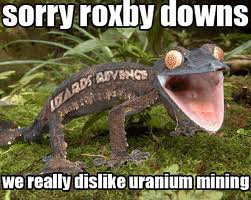 Zombie dance protest against nuclear industry, in Adelaide’s Rundle Mall http://www.abc.net.au/news/2016-06-28/zombie-dance-protest-rundle-mall/7551626 By Claire Campbell Anti-nuclear campaigners dressed as “zombie mine workers” have taken their message to shoppers in Adelaide’s busy Rundle Mall.
Dancing to the song Radioactive by Imagine Dragons, they rallied against nuclear energy use in Australia and a planned expansion of the outback Olympic Dam uranium mine near Roxby Downs.
Protestor Izzy Brown said South Australia needed to reject proposals that it expand its role in the nuclear fuel cycle. “We’re trying to raise awareness about the dangers of radiation, especially as South Australia is facing an expansion of the nuclear industry,” she said.
“There’s a threat of a national and international waste dump, Roxby wants to expand its uranium mining as well. “So we wanted to get out on the streets of Adelaide. The flash mob is just one small piece of a very big artistic theatrical theme.”
The protest group, the Desert Liberation Front, has dubbed its latest campaign, The Lizard Bites Back. An earlier protest at Olympic Dam four years ago saw police and protesters clash as some broke through a perimeter fence of the mine.
The Risky Economics of South Australia’s Nuclear Waste Importing Plan
 Risks, ethics and consent: Australia shouldn’t become the world’s nuclear wasteland, The Conversation, Mark Diesendorf, Associate Professor, Interdisciplinary Environmental Studies, UNSW Australia, June 28, 2016 Last month the South Australian Nuclear Fuel Cycle Royal Commission recommended that the state government develop a business venture to store a large fraction of the world’s high- and intermediate-level nuclear power station wastes in South Australia. It proposes to do this by first building an interim above-ground store, to be followed by permanent underground repository.
But the commission’s recommendation is based on several debatable assumptions, including:
- an economic analysis that purports to show huge profits with negligible commercial risk
- the notion that social consent could be gained by “careful, considered and detailed technical work”
- the argument that Australia, as a net exporter of energy, has an ethical responsibility to help other countries lower their carbon emissions by means of nuclear power.
I have analysed critically these and other assumptions of the royal commission in a scholarly paper published in the international journal Energy Research and Social Science.
Risky economics
The commission’s economic analysis rests on the heroic assumption that customers would, upon delivery of their nuclear wastes to South Australia, pay up-front for both interim above-ground storage andpermanent underground storage. This would be up to 17 years before the underground repository has actually been built. The estimated total payment would be about A$1.75 million per tonne of heavy metal (tHM) for storing possibly 138,000 tHM in total.
However, this ignores the huge financial risk to the government and taxpayers in the following scenario: the SA government builds the initial facilities – port, underground research and an interim above-ground storage – at a cost of about A$3 billion. Commencing in year 11, customers deliver their nuclear wastes in dry casks, but pay initially only for the costs of interim storage of the casks, declining to pay for geological storage until the underground repository has been built and becomes operational in year 28.
Despite the royal commission’s claim that the government would not develop the project under these conditions, the government could be influenced to accept the wastes by pressure, both positive and negative, from overseas governments, multinational corporations and/or internal politics.
Then, after a large quantity of nuclear waste has been placed into interim storage in SA, the government might not proceed with the geological storage, costing an extra A$38 billion, for technical, political or financial reasons.
A similar situation occurred in the United States with the termination of funding for the Yucca Mountain repository after US$13.5 billion had already been spent.
In this scenario, SA would be locked into managing a large number of dry casks, designed only for interim storage and located above ground, which will gradually erode and leak their dangerous contents over several decades. The physical hazards and the corresponding financial burden on future generations of all Australians would be substantial.
In this scenario, it would also be risky for customers who relied upon it and so failed to provide their own domestic geological repository……… https://theconversation.com/risks-ethics-and-consent-australia-shouldnt-become-the-worlds-nuclear-wasteland-61380
Queensland approves all environmental activity applicants despite ‘disqualifying events’ ‘An independent review has raised se
rious questions about the system for registering people and companies for sensitive environmental activities in Queensland.
Key points:
– Applicants were approved despite leaving questions unanswered, missing documents
– Environmental lawyer describes the process as “sloppy”
– The Environment Department says it helps applicants fix applications
The ABC can reveal that not a single applicant has been denied “suitable operator” status
since the system was brought in three years ago, despite instances of missing paperwork,
inadequate information, and applications containing “disqualifying events”.’
‘Concerns over #Adani port expansion prompted review …
Background check ‘ignores foreign offences’ … ‘
Exclusive by the National Reporting Team’s Mark Willacy | ABC News
http://www.abc.net.au/news/2016-06-27/no-applicants-rejected-under-qld-environmental-activity-register/7546290
Social Consent and South Australia’s Nuclear Waste Import Plan
Risks, ethics and consent: Australia shouldn’t become the world’s nuclear wasteland, The Conversation, Mark Diesendorf, Associate Professor, Interdisciplinary Environmental Studies, UNSW Australia, June 28, 2016
“…….Aware that Australians are divided on the nuclear industry, the royal commission acknowledges that gaining “social consent warrants much greater attention than the technical issues during planning and development”.
Then, on the same page of its report, it postulates that community support could be gained by “careful, considered and detailed technical work”. It thus creates the false impression that all social and ethical concerns can be reduced to technical issues.
Ultimately, gaining social consent is a socio-political struggle that draws only slightly on research and education on science, technology and economics. This is demonstrated by current debate in Australia on climate science, in which citizens are influenced by a print media that in many cases is biased towards denial, and a Coalition government that contains several vocal climate sceptics
Indigenous Australians have successfully opposed for 20 years an above-ground dump for low-level national nuclear waste on their land at Muckaty in the Northern Territory. Indigenous communities are already mobilising, together with environmentalists, to resist very strongly any development of intermediate- and high-level repositories in South Australia. The social impacts of a low-level waste dump are bad enough, but would be dwarfed by the social, physical and financial impacts of a high-level waste repository…….” https://theconversation.com/risks-ethics-and-consent-australia-shouldnt-become-the-worlds-nuclear-wasteland-61380
Canberra’s community- owned solar farm to be largest in Australia
 ‘Largest community-owned’ solar farm in Australia taking root in Canberra vineyard June 28, 2016 Katie Burgess Canberra Times reporter There are two reasons Canberra’s David Osmond puts his money into solar panels rather than stockpiling it in the bank.
“The returns are better plus it’s going towards a cause I’m very passionate about,” he said.
The latest solar project Mr Osmond will invest in will be the largest community-owned solar farm in Australia – and it will be right here in Canberra.
Mr Osmond is one of the first investors in the SolarShare Community Energy Majura Solar Farm, a $3 million solar plant that, when built, will generate enough electricity to power 250 Canberra homes.
SolarShare project leader Lawrence McIntosh said more than 5000 solar panels will be mounted on three hectares leased from the Mount Majura Vineyard, producing 1.9GWh of electricity each year.
“Wine grapes are best grown on slopes, which leaves the flatter land at the bottom of the valley with not much interest for grape growing but great for a solar project,” he said.
While only 5 per cent of the size of the Royalla Solar Farm south of Canberra, this one will be owned by the community, investors pledging $50 to $10,000 each towards its construction and maintenance.
About 400 people have registered as investors so far and more are being welcomed, Mr McIntosh said.
The flagship farm is predicted to earn more than $360,000 a year in revenue from selling electricity to the energy networks, its profits shared among the project’s investors…….http://www.smh.com.au/environment/energy-smart/largest-communityowned-solar-farm-in-australia-taking-root-in-canberra-vineyard-20160620-gpnu4k.html
Australian SILEX laser uranium enrichment process has weapon sproliferation danger
Laser uranium enrichment technology may create new proliferation risks, Science Daily, June 27, 2016 Princeton University, Woodrow Wilson School of Public and International Affairs
- A new laser-based uranium enrichment technology may provide a hard-to-detect pathway to nuclear weapons production, according to a forthcoming paper in the journalScience & Global Security by Ryan Snyder, a physicist with Princeton University’s Program on Science and Global Security.
- One example of this new third-generation laser enrichment technique may be the separation of isotopes by laser excitation (SILEX) process which was originally developed in Australia and licensed in 2012 for commercial-scale deployment in the United States to the Global Laser Enrichment consortium led by General Electric-Hitachi. Research on the relevant laser systems is also currently ongoing in Russia, India and China.
The paper explains the basic physics of the new uranium separation concept, which relies on the selective laser excitation and condensation repression of uranium-235 in a gas. It also estimates the key laser performance requirements and possible operating parameters for a single enrichment unit and how a cascade of such units could be arranged into an enrichment plant able to produce weapon-grade highly enriched uranium.
Using plausible assumptions, the paper shows how a covert laser enrichment plant sized to make one bomb’s worth of weapon-grade material a year could use less space and energy than a similar scale plant based on almost all current centrifuge designs, the most efficient enrichment technology in use today. The results suggest a direct impact on detection methods that use size or energy use as plant footprints……..https://www.sciencedaily.com/releases/2016/06/160627160941.htm
The Ethics of the Nuclear Waste Import Plan
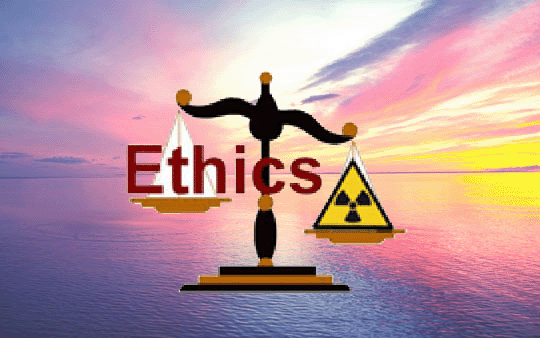 Risks, ethics and consent: Australia shouldn’t become the world’s nuclear wasteland. The Conversation, Mark Diesendorf, Associate Professor, Interdisciplinary Environmental Studies, UNSW Australia, June 28, 2016
“……..One of the assumptions underlying the royal commission’s ethical argument is that nuclear power will continue to be a low-carbon energy source.
However, the life-cycle CO₂ emissions from conventional nuclear power will increase greatly as high-grade uranium ore is used up and low-grade ore is mined and milled with fossil fuels. This limitation could be avoided only if mining and milling are done with renewable energy or if new fuel is produced in fast breeder reactors, but neither of these options appears likely on a commercial scale within the next 20 years.
Second, the royal commission assumes that those countries that lack sufficient indigenous renewable energy cannot be supplied by trade of renewable electricity via transmission lines or renewable liquid and gaseous fuels delivered by tanker. After all, countries that lack fossil fuels or uranium are supplied by sea trade.
Third, it assumes that it is ethically a good thing to foster the expansion of an energy technology that has risks with huge potential adverse impacts, possibly comparable in magnitude to those of global climate change.
The risk with the highest impacts could be its contribution to the proliferation of nuclear weapons (for details see the Nuclear Weapon Archive and chapter 6 of Sustainable Energy Solutions for Climate Change) and hence the likelihood of nuclear war that could cause a nuclear winter…….. https://theconversation.com/risks-ethics-and-consent-australia-shouldnt-become-the-worlds-nuclear-wasteland-61380
Citizens Jury: the ever climbing costs of Jay Weatherill’s nuclear waste dream
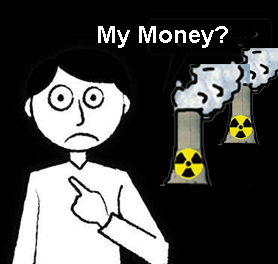 $7k each for Jay Weatherill’s nuclear citizen jury http://www.theaustralian.com.au/news/briefs-nation/7k-each-for-jay-weatherills-nuclear-citizen-jury/news-story/c363f8aac22374ef76e470b9c71d33e8 JUNE 27, 2016 Rebecca Puddy Reporter Adelaide The South Australian government has set aside $350,000 for 50 randomly chosen people to meet over four days to discuss the establishment of a nuclear waste dump, equating to $7000 a person.
The first two days of consultations of the citizens’ jury were held at the weekend, with Premier Jay Weatherill picketed by anti-nuclear activists on his way to open the deliberations over whether the state should have a high-level nuclear waste repository.
It is understood a budget of $350,000 has been set aside for the four days, including recruitment and management, accommodation and transport, event facilitation over the two weekends, live streaming and transcription services, catering, venue hire and security.
In announcing the citizens’ jury, Mr Weatherill last month said less than a $1 million had been budgeted for his nuclear consultation process, but more would likely be assigned in the state budget on July 7.
Blow to South Australian govt: BHP categorically rejects any role in nuclear waste importing
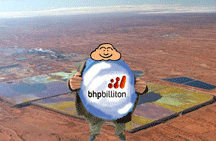 In another potential blow to the South Australian government, which had pinned the state’s economic future on the original expansion plan, Olympic Dam asset president Jacqui McGill categorically rejected siting a high-level international nuclear waste repository on any land covered by its indenture agreement.
We’re not a waste repository company, so that’s not in our business model and it’s not in our plans,” she said. BHP had no moral responsibility to manage waste
BHP: Fukushima set uranium industry back for years THE AUSTRALIAN JUNE 27, 2016 Michael Owen SA Bureau Chief Adelaide A key reason for BHP Billiton’s decision four years ago to indefinitely mothball a $30 billion plan to turn Olympic Dam into the world’s biggest uranium mine was the Fukushima nuclear plant explosion rather than cost concerns, it has been revealed. Continue reading
1 This month
17 October, Free Public Talk on Nuclear Issues in South Australia
David Noonan will speak on public interest concerns over the new Roxby Downs Indenture Act 2026 on BHP copper-uranium mining and ore processing in SA, and on how AUKUS may face SA with a High-Level nuclear waste agenda.
Dr Jim Green will discuss international developments in the field of nuclear power including ‘small modular reactors’ and Generation 4 ‘advanced’ nuclear reactor concepts.


Help Aunty Sue Protect Her Land and Sacred Sites From Destructive Rocket Testing.
.

Australians deserve the truth
about
AUKUS – https://aukuspublicinquiry.com/

PETITION – To: Prime Minister Anthony Albanese and the Australian Labor Government

of the week – Australians for War Powers Reform (AWPR)
To see nuclear-related stories in greater depth and intensity

