The powerful influence of mining companies on Australia’s political parties
 serious questions about the influence that mining and energy companies have on major political parties during election campaigns.
It is well known there is a perpetually revolving door between mining/energy companies and politicians/staffers from the major parties.
Take the Labor Party. When Labor lost the last election, Martin Ferguson, Craig Emerson and Greg Combet either took up management jobs with mining and energy companies and associations or worked as consultants for them.
Combet, a former climate change minister, took up consultancies for coal seam gas companies AGL and Santos. Ferguson, resources minister during Labor’s last term of office, landed the position as chairman of the Australian Petroleum Production and Exploration Association’s advisory committee only six months after leaving politics.
With the Coalition, former National Party leader Mark Vaile is chairman of Whitehaven Coal, the company at the centre of protest and controversy at the Maules Creek mine. Another former National Party leader, John Anderson, became chairman of Eastern Star Gas only two years after quitting Canberra.

How Big Mining’s donations influence the political agenda in Canberra, Independent Australia The Conversation 25 June 2016, Voters take note: As the old adage goes, if you take the King’s shilling, you do the King’s bidding. In this case, it is King Coal— and its biggest subject is the Coalition. Monash University’s David Holmes reports.
THE ENDORSEMENT for coal mining from the Labor-Coalition duopoly that the election campaign has seen in the last week makes the token appeals that have been made about tackling climate change even more disingenuous.
In this election campaign, the major parties have only brought up climate change when they have been pressed to do so at public forums, like leaders’ debates, the ABC’s Q&A, or when they treat social media as something that needs to be quelled.
The Coalition’s response is simply to say that Australia participated in the Paris agreement, and that is good enough. Labor, on the other hand, points to having outbid the Coalition on targets. Yet neither party is planning to deliver the cuts needed for Australia to play its part in keeping global warming below the 2℃ threshold.
Which leads us back to a question I will deal with at the end of this article: if polls are consistently showing that Australian voters want climate change on the election agenda, why are the leaders keeping so quiet about it?
Neither party is shy of talking up coal, however. Bill Shorten declared last week that a Labor government would not ban coal mining — and that it would be part of Australia’s energy needs for the foreseeable future.
But then on Tuesday, Attorney-General George Brandis, campaigning for Queensland’s most marginal seat of Capricornia, put in one of the pluckiest coal-selling performances of the campaign. He cited the gigantic Adani mine in central Queensland a saviour for the electorate……. Continue reading
1 – 3 July – Lizard Bites Back festival at Olympic Damn Uranium Mine
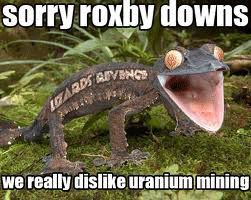 The Lizards Bites Back music and arts festival and protest camp will take place at the gates of the Olympic Dam uranium mine (or close by) from the 1st – 3rd of July this year. The “protestival” will include a variety of musicians and artists from around the country, mobile artworks, workshops on nuclear issues, non-violent direct action, and the message that there is strong community opposition to uranium mining and any expansion of the nuclear fuel chain in South Australia, from BHP Billiton’s planned heap leach demonstration plant to current proposals for South Australia to host a nuclear waste dump. The event will run entirely on solar and wind power.
The entire nuclear fuel chain from mining to nuclear waste dumps poses unique health and environmental risks that span generations. With South Australia currently facing two proposals for nuclear waste dumps The Lizard Bites Back will re-focus on the source of the problem, highlighting an absurd global situation where we continue to mine a mineral that we cannot dispose of safely, whilst proposals are again being made to force nuclear waste dumps on communities that do not want them. The Olympic Dam mine itself will also eventually become a dump – in the sense that once it is closed, it will leave millions of tonnes of radioactive tailings on the surface of the land forever.
Uranium mining is the beginning of the nuclear fuel chain, and the problem of the long term storage of radioactive waste remains unresolved. Until the industry and governments stop creating nuclear waste by mining uranium, operating nuclear reactors and making nuclear weapons, why should any community bear the health and environmental risks associated with a nuclear waste dump? The government’s current approach mops up the bathroom floor whilst the tap is still running.
A responsible approach to managing nuclear waste would begin with stopping its production. An environmentally and socially just approach would stop targeting Aboriginal lands as sacrifice zones.
The Lizard Bites Back follows on from the Lizards Revenge in July 2012, which mobilised 500 people against the proposed expansion of the mine. Since then, that proposal has been shelved and the company has been investigating heap leach mining as part of a cheaper expansion plan. BHP is projected to begin a heap leach trial on the current mining lease by late this year. Even though this technique is not currently used on-site, Federal approval of the trial did not require environmental assessment.
Please see below for a summary of the issues. Continue reading
Port Augusta protest against federal government’s plan for dumping Lucas Heights nuclear wastes at Barndioota

Doctor Margaret Beavis, a Melbourne-based GP, joined the protest today and 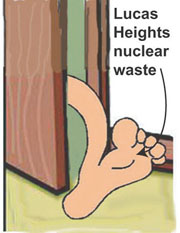 says the community needs help addressing this issue.
“I think it’s important to realise that most of this waste doesn’t come from the use of medicine,” Dr Beavis said.
Nuclear waste protest gives people voice http://www.transcontinental.com.au/story/3990175/nuclear-waste-protest-gives-people-voice/ Matt Carcich @MattCarcich June 24, 2016,Around 150 people made their voices heard in a protest against the federal government’s plan for a national nuclear storage facility in the Flinders Ranges at the Barndioota site near Hawker.
The march started at the Port Augusta foreshore, before stopping out the front of State MP Dan van Holst Pellekaan’s office.
The rally continued down the main street, stopping at every major intersection and Woolworths, before heading to the Port Augusta Regional Council building and finishing at Gladstone Square.
People travelled from Port Pirie, Whyalla, Hawker, Quorn and Adelaide for the event.
Upon arrival at Mr van Holst Pellekaan’s office, the state MP for Stuart and protesters discussed about multiple facets of the proposal.
Australian Greens candidate for Grey Dr Jillian Marsh, who is a Adnyamathanha Traditional Owner, accompanied the march and made an impassioned speech.
Dr Marsh said it’s important for people to have their voices heard and reinforced the Australian Greens’ stance against the proposal. Continue reading
Protest outside South Australia’s Nuclear Citizens Jury
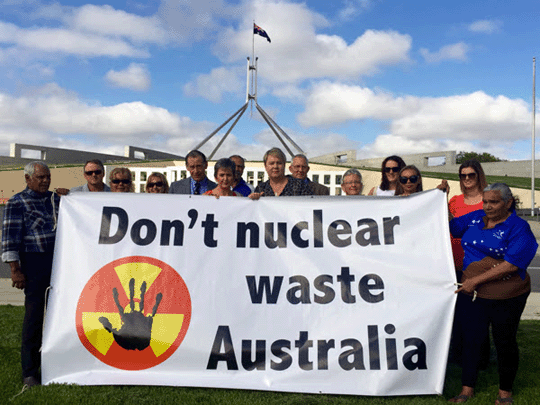 Nuclear royal commission: Protesters voice opposition to SA waste dump outside citizens’ jury, ABC News, 25 June 16 Anti-nuclear protesters have confronted SA Premier Jay Weatherill on his way into a citizens’ jury which is meeting to consider a controversial proposal to build a nuclear waste dump in the state.
The event at the South Australian Health and Medical Research Institute (SAHMRI) was prompted by the Nuclear Fuel Cycle Royal Commission, which handed down its findings earlier this year.
The final report by commissioner Kevin Scarce delivered to the SA Government in May made 12 recommendations, including the creation of waste storage sites and the relaxation of federal restrictions on nuclear power.
Tentative findings released in February also urged the creation of a dump with capacity for 138,000 tonnesof spent fuel from the world’s nuclear reactors.
Dozens of protesters gathered outside SAHMRI in Adelaide this morning, shouting out their concerns when the Premier arrived.
Gypsy-Rose Entriken from the Barossa Valley said she was worried about the dangers of transporting nuclear waste. “I’m really worried about what the implications of this long-term dump are going to be, and how it’s going to affect us for the rest of our lives and for generations,” she said.
“How are they going to get it here? There’s so many things that can go wrong.”
The citizens’ jury is made up of 50 people selected from about 1,100 registrations by research organisation newDemocracy Foundation, and is part of a public relations exercise organised by the State Government.
Its job is to decide which elements of the royal commission’s recommendations need to be discussed in more detail…….http://www.abc.net.au/news/2016-06-25/citizens-jury-to-consider-nuclear-dump-proposal/7543314
Whitsunday residents take expansion of Adani’s Abbot Point Terminal to court
 EDO Qld
The following statement is from our client
Whitsunday Residents Against Dumping (WRAD):
http://www.edoqld.org.au/news/wrad-media-release-whitsunday-residents-take-expansion-of-abbot-point-terminal-to-court/ 24 June 2016:
“Local community group, Whitsunday Residents Against Dumping,
which aims to protect the Great Barrier Reef from damage,
is asking the QLD Supreme Court to scrutinise whether the QLD Department of Environment
properly considered legislative tests when granting authority for
Adani’s controversial Abbot Point Terminal 0 expansion to go ahead.
The first directions hearing is taking place today in the Queensland Supreme Court.
Local grandmother, former tourism worker and spokesperson for Whitsunday Residents Against Dumping, Sandra Williams said,
“Our precious Great Barrier Reef is already in poor health, and Adani’s controversial port project,
which will cause irreparable damage, has raised significant concern in our community.
“Residents in our group have never taken legal action before,
but we were forced to because of our worry that the approval of the port expansion,
which will require damaging dredging and see hundreds of extra ships through the Reef each year, was not lawful.
“There is a question mark over whether the Department of Environment and Heritage Protection
properly assessed the project, as required by law, before it gave this billion dollar proposal the green light.
“It is critically important that the decision, which has such grave implications for the Reef, is properly scrutinised. … ”
To continue reading the full statement, click on this link:
http://www.edoqld.org.au/news/wrad-media-release-whitsunday-residents-take-expansion-of-abbot-point-terminal-to-court/
At long last Kenbi Aboriginal land claim is settled
KENBI: settlement at last!
‘As we look to celebrate the 40th anniversary of the Aboriginal Land Rights (Northern Territory) Act,
final settlement has been reached over the Kenbi land claim. In a battle that has been going on for nearly as long as the existence of the Land Rights Act itself, the Kenbi claim has been the focus of numerous court cases and claim hearings, and hostility from a succession of CLP governments.’
Land Rights News | Northern Edition | April 2016 Issue 2 Page 1
https://groups.google.com/forum/#!topic/wgar-news/2AjmlTzThP0 via WGAR News
http://www.nlc.org.au/files/pdfs/LRN_April_2016_web.pdf
Gems from Nuclear Citizens Jury – South Australia today
Morning Session
DemocracyCo advises on streaming of Nuclear Citizens Jury hearings in Adelaide
Emily from democracyCo here.
 The Lifestream sessions will be up tomorrow on this website. http://yoursay.sa.gov.au/decisions/yoursay-engagements-nuclear-community-conversation/about First session will be from 9.20am. We are also transcribing all presentation & Q&A sessions with the Jury – we can’t transcribe workshop sessions though, too tricky! On Facebook & Twitter you will also be able to find updates throughout the day.
******************************************
 For any credibility, the hearings with witnesses would need to be available on video and audio, and preferably televised. I fear that NewDemocracyCo is being played by the Nuclear Royal Commission and the Weatherill government.
National Labor opposes nuclear waste importing: an obstacle to South Australia’s plan

 Labor’s national policy against nuclear could create issues for SA’s waste dump proposal http://www.abc.net.au/news/2016-06-24/alp-policy-could-create-issues-for-sa-nuclear-vision/7539166?utm_source=dlvr.it&utm_medium=twitter By Leah Maclennan Labor may oppose a high-level nuclear waste dump, even if the South Australian Government decides to build one, a federal Labor MP says.
The State Labor Government is consulting on the proposal following the recommendations of the Nuclear Fuel Cycle Royal Commission.
But Labor MP Nick Champion told a forum in Adelaide that he is against it, and would not want one in his electorate, which covers the northern suburbs and the Barossa Valley.
“I think the transport of it. I think the actual construction of it, the fact that nobody in the world has done it,” Mr Champion said. “Canada hasn’t done it. I think the Fins have only just established one, I think there is a lot more thinking that would have to go into it before we embarked on such a route.”
Mr Champion also raised the issue of the Labor Party’s policies, saying it has a national position in opposition to a high-level nuclear waste dump.
“There’d be some interesting debates at the national conference as there has been for the last three decades on nuclear issues,” he said
“But at the moment our platform opposes a high-level nuclear waste dump and so I suspect that’s the way the policy will be.”
Liberal senator Simon Birmingham told the forum it was the strongest opposition he has heard from a Labor MP.
“I’ve heard Bill Shorten and Penny Wong and Anthony Albanese express reservations about a nuclear waste dump before but I think Nick has put the party platform and position more clearly today than I’ve actually heard from a lot of others,” he said.
“For South Australians who think there is a good opportunity for our economy here, and [Premier] Jay Weatherill appears to be one of them, that’s a concerning proposition that you’ve put that it would seem to be very hard to get cooperation from a federal Labor government if SA is to go down this pathway.”
The federal Liberal Government has said it would work cooperatively with the South Australian Government if it decides to go ahead with the plan.
S Australia’s Nuclear Citizens Jury – dubious panel, dubious public accessability
omigawd I can’t believe that they are classing nuclear business lobbyists Nigel NcBride 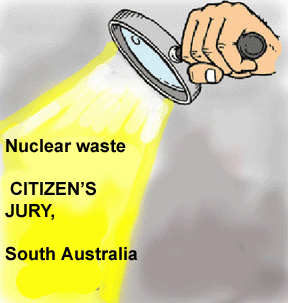 and Jason Kuchel as “experts” on nuclear science.
This Citizens jury panel is worse than I expected it to be. As for the link to “streaming” – it does not lead you there. It leads you to the Nuclear Royal Commission’s page where you’re invited to “register for discussion”. So much for public access to the hearings. This is a charade of the Citizens Jury Process.
To have any credibility a Citizens Jury on this nationally important matter should be televised, or at very least available as video, audio and transcript.
South Australia’s Nuclear Citizens Jury to have a ?scientific panel
A businessman, an environmentalist and an oncologist walked into a citizens’ jury…http://indaily.com.au/news/local/2016/06/23/a-businessman-and-environmentalist-and-an-oncologist-walked-into-a-citizens-jury/ Passionate advocates and fierce opponents of a state-based high-level nuclear waste dump will confront the first Citizens’ Jury debating the issue over the weekend.
Business SA chief Nigel McBride, who last week confirmed his organisation was now “advocating actively and positively for a high-level waste repository” will join a panel of prominent figures to debate the issues and field questions from the 50 jurors on Sunday.
McBride will butt heads with the likes of Conservation Council SA chief Craig Wilkins, who has strongly argued against increasing SA’s involvement in the nuclear fuel cycle.
They will join SA’s chief scientist Dr Leanna Read, SA Native Title Services CEO Keith Thomas and ethicist Simon Longstaff on the panel, along with mining lobbyist Jason Kuchel, Kelly-Anne Saffin from the Northern and Yorke Regional Development Australia and Michael Penniment, Director of Radiation Oncology at the Royal Adelaide Hospital.
Nuclear Fuel Cycle Royal Commission Consultation and Response Agency chief executive Madeline Richardson said in a statement the panel was “a dynamic way of exploring some of the big issues in an open and informative way”, with the discussion to be livestreamed to the public.
“It is about letting everyday South Australians frame what the community should focus on, rather than the Government, politicians or lobby groups setting the agenda,” she said.
The jury will meet for four days across two weekends to identify key issues that require further debate.
Jury convenor Emily Jenke, from DemocracyCo, said the panel discussion was “designed to stretch the jurors’ thinking, spark ideas and explore issues through presentations by speakers who can elevate the conversation”.
“We know jurors want to hear from people who have strong opinions, and also people who have specific expertise,” she said.
“The group is made up of a range of people – leaders, experts and people with a specific interest – and that’s the balance we are looking for.”
Topics such as health, Aboriginal heritage, environment, industry, ethics, community, business and potential reputational damage will be canvassed.
Taxpayers $100,000,000 to be spent up front BEFORE any decision on South Australia nuclear waste importing
 Valdis Dunis Nuclear Fuel Cycle Watch South Australia 24 June 16
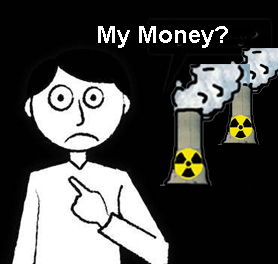
Last night on Adelaide ABC TV News, The Royal Commission’s Jacob Engineering Manager Tim Johnson was interviewed after his submission to SA Parliament yesterday. He stated for the government to be certain that a waste dump would be feasible technically and financially would – like any large technical engineering program – require detailed analysis, and given the complexity Jacob’s estimate is about A$100M that the State Government would have to spent upfront BEFORE we could confirm a yes/no to make sure it will work and make money for us.
Should we spend $100M on more nuclear analysis, or spend the money instead on renewables and other services in our state?
http://nuclearrc.sa.gov.au/…/2016/02/JOHNSON-Tim-489-496.pdf
http://www.abc.net.au/news/sa/
Australia joins the nuclear marketing push to India
 Australia backs India to join nuclear supplier club, China hesitates http://www.smh.com.au/world/australia-backs-india-to-join-nuclear-supplier-club-china-hesitates-20160623-gpq1pq.html
June 23, 2016 Daniel Flitton Senior Correspondent Australia will formally back India to join the club of nuclear suppliers at a summit in Seoul on Friday, a move that will finally lay to rest a bitter stoush over selling uranium to the nuclear armed giant.
But China has signalled it could veto the bid because India has refused to sign the international treaty to stop the spread of atomic weapons.
 The US is strongly backing India to join the 48-nation Nuclear Suppliers Group, seen as the last hurdle to allow international trade in nuclear materials to India.
The bid has been complicated by a late application from Pakistan to also join the group. India and Pakistan have each built atomic arsenals, but insist they only want access to nuclear materials to generate electricity. The potential sale of uranium to India has a long history and is seen as a test of great power rivalry in the region.
Australia fell out with India during the Kevin Rudd years after Labor junked a Howard-era deal to sell uranium to New Delhi on a promise the yellowcake would only be used for peaceful purposes. Mr Rudd insisted allowing India an exemption would weaken global rules, with an angry India insisting it had never spread nuclear technology.
A fierce debate later erupted within Labor after Julia Gillard decided to reverse Australia’s position and back the deal.
Labor’s national platform now calls for the export of uranium “only under the most stringent conditions” and to countries signed up to the non-proliferation treaty, which limits the number of nuclear armed nations and pledges to work toward disarmament.
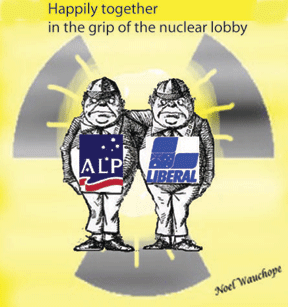 But Labor has granted India an exception as “an important strategic partner for Australia” despite concern over an Abbott government deal that safeguards on uranium sales to India are too weak and parliamentary calls for additional controls.
Australian diplomats at the meeting in Seoul will “strongly support” India’s application but have yet to commit on Pakistan’s bid.
There is a wait-and-see approach to Pakistan on how it will control export of nuclear materials, given the record of the country’s former chief scientist Abdul Qadeer Khan in providing nuclear technology to Iran and North Korea.
Any country in the nuclear suppliers group effectively wields a veto as the organisation makes decisions only by consensus. China, one of five countries recognised as nuclear-armed nations under international law, has flagged its objection to allowing India into the group without signing the non-proliferation treaty.
But India has refused to sign on, given this would mean surrendering its nuclear weapons.
Australians have saved $4.4bn in a few years, with solar rooftops
the report estimated solar owners will avoid 6.3m tonnes of carbon dioxide emissions in 2016 – which they found is equivalent to taking a third of all trucks off Australian roads.
 Solar Citizens found 80% of federal electorates have more voters with rooftop solar than would be required to change their sitting members. And of the electorates with the highest numbers of solar owners, seven out of the top 10 were now held by Coalition MPs.
Australians have spent almost $8bn on rooftop solar since 2007, says report https://www.theguardian.com/environment/2016/jun/22/australians-have-spent-almost-8bn-on-rooftop-solar-since-2007-says-report Solar Citizens says since the 2012-13 financial year, rooftop solar owners have saved about $1bn on their household bills each year, Guardian, Michael Slezak, 22 June 16, Australian households and small businesses have invested more than $1bn a year in rooftop solar over the past five years, spending a total of almost $8bn since 2007, new calculations show.

In its latest State of Solar report, Solar Citizens – which campaigns for, and represents the interests of, solar owners – has for the first time estimated Australian’s out-of-pocket investment in rooftop solar, how much money it has saved consumers, and how much carbon it has abated. Continue reading
New South Wales leading the nation with large scale solar farms
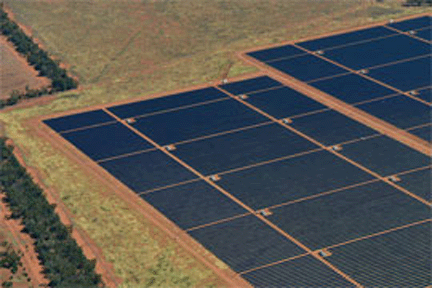 NSW to double existing solar farm capacity with four new plants approved, SMH, Peter Hannam ENVIRONMENT EDITOR, THE SYDNEY MORNING HERALD 23 JUNE 16 The Baird government has granted planning approval for four new large-scale solar plants, potentially more than doubling the existing capacity in the state.
The four plants approved for construction have a combined capacity of 175 megawatts (MW), and would generate another electricity for 56,000 homes if built. “NSW is Australia’s large-scale solar leader, with the country’s three largest solar farms and hundreds of megawatts of solar electricity capacity online and in the pipeline,” planning minister Rob Stokes said. Continue reading
1 This month
17 October, Free Public Talk on Nuclear Issues in South Australia
David Noonan will speak on public interest concerns over the new Roxby Downs Indenture Act 2026 on BHP copper-uranium mining and ore processing in SA, and on how AUKUS may face SA with a High-Level nuclear waste agenda.
Dr Jim Green will discuss international developments in the field of nuclear power including ‘small modular reactors’ and Generation 4 ‘advanced’ nuclear reactor concepts.


Help Aunty Sue Protect Her Land and Sacred Sites From Destructive Rocket Testing.
.

Australians deserve the truth
about
AUKUS – https://aukuspublicinquiry.com/

PETITION – To: Prime Minister Anthony Albanese and the Australian Labor Government

of the week – Australians for War Powers Reform (AWPR)
To see nuclear-related stories in greater depth and intensity

