South Australia’s Labor and Liberal leaders for nuclear jaunt together to Finland
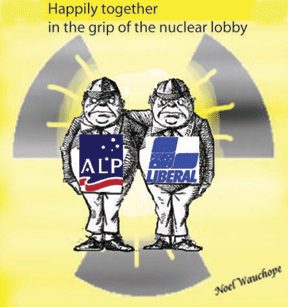 Weatherill, Marshall to make bipartisan trip to permanent nuke waste dump in Finland June 9, 2016 , Daniel Wills and Luke Griffiths,The Advertiser
PREMIER Jay Weatherill and Opposition Leader Steven Marshall will make a bipartisan trip to Finland in August and visit the world’s first long-term nuclear waste storage facility……
The bipartisan delegation to Finland will also include members of the Nuclear Fuel Cycle Royal Commission Consultation and Response Agency Advisory Board, which is overseeing statewide consultation on the proposal as the State Government considers whether to proceed.
It will visit the Onkalo nuclear waste facility in northern Finland, where the country plans to bury its own spent fuel in a labyrinth of tunnels 520m under the ground for permanent storage. Onkalo is expected to accept fuel for 100 years before being sealed for eternity. The facility is currently under construction is expected to become operational within a decade.
Mr Weatherill said it was critical to see first-hand the kind of facility SA could build.
“The research and evidence shows SA can safely deepen its involvement in the nuclear fuel cycle,” he said. “I want to see first-hand what this might look like and see what lessons Finland can share with us, should this be something South Australians want to consider.”
“To make an informed decision later this year, it’s important that I understand the concept of deep geological disposal. This bipartisan visit to the Onkalo site will allow us to learn valuable lessons from the Finnish experience, which we will share with the SA community.”
Mr Marshall said it’s important there is a bipartisan investigation of the opportunity and co-operation during the community consultation process.
Also on the panel was Greg Ward, chief of staff to the Nuclear Royal Commission…….http://www.adelaidenow.com.au/news/south-australia/weatherill-marshall-to-make-bipartisan-trip-to-permanent-nuke-waste-dump-in-finland/news-story/8a1be359682fb154b4fdccd48cc36dca
Australia’s environment must remain an issue for NATIONAL, not just STATEs’ oversight
This week the Greens announced an ambitious policy for new national environment laws and an independent body to oversee and enforce them. The Greens’ policy on environmental democracy and its commitment to resource Environmental Defenders Officers would enable communities to hold government decision makers to account based on the merits of their decisions.
The truth is Australia’s nature protection laws are not adequately protecting our air, water, wildlife and places we love. The laws that protect nature are the foundations of a thriving Australia, but it’s clear they are not strong enough to keep the places we love safe and healthy.
The environment is not merely a matter for state governments http://www.sbs.com.au/news/article/2016/06/08/comment-environment-not-merely-matter-state-governments Why is the federal government so keen to give up national oversight of the environment, asks James Trezise. In regional Australia, coal mining and coal seam gas have altered landscapes forever, polluted water supplies and divided communities.
This came into sharp focus on Monday night’s Q&A program – shot in front of a live audience in Tamworth, NSW – where national environment laws came bursting right into the election frame.
From the get-go Barnaby Joyce was pegged down by a ropable community in Tamworth, frustrated at government failure to protect their farms and water supplies from invasive mining projects.
The Deputy Prime Minister tried to crab walk away from the awkward reality that his government approved the development of the Shenhua coal mine, a highly unpopular proposal at the edge of his New England electorate.
The crowd was unimpressed by Mr Joyce’s attempts to downplay the federal government’s ability to influence decisions on the environment. He claimed the states had all the power.
Former longstanding New England MP Tony Windsor appeared to be the local favourite on the night.
In 2013 Mr Windsor played a key role in having a “Water Trigger” added to our national environment law, the Environment Protection and Biodiversity Conservation Act. The rationale for the legislative change was that state government had not been sufficiently protecting groundwater resources. This has been clear for all to see at Chinchilla, where groundwater has been polluted by an experimental underground coal gasification project.
Three decades prior to the introduction of the water trigger the federal government’s role in protecting Australia’s environment was cemented by the historic Franklin Dam case. Continue reading
Record wind energy output last month kept electricity prices down
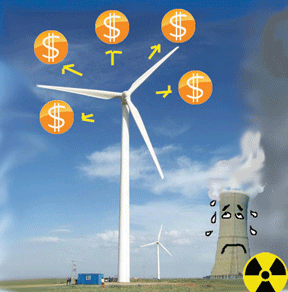 Wind energy’s biggest month, and how it keeps prices down REneweconomy, EBy Giles Parkinson on 8 June 2016 Wind energy in Australia has enjoyed its biggest every month in May, producing nearly a quarter more electricity than its previous record month, and overtaking hydro to provide 8.5 per cent of electricity demand in the country’s main grid.
The record output came, coincidentally, in the same month that the last coal fired power station in South Australia was closed (May 9). And a new analysis from energy consultants Pitt & Sherry points to how wind generation is keeping a lid on wholesale electricity prices.
The Pitt & Sherry analysis notes that four states recorded record monthly totals in May – South Australia (where wind met 49 per cent of demand), Victoria, New South Wales and Tasmania. (There is only one very small wind farm in Queensland and Western Australia operates on a separate grid).
The 3.9GW of wind generation in the month of May operated at a capacity factor of 49 per cent, according to Pitt & Sherry, meaning that it produced 22 per cent more than it did in its previous record month (July, 2015). (See this story for more details, and how most wind farms in NSW operated at a higher capacity factor than some of the biggest coal plants).
South Australia has the biggest share of wind farms, with 1.5GW, and this accounted for 49 per cent of its electricity demend in the month. On some occasions, wind energy provided more than 100 per cent of electricity demand in the state.…….http://reneweconomy.com.au/2016/wind-energys-biggest-month-and-how-it-keeps-prices-down-69687
South Australia’s nuclear waste dump money mirage
Real juries hear both the Prosecution and Defence cases in open court. What I fear is that my fellow citizens selected for citizen’s jury duty will get to read and hear only what the State Government wants them to read and hear, so that they will give Premier Weatherill the “social licence” he wants in order to proceed with the dump.
South Australians do not need to mortgage their descendants’ future by building a high level nuclear dump in order to make ends meet. The alleged riches that the dump has been claimed to bring are a mirage, but the long-term risks are not.

How a high-level nuclear waste dump could lose money http://indaily.com.au/business/analysis/2016/06/07/how-a-high-level-nuclear-waste-dump-could-lose-money/ June 7 2016 The economic case for a high level nuclear waste facility in South Australia is far from convincing, writes Richard Blandy.
The Nuclear Fuel Cycle Royal Commission delivered its report early in May. I submitted my InDaily article on the Royal Commission’s tentative findings to the inquiry for its consideration. I received no acknowledgement, but I know that the article was discussed within the royal commission’s processes. It does not appear to have had any substantive effect on the report.
Having read the relevant sections of the report, I continue to believe that South Australia should not use part of its land mass as a dump for highly radioactive used fuel from overseas nuclear reactors (sp-called “high level waste”) which, in the royal commission’s own words, “requires isolation from the environment for many hundreds of thousands of years”.
The only reason why most South Australians would give a high level nuclear waste dump even a second’s thought is because it is being sold to them as a financial bonanza – a no-risk economic lifeline to a state down on its luck. Something for nothing.
In the summary of its report, the royal commission says that a high level waste dump “could generate more than $100 billion income in excess of expenditure over the 120-year life of the project (or $51 billion discounted at 4 per cent)”. Note that the report says “could”, not “would”.
But, in Appendix J, the report says that “applying a commercial pre-tax discount rate of 10 per cent the net present value of profits to the State would amount to $11.5 billion”. This is a big reduction from the headline number in the summary of $100 billion. Continue reading
Rushing the South Australian nuclear waste discussion will be a failure
 Royal commission engagement expert says nuclear opportunities will disappear if decision is rushed http://www.adelaidenow.com.au/business/royal-commission-engagement-expert-says-nuclear-opportunities-will-disappear-if-decision-is-rushed/news-story/f1bc0cf254e6b9d934669704a1b7196c June 8, 2016 Luke Griffiths The Advertiser THE person responsible for the Nuclear Royal Commission’s regional engagement says that if community consultation is rushed to meet political deadlines, the whole process will fall over.
Jon Bok, a former stakeholder engagement adviser to Santos, visited more than 50 SA communities over the course of 12 months. He told attendees at an Australasian Institute of Mining and Metallurgy uranium conference in Adelaide yesterday that if the State Government is to develop a high-level nuclear waste repository, the “fundamental threshold issue of safety has to be addressed”.
“For many people, it’s going to take a long time to get from where they are now to have a sufficient level of trust and confidence in government and industry that this can actually be done safely and taken forward,” he said.
Resistance remained strong in many areas, which Mr Bok said can be attributed in part to legacy issues that include the British government’s nuclear tests in Maralinga and issues at Radium Hill uranium mine in the state’s far east.
Royal Commission head Kevin Scarce delivered his final report to Premier Jay Weatherill in early May. His key finding was that a high-level waste storage facility would generate economic benefits in excess of $250 billion and that its development should be pursued by the State Government.
Mr Weatherill has since established a consultation and response agency, overseen by an advisory board, and a citizens’ jury to facilitate further community feedback.
He told Parliament on May 17 that, guided by the outcomes of this engagement, he will provide the Government’s response to the Commission’s report by the end of the year.
While unwilling to criticise the Government, Mr Bok said a timeline must not be set on the education of “dubious and curious” residents.
“There’s simply not going to be enough information in the public domain to make a yes or no decision in the next 12-18 months,” he said.
“The Government wants to be in a position to know where to take this by the end of the year, which is a very short time frame. But all of the international evidence suggests that rushing this process will lead to failure — it cannot be rushed. Continue reading
Warning on threat posed by nuclear waste plan to South Australia’s clean agriculture image
 Agriculture and Water Resources Assistant Minister Anne Ruston warns SA nuke plan mustn’t come at expense of clean, green image, The Advertiser, June 7, 2016 FEDERAL Agriculture and Water Resources Assistant Minister Anne Ruston has warned concerns about the country’s international reputation for exporting clean and green food must be addressed before proposals for nuclear waste storage in the state could be approved.
Senator Ruston today appeared for the Liberals at an Adelaide City Council debate of candidates for the federal seat of Adelaide, after her party’s David Colovic declined to appear……..
Senator Ruston said the Coalition was open to considering the prospect of nuclear waste in SA, but stressed it should not come at the cost of the state’s reputation for premium produce. “I am the assistant minister for agriculture and water resources. I believe that SA, but also the whole of Australia, has a competitive advantage in the international marketplace because we’re clean, we’re green and we’re safe,” she told the audience…….
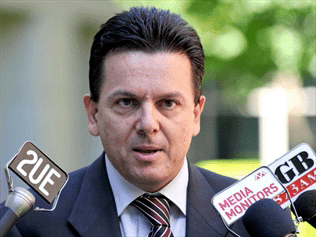 Nick Xenophon Team candidate Joe Hill said the state should vote before approval was given.
“Certainly glad that we’re having a discussion around this and remain open-minded.
“We do support a referendum because of the magnitude and significance of this,” he said.
Speaking on FIVEaa radio this morning, Labor Leader Bill Shorten said: “Consultations around that have got a long way to go, so I’m going to concentrate on winning the election and prioritising jobs rather than get into that debate at this point.”……http://www.adelaidenow.com.au/news/south-australia/agriculture-and-water-resources-assistant-minister-anne-ruston-warns-sa-nuke-plan-mustnt-come-at-expense-of-clean-green-image/news-story/baf27ae82b2098a613609d8131fe3e4f?sv=501bdd53a265db7876b5905830257d73
First a propaganda push for nuclear waste importing, then one for nuclear submarines
Federal election 2016: nuclear-powered subs needs discussion, PETER JENNINGS, THE AUSTRALIAN, JUNE 7 “……..Readers will appreciate the irony of Australia selecting the French-designed Shortfin Barracuda — a nuclear submarine that will be adapted to conventional propulsion……….
[2016 white paper] –
“During the long life of the new submarines, the rapid rate of technological change and ongoing evolution of Australia’s strategic circumstances will continue. As part of the rolling acquisition program, a review based on strategic circumstances at the time, and developments in submarine technology, will be conducted in the late 2020s to consider whether the configuration of the submarines remains suitable or whether consideration of other specifications should commence.”
This could be hinting that nuclear propulsion may be considered a decade or more from now. However, no Australian government in the 2030s or later will be in a position to adopt nuclear propulsion unless earlier decisions have been taken to prepare the ground for such a major development…….
After the 2016 election, the government should start to scope out what steps might sensibly be taken to create a realistic option for nuclear propulsion at the end of the 2020s. A key part of this strategy should be to have an open discussion with the Australian people explaining the basis for the submarine design decision. Government should consider the following steps:
1. Commission an expert panel to evaluate the necessary steps to position for a nuclear propulsion option. The panel should produce a public discussion paper setting out the challenges, risks, opportunities, financial cost and industry requirements necessary to support this technology. Continue reading
Totally Renewable Yackandandah leading Victorian town to 100% renewable energy
 A Yack attack on climate in Yackandandah, TUCKED away in a picturesque nook of Victoria’s North East is a small town doing big things.June 7, 2016
Yackandandah — home to between 700 and 2200 people, depending on where you draw the town border — is one of dozens of communities across the country leading the way on renewable energy.
Its goal is ambitious: to be 100 per cent reliant on renewable energy sources by 2022.
At the helm is Matthew Charles-Jones, an environmental education teacher and former university lecturer who runs an education and accommodation facility at Falls Creek.
He’s a co-chair of Totally Renewable Yackandandah, or TRY as it is more familiarly known, a committee of about half a dozen passionate locals promoting the renewable energy message……
Although Matthew is quick to clarify the 100 per cent target is TRY’s goal and not the official town plan, if the yellow cardboard yaks popping up across the district are any indication, plenty of locals are signing up to the vision.
The Australian PV Institute tracks solar power installations across the country. Its most recent data shows 249 dwellings within the 3749 postcode (taking in Yackandah and Bruarong, a hamlet about 13km south) are producing their own solar energy, about 35 per cent of a combined 700 homes.
This, says Matthew, is up from 24 per cent when TRY entered the scene.
Yackandandah Health, a facility that provides aged care as well as a host of primary health services, was one of the first organisations to take up the mantle.
It has installed 348 solar panels to provide 90kW of power and reduce its annual greenhouse gas emissions by 115 tonnes — in real terms, the equivalent of taking 23 cars permanently off the road.
The system, which produces about a quarter of their electricity consumption, is also expected to save the non-profit, community-owned organisation $1 million over the next 25 years…….
While it is not uncommon for town-folk to be perceived as more progressive than their farming neighbours, around Yackandandah, farmers are also jumping on the bandwagon…….
Firm believers in solar energy’s ability to give a financial return to home and business owners, the TRY committee has established a “perpetual energy fund” to help further ease the cost concern, offering loans for people to install solar systems and then make repayments with the savings off their electricity bill.
It’s an initiative designed to fill the gap left by changes to Australian energy policy that have put solar energy, and renewables in general, on the back burner.
“We need such a massive amount of change in this sector and for me, our traditional institutions aren’t doing enough about it,” Matthew says.
“Around the world countries, communities and business are investing heavily in renewable energy but because there hasn’t been a clear, enduring policy in Australia and in that absence, investment in renewable energy collapsed…….
Yackandandah is not alone.
Matthew estimates there are nearly 80 communities across Victoria leading the way in renewable and community energy.
Closest to home is Newstead, a small town about a 15-minute drive from Castlemaine in central Victoria. Six years ago it announced its goal to be Australia’s first 100 per cent renewable energy town by 2021.
“They’re doing remarkable work,” says Matthew, while noting the town has been helped along by significant financial input from the Victorian Government…….http://www.weeklytimesnow.com.au/country-living/a-yack-attack-on-climate-in-yackandandah/news-story/92775dad3e4dd28f80e052c40668e766
Government MPs push for stifling environmental protests
 Ministers push for laws to make it harder for greenies to mount environmental challenges on major developments, June 6, 2016 Steven Scott The Courier-Mail SENIOR Government ministers are planning to ramp up pressure on Prime Minister Malcolm Turnbull to make it harder for green groups to challenge major developments.
The Courier-Mail can reveal several senior MPs have already canvassed options to discourage legal challenges to projects such as mines and dams, including by imposing time limits on appeals.
Mr Turnbull will face increased pressure from his own MPs should he win the July 2 election. Ministers have discussed ways to make it easier for courts to impose costs orders against funders of court cases, to prevent green groups using shelf organisations to limit their financial risk.
The move would revive former prime minister Tony Abbott’s controversial plans to restrict environmental challenges.
Mr Abbott wanted to change the Environment Protection and Biodiversity Conservation Act to limit green groups’ challenges after the Mackay Conservation Group last year used the law to hold up the approval of Adani’s central Queensland mine.
The plan is still Coalition policy but it has been quietly shelved because there was not enough support to pass the changes through the Senate and some ministers held concerns about the proposed changes……http://www.couriermail.com.au/news/queensland/ministers-push-for-laws-to-make-it-harder-for-greenies-to-mount-environmental-challenges-on-major-developments/news-story/9cf9f552fb112db47058f3f72d24cb9d
Hi-tech renewable energy jobs reviving south-west Victoria’s economy
 High-tech, clean energy jobs key to future of Geelong, south-west Victoria, ABC News, 5 June 16 By Cameron Best Steve Garner understands how important his wind farm manufacturing business is for the town of Portland in south-west Victoria.
As the state’s traditional manufacturing base continues to decline, jobseekers and the wider economy are looking for the jobs of the future.
Six months ago, Mr Garner’s Keppel Prince Engineering facility lay idle under the Federal Government’s freeze on new wind energy investment and former prime minister Tony Abbott’s desire to reduce the growth rate of what he labelled as “visually awful” wind farms.
Now, under a new Clean Energy Finance Corporation mandate, the production line at Keppel Prince is back up and running with about 300 workers making towers for a project near Ararat.
It has come just in time for Portland, which is facing the possibility of life without its major employer……
“the stronger we can grow something like this [facility], that actually does create a lot of jobs, the better off we’re going to be.
“And if we get government support to do that, we’ve then got a sustainable business for a long period of time.”…
New-wave tech replacing manufacturing of old
High-tech industries are springing up to utilise some of the skilled workers coming out of the automotive industry but in order to remain globally competitive, this new wave of advanced manufacturers cannot afford to be as labour-intensive as the companies of old…….http://www.abc.net.au/news/2016-06-05/high-tech,-clean-energy-jobs-the-key-to-geelong-future/7476816
Fantastic news! Port Augusta’s opportunity to become a world class solar energy hub
Revealed: Proposal for $1.2bn solar thermal power plant at Port Augusta June 4, 2016 http://www.adelaidenow.com.au/news/south-australia/revealed-proposal-for-12bn-solar-thermal-power-plant-at-port-augusta/news-story/58e18b826e4ecedfb57a9d11dc5fe7ba Sheradyn Holderhead Tory Shepherd A NEW proposal for a $1.2 billion solar thermal plant at Port Augusta, backed by former federal Liberal leader Dr John Hewson, can be revealed by The Advertiser just weeks after the city was hit with the closure of its power station.
Solastor Australia will next week unveil its plans to build a solar thermal power station with a generation capacity up to 170 megawatts and energy storage capabilities, The Advertiser has discovered.
While details of the project remain secret until an official announcement on Tuesday, a similar proposal from US company SolarReserve would create up to 1000 jobs during construction and about 50 permanent jobs.
Solastor Australia chairman Dr Hewson will reveal the company intends to build a fully integrated, solar thermal power station and energy storage system to provide SA with “24/7 base load and peak load generation”.
“We’ll be announcing it all on Tuesday,” he said last night. “This is world-class. We think this is something we can roll out not only across Australia but internationally. It’s Australian technology, it gives Australia a real edge … in actually being able to turn sunlight into effective baseload energy.”
The Advertiser understands behind-the-scenes work on the proposal has been underway for months. The company has a plant in China and has been working in the Middle East.
And Solastor believes that it can produce affordable energy from the plant. In a statement, Solastor Australia said the proposed power station would cost about $1.2 billion and would have a generation capacity of 110mW in winter and 170mW in summer.
“Once completed, it will generate approximately 1.25 billion kilowatt hours of electricity per annum, which is sufficient to provide power to more than 200,000 Australian homes,” the statement said.
Both Federal and State governments are aware of the plans — and consider it to be a legitimate proposal.
Last month, Federal Environment Minister Greg Hunt promised financial support for the 110mW SolarReserve project, which until now was the only publicly known proposal for a solar thermal plant at Port Augusta.
Port Augusta mayor Sam Johnson said the second proposal was “fantastic news” and, along with four other renewable energy projects, was the “saving grace” for the town and the state’s economy.
“This reinforces comments in the past that Port Augusta will be the renewable capital of Australia,” he said. “This would be South Australia and Australia transitioning to a new world and would be a saving grace for Port Augusta and the SA economy.”
Mr Johnson said this proposal was the fifth renewable energy power station plan, which also included two 100mW solar panel farms, and a combined wind turbine and solar panel farm, the approval of which was expected to be announced next week
These projects will support Arrium and the skilled workforce we have, as well as benefiting small business throughout the region,” Mr Johnson said. “All up these projects would replace the generation from the coal-powered plant.” Repower Port Augusta campaigner Dan Spencer said it was great news that more companies were coming forward with proposals.
“Port Augusta really has the opportunity to become a renewable energy hub,” he said.
“More and more proponents are coming forward and saying they want to invest which is really exciting.
“There’s no reason we couldn’t see both these solar projects get built. The more projects, the more investment, the more clean energy.”
In April a Repower Port Augusta-commissioned ReachTEL poll of 1195 people showed that three-quarters believed the Federal Government should help fund the construction of a solar thermal power plant at Port Augusta.
Submission time again – this time to South Australian Parliamentary Committee
JOINT COMMITTEE ON FINDINGS OF THE NUCLEAR FUEL CYCLE ROYAL COMMISSION

South Australian ‘Citizens’ Jury’ to kick off expensive nuclear publicity juggernaut
 Jay Weatherill launches a nuclear propaganda juggernaut, Independent Australia 1 June 2016, Noel Wauchope examines Jay Weatherill’s elaborate publicity campaign featuring so-called “citizens’ juries” ahead of a nuclear waste dump in South Australia.
SOUTH AUSTRALIAN Premier Jay Weatherill is launching an all out campaign to inform the public about the recent Nuclear Fuel Chain Royal Commission‘s plan for a global nuclear waste importing industry.
This is all going to be terribly democratic, we are told. There will be “citizens’ jury” meetings on 25-26 June and 9-10 July.
I am, in fact, in favour of the citizens’ jury idea. Instead of us being “talked down” to by experts (who are likely to have a vested interest in the nuclear waste import plan), ordinary non-experts hear all the evidence and opposing opinions, discuss these and come up with a sensible verdict……
My first problem with the South Australian citizens’ juries on nuclear waste importing is that the first jury isn’t given a true jury role.
The letter sent to potential jury participants says that their task will be to:
‘… produce an independent guide to help every South Australian understand the recommendations raised by the Royal Commission’s report.’
This jury will not produce a verdict on whether or not the jury thinks that the nuclear waste import plan should go ahead….It is going to provide material for the Nuclear Fuel Cycle Royal Commission‘s information campaign. And how will this jury gather this information? Well, it will presumably be informed by the newly created Nuclear Fuel Cycle Royal Commission Consultation and Response Agency — about which nobody seems to know anything. Who are the members?……
There are other questions as to its role. A citizens’ jury is supposed to have an independent advisory panel. Who will be on this panel? It’s also supposed to have an independent monitor supervising its meetings. Who will this be? The jury will hear expert witnesses. Who will they be? And where will the jury get its documentary information? How transparent will this citizens’ jury be?
One comforting thought is that newDemocracy’s reputation is at stake if their jury process is seen to be unfair. However, will they be able to withstand the pro-nuclear pressure from the Weatherill Government and Kevin Scarce‘s Royal Commission crew?……
Meanwhile, Jay Weatherill has wasted no time in setting out the rest of the process that will follow this first Citizens’ Jury meeting….
This again raises those questions about just who will be informing the public, with what materials and so forth. And there’s another great question that nobody seems keen to answer.
How much is this nuclear publicity juggernaut going to cost taxpayers? https://independentaustralia.net/politics/politics-display/jay-weatherill-launches-a-nuclear-propaganda-juggernaut,9055
Globally unprecedented scale of Nuclear waste shipments target Australia:
 Nuclear Waste Brief by David Noonan, Independent Environment Campaigner. 3 June 16 An un-declared Australia port is targeted to receive a globally unprecedented scale of high level nuclear waste transport and shipping, facing some 100 000 tonnes of SNF waste over a circa 33 year period of proposed peak Nuclear port operations from project Year 11 to Year 45 (Jacobs MCM, Executive Summary, Figure 3 Timeline of spent fuel transfers, p.5).
This is some 25 per cent higher than the global total of 80 000 tonnes of SNF waste shipped around the world in a 45 year period since 1971 according to the World Nuclear Association report “Transport of Radioactive Materials” (Sept 2015) and the Jacobs MCM consultancy (p.152).
A total of 30 000 tonnes of high level nuclear wastes were shipped to the UK Sellafield reprocessing facility and a total of 40 000 tonnes was shipped to the French La Hague reprocessing facility, by far the world’s largest nuclear ports, in the 45 year period since 1971 (WNA report).
An undeclared Australian port is targeted to take over three times the total tonnage of high level nuclear waste shipped to Sellafield and two and a half times the total tonnage shipped to La Hague.
Some 400 waste ships of high level nuclear waste, totalling 90 000 tonnes SNF waste and requiring 9 000 transport casks, are to be brought into Australia in a 30 year period of peak port operations.
In a comparable 30 year period, there were some 160 high level nuclear waste shipments from Japan to Europe from 1969 to late 1990’s, totalling 7 040 tonnes SNF waste and involving some 4 000 nuclear waste transport casks (WNA report).
Sweden has shipped over 4 500 tonnes SNF waste around the Swedish coast to their CLAB central interim storage facility by mid-2015 (WNA report). Australia is proposed to do so every 18 months.
Questions on the location of a Nuclear port and on the safety of waste shipments:
The SA State government must publicly explain the basis for the farcical claim made by Jacobs MCM (Introduction p.11) of “an abundance of locations” suitable for deep sea Nuclear port sites in SA.
Is a new deep sea Nuclear port and high level SNF waste storage site to be imposed in the coastal region south of Whyalla? Or as reported in The Australian “World’s nuke waste may pass through NT, SA” (12 May 2016): Is the Port of Darwin also in the Nuclear target range?
The Final Report Concludes: “…if a cask was lost at sea and was irrecoverable, there is a potential for some members of the public consuming locally sourced seafood to receive a very small dose of radiation”; and Concludes that terrorist attack scenarios are conceivable and rocket attack has the greatest potential to cause a release of radiation (Appendix L – Transport risk analysis p.312).
A further Jacobs MCM desk top Concludes that radioactivity that escapes from an unrecovered and degrading cask is expected “to be diluted in thousands of cubic kilometres of seawater” (“Safety and risks in the transportation of radioactive material to and from Australia”, April 2016, p.50). see http://www.nodumpalliance.org.au/
Nuclear ‘Citizens Jury’ will be a farce if it relies solely on that biased South Australian Royal Commission
 A big limitation of this so called first “Citizens’ jury is that it will take its information from the Nuclear Fuel Chain Royal Commission. But there are important aspects that are almost completely glossed over in that Commission. For example – they barely mention the dangers of transporting radioactive trash. That is an issue of high concern internationally.
Quoting a recent UK report on the dangers of a radioactive accident or of a radioactive attack – “The report on nuclear security, compiled by Dr David Lowry, a senior research fellow with the US Institute for Resource and Security Studies, argues that nuclear materials transported by road, rail, sea and air are also potential targets.”
If the “Agenda Setting Jury” is going to rely only on that biased pro nuclear Commission for the topics for discussion, then the whole thing will be a farce
1 This month
17 October, Free Public Talk on Nuclear Issues in South Australia
David Noonan will speak on public interest concerns over the new Roxby Downs Indenture Act 2026 on BHP copper-uranium mining and ore processing in SA, and on how AUKUS may face SA with a High-Level nuclear waste agenda.
Dr Jim Green will discuss international developments in the field of nuclear power including ‘small modular reactors’ and Generation 4 ‘advanced’ nuclear reactor concepts.


Help Aunty Sue Protect Her Land and Sacred Sites From Destructive Rocket Testing.
.

Australians deserve the truth
about
AUKUS – https://aukuspublicinquiry.com/

PETITION – To: Prime Minister Anthony Albanese and the Australian Labor Government

of the week – Australians for War Powers Reform (AWPR)
To see nuclear-related stories in greater depth and intensity

