Ever-growing boom in rooftop solar energy in New South Wales
 Solar usage through the roof in South West https://au.news.yahoo.com/thewest/wa/a/31844405/solar-usage-through-the-roof-in-sw/ Daniel Mercer – The West Australian on June 16, 2016,
In its first snapshot of the South West electricity market since getting responsibility for it last year, the Australian Energy Market Operator will today report that the number of solar panels had trebled in six years.
AEMO said there were 180,000 customers with solar panels across the network from Kalbarri to Kalgoorlie and south to Albany, compared with 165,000 a year ago and just 60,000 in 2011.
Though the latest figure represents more than 18 per cent of State-owned power provider Synergy’s entire customer base, the percentage of households with solar cells is even bigger.
AEMO says 22.5 per cent of South West network households have a system, making WA third for solar panels behind Queensland and South Australia.
The Melbourne-based body also found households and businesses were using bigger systems with the average size of new installations doubling over five years to 4.5kW.
AEMO said the growth rate in solar panel installations in WA was unlikely to slow as prices fell, electricity tariffs rose and subsidies continued. It said the amount of electricity solar panels generated would almost treble between 2016-17 and 2025-26.
One consequence would be flatter demand from the grid as more people generated electricity. With battery storage developing rapidly, the shift from grid power could accelerate with cost implications for customers unable or unwilling to use solar.
Sourcing half of Australia’s electricity from renewables would create more than 28,000 Australian jobs
 Renewables Could Boost Australian Employment by 50% – NFP Report http://probonoaustralia.com.au/news/2016/06/renewables-boost-australian-employment-50-nfp-report/
Sourcing half of Australia’s electricity from renewables would create more than 28,000 Australian jobs, half of which would be in solar, according to new Not for Profit research. The Renewable Energy: Future Jobs and Growth report, by Ernst and Young (EY) and the Climate Council, found that building 50 per cent renewables by 2030 would boost employment by almost 50 per cent more than if Australia stayed on its current trajectory.
The report found that if Australia aimed for at least 50 per cent renewable electricity by 2030 more than 11,000 additional jobs would be created in New South Wales, more than 6,000 in Queensland, around 4,000 in Victoria, more than 3,600 in South Australia, almost 2,000 in Western Australia and more than 500 in Tasmania.
The report said that most states would see around half of all jobs in 2030 from rooftop solar PV (photovoltaics) systems and in Tasmania and NSW rooftop solar PV jobs would comprise around 25 per cent. Continue reading
One response to the recommendations of the South Australian Nuclear Fuel Chain Royal Commission
 john jasson 09 Jun 2016
Recommendations 1, …. Strongly disagree with removal of State powers on these matters. This is contrary to the interests of South Australians
Recommendations 2,3,4…….Agree with these recommendations as they apply to mining generally.
Recommendation 5 is an absolute nonsense and I strongly disagree as it is not practical and realistically enforceable. This appears to me be a hollow and deceptive assurance to gain support for recommendations 8 through 12. The recommendation overlooks the appalling history of contamination in this State that has already occurred and can not be economically remediated.
Recommendation 7 Agree subject to this activity NOT contravening the original intent and purpose of this facility. Priority should at all times support the fundamental purpose for which this facility was created.
Recommendation 8 Strongly disagree.
Recommendation 9 Agree with the intent of this recommendation but subject to the removal of Nuclear.
Recommendations 10, 11, 12 Strongly disagree. http://yoursay.sa.gov.au/discussions/nuclear-community-conversation-comment-on-the-specific-recommendations-in-the-final-report
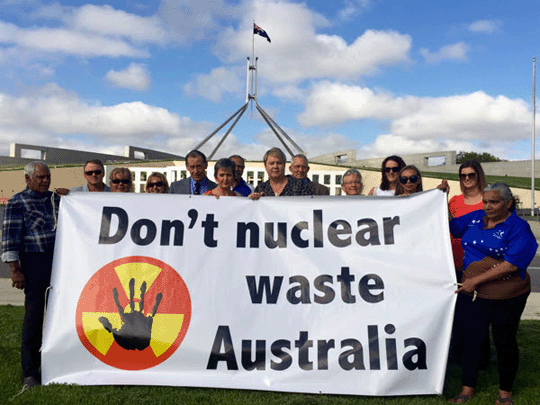
Why South Australians should say NO to the nuclear waste importing plan
 Penny Kleemann 08 Jun 2016 To Jay and the state Labor Party:
 As I type, I’m looking at a photo of Mike Rann celebrating with the Kupa Piti Kungka Tjuta when they defeated the Howard nuclear dump proposal. Do the words “Judas” and “betrayal” mean anything to you?
Do you really think South Australians are so stupid? This state dump proposal is so full of lies and so obviously about greed, money before the planet, and the rich getting richer. The bias of the Royal Commission is gob-smacking. Let’s start with Kevin Scarce:
He appointed three nuclear advocates to the Committee and only one person who was opposed. Wow – unbiased. Sounds like the work of a nuclear lobby group to me.
We are leading the country in renewables. Why touch poison when we can be clean, green?
The supposed financial benefits are based on very shakey modeling, and if it all goes wrong, it will bring the opposite of financial windfall and could bankrupt the state.
And, the state Labor government embezzled 9.1 million plus of OUR public money on a Royal Commission when they could have just asked The Australia Institute to do it. For that money we could be well on the way to building our solar thermal plant at Port Augusta. http://yoursay.sa.gov.au/discussions/nuclear-community-conversation-comment-on-the-specific-recommendations-in-the-final-report
Greens propose a more rational way to deal with Lucas Heights’ returning nuclear wastes

“The Greens policy delivers a way forward by redirecting existing funding of $30 million from the current process to a new deliberative public inquiry focused on transparency and evidence to come up with the best possible solutions,” South Australian Greens senator Robert Simms said.
Federal election 2016: Greens would put nuke dump on hold JARED OWENS The Australian,June 10, 2016 The Greens are pushing to stockpile radioactive waste in suburban Sydney, pending an independent inquiry that would expressly exclude evidence from anyone who might profit from a dedicated nuclear dump.
The party’s nuclear policy would cancel the process led by Resources Minister Josh Frydenberg that has identified farmland at Barndioota, 400km north of Adelaide, as a potential nuclear waste site, despite objections raised by some traditional owners.
Under the policy, exports of Australian nuclear medicine to overseas patients would be curbed and research would be funded to find alternatives to radiotherapy.
The proposed independent inquiry would be charged with recommending a long-term solution to storing nuclear waste — typically, used medical equipment and spent fuel rods from Sydney’s Lucas Heights reactor — without imposing a dump site on reluctant communities. Continue reading
Artist Anohni again joins the fight of Martu people against Western Australian uranium mine
Artist Anohni completes outback trek in fight with Martu people against WA uranium mine, ABC News, By Claire Moodie , 13 June 16 Oscar-nominated transgender musician Anohni has described the proponents of a uranium mine in Western Australia’s Pilbara as “desolate souls” after taking part in a protest march to the site of the proposed project.
Anohni, formerly known as Antony Hegarty of Antony and the Johnsons, made the comments after joining the Martu people on the 110 kilometre walk from the Parnngurr community to the site of Cameco’s Kintyre project, northeast of Newman. Continue reading
Solar change brings economic, social benefits to remote community
 Solar change brings economic, social benefits
In the space of three months, the community’s power bill dropped by more than half, the population grew from three to 40, and local jobs and a school sprang up.
“The sun hits your solar panel, which is on the roof, and creates energy,” Mr Pratt said. “The community will either use that energy during the day, and energy that they’re not using will get stored in the batteries, and they’ll use that energy at night-time when the sun goes down.”
Indigenous Business Australia bought the Allgrid solar system and leased it to the Munungurra Aboriginal Corporation.
Graeme Smith said leasing the system saved the corporation making a large capital withdrawal and allowed the community to change along with developments in technology.
“We can go back and renew our lease upon the latest technology that comes in, so we’re not stuck with the system we’ve got,” Mr Smith said.
Income from the community’s investment portfolios will pay the leasing costs until Munungurra owns the power system outright. With the promise of cheaper power, the community transformed.
Remote community transformed after swapping diesel generator for solar panels http://www.abc.net.au/news/2016-06-14/remote-community-swaps-diesel-for-solar-panels/7508300 By the National Reporting Team’s Kate Wild Graeme Smith was mulling over a long-standing problem at the end of 2015: how to provide affordable power to his tiny, off-grid community.
Despite having freehold title to 170 square kilometres of land east of Tennant Creek and plenty of money in the bank, members of the Munungurra Aboriginal Corporation could not afford to live on their country.
The cost of providing power to such a remote location prevented them building an economy on their land.
“We originally had no power and no water, because we’re not on a grid. We put houses on it, we put generators on it. But still that wasn’t enough,” said Mr Smith, the corporation’s chief executive.
The corporation paid for two diesel generators to run power to two small communities, where two out of eight houses were permanently occupied.
“Whilst it gave people reliable power with two houses pulling off a generator, we’d be going through $600 to $700 a week in diesel,” he said.
“Because we have no employment on community, people weren’t able to pay for the diesel. So they decided to live in town, look after their kids at school, get houses in town, and just go on the dole.”
So on Mr Smith’s initiative, Munungurra Aboriginal Corporation leased a solar power system at a cost of more than $200,000 from Indigenous Business Australia (IBA), and switched off its diesel generator.
IBA is a government-funded organisation that promotes economic independence for Aboriginal and Torres Strait Islander people. Continue reading
Most Australian prioritise Great Barrier Reef over coal industry
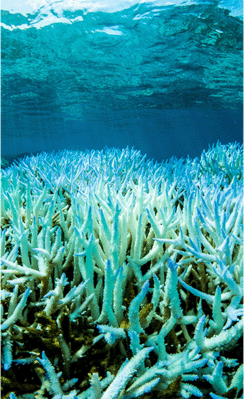 YourVote: Great Barrier Reef should be prioritised over coal mining, survey shows http://www.smh.com.au/federal-politics/federal-election-2016/most-australians-want-great-barrier-reef-saved-at-expense-of-coal-mining-survey-20160614-gpim6w.html June 14, 2016 Nicole Hasham Environment and immigration correspondent A thumping majority of Australians want the health of the Great Barrier Reef prioritised over coal mining, according to a survey of more than 63,000 Fairfax Media readers.
However the result suggests neither major party has fully grasped the strength of public sentiment for protecting the natural wonder, which is suffering from declining water quality, and record coral bleaching largely caused by warming oceans.
An analysis of Fairfax Media’s YourVote tool, which gauges respondents’ beliefs to determine their political leanings, shows about 49,900 respondents – or 79 per cent – “strongly agree” or “agree” that the health of the Great Barrier Reef should be prioritised over coal mining. Continue reading
The ‘pie in the sky’ financials of the South Australian Nuclear Royal Commission’s Report
What happens when the private public partnership goes wrong, the private company can just declare bankruptcy and go back to whatever tax haven they more than are likely based in?
David Richards, Commenting on the specific recommendations in the Royal Commission’s Report, 12 June 16 http://yoursay.sa.gov.au/discussions/nuclear-community-conversation-comment-on-the-specific-recommendations-in-the-final-report
 The real weakness for this report is the ‘pie in the sky’ financials: The numbers may add up, however their basis in fact is largely illusory… Completion of the construction of the underground storage facility is by use of the money collected after many thousands of tonnes of waste has been collected and stored on the S.A surface. The proposal’s model is supposed to be simple: we start collecting the used fuel for which we will be paid $1.2 million a tonne, we store it on the surface for 10 plus years while the repository is prepared under the surface, and then inter it permanently underground. The weakness of this financial model is that it relies upon our potential customers providing a constant supply of waste at a premium price that we nominate for a sustained period.
What happens if not all of our customers is prepared to continue to pay the $1.2 million a tonne? They might send, 100 tonne, say, at the nominated price to get things started, and then ask for a discount. The potential suppliers will know the score, once the canisters are on the surface; the clock in S.A is ticking: success will rest upon this timeline for permanent storage below the surface, achieved by the sustainability of the cash flow generated by maintenance of the waste stream at the nominated price. The overseas suppliers will have done their sums, some of them have held on to this waste for the last 50 years, holding back for a little while longer to get a cheaper price is good business sense. Paying our initial asking price may free up enough space in their local repositories to allow them to absorb new waste until we offer them disposal at a reduced rate. They will have a good idea of the breakeven point of disposing of this waste, and will if they are feeling generous offer this price. Once the waste is accumulating on the South Australian surface, who will be the most desperate, those getting rid of the stuff, them that have been stock piling it for years, or us with a partially built facility and waste in temporary storage on the surface? Continue reading
Bill Shorten ambivalent at the least, about Australia importing nuclear waste
 Bill Shorten signals he may be open to supporting high level nuclear waste dump for SA, ABC News By Michael Coggan 17 Feb 2016, Federal Opposition Leader Bill Shorten has given qualified support for the establishment of a multi-billion-dollar nuclear waste storage repository in South Australia.
Key points:
- Bill Shorten may back a high-level nuclear waste dump in SA if economics and safeguards stack up
- Labor has traditionally opposed an expansion of the nuclear industry
- Mr Shorten says issue must not be consigned to the “too-hard basket”
Traditionally, Labor has opposed the expansion of the nuclear industry.
The Royal Commission into the Nuclear Fuel Cycle released tentative findings yesterday that suggested South Australia stood to reap $5 billion a year if it established a “high-level” nuclear waste facility.
The early findings suggest that nuclear power generation is not viable in the short term.
In response to the nuclear waste dump option, Mr Shorten said “on this question, (SA Premier) Jay Weatherill and I are of one mind”.…….http://www.abc.net.au/news/2016-02-16/shorten-and-weatherill-of-one-mind-on-sa-nuclear-waste-dump/7174002
Bill Shorten refuses to back South Australian nuclear probe, THE Australian 10 Feb 15 BILL Shorten has refused to back the South Australian Labor government’s proposal to investigate nuclear energy. …..
spokesman for the federal Opposition Leader said he would not support the inquiry, and the ALP had a “longstanding position on nuclear power based on the best available expert advice”.
Labor has maintained consistent opposition to the establishment of nuclear power plants and all other stages of the nuclear fuel cycle. It is also “strongly opposed” to the importation and storage of nuclear waste sourced from overseas in Australia…… http://www.theaustralian.com.au/national-affairs/state-politics/bill-shorten-refuses-to-back-south-australian-nuclear-probe/story-e6frgczx-1227213806115
Melbourne’s world first renewable energy project
 Climate change: Melbourne renewable energy project provides global blueprint
The project, which would create a guaranteed market for renewable energy, aims to reduce city’s annual emissions by 138,000 tonnes a year, Guardian, David Sparkes 10 June 16, “……… major cities around the world are watching closely to see if Melbourne’s strategy could become a blueprint for them to follow.
The Melbourne renewable energy project, conceived and managed by the city council, has been two years in the making. Thirteen major institutions operating in the city have formed a consortium that will sign an agreement to purchase a large chunk of their electricity from a new large-scale renewable energy project.
The consortium members are the city of Melbourne, Australia Post, National Australia Bank, the University of Melbourne, RMIT, data centre operator NEXTDC, Zoos Victoria, the city of Port Phillip, Moreland city council, the city of Yarra, Citywide, Melbourne convention and exhibition centre and Bank Australia. If the project goes ahead, it will reduce Melbourne’s carbon emissions by 138,000 tonnes per year……..
The strategy is revolutionary, as it is the first time in Australia that a group of buyers has joined forces to purchase large-scale renewable energy. In fact, the council says it is not aware of a similar model anywhere in the world, especially under the leadership of a city council………http://www.theguardian.com/sustainable-business/2016/jun/10/climate-change-melbourne-renewable-energy-project-provides-global-blueprint
Government rules out public funds for #Adani coal project, activists claim
 ‘WWF Australia says it has been advised by the federal director of the Liberal party,
Tony Nutt, that no taxpayer money will be sunk into the venture’ Joshua Robertson | The Guardian Australia
https://www.theguardian.com/business/2016/jun/10/government-rules-out-public-funds-for-adani-coal-project-activists-claim
“A top Liberal party official has given “unambiguous” assurance that a future Turnbull government will not
sink public funds into Adani’s Queensland coal mining project, conservation groups have claimed. …
A spokeswoman for Australian Marine Conservation Society (AMCS), Imogen Zevothen, said
conservationists “strongly welcome this commitment from the Liberal party to rule out any public funding for Adani”. …
Zevothen said this meant “both major parties have now ruled out any public funding for Adani” after a
similar commitment from the opposition leader, Bill Shorten. Adani has most key project approvals in place
but has struggled to gain financial backing for the $16bn project amid a coal market slump … “
Some even more disturbing numbers on folly of South Australia nuclear waste import plan
Kim Mavromatis 10 June 16 MORE NUMBERS – 138,000 tonnes of high level nuclear waste in 69,000 high level radioactive waste canisters equates to a permanent underground nuclear waste dump size of around 112 square kms or 5,500 Adelaide ovals, 400 metres underground – and that’s not taking into consideration the 470,000 m3 of low and intermediate level nuclear waste.
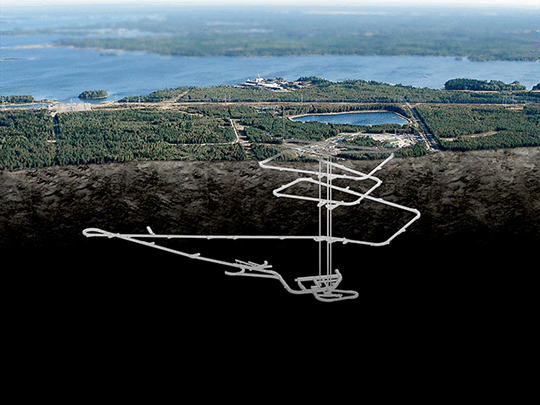
You can’t seriously tell me they will be able to build one nuclear waste dump that big?? in ground where there is no seismic activity in SA. Say yes to one and we will have many – say yes to one and we will end up with a toxic white elephant that will do us in or an economic white elephant that will do us in.
Nick Xenophon Team has NO policy on nuclear wastes
How long can Senator Nick Xenophon sit on the fence regarding the plan for Australia to import the world’s nuclear waste?
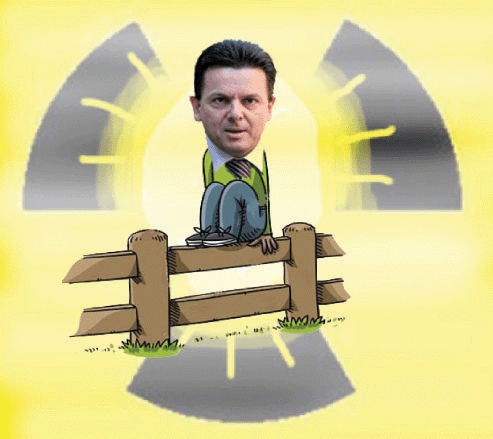
Xenophon has said that he wants a referendum in South Australia, on this issue – BUT ONLY AFTER a dump site has been selected.
Nuclear waste dumping was the main focus of questions at a recent Nick Xenophon forum.
The nuclear waste import plan is not just a matter for South Australia. It is a critically important issue for all of Australia. With the federal election looming, it’s becoming apparent that the Nick Xenophon Team could well hold the balance of power, post election.
There’s no mention of nuclear issues in their national policy. Not good enough. Time Xenophon came clean on whether or not he will fall in with the nuclear lobby’s plans.
South Australia’s proposed nuclear waste import dump would be massively larger than Finland’s
Kim Mavromatis, 10 June 16 THE NUMBERS TELL A STORY
At the Royal Commission NFC event at the Hawke Centre in Adelaide (Wed June 1), Kevin Scarce made reference to Finland’s permanent underground high level Nuclear Waste dump, currently being built at Onkalo, which will have a capacity of 5,000 to 10,000 tonnes. Onkalo is featured in the must see doco “Into Eternity”(https://vimeo.com/111398583). The Royal Commission NFC final report specifies a capacity of 138,000 tonnes of high level nuclear waste for the proposed Nuclear Waste dump in SA and Kevin Scarce highlighted this figure at the Hawke Centre Nuclear event.
Comparing the Nuclear Royal Commission numbers with Onkalo, it’s clear that the proposed Nuclear Waste dump in SA will be of mammoth proportions.
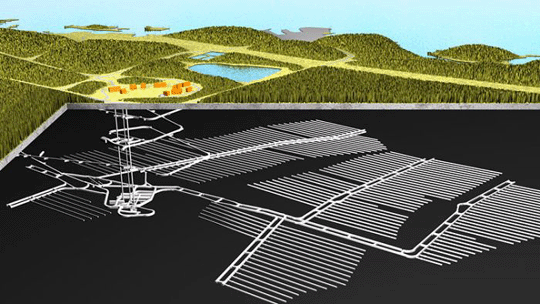
Onkalo (Finland), permanent underground high level Nuclear Waste Dump :
• Capacity 5,000 to 10,000 tonnes high level nuclear waste,
• or 2,500 to 5,000 high level nuclear waste canisters.
Proposed SA Nuclear Waste Dump :
• Capacity 138,000 tonnes high level nuclear waste or 69,000 high level nuclear waste canisters.
• Capacity 390,000 m3 intermediate nuclear waste.
• Capacity 81,000 m3 low level nuclear waste.
• Above Ground Temporary facility Capacity 72,000 tonnes high level nuclear waste.
• Above Ground Temporary facility Capacity 175,000 m3 Intermediate nuclear waste.
Just for high level nuclear waste alone, it will require a waste dump 14 to 28 times the size of Onkalo (69,000 high level nuclear waste canisters). And for decades, half of the high level nuclear waste will be stored above ground in a temporary facility. Imagine the risk of nuclear holocaust with all that high level nuclear waste in the one location?
And the preferred site for the proposed Federal govnt’s low and intermediate level nuclear waste dump, in the Flinders Ranges, is in an area where there is regular earthquake activity.
How smart are these people?????
I suspect if the state govnt say yes to one Nuclear Waste Dump (low, intermediate, high), the floodgates will open and there won’t just be one Nuclear Waste Dump site in South Australia, there will be many (50, 100 ????). And saying yes in SA will also open the floodgates to the rest of Australia. And I question whether they’ll stop at 138,000 tonnes (69,000 canisters) of high level nuclear waste????? If the state govnt takes us down this path and we become the world’s nuclear waste dump, there is no turning back
1 This month
17 October, Free Public Talk on Nuclear Issues in South Australia
David Noonan will speak on public interest concerns over the new Roxby Downs Indenture Act 2026 on BHP copper-uranium mining and ore processing in SA, and on how AUKUS may face SA with a High-Level nuclear waste agenda.
Dr Jim Green will discuss international developments in the field of nuclear power including ‘small modular reactors’ and Generation 4 ‘advanced’ nuclear reactor concepts.


Help Aunty Sue Protect Her Land and Sacred Sites From Destructive Rocket Testing.
.

Australians deserve the truth
about
AUKUS – https://aukuspublicinquiry.com/

PETITION – To: Prime Minister Anthony Albanese and the Australian Labor Government

of the week – Australians for War Powers Reform (AWPR)
To see nuclear-related stories in greater depth and intensity

