New South Wales lags behind in renewable energy use
NSW last in class on Climate Council report card for renewable energy use
South Australia and the Australian Capital Territory take the green podium for their efforts and policies pushing renewable energy targets, Guardian, Michael Slezak, 26 May 16. New South Wales is the worst Australian state at driving renewable energy, and South Australia and the ACT lead the pack, a report produced by the Climate Council has found.
The results came just weeks after South Australia closed its last coal power station, and the ACT announced a target to source 100% of its energy from renewable sources by 2020.
The report examined state and territory percentages of renewable electricity, the amount of large-scale renewable capacity per capita and the policy settings driving renewables.
NSW was bottom of the class in every category except rooftop solar. But it beat only Tasmania, which receives less solar radiation than any state or territory.
The territories had no comparable data for the percentage of their electricity that came from renewables, so they were scored separately. But the ACT was singled out as a leader for its 100% renewable energy target, which it will achieve using reverse auctions for large-scale renewable energy.
In the middle of the pack were Queensland, Western Australia and Victoria, although Queensland recently overtook South Australia with rooftop solar, now at 29.6% of households.
NSW and Victoria were the only states to have decreased the percentage of their electricity sourced from renewables. Between 2013 and 2014, NSW’s share of renewable energy dropped from 7% to 6% and Victoria’s from 12% to 10%. The Northern Territory was highlighted as lagging, along with NSW, with no specific renewable energy targets or policies and a low uptake of rooftop solar……http://www.theguardian.com/environment/2016/may/25/nsw-last-in-class-on-climate-council-report-card-for-renewable-energy-use
Campaign to scrap SA nuclear waste dump plans goes national
Campaign to scrap SA nuclear waste dump plans goes national Stephanie Corsetti reported this story on May 25, 2016 MP3 DOWNLOAD http://www.abc.net.au/worldtoday/content/2016/s4468848.htm


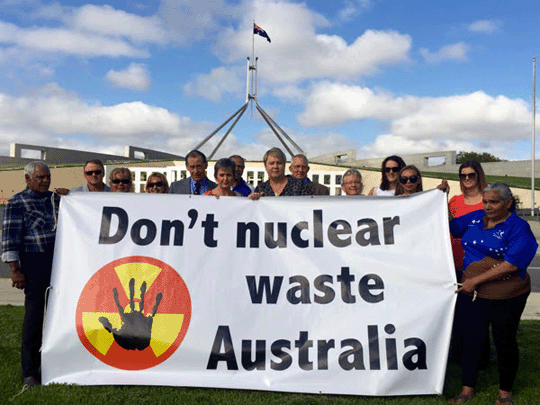
The group of Adnyamathanha women are from the Flinders Ranges say it’ll be the first time they’ve made their case directly to the Minister, Josh Frydenberg.
As Stephanie Corsetti reports.
Traditional owner Vivianne McKenzie addressed a town hall meeting in the Melbourne suburb of Northcote last night.
VIVIANNE MCKENZIE: This is what you call the genocide once again of Aboriginal people.
On the land, we are only a minority group in this country. They tell us we’re only three per cent, but I’ll tell you what, by the time we finish this campaign to stop this waste dump, we’ll be at 300 per cent in this country.
(Sound of applause)
STEPHANIE CORSETTI: The Federal Government is looking for what it calls a “willing community” to host a national radioactive waste management facility.
Now the McKenzie’s have travelled across the border to Victoria to send their message to the Federal Government.
VIVIANNE MCKENZIE: This is mental and emotional abuse, on the minds of adults, on children, you see the generational abuse on Aboriginal people.
STEPHANIE CORSETTI: Vivianne’s sister is Regina McKenzie.
REGINA MCKENZIE: If we were to go to a Catholic church or the Vatican and ask them to move or say we want to move the Vatican five miles over and put a waste dump there, that’s the same thing.
It’s our belief system.
STEPHANIE CORSETTI: Last month, the Federal Government said it would accept new nominations for the nuclear waste site after narrowing down the list to the South Australian site near Yappala Station.
The Federal Resources Minister Josh Frydenberg has agreed to meet the McKenzies on Thursday in his Melbourne electorate of Kooyong.
Dr Jim Green from Friends of the Earth is calling for a national campaign against the nuclear plans.
JIM GREEN: There’s unanimous opposition from traditional owners, it’s an extraordinarily beautiful part of the iconic Flinders Ranges, and I really wonder why it was chosen in the first place. And I’m sure they were aware of the possibility that it’s not going to go ahead, and that’s why they’ve opened up nominations from other land holders from around Australia.
STEPHANIE CORSETTI: Dave Sweeney from the Australian Conservation Foundation agrees.
DAVE SWEENEY: It’s a test of our maturity to have a debate about a difficult policy issue, and it’s also a test of how we view and relate with the First Nations people of Australia.
STEPHANIE CORSETTI: The Federal Government says it hasn’t made a final decision and consultation with the Indigenous community is an integral part of the process.
Minister Frydenberg says a heritage assessment will be done with the traditional owners to ensure the area is protected.
ELEANOR HALL: Stephanie Corsetti reporting.
Business South Australia’s Nigel McBride touts nuclear waste importing plan
 Homer Simpson and nuclear politics as France shows the way for SA, Fin Rev 23 May 16 by Simon Evans Nigel McBride, the chief executive of Business SA, the organisation that oversees the interests of more than 46,000 businesses in South Australia, has just returned from Finland and France, where he researched the nuclear waste industry.
He is convinced there would be no detrimental impact to the image of prime wine regions such as the Barossa Valley, McLaren Vale, Clare Valley and the Coonawarra from having an underground storage facility elsewhere in the state.
“We’re not going to have any overt signs anywhere,” Mr McBride told reporters in Adelaide on Monday………
Mitchell Taylor, the managing director of Taylors Wines, which has operations in the Clare Valley, Adelaide Hills, McLaren Vale and the Coonawarra, said the most sensible thing would be to locate any future nuclear waste storage facility in arid lands hundreds of kilometres away from agricultural land.
“You wouldn’t put it close to agricultural land,” he said…….
From an overseas marketing viewpoint, Mr Taylor said he didn’t think it would have any impact on the image of South Australian wines and premium food, provided the two were kept separate.
“You’ve got to get politics out of it,” he said.
Mr McBride said the regulatory model in Finland was a good benchmark, and there had been too much simplistic criticism of a nuclear industry based on what he termed “The Simpson’s model” taken from the popular cartoon series where a hapless Homer Simpson works at the Springfield nuclear power plant.
A final report by royal commissioner Kevin Scarce in early May recommended the state set up a nuclear waste storage facility to generate $100 billion in profits over the project’s forecast 120-year life, with Mr Weatherill saying he would make a decision by the end of the year after an extensive community consultation process, on whether to proceed. http://www.afr.com/it-pro/homer-simpson-and-nuclear-politics-as-france-shows-the-way-for-sa-20160522-gp1851
More worrying aspects of the Nuclear Royal Commission’s Final Recommendations
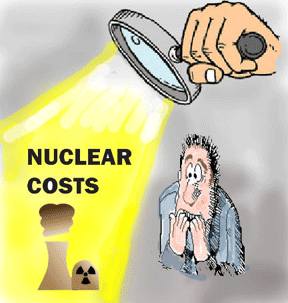 There is no existing market to ascertain the price that a customer may be willing to pay for the permanent disposal of used fuel.(CH 5 p 93)
The Commission is very vague on the nature of the public- private partnership that will pay for the capital costs of AS 41$billion (Ch 5 p.100)
The revenue would be paid on delivery of wastes to a South Australian port. That will be after the 20 – 30 years it will take to construct the facility, plus 10 years after the project begins operation.-
“a pre-commitment before project commencement would provide added assurance that capital costs are fully covered before construction began” (But after a commitment 40 years before, a foreign nuclear company could have gone bankrupt” (Ch 5 p. 100 -102) Finland.http://yoursay.sa.gov.au/system/NFCRC_Final_Report_Web.pdf
Worrying financial aspects of the Nuclear Royal Commission Final Recommendations.
 It looks as if the customers for the nuclear waste import business could be dodgy Asian and Middle Easter ones, with unstable politics. The Commission does not name any countries as potential customers, but DOES RULE OUT countries that will NOT be – i.e. United States, France, the United Kingdom and Canada, and countries which have national laws that prohibit their export of waste, such as Sweden and Finland.http://yoursay.sa.gov.au/system/NFCRC_Final_Report_Web.pdf CH 5 p.93.
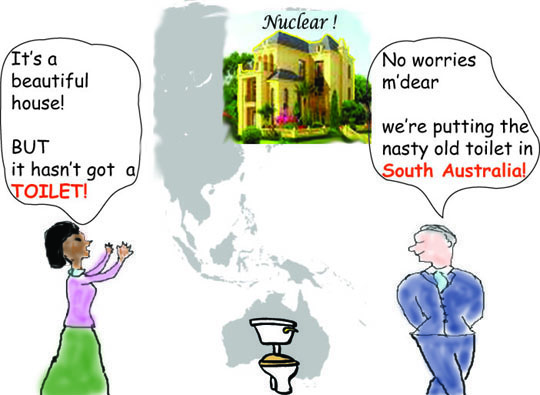
Dr Andrew Allison assesses the FINAL RECOMMENDATIONS of South Australia’s Nuclear Fuel Chain Royal Commission
 Andrew Allison 23 May 16 Here is my assessment of “NUCLEAR FUEL CYCLE ROYAL COMMISSION – FINAL RECOMMENDATIONS Copied from Pg. 169 of the Commission’s final report, and republished here for the purpose of discussion.
Based on the findings set out in this report, the Commission recommends that the South Australian Government:
1. pursue the simplification of state and federal mining approval requirements for radioactive ores, to deliver a single assessment and approvals process
AA: The devil is in the detail for this one. The word “simplification” could be code for reducing environmental standards, or allowing corporations to avoid the consequences of their actions. I am suspicious.
2. further enhance the integration and public availability of pre-competitive geophysical data in South Australia
AA: It depends who owns the data. If a corporation has collected the data then it is part of the intellectual property of that corporation. It is difficult to see how they could be forced to share it, by a state government. If the data were collected by the state government then one would have to ask why she state government is investing in prospecting for nuclear materials. This is in an era where state governments supposedly cannot operate water utilities, banks, gas companies, public transport etc etc…. Why are they breaking their own laws to prospect for nuclear materials?
3. undertake further geophysical surveys in priority areas, where mineral prospectivity is high and available data is limited
AA: This is a matter for the corporations, subject to regulatory approval.
http://www.theaustralian.com.au/…/story-e6frg6n6…
AA: Readers may remember that Marathon resources breached environmental guidelines in The Flinders Ranges in 2012. We cannot allow this. I don’t see why the resources of the state should be spent prospecting on behalf of mining companies.
4. commit to increased, long-term and counter-cyclical investment in programs such as the Plan for Accelerating Exploration (PACE) to encourage and support industry investment in the exploration of greenfield locations
AA: Once again, this is a purely commercial matter. I don’t see why the state government should be investing money in this. There are much more efficient ways of carrying out counter-cyclical Keynesian investment, than exploring for nuclear materials. We could invest in schools, and hospitals and public transport infrastructure, for example.
5. ensure the full costs of decommissioning and remediation with respect to radioactive ore mining projects are secured in advance from miners through associated guarantees
AA: This seems to be very sensible to me. I ask the question: aren’t we already doing this? See the reference to marathon resources, above.
6. remove at the state level, and pursue removal of at the federal level, existing prohibitions on the licensing of further processing activities, to enable commercial development of multilateral facilities as part of nuclear fuel leasing arrangements
AA: In my view, the existing laws are in place to protect public safety and no good case has been made to overturn them. There is currently a glut of Uranium on the world market. The prices are low. To increase the supply of Uranium at this time would only depress the price further and affect the viability of existing producers.
7. promote and actively support commercialisation strategies for the increased and more efficient use of the cyclotron at the South Australian Health and Medical Research Institute (SAHMRI)
AA: The limited and controlled use of nuclear technology in medicine has been shown to be beneficial. I don’t see any logic in expanding the program, unless there is a demonstrated need that is currently not being met in South Australia.
AA: The use of cyclotrons should be carefully regulated, since they can be used to enrich fuel, leading to weapons proliferation:
http://nuclearweaponarchive.org/Iraq/Calutron.html
8. pursue removal at the federal level of existing prohibitions on nuclear power generation to allow it to contribute to a low-carbon electricity system, if required
AA: It is very doubtful that nuclear energy is “low carbon”, if one considers the entire fuel cycle.
9. promote and collaborate on the development of a comprehensive national energy policy that enables all technologies, including nuclear, to contribute to a reliable, low-carbon electricity network at the lowest possible system cost
AA: Of course, a centralized government energy policy that was oriented towards the needs of the people would be sensible. Unfortunately state governments were in a rush to privatize their energy assets (or to lease out monopolies on a long-term basis) so the control of the system has been relinquished to corporations, for the time being. The Royal Commission has admitted that there is no commercial basis for nuclear power, in Australia, for the foreseeable future.
10. collaborate with the Australian Government to commission expert monitoring and reporting on the commercialisation of new nuclear reactor designs that may offer economic value for nuclear power generation
AA: I will believe in “Generation IV” nuclear power stations when I see one actually operating. In the mean time, we do have to consider the opportunity cost associated with investing Australia’s limited research dollars on a technology that Australia does not even use, and will not use for the foreseeable future.
11. pursue the opportunity to establish used nuclear fuel and intermediate level waste storage and disposal facilities in South Australia consistent with the process and principles outlined in Chapter 10 of this report
AA: I am very curious to know why the Royal Commission is in such a hurry for South Australia to commit to a facility that may not even work, and will not actually hold any nuclear waste for over eighty years. I think that it would be much more prudent for South Australia to watch technological developments elsewhere in the world before committing to such a great an irreversible development as a nuclear waste dump. We should note that no country has yet completely solved the nuclear waste storage problem, not even the former nuclear superpowers, the USA and Russia.
12. remove the legislative constraint in section 13 of the Nuclear Waste Storage Facility (Prohibition) Act 2000 that would preclude an orderly, detailed and thorough analysis and discussion of the opportunity to establish such facilities in South Australia.”
AA: I argue that this legislation serves an important public safety purpose. A convincing case has not yet been made to remove this important piece of safety legislation. The “economic” analysis of the Royal commission is mostly based on the opinion of one consultant, in the Jacobs report. The assumptions that were made in this report are very generous to the pro-dump case.
Aboriginal group to take their protest against nuclear waste dump to Resources Minister Josh Frydenberg
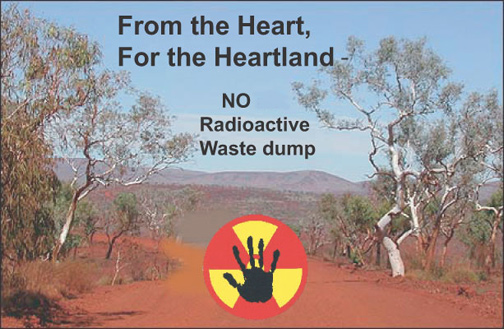 Fears nuclear dump will end their story, MEREDITH BOOTH, THE AUSTRALIAN,MAY 23, 2016 Australia’s first registered Adnyamathanha storyline runs 70km from Hawker to Cotebina Spring through pastoral and indigenous lands between Lake Frome and South Australia’s picturesque northern Flinders Ranges, where it is emerging as a battleline between anti-nuclear activists and the federal government.
Its landmarks, 440km north of Adelaide, tell the origin of Pungka Pudanha spring, where it is said tears falling from a grieving husband merged with the birth waters of his buried pregnant wife — a story that teaches children about family relationships and provides the basis for deeper women’s business.
Custodian and elder Regina McKenzie, a descendant of the king of five clans known as the Adnyamathanha or “people of the rock”, said Pungka Pudanha was the first storyline in Australia to be registered with Aboriginal heritage authorities, in 2012.
But it was now at risk of destruction since pastoral neighbour Wallerberdina Station was named last month as the preferred site for the federal government’s low and intermediate-level nuclear waste dump.
If further technical and environmental testing proves the site suitable, five million litres, or two Olympic-sized swimming pools’ worth, of low radioactive waste will be stored in a warehouse and underground facility.
Ms McKenzie’s worry is mostly for the 25 tonnes of intermediate waste, spent fuel from Sydney’s Lucas Heights reactor returned from reprocessing in France and which requires handlers to wear protective clothing.
She said the Adnyamathanha didn’t want the risk of contamination of groundwaters that fed mound springs on the floodplain where Ms McKenzie brought groups to camp, drink from the spring, and hunt and cook kangaroo in traditional ground ovens and share stories.
“We want to share the culture so we can promote this region to the world,’’ she said.
“Nobody takes the Aboriginal belief systems seriously — it’s our belief system. I just wish that non-Aboriginal people will look and see the richness in our culture.’’
Ms McKenzie and her sister Vivienne, two of 13 children in the McKenzie clan and part of a wider 200 indigenous people in the area, will take their protest, supported by conservation groups, to federal Resources Minister Josh Frydenberg in Melbourne on Wednesday to stop a dump at Wallerberdina………http://www.theaustralian.com.au/national-affairs/indigenous/fears-nuclear-dump-will-end-their-story/news-story/0bf29b3b919547bad0c797ac1b9a4631
Adelaide prize contest for new green businesses
ADELAIDE COULD BE FIRST ZERO-CARBON CITY IN WORLD WITH SOUTH AUSTRALIA’S NEW ENTREPRENEUR CONTEST http://www.theclimategroup.org/what-we-do/news-and-blogs/adelaide-could-be-first-zero-carbon-city-in-world-with-south-australias-new-entrepreneur-contest/?platform=hootsuite 15 MARCH 2016
LONDON: Adelaide has launched a low carbon contest with an AU$250,000 (~US$187,000) prize, which is open to innovative entrepreneurs who can help the South Australian capital become the world’s first carbon neutral city.
South Australia’s Low Carbon Entrepreneur Prize will transform groundbreaking ideas from around the world into real projects, and is the first initiative of the ‘Adelaide to Zero Carbon Challenge’ which aims to reduce greenhouse gas emissions while stimulating opportunities for pioneering green businesses. Continue reading
First impressions of South Australian government’s “Citizens’ Jury”
 Well, they will provide to the jury members meals, $500 compensation, travel assistance and accommodation if needed. This is all fair enough. If the jury members were not compensated in this way, we’d be likely to end up with a bunch of volunteered pro nuclear shills.
They apparently don’t assist with child care – probably eliminating young mothers from the jury.
The jury is asked to produce an independent guide to help every South Australian understand the recommendations raised by the Royal Commission’s report.
South Australia runs over 50% on renewable energy
 South Australia runs mainly on renewable energy following coal
  plant closure, The Independent, Gabriel Samuels 12 May 16 Majority of energy comes from solar and wind but the transition has been fraught with difficulties South Australia now gets the bulk of its electricity from wind and solar power, following the closure of its last coal-fired power station.
The state, which includes the city of Adelaide, exclusively has gas generators, solar panels and wind turbines serving a population of 1.7 million.
More than 50% of the region’s electricity stems from wind and solar with the remainder coming from energy efficient combined cycle gas plants.
The final coal station still in operation in Port Augusta closed down on May 9 after operating for 31 years. It generated 520 megawatts of power from coal but failed to compete with the falling price of clean renewable energy. Its closure produced a brief faltering in wholesale energy prices across the state.
The RenewablesSA transition initiative was established by the state govenment in late 2009 with a promise of $10 billion invested in low carbon generation by 2025…….
The state plans to become Australia’s wind and solar capital and is working towards complete reliance on natural sources
The state’s leading electricity provider, SA Power Networks, yesterday announced it will undertake Australia’s largest trial of storage batteries in solar homes in a bid to defer a $3 million network upgrade.
Meanwhile, last week Portugal ran entirely on renewable energy for four consecutive days between Saturday and Wednesday, in a bid to become completely reliant on natural resources.
The Independent has contacted RenewablesSA for comment. http://www.independent.co.uk/news/world/australasia/south-australia-runs-entirely-renewable-energy-following-coal-plant-closure-a7037646.html
University of New South Wales team sets new world record for converting sunlight to electricity
 New world record set for converting sunlight to electricity http://www.gizmag.com/solar-cell-electricity-efficiency-world-record-unsw/43384/ Eric Mack May 17, 2016 An Australian team has set a new record for squeezing as much electricity as possible out of direct, unfocused sunlight via a new solar cell configuration. Engineers at the University of New South Wales (UNSW) achieved 34.5 percent sunlight-to-electricity conversion efficiency, a new mark that also comes closer than ever to the theoretical limits of such a system.
UNSW’s Dr. Mark Keevers and Professor Martin Green set the record with a 28 centimeter-square (4.3 sq in), four-junction mini-module embedded in a prism. This new configuration allows the sun’s rays to be split into four bands so that a higher amount of energy can be extracted from each beam.
The same team reached an even higher level of efficiency a few years back using mirrored concentrators that were able to convert 40 percent of incoming sunlight to electricity. However, this new record is the highest level achieved without the use of concentrators.
“What’s remarkable is that this level of efficiency had not been expected for many years,” said Green, citing a German study that set a goal of 35 percent efficiency to be reached by 2050.
The team does not expect that its record-breaking cell configuration will find its way on to home or office rooftops anytime soon, as they are more costly to manufacture. The group is working to reduce the complexity to make them cheaper to produce and sees a future for them on solar towers that make use of concentrating mirrors.
Meanwhile, efficiency gains are also being made in the development of organic solar cells that are cheaper and more flexible. There’s still a long way to go though, as the most recent record for organic photovoltaics set in February was 13.2 percent efficiency. Source: University of New South Wales
No change to Labor’s policy against importing nuclear waste – National President Mark Butler
 Labor National President Mark Butler raises doubts about international nuclear waste dump proposed for South Australia, Adelaide Now , 19 May 16 LABOR national president and Port Adelaide MP Mark Butler has poured cold water over the proposal for an international nuclear waste storage facility to be located in South Australia.
The State Government will need federal approval if it decides to adopt Royal Commissioner Kevin Scarce’s recommendation for the international waste dump.
Labor’s national policy platform prohibits further Australian involvement in the nuclear fuel cycle beyond uranium mining — including the importation of foreign nuclear waste.
Mr Butler, federal Labor’s environment spokesman, said Wednesday the case was yet to be made for a waste dump in SA.
“I think it’s still a very open question about whether the South Australian community will accept that or not,’’ Mr Butler said during a debate with Environment Minister Greg Hunt at the National Press Club in Canberra.
“Our position as federal Labor is that no case has been made to change our longstanding platform about this issue.’’….http://www.adelaidenow.com.au/news/south-australia/labor-national-president-mark-butler-raises-doubts-about-international-nuclear-waste-dump-proposed-for-south-australia/news-story/12626f088948b5b9e72953e65ac2dd30
Remind Labor Party of their staunch policy against nuclear industry expansion
2015 National Policy Platform states:
- Labor will:
- Vigorously and totally oppose the ocean dumping of radioactive waste;
- Prohibit the establishment of nuclear power plants and all other stages of the nuclear fuel cycle in Australia;
- Fully meet all Australia’s obligations as a party to the NPT; and
- Remain strongly opposed to the importation and storage of nuclear waste that is sourced from overseas in Australia.
It would be good if people could contact Butlers office and welcome this comment. And as many as possible contact Labor contacts, candidates and connections to make them aware of this and call for them to echo it.
Maritime Union of Australia will fight plans to import world’s nuclear waste
Despite Northern Territory legislation preventing the transport and storage of nuclear waste, Mr Giles met with the South Australian Premier to discuss the nuclear royal commission findings and to hatch a rail or road transport plan.
 MUA Fights Plans to Contaminate Aussie Hands with World’s Nuclear Waste, 18 May 16
The Maritime Union of Australia will fight any plans to allow the world’s spent nuclear fuel rods and radioactive waste to enter Australia through the Port of Darwin.
The MUA is outraged NT Chief Minister Adam Giles has gone out of his way to not only offer to accept the hazardous cargo, but then transport it through Territorian communities to its destination in South Australia.
“Mr Giles is happy to sell out Territorians so that Malcolm Turnbull can use them as a dirty rag for his own personal gain and to benefit his top end of town mates,” MUA NT branch secretary Thomas Mayor said.
“It’s like putting Homer Simpson in charge of nuclear waste and his big business “Mr Burns” mates are rubbing their hands together. All the while Chief Clancy, aka Natasha Griggs, is none the wiser.”
The MUA says the move further compromises Australia’s national security.
“Malcolm Turnbull allowed the strategic Port of Darwin to fall under the control of Chinese company Landbridge, when it was granted a controversial 99 year lease,” Mr Mayor said.
“If his counterpart Adam Giles is successful then he will be allowing a foreign company oversight of high level nuclear waste.
“Turnbull has already sold out Australian shipping. Not only will foreign flagged ships carry the hazardous cargo, but the port that they are taking it to will also be run by foreign interests.
The MUA warns the plan would see high level hazardous waste transported thousands of kilometres through many Territorian communities to South Australia.
Mr Mayor said there was no agreement with traditional land owners to use their land.
“Yet again, Natasha Griggs is silent on an important issue to the people she purports to represent. Has she or any of her CLP counterparts even consulted with the traditional landowners, the Larrakia people?”
Despite Northern Territory legislation preventing the transport and storage of nuclear waste, Mr Giles met with the South Australian Premier to discuss the nuclear royal commission findings and to hatch a rail or road transport plan.
The Commission report says it takes 500 years for the most radioactive elements of high level waste to decay and total isolation from the environment is needed for hundreds of thousands of years.
Australia’s political leaders ignoring climate change, in lead-up to election

 Climate policy silence: Can’t our leaders handle the heat?, ABC, 19 May 16 By Greg Jericho We’re way past the point of pretending the world isn’t warming, so the question really should be why the major parties are so silent on their climate policies during an election campaign, writes Greg Jericho.
One aspect of having an election during winter is that even though temperature records are being broken, climate change is largely out of voters’ minds.
While there is fierce debate over housing affordability, jobs and industrial relations, the debate on climate change has largely been put to the side by Labor and only used by the Government as a fear tactic to cover their own policy failure.
On Monday, NASA announced that April this year was the hottest April on record, marking the seventh month in a row the monthly record had been broken, and the third month in a row of the record being broken by a record amount…….
Since 1880 the record average temperatures for January-April has been set 17 times (including 1880). The average increase in the record has been .07C, and there has never been an increase in the record of more than 0.2C. And yet in the first four months of this year the average temperature was 0.38C above the previous best – an increase 5.3 times greater than the average increase:…..
The temperature in April also meant that the previous 12 months was the warmest 12 month period on record – beating the previous best which was set in March, which beat the previous best which was set in February, which beat the previous best which was set in January, which beat the…
……On the Friday after the budget the Department of Environment released the latest quarterly update on our nation greenhouse gas emissions.
It showed that for the sixth quarter in a row, annual electricity emissions had risen. Continue reading
1 This month
17 October, Free Public Talk on Nuclear Issues in South Australia
David Noonan will speak on public interest concerns over the new Roxby Downs Indenture Act 2026 on BHP copper-uranium mining and ore processing in SA, and on how AUKUS may face SA with a High-Level nuclear waste agenda.
Dr Jim Green will discuss international developments in the field of nuclear power including ‘small modular reactors’ and Generation 4 ‘advanced’ nuclear reactor concepts.


Help Aunty Sue Protect Her Land and Sacred Sites From Destructive Rocket Testing.
.

Australians deserve the truth
about
AUKUS – https://aukuspublicinquiry.com/

PETITION – To: Prime Minister Anthony Albanese and the Australian Labor Government

of the week – Australians for War Powers Reform (AWPR)
To see nuclear-related stories in greater depth and intensity

