Great Barrier Reef should be a central election issue – Tim Flannery
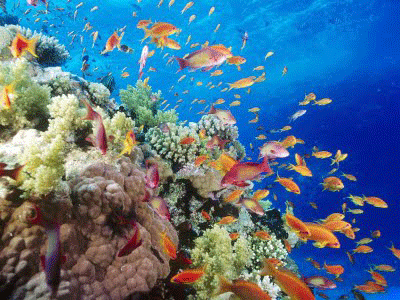
 Saving Great Barrier Reef from climate change should be central election issue, says Tim Flannery http://www.theguardian.com/environment/2016/may/17/saving-great-barrier-reef-climate-change-should-be-central-election-issue-says-tim-flannery
Scientist says lack of attention to climate change is ‘staggering’ given it is Australia’s last chance ‘to close down coal-fired power stations and save the reef’, Guardian, Calla Wahlquist, 17 May 16, Tim Flannery says preserving the Great Barrier Reef from coral bleaching linked to climate change should be a central issue in the federal election campaign.
Flannery, a scientist and member of the Climate Council, said the lack of attention paid to climate change so far in the eight-week campaign was “staggering”.
“This needs to be the reef election,” he told Guardian Australia. “This is the last moment I think that we can realistically expect that we can enact some policies … to close down coal-fired power stations and save the reef.
“Other issues are still going to be there in another four years. This one won’t.”
A study in April found that almost 93% of the Great Barrier Reef had been affected by global bleaching, part of a global coral bleaching event that scientists say was caused partly by El Niño and partly by background global warming.
The aerial survey, conducted by James Cook University, found the bleaching was most severe in reefs north of Port Douglas, where about 81% of reefs were assessed as having severe bleaching. Prof Terry Hughes, head of the National Coal Bleaching Taskforce, told Guardian Australia last month that the mortality rate in coral reefs in that area was already at more than 50%.
Hughes said it was five times worse than the last two bleaching events, in 1998 and 2002, when 40% of the reef escaped bleaching.
Coral bleaching has also been recorded in Western Australia’s Kimberley region, where between 60-90% of some reefs are reported to be bleached. Continue reading
Parry Agius – founding member of Uranium lobby group – should not be on “independent” Nuclear Advisory Board.
The South Australian government will make the decision on whether or not to make that State become the world’s nuclear toilet.
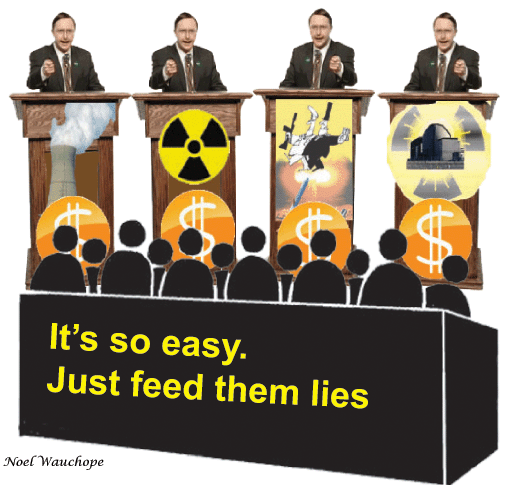 However, they’ll still go through a process of informing and consulting the community, beforehand. That will be the job of the new Nuclear Fuel Cycle Royal Commission Consultation and Response Agency :-
It will “draw upon existing government expertise and expertise from the Royal Commission itself to to increase awareness of the Royal Commission’s report and facilitate the community consultation process.”
The other one, Nuclear Fuel Cycle Royal Commission Consultation and Response Advisory Board, will oversee the Agency throughout the consultation process. That’s the one chaired by John Mansfield, and with Adjunct Professor Daniela Stehlik, Rebecca Huntley, Professor Deb White, and Parry Agius.
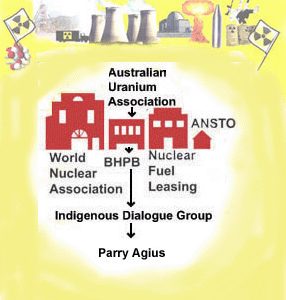
I don’t think that Parry Agius should be on this supposedly independent Board. He is a founding member of the Australian Uranium Association’s Indigenous Dialogue Group. He’s also been a member of the Resources Industry Development Board in South Australia.
South Australian Premier creates two new Nuclear Advisory Agencies
 Premier Jay Weatherill, 17 May 16 Cabinet has approved the establishment of the Nuclear Fuel Cycle Royal Commission Consultation and Response Agency and the appointments to the Nuclear Fuel Cycle Royal Commission Consultation and Response Advisory Board…
Last week I announced that the Government would establish these two bodies, and today I confirm that Cabinet has approved the establishment of the Nuclear Fuel Cycle Royal Commission Consultation and Response Agency and the appointments to the Nuclear Fuel Cycle Royal Commission Consultation and Response Advisory Board.
The purpose of the new agency, which will draw upon existing government expertise and expertise from the Royal Commission itself, will be to increase awareness of the Royal Commission’s report and facilitate the community consultation process.
The independent Advisory Board will oversee the Agency throughout the consultation process.
The Board will be chaired by the Honourable John Mansfield, Member of the Order of Australia and retiring Justice of the Federal Court of Australia, who will commence the role immediately after his retirement from the Federal Court.
The other members of the board will be:
- Parry Agius, former Chief Executive Officer of the South Australian Native Title Service; – 3 –
• Adjunct Professor Daniela Stehlik, Griffith University, is one of Australia’s leading social scientists in the fields of sustainability, human services and social cohesion with a particular focus on families and communities.
• Rebecca Huntley, Social researcher and former Director of The Mind & Mood Report, Australia’s longest running social trends report;
• Professor Deb White, Director of Cancer Research at the South Australian Health and Medical Research Institute (SAHMRI)
The outcomes of this community engagement process will help inform the government’s response to the Report, which I intend to deliver to the Parliament by the end of this year…. http://www.premier.sa.gov.au/images/speeches/NuclearFuelCycleRoyalCommission.pdf
South Australia sets up parliamentary inquiry on proposed nuclear waste importing
 SA to set up inquiry into nuclear dump https://au.news.yahoo.com/sa/a/31626088/sa-to-set-up-inquiry-into-nuclear-dump/ AAP on May 17, 2016, The South Australian government will set up a parliamentary inquiry into whether the state should host a nuclear waste dump.
Premier Jay Weatherill says a joint select committee will help inform the government’s response to the nuclear fuel cycle royal commission, which recommended the state pursue building such a facility.
A citizen jury will also be selected by an independent panel to identify key questions about the issue, while a second jury will be asked to produce a report outlining community views.
Jay Weatherill could now be in a dither over nuclear waste dump proposal
Jay Weatherill: Nuclear waste and citizens’ juries, Independent Australia 17 May 2016 Jay Weatherill has announced the establishment of “citizens’ juries” to debate the Royal Commission’s recommendation in favour of a nuclear waste dump for SA— and angered both sides of politics in the process. Noel Wauchope reports.
NEITHER the Left nor the Right is happy with the South Australian Premier’s plan for “citizens’ juries” on the question of importing nuclear waste.
Jay Weatherill will surely be remembered as the quintessential flip flop Premier. In past years, Weatherill was a Labor Left faction opponent of the nuclear fuel cycle and a strong supporter of renewable energy. In the face of the collapse of the car industry in SA and the uncertainty around the shipbuilding and submarine contracts, he was enticed by the nuclear lobby to do an about turn on the nuclear industry.
He went off to the Paris climate summit, preaching about “low carbon electricity” — which is nuclear lobby code for nuclear energy, not “renewable” energy. However, he had earlier described nuclear power as not being viable.
Weatherill went on to set up the Nuclear Fuel Cycle Royal Commission, led by pro-nuclear Kevin Scarce and with a team in which nuclear power experts predominated. It produced – no surprises here – the recommendation for South Australia to set up a nuclear waste importing industry, in thewords of Kevin Scarce, ‘as soon as possible’.
So, the hasty programme for nuclear waste importing is underway. The first step is to be citizens’ juries. In a process run by New Democracy, 2,500 invitations are being mailed this week to potential participants — 50 will be selected for the first meeting in a month’s time and 350 for the next one in October. There are other initiatives too. The Government is launching an advertising campaign entitled, NuClear, with advertisements to be run on radio, television, print and social media. They also have a consultation website, YourSAy. All very good for the nuclear waste import plan.
But now, the plan does seem to be running into a bit of trouble.
The Advertiser ran a poll early last week was a negative result for the nuclear waste cause….
There must be sufficient anxiety in the South Australian Government and the Liberal Opposition to warrant consideration of a referendum on the subject:……..Previously, a referendum was not considered an option. …..
Meanwhile, the immediate trouble lies with this citizens’ jury plan.
Spruiking about citizens’ juries, Jay Weatherill sounds like an old style Liberal:…….In his press release about the nuclear waste plan, Weatherill said:
‘This first Citizens’ Jury will guide the debate by identifying the key issues that need to be considered during the state-wide consultation phase.’
This is not to the liking of today’sLiberals, nor today’s pro-nuclear Laborites, nor even the anti-nuclear camp.
The pro-nuke response was best expressed by Chris Kenny, in Adelaide Now:
‘Forget the citizens jury, Mr Weatherill — just make a decision. That’s what you were voted in to do!’
Liberal Opposition Leader Steven Marshall fumed:
‘This is the largest decision in the history of the state, and Jay Weatherill’s plan is to outsource it to 50 randomly selected individuals. It’s just outrageous.’…….
….. Meanwhile, on Facebook pages, and in some comments on other sites, the anti-nuclear people were up in arms, certain that the process would be stacked with pro-nuclear experts and participants would be brain-washed with nuclear advertising.
It looks as if Jay Weatherill started out on all this in socialist mode — with political and technical experts running the show. Then he aberrated into old “wet” style Liberal mode, towards participatory democracy. In the process, he seems to have pleased nobody…..https://independentaustralia.net/politics/politics-display/jay-weatherill-nuclear-waste-and-citizens-juries1,8998
Global nuclear waste dump for South Australia is opposed by women and Labor voters
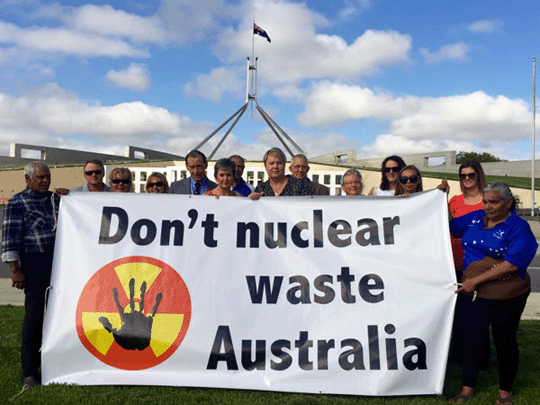 Women and Labor voters opposed to international nuclear waste dump in South Australia, poll finds, Adelaide Now, March 21, 2016 PETER JEAN, POLITICAL REPORTER The Advertiser PREMIER Jay Weatherill will need to win the support of women and his own Labor voters if the State Government decides to back the construction of an international nuclear waste storage facility in South Australia.
The results of a new opinion poll show almost 60 per cent of women and most Labor voters are opposed to a global nuclear waste facility being located in the state.
The ReachTEL Poll of 1077 SA residents conducted on March 10 found that 37 per cent of voters supported of voters supported an international nuclear waste dump, 48.5 per cent were opposed and 14 per cent were undecided….
Australia Institute executive director Ben Oquist said South Australians were increasingly aware of the risks posed by the project, including the damage it could do to the state’s reputation.
“I think people are increasingly wise to the projects that are jobs-rich, versus those that are expensive, likely to involve a large upfront government subsidy and won’t produce long-term jobs,’’ Mr Oquist said.
“Those industries that are jobs-intensive are potentially put at risk by South Australia’s brand being threatened by a global nuclear waste dump.’’….. http://www.adelaidenow.com.au/news/south-australia/women-and-labor-voters-opposed-to-international-nuclear-waste-dump-in-south-australia-poll-finds/news-story/35d4ad38cadbaae4798ca89e91c74f5f
Nuclear waste dumping in South Australia – an act of cultural genocide
 Nuclear dump protesters warn of ‘cultural genocide’ in South Australia, ABC , 17 May 16 By Claire Campbell Building a nuclear waste dump in South Australia would be “cultural genocide”, an Indigenous Australian says, as a campaign against a potential facility in South Australia ramps up.
Flinders Ranges Adnyamathanha woman Candace Champion was among unions, community groups and traditional landowners who today launched an alliance to protest the dump if it goes ahead.
Nuclear Fuel Cycle Royal Commissioner Kevin Scarce made a recommendation earlier this month that SA build a used-nuclear fuel and intermediate level waste storage facility as an economic opportunity.The State Government has not committed to building a dump and said community engagement would be pivotal before a proposal was considered.
But the alliance believes going ahead with such a facility would ignore Aboriginal rights and put public health, the environment and the state’s finances at risk. It includes the Australian Nursing Midwifery Federation, Conservation Council, Maritime Union of Australia and the Uniting Church.
“This proposal and the proposals of nuclear dumps right around Australia is a threat to Aboriginal culture and society and it is cultural genocide,” Ms Champion said.
“As a young Adnyamathanha woman, I can tell you that my family will be affected by this nuclear dump. It is bringing back a lot of anxiety, a lot of anxiousness and a lot of mental health issues within my family and my community.”
Premier Jay Weatherill in February said it was important that everybody was “afforded an opportunity to have their say” and believed an emotion-charged debate was required.
“In a sense, this is a test of our democracy,” Mr Weatherill said……..http://www.abc.net.au/news/2016-05-16/nuclear-dump-protesters-warn-of-cultural-genocide-in-sa/7419406
International solidarity with indigenous peoples against nuclear waste dumping
 If you’re from the United States, then this whole ordeal should sound somewhat familiar.
According to the Scientific American, “[n]ative tribes across the American West have been and continue to be subjected to significant amounts of radioactive and otherwise hazardous waste as a result of living near nuclear test sites, uranium mines, power plants and toxic waste dumps.”
Take Action!
The final decision for the nuclear dumping site will occur in a year, please act now by signing and sharing this petition urging Australian leaders not to dump nuclear waste near Adnyamathanha territory.
Stop Australia From Committing “Cultural Genocide” and Environmental Injustice http://www.truth-out.org/news/item/36006-stop-australia-from-committing-cultural-genocide-and-environmental-injustice, 14 May 2016 By Jessica Ramos, Care2 | Report Australia is about to make a horrible mistake. The country has (at least, tentatively) earmarked the location of its first nuclear dumping site next to an aboriginal cultural site. And the aboriginal community is speaking out — calling the proposed site “cultural genocide.” Australia is on the path to repeating the United States’ past mistakes and environmental injustices.
Can You Put a Price on Cultural Genocide and Death? Yes, Apparently
The traditional lands at the center of the controversy belong to the Adnyamathanha, also known as the “rock people,” from Flinders Ranges, South Australia. In 2009, the Federal Court of Australia recognized the Adnyamathanha’s native rights over 16,000 square miles of territory. But a nuclear dumping site of low- and intermediate-level nuclear waste (e.g. from medical procedures) endangers their territory and legal rights. Continue reading
Australia’s Lucas Heights is part of the IAEA’s nuclear propaganda blitz on schoolkids
IAEA Invites Students to Learn Nuclear Science Through Play. IAEA, By Laura Gil, IAEA Office of Public Information and Communication, 12 May 16, Teachers have reached almost 10 000 students in four Asian countries through a guidebook designed to bring nuclear science and technology closer to young adults. The compendium, which is being tested by the IAEA and education experts from several countries, collects unique teaching strategies and materials to introduce science and technology in education systems.
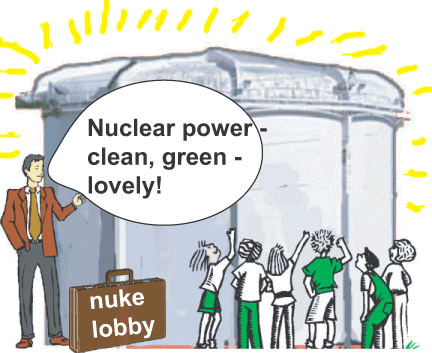
By generating interest in science among young generations, the compendium aims at contributing to the sustainability of the nuclear industry and related technologies in the future. With populations growing, applications of nuclear technology rapidly expanding, and active nuclear scientists ageing, a new generation of professionals will soon need to step up……
In preparation for the curriculum, experts collected ideas from, for example, Japan, where teachers often organize field trips for students; India, where education centres convoke essay contests all across the country to create an interest in the student community; Israel, where the government has built a nuclear science park and museum; and Australia, where school children are invited to an exhibition centre in the Australian Nuclear Science and Technology Organisation already from an early age. https://www.iaea.org/newscenter/news/iaea-invites-students-to-learn-nuclear-science-through-play
Australian environment groups unite to oppose govt plans to cut their charitable status
 Federal election 2016: climate survey fires up green council of war Graham Lloyd THE AUSTRALIAN MAY 17, 2016 Peak environment groups have prepared a co-ordinated election blueprint on climate change, the Great Barrier Reef and fossil fuels, staring down threats to cut the charitable status of organisations that play politics.
The groups, including Greenpeace, WWF, the Australian Conservation Foundation and the Wilderness Society, have spent the past fortnight planning a strategy against the background of a parliamentary report that set out a road map to punish critics of the government and resource industry.
Established by Environment Minister Greg Hunt, it recommended groups be required to spend 25 per cent of fundraising on tree planting and land repair or lose tax-deductible status. It also said organisations should be made liable for illegal actions of members, supporters or volunteers.
The lower house committee recommendations were not supported by Labor members and the report included a dissenting statement from Liberal member Jason Wood. Mr Wood listed potential casualties, including Beyond Zero Emissions, Great Barrier Reef Foundation, Environment Victoria, Friends of the Earth, Greenpeace Australia, Australian Youth Climate Coalition, The Wilderness Society, EDOs of Australia, Australian Orangutan Project and Environmental Justice Australia.
Wilderness Society national campaign manager Lyndon Schneiders said: “They are also saying to a bunch of rednecks that they will deal with environment groups’ campaigns against controversial oil and gas projects.”
Former Greens leader Bob Brown said making groups responsible for the actions of members and volunteers “would be right at home in Vladimir Putin’s Russia”. Climate Change organisation 350.org said the recommendations were anti-democratic and “an unnecessary witch-hunt”.
The Wilderness Society said it made more sense to spend money lobbying to stop trees being cut down that to replant them……http://www.theaustralian.com.au/federal-election-2016/federal-election-2016-climate-survey-fires-up-green-council-of-war/news-story/b8af615de95a65ca71c609ae8990700b
Things really are crook in the uranium industry
Australia’s uranium industry is also struggling just to stand still. The industry accounts for just 0.2 percent of national export revenue and less than 0.01 percent of all jobs in Australia. Those underwhelming figures are likely to become even less whelming with the end of mining and the winding down of processing at the Ranger mine in the NT.
Uranium on the rocks http://onlineopinion.com.au/view.asp?article=18236&page=0

| By Jim Green , 17 May 2016 Indicative of the uranium industry’s worldwide malaise, mining giant Cameco recently announced the suspension of production at Rabbit Lake and reduced production at McArthur River/Key Lake in Canada. Cameco is also curtailing production at its two U.S. uranium mines. About 500 jobs will be lost at Rabbit Lake and 85 at the U.S. mines. A Cameco statement said that “with today’s oversupplied market and uncertainty as to how long these market conditions will persist, we need to focus our resources on our lowest cost assets and maintain a strong balance sheet.”Christopher Ecclestone, mining strategist at Hallgarten & Company, offered this glum assessment of the uranium market: “The long-held theory during the prolonged mining sector slump was that Uranium as an energy metal could potentially break away irrespective of the rest of the metals space. How true they were, but not in the way they intended, for just as the mining space has broken out of its swoon the Uranium price has not only been left behind but has gone into reverse. This is truly dismaying for the trigger for a uranium rebound was supposed to be the Japanese nuclear restart and yet it has had zero effect and indeed maybe has somehow (though the logic escapes us) resulted in a lower price.”
Ecclestone adds that uranium has “made fools and liars of many in recent years, including ourselves” and that “uranium bulls know how Moses felt when he was destined to wander forty years in the desert and never get to see the Promised Land.” He states that uranium exploration “is for the birds” because “the market won’t fund it and investors won’t give credit for whatever you find”. Continue reading |
Australian govt’s “Direct Action” ineffective, could even increase Co2 emissions
it was entirely possible some projects would end up, perversely, funding emissions increases.
Direct Action funds ‘spent on projects that would have happened anyway’, http://www.theguardian.com/australia-news/2016/may/16/direct-action-funds-likely-spent-on-projects-that-would-have-happened-anyway Guardian, Michael Slezak, 17 May 16,

Payments to greenhouse gas emitters more likely to go to reduction schemes that would have taken place without government funding, says economist. The government’s $2.55bn emissions reduction fund, which pays greenhouse gas emitters to pollute less, will inevitably pay for reductions that would have happened anyway, for the same reason that secondhand car markets are full of lemons, an economic analysis has concluded. Continue reading
Some parts of tourism industry trying to conceal the plight of the Great Barrier Reef
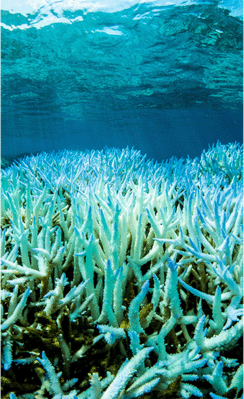 Great Barrier Reef tourism operators refuse media and politicians access to bleached reefs, Guardian, Joshua Robertson, 28 April 16, Several major operators refuse to take Greens’ senators to bleached reefs as a backdrop for policy announcements, fearing potential impact on tourism. North Queensland tourism operators are routinely refusing to take media and politicians to see coral bleaching on the Great Barrier Reef for fear the attention will trigger a collapse in visitor numbers, it has been claimed.
Several major operators with the backing of industry heavyweightsrefused to ferry Greens senators Richard di Natale and Larissa Waters to reefs off Cairns, the backdrop for their election campaign announcement on reef policy on Thursday.
They were just the latest in a string of operators denying media requests to help them obtain pictures and footage and report on what scientists say is the worst bleaching event in the reef’s history, according to dive operator, Tony Fontes. Continue reading
South Australia – “base load” power from wind and solar – Giles Parkinson
 Wind and solar become new “base load” power for South Australia http://reneweconomy.com.au/2016/wind-and-solar-become-new-base-load-power-for-south-australia-99364 [good graphs] By Giles Parkinson on 16 May 2016
This is expected to be the pattern of the future, as energy systems with high renewable energy penetration rely first on variable energy providers such as wind and solar, and then on “flexible” or “dispatchable” energy from the likes of gas, but ultimately hydro, solar towers with storage, and emerging technologies such as geothermal and ocean energy and battery and other energy storage. Continue reading
No Dump Alliance – anti-nuclear advocacy group launched

Advocacy group protests against high-level nuclear waste dump in SA, saying it poses great health, environment and financial risks http://www.abc.net.au/news/2016-05-16/nuclear-dump-protesters-warn-of-cultural-genocide-in-sa/7419406 May 16, 2016 Erin Jones The Advertiser
A NEW advocacy group will lobby against a high-level nuclear waste dump being built in SA.
The No Dump Alliance group launched on Monday and already has the support of several groups, including the Australian Nursing & Midwifery Federation, the Maritime Union of Australia and SA Aboriginal Congress.
The group formed after the Nuclear Fuel Cycle Royal Commission earlier this month recommended the state urgently pursue the opportunity of a nuclear dump.
The No Dump Alliance believes the proposal shows a lack of respect for traditional owners, who opposed the dump and said it could pose significant health, environment and financial risks.
Candice Champion is a Adnyamathanha woman from the Flinders Ranges who said a nuclear storage facility could pose many risks to her community.
“As a young Adnyamathanha woman my family will be affected by this nuclear dump, which is bringing about a lot of anxiety and mental health issues to my family and community,” Ms Champion said.
“These places are of quality and significance to me and people continue to discount the Adnyamathanha voice which is frustrating and disheartening.
“We want to be able to invest in our future generations and be able to pass something over that is important and pristine, not something posing any risks.”
SA Aboriginal Congress chairman Tauto Sansbury said the group must have a united front and it was not just an “Aboriginal fight” to protect the land.
“This will be a united front to protect SA and make sure it continues to grow from other opportunities, apart from being the international dumping ground,” Mr Sansbury said.
“I believe we’re going to win this because this is not just about an Aboriginal fight … it’s everyone’s fight.”
The State Government will use a jury of 350 randomly selected South Australians to make recommendations to it in November on whether to proceed with the plan for a nuclear waste dump.
The jury was part of a six-step process to unfold over the next seven months, culminating in a firm Government position being outlined to State Parliament.
Premier Jay Weatherill has previously stressed the project could not proceed without broad political and community support.
1 This month
17 October, Free Public Talk on Nuclear Issues in South Australia
David Noonan will speak on public interest concerns over the new Roxby Downs Indenture Act 2026 on BHP copper-uranium mining and ore processing in SA, and on how AUKUS may face SA with a High-Level nuclear waste agenda.
Dr Jim Green will discuss international developments in the field of nuclear power including ‘small modular reactors’ and Generation 4 ‘advanced’ nuclear reactor concepts.


Help Aunty Sue Protect Her Land and Sacred Sites From Destructive Rocket Testing.
.

Australians deserve the truth
about
AUKUS – https://aukuspublicinquiry.com/

PETITION – To: Prime Minister Anthony Albanese and the Australian Labor Government

of the week – Australians for War Powers Reform (AWPR)
To see nuclear-related stories in greater depth and intensity

