South Australia Aboriginal land again targeted, for probably unnecessary radioactive trash dump
The Flinders Ranges site was nominated by Grant Chapman but he has precious little connection to the land. Conversely, the land has been precious to Adnyamathanha Traditional Owners for millennia. The fact that the government is once again targeting a ‘remote’ Aboriginal site is beyond comprehension and creates a lot of frustration and hurt.
“Adnyamathanha Traditional Owners weren’t consulted about the nomination. Even Traditional Owners who live next to the proposed dump site at Yappala Station weren’t consulted. The proposed dump site is adjacent to the Yappala Indigenous Protected Area.
 SA once again targeted for nuclear waste dump, http://www.onlineopinion.com.au/view.asp?article=18200, Anica Niepraschk, 2 May 16
Last Friday the government announced its preferred site for a national radioactive waste dump, near Hawker in South Australia’s Flinders Ranges. The site was nominated by former Liberal Senator Grant Chapman, who holds a long-term lease over the Barndioota station, and his nomination has been endorsed by the Liberal government in Canberra.
The latest process to find a dump site follows 20 years of failed attempts trying to force a dump on Aboriginal communities in SA and later the Northern Territory. Continue reading
Liberal coalition plans nuclear submarine fleet so that we can fight China
Coalition plans nuclear-powered submarine fleet over long term. Fin Rev, by Aaron Patrick and Phillip Coorey, 1 MAY 16
Some of Australia’s new submarines could be nuclear-powered by the time they enter service, making them much more potent against the huge Chinese navy.
One of the reasons French ship builder Direction des Constructions Navales Services, also known as DCNS, won the $50 billion contract was its ability to switch easily to a nuclear version of the submarines being designed for the Royal Australian Navy.
That is because the Australian diesel-powered Shortfin Barracuda will be a shorter, lighter version of a nuclear submarine already being manufactured by DCNS in Cherbourg on the English Channel.
Cabinet ministers and defence officials have already discussed the possibility of switching from diesel engines to nuclear power part-way through the construction contract, political, government and industry sources say.
The Coalition wants to keep the option open in case public opposition to nuclear power changes in the future. National polls taken from 2006 to 2009 found between 35 and 50 per cent of Australians supported introducing nuclear power, a study by the National Academies Forum showed.
DCNS, which is majority owned by the French government, is expected to start building the Australian submarines in Adelaide next decade. The last one might not be completed until 2050.
The other bidders for the contract, Germany’s Thyssenkrupp Marine Systems and Japan’s Kawasaki Heavy Industries and Mitsubishi Heavy Industries, don’t make nuclear submarines………..
The government, which has been criticised for opting to build the submarines in Australia, said it was not considering switching to a nuclear-powered version………
Another drawback of nuclear reactors is that, unlike diesel motors, they can’t be turned off to make the submarine silent.
Australia’s submarines are unusual. They would be the only conventionally powered ones that used pump jets for propulsion rather than propellers, Stephan Fruehling, a defence expert at the Australian National University’s College of Asia and the Pacific, said.
The Coalition government quietly supports developing a nuclear industry in Australia and on Friday proposed storing radioactive waste on a remote South Australian cattle station.
It has encouraged the South Australian Labor government to push ahead with a debate over storing spent nuclear rods from overseas. Given the submarines will be built in Adelaide and South Australia has some of the largest uranium deposits in the world, the state could one day become the centre of an Australian nuclear industry. http://www.afr.com/business/manufacturing/coalition-plans-nuclearpowered-submarine-fleet-over-long-term-20160429-goieal
Australia’s uncertain politics mean that Renewable Energy Target is in doubt
Renewable energy target in doubt as $10b investment needed The Age, Angela Macdonald-Smith, Energy Reporter , 2 May 16,Fresh doubts have been raised about the country’s ability to meet the 2020 renewable energy target after a new analysis found that $10 billion of extra investment is needed in a market where lenders are wary because of changing regulations.
In research to be released on Monday, BIS Shrapnel has determined it is “highly doubtful” the 2020 target of 33,000 gigawatt-hours of renewable energy output can be achieved given the stalling of investment over the past few years that means a huge catch-up effort is required. It expects the goal may only be reached one or two years late.
Some 4850 megawatts of wind farms and solar power plants need to be installed to meet the deadline, with most expected to be built in NSW, Queensland and Victoria, the research firm found. It calculates that though $340 million of investment has been committed to new projects, another $10 billion is needed.
The findings come as the Clean Energy Council is calling for an increase and extension to the 2020 target as part of a package of measures proposed to end greenhouse emissions from the electricity sector by 2050, as required if climate change is to be limited to less than 2 degrees C.
In a document called Power Shift, also released on Monday, the council proposes measures to ensure the “orderly” closure of heavy-emitting coal plants, which chief executive Kane Thornton said were “more at home in the Eastern Bloc” than in Australia.
“As these plants phase out, Australia can take advantage of our world-class sun, wind, waves and bio-energy that will deliver the lowest-cost form of new electricity generation,” Mr Thornton said. The document says regulated emissions limits or emissions trading could be used to drive plant closures.
On the renewable energy target, which peaks at 2020 and then continues flat until 2030, the council is pushing for an extension of the system to 2035 to provide the certainty required for investment…….http://www.theage.com.au/business/energy/renewable-energy-target-in-doubt-as-10b-investment-needed-20160428-gohsyo.html
New submarines chosen as prelude to nuclear submarines

 Business SA says Future Submarine fleet could include nuclear-powered versions once local atomic industry is established, Adelaide Now April 30, 2016 State political reporter Daniel Wills, Paris, France, Sunday Mail (SA) AUSTRALIA’S future submarine fleet could be transitioned to include a potent mix of both intelligence gathering diesel boats and rapid, fast-moving nuclear-powered vessels once the state develops a sophisticated atomic industry based around storage, Business SA says.
The Federal Government is facing calls from across the strategic policy and business communities, as well as from an outspoken SA Senator, to strongly consider the nuclear option.
Premier Jay Weatherill visited DCNS’ Cherbourg shipyard last on Friday Adelaide time, just hours after SA was chosen as the likely site of a low-level nuclear waste dump and as former governor Kevin Scare puts the finishing touches on a Royal Commission due for release within days.
Business SA chief executive Nigel McBride, who joined the Cherbourg tour to observe the construction of a nuclear Barracuda sub that will become the template for Australia’s diesel fleet, said there was strong national defence reasons for having a mix of the two…..
Mr McBride told the Sunday Mail that building community confidence behind nuclear storage was crucial before the question of expanding the industry into defence capabilities.
“As we’ve gone around Europe and looked at their nuclear cycle, and take into account the likely final recommendations from the Royal Commission in regards to the storage of waste, we will as a nation and state soon come to a decision about if we participate or not,” he said…….
Mr McBride said storage was a “starting point” in a discussion about other applications.
The first future sub is set to hit the water in the early 2030s, about the time when Mr Scarce says the state could have a storage industry up and running if it moved to do so immediately……
“We walked around a facility today which had a significant nuclear threat, nobody even blinked. We walked around and took it for granted that it would be professionally contained,” Mr McBride said……
Senator Day said there was “no escaping” the strategic need for nuclear subs…….
“The winning DCNS bid links SA with a French nation with nuclear subs and nuclear power. This opens up great opportunities for SA to learn how to embrace all facets of the nuclear fuel cycle.”…….
Mr Thomson said diesel subs were valuable in “certain, specific circumstances”.
“But if you had to choose between 12 nuclear or 12 conventional subs, it’s a no-brainer. You’d have the nuclear subs every time…
Australian law currently bars the use of nuclear subs………http://www.adelaidenow.com.au/news/south-australia/business-sa-says-future-submarine-fleet-could-include-nuclearpowered-versions-once-local-atomic-industry-is-established/news-story/9ae30cb1933a6119182944f6dbdcf09c
The Adnyamathanha people will not be bribed: they will fight the nuclear waste dump plan
 Adnyamathanha to fight federal government’s nuclear dump planned Barndioota location.Transcontinental, Port Augusta,30 Apr 16 ADNYAMATHANHA traditional owners are vowing to fight the federal government’s plans to house a nuclear waste facility Wallerberdina Station near Barndioota in the Flinders Ranges.
The call comes as the site was shortlisted by the federal government as the possible location of Australia’s first facility of its kind on Friday morning
Adnyamathanha Traditional Owner Regina McKenzie, who lives at Yappala Station near the proposed dump site said the Adnyamathanha were not consulted about the nomination.
‘Even Traditional Owners who live next to the proposed dump site at Yappala Station weren’t consulted,” Ms McKenzie said.
“The proposed dump site is adjacent to the Yappala Indigenous Protected Area. On the land with the proposed dump site, we have been working for many years to register heritage sites with the SA government.”
Ms McKenzie said the Arngurla Yarta (spiritual land) holds special significance to her people and the proposed dump site features countless thousands of Aboriginal artifacts.
“Our ancestors are buried there,” Ms McKenzie said.
“The nominated site is a significant women’s site. Throughout the area are registered cultural heritage sites and places of huge importance to our people.”
“We call on the federal government to withdraw the nomination of the site and to show more respect in future. We call on all South Australians − all Australians − to support us in our struggle.
“Adnyamathanha Traditional Owners and Viliwarinha Yura Aboriginal Corporation will fight the proposal for a nuclear waste dump on our land for as long as it takes to stop it.”
Member for Grey MP Rowan Ramsey said the Hawker community would benefit if Barndioota became the site of the low and intermediate nuclear waste repository.
“The open mindedness of the Hawker community on this issue is to be admired and I am very pleased a community in my electorate stands to benefit substantially from this investment. …….
Mr Frydenberg stressed the federal government’s decision was not final. http://www.transcontinental.com.au/story/3879196/adnyamathanha-to-fight-nuclear-dump-plan/
Nuclear inquiry needed for waste dump sites
 29 Apr 2016 The Australian Greens have called for an independent, deliberative inquiry into long-term stewardship options for spent nuclear fuel, drawing widely on international experience in light of today’s announcement to use Wallerberdina Station near Barndioota in South Australia’s Flinders Ranges as a proposed dump sitefor WA Scott Ludlam said this should start with the question, what is the safest way to isolate long-lived wastes from people and the environment for tens of thousands of years, rather than where should we dump it?
“Existing spent fuel and reprocessing wastes should be properly containerised in 60-year licenced castors, effectively big bomb-proof lead and steel containers, and remain at Lucas Heights under active care and maintenance,” he said.
The Government must also come clean about what kinds of waste they intend to dump.
“While the Government emphasises that this debate is about low-level medical wastes (gloves and discarded diagnostic equipment), the real debate is about where the spent nuclear fuel from the Lucas Heights research reactor ends up,” he said.
Mr Ludlam said today’s announcement was only happening because community action led by Aboriginal leaders managed to defeat the proposal to dump nuclear waste at Muckaty Station in the Northern Territory.
“Unless the Government wants a repeat of that disaster, it needs to listen to local voices now. Minister Josh Freydenberg and his predecessor Ian MacFarlane said they would not proceed without consent. That consent is clearly missing: the community is saying no, and this must be respected,” he said.
“What we needed was a genuinely deliberative investigation into how to isolate this waste for tens of thousands of years; instead we got this attempt to cut corners and dump it off on an unsuspecting community.”
The Greens have committed to support local Aboriginal people who recently led a tour of the region for Australian Greens representatives.
The Greens also call for: Continue reading
Ocean temperatures on Tasmania’s East Coast are among the fastest-rising in the world
OCEAN temperatures on Tasmania’s East Coast are now among the most rapidly warming in the world, with oyster, salmon, rock lobster and abalone industries feeling the impact.
http://www.themercury.com.au/news/tasmania/ocean-temperatures-on-tasmanias-east-coast-are-among-the-fastestrising-in-the-world/news-story/70e83dcbe51376aa439a53cd2d8d32f7
‘Perilous’: Bureau of Meteorology boss Rob Vertessy exits with climate warning
Australia faces a “perilous” water security future from climate change even as the Turnbull government eyes budget cuts to water programs and CSIRO halves climate investment, Rob Vertessy, the outgoing head of the Bureau of Meteorology, says.
Reservoirs in the Murray-Darling basin are now close to their lowest levels since the Millennium Drought and Tasmania is also facing “serious” issues”, Dr Vertessy told Fairfax Media on Friday, his final day as the bureau’s chief.
Were those French submarines chosen so that t they could later be NUCLEAR submarines?
Why did we agree to pay too much for French submarines? THE AUSTRALIAN
APRIL 29, 2016 Robert Gottliebsen,Business Spectator columnist Melbourne The evidence now mounting shows that the submarine tender is one of the most irregular ever conducted in Australia. Defence officials in the US, Japan and Germany are shocked at what is now being revealed.
Within 24 hours of the tender being announced, both sides are saying different thingsso, as anyone experienced with tenders knows, that means the deal has every prospect of becoming a disaster. (The good, the bad and the ugly of the submarine tender process, Apr 29)
There is mounting evidence that the French do not want to build the first two submarines in Australia. They need to make the first two submarines back home.
In Paris, they were shocked that Prime Minister Malcolm Turnbull was so definitivein his statement that all 12 submarines would be built in Australia.
To understand how this bizarre situation developed and the implications that stem from it, we need to go back to the defence white paper which estimated the cost of the 12 submarines at $50bn (we learned later that this is an inflation-adjusted figure).
At the time, the Japanese were mystified because they knew their tender was less than half that and the German “all local” tender was even lower — probably under $20bn…….
Why would you need 4,000 French workers — three times the number of Australian workers required for the German bid — when 12 submarines are to be built in Australia?
The other strange aspect of the submarine tender is that the submarines are not going to be delivered until 2033 or 2034. The Germans were offering to have submarines available around 2028.
But maybe there was something about doing the deal with the French that has not been disclosed. Perhaps a group of defence officials believe longer term that Australia needs nuclear submarines because of their greater range. Given its 15 years before the first submarine arrives, everyone would have forgotten what Malcolm Turnbull said this week. Indeed, he will have retired.
To build a nuclear submarine in Australia requires a change in the legislation, and a nuclear industry, which we don’t have, although the climate is changing and South Australia looks set to become a nuclear hub.
When the tender was first announced, I noted that there might be a nuclear agenda but at that stage I had no idea of the tendering mess (Australia’s defence options open up, April 27).
If it’s a nuclear submarine that Australia wanted, then it would have only been fair the other tenderers know about it and be given an opportunity to include a nuclear option. http://www.theaustralian.com.au/business/opinion/robert-gottliebsen/why-did-we-agree-to-pay-too-much-for-french-submarines/news-story/9ed179b276d13922c15d767873c6dea2
Adnyamathanha Traditional Owners will fight nuclear waste dump plan
29 Apr 16, The federal government has announced that the Flinders Ranges has been selected as the preferred site for a national nuclear waste dump. The land was nominated by former Liberal Party Senator Grant Chapman and his nomination has been endorsed by the Liberal government in Canberra.
Adnyamathanha Traditional Owner Regina McKenzie, who lives at Yappala Station near the proposed dump site and is a member of Viliwarinha Yura Aboriginal Corporation, said:
“Adnyamathanha Traditional Owners weren’t consulted about the nomination. Even Traditional Owners who live next to the proposed dump site at Yappala Station weren’t consulted. The proposed dump site is adjacent to the Yappala Indigenous Protected Area. On the land with the proposed dump site, we have been working for many years to register heritage sites with the SA government. The area is Adnyamathanha land. It is Arngurla Yarta (spiritual land). The proposed dump site has countless thousands of Aboriginal artifacts. Our ancestors are buried there. The nominated site is a significant women’s site. Throughout the area are registered cultural heritage sites and places of huge importance to our people.
“There are frequent yarta ngurra-ngurrandha (earthquakes and tremors). At least half a dozen times each year, we see and feel the ground move. It is flood land. The water comes from the hills and floods the plains, including the proposed dump site. Sometimes there are massive floods, the last one in 2006.
“We don’t want a nuclear waste dump here on our country and worry that if the waste comes here it will harm our environment and muda (our lore, our creation). We call on the federal government to withdraw the nomination of the site and to show more respect in future. We call on all South Australians − all Australians − to support us in our struggle. Adnyamathanha Traditional Owners and Viliwarinha Yura Aboriginal Corporation will fight the proposal for a nuclear waste dump on our land for as long as it takes to stop it.
“Last year I was awarded the SA Premier’s Natural Resource Management Award in the category of ‘Aboriginal Leadership − Female’ for working to protect land that is now being threatened with a nuclear waste dump. But Premier Jay Weatherill has been silent since the announcement of six short-listed dump sites last year. Now the Flinders Ranges has been chosen as the preferred site and Mr Weatherill must speak up. The Premier can either support us or he can support the federal government’s attack on us by maintaining his silence. He can’t sit on the fence.”
Adnyamathanha Traditional Owner Enice Marsh said:
“Vulnerable communities are suffering from lack of vision from our government and industry ‘leaders’ and should not be the government’s target for toxic waste dumps. This predatory behaviour is unethical and is an abuse of human rights. An Indigenous Protected Area is a Federal Government initiative, but it seems that in the case of Yappala this means nothing to the government. We ask you to honour this commitment to protect, not pollute and damage our land. This facility will cause immeasurable damage to the whole area which is covered with thousands of artefacts, home to people, animals, birds and reptiles. The building of this facility will cause widespread damage. It will scar the area and break the spiritual song-lines like never before in the 60000+ years of human occupation. We don’t want this waste in our country, it’s too toxic and long lived.”
Adnyamathanha Traditional Owner Jillian Marsh said:
“The First Nations people of Australia have been bullied and pushed around, forcibly removed from their families and their country, denied access and the right to care for their own land for over 200 years. Our health and wellbeing compares with third world countries, our people crowd the jails. Nobody wants toxic waste in their back yard, this is true the world over. We stand in solidarity with people across this country and across the globe who want sustainable futures for communities, we will not be moved. We challenge Minister Josh Frydenberg on his claim that this waste is just “gloves, goggles and test tubes” – the intermediate-level waste is much more toxic so why not talk about it? What about the damage to the area that construction of this site will cause? You can’t compensate the loss of people’s ancient culture with a few dollars.”
Scrapped radioactive waste sites supporting Flinders community campaign
29 Apr 16 Since November 13, six communities across Australia have been waking with a nuclear cloud overhead, after individual landholders in their region nominated sites to host the national radioactive waste facility.
This morning Minister Josh Frydenberg announced that only one area would be further pursued: Barndioota, in the iconic Flinders Ranges in South Australia.
Though relieved their regions have now been scrapped from the list, representatives from each of the other five sites have all reiterated support to their counterparts in the Flinders.
Statements from each of the communities are below.
BARNDIOOTA, Flinders Ranges, SA Jillian Marsh- Adnyamathanha Traditional Owner This morning we awoke to a sickening announcement from the Federal government of its intention to continue burdening our lands and our peoples with this toxic nuclear industry. Our lives are as caretakers of the land, as neighbours to other leaseholders, as friends and family to the people who love this region. Once more our communities are split, and our well-being is jeopardised by relentless money makers who can’t think past their own personal or business gains.
Successive Australian governments continue to operate under world’s worst practice in managing toxic nuclear waste, and sadly the Australian public is tested once more for its resilience. Regrets from past Ministers and swapping sides on environmental issues haunt all sides of government, but Traditional Owners remain vigilant.
The onslaught from industry and government is blatant in its colonialism, but the Traditional Owners, the Adnyamathanha men women and children of this region who love their country will not be silent or be silenced.
We thank those who have and continue to support us. Together we are strong.
OMAN AMA, Qld Susan Campbell and Mark Russell- Friends of Oman Ama.The Friends of Omanama stand shoulder to shoulder with our friends and colleagues in the community of Barndioota. This has been an appalling process and we are saddened that they will continue to suffer from its shortcomings.
We will be meeting next week to discuss how we can best provide moral and practical support to them in the next phase of this campaign.
HILL END, NSW The radioactive waste management process has been flawed from the start. From day one ordinary people have had their lives turned upside down. It’s hard to be excited to have been removed from off the list because we know our fellow proposed site of ‘Barndioota Station’ in Flinders Ranges and friends we have made there through this process have woken to the most devastating news this morning. Their site to them is as precious as Hill End is to us. We will continue to support them as best we can. It’s important to note that all sites have supported each other through this process.
What we have learnt? That the Government doesn’t care about ordinary Australians who elect them and vote for them.
It’s not appropriate to hear about being a proposed site on the radio on the morning of 13 Nov 2015 and it’s not appropriate again to hear about our removal from off the list again via media this morning. It shows our fellow elected constituent John Cobb lacks the fortitude to treat his electorate with the respect we deserve.
I’d like to thank our community for giving us their support, especially all the councils within the Central West. The Government has made it difficult to define what is a community but to know that your community is with you in good times and bad is what has made this achievable.
When we have had no alternative to fight as hard as we have, our friends have been what has gotten us through this. Community means everything they couldn’t break us and it goes to show that people power is all we have when our backs are to the wall.
KIMBA (Pinkawillinie and Cortlinye) , SA, Peter Woolford, Toni Scott and Kellie Hunt- No Radioactive Waste on Agricultural Land in Kimba or SA committee.
The No Radioactive Waste on Agricultural Land in Kimba or SA committee together with our members are extremely happy with today’s announcement removing Kimba from the final shortlist to host the nations radioactive waste.
We are pleased the government has acknowledged that there is not broad community support in our district. Eyre Peninsula is an export reliant region, and the decision this government has made to remove Kimba through from the next stage of this process ensures we will maintain our clean green reputation.
However we are disappointed and concerned that the nominated site at Barndioota has been selected for the final shortlist and we will continue to support their opposition wherever we can. This process has been flawed from the beginning and all sites were hopeful that Minister Frydenberg would acknowledge this and seek an alternative solution. Our hearts go out to our friends at the shortlisted site- we understand the uncertainty they are now facing.
HALE, NT Loyola Jones and family- Oak Valley The LeRossignol and Kenny families would like to thank the wonderful people who helped us find our voice and supported us through this process and the Traditional Owners (our family) from Santa Teresa and Tjitjikala for the strong and united stand against this proposal.
We are thankful that all our collective hard work paid off and the Hale site is off the list. But we can’t forget that there is still one of the six sites under threat. My family acknowledge our connection and relationship with Regina McKenzie and the Adnyamathanha mob. They don’t stand alone.
Our hearts ache that they still have to fight this. We stand with them and will offer whatever support we can. We stand in solidarity.
Nice little bonanza for former SA Liberal Senator Grant Chapman in choice of nuclear waste dump site
 Mr Frydenberg said Barndioota, owned by former SA Liberal Senator Grant Chapman, had been chosen ahead of others because of broad community support
If Barndioota is chosen, Mr Chapman and his business partner would get four times the land value for the 100ha excised for the repository from the 6357ha section of their station which has been nominated.
National low-level nuclear waste dump earmarked for Barndioota, near Wilpena Pound April 29, 2016 The Advertiser
A CATTLE station west of Wilpena Pound has been earmarked as the site for a national radioactive dump for medical and laboratory waste. In a surprise pre-election move, federal Resources Minister Josh Frydenberg will on Friday reveal that South Australia’s Barndioota has been pinpointed for the dump ahead of five other voluntarily nominated sites.
Mr Frydenberg emphasised that the short-listing was not a final decision to put the national facility at Barndioota, 35km northwest of Hawker, but it now represents the only option.
In a significant development, Treasurer Tom Koutsantonis said the State Government was supportive of the site’s short-listing and he called the process rigorous.
Overwhelming state and community opposition in 2004 forced the-then prime minister John Howard to abandon plans for a similar national radioactive waste dump near Woomera.
Mr Frydenberg, who will face voters at a July 2 double dissolution election, said he would make a final decision on the site within a year — after design, safety, technical, environmental and indigenous heritage assessment at Barndioota. He had previously been expected to nominate two SA sites — one near Kimba and Barndioota — on a shortlist of two or three ahead of a final decision later this year.
Traditional land owners say the site, near the Flinders Ranges and the famed Wilpena Pound, is home to countless sacred sites and culturally important landmarks that would be destroyed by a radioactive waste dump……. Continue reading
South Australia’s Nuclear Royal Commission was a nuclear lobby set-up from the beginning
There is no logical reason to believe that the SA government would perform any better than the U.S. government. On the contrary, there are good reasons to believe that nuclear waste management would be more difficult here given that the U.S. has vastly more nuclear waste management expertise and experience than Australia.
 SA nuclear Royal Commission is a snow job Jim Green, 29 April 2016 http://reneweconomy.com.au/2016/sa-nuclear-royal-commission-is-a-snow-job-18368
The South Australian Nuclear Fuel Cycle Royal Commission (RC) will release its final report on May 6. It was established to investigate opportunities for SA to expand its role in the nuclear industry beyond uranium mining.
Before his appointment as the Royal Commissioner, Rear Admiral Kevin Scarce said little about nuclear issues but what he did say should have excluded him from consideration. Speaking in November 2014 at a Flinders University guest lecture, Scarce acknowledged being an “an advocate for a nuclear industry”. Just four months later, after his appointment as the Royal Commissioner, he said the exact opposite: “I have not been an advocate and never have been an advocate of the nuclear industry.”
Other than generalisations, and his acknowledgement that he is a nuclear advocate, Scarce’s only comment of substance on nuclear issues in his 2014 lecture was to claim that work is “well underway” on a compact fusion reactor “small enough to fit in a truck”, that it “may be less than a decade away” and could produce power “without the risk of Fukushima-style meltdowns.” Had he done just a little research, Scarce would have learnt that Lockheed Martin’s claims about its proposed compact fusion reactor were met with universal scepticism and ridicule by scientists and even by nuclear industry bodies.
So the SA government appointed Scarce as Royal Commissioner despite knowing that he is a nuclear advocate who has uncritically promoted discredited claims by the nuclear industry. Scarce appointed an Expert Advisory Committee. Despite claiming that he was conducting a “balanced” RC, he appointed three nuclear advocates to the Committee and just one critic. The bias is all too apparent and Scarce’s claim to be conducting a balanced inquiry is demonstrably false.
Given the make-up of the RC, it came as no surprise that numerous questionable claims by the nuclear industry were repeated in the RC’sinterim report released in February. A detailed critique of the interim report is available online, as is a critique of the RC process.
The RC’s interim report was actually quite downbeat about the economic prospects for a nuclear industry in SA. It notes that the market for uranium conversion and enrichment services is oversupplied and that a spent fuel reprocessing plant would not be commercially viable. The interim report also states that “it would not be commercially viable to generate electricity from a nuclear power plant in South Australia in the foreseeable future.”
In a nutshell, the RC rejected proposals for SA to play any role in the nuclear fuel cycle beyond uranium mining. But that still leaves the option of SA offering to store and dispose of foreign high-level nuclear waste (HLW) and the RC strongly promotes a plan to import 138,000 tonnes of HLW for storage and deep underground disposal.
SA as the world’s nuclear waste dump The RC insists that a nuclear waste storage and dumping business could be carried out safely. But would it be carried out safely? The RC ought to have considered evidence that can be drawn upon to help answer the question, especially since Kevin Scarce has repeatedly insisted that he is running an evidence-based inquiry.
So what sort of evidence might be considered? The experience of the world’s one and only deep underground nuclear waste dump ‒ the Waste Isolation Pilot Plan (WIPP) in the U.S. ‒ is clearly relevant. And Australia’s past experience with nuclear waste management is clearly relevant, with the clean-up of nuclear waste at the Maralinga nuclear test site in SA being an important case study.
But the RC completely ignores all this evidence in its interim report. We can only assume that the evidence is ignored because it raises serious doubts about the environmental and public health risks associated with the proposal to import, store and dispose of HLW. Continue reading
First site chosen for nuclear waste dump – a former Liberal Senator’s property
Former Lib senator’s property first pick for nuclear dump, Fin Rev, by Fleur Anderson Simon Evans 29 Apr 16 A remote South Australian outpost on a cattle station part-owned by former Liberal senator Grant Chapman has been short-listed as the possible site for Australia’s first nuclear waste dump.
Barndioota station, one of six short-listed properties for the dump which would store nuclear waste from hospitals, universities and other locations, will be announced on Friday as the leading contender and there will now be further consultation for the site’s technical suitability and Indigenous heritage.

The Barndioota community, listed as having a population of three people, will receive up to $2 million for local projects that create lasting economic or social benefits and “in recognition of any short-term disruption that this detailed assessment may involve”, Resources and Energy Minister Josh Frydenberg said.
Mr Chapman is one of the owners of the long-term lease over a large 25,000 hectare outback pastoral property near Barndioota, which is about 45km north-west of the town of Hawker in the lower Flinders Ranges.
He chaired a Senate-select committee studying radioactive waste dangers and in 1996 proposed a national repository.
The site which Mr Chapman put forward is understood to only be about 100ha of the pastoral property at the northern end. The site is on dry, arid land where only saltbush grows and is about 440km north of Adelaide, and close to a railway line…….
The nuclear dump process is separate to the Nuclear Royal Commission headed by Royal Commissioner Kevin Scarce who is due to hand down his final report on May 6, but in preliminary findings in February outlined the economic benefits of SA becoming involved in nuclear storage.
The current federal Liberal Member for Grey, Rowan Ramsey, whose electorate covers a vast area on the Eyre Peninsula, in the initial stages of the process had nominated his own property as a potential site but later withdrew from the process because of perceptions of a conflict of interest……http://www.afr.com/news/politics/former-lib-senators-property-first-pick-for-nuclear-dump-20160428-gohggc
First-ever council solar farm for Queensland – on the Sunshine Coast
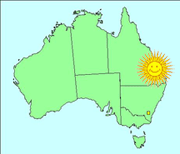 Sunshine Coast builds Queensland’s first-ever council solar farm Brisbane Times, Tony Moore, 28 Apr 16, Queensland’s first large-scale solar farm run by a local government – saving that council $22 million in electricity costs over 30 years – is now being built on the Sunshine Coast. It will provide green power on the Sunshine Coast by mid-2017 and will slash the council’s costs of buying electricity for everything including streets lights, sports facilities, buildings, galleries, parks and libraries.
The council expects to be able to sell excess electricity from the solar farm, with documentation showing the farm will generate more electricity than the council needs.
Queensland’s Local Government Association says nine local governments are also investigating geothermal energy plans.Redland City Council is also exploring a solar farm.
The Sunshine Coast will build the 15-megawatt solar farm on 50 hectares behind Coolum, making it the first local government in Australia to finance a solar plant itself……. More than 57,800 solar panels will be built on stands three to four metres high above an abandoned canefield owned by the council.
They will generate power by early 2017. The Sunshine Coast Council will fund the $48.5 million to build the solar power plant and awarded the contract to construction firm Downer Utilities.
About 60 jobs will be created during construction and a 10-metre buffer will be planted around the solar farm, which will include a solar research centre…….
“Where we originally planned to save our ratepayers $9 million over the 30-year life of the project, we are now forecasting we will save $22 million,” Cr Jamieson said. Solar energy is popular on the Sunshine Coast, with 30,000 homes installing solar system in the past five years……http://www.brisbanetimes.com.au/queensland/sunshine-coast-builds-queenslands-firstever-council-solar-farm-20160427-gogbw5.html
1 This month
17 October, Free Public Talk on Nuclear Issues in South Australia
David Noonan will speak on public interest concerns over the new Roxby Downs Indenture Act 2026 on BHP copper-uranium mining and ore processing in SA, and on how AUKUS may face SA with a High-Level nuclear waste agenda.
Dr Jim Green will discuss international developments in the field of nuclear power including ‘small modular reactors’ and Generation 4 ‘advanced’ nuclear reactor concepts.


Help Aunty Sue Protect Her Land and Sacred Sites From Destructive Rocket Testing.
.

Australians deserve the truth
about
AUKUS – https://aukuspublicinquiry.com/

PETITION – To: Prime Minister Anthony Albanese and the Australian Labor Government

of the week – Australians for War Powers Reform (AWPR)
To see nuclear-related stories in greater depth and intensity

