Approval of Adani’s Queensland coalmine faces another legal challenge
 ‘Conservationists claim the state government failed to ensure the planned Carmichael mine was ecologically sustainable’
Joshua Robertson | The Guardian Australia
http://www.theguardian.com/environment/2016/apr/27/approval-of-adanis-queensland-coalmine-faces-another-legal-challenge
 “Adani’s plan for Australia’s largest coalmine faces yet another snag, with a conservation group mounting what is now the eighth legal challenge to the contentious project. …
The Coast and Country spokesman, Derec Davies, said the decision to grant environmental authority to the Galilee basin mine “ignored climate change totally and failed to properly take account of the true jobs figures – 1,464 net jobs not the 10,000 advocated”. …
The federal court is yet to rule on an Australian Conservation Foundation appeal against federal
environmental approval of the mine. … representatives of the mine site’s traditional owners, the Wangan and Jagalingou people, have several legal actions under way to challenge a land use deal with Adani … “
6 reasons why Australia’s Liberal Coalition government’s climate scare campaign is wrong
 Labor, and those in the Coalition who understand that climate change is a thing, are actually converging in their ideas about what policies Australia should adopt. They are moving towards sectoral, and maybe intensity-based, trading schemes and towards using a suite of policies (energy efficiency, vehicle standards, regulations) to get to our targets. And every interest group with a stake in this argument – business, environment groups, investors – are desperately willing the major parties to find some kind of consensus. The Business Council of Australia said Labor’s policy could be a “platform for bipartisanship”. They are right.
And the barren, stupid climate wars and dumb fact-free scare campaigns are a guaranteed recipe for a terrible economic and environmental failure.
 Why Coalition climate scare campaign is not credible and makes no sense, http://www.theguardian.com/australia-news/2016/apr/27/why-coalition-climate-scare-campaign-is-not-credible-and-makes-no-sense Guardian, Lenore Taylor
Malcolm Turnbull is attempting to discredit Labor’s new emissions plan. Here are six reasons the government’s campaign is wrong
1. The prime minister says that by promising to cut emissions by 45% by 2030, rather than 26% to 28% (as the government has pledged) Labor is “doubling the burden” on Australians. But modelling commissioned by the Coalition from leading economist and former Reserve Bank board member Warwick McKibbinshowed that a 45% cut would shave between 0.5% and 0.7% from gross domestic product (GDP) by 2030, whereas a 26% cut would shave between 0.2 and 0.3%. In other words the difference in the economic cost of the Coalition’s target and Labor’s target is about 0.3% of GDP in 2030. That’s 0.3% of an estimated GDP of over $3.5 trillion. It’s not hard to work out that is not doubling an economic burden. Continue reading
A likely boost to community-owned renewable energy projects in regional Australia
 Community-owned renewable energy projects to receive boost thanks to federal election, advocates say, ABC News, 28 Apr 16, By Bridget Judd An increased political emphasis on climate change will drive more community-owned clean energy projects in Victoria, renewable energy advocates say.
There are more than 70 community groups across Australia currently involved in the development of self-sustaining renewable projects, such as the Hepburn wind farm, west of Melbourne. Hepburn Wind is the owner and operator of Australia’s first community-owned wind farm, providing clean energy for more than 2,000 homes.
The Community Power Network’s Nicky Ison said renewed support for renewable projects ahead of the upcoming federal election would help bolster similar projects across the state. “We have amazing renewable energy sources, and most of those resources are located in regional Australia, particularly in south-west Victoria” she said.
“These projects, they provide greater levels of local employment and greater levels of investment opportunity, which means more money from the renewable energy boom stays circulating in regional economies.”
Ms Ison said a direct investment in Community Power Network’s, as outlined in the federal Opposition’s wider Climate and Energy policy package announcement, could help prospective community-run projects navigate legal and technical challenges.
“It will help them negotiate a good power purchase agreement, and allow them to have some of that upfront funding to get through the riskier stages,” she said………http://www.abc.net.au/news/2016-04-27/community-renewable-energy-to-receive-boost-federal-election/7363126
Submarines to Australia – the Australia-France “contract of the century”
In a possible signs of things to come, France’s ambassador to Australia, Christophe Lecourtier, said future ties would not just be limited to submarines.
Australia-French relations: from nuclear villains to submarine purveyors, AFR, 28 Apr 18, “……France winning, against hefty odds, the $50 billion contract to supply 12 French-designed submarines for the Australian Navy. State-controlled defence contractor DCNS won out over Germany’s ThysennKrupp Marine Systems and Japan’s Mitsubishi Heavy Industries to build 12 conventional submarines in Australia, a coup hailed by the French media as “the contract of the century”…… Continue reading
Urgent need to end $7.7 Billion Fossil Fuel Subsidies
 $7.7 Billion Fossil Fuel Subsidies ‘Like Being In Bed With Big Tobacco’ , New Matilda, By Thom Mitchell on April 26, 2016 Calls for an end to fossil fuel subsidies are growing louder in the lead up to Treasurer Scott Morrison’s May 3 budget, with a diverse coalition of advocates demanding an end to the $7.7 billion free ride they claim the fossil fuel industry gets each year.
At a press conference in Canberra this morning academics, religious leaders, renewable energy interests and unionists said it was illogical and counter-productive for the government to continue to subsidise fossil fuels if it’s serious about transitioning to clean energy.
“Continuing to fund polluters when we know the damage being done to the environment is unforgivable intergenerational theft,” said Luke Stickels, from the Australian Education Union.
“It is grossly foolish and unfair. Developing our nation’s future is foremost in the minds of educators in schools across the country, but that future is not secure when the government continues to defy the urgent public desire for strong action on climate change,” he said.
In a letter sent late March, a group of more than 50 civil society groups spelled out the savings they believe could be made if the government winds back subsidies to the industries which are fuelling climate change. They urged the government to:
● End nonagricultural fuel tax credits, boosting the budget by $5.5 billion in 2016/17
● End exploration and prospecting deductions for the mining industry ($650m)
● End statutory effective life caps for the oil and gas sector ($349m)
● End the concessional rate of excise levied on aviation gasoline and aviation turbine fuel ($1.24b)
● Confirm that the Northern Australia Infrastructure Facility will not invest in fossil fuel projects or in infrastructure that primarily assists such projects
This morning, former Anglican Church Bishop George Browning reiterated that the government “must stop handing over billions of our dollars to the fossil fuel industry, whose activities are driving dangerous climate change”.
“Science and Christianity are on the same page in urging human responsibility in the face of escalating climate change,” he said. “The clock is ticking. We cannot sit on our hands any longer.”……..https://newmatilda.com/2016/04/26/govt-urged-to-pull-the-handbreak-on-fossil-fuel-industrys-7-7-billion-free-ride/
#NuclearCommissionSAust sets up a pro nuclear Committee for Adelaide overseas junket
Business SA chief Nigel McBride, who will join the tour, told InDaily the delegation would examine “what most people regard as a state-of-the-art piece of engineering [in terms of a] high-level waste repository”. “We don’t want to see people rely on fear and oozing-green Simpsons-cartoon-like imagery”
 SA leaders to tour key nuclear sites, Committee for Adelaide, 25 Apr 15 A high-powered delegation of South Australian business leaders and parliamentarians will jet off to Europe next month to visit key nuclear sites in a bid to facilitate a community debate on the merits of expanding the state’s role in the nuclear fuel cycle.
The trip was organised after consultation with Kevin Scarce’s Royal Commission, which last month handed down tentative findings outlining a multi-billion-dollar economic boon if SA established a high-level nuclear waste dump.
The delegation – to be capped at 10, plus prospective MPs and their staff – was organised by the Committee for Adelaide, an independent think-tank of community leaders, and will likely include representatives from environmental business consultants Golders, property group Knight Frank, engineering consultancy Mott MacDonald and Business SA, among others.

Committee for Adelaide general manager Matt Clemow told InDaily the tour would take in France, Finland, the UK and possibly Sweden, and was designed “to understand the issues and opportunities involved in the nuclear fuel cycle with specific focus on safety, alignment with agriculture and tourism, and associated industry regulations”.
The tour also aims “to create a cohort of SA people who have experienced the operations of the nuclear fuel cycle and will be able to contribute to the public discourse”.
The delegation – whose members will pay their own way – departs in late April, returning the day before Scarce hands down his final recommendations on May 6……
Minerals Council of Australia on the back foot with its pro uranium campaign
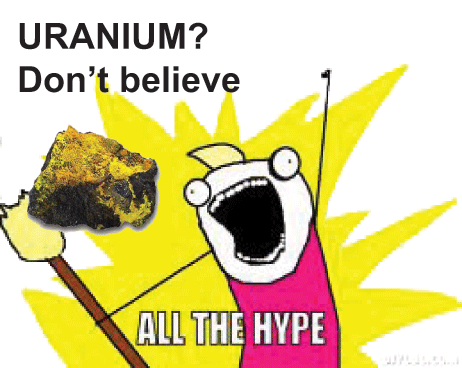 Pro-uranium social media campaign’s #epicfail Why are some still championing nuclear power when renewable energy generation has doubled worldwide over the past decade? Jim Green, SBS, 25 Apr 2016 www.sbs.com.au/news/article/2016/04/25/comment-pro-uranium-social-media-campaigns-epicfail
The Minerals Council of Australia launched a pro-uranium social media campaign on Wednesday. By that afternoon the twitter hashtag #untappedpotential was trending but ‒ as an AAP piece picked up by SBS and others noted ‒ contributors were overwhelmingly critical.
Nearly all contributors offered thoughts such as these: “A week away from the #Chernobyl 30-year anniversary and Minerals Council begins propaganda trip on the #untappedpotential of uranium. Huh?!” said Twitter user Jemila Rushton.
“We need to better harness the #untappedpotential of solar power”, tweeted Upulie Divisekera.
“#untappedpotential to put more communities at risk of nuclear waste dumps,” Ace Collective said.
“We concur that uranium has much #untappedpotential … for disaster, cost and time blowouts and proliferation,” Anglesea After Coal said.
No doubt the Minerals Council anticipated the negative publicity and is working on the basis that all publicity is good publicity. But what the MCA didn’t anticipate is that in recent days the uranium price has fallen to an 11-year low. Mining.com noted in an April 20 article that the current low price hasn’t been seen since May 2005. The current price, under US26/lb, is well under half the price just before the 2011 Fukushima disaster, and under one-fifth of the 2007 peak of a bubble.
Mining.com quotes a Haywood Securities research note which points out that the spot uranium price “saw three years of back-to-back double-digit percentage losses from 2011-13, but none worse than what we’ve seen thus far in 2016, and at no point since Fukushima, did the average weekly spot price dip below $28 a pound.”
Mining.com notes that five years after the Fukushima disaster only two of Japan’s 50 nuclear reactors are back on line, and that in other developed markets nuclear power is also in retreat. The last reactor start-up in the U.S. was 20 years ago. The French Parliament legislated last year to reduce the country’s reliance on nuclear power by one-third. Germany is phasing out nuclear power. The European Commission recently released a report predicting that the EU’s nuclear power retreat ‒ down 14% over the past decade ‒ will continue.
China is a growth market but has amassed a “staggering” stockpile of yellowcake according to Macquarie Bank. India’s nuclear power program is in a “deep freeze” according to the Hindustan Times (unfortunately the same cannot be said about its nuclear weapons program), while India’s energy minister Piyush Goyal said on April 20 that India is not in a “tearing hurry” to expand nuclear power since there are unresolved questions about pricing, safety and liability waivers sought by foreign companies.
Even if all of Japan’s 50 reactors are included in the count, the number of power reactors operating worldwide is the same now as it was a decade ago. Zero growth despite the endless rhetoric about a nuclear renaissance.
A decision on two planned reactors in the UK could be announced in the next fortnight and the price-tag for the reactors explains why nuclear power is stagnant worldwide and why the Minerals Council is talking about uranium’s ‘potential’ rather than its current contribution to export revenue and employment. The total price-tag for the two planned reactors is A$45 billion. If the project proceeds, the industry will be hoping it doesn’t go three times over budget, as reactor projects in France and Finland have.
South Australian academic Richard Leaver has neatly summed up the uranium industry’s tiresome rhetoric: “‘Potential’ is one of the most powerful chemicals available to the political alchemist. Any individual, firm or sector deemed to have potential is relieved of a massive and perpetual burden − the need to account for past and present achievements (or, more probably, the lack of them). The history of Australian involvement in the civil uranium industry offers an excellent example of this alchemy at work.”
Whatever the future potential of the uranium industry, it contributes next to nothing to the economy at the moment: <0.2 percent of national export revenue and <0.01 percent of all jobs in Australia. And those figures will fade further into irrelevance with the end of mining and the gradual winding down of processing at the Ranger uranium mine in the NT.
The stagnation and cost escalation of nuclear power contrast sharply with the trajectory of renewables. Driven by sharp cost reductions, renewable energy generation has doubled worldwide over the past decade and renewables now produce more than twice the amount of electricity as nuclear power. The gap is widening every day. Dr Jim Green is the national nuclear campaigner with Friends of the Earth, Australia.
Australia’s unrecognised nuclear test veterans – sailors on HMAS Murchison 1952
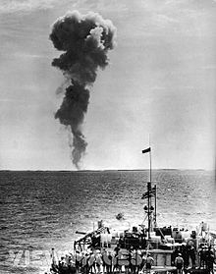 HMAS Murchison conscripts still seeking recognition as nuclear participants, SMH, Lucy Cormack April 24, 2016 – Ken Palmer remembers standing on the upper deck of the HMAS Murchison in 1952. Dressed with his fellow national serviceman in “shorts and sandals,” he remembers the mushroom cloud, formed from the explosion of Britain’s first atomic bomb at the Monte Bello archipelago, off Western Australia.
“They said, don’t face the blast and when I tell you, you can turn around. We had just left our mother’s breast, we didn’t think much about it,” said Mr Palmer, now in his 80s.
“When we got to Monte Bello it was a complete surprise to us. Nobody ever told us we were there . . . circling [to keep] everybody else out of the road until the climate was right to explode this atomic bomb in the bowels of the H.M.S. Plym.”
Mr Palmer is one of 23 surviving national serviceman of the 62 that were conscripted to serve on the Murchison in October 1952.
This Anzac Day Mr Palmer is hoping to reignite a long-running campaign of the surviving servicemen, seeking recognition as “Australian Participants” in the British government’s nuclear tests at the Monte Bello archipelago.The campaign was launched around eight years ago by the late Michael Rowe, who also served on the Murchison. He believed many of the cancers and illnesses suffered by his shipmate were related to nuclear radiation, following their time on the Murchison.
Mr Rowe began the campaign after a 2006 decision to award health care assistance to participants in Britain’s atomic bomb tests, with the exclusion of all serviceman on the Murchison, on grounds they were not close enough to the blast site.
Radiation exposure claims not accepted
A Department of Veterans’ Affairs spokesperson said Defence Force members who served on the Murchison could claim compensation and benefits under the Safety, Rehabilitation and Compensation Act for any condition, however any claim based on radiation exposure “would not be accepted.”………
Another national serviceman, Col Crawford, said “there was no denying we were there,” adding that he had given up the fight long ago, as it had become “complete and utter bureaucratic nonsense”.
Sandy Godfrey, who has assisted Mr Palmer and his fellow serviceman with their campaign over the years, said he cannot understand the “arbitrary” barriers being put up by the government.”The way the nuclear test participant has been defined in the Veterans Entitlement Act gives an arbitrary 10 kilometre radius, which excludes an enormous number of people that actually participated in the testing in the 50s,” he said.
“From our point of view it appears the government are waiting for them to die, so the issue will disappear.” http://www.smh.com.au/national/hmas-murchison-conscripts-still-seeking-recognition-as-nuclear-participants-20160422-gocy6r.html
Australian govt might have to back down on its cuts to CSIRO climate research
CSIRO eyes alternative plan to climate job cuts as Chairman Thodey faces inquiry, The Age, April 24, 2016 Peter Hannam Environment Editor, The Sydney Morning Herald CSIRO is expected to offer an alternative to deep cuts of its climate science program as soon as this week in a bid to defuse criticism as a Senate committee prepares to widen its inquiry to include chairman David Thodey.
Mr Thodey is scheduled to address the committee in Canberra on Wednesday. Unusually, the chairman has asked the session be held in camera and that he not be joined by CSIRO management, Fairfax Media has been told.
Speculation of a resolution was fanned by Environment Minister Greg Hunt last week breaking his silence on the cuts, which originally targeted as many as 110 of the 140 staff in the key Oceans & Atmosphere division……..
Instead, senior CSIRO staff now expect the agency to pare back the planned cuts and offer a “face-saving” alternative of a special climate unit, possibly headquartered in Hobart……http://www.theage.com.au/environment/climate-change/csiro-eyes-alternative-plan-to-climate-job-cuts-as-chairman-thodey-faces-inquiry-20160424-godtal.html.
Export industry potential for Victorian solar energy project, backed by Australian Renewable Energy Agency
 Victorian solar project wins government grant to take its technology to world, The Age, April 24, 2016 –Tom Arup A Victorian technology company striving to produce more efficient and cheaper solar power has won financial backing from the national renewable energy agency to expand its plans.
RayGen Resources, based in Melbourne, will receive a new $2.9 million government grant to help it commercialise what the company says is ground-breaking solar technology that has already received overseas interest.
The technology involves laying out a large array of mirrors that tracks the sun throughout the day and creates a concentrated light beam onto a highly efficient solar photovoltaic receiver sitting on top of a central tower.
In March last year, RayGen opened a 200-kilowatt pilot plant at Newbridge, near Bendigo, to showcase the technology, which the company has dubbed “PV Ultra”. The pilot was built with support from the Australian Renewable Energy Agency, also called ARENA.
The company has now won another ARENA grant, to be announced on Monday, to upgrade the Newbridge project with later versions of the technology and to bolster its solar receiver manufacturing operations at its Blackburn headquarters.
All up it is expected to cost $5.8 million and be completed by December.
RayGen chief executive Alex Wyatt said the expansion would help the company deliver its solar receivers to overseas buyers, including solar-concentrating projects in China.
The RayGen solar PV receivers use a compound called gallium arsenide, commonly used in satellites and space stations, instead of the more typical silicon-based technology. While gallium arsenide is more expensive than silicon, it is also more efficient and when enough sunlight is concentrated it can become cost effective to use, particularly in very sunny areas.
RayGen and ARENA were also partly involved in a 2014 project at the University of NSW, called Power Cube, which set a world record for converting sunlight into power for a solar PV system……
The Turnbull government recently announced it would retain ARENA, dropping Abbott-era plans to axe the agency. But it is seeking to slash the $1.3 billion that ARENA was still due to receive in coming years to help foster new renewable energy development. http://www.theage.com.au/environment/victorian-solar-project-wins-government-grant-to-take-its-technology-to-world-20160422-god18z.html
Malcolm Turnbull – fine words, but actually retreating on climate action
 ‘Walking in the other direction’: Malcolm Turnbull’s broad retreat on climate, The Age April 22, 2016 Peter Hannam Environment Editor, The Sydney Morning Herald When Prime Minister Malcolm Turnbull rose to address the United Nations Climate Change Conference in Paris late last year, he told the world Australia would meet the challenges of global warming “with confidence and optimism”.
You don’t turn off R&D spending when there’s a revolution under wayAndrew Blakers, Centre for Sustainable Energy Systems, ANU
Australia’s carbon emissions target – slicing 2000 levels by about 19 per cent by 2030 – would halve pollution on a per capita basis, “one of the biggest reductions” of any G20 nation, Turnbull said. The government would also double “clean energy innovation” investment over the next five years, and carve out $1 billion from the existing aid budget to help threatened Pacific neighbours build “climate resilience” and cut emissions……….
The pact, which the government plans to ratify later this year if re-elected, aims to limit global temperature increases to between 1.5 and 2 degrees of pre-industrial levels – even if current national offers fall far short of the greenhouse gas reductions needed.
But in the four months since Turnbull’s speech, climate news from abroad and at home has been anything but positive………..
For policy areas directly under Turnbull’s control, it’s been a dismal few months for climate action, not least CSIRO’s assault on climate science launched on February 4 that will see dozens of leading researchers sacked among as many as 450 jobs to go.
Despite pleas of budget penury, the government somehow managed to find $15.4 million a couple of weeks later for a new Oil, Gas and Energy Resources Growth Centre to, among other things, “foster community support” for non-renewables, including coal and nuclear energy.
It is also forked out $3.3 million to two researchers to examine the effects of wind farms on health. Just four researchers made submissions for the cash, a remarkably small number, according to Sydney University public health expert, Simon Chapman.
Taken for granted
And a fresh concern surfaced this week with 61 leading scientists writing to Turnbull decrying the government’s decision last month to end grants from the Australian Renewable Energy Agency (ARENA).
Set up by the Rudd-Gillard government, the agency still had $1.3 billion in funding to disperse by 2022.
Instead, it will now work with the Clean Energy Finance Corp to offer $100 million in loans annually for 10 years to foster “clean and renewable energy”. ARENA still has $130 million to be allocated, with “high interest” from potential proponents, Hunt says.
The proposed end of ARENA’s grant funding removes “an essential component of technology innovation”, the mostly solar researchers said in the letter obtained by Fairfax Media.
Forty years of such grants over had allowed Australia to contribute “very far above its weight” in renewable energy. By contrast, reliance on equity returns “have rarely been effective” in advancing early-stage research, the scientists said.
Richard Corkish, chief operating officer of UNSW-based Australian Centre for Advanced Photovoltaics, said his facility faced “an existential threat” if the $4 million in annual ARENA funds ended. The school continues to spawn world-leading technology, including new types of solar cells using abundant, non-toxic materials.
“ARENA is our major funding source,” Corkish says.
Andrew Blakers, who led development of the solar PV technology being adopted by the world’s largest producers, said all new electricity investment in Australia over the past five years had been in solar or wind energy.
“This is incredible”, says Blakers, who heads the Centre for Sustainable Energy Systems at the Australian National University. “You don’t turn off R&D spending when there’s a revolution under way.”
………Greens deputy leader Larissa Waters said there’s “an obvious disconnect between the Prime Minster’s rhetoric in Paris last year and his actions in Canberra”.
“Presiding over cuts to CSIRO’s world-leading climate research and gutting renewable technology research is stupid on so many levels.
“The government is tipping new money into fossil fuel research so that the big mining companies profiting off the world’s warming don’t have to pay for research themselves,” Waters says……..http://www.theage.com.au/environment/climate-change/walking-in-the-wrong-direction-malcolm-turnbulls-broad-retreat-on-climate-20160420-goat2p.html
Australia needs action, not just Turnbull’s words, to save the Great Barrier Reef
 Climate deal won’t stop Great Barrier Reef from getting ‘cooked’, say Greens, Guardian, 23 Apr 16 Australia’s lack of action on pollution reduction targets has made the country a laughing stock on the international stage, according to senator Larissa Waters Australia’s lack of follow-through on climate change will leave the Great Barrier Reef “completely cooked” despite it signing the Paris climate deal, the Greens say…….
“Unfortunately, minister Hunt likes to bandy about some figures but Australia has been a laughing stock on the international stage,” she said.
“Our pollution reduction targets are so far below the science and people know that our policies aren’t even getting us towards those very low targets.”
Senator Waters rejected the government’s commitment of a further $11m on projects to continue improving water quality on the Great Barrier Reeffollowing a study this week showing 93% of the reef was bleached.
She pointed to the Queensland and federal government’s backing of the Adani coal mine, which critics say will further imperil the reef. “We need to really have a change of policy when it comes to approving every coal mine anyone ever thinks of and instead really fund and support the transition and speed it up to clean-energy,” Senator Waters said. http://www.theguardian.com/environment/2016/apr/23/climate-deal-wont-stop-great-barrier-reef-from-getting-cooked-say-greens
Secrecy on health information about uranium workers – Submission to #NuclearCommissionSAust
 NUCLEAR FUEL CYCLE ROYAL COMMISSION TENTATIVE FINDINGS RESPONSE March 2016 Dan Monceaux – Documentary filmmaker & South Australian citizen
EXPLORATION, EXTRACTION & MILLING “………I have previously expressed my criticism that this, and indeed all Royal Commissions conducted in South Australia are exempt from the Freedom of Information Act 1991. This is fundamentally undemocratic, and contradicts claims made by the Commissioner on many occasions of his commitment to openness and transparency.

Returning to the subject of exploration drilling, I would suggest that there is another factor confounding the efficacy of exploration drilling regulation in South Australia- namely regulatory capture. This is accompanied by a tendency to withhold information regarding non-compliance and regulatory failure. The resulting impression can be one of false assurance. For example, by citing Marathon Resources Rectification Plan 2008 in its Tentative Findings, while neglecting to list the Eyre Iron compliance audit report which it also received, the Commission is misleading the reader. A reader would be forgiven for assuming that Marathon’s non-compliance was an isolated example, when clearly, this is not the case. The compliance audit report is found as Appendix A attached to my submission below. http://nuclearrc.sa.gov.au/app/uploads/2016/03/Dan-Monceaux-10-08-2015.pdf
The Government of South Australia has on its own record admissions of its institutional knowledge of lung cancer risk to uranium workers in underground mines. The evidence base dates back to the early experiences of miners at Joachimstahl in Czechoslovakia, from whose high incidence of lung cancer the first precautionary safety standards were subsequently set in other jurisdictions. The risk was understood in the 1920s as evidenced by publications of the South Australian Department of Mines from the mid 1950s, namely: Possible health hazards in uranium mining – Armstrong, A.T., Department of Mines (1955) https://sarigbasis.pir.sa.gov.au/WebtopEw/ws/samref/sarig1/image/DDD/RB00429.pdf The health consequences of workers in the uranium industry – Dr. B. S. Hanson (1956) https://sarigbasis.pir.sa.gov.au/WebtopEw/ws/samref/sarig1/image/DDD/RB4200080.pdf
They are found in the results of Radium Hill worker cohort studies published in peer-reviewed medical journals. The epidemiological studies of the 1980s, published circa 1990 proved, with epidemiological evidence of elevated cancer incidence, that confidence expressed in the safety of working conditions at the Radium Hill mine in the 1950s and 1960s was ill-founded.
Radon daughter exposures at the Radium Hill uranium mine and lung cancer rates among former workers, 1952-1987 – Alistair Woodward, David Roder, Anthony J. McMichael, Philip Crouch and Arul Mylvaganam (1991) http://www.jstor.org/stable/3553403………
the Olympic Dam mine’s radiological safety measures and records remain protected by special secrecy provisions established under the Roxby Downs (Indenture Ratification) Act 1982. Secrecy during the time of the Radium Hill mine was a matter of protecting Commonwealth secrets during the Cold War. The secrecy provisions of the Roxby Downs Indenture (Ratification) Act 1982, were according to Ian Gilfillan of the Australian Democrats, at least in part to protect the project from attack by environmental groups. The Indenture Act was revised in 2011, and forfeited the ideal opportunity to repeal Cold War-style exemptions as a sign of good faith to the people of South Australia and movement towards open government………… https://www.academia.edu/23544163/Nuclear_Fuel_Cycle_Royal_Commission_Tentative_Findings_Submission_-_March_2016
ANOTHER Liberal Senator doubts the science of climate change!
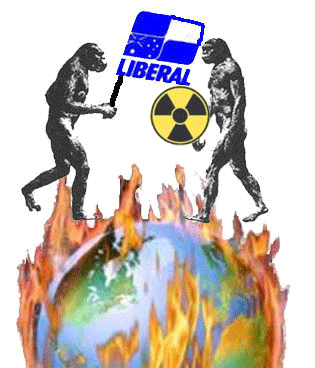 Senator agrees climate science ‘not settled’ http://www.skynews.com.au/news/politics/federal/2016/04/21/senator-agrees-climate-science–not-settled-.html 21 April 2016 Deputy Nationals leader Fiona Nash has supported her coalition colleague Liberal Senator George Brandis’ view that the science on climate change is not settled.
Labor has condemned Senator Brandis after he told parliament he was not ‘at all’ convinced there is a scientific consensus about climate change.
‘It doesn’t seem to me that the science is settled at all,’ Senator Brandis said on Tuesday during debate on the tabling of documents relating to the Commonwealth Scientific and Industrial Research Organisation (CSIRO).
‘The commitment of Senator Brandis to addressing the impacts of climate change is so shallow, he hasn’t made up his mind whether it actually exists yet,’ environment spokesman Mark Butler and shadow attorney-general Mark Dreyfus said in a statement.
Senator Nash told Sky News she agrees there are ‘varying views’ between scientists on climate change..
‘I don’t think it is certainly necessarily settled,’ she said. ‘I think we should be taking every precaution that we ensure the planet is healthy.’
The NSW Senator says she was not sure whether her view on climate science was shared by her cabinet colleagues
‘I think you would have to ask the other cabinet ministers but it’s certainly my view.’
– See more at: http://www.skynews.com.au/news/politics/federal/2016/04/21/senator-agrees-climate-science–not-settled-.html#sthash.4k3e4pDd.dpuf– See more at: http://www.skynews.com.au/news/politics/federal/2016/04/21/senator-agrees-climate-science–not-settled-.html#sthash.4k3e4pDd.dpuf– See more at:http://www.skynews.com.au/news/politics/federal/2016/04/21/senator-agrees-climate-science–not-settled-.html#sthash.4k3e4pDd.dpuf
The health of uranium and nuclear workers. Response to #NuclearCommissionSAust’s ‘Tentative Findings’
It is extraordinary that the South Australian Nuclear Fuel Chain Royal Commission is not publishing Responses to its “Tentative Findings” before it makes its final announcement on May 6th.
Meanwhile, here is part of at least one very clear and informative response.
NUCLEAR FUEL CYCLE ROYAL COMMISSION TENTATIVE FINDINGS RESPONSE March 2016 Dan Monceaux – Documentary filmmaker & South Australian citizen.
“…… I sincerely hope that the health and wellbeing of South Australia’s workforce, its citizenry and its environment are considered sufficiently important topics for this Commission to elaborate on the matters raised here ahead of its final report to Parliament in May.
………The Commission’s opening tentative finding states that “South Australia can safely increase its participation in nuclear activities, and by doing so, significantly improve the economic welfare of the South Australian community.”
The evidence base for adopting such a confident and conclusive statement is questionable. In the case of nuclear industrial activities which have established links with health conditions including cancer and associated heart, lung and liver conditions and potential genetic harm, the safety or otherwise of an activity or regulatory regime can only be proven by epidemiological studies spanning a timeframe of decades. For example, little is known about the fates of worker cohorts from existing and past uranium mining and milling activity in South Australia………. The Commission has had time to consider this matter, but appears to have not deemed it sufficiently important. ……
I wish to make a case for the prioritisation of epidemiological studies of past and present South Australian uranium worker cohorts as a matter of the utmost importance. The results of such studies could provide an empirical basis for future commentary regarding the safety or otherwise of the industry as it has existed until now…….
The Commission states that “policies must be based on evidence, not opinion or emotion.” The same rule should apply to statements made by the Commission. To be considered credible, they must be supported by material evidence. The absence of evidence is not evidence of absence. Harm can neither be proven, nor safety assured without relevant epidemiological studies. This was known to South Australia’s Department of Mines in 1956, when Dr. B. S. Hanson wrote in The Health of Workers in the Uranium Industry (pg. 16): “It is only by long-term health examinations that the validity of our present speculative exposure limits may be tested.” This document is currently available on SARIG, the South Australian government’s resources industry geoserver: https://sarigbasis.pir.sa.gov.au/WebtopEw/ws/samref/sarig1/image/DDD/RB4200080.pdf…….
The available evidence suggests that contemporary publications of South Australian Government departments fail to adequately communicate occupational exposure risk to their readers. The perfect example of this is the Uranium fact sheet published by the Department of State Development in 2015, during the proceedings of this Commission. The “Fact Sheet” poses the question “Is uranium safe?” then neglects to answer the question. Instead, it provides the graphic reproduced from http://www.statedevelopment.sa.gov.au/upload/uranium/uranium%C2%ADthe-facts-final.pdf? t=1458534521755
Compare this to Hanson and Armstrongs statement from 1956, in documents held by the same South Australian government, written 60 years earlier:
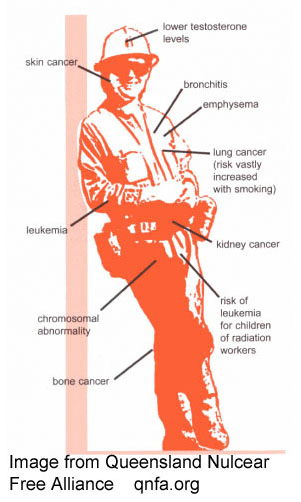 “Hazards associated with uranium ore are of two kinds, those due to radioactivity, including 6 external radiation as well as internal radiation; and those due to uranium metal poisoning. Radon gas and its solid daughter products would appear to offer the greatest potential danger. They can be inhaled and the solid products so lodged in the body.” (Armstrong, pg. 18)
“The individual employed in a mine or mill risks damage by external or internal radiation, and as to the latter the radioactive particles which form a danger are either ingested or inhaled.” (Hanson pg. 7)
“The daughter products are insoluble, but together with the dust to which they adhere some are engulfed by the reticulo-endothelial cells of the lung surface and there theoretically give a high intensity of alpha radiation to those very surface cells which form the type seen in the usual cancer of the lung.” (Hanson pg. 9)
“The inhalation of active deposit on dust particles, is so much the most important one that most of our [Department of Mines’] effort should be directed towards overcoming it.” (Hanson pg.10)
“In my opinion, dusty clothes inevitably mean an inhalation risk as well as an ingestion risk.” (Hanson pg.14)
“Almost without exception this report deals with the real or probable dangers of radioactivity.” (Hanson pg. 19)
The disparity between the messages of 1955 and 1956 (Department of Mines) and 2015 (Department of State Development) is alarming and deeply concerning…… https://www.academia.edu/23544163/Nuclear_Fuel_Cycle_Royal_Commission_Tentative_Findings_Submission_-_March_2016
1 This month
17 October, Free Public Talk on Nuclear Issues in South Australia
David Noonan will speak on public interest concerns over the new Roxby Downs Indenture Act 2026 on BHP copper-uranium mining and ore processing in SA, and on how AUKUS may face SA with a High-Level nuclear waste agenda.
Dr Jim Green will discuss international developments in the field of nuclear power including ‘small modular reactors’ and Generation 4 ‘advanced’ nuclear reactor concepts.


Help Aunty Sue Protect Her Land and Sacred Sites From Destructive Rocket Testing.
.

Australians deserve the truth
about
AUKUS – https://aukuspublicinquiry.com/

PETITION – To: Prime Minister Anthony Albanese and the Australian Labor Government

of the week – Australians for War Powers Reform (AWPR)
To see nuclear-related stories in greater depth and intensity

