Australia’s government completely beholden to fossil fuel industries

 The links between big polluters and politicians , The Saturday Paper, BILL MCKIBBEN, 16 Apr 16 “…….Despite the crisis unfolding around it, the current Australian government seems determined to ignore the role it has to play in preventing the planet from cooking.
Six months ago, Australia agreed to the Paris deal. Yet, since then, Australia has reapproved one of the world’s largest coalmines, opened a new research centre for the fossil fuel industry, cut funding for renewable energy, cut funding for climate research. The bewildering list goes on and on…..
Australia’s political system is …….becoming more and more American with each new donation. Until recently you had a prime minister who, between mouthfuls of onion, told the world that coal was good for humanity.
Granted, Malcolm Turnbull is no Tony Abbott. But Turnbull is also friendly with the fossil fuel industry. Just this week in Perth, he attended a dinner with the CEOs of Shell, Chevron and Woodside. Blocked by radical conservatives and wined and dined by the fossil fuel industry, Australia is now left adrift with a laughable climate strategy.
As the planet burns, Australia continues to dig up more fossil fuels. But it’s no surprise when you look at the amount of cash changing hands between your politicians and the big polluters.
In fact, for every $1 the fossil fuel industry has donated to Australia’s major political parties since your most recent federal election, they will be handsomely rewarded with $2000 worth of handouts in the upcoming federal budget. We have a similar crisis in the US. The more donations the industry gives to congress, the more they get back in subsidies. Recent research shows members of the US house of representatives who voted in favour of the Keystone Pipeline got 13 times more in donations from Big Oil than those who voted against. All up, five key refinery companies spent $58.8 million lobbying.
Like the US, the companies that donate most in Australia are those that have the most to lose from your government taking action on climate. They’re companies such as Australia’s biggest carbon polluter, AGL; or Origin, whose existence depends on throwing a wrecking ball through the solar and wind sector; and Chevron, from the same family of companies as Exxon, which knew about the climate damage we were setting ourselves up for yet pushed its dangerous product onto the world.
And then there’s the revolving door between your government and the mining industry. One of your chief negotiators on the Kyoto Protocol left public service to become the head of the Australian Coal Association. Australia’s former climate change minister is now an adviser to AGL and Santos. The deputy prime minister to John Howard left parliament to sit on the board of Whitehaven Coal. Heck, one of your richest coal barons is a sitting parliamentarian. And this is just the tip of the melting iceberg: it doesn’t consider the many staffers and unelected individuals who walk back and forth between parliament and the fossil fuel industry. This is why Prime Minister Turnbull has no climate plan. His government is full of climate deniers and fossil fuel fanatics whose political life depends upon blocking climate action. …..
Parliamentarians such as Cory Bernardi, who has spent his time in Canberra questioning the weather bureau and running “grassroots” campaigns to axe the carbon price. Or Angus Taylor, who describes human-induced climate change as “religion” devoid of facts. People such as former oil and gas executive, now senator, Gary Gray, who helped found one of the world’s most notorious climate denialist think tanks…….
The incoming federal election means politicians currently have their ear to the ground. Right now is a perfect opportunity to begin calling for an end to polluter handouts and donations – and real action on climate change.
It will take a movement to break the link between Australia’s politicians and the big polluters. But the foundations for a pollution-free politics, here in Australia and around the world, are building by the day. https://www.thesaturdaypaper.com.au/opinion/topic/2016/04/16/the-links-between-big-polluters-and-politicians/14607288003136
Election: Liberal and Labor prefer to ignore Climate Change
 Climate change has dropped off the political radar (and this is a big problem) ABC THE DRUM, 14 APR 16 By Mike Steketee The aversion to talking about climate change during the election campaign reflects a wider problem: our concern for this issue has fallen even while it has become larger and more urgent, writes Mike Steketee.
How much of an issue will climate change be in this year’s election?
Not a major one, if Malcolm Turnbull gets his way. He has saddled himself with Tony Abbott’s policy as one of the costs of appeasing the conservatives in his ranks.
And while Bill Shorten will be arguing he has a superior policy – but also risking a fear campaign over re-introducing a carbon tax – Labor, too, believes it has bigger fish to fry, such as pushing forward its credentials on education and health. Continue reading
Victoria making coal mine owners pay for rehabilitation
Victoria’s coalmines forced to pay more towards site rehabilitation costs http://www.theguardian.com/australia-news/2016/apr/15/victorias-coalmines-forced-to-pay-more-towards-site-rehabilitation-costs The state’s premier says owners of Latrobe valley mines are profitable enough to absorb tens of millions of dollars in extra costs without cutting jobs Victoria’s coalmines are being ordered to hand over hundreds of millions of dollars more for the rehabilitation of their sites when mining ceases.Latrobe coalmines not paying enough for cleanup: Hazelwood fire inquiry

The state’s premier, Daniel Andrews, maintains the additional payments will not put jobs at risk.
The Victorian government announced on Friday the existing rehabilitation bonds would be increased in June from $15m or less to $34.25m for Yallourn, $36.7m for Hazelwood and $56m for Loy Yang.They will all then double again – to the current estimated rehabilitation liability for each mine – by January. On Thursday, the fourth and final report into the Hazelwood mine fireconcluded Latrobe valley mines were not making sufficient paymentsto cover rehabilitation costs.
It urged an immediately increase of tens of millions of dollars in the bonds until a review into the system was complete.
Andrews said on Friday the mines’ owners were profitable enough to absorb the additional costs. “We’ve had companies for too long that have been allowed to put aside just a fraction of what it costs to keep their mines safe and return those mine sites to the community … at the end of their useful life,” Andrews told reporters in Morwell.
“These are profitable companies. Let’s not have any of this talk that jobs are at risk – they are not at all.”
Great Barrier Reef will soon be unable to cope with global warming
Now the scientists have found that the coping mechanism barrier reef corals use to prepare themselves to face warm summer water is also under threat from global warming, and from human activities such as agriculture, shipping, and fishing.
“As temperature warms, the evidence is that this protective mechanism will no longer function
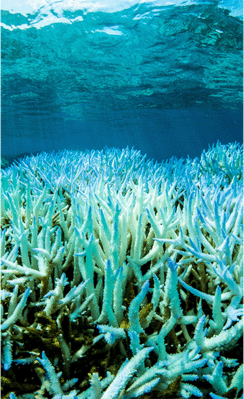 How the Great Barrier Reef is going from bad to worse Christian Science Monitor, 14 Apr 16 Though the corals of Australia’s Great Barrier Reef historically have managed to adjust to gradually warming seawater of the summer months, they will likely lose their defenses when the ocean warms overall in the near future, say scientists.
This was the latest finding from a team of American and Australian coral reef experts from James Cook University, the University of Queensland, and the US National Oceanic and Atmospheric Administration (NOAA).
These same scientists recently reported that their aerial surveys of some of the 3,000 coral reefs that make up this iconic natural wonder off Australia’s northeastern coast have showed that coral bleaching this year is the worst that has ever been observed. This is largely due to a recurring weather event known as El Niño, a storm system that is expected to become more frequent and more severe in the future.
I agree that El Niño is a natural variability; it’s a part of nature, but that variation in patterns and temperatures is superimposed upon a trend of warming,” Scott Heron, a NOAA coral reef scientist based in Australia, tells The Christian Science Monitor in an interview. “There are ups and downs, but now there are just higher ups than ever before, and the downs are not as low,” he says.
Coral bleaching happens when ocean temperatures rise to a point that zooxanthellae – tiny algae that live on corals and provide them with nutrients and their radiant colors – leave their coral homes, thereby rendering coral white or “bleached.” When corals go without zooxanthellae for too long, they die. This affects about a quarter of marine species that depend on coral reefs for shelter, and the humans who depend on those species for their livelihoods.
This year’s is the third major bleaching event in recent history for the 2,300-kilometer-long Great Barrier Reef, which is home to one of the most diverse ecosystems in the world. But this one is much worse than the bleaching events that occurred in 1998 and 2002, say scientists who recently found bleaching in almost 1,100 kilometers of northern barrier reef, from the island of New Guinea to the Australian coastal city of Cairns. The researchers estimate that 30 to 50 percent of the corals there are already be dead.
Now the scientists have found that the coping mechanism barrier reef corals use to prepare themselves to face warm summer water is also under threat from global warming, and from human activities such as agriculture, shipping, and fishing.
“As temperature warms, the evidence is that this protective mechanism will no longer function,” C. Mark Eakin, a scientist with NOAA Coral Reef Watch, tells the Monitor in an interview…….
The most viable immediate remedy, say paper authors, is to reduce the carbon emissions that cause warming and restrict other human activities near the reefs that add more stress, including runoff from agriculture, unsustainable fishing practices, and physical damage to the reef from ship groundings.
“These are all human stressors on reef that have to be minimized or eliminated for reefs to be able to bounce back from these bleaching events, even in a decade or two,” Eakin says.http://www.csmonitor.com/Science/2016/0414/How-the-Great-Barrier-Reef-is-going-from-bad-to-worse
Climate Institute Report recommends shutdown of coal plants, and real price on carbon
Shut down coal power, price carbon: report http://www.news.com.au/national/breaking-news/shut-down-coal-power-price-carbon-report/news-story/5eee677132223a88b2c3ed14d603a701 APRIL 14, 2016 By Elise ScottAAP
The Climate Institute report found delaying a transition to cleaner energy until 2030 would cause sudden unemployment in some communities and drive up electricity costs. A “modest” carbon price of $40 per tonne by 2030 alone would not be enough to mitigate the need for fast, deep emission cuts, the modelling found. That price would achieve the Turnbull government’s 26 to 28 per cent target by 2030 but would also mean a 60 per cent collapse in projected clean energy growth from 2020, the report found. Continue reading
Greens manage to put some brakes on South Australian govt’s pro nuclear promotion
 Nuclear waste dump ‘spruiking’ with taxpayers’ money stopped by Greens http://www.abc.net.au/news/2016-04-14/nuclear-waste-dump-‘spruiking’-with-taxpayers’-money-stopped/7325076 An attempt to change the law in South Australia to allow public money to be spent on promoting a nuclear waste dump has been stopped with the Greens claiming a victory.
A law passed in 2000 to stop public funds from being used in any activity associated with a nuclear waste facility.
The State Government had tried to amend the law to allow consultation with the community on the results of the Nuclear Fuel Cycle Royal Commission.
Greens MLC Mark Parnell said the proposed change was too wide ranging and the Upper House had stepped in to protect taxpayers.
“The Greens do accept that we do need to have a public debate,” he said.
“We’re confident we know what the result will be but nevertheless the Government says they only want to consult, they don’t want to spruik and they don’t want to plan for a nuclear waste dump.”
He said the Government had attempted to “overreach”.
“The law now says that the Government can use public money to consult the community but they’re not to use public money for promoting or designing or even buying land for a nuclear waste dump.”
Aboriginal nuclear test survivors to join Japan’s Hibakusha in Nagasaki
Maralinga nuclear test survivors connect with Japanese bombing survivors, ABC News, AM By Natalie Whiting 14 Apr 16, They are two communities separated by continents and culture, but connected by a terrible past.
Members of an Aboriginal community affected by nuclear bomb tests at Maralinga in the 1950s are connecting with nuclear bomb survivors in Japan.
A group of artists from Yalata in South Australia are flying to Nagasaki to unveil a sculpture for its peace park, which will be the first Australian sculpture in the memorial.
The exchange is also allowing the two groups to share stories and discuss their experiences.
Yalata community leader Russell Bryant was part of a group that last year travelled to the peace park in Nagasaki, one of the Japanese cities hit by a nuclear bomb during World War II.
“When I went there I [saw] a lot of sculpture from different places, from overseas and there’s nothing there for Australia, from our country,” Mr Bryant said.
The people from Yalata and nearby Oak Valley had stories to share with the nuclear bomb survivors in Japan.
Anangu people were forced to move to remote communities because of the British nuclear tests at Maralinga. “They didn’t know what was happening in Maralinga, when the bomb went off, some people survived, some people died,” Mr Bryant said……..
Mr Brown said one of the main aims of the project was to connect nuclear bomb survivor groups.
During the first visit to Japan the Anangu people sat down with the Japanese survivors, called hibakusha………http://www.abc.net.au/news/2016-04-14/australian-japanese-nuclear-survivors-connect-maralinga-nagasaki/7326376
Wangan and Jagalingou people taking further legal action, against Adani coal mining leases
 Carmichael coal mine: Wangan and Jagalingou people plan further legal action, ABC News By Jessica Van Vonderen 14 Apr 16, The Queensland Indigenous group that has waged a long fight against Australia’s largest proposed coal mine is seeking to take further legal action.Members of the Wangan and Jagalingou (W&J) people have filed an application in the Federal Court of Australia challenging the mining leases that were issued for Indian company Adani’s Carmichael coal mine in the Galilee Basin.
The Queensland Government issued three mining leases for the $21 billion project earlier this month, saying it would create thousands of jobs, while also imposing strict controls to protect the environment.
W&J people spokeswoman Murrawah Johnson said they would “continue to fight against this monstrous proposal”.
“The application will seek to have heard that the leases for the Carmichael mine issued by Mines Minister [Anthony] Lynham … were not properly issued,” she said.
“We will not stand by and be bullied into accepting the inevitability of this mine.”
She slammed Mr Lynham for not waiting for the outcome of a judicial review into a Native Title Tribunal decision to allow mining leases to be issued.
‘They’re being racist’
Ms Johnson’s uncle, Adrian Burragubba, was even more scathing in his criticism.
“The State Government are basically, they’re being racist, they’re not allowing our due process,” he said…….http://www.abc.net.au/news/2016-04-13/wangan-and-jagalingou-plan-legal-action-carmichael-mine/7323728
Business Council of Australia firmly in the grip of the nuclear lobby

Today THE AUSTRALIAN quotes The Business Council of Australia (BCA) spruiking some as yet unpublished research that portrays Australia as needing nuclear power as an “insurance policy” against future surges in gas prices.
The BCA has long been in the grip of the nuclear lobby, and also told the [Nuclear Fuel Cycle Royal] commission that involvement in the nuclear fuel cycle could deliver a “significant contribution to economic growth”, and new regulations for the management, storage and disposal of nuclear waste should be developed.
Solar powered vehicles for Australia – energy utilities now supportive
 Australia Could Be World Leader In Solar-Powered Electric Vehicles Claen Technica, April 12th, 2016 by Giles Parkinson Originally published on RenewEconomy
The shift from petrol cars to electric vehicles appears to be more than a consumer-driven,Tesla-inspired phenomenon. The big utilities are also getting on board.
Origin Energy, one of country’s big three utilities, says Australia could a market leader in solar-powered electric vehicles, given the right incentives and policies that could encourage the uptake of renewable energy and force the closure of the most polluting brown coal power stations. “With an already high penetration of residential solar PV systems in Queensland and South Australia and the emergence of home battery technologies, there is an exciting opportunity for Australia to be a market leader in electric vehicles powered by solar energy,” the company says in a submission to the Climate Change Authority.
Nearly one quarter of Australian homes are equipped with rooftop solar, and Australia is seen as the likely first “mass-market” for battery storage – because of that high solar penetration and because of the country’s high electricity prices, courtesy of its high-cost grid.
Anecdotal evidence suggests that many of the early adopters of electric vehicles are already charging their EVs with their own rooftop solar, and utilities are already switching controlled loads for electric hot water systems back to the day-time from overnight to take advantage of excess solar power. Continue reading
Australian authorities covering up severity of Great Barrier Reef’s plight
 Great Barrier Reef disaster: Marine biologist lashes out at reef authorities for ‘cherry-picking to try and paint a better picture’ IBT, By Ritwik Roy @ritwikroy1985 on April 14 2016 The Great Barrier Reef is getting destroyed by massive coral bleaching, and marine biologist Glen Holmes is disappointed with the statements by the Reef and Rainforest Research Centre (RRRC). Despite reports that the Great Barrier Reef may never recover from the extent of damage done by widespread coral bleaching, the RRRC has said that popular diving areas near Cairns have suffered only low levels of damage.
Recent underwater surveys have found that of the 32 reefs between Lizard Island and Cairns, only five percent have suffered from bleaching and that only has low level of damage. RRRC managing director Sheriden Morris said the bleaching was “patchy,” which means the corals have a good chance of recovery. However, Holmes believes it is too early to be passing such comments.
“It’s way too early to be hanging comments off reports on the level of mortality. I think they’re cherry-picking to try and paint a better picture,” said Holmes.
Morris on the other hand believes reefs off Cairns are more likely to recover than others, reports AAP.
Unfortunately, according to Independent Australia, the Great Barrier Reef may lose out to mining giant Adani as State and Federal governments are favouring the mining giant more than the world heritage site. This has irked conservationists around the globe and numerous Australians who want to preserve the natural wonder.
CEO of the Australian Conservation Foundation, Kelly O’Shanassy said that if Federal and State governments side with Adani, there will be “hell of a fight.” The Queensland government had already given Adani the licence to dig Australia’s biggest ever coal mine.
Adani’s Carmichael coalmine will produce massive climate pollution and as the Great Barrier Reef can undergo coral bleaching with even a little temperature change, O’Shanassy is at a loss of words and she can’t believe how the licence was given as Carmichael will be raising Australia’s water temperatures greatly.
According to The National Coral Bleaching Taskforce, almost 95 percent of the reefs in the northern region are severely bleached. The convenor of the taskforce, Professor Terry Hughes, said every reef showed highly levels of bleaching “from the reef slope right up onto the top of the reef.”
“We flew for 4000km in the most pristine parts of the Great Barrier Reef and saw only four reefs that had no bleaching. The severity is much greater than in earlier bleaching events in 2002 or 1998,” Hughes added……. http://www.ibtimes.com.au/great-barrier-reef-disaster-marine-biologist-lashes-out-reef-authorities-cherry-picking-try-paint?utm_source=www.titles.ws&utm_medium=links&utm_campaign=BolsaDeNoticias
Tasmania’s Bruny Island residents to sell solar power to the grid
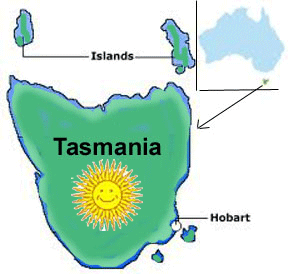 after $2.9m renewable energy grant http://www.themercury.com.au/news/tasmania/residents-on-bruny-island-to-sell-solar-power-after-29m-renewable-energy-grant/news-story/945d59a87250bbfc2d533e8ff9009ace April 14, 2016 RESIDENTS of Bruny Island have the chance to turn their homes into mini-power stations and trade on the national electricity grid to boost the island’s energy security and offset their power costs at the same time.
The Australian Renewable Energy Agency yesterday announced $2.9 million to help a project to help fund solar panels and batteries for up to 40 households on the island.
Harnessing the surplus power they generate is hoped to help take pressure off Bruny Island’s power system during peak times.
The systems will include software that allows homeowners to sell their power back to the grid during times of peak demand — and hence prices — on the National Electricity Market.
“The reason Bruny Island was chosen was because of the constraints they have from their undersea cables,” he said. “A battery with a solar panel can be converted into a remarkable power station. It’s fast and can both produce and consume power in an instant — it’s the type of power station the future needs.”
He said the benefit for households was they could sell their power into the market at a price of about $1 per kilowatt hour — compared to the much lower 5.5c per kilowatt hour feed-in tariffs available at present.
TasNetworks will begin consulting Bruny Island residents about the project over the coming months and seeking expressions of interest via public forums on the island this year.
New board and chairman for Australian Renewable Energy Agency
Australian Renewable Energy Agency gets new board and chairman
The environment minister, Greg Hunt, announces six new directors who have been appointed for a two-year term, Guardian, Paul Karp, 13 Apr 16, The government has appointed six new directors to the Australian Renewable Energy Agency (Arena) board, to be headed by a new chairman, Martijn Wilder, an environmental markets lawyer.
The appointments of Arena’s former board members expired in January, leaving it governed by the environment department secretary, Gordon de Brouwer.
On Wednesday the environment minister, Greg Hunt, announced six directors who have been appointed for a two-year term.
Wilder was appointed both a director and chairman of the Arena board. He is the head of Baker & McKenzie’s global environmental markets practice, an adjunct professor at the Australian National University, and board director of the Clean Energy Finance Corporation (CEFC).
The other five directors are Susan Jeanes, Meg McDonald, Katherine Woodthorpe, Maria Atkinson and Jonathan Jutsen.
The appointments follow the government’s decision in March to restructure Arena and the CEFC by setting up a clean energy innovation fund. The fund will in time take over Arena’s role of providing grants to help commercialise emerging technologies.
The government said Arena would “continue to manage its existing portfolio of grants and deliver the announced $100m in large-scale solar projects”. Arena would then move from a grant-based role to predominantly a debt and equity basis under the new CEFC…….http://www.theguardian.com/environment/2016/apr/13/australian-renewable-energy-agency-gets-new-board-and-chairman
Australian oil and gas lobbies spent up big, to discredit science of climate change
 Australian oil and gas lobby spent millions advocating against climate action: report Tom Arup Environment editor, The Age April 12, 2016 Australia’s peak oil and gas industry lobby group spent almost $4 million last year trying to “obstruct” more ambitious climate change policy, according to British research group InfluenceMap.
It was part of an overall $150 million spent globally in 2015 by five major oil companies and lobby groups.
The Australian Petroleum Production & Exploration Association (APPEA) represents the domestic oil and gas industry and counts among its 70 members giant companies such as Woodside, Shell Australia and Chevron Australia.
According to the analysis, InfluenceMap estimated that APPEA spent about $5.5 million on climate-related advocacy in 2015 though expenditure on staff, public campaigns, advertising and other external public relations.
InfluenceMap then made an assessment of the position, tone and transparency of this work. They determined about $3.9 million of it went towards what they described as “obstructive spending”.
InfluenceMap took its definition of advocacy from a 2013 United Nations report that included activities beyond direct approaches to government, such as advertising, public relations, political contributions and industry group memberships.
The report cited APPEA’s support for less-stringent emissions targets, lobbying to remove Australia’s renewable energy target and its argument that the Turnbull government’s greenhouse gas “safeguard mechanism” should apply only to emissions above business as usual levels, as examples of its opposition to climate policies.
The report also points to consultation, messaging and two publicity campaigns by APPEA “to put pressure on policy makers to support unrestricted conventional & unconventional oil and gas production”. …….
The negative climate advocacy by APPEA calculated by InfluenceMap is a tiny fraction of the estimates it has produced for other major oil players that are assessed in the report. It says ExxonMobil may have spent $35 million in 2015, while Shell may have spent $29 million.
Alongside APPEA, the report also looked at the spending of two United States industry bodies, the American Petroleum Institute and the Western States Petroleum Association (WSPA), finding negative climate advocacy spending of $85 million and $8 million respectively.
Charlotte Wood, campaigns director of anti-fossil fuels group 350.org Australia, said: “It is astounding that in the 21st century, when we know the scientific consequences of burning fossil fuels, that Australian oil and gas companies have still spent almost $4 million dollars to undermine consensus on climate change.”
Australian nuclear shill Ben Heard under fire from Canadian nuclear shill Patrick Moore
Climate Science Denier Patrick Moore Under Attack From Fellow Nuclear Energy Advocates, DESMOG, By Graham Readfearn • Thursday, April 7, 2016 Climate science  denialist Patrick Moore is all about “consensus building.” We know this because it says so on his biography at the think tank Frontier Centre for Public Policy.
And so, fresh from delivering a coal-funded talk in Brussels where he told the audience to “celebrate CO2”, the Canadian has been out doing a bit of that “consensus building” in his own unique way.
In recent days, Moore has accused respected climate scientist Ken Caldeira of “fakery”, called him a “jerk” and then told a fellow nuclear power advocate to “GFY”.
The nuclear advocate in question was Australian energy and climate consultant Ben Heard, who had  engaged Moore on social media. He’s written a blog about the exchange.
British environmentalist and author Mark Lynas, who is also pro-nuclear energy, weighed in too, describing Moore as “just a predictable right-wing anti-green contrarian”.
When DeSmog UK gave Moore the chance to respond to a story showing he had been paid by coal lobbyists to deliver a talk, his response was “bugger off”.
Who is Patrick Moore?
For those that don’t know, Patrick Moore is often described as a former senior member of Greenpeace, even though he left that organisation 30 years ago.
Since then, he has spent his time being an advocate for nuclear power, GM crops, forestry and, apparently, burning as much coal as you can get your hands on.
In a French television interview last year, Moore told a journalist that the pesticide glyphosate was not a carcinogen and was so safe, “you could drink a whole quart of it and it won’t hurt you”.
Moore was then immediately offered the chance to drink a glass by the interviewer, which he declined. “I’m not an idiot,” he said.
Moore is a long-time climate science denialist and claims, against all credible scientific institutions, that there is “no proof” that the extra CO2 in the atmosphere (about 40 per cent more than there was before the industrial revolution) is causing any global warming.
Acidification denial ……..http://www.desmogblog.com/2016/04/07/climate-science-denier-patrick-moore-under-attack-fellow-nuclear-energy-advocates
1 This month
17 October, Free Public Talk on Nuclear Issues in South Australia
David Noonan will speak on public interest concerns over the new Roxby Downs Indenture Act 2026 on BHP copper-uranium mining and ore processing in SA, and on how AUKUS may face SA with a High-Level nuclear waste agenda.
Dr Jim Green will discuss international developments in the field of nuclear power including ‘small modular reactors’ and Generation 4 ‘advanced’ nuclear reactor concepts.


Help Aunty Sue Protect Her Land and Sacred Sites From Destructive Rocket Testing.
.

Australians deserve the truth
about
AUKUS – https://aukuspublicinquiry.com/

PETITION – To: Prime Minister Anthony Albanese and the Australian Labor Government

of the week – Australians for War Powers Reform (AWPR)
To see nuclear-related stories in greater depth and intensity

