Traditional Owners take legal action on Adani’s Carmichael leases
 Traditional Owners take legal action on Adani’s Carmichael leases;
release letter from QLD Mines Minister Lynham saying
no intention to issue leases until Federal Court challenge resolved
Wangan & Jagalingou (W&J) http://wanganjagalingou.com.au/challenge/
13 Apr 16:
“Wangan and Jagalingou (W&J) representatives today filed an interlocutory application in the  Federal Court of Australia challenging the leases that have been issued for the Adani Carmichael coal mine, slated for their traditional homelands in Queensland’s Galilee Basin.
The Application will seek to have heard that the mining leases, announced by QLD mines minister Anthony Lynham on 3 April, with the imprimatur of Premier Annastacia Palaszczuk, were not properly issued.
The QLD government issued the mine leases in the absence of the consent of the W&J people to Carmichael mine, and in the face of their three-time rejection of an Indigenous Land Use Agreement (ILUA) with Adani, most recently at an ILUA authorisation meeting on 19 March 2016. (Attached: W&J legal counsel’s letter notifying Minister Lynham and Premier Palaszczuk of rejection of ILUA).
In another new development, the W&J people have today released a October 2105 letter … “
ERA’s uranium mining at Ranger ends: ERA can afford rehabilitation of site
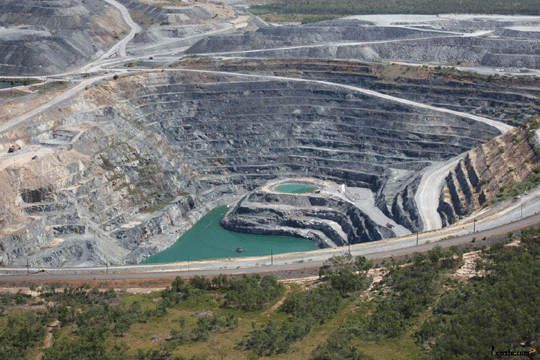 ERA to unveil strategy as Ranger mining ends BARRY FITZGERALD, RESOURCES EDITOR, THE AUSTRALIAN APRIL 12, 2016 MELBOURNE BARRY FITZGERALD HAS COVERED THE RESOURCES INDUSTRY FOR 30 YEARS. THE INAUGURAL WINNER OF THE DIGGERS & DEALERS MEDIA AWARD IN 2003, BARRY IS A COMMITTEE MEMBER OF THE MELBOURNE MINING CLUB, A NON-PROFIT ORGANISATION FORMED TO FOSTER INDUSTRY DEBATE.
Energy Resources of Australia is close to releasing the outcome of its strategic review into its future. The review was forced upon the company after Rio Tinto and Ranger’s traditional owners rejected its plan to extend the life of its uranium mining and processing operations inside Kakadu by developing the Ranger Deeps deposit.
Its pending release comes as ERA continues to narrow the gap between its cash balance and the $509 million needed to complete the rehabilitation of Ranger. At last report, ERA was holding cash of $433m and had no debt after adding $72m to its cash balance during 2015.
While mining operations have stopped, ERA continues to produce from stockpiled material, and has said previously it could possibly continue to do so until late 2020.
The rate of cash accumulation over the past five years suggests ERA could end up with cash surplus to the rehabilitation costs, raising the prospect of an eventual capital return to shareholders, depending on what plans for ERA’s future emerge from the strategic review. Continue reading
A solar world first for Perth: solar panels and battery storage on apartment buildings
Apartments set for solar world first https://au.news.yahoo.com/thewest/wa/a/31335712/apartments-set-for-solar-world-first/ Daniel Mercer – The West Australian on April 13, 2016 Dozens of apartments will be able to use, store and trade power under a world-first trial of micro-grid technology to be unveiled in Perth’s south.

Federal Environment Minister Greg Hunt will today announce the Commonwealth’s green energy fund ARENA has tipped $1 million into a micro-grid project in White Gum Valley.
The $3 million project will have solar panels and batteries installed across four separate apartment developments. It would be up to the strata companies managing the apartment buildings to on-sell the electricity to tenants, rather than State-owned power provider Synergy. The strata companies could sell the electricity cheaper than Synergy or at the same price, currently set at 25.7¢ for every unit of electricity sold. Homes owners and tenants would also be able to trade power to other apartments within the complex during the day and night.
Headed by Curtin University and backed by Western Power, LandCorp, the City of Fremantle and Balance Services Group, the project aims to establish a viable model for the uptake of solar panels on apartment buildings.
Demand for solar panels has exploded across Perth, with more than 170,000 homes installing the systems on their roofs. Apartments, which make up a third of Perth’s housing stock, have been much slower on the uptake.
Curtin University’s Jemma Green said that with battery systems rapidly becoming commercially viable, there was an unprecedented opportunity for apartments to get in on the act.
And she said the implications could be huge, with micro-grids such as White Gum Valley popping up everywhere and transforming the way electricity was generated, transported and sold.
“These kinds of innovations are not only making solar power a viable option for everyone, but potentially reflect the future of power utilities,” Ms Green said.
As CSIRO slashes jobs, water science in South Australia a big loser
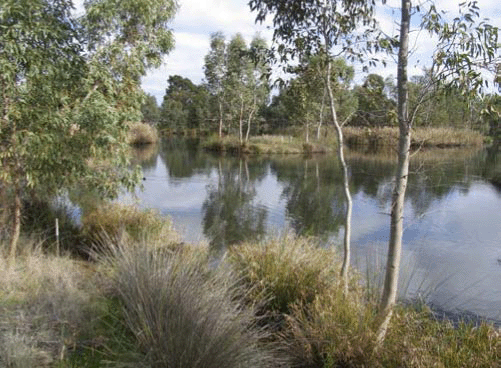
Water science in South Australia could evaporate as CSIRO looks to slash 350 jobs across the country April 12, 2016 CLARE PEDDIE SCIENCE REPORTER The Advertiser SOUTH Australian water science at the CSIRO is in the firing line as the national research organisation prepares to cut 350 staff across the country in the next two years.
Staff in SA have been told job losses are inevitable with “reductions in headcount” at CSIRO Land and Water, which has 103 people at its Urrbrae base.
Other research areas could also be impacted………
Former CSIRO scientist Dr Peter Dillon said the anticipated job cuts were “economic nonsense”. He said 35 of 50 staff were set to go from the CSIRO’s urban water research area, while rural research was also thought to be on the chopping block.
“Just like building submarines, in research it takes years to develop world-leading teams and shutting down a productive area can’t be quickly reversed,” he said.
CSIRO Staff Association deputy president and Waite Campus staff representative Sonia Grocke said staff felt strongly about the fundamental change to the type of work the CSIRO had done on water, agriculture and the environment.
“We think the current round of cuts and particularly the areas of science that are being targeted will severely impact CSIRO’s ability to address major environmental events as they impact South Australia,” she said. “The Murray-Darling Basin is a good example of that.”…….http://www.adelaidenow.com.au/news/south-australia/water-science-in-south-australia-could-evaporate-as-csiro-looks-to-slash-350-jobs-across-the-country/news-story/647fd6fdbfebfca28d4c683c4166336e
Michele Madigan remembers Bob Ellis and that other nuclear royal commission
In July 2004, a six-year anti-nuclear campaign spearheaded by Aboriginal women, who themselves had suffered in the British nuclear tests, was successfully concluded with the federal government’s announcement: ‘No national radioactive dump for SA.’
who could have imagined that just 11 years later, a new and far more dangerous plan would be launched by another royal commission, perhaps the first royal commission to plan a future scheme rather than examine one past?
Since this royal commission’s ‘tentative findings’ in February for South Australia to import international high-level nuclear waste, which it actually names as radioactive for ‘many hundreds of thousands of years’, the scepticism among South Australians is growing.
Bob Ellis and the other nuclear royal commission http://wwweurekastreet.com.au/article.aspx? aeid=47194#.VwrLvtR97Gg Michele Madigan | 07 April 2016
The passing of Bob Ellis recalls his faithful accompanying of the 1984–1985 royal commission into the British nuclear tests conducted in South Australia in the 1950s and 1960s. He went ‘to England and back’ and, as he described it, ‘to each black polis’ of the royal commission hearings.
Ellis’ article on the Wallatina hearings (The National Times, 3–9 May 1985), described what he named as the commission’s ‘worst story of all’ — Edie Milpudie’s telling of herself and her family camping, in May 1957, on the Marcoo bomb crater.
She told of being ‘captured by men in white uniforms … forcibly and obscenely washed down, miscarrying twice and losing her husband who to prove to the soldiers he knew English, sang, “Jesus loves me, this I know. For the Bible tells me so.”
‘And how the soldiers shot their beloved irradiated dogs.’
‘The bad parts of the story,’ Ellis went on, ‘the miscarriage and afterward, were communicated to Jim (Commissioner McClelland) in secret session, in the distance in the bush, with Edie’s women friends giving her comfort, and prompting with giggles and nudges her reminiscence of a story they knew by heart, already an old legend.
‘Jim called these women the best in the world, unstinting comforters, inextinguishable friends”
Five years later I had the privilege myself of meeting Edie Milpudie at her Oak Valley camp in the SA Maralinga lands. Many of the Yalata elders had prepared me in a way with the constant mantra: ‘Milpudie — she went through the bomb.’ Continue reading
Australia cuts aid to Africa, encourages Ugly Australian Mining Companies
Last year, the International Consortium of Investigative Journalists released a report called Fatal Extraction: Australian Mining Companies Digging a Deadly Footprint in Africa. It reported that Australian mining companies were the most rapidly expanding of all mining investors in Africa. From 2000 to 2009, prospecting licences held by Australian companies in Botswana alone increased from 14 to 260.
According to the report, Australian mining companies were responsible for multiple cases of negligence, unfair dismissal, violence and environmental law-breaking across Africa. It claims that since 2004 more than 380 people have died in mining accidents or in offsite skirmishes connected to Australian mining companies in 13 countries in Africa.
In comparison with Australia, African tax regulations are relatively flexible, while wages and working conditions, environmental protection, and occupational health and safety laws are weak.
Last year Foreign Minister Julie Bishop announced that the Australian government would actively promote the interests of the mining sector ahead of economic aid to Africa.
Australian miners in South Africa In the wake of a local activist’s murder, Australian mining interests in Africa are being called into question. https://www.thesaturdaypaper.com.au/news/resources/2016/04/09/australian-miners-south-africa/14601240003106 PHILLIP WALKER 9 Apr 16 Thee assassination of South African community activist Sikhosiphi “Bazooka” Radebe was shocking but sadly not surprising.
On the night of his death – March 22 – Radebe had warned his colleagues in the Amadiba Crisis Committee of a hit list. An hour later, two men masquerading as police arrived at Radebe’s house and shot him eight times in the head.
Radebe had been opposing titanium mining at Xolobeni, on the ancestral land of the Pondo people on South Africa’s east coast. The mining company involved is Australian-based Mineral Commodities Limited.
At Radebe’s funeral last weekend, Chief Cinani, representing the Queen and the Royal House of the amaMpondo, criticised the government’s acceptance of Australian investment and investment from the Indian business family the Guptas. “I am blaming the government because the government gave permits for those Australians, while people were saying ‘no’ to the government . It is clear that the business community is ruling the government. It is not only about the Guptas. Now we have seen the Australians. People are coming here with huge sums of money to divide the people.”
Through its director, Mark Caruso, Mineral Commodities Limited (MRC) and its South African subsidiary, Transworld Energy & Minerals Resources (TEM), have long been in dispute with the Amadiba community. The latest tragedy marks an escalation of hostility in a conflict now entering its 10th year. Continue reading
Perth-based Mineral Commodities Limited (MRC) denies role in murder of South African activist

 Australian mining company denies role in murder of South African activist
Campaigners claim death of Sikhosiphi Rhadebe is an escalation of violence against opponents of a mine owned by Perth’s Mineral Commodities Limited, Guardian, Joshua Robertson, 25 Mar 16 An Australian-owned mining company has denied any link to the murder of an activist leading a campaign against its plans to mine titanium in South Africa.
Sikhosiphi “Bazooka” Rhadebe was gunned down at his home in Xolobeni on South Africa’s Wild Coast on Tuesday, in what fellow activists claimed was an escalation of violence and intimidation against local opponents of a mine owned by Perth-based Mineral Commodities Limited (MRC).
MRC, which has repeatedly denied inciting violence involving its supporters, said it was “in no way implicated in any form whatsoever in this incident”.
Mzamo Dlamini is a fellow activist who believes he is among the “prime targets” on the anti-mining Amadiba crisis committee following Rhadebe’s death.
Despite fearing for his life, Dlamini vowed to continue organising resistance to a project that campaigners said would force the relocation of an estimated 100 households and up to 1,000 people.
“The assassination affects us all,” he said. “There will be more Bazookas long after we have died.”
Six people associated with the mining venture were subject to court orders last May after a clash over land access, during which a TEM director fired a “warning shot” in the air.
Four people, including an alleged employee of another MRC mine at Tormin, are due to face court next month over alleged assault and intimidation, including with firearms, of mining opponents in Xolobeni in December. These allegations are yet to come before a court and there is no suggestion these or any other employees were involved in Rhadebe’s murder……..
Lawyer Henk Smith of the Legal Resources Centre, which has acted for landholders opposing MRC’s Tormin mine, said the killing of Rhadebe, a “principled democrat”, had likely ended the prospect of conciliation meetings between the miner and its opponents.
“I think the company has made a few statements condemning the violence but it comes after the event and the company has never taken any steps to encourage conciliation or mediation or consultation even a meeting,” Smith said.
“In fact the company shies away from meeting the community which as a result, there’ll be little chance of simply starting a process of meetings now.
“For the rest, they’ve got [to] swallow what the company offers.” http://www.theguardian.com/environment/2016/mar/25/australian-mining-company-denies-role-in-of-south-african-activist
Carbon Disclosure Project lists Canberra as a global climate change leader
Canberra ranked as a global climate change leader, http://www.canberratimes.com.au/act-news/canberra-ranked-as-a-global-climate-change-leader-20160408-go1utu.html, James Hall Canberra’s ranking as a global climate change leader by the Carbon Disclosure Project is an “important acknowledgement”, Climate Council chief executive Amanda McKenzie says.
The CDP placed the capital among the top 10 cities in the world for its “quality and completeness” of environmental risk reporting.
“It’s not just that one area of the policy is doing well [to be ranked so highly],” Ms McKenzie said. “Reducing emissions, adequately reporting and disclosing internationally, a renewable energy policy, a risk assessment of what the climate change impact will be and have a plan to adapt to those consequences.”
Despite the ACT being significantly smaller than other states and territories and not having coastal environmental concerns, she said the city had substantial environmental elements affecting its climate.
She said Canberra’s recognition by the CDP is significant because its size is more common globally and it provides a more realistic comparison on how to implement sustainable technologies and processes. “Our view is that it is a very good example of how you transition a community that has previously been reliant on fossil fuels and moving towards more renewable energy,” Ms McKenzie said.
ACT Environment and Climate Change Minister Simon Corbell said the government had shown Canberrans and the world it was committed to tackling climate change. “In doing so we are also showing the world that moving to a low-carbon economy is not only achievable and affordable, but also can be a benefit to both the community and our economy,” he said. “By attracting renewable energy companies to Canberra and fostering a positive environment for renewable energy operation, research and development through our progressive policies we have positioned the territory to take advantage of growth in the renewable energy industry”.
Much of the sustainable energy being harnessed by the nation’s capital is being supplied by interstate facilities, but Ms McKenzie said it was the implementation of the energy being produced which is both environmentally responsible and economically innovative.
“It depends on why those projects have been built and if Canberra has played a significant role in making those projects get off the ground,” she said. “And then if the electricity is then being used by Canberra, the ACT has then brought in the investment for plants.”
“That is also reflected in some of the local businesses that now exist in Canberra, like Reposit Power for instance, businesses are being attracted to Canberra because it is a better investment environment for renewable energy than other parts of the country.”
Since Liberal Coalition govt dumped carbon price, greenhouse emissions have soared
 Electricity emissions soar since Coalition dumps carbon price, Independent Australia Giles Parkinson 9 April 2016 RenewEconomy‘s Giles Parkinson discusses Australia’s rapidly rising electricity emissions following the Coalition’s axing of the carbon price and in direct contradiction to the Paris climate agreement.
AUSTRALIA’S ELECTRICITY emissions continue to rise and are now 5.5 per cent higher than they were before the carbon price was dumped, putting Australia against the global trend which is seeing energy emissions flat-lining even as the global economy expands.
Pitt & Sherry analyst Hugh Saddler says in his latest monthly survey that total emissions from electricity generation in the National Electricity Market (NEM) – all but Western Australia and the Northern Territory – increased again in the year to March 2016.
Annual emissions were 5.5 per cent higher than in the year to June 2014, when the Coalition killed the carbon price introduced by the Labor Government, to much acclaim from the government.
This startling jump in emissions comes despite the fact that Australia has signed up to the Paris climate agreement, which seeks to limit global warming to 2°C, and if possible 1.5°C. Energy emissions, according to the International Energy Agency, have flatlined for the past two years.
The rise in emissions also comes amid rising global CO2 levels, soaring temperatures, and the most serious coral bleaching event ever witnessed in the Great Barrier Reef.
Saddler blames the rise in emissions on a number of factors. One is the removal of the carbon price, which paved the way for more burning of coal, black coal in particular.
Another is the rise in coal generation in Queensland to support the exports of liquefied natural gas — which will contribute an extra 8 million tonnes of CO2 equivalent a year. Continue reading
Climate denialist Maurice Newman might split the Liberal Party?
Maurice Newman claims to be head of business council disbanded by Turnbull
Former adviser to Tony Abbott says Malcolm Turnbull’s ‘left leaning positions’ could lead to formation of breakaway conservative party, Guardian, Lenore Taylor, 8 Apr 16 Businessman Maurice Newman has insisted he remains the head of the prime minister’s business advisory council, despite being informed by Malcolm Turnbull last year that the council was being disbanded.

Last September Guardian Australia revealed that Newman’s term as chairman of the prime minister’s business advisory council had expired and that a spokesman for Turnbull had confirmed he would not be reappointed………
Newman, a strong supporter of former prime minister Tony Abbott, told Lateline Turnbull’s “left leaning positions” could potentially lead to the formation of a breakaway conservative party…….
Asked whether he was saying Turnbull’s leadership could lead to the emergence of a new conservative party Newman replied “Well, I think it’s most likely that if the people who support the Liberal party and the Liberal party values find that essentially it’s a Labor-like party, then they’ll clearly be attracted to whatever alternatives might be presented to them.”
He nominated “giving more money” to renewable energy and the Clean Energy Finance Corporation as Labor-like policies being undertaken by the Coalition.
Newman has used a weekly column in the Australian to expound his views on climate change, including that the world was ill-prepared for a period of global cooling and that the United Nations was using debunked climate science to impose a new world order under its own control.
He also called for a government-funded review of the Bureau of Meteorology to “dispel suspicions of a warming bias” in its temperature record-keeping, something freedom of information documents last year revealed was under consideration by the former prime minister’s department…….http://www.theguardian.com/australia-news/2016/apr/08/maurice-newman-claims-to-be-head-of-business-council-disbanded-by-turnbull
Minister Greg Hunt did not impress David Attenborough, with his uninformed comments about the Great Barrier Reef
 Greg Hunt rebuked by Attenborough film-maker after upbeat verdict on Great Barrier Reef http://www.theguardian.com/environment/2016/apr/08/greg-hunt-rebuked-by-film-maker-after-great-barrier-reef-verdict
Environment minister told to ‘watch the series’ after saying David Attenborough documentary is evidence reef is safe, Guardian, Melissa Davey and Steph Harmon, 8 Apr 16 Enamoured by stunning footage in David Attenborough’s latest documentary series, the Australian environment minister, Greg Hunt, took it as proof that theGreat Barrier Reef remained an untouched beauty.
But he might have been better off waiting to see the whole series before commenting.
“The key point that I had from seeing the first of the three parts is that, clearly, the world’s Great Barrier Reef is still the world’s Great Barrier Reef,” Hunt told theCourier Mail.
The documentary was one of “profound importance” that “Australia would rightly be proud of”, he continued, and was evidence that the reef was not facing the death that climate change scientists and environmentalists feared.
Hunt made the comments after seeing part one, which airs on the ABC on Sunday night. Had he watched the full series, however, he would have seen footage of coral bleaching and heard Attenborough describe, in the final part of the documentary, how “the Great Barrier Reef is in grave danger”.
“The twin perils brought by climate change – an increase in the temperature of the ocean and in its acidity – threaten its very existence,” Attenborough says.
“If they continue to rise at the present rate, the reefs will be gone within decades. And that would be a global catastrophe. About a quarter of the species of fish in the world spend some part of their lives in the reefs. If the reefs go, the fish will also disappear. And that could affect the livelihood and diet of human communities worldwide.”
The producer of the Great Barrier Reef series, Anthony Geffen, responded to Hunt’s comments, encouraging him to “watch the series, you know”.
“It’s like watching one of those Hollywood movies when everybody’s happy at the front and everybody’s dead at the end, and saying, ‘Well I think the family was really happy and everybody’s really good’, but you haven’t got to the end of the movie, where his whole family is lying on the floor dead,” Geffen told Guardian Australia.
Geffen said the series captured “horrific” levels of coral bleaching, which occurs when rising sea temperatures destroy the tiny marine algae that live inside corals’ tissue and provide up to 90% of the energy corals require to grow and reproduce.
“It was horrific and, obviously, we’ve been very much still in touch with the scientists and some of the areas we’ve just filmed in have been devastated by bleaching,” he said.
“And, in fact, scientists were asking for our footage so they could compare what had disappeared, which is quite extraordinary. I mean [the documentary] is only just coming out in Australia and already the footage is being used as archives to [document] the destruction of the reef.”
However, Geffen described the series, which has already aired in the UK, as “bigger than” and “above” politics.
“This series has gone out to, I think by the end of the year, a billion people or something – that’s what people should be reflecting on,” he said. “And I hope it doesn’t get hacked over by political means and ends, because it shouldn’t.”
South Australia’s Nuclear Fuel Chain Royal Commission virtually ignored dangers of transporting radioactive trash
As the days get a bit closer to #NuclearCommissionSAust’s announcement of its (predetermined) findings, we need to remember that the Commission’s “Issues Papers” almost completely ignored the question of the dangers of transporting highly radioactive trash across land and sea.
Paul Langley, in his fine response to the Commission’s “Tentative Findings” raised this very important matter – in the extract below
Response to the Tentative Findings of the SA Nuclear Fuel Cycle Royal Commission A Submission by Paul Langley Nuclear Exhaust 16 Mar 16 “……Transport of HLNW from around the world to a SA HLNW geologic repository
 The Royal Commission apparently assumes that the movements of many hundreds of thousands of tonnes of spent nuclear fuel from many countries around the world to the Gawler Craton will be low risk, no problems and perfectly safe. As contradictory as those stances are. I do not accept that position of default safety. Further I do not accept that the unloading of the HLNW will be perfectly safe. I do not accept that road transport from port to repository site will be perfectly safe, even on a dedicated purpose built road.
 I would recommend that Super Freighters laden with the contents of countless reactor cores not sail down the Somali coast nor in the waters to the south of Thailand for fear of pirates. They should avoid man made Islands in the South China Sea. I suppose the ships will be guarded by 6 English policemen each with two revolvers between them. Rather than half the Pacific Fleet they would actually warrant. If they ever get to leave their home ports. What is the Somali coast going to be like in 40 years? Peaceful or short of rad weapons?…….” https://nuclearexhaust.wordpress.com/2016/03/15/response-to-the-tentative-findings-of-the-sa-nuclear-fuel-cycle-royal-commission/
Greens lock in behind new push to ban nuclear weapons
 9 Apr 16 The Australian Greens today launched a campaign calling for Julie Bishop to support a global treaty to ban nuclear weapons.
In December last year, 138 countries voted at the UN General Assembly in favour of supporting a humanitarian pledge for the prohibition and elimination of nuclear weapons. Australia did not support this vote.
Greens co-deputy leader and nuclear spokesperson Senator Scott Ludlam said nuclear weapons are the most destructive on earth.
“In 1972 the world banned biological weapons, in 1993 we banned chemical weapons, in 1997 we banned land mines, and in 2008 we banned cluster munitions. This campaign calls for Australia to join 138 countries in the UN General Assembly to prohibit and eliminate nuclear weapons,” he said.
“The risks are real and the consequences are catastrophic. The best protection against nuclear war is eliminating nuclear weapons.
“At this year’s UN Working Group on Nuclear Disarmament, Australia has an opportunity to stand with the majority of other countries and call for a global treaty banning nuclear weapons.”
Fact Box:
- There are more than 15,000 nuclear weapons belonging to just 9 countries
- In December 2015 the UN General Assembly voted on a Humanitarian Pledge for the prohibition and elimination of nuclear weapons. 138 countries voted in favour, 29 voted against and 17 abstained. Australia voted against the motion.
- In 2016 there will be three meetings of the UN Working Group on Nuclear Disarmament where there will be a push to develop a global treaty banning nuclear weapons
- In Janurary 2016 the Bulletin of Atomic Scientists kept the doomsday clock at 3 minutes to midnight – citing the growing threat of terrorism, climate change and nuclear weapons as the core reason for the threat rating. The Doomsday Clock was at 3 minutes to midnight at the height of the cold war.
- This week the International Coalition to Abolish Nuclear Weapons has launched the “Black Mist White Rain” tour with Aboriginal women from South Australia and the Marshall Islands to discussing the humanitarian consequences of nuclear weapons.
See the campaign page here http://grns.mp/ban-the-bomb
Paris climate agreement to be signed by Australia
 Australia to sign Paris agreement on climate change, ABC News 7 Apr 16 By environment reporter Sara Phillips Australia will be among the first countries in the world to sign the Paris agreement on climate change, with a “very senior” representative being sent to a signing ceremony in New York later this month, according to government sources. Continue reading
Ignorance about radiation, in the self styled “Pro Nuclear Environmentalists (PNEs)”
Australian ‘ecomodernist‘ academic Barry Brook says the Chernobyl death toll is less than 60. Ben Heard, another Australian ‘ecomodernist’ (in fact a uranium and nuclear industry  consultant), claims that the death toll was 43.
Evidence of PNE ignorance abounds. For the most part, PNEs had a shaky understanding of the radiation/health debates (and other nuclear issues) before they joined the pro-nuclear club, and they have a shaky understanding now.
the WHO, IAEA and other UN agencies estimated 9,000 deaths in ex-Soviet states in their 2005/06 reports, and more recently UNSCEAR has adopted the position that the long-term death toll is uncertain.
Radiation harm deniers? Pro-nuclear environmentalists and the Chernobyl death toll, Ecologist, Dr Jim Green 7th April 2016 “……….the self-styled pro-nuclear environmentalists (PNEs). We should note in passing that some PNE’s have genuine environmental credentials while others – such as Patrick Moore and Australian Ben Heard – are in the pay of the nuclear industry.
James Hansen and George Monbiot cite UNSCEAR to justify a Chernobyl death toll of 43, without noting that the UNSCEAR report did not attempt to calculate long-term deaths. James Lovelock asserts that “in fact, only 42 people died” from the Chernobyl disaster.
Patrick Moore, citing the UN Chernobyl Forum (which included UN agencies such as the IAEA, UNSCEAR, and WHO), states that Chernobyl resulted in 56 deaths. In fact, the Chernobyl Forum’s 2005 report (p.16) estimated up to 4,000 long-term cancer deaths among the higher-exposed Chernobyl populations, and a follow-up study by the World Health Organisation in 2006 estimated an additional 5,000 deaths among people exposed to lower doses in Belarus, the Russian Federation and Ukraine. Continue reading
1 This month
17 October, Free Public Talk on Nuclear Issues in South Australia
David Noonan will speak on public interest concerns over the new Roxby Downs Indenture Act 2026 on BHP copper-uranium mining and ore processing in SA, and on how AUKUS may face SA with a High-Level nuclear waste agenda.
Dr Jim Green will discuss international developments in the field of nuclear power including ‘small modular reactors’ and Generation 4 ‘advanced’ nuclear reactor concepts.


Help Aunty Sue Protect Her Land and Sacred Sites From Destructive Rocket Testing.
.

Australians deserve the truth
about
AUKUS – https://aukuspublicinquiry.com/

PETITION – To: Prime Minister Anthony Albanese and the Australian Labor Government

of the week – Australians for War Powers Reform (AWPR)
To see nuclear-related stories in greater depth and intensity

