South Australia to weaken Aboriginal Heritage Act -(nice for the nuclear industry)
 Aboriginal Heritage Act changes give traditional owners less say: Indigenous groups ABC News By Nicola Gage 10 Mar 16 Proposed changes to South Australia’s Aboriginal Heritage Act will reduce powers of traditional owners, according to Indigenous groups.
Amendments to the act were introduced to Parliament a fortnight ago and today passed the Legislative Council.
South Australian Native Title Services chief executive officer Keith Thomas believed amended language in the act would give traditional owners less say over their heritage. “This is going to help people who want to access lands and destroy heritage, rather than improving the protection of Aboriginal heritage,” he said.
There are tens of thousands of sacred Indigenous sites across South Australia, from ancient song lines and springs to burial grounds.
The act is in place to protect them from different activities, including mining operations. Mr Thomas said the proposed changes would make it harder to prosecute companies if they had disturbed a site without approval.
“At the moment they’re very concerning, because it’s diluting Aboriginal rights, whereas the Aboriginal Heritage Act should be strengthening Aboriginal rights to protect their heritage,” he said. Mr Thomas said the changes would also remove clause 6-2 in the act, which stipulates the minister must delegate his or her powers to the traditional owners of a site.
Aboriginal groups from Lake Torrens have been trying to use that clause over recent years to stop a mining operation from going ahead. “I think the amendments are being rushed through for some reason,” he said. “It means that the minister doesn’t have to delegate his powers and it paves the way for the miners to come back and have another go.”
Some Aboriginal groups said they had not been properly consulted over the amendments.
Traditional owner Karina Lester grew up on South Australia’s Anangu Pitjantjatjara Yankunytjatjara Lands and did not know the bill was in Parliament. “That was quite concerning for us as native title [holders] because we hadn’t been informed,” she said.”Therefore, we didn’t know what changes were being proposed.”…..http://www.abc.net.au/news/2016-03-10/changes-aboriginal-heritage-act-give-traditional-owners-less-say/7236302
Australian uranium fuelled Fukushima nuclear reactors at time of the catastrophe
Fukushima five years on, and the lessons we failed to learn, Guardian, Dave Sweeney, 11 Mar 16 “…….In October 2011 it was formally confirmed to the Australian parliament that not only was Australian uranium routinely sold to the corner-cutting Tepco but that a load of true blue yellowcake was fuelling the Fukushima complex at the time of the disaster. Australian radioactive rocks were the source of Fukushima’s fallout.
Surely after directly fuelling disaster Australia would have taken some steps to review and possibly reconsider our role in the global nuclear trade?
The UN thought so. In September 2011 the UN secretary-general called on Australia to conduct “an in-depth assessment of the net cost impact of the impacts of mining fissionable material on local communities and ecosystems”.
This has never happened. It needs to, and Australia’s uranium sector deserves some long overdue scrutiny.
The most recent independent assessment of the Australian uranium industry – a Senate inquiry in October 2003 – found the sector characterised by underperformance and non-compliance, an absence of reliable data to measure contamination or its impact on the environment and an operational culture focussed on short term considerations…….http://www.theguardian.com/commentisfree/2016/mar/11/fukushima-five-years-on-and-the-lessons-we-failed-to-learn
Genetic damage to later generations from Maralinga radiation fallout
New generations of Australian families suffering deformities and early deaths because of ‘genetic transfer’,news.com.au MARCH 10, 2016 [EXCELLENT PHOTOS] PEOPLE who worked at Australian atomic bomb test sites claim they have produced generations of children with severe deformities and suffered a high number of stillbirths.
Documents obtained exclusively by news.com.au show hundreds of children and grandchildren of veterans exposed to radiation were born with shocking illnesses including tumours, Down syndrome, cleft palates, cerebral palsy, autism, missing bones and heart disease.
One veteran, who was posted to the Maralinga nuclear test site in South Australia in the 1950s as part of the British Nuclear Test (BNT) program, says the radiation contaminated his sperm and is to blame for the death of a child he never got to know.
But he is not alone, with the documents detailing a litany of miscarriages and stillbirths that has allegedly passed the devastation from generation to generation.
Australian ex-servicemen and their families originally made submissions to a Federal Government review in 2003 over deaths and disabilities they believe were caused by exposure to radiation from nuclear testing in South Australia and Western Australia in the 1950s and 60s.
The submissions were later compiled to use in a class action against the British Ministry of Defence, but the case was not allowed to proceed because it was deemed impossible to prove radiation caused their illnesses. Continue reading
Australia’s uneconomic and declining uranium industry
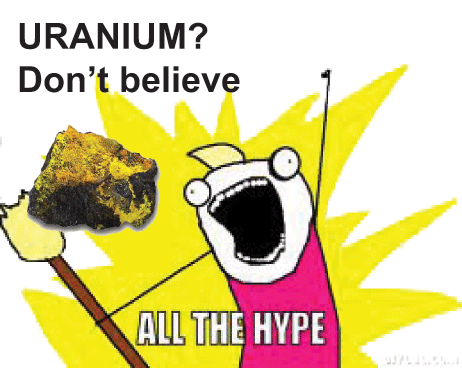 Fukushima five years on, and the lessons we failed to learn, Guardian, Dave Sweeney, 11 Mar 16 “…….As home to around 35% of the world’s uranium reserves, Australia has long been a significant player in the global nuclear trade.
Since the 1980s Australian uranium mining has been dominated by two major operations – Ranger in Kakadu and Olympic Dam in northern South Australia. Both operations and their heavyweight owners have been voting with their feet and their finances since 2011. Processing of stockpiled ore continues at Ranger but mining has ended and parent company Rio Tinto is now preparing to commence costly and complex rehabilitation work.
At Olympic Dam the world’s biggest mining company BHP Billiton stunned the South Australian government in 2012 when it shelved an approved and long planned multi-billion dollar mine expansion.
Smaller mines like Honeymoon in South Australia have been placed on extended care and maintenance, junior companies have abandoned the field and the sectors prevailing business model is to get the paperwork in order and wait in hope for better times.
Historically the sector has been constrained by political uncertainty, restrictions on the number of mines, a consistent lack of social license and strong Aboriginal and community resistance.
Recent years have seen fewer political constraints but a dramatic decline in the price of uranium and popularity of nuclear power following Fukushima.
Australia now accounts for approximately 11% of global uranium production, down from over 18% a decade earlier. Australia’s uranium production of 5,000 tonnes in 2014 was the lowest for 16 years.The industry generates less than 0.2% of national export revenue and accounts for less than 0.02% of jobs in Australia. Less than one thousand people are employed in Australia’s uranium industry.
In an attempt to jump start the flat-lining uranium trade, successive federal governments have preferred enthusiasm to evidence. They have failed to conduct the requested industry review and instead fast-tracked increasingly irresponsible uranium sales deals, most recently with India.
Approvals are fast-tracked, regulators are complacent, community concerns are air-brushed away and all for a sector that never really made sense and now doesn’t even make dollars.
In short, Australia’s uranium sector is high risk and low return. It leaves polluted mine sites and home and drives nuclear risk and insecurity abroad. And it fuelled Fukushima – a profound environmental, economic and human disaster that continues to negatively impact lives in Japan and far beyond.http://www.theguardian.com/commentisfree/2016/mar/11/fukushima-five-years-on-and-the-lessons-we-failed-to-learn
AUSTRALIAN GOVERNMENT DENIES LINK BETWEEN RADIATION EXPOSURE AND ILLNESS
New generations of Australian families suffering deformities and early deaths because of ‘genetic transfer’, news.com.au MARCH 10, 2016 [EXCELLENT PHOTOSlifestyle/health/health-problems/new-generations-of-australian-families-suffering-deformities-and-early-deaths-because-of-genetic-transfer/news-story/5a74b7eab2f433402aa00bc2fcbcbea4 “…….. But the link between exposure to radiation at the test sites and subsequent illness of the BNT veterans and their descendants has never been accepted by the Australian Government.
Those who can prove they sustained an injury or disease related to their service are eligible for compensation under the Safety, Rehabilitation and Compensation Act 1988 (SRCA), and its antecedent Acts.
But BNT veterans told news.com.au they are continually rejected on the grounds that the levels of radiation they were exposed to were “too low” to cause their illnesses.
It’s a stark contrast to a 1999 study for the British Nuclear Test Veterans Association, which found that 30 per cent of the nuclear test veterans had died, mostly in their 50s, from cancers or cancer-related illnesses.
In addition, a 2007 New Zealand study found that New Zealand sailors who had been exposed to the nuclear testing had three times the level of genetic abnormality and notably higher rates of cancer than the general population.
Following a British decision in 1988, the Australian Government negotiated compensation for a small group of Australian servicemen suffering from two specific conditions — leukaemia (except lymphatic leukaemia) and a rare blood disorder known as multiple myeloma.
But the bulk of BNT Australian veterans have never been compensated over radiation exposure during the atomic bomb tests in the 1950s and 60s. Nor have their medical conditions been officially linked to their exposure.
While BNT service personnel have had access to disability pensions and health care under the Veterans’ Entitlements Act 1986 (VEA) since July 1, 2010, and cancer treatments, many of them say they are not entitled to full benefits.
Mr Batchelor said he wasn’t even entitled to a veteran’s gold card despite all he has suffered, sacrificed and lost.
“Those (veterans) that are left could desperately do with a gold card,” he said.
“I don’t think that’s asking for too much.” http://www.news.com.au/lifestyle/health/health-problems/new-generations-of-australian-families-suffering-deformities-and-early-deaths-because-of-genetic-transfer/news-story/5a74b7eab2f433402aa00bc2fcbcbea4
Greens plan for solar shade in Brisbane’s King George Square
Brisbane council election: Greens promise ‘solar shade’ in  , Brisbane Times March 9 2016 Cameron Atfield It’s long been the civic centre of Brisbane, but now King George Square has again found itself at the centre of Brisbane’s council election campaign.
Greens lord mayoral candidate Ben Pennings has unveiled a plan to cover the square in solar shading, which would come equipped with sockets for people to charge their phones in the shade. Below – solar shade , Arizona University
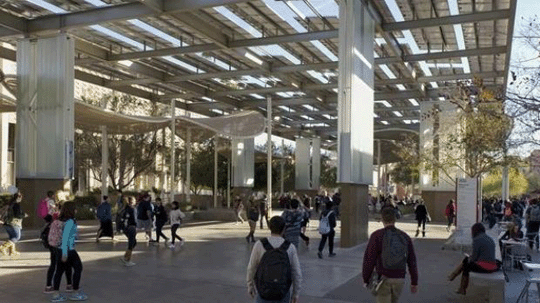
The Greens want to introduce solar shade, similar to this at Arizona State University, to Brisbane’s King George Square
Mr Pennings said the solar panels would generate 100,000 kilowatt hours a year to help charge City Hall, which he said would save Brisbane City Council $20,000 in annual electricity bills.
“The Greens’ plan for King George Square embraces this century rather than looking to the past of roped-off grass,” he said. “A one-off investment of $2.5m will shade King George Square with solar panels.”Residents can relax in the shade and use the power to charge their phones, tablets or laptops.
“New seating will allow people to recharge on their own or connect under the shade in small groups.”………http://www.brisbanetimes.com.au/queensland/brisbane-council-election-greens-promise-solar-shade-in-king-george-square-20160309-gneylr.html
Nuclear Royal Commission findings agree with French report: Nuclear power is prohibitively expensive
 The Nuclear Industry Prices Itself Out Of Market For New Power Plants, Climate Progress, BY JOE ROMM MAR 8, 2016 “……… in newly-released findings, South Australia’s nuclear royal commission found that the price of electricity from new nukes greatly exceeded not only business-as-usual projections for electricity prices but also prices in a “strong climate action” case. The Commission concluded “it would not be commercially viable to generate electricity from a nuclear power plant in South Australia in the foreseeable future.”
The Commission explicitly looked at plausible electricity prices for a new reactor in 2030 based on both current designs and possible fourth-generation ones, such as small modular reactors (SMRs). The Commission estimated the cost for the most viable nukes at US$7 billion for a typical large 1125-megawatt reactor and $2.8 billion for two 180-megawatt SMRs. The smaller SMRs would be providing electricity for a whopping US$0.17 a kilowatt-hour!
A study done for the Commission found that both large nukes and SMRs “consistently deliver strongly negative NPVs” (net present values) for both 2030 and 2050 — even for the strong climate action scenario. The Commission Chair noted that given how Australia’s National Electricity Market works, renewables are “the first energy that goes into the market” because they have the lowest costs.
The Commission’s findings are consistent with a 2014 Energy Policy study, “The cost of nuclear electricity: France after Fukushima.” Using cost data released by the French government after the Fukushima disaster, the study found the cost of French nuclear plants steadily escalated over the past four decades. Further, it projects “the future cost of nuclear power in France to be at least 76€/MWh (US$0.084/KWh) and possibly 117€/MWh (US$0.129/KWh),” which “compares unfavorably against alternative fuels,” such as wind……..”http://thinkprogress.org/climate/2016/03/08/3757281/nuclear-industry-prices/
Capping of Ranger open cut uranium mine
Ranger uranium mine open cut pit capped as part of ongoing site rehabilitation ABC Radio NT Country Hour By Daniel Fitzgerald 10 Mar 16 An open cut pit at the Ranger uranium mine in the Northern Territory has been capped after 20 years of rehabilitation work.
Energy Resources Australia (ERA) began filling in Pit 1 after mining in the pit ceased in 1996, with work continuing intermittently around other activities at the site, which is surrounded by Kakadu National Park. AUDIO: Tim Eckersley speaks about rehabilitation works at ERA’s Ranger mine (ABC Rural)
Leftovers from the processing operations at the mine, known as tailings, were dumped into the large pit and left to settle. General manager of operations at the Ranger mine, Tim Eckersley said the tailings were a “sandy, muddy mixture so it has taken quite some years to consolidate.”………..
Since 2012 ERA said it had spent more than $400 million on rehabilitation works at the mine.
Environmental management of the mine site had been marred by several incidents in recent years.Last year, a fire on the site burnt into Kakadu National Park and threatened nearby Indigenous cultural sites.ERA avoided charges over a 2013 incident when 1,400 cubic metres of radioactive slurry was spilt after a tank collapsed.
The mine has an uncertain future after traditional owners said they would not support mining operations after the mining lease ended in 2021. http://www.abc.net.au/news/2016-03-09/disused-open-cut-pit-at-ranger-uranium-mine-capped-era/7221720
Australia’s Liberal Party Wants National Debates on whether or not Climate Change is happening!

NSW Liberals call for national debates on climate change science
The NSW Liberals have formally called on the Turnbull government to conduct public debates about climate change – including as to whether the science is settled – in a stark reminder of the deep divisions within the party over the issue.
http://www.smh.com.au/nsw/nsw-liberals-call-for-national-debates-on-climate-change-science-20160307-gnd3zn.html
The Sorry History of the Liberal Party’s Religious Conversion to Climate Denialism
Lest anyone assume that this is an issue only for the Liberals, it should be noted that the Australian Labor Party’s climate policies have hardly been consistent, veering from indifference under Paul Keating, to grave moral challenge under Rudd, and finally the “art of the possible” under Julia Gillard. Meanwhile, the arcane accounting rules around the Kyoto Protocol have allowed both Labor and Liberal governments to draw a veil over the true progress.
As economist Ross Garnaut warned in 2008, it may be that the problem is simply too wicked for our democratic system to cope.
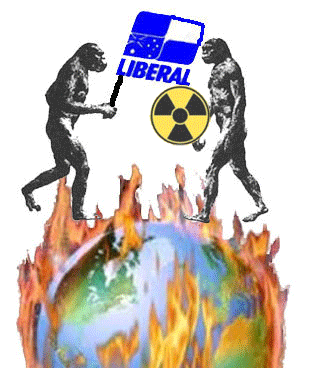 How climate denial gained a foothold in the Liberal Party, and why it still won’t go away, The Conversation, Marc Hudson, March 10, 2016 It seems the Liberal Party is still having trouble letting go of climate denial, judging by the New South Wales branch’s demand that the Turnbull government arrange a series of public debates on climate science.
Leaving aside the fact that this kind of town hall debate would only entrench opposing viewpoints rather than making scientific headway (a task best left to peer-reviewed journals), it is not the only recent example of Liberal Party members seeking to stoke doubts over the reality of climate change.
Last September, Liberal National Party senator Ian Macdonald told the federal parliament that Australia’s children have been “brainwashed” about human-induced climate change, which he described as “a fad or a farce or a hoax” and “farcical and fanciful”.
Two months earlier, Macdonald’s fellow LNP MP George Christensen attended the Heartland Institute’s climate sceptic conference. There he described climate concerns as “hysteria” and the stuff of science fiction.
And a month before that, rural Liberals called for a parliamentary inquiry into climate science, while urging Australia not to sign any binding agreement at December’s Paris climate talks.
This pervasive climate scepticism might make it look like this is a longstanding position within the Liberal Party. But history tells rather a different story.
The forgotten history of Liberal climate positions
Dangerous global warming will happen sooner than thought
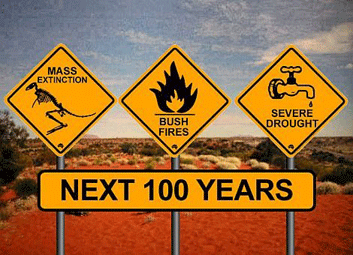 Dangerous global warming will happen sooner than thought – study, Guardian, Joshua Robertson, 10 Mar 16 Australian researchers say a global tracker monitoring energy use per person points to 2C warming by 2030. The world is on track to reach dangerous levels of global warming much sooner than expected, according to new Australian research that highlights the alarming implications of rising energy demand.
University of Queensland and Griffith University researchers have developed a “global energy tracker” which predicts average world temperatures could climb 1.5C above pre-industrial levels by 2020.
That forecast, based on new modelling using long-term average projections on economic growth, population growth and energy use per person, points to a 2C rise by 2030.
The UN conference on climate change in Paris last year agreed to a 1.5C rise as the preferred limit to protect vulnerable island states, and a 2C rise as the absolute limit.
The new modelling is the brainchild of Ben Hankamer from UQ’s institute for molecular bioscience and Liam Wagner from Griffith University’s department of accounting, finance and economics, whose work was published in the journal Plos One on Thursday.
It is the first model to include energy use per person – which has more than doubled since 1950 – alongside economic and population growth as a way of predicting carbon emissions and corresponding temperature increases.
The researchers said the earlier than expected advance of global warming revealed by their modelling added a newfound urgency to the switch from fossil fuels to renewables.
Hankamer said: “The more the economy grows, the more energy you use … the conclusion really is that economists and environmentalists are on the same side and have both come to the same conclusion: we’ve got to act now and we don’t have much time.”……..
The researchers suggested switching $500bn in subsidies for fossil fuels worldwide to renewables as a “cost neutral” way to fast-track the energy transition.
Wagner said pulling the rug from out under the fossil fuels industry was a move of “creative destruction” and “more a political issue rather than an economic issue”…….http://www.theguardian.com/environment/2016/mar/10/dangerous-global-warming-will-happen-sooner-than-thought-study
High Court challenge to Tasmania’s anti protest laws – by Bob Brown
 Bob Brown challenges Tasmania’s anti-protest laws in High Court ABC News 9 Mar 16 Former Australian Greens leader Bob Brown has issued a High Court challenge to the Tasmanian Government’s anti-protest laws.
The legislation which passed Parliament in 2014 allows for on-the-spot fines and tougher penatlities for repeat offenders.
Mr Brown and a number of others were arrested and charged in January, under the new laws, for protesting against the logging of Lapoinya Forest in Tasmania’s north west.
He issued the High Court challenge on the grounds the laws were contrary to the implied freedom of speech on government and political matters under the Australian constitution.
“I know that a challenge in the High Court can be a very expensive thing but I also know that a lot of people are worried about this legislation and the spread of it in other states,” he said.
“The laws will, if not challenged, trap everybody who wants to take a stand against something that’s manifestly wrong going on in our country.” Mr Brown said the Tasmanian Government promised the laws were not aimed at “mum and dad” protesters.
But he said “first up, they trapped a young mother and nurse who grew up in the Lapoinya area and a local grandfather”.
Hobart solicitor Roland Brown said the High Court challenge was a test case.
“This case is unusual because it’s seeking to have made invalid, or declared invalid, legislation that targets people’s political belief and their opinion in relation to environmental, social, cultural and economic factors,” he said………http://www.abc.net.au/news/2016-03-10/bob-brown-flags-high-court-challenge-to-workplace-protest-laws/7236124
Rail upgrade Adelaide to Tarcoola – convenient for the nuclear industry?
What’s the bet that today’s announcement by Turnbull of a plan to “bring forward by some years” the upgrading of 600km of rail line from Adelaide to Tarcoola just happens to fit in nicely with the Weatherill plan to expand the nuclear industry in SA.
Sallys Flat: How “ordinary people” are fighting back against nuclear waste dumping
 Nuclear dump site journey continues “http://www.westernadvocate.com.au/story/3777432/finish-lines-in-sight-for-hill-end-eco-warriors/
By LOUISE EDDY March 9, 2016, The past three months have seen three unlikely environmental advocates embark on a journey that has taken them all the way to Canberra and the halls of power.
Restoring social order? Treaty with Alyawarr people first!
 “Sir – I am an Alyawarr traditional custodian and I am calling for a treaty on the back of
Dr Dennis Jensen MP’s controversial speech in Parliament last week regarding Aborigines. …
Greater autonomy within Aboriginal communities is necessary to address these issues and the way to achieve this is through treaties, and I call for one between the
Commonwealth Government and the Alyawarr people.
1 This month
17 October, Free Public Talk on Nuclear Issues in South Australia
David Noonan will speak on public interest concerns over the new Roxby Downs Indenture Act 2026 on BHP copper-uranium mining and ore processing in SA, and on how AUKUS may face SA with a High-Level nuclear waste agenda.
Dr Jim Green will discuss international developments in the field of nuclear power including ‘small modular reactors’ and Generation 4 ‘advanced’ nuclear reactor concepts.


Help Aunty Sue Protect Her Land and Sacred Sites From Destructive Rocket Testing.
.

Australians deserve the truth
about
AUKUS – https://aukuspublicinquiry.com/

PETITION – To: Prime Minister Anthony Albanese and the Australian Labor Government

of the week – Australians for War Powers Reform (AWPR)
To see nuclear-related stories in greater depth and intensity

