Government trashing Australia’s international reputation, with climate study cuts to CSIRO
“our whole reputation is at risk … it’s our international reputation in delivering results”.
A petition signed by 150 scientists attending the conference has called on the Federal Government to reconsider the organisation’s restructure.
 Global spotlight on CSIRO cuts as work culture turns toxic, inquiry hears , ABC News, 7 Mar 16 Australia’s top marine scientists are warning that the country’s international scientific standing will be damaged by the CSIRO’s climate restructure.
About 350 jobs nationally are expected to go by mid 2017, including positions from the Oceans and Atmosphere Unit and 100 from land and water research.
A total of 191 staff work in the Oceans and Atmosphere division in Tasmania.
Scientific leaders from the Australian Antarctic Division (AAD) and Institute for Marine and Antarctic Studies (IMAS) are giving evidence before the Senate’s Select Committee into Scrutiny of Government Budget Measures in Hobart. Continue reading
South Australian Government pro-nuclear waste dump PR campaign set to roll
The Premier’s announcement today that the State Labor Government will move to repeal part of the 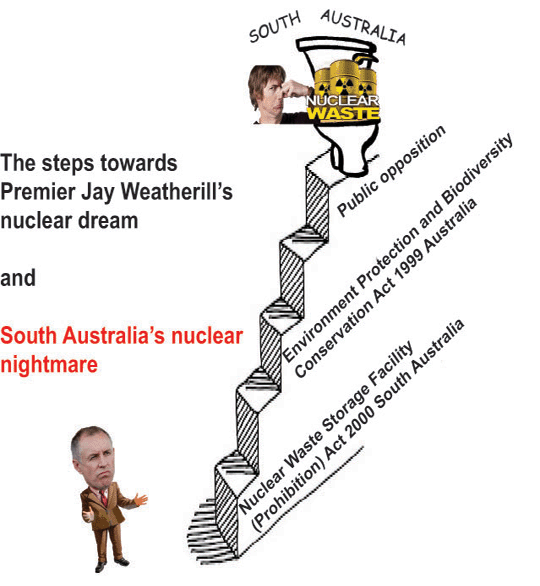 Nuclear Waste Storage Facility (Prohibition) Act 2000, indicates that a taxpayer-funded pro-nuclear waste dump public relations campaign is on its way.
The Government says the repeal is necessary in order to consult with the community over the Nuclear Royal Commission’s findings.
“That’s just not true”, according to SA Greens Leader and environmental lawyer, Mark Parnell MLC.
“The Act only prohibits the use of public money to “encourage or finance any activity associated with the construction or operation of a nuclear waste storage facility in this State”. It doesn’t preclude genuine public consultation that asks South Australians whether or not they believe SA should host a high-level nuclear waste dump. Genuine consultation with the South Australian community is allowed, even if it uses Government resources. What isn’t allowed is a biased or one-sided PR campaign that “encourages” the construction or operation of a nuclear waste dump.”
“If the Government’s intentions were honourable, it wouldn’t need to repeal this legislation.”
“What is most galling is that the Premier isn’t even prepared to wait for the Royal Commission’s final report in May before legislating to be able to spruik a nuclear waste dump. The Government had said it would wait until the end of the year before deciding what to do with the Royal Commission’s findings. Rushing now to repeal this legislation suggests that it’s mind might already be made up.
“If this legislation is repealed, the Government will be able to legally spend millions of dollars of taxpayers’ money to promote SA as the Nuclear Waste State. It will also be able to conduct detailed planning and design work for a nuclear waste dump, with only the final consent requiring Parliamentary approval,” concluded Mark Parnell.
South Australia nuclear law repeal opens door to taxpayer funded spin
Conservation Council of South Australia 7 Mar 16 The move by the Weatherill Government to repeal parts of the SA Nuclear Waste Storage Prohibition Act even before the Nuclear Royal Commission hands down its final report is deeply disappointing.
“This move is cold comfort for communities in Kimba and the Flinders Ranges who are currently in the frame for a national radioactive waste facility,” said Conservation SA Chief Executive, Craig Wilkins.
“With the Royal Commission months from handing down its final report, Premier Weatherill is clearly jumping the gun.
“The South Australian public now has every right to question how genuine the ‘listening’ process in response to the Royal Commission will be over the coming months.
“They will rightly be outraged if the Government intends to free up taxpayer funds to spin an unpopular nuclear waste dump proposal,” he said.
The object of the Nuclear Waste Storage Facility (prohibition) Act is to ‘protect the health, safety and welfare of the people of South Australia and to protect the environment in which they live by prohibiting the establishment of certain nuclear waste storage facilities in this state.’ The Act expressly bans the use of public money ‘for the purpose of encouraging or financing any activity associated with the construction or operation of a nuclear waste storage facility in this State’. This clause is now set for repeal.
Rose Lester, Yankunytjatjara Anangu woman said: “When many Anangu people have clearly expressed opposition to nuclear industry, weakening any protection is not a step in the right direction for reconciliation. It is very disheartening that people who don’t have strong connection to country change laws to suit their ideology rather than acknowledging and respecting the law of the land.”
South Australian Laws to be repealed to allow tax-payer funding for nuclear activity
 The State Government will move this week to repeal laws that prevents it from consulting on the merits of a nuclear waste storage facility once the Royal Commission hands down its final report to Government due in May.
Section 13 of the Nuclear Waste Storage Facility (Prohibition) Act 2000, states: “Despite any other Act or law to the contrary, no public money may be appropriated, expended or advanced to any person for the purpose of encouraging or financing any activity associated with the construction or operation of a nuclear waste storage facility in this State.”
Canberra’s renewable energy now paying dividends
 ACT government leads the way on renewable energy March 6 2016 The Canberra Times
The ACT government’s commendable commitment to renewable energy has the potential to deliver for this community on a number of levels.
The first, and most obvious, is that Canberrans have shifted further away from dependence on fossil fuel generated electricity than almost any other mainland state or territory.
The second is that while the ACT government’s 2015 commitment to 100 per cent renewable energy by 2025 was initially mocked in some circles, the aspirational nature of that goal is now paying dividends.
The territory is expected to reach 60 per cent of power generation from renewables by the end of next year and 90 per cent by 2020. Both of these figures are impressive given the federal government’s much more modest target of 23.5 per cent from renewables by the end of the decade.
That Canberra’s commitment to this path occurred at the same time the federal government was openly hostile to investment in renewables and after former treasurer Joe Hockey said wind farms were a blight on the landscape makes it even more remarkable.
The announcement that, as a result of the “reverse auction” process initiated by the territory, Sapphire has been awarded a contract to build a local 100 megawatt hour windfarm for completion by April 2018, is the latest in a number of positive steps…….
With the Royalla 20 megawatt solar power plant in operation since September 2014 and the 13 megawatt Mugga Lane solar park expected to come on line this year, considerable expertise is already available on the solar power front as well……
It is remarkable that these achievements have been delivered while, at the same time, local power consumers continue to enjoyed the lowest electricity prices in the nation. http://www.canberratimes.com.au/comment/ct-editorial/act-government-leads-the-way-on-renewable-energy-20160304-gnawvc.html
The myth that a nuclear reactor is needed for medical uses
A very comprehensive 2010 OECD Nuclear Energy Agency report found reactor based isotope production requires significant taxpayer subsidies, as the cost of sale does not cover the cost of production.
The report concludes: “In many cases the full impact of Mo-99/Tc-99m provision was not transparent to or appreciated by governments… The full costs of waste management, reactor operations, fuel consumption, etc were not included in the price structure. This is a subsidisation by one country’s taxpayers of another country’s health care system. Many governments have indicated that they are no longer willing to provide such subsidisation.”
What is needed urgently is a debate about how much waste we make. We have a choice: whether we follow ANSTO’s expensive business model to ramp up reactor manufacture (and the long-lived radioactive waste that goes with it), or collaborate with Canada to develop cyclotron manufacture of isotopes that does not produce long-lived nuclear waste.
Debunking the myths around medicine and a nuclear waste dump
The Federal government is seeking a location for a nuclear waste facility. But the provision of information to communities has been problematic, with some major flaws.
Claims have been made that provision of nuclear medicine services is a key reason to build it, but existing medical waste makes up a very small proportion of the total waste requiring disposal.
In addition, little has been said about ANSTO’s business plan to greatly ramp up Australia’s reactor based production of isotopes from 1 per cent to over 25 per cent of the world’s market, which will massively increase the amount of long-lived radioactive waste produced in the future.
A new process may reduce the volume of the waste, but the actual quantity of radioactive material to store will be significantly greater, and will become most of the radioactive waste Australia produces.
In Australia nuclear medicine isotopes are indeed useful, but according to Medicare figures represent less than 3 per cent of medical imaging. They are most commonly used for bone scans and some specialised heart scans. They are not needed (as claimed by government) for normal X-rays, most heart scans and the vast majority of cancer treatments (surgery, chemotherapy and radiotherapy). Continue reading
Barnaby Joyce shows his ignorance on renewable energy
Memo to Barnaby: If you want cheap electricity, nuclear is not the answer, REneweconomy, By Sophie Vorrath on 4 March 2016 [good graphs] There’s right, and there’s wrong… and then there’s Barnaby Joyce. Joyce – Australia’s LNP minister for agriculture who was recently sworn in as deputy leader of the entire country – was right when he declared the cost of electricity bills to be one of the uppermost issues for Australian consumers, in an interview with the Adelaide Advertiser on Thursday.
He was wrong, however, when he suggested that the answer to the issue of electricity prices was not renewable energy, but nuclear, what he described as the “the ultimate renewable energy”.
Joyce, as we learned in our piece last year, “Barnaby Joyce’s renewable energy target: 100% ignorance” is one of the biggest opponents of wind farms in the Coalition, and it’s a little ironic to see that his electorate is about to became a major renewable energy hub, with two large wind farms and solar farms to be built near Glen Innes.
So it’s not necessarily surprising that he took another pot shot at renewables in the Murdoch media today……….
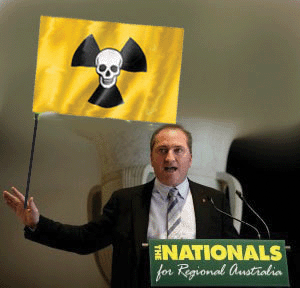
Back in 2013, he made his feelings clear, when he lamented to the Senate the “insane lemming-like desire to go to renewables” in Australia, and questioned what it would do to the national economy.
What is a little surprising is his endorsement of nuclear as a suitable and cheap alternative for new electricity generation in South Australia, as old coal-fired power is retired, when this is precisely the opposite finding arrived at by various recent and significant studies on the subject, not least of all the SA Royal Commission into nuclear power for Australia. Continue reading
Australian indigenous people do NOT agree to nuclear waste dumping on their land
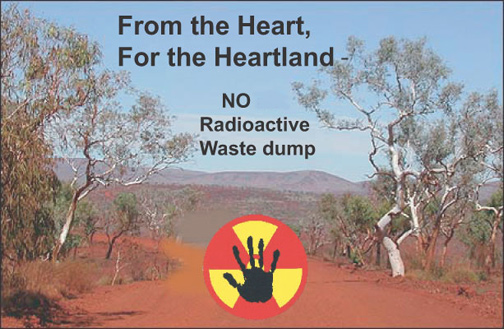 Diane King, 5 Mar 16 The Government may have agreed to mine uranium and take back the waste for storage, but the People DID NOT. The Government does not own the land, it belongs to the Original Sovereign Tribes, who never ceded their Sovereignty to the Grown or the Government. The ‘Australian Government’ is a separate State, an administrative Corporation, who’s services can be dispensed with on your land, if that is what you want. Reasserting Sovereignty over your land is the way to regain control of your land and your future.
Please learn about Sovereignty at the Sovereignty-Truth website:
http://sovereignty-truth.net/about
If government continues the acts of genocide and ‘crimes against humanity’ against you, such as removal of children, unwarranted incarcerations, removal of services and the creation of conditions designed to destroy in whole or in part, your tribe and your culture, severe mental and physical torture, you can ask the International Criminal Court to prosecute them by submitting a detailed complaint to:
otp.informationdesk@icc-cpi.int
Please note that they will only prosecute crimes of genocide and crimes against humanity committed after 2002, and there are strict criteria to be met for an investigation to take place. These are
outlined in Article 6 and article 7 of the Rome Statute:
‘Genocide
For the purpose of this Statute, “genocide” means any of the following acts committed with intent to destroy, in whole or in part, a national, ethnical, racial or religious group, as such:
(a) Killing members of the group;
(b) Causing serious bodily or mental harm to members of the group;
(c) Deliberately inflicting on the group conditions of life calculated to bring about its physical destruction in whole or in part;
(d) Imposing measures intended to prevent births within the group;
(e) Forcibly transferring children of the group to another group.
Article 7
Crimes against humanity
1. For the purpose of this Statute, “crime against humanity” means any of the following acts when committed as part of a widespread or systematic attack directed against any civilian population, with knowledge of the attack:
(a) Murder;
(b) Extermination;
(c) Enslavement;
(d) Deportation or forcible transfer of population;
(e) Imprisonment or other severe deprivation of physical liberty in violation of fundamental rules of international law;
(f) Torture;
(g) Rape, sexual slavery, enforced prostitution, forced pregnancy, enforced sterilization, or any other form of sexual violence of comparable gravity;
(h) Persecution against any identifiable group or collectivity on political, racial, national, ethnic, cultural, religious, gender as defined in paragraph 3, or other grounds that are universally recognized as impermissible under international law, in connection with any act referred to in this paragraph or any crime within the jurisdiction of the Court;
(i) Enforced disappearance of persons;
(j) The crime of apartheid;
(k) Other inhumane acts of a similar character intentionally causing great suffering, or serious injury to body or to mental or physical health.’
You can download the Rome statute from the UN website. Here is a link to the Jurisdiction of the court:
http://legal.un.org/icc/statute/romefra.htm
International criticism of Australian govt cuts to climate science
New York Times criticises CSIRO climate science cuts as ‘deplorable misunderstanding’http://www.abc.net.au/news/2016-03-04/australia-turning-its-back-on-climate-science-nyt-editorial/7222830 By Patrick Wright The New York Times has criticised Australia for turning its back on climate science, saying the CSIRO’s decision to move away from monitoring the changing climate is “deplorable”.
In an editorial titled Australia Turns Its Back on Climate Science, the Times said the federally-funded science agency’s shift in focus made no sense. “To do this at the expense of research and monitoring — undermining the search for commercially viable solutions that CSIRO proposes to join — makes no sense,” the editorial said.
“Long-term research on carbon dioxide levels in the atmosphere, and on changing ocean and weather processes, is essential to learn what lies ahead and how to prepare for it.”
The CSIRO’s new chief executive Larry Marshall, a former Silicon Valley venture capitalist, announced the shake-up in February. The plan, which involves reassigning hundreds of researchers and likely redundancies, came after $110 million was slashed from the organisation’s budget in 2014, a decision that sparked national protests.Thousands of scientists signed an open letter protesting the changes.
The Times said the cuts could affect Australia’s role in supporting the landmark climate agreement reached in Paris in December. “The decision … demonstrates a deplorable misunderstanding of the importance of basic research into what is arguably the greatest challenge facing the planet,” the Times editorial said.
The CSIRO’s shake-up of its Oceans and Atmosphere and Land and Water divisions have drawn the ire of scientific and meteorological organisations around the world.
The World Meteorological Organisation released an unprecedented statement last month condemning the decision.”Normally as a UN agency we would never intervene or interfere like this, but this is just so startling and so devastating that we have to take this stand,” director Dr Dave Carlson said.
Dr Marshall has said there will not be a net loss of jobs due to the restructure.
Western Australia’s largest solar installation at Perth shopping complex
WA’s largest solar installation generating one-third of Perth shopping centre’s power http://www.abc.net.au/news/2016-03-03/solar-panel-installation-broadway-shopping-centre-wa-largest/7217984 By Kathryn Diss A shopping complex in Perth’s western suburbs is generating one third of its power from the sun after undertaking Western Australia’s largest solar panel installation on its roof.
The Broadway Fair complex has installed 948 solar panels with the capacity to generate 312 kilowatts of power. Broadway Fair general manager Paul Avon-Smith said the move would save the complex about $20,000 a month in power bills, which could be put towards funding capital works.

“We were looking for soft approach for the cost of doing capital works,” Mr Avon-Smith said. “It gives us an alternative to help cushion rent increases and price rises for our tenant base in a pretty tough market, but allows us to finance crucial capital works. “So that allowed us to do a roof replacement project, plus put the solar in, with there being no upward pressure on our rents for tenants.”
Infinite Energy installed the system at a cost of $600,000.
Managing director Aidan Jenkins said the huge fall in the cost of solar panels in recent years has meant the business model now stacked up for commercial-sized installations. “Solar currently represents the cheapest way to generate electricity, so we will start to see these type of systems become the norm over the next couple of years.”
Government grappling with ‘tsunami’ of solar installations
Large-scale solar installation poses a big challenge for the Government, which currently has too much available power in its network. The rapid uptake of rooftop solar panels has been a big contributor to the problem, displacing traditional sources of power like coal and gas.
Energy Minister Mike Nahan has been an outspoken supporter of solar power and said the state is going to experience a “tsunami” of these types of commercial installations in coming years.
“It just adds more generating capacity to an already oversupplied system, but it is something we have to cope with,” Mr Nahan said. “Over the next decade these are going to crowd out traditional, large-scale generation of coal and gas. “As we go down the track, these technologies on businesses and households illustrates that into the future we are going to have to reduce our production of traditional energy sources and that’s the challenge.”
Victorian town Newstead set for 100% renewable energy within 5 years
PowerCor’s Thomson says it is clear that the majority of the population in Newstead are passionate  about their goal for 100% renewables, and at least five other townships are looking to follow suit.
Newstead could be the host of Victoria’s first solar-powered micro-grid.
The Victorian government is also heavily involved, allocating $200,000 in the hope that the model created for Newstead can be replicable in other communities across Victoria.
 Australian first: Newstead aims to run on 100% renewable energy within five years, http://www.theguardian.com/sustainable-business/2016/mar/01/australian-first-newstead-aims-to-run-on-100-renewable-energy-within-five-years Guardian, Giles Parkinson, 1 Mar 16
Agreement with energy company Powercor will see Victorian town move to solar power, save money and perhaps become a model for other towns. The quiet Victorian town of Newstead – population approaching 500 – has a big ambition: to source all its electricity needs without burning any fossil fuels at all. Within five years, it wants all of its power to come from renewable energy sources.
Newstead is not unique in that goal. At least a dozen towns around Australia, including Yackandandah, Tyalgum, Byron Bay and Lismore, have declared a similar ambition, even if most are allowing themselves more time to reach the target.
What makes Newstead’s situation particularly interesting is it is going ahead with the support, indeed the encouragement, of its local network provider, Powercor.
An agreement struck between the network and Newstead 2021 – the local group driving the township’s ambition – is being hailed as a “game-changer” for the way communities and network operators work together to accelerate the transition to renewable energy.
Glen Thomson, the head of the energy solutions division of Powercor, says renewable generation is now a reality, and solar, wind power and energy storage are increasingly being integrated into electricity networks. Continue reading
Sapphire Wind Farm to bring huge benefits to Australian Capital Territory’s economy
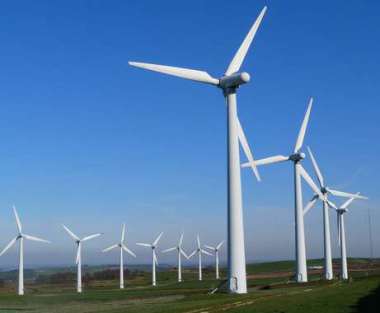 Latest wind auction winner promises millions in benefits to Canberra economy, SMH March 4, 2016 – Tom McIlroy Legislative Assembly reporter at The Canberra Times The fifth and final winner of the ACT government’s large-scale wind reverse-auction will provide enough power for more than 48,000 Canberra homes.
Environment and Climate Change Minister Simon Corbell has announced Sapphire Wind Farm, 18 kilometres west of Glenn Innes in north-eastern New South Wales, as the latest successful proponent from the government’s second wind auction, promising an estimated $100 million dollars in economic benefits to the ACT
Sapphire has been awarded a feed-in-tariff of $89.10 per mW/h for 100mW capacity. The company will spend $34 million on development of an ACT-based asset and operations management centre, relocating operations from Newcastle.
A spokesman for Mr Corbell said the consortium behind the bid included companies Continental Wind Partners and Wind Energy Holdings.
“By the time Sapphire starts producing energy in 2018, the ACT will be sourcing 80 per cent of its energy needs from renewable sources and well on the way to achieving 90 per cent by 2020,” Mr Corbell said.
In August last year, the government called for bids in its second wind auction to power up to 106,000 Canberra homes, seeking 200 megawatts in new capacity to come online within three years.
It follows two previous auctions: in 2013, three solar farms won 20-year feed-in deals, delivering 40 megawatts capacity, and in a wind auction earlier this year three wind farms won similar deals, delivering 200 megawatts among them.
CWP Renewables managing director Alex Hewitt said the auction result had allowed commencement of construction of what will be the largest wind farm in the NSW. http://www.smh.com.au/environment/energy-smart/latest-wind-auction-winner-promises-millions-in-benefits-to-canberra-economy-20160303-gn9n0a.html
Renewable energy micro-grid plannned for Kalbarri, Western Australia
 Renewable energy micro-grid could help restore faith in Kalbarri power supply, ABC News, 3 Mar 16 By Bonnie Christian The WA Government has announced it will commit $300,000 to investigate a way to build an energy micro-grid powered by renewables for the coastal town of Kalbarri.
Kalbarri has experienced several extended power outages over the past two years, costing local businesses thousands of dollars in lost trade and tourism.
The outages had been blamed on a build up of dust and salt on the 140-kilometre-long feeder line that delivers power to the town from Geraldton………..
Rebuilding trust in power supply
Western Power chief executive Paul Italiano said if the new grid did go ahead it would be the largest of its kind in Australia.
“What we’re proposing to do here is evaluating the feasibility of building a micro-grid in Kalbarri that has a combination of solar, perhaps wind, and large scale battery storage that work together to create a level of self-sufficiency for the town,” he said.
“This particular trial — if we’re able to pull it off — will be the largest in Australia.
“There’ll be lessons from this that we can apply to the rest of Western Australia. But more importantly for the whole power industry nationally.”…….http://www.abc.net.au/news/2016-03-02/kalbarri-looks-to-renewable-energy-micro-grid-for-power-solution/7215630
Australia’s uranium -nuclear sector – high risk, low return
Failed Uranium Promises Highlights Need For Caution On Radioactive Waste Plans New Matilda, By Dave Sweeney on March 3, 2016 There’s no market, there’s no expertise, and there’s no need for Australia to become the world’s nuclear waste dump.
Having failed to deliver on promises of national wealth from uranium mining – nuclear industry promoters are now talking up the prospect of ‘stupendous’ riches from Australia hosting the world’s high-level radioactive waste.
The South Australian Nuclear Fuel Cycle Royal Commission, headed by former Governor Rear Admiral  Kevin Scarce, has unleashed a frontier style enthusiasm that has seen SA’s Adelaide Advertiser newspaper trumpeting the “Scrooge McDuck levels of cash which the state would be swimming in”.
With the promised dollar signs shinier in the eyes of many politicians and commentators than the very real danger signs, it is time for some cool heads when it comes to plans to import hot wastes.
As home to around 35 per cent of the world’s uranium reserves, Australia has long been a significant player in the global nuclear trade and there are some useful lessons from this experience.
Since the 1980’s the ‘modern’ period of Australian uranium mining has been dominated by two major operations – Ranger in Kakadu and Olympic Dam in northern South Australia.
The sector has been constrained by political uncertainty, restrictions on the number of permissible mines, a consistent lack of social license and strong Aboriginal and community resistance.
Recent years have seen fewer political constraints but a dramatic decline in the price of uranium and popularity of nuclear power, following the Australian uranium fuelled Fukushima nuclear crisis – which 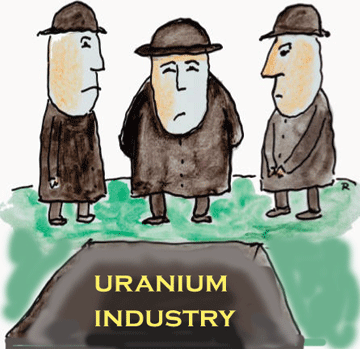 is fast approaching its five year anniversary, and whose radioactive fallout continues to negatively impact lives in Japan and beyond.
Australia now accounts for approximately 11 per cent of global uranium production, down from over 18 per cent a decade earlier.
Australia’s uranium production of 5,000 tonnes in 2014 was the lowest for 16 years.
The industry generates less than 0.2 per cent of national export revenue and accounts for less than 0.02 per cent of jobs in Australia. Less than one thousand people are employed in Australia’s uranium industry.
In short, the sector is high risk and low return………. https://newmatilda.com/2016/03/03/failed-uranium-promises-highlights-need-for-caution-on-radioactive-waste-plans/
From politician to mining executive and back again: how miners control Australian government policy
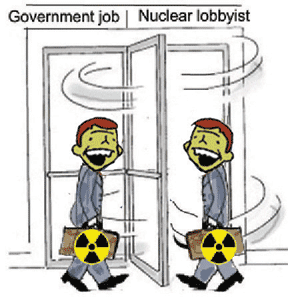 Larissa Waters: Ban donations from mining companies and stop ministers working for them, Larissa Waters, Guardian, 1 Mar 16 “……….The revolving door
Former politicians:
- Former Nationals leader and deputy prime minister John Anderson became chairman of Eastern Star Gas, the company behind the Narrabri Gas Project (which is now owned by Santos) about two years after leaving politics.
- Former Nationals leader and deputy prime minister Mark Vaile became a director and then chairman of Whitehaven coal.
- Former Labor resources minister Martin Ferguson became chairman of the APPEA Advisory Board – in October 2013 – just six months after he stopped being the minister. (The lobbying code of conduct requires an 18-month cooling-off period for ex-ministers).
- Craig Emerson, a former federal Labor trade minister went on to be a consultant for AGL Energy and Santos.
- Former foreign minister Alexander Downer was at one point a registeredlobbyist with Bespoke Approach, which included the likes of Woodside Petroleum, Xstrata, Petrochina and Yancoal among its clients.
- Greg Combet, the federal Labor climate change minister, went on to be a consultant to AGL Energy and Santos.
Political staffers:
- Bill Shorten’s current chief of staff, former Queensland Labor state secretaryCameron Milner, has also worked with Adani. He was director of Milner Strategic Services & Next Level Holdings, which is co-owned by former Liberal staffer David Moore and was reportedly providing advice to Adani on the controversial Adani Carmichael coal project.
- Ben Myers worked for Queensland Gas Company, and went on be Queensland LNP premier Campbell Newman’s chief of staff.
- Mitch Grayson worked as a staffer for Queensland LNP premier Campbell Newman in 2012 and, by early 2013, had joined Santos. Later, he re-joined Premier Newman’s office.
- Stephen Galilee, who worked as chief of staff to Ian Macfarlane as Liberal federal resources minister for three years, and chief of staff to Mike Baird as NSW treasurer and shadow treasurer, went on to be CEO of the NSW Minerals Council.
- Geoff Walsh, former adviser to Labor prime ministers Paul Keating and Bob Hawke, and a former national secretary of the Labor party, was made director of public affairs at BHP in 2007.
- Claire Wilkinson, spent a year as a senior media adviser for Labor resources minister Martin Ferguson before getting a job as a senior external affairs adviser for Royal Dutch Shell. She is now at Total E&P.
- Brad Williams, who spent four years as Mark Vaile’s chief of staff, went on to become the manager for government affairs at Inpex – an oil and gas company that has approval for a $34bn LNG project near Darwin. He is now working in government relations at another mining company, South32.
- Shaughn Morgan worked as adviser to Jeff Shaw, NSW Labor’s attorney general, before becoming the manager of government and external relations at AGL.
- Lisa Harrington was a senior adviser to Mike Baird before becoming the head of government relations at AGL Energy.
- Sarah Macnamara worked at AGL before becoming chief of staff to federal Liberal resources minister Ian Macfarlane, and was resource policy adviser to Liberal PM Tony Abbott.
- Robert Underdown was senior adviser to Liberal resources minister Ian Macfarlane before becoming the manager of the government and public policy group at Santos.
-
- Caroline Hutcherson was senior media adviser to the then Liberal NSW resources minister Chris Hartcher before working as a senior adviser to Santos, and going on to work as a senior adviser to NSW Liberal premier Mike Baird.
- Alexandra Gibson was an adviser to Christopher Pyne, before becoming a policy adviser to APPEA, the oil and gas lobby group.
- Paul Fennelly was the director of the Queensland Department of State Development, Trade and Innovation before becoming the CEO of APPEA.
- Chris Ward was an adviser to the Queensland treasurer and to the consumer affairs minister in the federal Labor government under Kevin Rudd and Julia Gillard, before taking a job as media manager at APPEA.
- Charles Perrottet was senior media adviser to the then Liberal NSW resources minister Chris Hartcher, then an executive of the NSW Liberal party before becoming a government affairs analyst at BP Australia.
- Andrew Humpherson was chief of staff to the then Liberal NSW resources minister Chris Hartcher before working as a consultant to the NSW Minerals Council.
- Emma Browning was a media adviser for the then Liberal NSW resources minister Chris Hartcher before becoming director of government relations at the NSW Minerals Council.
- Brad Emery was a media adviser to federal Liberal minister Peter Dutton before working as director of media and public affairs at the NSW Minerals Council.
- Chris Rath was media and public affairs manager at the NSW Minerals Council before working as an adviser to NSW Liberal resources minister Anthony Roberts.
- Lindsay Hermes was media and communications manager at the NSW Minerals Council before working as an adviser to federal Liberal resources minister Ian Macfarlane. http://www.theguardian.com/commentisfree/2016/mar/01/larissa-waters-ban-donations-from-mining-companies-and-stop-ministers-working-for-them
1 This month
17 October, Free Public Talk on Nuclear Issues in South Australia
David Noonan will speak on public interest concerns over the new Roxby Downs Indenture Act 2026 on BHP copper-uranium mining and ore processing in SA, and on how AUKUS may face SA with a High-Level nuclear waste agenda.
Dr Jim Green will discuss international developments in the field of nuclear power including ‘small modular reactors’ and Generation 4 ‘advanced’ nuclear reactor concepts.


Help Aunty Sue Protect Her Land and Sacred Sites From Destructive Rocket Testing.
.

Australians deserve the truth
about
AUKUS – https://aukuspublicinquiry.com/

PETITION – To: Prime Minister Anthony Albanese and the Australian Labor Government

of the week – Australians for War Powers Reform (AWPR)
To see nuclear-related stories in greater depth and intensity

