South Australian premier out on a limb, as national Labor dithers about nuclear policy
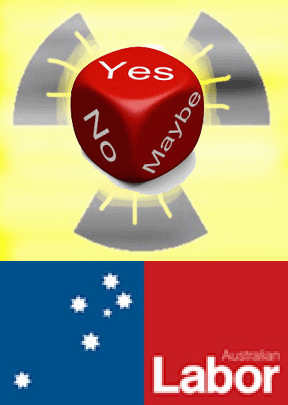 Royal commission tipped to back radioactive dump REBECCA PUDDY, The Australian, Monday 15 February Australia could be a step closer to establishing a nuclear industry today when the interim findings of South Australia’s nuclear royal commission are handed down amid an increasingly favourable political landscape…… it is widely tipped to recommend establishing a high-level radioactive waste dump as a money spinner for the struggling state economy.
The findings are also likely to leave open the option of building a nuclear power reactor in the southern state………..
While Premier Jay Weatherill has committed to responding to the report before the end of the year, his response could be constrained by his party’s national platform. In July it was revealed that Labor had shelved a move to end the party’s opposition to nuclear energy through amending its national platform, which outlines the party’s opposition to nuclear energy.
Labor’s resources spokesman Gary Gray, who was leading the campaign to change Labor’s position, said at the time that the draft proposal to soften the party’s stance on nuclear energy had been set aside while the South Australian Nuclear Fuel Cycle Royal Commission was under way.
The release of the commission’s findings will be accompanied by four technical documents commissioned by Rear Admiral Scarce, which will outline the costs and economic benefits of engaging in the nuclear fuel cycle.
Evidence provided to the commission over the course of its 34 sitting days included a business case that estimated an Australian nuclear reactor would cost between $3 billion and $6bn to build, with operations starting in 2030.
The findings will be released at 11am, with the first of a series of public meetings on the issue scheduled for tonight at the Adelaide Town Hall.
Environmental campaigner David Noonan said anti-nuclear activists would be present at the meeting but would be “deliberately polite”, to ensure the public’s focus stayed on the issue. He said neither of the major parties would advocate for a change in direction with nuclear power or storage until after the federal election, leaving the South Australian Labor government out on a limb.
“There’s a lot of caution there in the political landscape right now,” Mr Noonan said. “Josh Frydenberg will try to get his low-level radioactive waste site over the line before he moves on anything else.”
Dr Jim Green predicts that Nuclear Commission report will be a “foregone conclusion”
Friends of the Earth anti-nuclear campaigner Dr Jim Green said the contents of today’s findings were a “foregone conclusion” accusing the commission of bias.
“We expect that [the findings] will be mostly interested in the idea of making money out of importing high-level nuclear waste,” he said.
Professor Ian Lowe: – “if the royal commission sticks to the facts and what’s proven, I think they’ll inevitably conclude there’s not a strong case for South Australia getting heavily involved in the nuclear industry,”
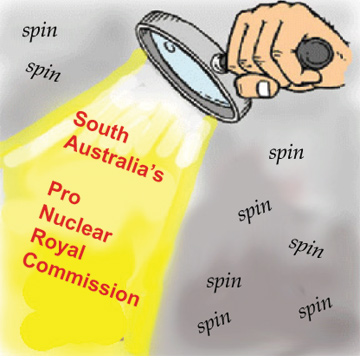 Nuclear dump tipped for South Australia amid ‘desperate’ times, ABC News 15 Feb 16
South Australia’s nuclear royal commission is set to release its tentative findings this morning, with experts from both sides of the debate predicting an outcome in favour of a nuclear dump………The issue has long stirred emotions in South Australia, with former premier Mike Rann and former prime minister John Howard at odds over a nuclear waste dump at Woomera for six years before the proposal was ultimately scrapped in 2004.
Current Premier Jay Weatherill is more receptive to the idea and set up the royal commission, saying there were economic opportunities in the mining, enrichment, energy and storage phases of the fuel cycle.
Flinders University associate professor of politics Haydon Manning said the Premier was looking for political gains as the state struggled with unemployment.
“If you understand the mood of South Australia, there is a degree of desperation,” Mr Manning said…….. Continue reading
Tasmanian Greens stick up for civil liberties, and the right to protest
 Protest laws under fire as Greens to attempt to have legislation banished from statute books http://www.themercury.com.au/news/tasmania/protest-laws-under-fire-as-greens-to-attempt-to-have-legislation-banished-from-statute-books/news-story/a7eec43b2cea4197b229e2a28fbc7c35 February 15, 2016 THE Greens will launch a bid to overturn the state’s anti-protest legislation, which they say is being used to stifle the democratic right to protest.
Acknowledging the attempt had little chance of success in the Liberal-dominated State Parliament, Greens leader Cassy O’Connor said the legislation needed to be overturned
Ms O’Connor said the legislation — which carries maximum fines of $10,000 and mandatory jail terms for repeat offenders — was being used against citizens protesting logging operations in the Lapoinya Forest — contrary to government promises about its intent.
“In recent weeks up at Lapoinya up in North West Tasmania, we’ve seen the Government’s draconian anti-protest legislation actually target the very people that Paul Harriss said it wouldn’t — mum and dad protesters.
“This Bill is not only highly political and draconian it is unnecessary — there is already legislation in Tasmania for trespass and public nuisance and we want to see this Bill banished from the statue books. “I believe this law will not remain on the statue books in Tasmania forever. It may be subject to a High Court challenge. It really has no place in a civil and democratic society like ours.”
Tasmanian spokesperson for Civil Liberties Australia. Rajan Venkataraman, said the Bill was a severe infringement on the right to peaceful protest. “The provisions in this Act are quite unique to Tasmania,” he said.
“Around most jurisdictions in Australia and indeed many countries around the world, they have provisions regarding trespass and public nuisance and certainly violent protest … but this kind of Act specifically targets protesters and specifically peaceful protesters. “The offences created by the Act and the penalties imposed are extreme and not in proportion to penalties imposed under other statutes, even for quite serious and violent offences.”
Resources Minister Paul Harriss dismissed opposition to the laws.
“It says a lot about the Greens that at a time when the state is a facing a number of serious challenges, they are most concerned about changing the law to allow their mates to try to stop others from lawfully harvesting a regrowth forest.”
World’s best-known climate crusader Al Gore urges Australian Government rethink on CSIRO cuts
FORMER US vice president and climate crusader Al Gore has added to the chorus of protest at plans to cull CSIRO’s ocean and atmosphere research positions, of which as many as 193, or 80 per cent, are in Hobart..
http://www.themercury.com.au/news/tasmania/worlds-bestknown-climate-crusader-al-gore-urges-australian-government-rethink-on-csiro-cuts/news-story/feda0e3aaaea4aba128e540d5c4de015
A Constitutional Lawyer examines the arguments for thye UN decision on Julian Assange
Whether or not you believe Mr. Assange is guilty of a sexual offence, whether or not you think he is a self-publicist deliberately resisting arrest, the fact remains that the authorities could use less restrictive means without compromising the initial investigation into the allegations regarding his sexual conduct in Sweden
Liora Lazarus: Is the United Nations Working Group on Arbitrary Detention Decision on Assange ‘So Wrong’? UK Constitutional Law Association 13 Feb 16 The United Nations Working Group on Arbitrary Detention handed down its decision on Julian Assange on Friday 5 February 2015 (A/HRC/WGAD/2015/54). It has been met with almost universal ridicule from a line of British officials, legal academics and the press. The decision has been described as ‘ridiculous’ by the UK Foreign Secretary, Phillip Hammond, and former Director of Public Prosecution Ken MacDonald argues that describing Assange’s conditions as ‘arbitrary detention’ is ‘ludicrous’. The press is equally incredulous. ………
Julian Assange UN Ruling – Geoffrey Robertson QC Joseph Kotrie-Monson interviewed
Factual background
Mr. Assange is wanted for questioning in Sweden to answer allegations of sexual assault. The Swedish prosecutorial authorities have issued a European Arrest Warrant (EAW) which the UK authorities are bound to implement. Mr. Assange, after arrest of 10 days and house arrest thereafter, was granted asylum by Ecuador after his appeal against the EAW failed. This is when he took up residence in the Ecuadorian Embassy in 2012. Assange argues that he fears ultimate extradition from Sweden to the USA on the grounds of his involvement in Wikileaks.
This is obviously no small fear, given the sentencing and treatment of Chelsea Manning in the USA, and the decision of Edward Snowden to take up asylum in Russia. The Swedish authorities refuse to grant Assange any guarantee of non-refoulement to the US, and his right to asylum has also not been recognized by the UK or Sweden. ……..
Mr. Assange argues that he is not free to leave the Embassy; he would have to accept the conditions of his immediate arrest, his extradition to Sweden and his subsequent questioning there. He would have to undertake the risk that he would be extradited to the US, and the subsequent risks to his rights were that to happen.
The mandate of the UN WGAD and the test for ‘deprivation of liberty’ Continue reading
Nuclear Royal Commission Special
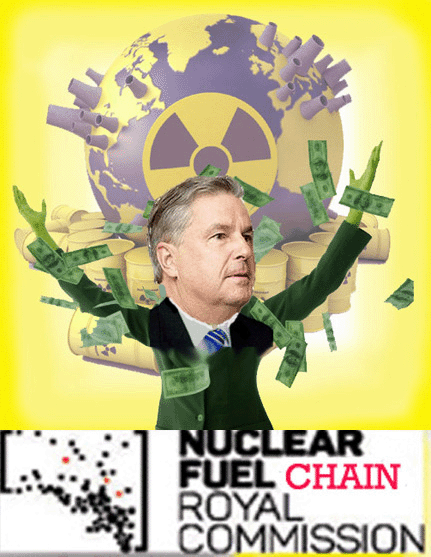
On February 15 the South Australian Nuclear Fuel Chain Royal Commission announced its “tentative findings”
 And guess what – Surprise Surprise!
After many months of such IMPORTANT pro nuclear persons getting paid large amounts of money to trip around the world, getting expert advice from the likes of France’s near bankrupt AREVA, and the crooked Canadian nuclear hierarchy – they came out with the conclusion that they had already decided upon at the beginning:
AUSTRALIA SHOULD BECOME THE WORLD’S RADIOACTIVE TRASH TOILET!
The subservient media and corporate controlled governments of the rest of Australia have just shut up about this for nearly a whole year, in the pretense that “It’s only a South Australian matter”. They left it to the likes of the nuclear lobby’s puppet “The Adelaide Advertiser” to give information on this purely State matter.
 Is it just a State matter? Or is Australia as a whole interested in the Scarce plan for this nation to become the only place in the world to invite in the global nuclear industry’s radioactive poo?
And the only nation foolish enough to think that this will make us prosperous!
South Australian nuclear waste import plan simply cannot succeed
Given the wildly optimistic price for waste modelled by the mid-scenario, not to mention the 56,000 tonnes of waste left over with no costed solution, and with all the uncertainties in developing the new technologies required, the simple conclusion is that this plan is simply all risk with no reward.
No-one else will line up to take advantage of this “once in a lifetime opportunity”, because the opportunity does not exist. The plan simply cannot succeed.

The impossible dream Free electricity sounds too good to be true. It is. A plan to produce free electricity for South Australia by embracing nuclear waste sounds like a wonderful idea. But it won’t work. THE AUSTRALIA INSTITUTE Dan Gilchrist February 2016
“……NO GOOD OUTCOME The free energy utopia depends on two new, as yet unproven technologies: PRISM reactors, and cheap borehole disposal. The Edwards plan appears to rely on these technologies not only being successfully developed, but remaining entirely in Australian hands. Competition is certainly not addressed in the plan.
Northern Territory Mine Regulator gives a free pass for uranium mining companies to pollute
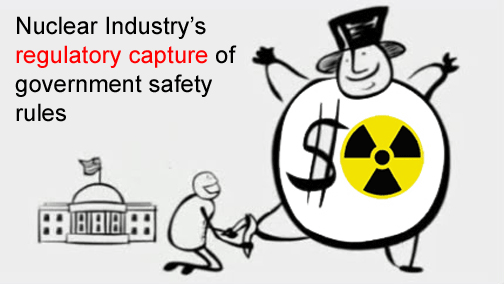 What is a regulator for again? http://linkis.com/greensmps.org.au/1cNkL 12 Feb 2016 The Northern Territory mine regulator is inviting uranium companies to ignore any environmental safeguards with their refusal to prosecute Energy Resources Australia, the Australian Greens said today.
“After more than two years, the NT regulator has given ERA a pass. The Ranger mine leaked nearly 1.5 million litres of radioactive acidic sludge into the plant area, and could have got people killed,” Australian Greens Deputy Leader Senator Scott Ludlam said today.
“Under estimates questioning we were told that the report into the leach tank spill was kept from the public while a decision was made about whether or not to prosecute. It’s hard to envisage a scenario that warranted the application of the full force of the law more than this one.
“The regulator failed to prevent the spill, they took years to deliberate, and came up with nothing. They’ve essentially announced to mining companies in the NT that there are no legal consequences for catastrophic negligence,” Senator Ludlam said.
“We urge the NT government to reverse this decision immediately and force ERA to be accountable.”
No charges over radioactive spill! How nice for ERA!
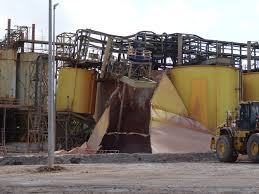 ERA radioactive slurry spill: NT Government won’t lay charges against miner A uranium miner has avoided charges over a 2013 spill of 1,400 cubic metres of radioactive slurry at its Ranger mine in the Northern Territory. ABC News 12 Feb 16
Key Points:
- Report focuses on radioactive spill from 2013 at Ranger Mine near Kakadu NP
- NT Government says not in public interest to lay charges
- Mining company Energy Resources Australia welcomes findings
The spill at the Energy Resources of Australia (ERA) Ranger uranium mine, which is surrounded by Kakadu National Park, saw a holding tank collapse on December 7, 2013. Workers discovered a hole in the side of the tank and were evacuated before the tank burst and the slurry escaped.
ERA said no-one was injured and no uranium leaked off the site into Kakadu.
The NT Government on Friday released the findings of its Completed Investigation Into Failure of Leach Tank 1 Ranger Uranium Mine.
Department of Mines and Energy chief executive, Ron Kelly, explained in the report that he accepted the “admission of fault by ERA to the unauthorised spill as a result of the failure of Leach Tank 1”.
“However I have decided that it is not in the public interest to lay a charge against ERA under Section 33 of the NT Mining Management Act [MMA],” he said……..
EDO blames ‘lack of political will’ for failure to prosecute
Principal lawyer with the non-profit Environmental Defenders Office in the NT, David Morris, said the Government did not need to show that ERA intended for the spill to occur to successfully prosecute the miner.
“The reason they are not bringing this prosecution? I think, lack of political will,” Mr Morris said.
“What this decision does is send a message to the Northern Territory community that we are not going to hold companies to account for a really poor standard of quality control on their mine sites,” Mr Morris said.
He said being forced to shut down the site was not a penalty.
“That is the cost of doing business when you do business poorly.” http://www.abc.net.au/news/2016-02-12/era-avoids-charges-over-radioactive-slurry-spill/7163560
Independent Australia cracks the mystery of “international award” to (Anti) Environment Minister Greg Hunt
 Mystery explained: Hunt’s award handed out by the oil industry, Independent Australia Lachlan Barker 12 February 2016, MANY THIS week, myself definitely included, were gobsmacked by Greg Hunt receiving an award for – get your sick bags ready everyone – “Best Minister in the World“.
When I first saw this, again like so many of you, I thought it was satire, perhaps done by that excellent SBS site The Backburner. I’ve repeatedly been taken in by this site, so plausible are their funny stories and so appalling is our federal government.
But no, when we all got off the floor, the stories were indeed real and Hunt had, indeed, been given this award.
However, I knew there was something rotten here and so I thought I better find out how this bizarre occurrence came about. So I went to the site of the organisation that gave out the award, the World Government Summit. There on the home page is a link to “Partners“, so I clicked on that and discovered that the intriguingly entitled ‘Entrepreneurship Partner’ is the Abraaj Group.
So I clicked on that and we come to the Abraaj page and discover their portfolio. Among them are such heartwarming industries as Chemicals, Metals and Industrials,Pharmaceuticals, Construction and Manufacturing and of course Energy, Mining and Utilities.
[Author lists the companies, with their logos]
One company, Auro Mira Energy is focussed on renewables; they pursue hydro and biomass power generation in India.
However, the rest is largely fossil fuels……..
So there you have it mystery solved, Greg Hunt’s award was sponsored in large part by the energy industry, most prominently oil.
Once I found this out, it kind of made Hunt’s award make sense.
The award was for “Best Minister in the World” and so if you are going to pick a minister who does more than any other to enable the continued and increased use of fossil fuels, then clearly Greg Hunt is your man………
Greg Hunt is the best at enabling ongoing and increasing use of fossil fuels, against all financial and global ecological sense. So they can give him an award, as long as it’s for “Most Destructive Environment Minister the Earth has ever Known”.
Lachlan Barker blogs at cyclonecharlie88.blogspot.com.au. You can follow him on Twitter at@cyclonecharlie8. https://independentaustralia.net/environment/environment-display/mystery-explained-hunts-award-handed-out-by-the-oil-industry,8672
Exploding Senator Edward’s plan for nuclear waste importing
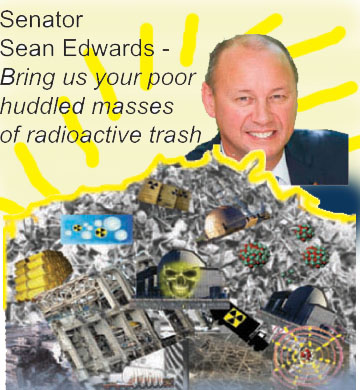 The impossible dream Free electricity sounds too good to be true. It is. A plan to produce free electricity for South Australia by embracing nuclear waste sounds like a wonderful idea. But it won’t work. THE AUSTRALIA INSTITUTE Dan Gilchrist February 2016
2900 scientists urge Malcolm Turnbull to prevent the drastic cuts to CSIRO’s climate researchers
Australia played a vital role in monitoring and modelling, particularly for the southern hemisphere.
 CSIRO climate cuts ‘devastating’, almost 3000 scientists tell Malcolm Turnbull http://www.smh.com.au/environment/climate-change/csiro-climate-cuts-devastating-almost-3000-scientists-tell-malcolm-turnbull-20160211-gms3ea.html Peter Hannam Environment Editor, Almost 3000 scientists from nearly 60 nations have appealed to Prime Minister Malcolm Turnbull and other Australian leaders to halt the CSIRO’s plans to halve the number of researchers working on climate monitoring and modelling.
In a letter that was also sent to the CSIRO’s board and chief executive Larry Marshall, the 2900 researchers said the decision to cut 100 full-time positions out of about 140 staff from two units of the Oceans and Atmospheric division “alarmed the global research community”.
“The decision to decimate a vibrant and world-leading research program shows a lack of insight, and a misunderstanding of the importance of the depth and significance of Australian contributions to global and regional climate research,” the letter said.
“The capacity of Australia to assess future risks and plan for climate change adaptation crucially depends on maintaining and augmenting this research capacity.”
The letter follows a statement earlier this week by the World Climate Research Program that the proposed axing risked severing “vital linkages with Australian colleagues and to essential southern hemisphere data sources, linkages that connect Australia to the UK, the US, New Zealand, Japan, China and beyond”. Continue reading
The massive holes in Senator Edward’s arguments for “new nuclear” technology for South Australia
not a single PRISM [ (Power Reactor Innovative Small Module] has actually been built…. the commercial viability of these technologies is unproven
Crucially, under the plan, Australia would have been taking spent fuel for 4 years before the first PRISM came online, assuming the reactors were built on time.
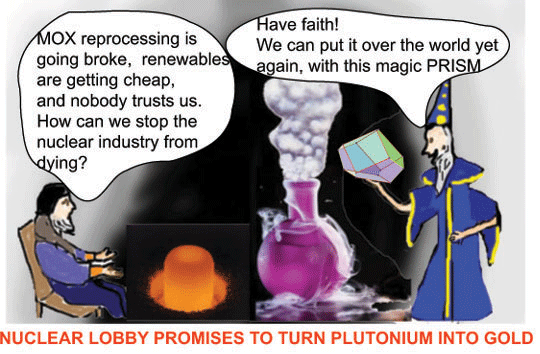
if borehole technology works as intended, and at the prices hoped for, why would any country pay another to take their waste for $1,370,000 a tonne, when a solution exists that only costs $216,000 a tonne, less than one sixth of the price?
 The impossible dream Free electricity sounds too good to be true. It is. A plan to produce free electricity for South Australia by embracing nuclear waste sounds like a wonderful idea. But it won’t work. THE AUSTRALIA INSTITUTE Dan Gilchrist February 2016
“……NEW TECHNOLOGY This comprehensively researched submission asserts that a transformative opportunity is to be found in pairing established, mature practices with cuspof-commercialisation technologies to provide an innovative model of service to the global community. (emphasis added) Edwards’ submission to the Royal Commission
Utility scale solar projects to benefit from ARENA funding as solar costs have fallen
 Cost cuts set solar on track to capture share of RET http://www.smh.com.au/business/energy/cost-cuts-set-solar-on-track-to-capture-share-of-ret-20160209-gmp73f.html February 11, 2016 Angela Macdonald-Smith Energy Reporter Rapid cost reductions have put solar power on a fast-track to capturing at least some of the 2020 Renewable Energy Target market for large-scale projects and are attracting a new breed of player into the local sector.
Last month’s short-listing by the Australian Renewable Energy Association of 22 projects for funding under its $100 million grant round featured a number of names new to Australia, as well as many taking their first foray into solar. Indian conglomerate Adani, better known for its controversial Galilee coal ambitions, also revealed its local solar ambitions this week.
Australia’s wealth of sunshine sets it up to become a leading player in large-scale solar, according to ARENA chief executive Ivor Frischknecht, in a logical follow-on from our enthusiastic adoption of rooftop solar.
Frischknecht points to startling progress on the cost front over the past few years for utility-scale solar projects. Continue reading
Western Australia’s Environmental Defender’s Office slams biodiversity bill
WA enviro defender slams biodiversity bill https://au.news.yahoo.com/thewest/wa/a/30797749/wa-enviro-defender-slams-biodiversity-bill/ AAP February 11, 2016, The Environmental Defender’s Office has advised against passing the West Australian government’s biodiversity conservation bill in its current form, saying the touted benefits are illusory. Environment Minister Albert Jacob introduced the bill in November, describing changes to the Wildlife Conservation Act as “the Holy Grail” of legislation change for every government going back to the 1980s.
The EDO, however, has released a 36-page white paper that strongly disagrees with the touted benefits of the changes.
Principal solicitor Patrick Pearlman conceded the bill had some good features including repealing two obsolete laws and substantially increasing potential fines for violations, but takes “a giant step back in many other ways”.
He said the proposed removal of “even the threat of jail time” for harming highly threatened species was particularly disturbing.
Mr Pearlman said the proposed changes would give virtually unfettered discretion to either the state environment minister or the Department of Parks and Wildlife’s chief executive in decision-making, leaving the scientific community and the public out in the cold when it came to identifying vulnerable species, critical habitat or key threats.
The bill would give offenders defences that would likely undermine enforcement efforts, and broadly exempt government and industry from the new law’s reach, he said.
“Even worse, the bill appears to promote short-term declines to foster development and permits the minister to allow species to be taken to the point of extinction,” he said.
Last year, the state government cut the EDO’s funding completely.
1 This month
17 October, Free Public Talk on Nuclear Issues in South Australia
David Noonan will speak on public interest concerns over the new Roxby Downs Indenture Act 2026 on BHP copper-uranium mining and ore processing in SA, and on how AUKUS may face SA with a High-Level nuclear waste agenda.
Dr Jim Green will discuss international developments in the field of nuclear power including ‘small modular reactors’ and Generation 4 ‘advanced’ nuclear reactor concepts.


Help Aunty Sue Protect Her Land and Sacred Sites From Destructive Rocket Testing.
.

Australians deserve the truth
about
AUKUS – https://aukuspublicinquiry.com/

PETITION – To: Prime Minister Anthony Albanese and the Australian Labor Government

of the week – Australians for War Powers Reform (AWPR)
To see nuclear-related stories in greater depth and intensity


