Inescapable conclusion – nuclear waste dump plan for South Australia is areal dud

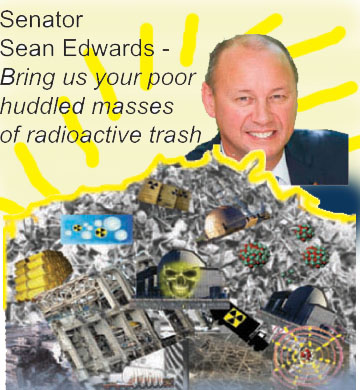 The impossible dream Free electricity sounds too good to be true. It is. A plan to produce free electricity for South Australia by embracing nuclear waste sounds like a wonderful idea. But it won’t work. The Australia Institute Briefing paper Dan Gilchrist February 2016
 Australia Institute Analyses Senator Sean Edwards’ Nuclear Plan For South Australia
The impossible dream Free electricity sounds too good to be true. It is. A plan to produce free electricity for South Australia by embracing nuclear waste sounds like a wonderful idea. But it won’t work. The Australia Institute Briefing paper Dan Gilchrist February 2016
Even if the countries of origin chose not to implement the miraculous technology proposed for South Australia, other countries could compete with Australia to provide this service. A plan predicated on monopoly profits of over 400 percent is, therefore, unrealistic.
Greens ready for #NuclearCommissionSAust report “all about waste dumping”
 “It’s all about the dump”: Greens gear up for nuclear war, IN Daily, 12 Feb 16 The South Australian Greens are preparing for a sustained public relations assault from next week, in the assumption that the Royal Commission into the state’s nuclear fuel cycle will recommend the viability of a nuclear waste dump. The commission, headed by former Governor Kevin Scarce, will detail its “tentative findings” on Monday morning, preceding another round on consultation.
Greens MLC Mark Parnell told InDaily the party had prepared a variety of options for leaflets and online material, with staff “putting out a call to Greens members for volunteers to hand out flyers”.
“What we’re doing is trying to anticipate what the Royal Commission might come up with, so there will be no surprises that the waste dump is front and foremost in our thinking,” Parnell said.
“That’s on the basis that nuclear power is incredibly expensive and slow [so] they might recommend it but I always thought that was less likely. The processing and value-adding stuff – my understanding is economically it doesn’t stack up [and] of all the different things they’re looking at, it keeps coming back to the dump.”
He said insiders he had spoken to insist “it’s all about the dump”.
“That’s the impression that we’ve had since about a week after the Royal Commission was announced, once the terms of reference were announced… but we’re preparing for a few different scenarios so we can respond on Monday,” he said.
“We have several different versions ready to go.”
He said his party’s position on nuclear waste storage “hasn’t really changed over the past many years”, and suggested Labor should maintain the position it took in 2004, when it went to the High Court to kill off a federal proposal to establish a repository at Woomera. Continue reading
Traditional Owners vow to fight nuclear proposals ahead of the Royal Commission’s draft report

Ahead of Monday’s release of the draft report of the Nuclear Fuel Cycle Royal Commission, SA Traditional Owners are once again voicing strong opposition to proposals for expanded uranium mining and proposals for nuclear waste dumps and other nuclear projects.
Sue Coleman-Haseldine, co-chair of the Aboriginal-led Australian Nuclear Free Alliance, is a Kokatha-Mula woman from Ceduna and winner of the 2007 Premier’s Award for excellence for indigenous leadership in natural resource management. Ms Coleman-Haseldine said: “I was born on Koonibba Aboriginal Mission in 1951. Atomic bomb tests began in the desert areas north of my birthplace in 1953 when I was two years old. First at Emu Fields and then Maralinga. I grew up under the Maralinga nuclear cloud. Do I want to see my state known worldwide as a nuclear waste dump? No. Do I have the right to subject our future generations to a life of nuclear fear? No. Accidents happen, be it at a uranium mine or on a nuclear freeway or at a nuclear reactor or a dump site.”
Kevin Buzzacott, Arabunna elder and President of the Australian Nuclear Free Alliance said: “We will fight this industry across the country, whether it be the expansion of uranium mining or a nuclear waste dump. It is our cultural obligation and responsibility to care for our land. It’s time the government and nuclear industry acknowledge and listen to us. There are and have been so many sick people as a result of this industry. Why has there not been a Royal Commission into the intergenerational health impacts of this industry? How will this Royal Commission measure the risks and impacts on culture and country? You cannot put a number on these things.”
Copied below is a statement from SA Traditional Owners.
 South Australian Traditional Owners say NO!
Statement from a community meeting held in Port Augusta on Saturday 16 May, 2015 to discuss the Royal Commission into the Nuclear Fuel Cycle.
We oppose plans for uranium mining, nuclear reactors and nuclear waste dumps on our land.
We call on the SA Royal Commission to recommend against any uranium mining and nuclear projects on our lands.
We call on the Australian population to support us in our campaign to prevent dirty and dangerous nuclear projects being imposed on our lands and our lives and future generations.
Endorsed by members from the following groups, Kokatha, Kokatha-Mirning, Arabunna, Adnyamathanha, Yankunytjatjara-Pitjanjatjara, Antikirinya-Yunkunytjatjara, Kuyani, Aranda, Western Aranda, Dieri, Larrakia, Wiradjuri
Senator Scott Ludlam backs 6 Australian communities opposing nuclear waste dump
 Greens senator wants towns off shortlist for waste dump site A Greens senator has backed six Australian communities campaigning to stop a nuclear waste dump being established in their areas. The Weekly, Mudgee, NSW, 10 Feb
- Acknowledge the opposition and lack of community support at all six sites, respect previous commitments on non-imposition and the importance of community consent, and remove all six sites from further consideration.
- Initiate a genuinely independent inquiry to investigate long-term stewardship options for spent fuel, reprocessing waste, and other categories of radioactive waste, including drawing on international examples and experience.
- Investigate options for active waste minimisation, including increased use of non-reactor based methods for radioisotope production.
- Clearly reaffirm policy and legislative prohibitions on the importation and disposal of international radioactive waste.
Strong opposition to Hill End nuclear waste plan- petition

 Petition calls to halt Hill End waste plans By ELLE WATSON , The Weekly, Mudgee, NSW, 10 Feb 16 Campaigners against a proposed nuclear waste dump at Hill End have taken to the streets of Mudgee to gather support for a petition to be presented to parliament later this month.
Senator Edwards’ fantasy of free nuclear electricity for South Australia
Free nuclear power is a fantasy: Report http://www.tai.org.au/content/free-nuclear-power-fantasy-report# A new report from The Australia Institute shows that a proposal to establish a global nuclear waste industry in South Australia would fail to secure 90% of the imported waste, leaving an expensive and risky legacy for the state.
The report was commissioned by the Conservation Council of South Australia to analyse the submission to the South Australian Nuclear Fuel Cycle Royal Commission by Liberal Senator Sean Edwards. The Royal Commission is due to release tentative results next week.
“The Edwards plan is deeply flawed. It is a plan funded by taking thousands of tonnes of nuclear waste, but would fail to process over 90% of that waste, leaving it to future generations to deal with,” said report author, The Australia Institute’s Dan Gilchrist.
Senator Edwards is proposing that South Australia imports 60,000 tonnes of spent nuclear fuel from other countries, and then leaves most of it, 56,000 tonnes, in dry cask storage which is designed for temporary use.
Report: The impossible dream: Free electricity sounds too good to be true. It is.
“The plan relies on technology that has never been deployed commercially – not with all the expertise in France or Germany or Japan or the United States.
“Indeed, logically, if a viable solution emerges, other countries will no longer pay Australia billions to hand over the waste.
“The plan fails to consider a basic economic principle: if Australia can generate free electricity – why wouldn’t other countries?
“Nothing in the plan explains what our great-great grandchildren are meant to do with this legacy. Indeed, the plan never mentions the leftover waste, as if it was not worth worrying about. Worse, all the money is spent in the first 50-60 years. Nothing is left to deal with the leftover waste.
“In many ways it is like a vastly complex loan. Australia will ‘borrow’ many billions of dollars, spend the lot, and leave it to future generations to pay it back. Indeed, a loan would be better, since it would not require South Australia to store tens of thousands of tonnes of radioactive material in the meantime.
“It is no wonder that Senator Edwards has been able to promise free electricity and reduced taxes. He is spending someone else’s money. Eventually, however, the piper must be paid.”
Sean Edwards proposal for nuclear pot of gold – a myth, says South Australia’s Conservation Council
Nuclear Pot of Gold is a Myth Conservation Council of South Australia, 11 Feb 16 The state’s peak environment body has welcomed today’s release of a new report that questions grandiose claims of an economic bonanza arising from the creation of a global nuclear industry in South Australia.
The report The impossible dream. Free electricity sounds too good to be true – it is was prepared by leading economic think-tank The Australia Institute. The Conservation Council of South Australia commissioned The Australia Institute to analyse the submission of Senator Sean Edwards to the SA Nuclear Royal Commission.
Conservation SA Chief Executive Craig Wilkins said the analysis presented a much-needed dose of reality.
“There’s been a lot of grandiose claims made about a nuclear waste-led economic boom for our state, including free power and the scrapping of all state taxes,” Mr Wilkins said.
“The reality is there is no magic pot of gold.
“The Edwards proposal manages to ignore basic economic laws of supply and demand while leaving tens of thousands of tonnes of highly radioactive nuclear waste for future generations to deal with.
“Either way you look at it the Edwards proposal contains high risk and fuzzy logic.
“Either South Australia solves the problem of long-term safe storage of toxic nuclear waste – a problem that no other country has yet been able to fix despite decades of research and failed proposals – in which case other countries will simply follow our lead and we quickly lose our monopoly position that underpins the economic case Senator Edwards is making, or we don’t solve it and are left with a social, economic and environmental nightmare for our state.
“This is not a legacy we should be leaving for our children.”
The Royal Commission is due to release tentative results Monday morning at 11am.
The Australia Institute Report can be found here and attached below. The Edwards submission can be found here. The Conservation SA submission to the Royal Commission can be found here. A critique of the Royal Commission can be found here.
Senator Sean Edwards’ Impossible Nuclear Dream
The impossible dream: Free electricity sounds too good to be true. It is. A new report from The Australia Institute shows that a proposal to establish a global nuclear waste industry in South Australia would fail to secure 90% of the imported waste, leaving an expensive and risky legacy for the state.
The report was commissioned by the Conservation Council of South Australia to analyse the submission to the South Australian Nuclear Fuel Cycle Royal Commission by Liberal Senator Sean Edwards. The Royal Commission is due to release tentative results next week.
Senator Edwards is proposing that South Australia imports 60,000 tonnes of spent nuclear fuel from other countries, and then leaves most of it, 56,000 tonnes, in dry cask storage which is designed for temporary use.
Telstra to rollout solar and battery storage technologies
 Telstra takes on energy utilities with home solar and storage plan, Independent Australia Giles Parkinson 11 February 2016 Telstra’s rollout of solar and battery storage looks to be a game-changer in the home energy market. RenewEconomy‘sGiles Parkinson reports.
AUSTRALIA TELECOMMUNICATIONS giant Telstra plans to accelerate the rollout of solar and battery storage technologies, and is looking to offer home energy services to millions of consumers in the first sign it will take on the major energy utilities.
Telstra has established a dedicated project team to be led by Ben Burge, the feisty CEO of Powershop and Meridian Energy Australia,which has made major inroads into the Australian energy oligopoly, and which has been a keen proponent of wireless technology and smart-phone apps.
The arrival of a giant corporation such as Telstra into the home energy market signals massive change in the industry, as new technologies such as solar and battery storage, and the “internet of things” offer new avenues to the consumer market.
Telstra is flagging the possibility of offering home energy services – including solar and battery storage – as part of its bundled services that includes internet and telephone.
Telstra’s head of new business, Cynthia Whelan says in her corporate blog:
We see energy as relevant to our Connected Home strategy, where more and more machines are connected in what is called the Internet of Things.
We are looking at the opportunities to help customers monitor and manage many different aspects of the home, including energy……..
Analysts have predicted for several years now that the traditional energy industry would come under attack from new players such as telcos, and IT giants such as Google.
Mark Coughlin, the head of utilities at PwC, says electricity utilities, are facing their “Kodak moment” as the emergence of rooftop solar, in combination with battery storage and smart software, shift the power from the utility to the customer.
And, he says, telcos such as Telstra are better at consumer service than energy utilities, which will struggle to maintain their right to survive. …….https://independentaustralia.net/environment/environment-display/telstra-takes-on-energy-utilities-with-home-solar-and-storage-plan,8666
Companies like AGL waiting for government clarity on renewable energy policy
 AGL puts an each-way bet on renewable energy, The Age February 11,
  2016 Elizabeth Knight AGL:Environmental terrorist or evangelist? Take your pick but financial pragmatist is probably the best description.
The fact is that this company makes most of its earnings off the back of carbon producing coal-fired energy production and is using the proceeds to seed a $3 billion renewable energy fund that will invest in clean sources of power like solar and wind.
There is nothing new age environmentally conscious in this. Like any corporation that is looking to maximise returns, AGL (like several others) understands that the writing is on the wall for the the production of dirty energy – in the longer term. Thus it is making an each-way bet on the future.
Make no mistake, companies like AGL make investment decisions primarily with reference to investment returns rather than environmental outcomes – regardless of the rhetoric. This is the company that last week announced it was winding down its interest in the coal seam gas industry.
Once again it was influenced by community uproar and protests about fracking in their back yards but the decision was one centred on the the gas supply/demand equation and the capital costs of firming up an unreliable coal seam gas resource……..
Renewables tipped to pay off
Longer term it is clear that AGL is taking a punt that the balance will ultimately move between clean renewable energy and the dirty stuff which earns its healthy profits today – hence this week’s creations of the renewables fund.
One of its existing clean energy assets will be effectively vended into this new renewables fund…….
To really move the dial towards producing cleaner energy, companies like AGL need stronger support from the government which under the Abbott government gave them little certainty about how much support and financial incentive would be given to green policies.
And AGL is the first to admit that the changes in government policies over the past 4 -5 years has made investment decisions difficult.
Ultimately AGL, which is the country’s largest generator, its largest emitter of greenhouse gases and the largest builder and operator of renewable energy is a particularly important part of the conversation about Australia’s energy use and generation.
And as such the allocation of its investment should exert some influence on government policy. But it is limited in how fulsome any commitment to investment in clean energy can be until it can be secure with the level and the timing it will receive from legislators. : http://www.theage.com.au/business/comment-and-analysis/agl-puts-an-eachway-bet-on-renewable-energy-20160210-gmqh1t#ixzz3zu51N8JO
Big Electricity Company AGL launches $3b renewable energy fund
AGL Energy going greener with launch of $3b renewable energy fund, SMH February 10, 2016 Angela Macdonald-Smith Electricity major AGL Energy has taken its most decisive steps yet to reposition itself for a lower-carbon future, launching a $3 billion renewable energy project fund and investing $US20 million ($28.4 million) in a Californian solar and battery storage developer.
The latest moves come less than a week after the country’s largest emitter of greenhouse gases announced it would quit natural gas production and caps what chief executive Andy Vesey describes as a “very significant strategic pivot” during his first 12 months in the role.
The new unlisted fund will hold AGL’s recently completed solar power projects in western NSW and will be partly owned by AGL, which will contribute $200 million in equity, alongside partners which are likely to be local infrastructure funds.
AGL’s exit from gas production incurred a $640 million after-tax write-down, as flagged last week, which drove the company into the red in the first half……..
Mr Vesey said the strong performance of AGL’s core business “highlights that we are well positioned to capitalise on the evolution occurring in the energy sector”, leading to the launch of the Powering Australian Renewables Fund, which he had hinted at late last year.
The fund will aim to develop at least 1000 megawatts of large-scale renewables projects, about 20 per cent of capacity needed to meet the 2020 Renewable Energy Target, at a cost of $2 billion to $3 billion.
Feedback from “soft soundings” among potential co-investors has been positive, with the line-up of partners likely to be finalised towards the end of June, Mr Vesey said. Australia’s large banks are likely to contribute senior debt, while mezzanine financing could also be involved, said chief financial officer Brett Redman.
Green welcomeGreen groups welcomed news of the fund, with Clean Energy Council head Kane Thornton describing it as the sort of move that is “crucial to unlocking the many thousands of megawatts of renewable energy projects that are ready and waiting to be built around Australia.” http://www.smh.com.au/business/energy/agl-energy-going-greener-with-launch-of-3b-renewable-energy-fund-20160209-gmq2in.html#ixzz3zu38xisy
A big mistake to gut CSIRO climate change research
 The gutting of CSIRO climate change research is a big mistake, Guardian, John Abraham, 10 Feb 16 To be able to adapt to climate change, we need scientists to project how the climate will change Last week, surprise news shocked the world’s scientific community. One of the most prestigious and productive scientific organizations is slashing hundreds of jobs, many related to climate change research. The organization, the Commonwealth Scientific and Industrial Research Organization (CSIRO for short) is simply put, one of the best in the world. It rivals well-known groups like NASA, NOAA, and the Hadley Centre for its contributions to climate science.
What does CSIRO do that is so special? Many things. For instance, they are world leaders in measuring what is happening to the planet. Their research includes ocean-going vessels and other instrumentation that measure the chemistry and temperature of the ocean; they help track where human-emitted carbon dioxide is going, how heat is building up in the oceans, and what is happening with the general health of the ocean biosystem.
CSIRO is also a modeling superpower. Their climate models form the backbone of our understanding of what changes have happened and what changes will happen because of human greenhouse gases.
But they also have deepened our knowledge about extreme weather. They’ve provided insights regarding how droughts, heat waves, and floods will change in the future.
All of these contributions are important not only for the understanding that they provide but also because this knowledge helps us plan for the future. If you want to know what we can do to mitigate or adapt to climate change, you need this information.
But according to CSIRO chief executive, Larry Marshall, CSIRO should shift focus. …….
Australia is a small country (by population). Yet, it has punched far above its weight class in research. To think that this treasure of a research organization will be gutted is just shocking.
This story has gotten a lot of press in Australia such as here and here. It is also covered in international venues such as here and petitions such as here and here. Let’s hope this move is reversed before it is too late. http://www.theguardian.com/environment/climate-consensus-97-per-cent/2016/feb/10/the-gutting-of-csiro-climate-change-research-is-a-big-mistake
UN Statement on arbitrary detention of Julian Assange
 Julian Assange arbitrarily detained by Sweden and the UK, UN expert panel finds United Nations Human Rights Office GENEVA (5 February 2016) – WikiLeaks founder Julian Assange has been arbitrarily detained by Sweden and the United Kingdom since his arrest in London on 7 December 2010, as a result of the legal action against him by both Governments, the United Nations Working Group on Arbitrary Detention said today.
In a public statement, the expert panel called on the Swedish and British authorities to end Mr. Assange’s deprivation of liberty, respect his physical integrity and freedom of movement, and afford him the right to compensation (Check the statement: http://www.ohchr.org/EN/NewsEvents/Pages/DisplayNews.aspx?NewsID=17012&LangID=E) Continue reading
Adani going for solar energy project in Australia
Adani pursuing solar energy project February 10, 2016 Indian mining giant Adani is pursuing a solar power project in Australia after years of delays in building a mega coalmine in central Queensland.
The company has confirmed it is chasing investment opportunities in Australia’s solar generation sector, saying it is focusing on potential opportunities in Queensland and South Australia……. http://www.brisbanetimes.com.au/queensland/adani-pursuing-solar-energy-project-20160210-gmqj19.html#ixzz3ztbMquoa
1 This month
17 October, Free Public Talk on Nuclear Issues in South Australia
David Noonan will speak on public interest concerns over the new Roxby Downs Indenture Act 2026 on BHP copper-uranium mining and ore processing in SA, and on how AUKUS may face SA with a High-Level nuclear waste agenda.
Dr Jim Green will discuss international developments in the field of nuclear power including ‘small modular reactors’ and Generation 4 ‘advanced’ nuclear reactor concepts.


Help Aunty Sue Protect Her Land and Sacred Sites From Destructive Rocket Testing.
.

Australians deserve the truth
about
AUKUS – https://aukuspublicinquiry.com/
PETITION – To: Prime Minister Anthony Albanese and the Australian Labor Government

of the week – Australians for War Powers Reform (AWPR)
To see nuclear-related stories in greater depth and intensity

