The Lizard is biting back at Olympic Dam uranium mine
 Lizard’ bites back with new message http://www.themonitor.com.au/news-articles/160210-lizard-bites-back-with-new-message– 10-Feb-2016 Patrick Glover Hundreds of protestors are set to descend on Olympic Dam for a three-day festival in July.
The Desert Liberation Front previously visited the area in 2012 with its Lizard’s Revenge event.
This year’s gathering, which will run from July 1-3, is being called The Lizard Bites Back.
“The first time, we were very focused on the expansion with the announcement having only been made a few months prior to our visit,” said event co-organiser Nectaria Calan.
“The mine is still there, and it’s four years later now, so we thought it was time to go back to the source.
“The mine is always an issue. It was not just when the expansion was going ahead – it is one of the largest uranium mines in the world, so for us it is already having an impact.
“Now there is the Royal Commission (into nuclear energy) on”
Ms Calan said the event was still in the early planning stages and no activities had been planned yet.
However, she said the group was hoping to hold educational workshops and other activities as part of the ‘protestival’.
The group is also aiming to reach out to more locals this time around. It is inviting anyone interested to visit the campsite during the event.
Ms Calan said she was hoping for a similar attendance to the previous festival’s crowd of hundreds.
Senior Sergeant Terry Boylan said South Australia Police (SAPOL) was well under way with planning for this year’s protest, as extra officers may need to be called in.
A BHP Billiton spokesperson told The Monitor the company wished to make no comment regarding the protestors’ visit at this point in time.
Environmental Defenders Office (SA) outlines critical issues in proposal for nuclear waste facility
 Possibility of a high level nuclear waste facility in SA Environmental Defenders Office (SA) Inc. The environment’s legal team since 1992 – protecting the public interest – evening the odds 10 Feb 16
As our nuclear industry, insofar as it exists is principally focused on mining and not on the generation of electricity there would have to be a large amount of new legislation that would have to be enacted in order to establish a high level nuclear waste facility in SA. There are issues regarding environmental impacts, workplace safety, the imposition on aboriginal land, the impact on future generations, the potential for technological changes and security concerns.
Some of the major issues.
Continue reading
South Australia – decision on nuclear expansion at end of 2016
 SA govt to hold off on nuclear call http://www.9news.com.au/national/2016/02/09/16/44/sa-govt-to-hold-off-on-nuclear-call South Australia’s government won’t decide whether to expand its nuclear industry until the end of the year, despite a royal commission preparing to release tentative findings.
Former governor Kevin Scarce will on Monday reveal his initial response to whether SA should play a bigger role in the mining, enrichment, energy and storage aspects of the nuclear fuel cycle before releasing his final report on May 6.
Premier Jay Weatherill told parliament on Tuesday that the government will consult with the community and the Commonwealth and provide its response before the end of the sitting year in December.
South Australian Premier Jay Weatherill’s Statement to Parliament on Nuclear Fuel Cycle Royal Commission
 Premier Jay Weatherill tabled a Statement (9/02/16) outlining the progress and next steps for the South Australian Nuclear Fuel Chain (sorry, they call it “Cycle”) Royal Commission.
Following the release on February 15, of its “tentative findings“, the Commission will hold a five week “comment period”, during which public meetings will be held in:
Adelaide, Port Pirie, Port Augusta, Whyalla, Port Lincoln, Mt Gambier, Ceduna, Renmark, and Aboriginal communities in the Far North and West Coast.
On 6 May, the Commission will present its final report.
Next – community discussion between May and August.
“Once we have the findings, I would anticipate some engagement with the Commonwealth Government about the final report”
Then “a period of decision making where Government will need to assess the evidence gathered by the Commission, and the feedback from the community before outlining its full response to the Royal Commission
I expect to provide a full response to the Royal Commission to the Parliament before the end of sitting this year.”
In bushfire season, Solar microgrids and batteries are safer than conventional grid
 Turner says his company has been in productive talks with Victorian energy minister Lily D’Ambrosio over the prospect of subsidising Zen Energy systems capable of running as a localised backup for periods when the grid needs to be switched off
|
Solar microgrids and batteries could prevent another Black Saturday bushfire, Guardian, Max Opray 9 Feb 16, The cause of the Kilmore East fires that contributed to Victoria’s 2009 Black Saturday bushfires was found to be an ageing SP AusNet power line
Smaller sustainable energy systems are a better option than trying to maintain ageing Australian energy infrastructure, say experts On 7 February, Australia solemnly marked the anniversary of an electrical fault.It was on this date in 2009 that Melbourne endured its hottest conditions on record – a sweltering 46.4C. To make matters worse, hot winds blasted through the region at speeds in excess of 100km/h. In Kilmore East, just north of Melbourne, a critical failure in a 43-year-old power line caused bursts of 5000C plasma to arc out and ignite the tinder-dry vegetation in the gully below. Fanned by such extreme winds, the fast-growing inferno would by the end of the day be responsible for the majority of the 173 lives lost in the dozens of fires that engulfed Victoria on Black Saturday, Australia’s worst bushfire disaster. Several of the other blazes that day were started by felled power poles and other electrical issues. This was also the case for many other fires before and since, including Australia’s previous-worst bushfire tragedy, the 1983 Ash Wednesday fires, which claimed 75 lives. Richard Turner, director of South Australian renewable energy powerhouse Zen Energy, has a plan to stop such a thing happening again. Continue reading |
South Australia Riverland farmers get new crop – harvesting the sun
 Solar venture in SA Riverland aims to make abandoned crop land productive again, ABC News, 10 Feb 16 By Isabel Dayman Solar energy might be a saviour for some South Australian Riverland fruit growers who abandoned their crops and land during severe drought late last decade.
Key points:
- Solar test site has 800 panels on the roof of an old storage depot
- Proponent Mark Yates says all profits would stay in the local community
- Many fruit blocks were abandoned at the end of last decade due to severe drought
A test site with 800 solar panels on the roof of an old storage depot at Renmark has been set up by Yates Electrical Services director Mark Yates to show what might be possible.
“We wanted to use this as a test case to see what the viability of the small-scale generation plants could be and whether they could be implemented in a community,” he said.
“We’d like to get 12 months of full data — that way we can draw a really clear picture and be really transparent to show people what the costs are and what the returns are.”
Mr Yates said the owners of vacant fruit blocks might be able to generate a profit from the abandoned land, which he said would be preferable to letting big investors set up large-scale solar operations and take any profits elsewhere.
“With our small-scale solar farms, 100 per cent of the profits that the system generates can be retained by the local community,” he said.
“Traditional methods of generating income are always going to [be there], but I suppose this is just a way we can introduce a completely new market to the area.”…….. The Renmark solar test site is expected to start generating power from the region’s abundant sunshine by the end of this month, and it is planned to be sold into the electricity grid. http://www.abc.net.au/news/2016-02-08/solar-plan-a-ray-of-hope-for-riverland’s-former-fruit-growers/7149150
Clean Energy Finance Corporation funds Energy-efficient housing
 Energy-efficient housing to get $250m boost from Clean Energy Finance Corporation, Guardian, Lenore Taylor, 8 Feb 16
The agency, which the government is still seeking to abolish, will fund up to 1,000 homes for low-income earners. The Turnbull government will announce $250m in loans for energy-efficient public housing on Tuesday, funded by an agency it is still seeking to abolish.
The $250m will be provided by the Clean Energy Finance Corporation (CEFC) to community housing providers to fund up to 1,000 new energy-efficient homes for low-income earners.
The government says it would still like to abolish the CEFC but cannot get the legislation through the Senate. Instead it is merging the body into a new division in the environment department called “climate change and renewables innovation”, apparently to reassure Coalition MPs sceptical about the CEFC’s operations that it is working in coordination with Coalition policy……..
Under Tony Abbott, the Coalition sought to ban the CEFC from investing in windfarms and the former treasurer Joe Hockey labelled it a “giant $10bn slush fund”.
After Malcolm Turnbull became prime minister that directive was softened to a request that it focus on “offshore wind technologies” as well as cities and the built environment. Hunt says abolishing the investment bank is still his “long-term” policy…… http://www.theguardian.com/australia-news/2016/feb/08/energy-efficient-public-housing-to-get-250m-boost-from-clean-energy-finance-corporation
Rural Australia loses climate science guidance from CSIRO
Martin McDonald: Climate change has not been answered for farmers – we need more information, not less
Cuts to the CSIRO’s climate and land and water research will make finding solutions – and making milk Australian families can afford – ever more difficult
http://www.theguardian.com/commentisfree/2016/feb/09/climate-change-has-not-been-answered-for-farmers-we-need-more-information-not-less
 Canberra Times Editorial: CSIRO a chance for PM to lead on climate
Malcolm Turnbull should give the research organisation with a little more room to breathe.
http://www.canberratimes.com.au/comment/ct-editorial/csiro-has-given-the-prime-minister-an-opportunity-to-lead-on-climate-policy-lead-20160208-gmp38x.html
Mel Fitzpatrick: Job cuts threaten to sink science
CLIMATE research community fears Australia’s highly regarded programs are at risk
http://www.themercury.com.au/news/opinion/talking-point-job-cuts-threaten-to-sink-science/news-story/a6932b8499835afe3233593a3df7ac52
Australian Government cuts climate science jobs at CSIRO
 CSIRO climate scientists speak out about job cuts
As the boss of the CSIRO continues to defend his planned restructure, senior climate scientists have spoken out about their fears. A Chief Research Scientist has told PM Australia risks losing world-leading research capabilities. Another says climate work that helps with weather prediction, ocean rescue, defence capabilities and natural disaster prediction is under a cloud.
http://www.abc.net.au/pm/content/2015/s4402366.htm
CSIRO staff ponder industrial action over climate shake-up
CSIRO’s staff body has taken steps towards industrial action as the fallout from the restructure continues.
http://www.theaustralian.com.au/national-affairs/industrial-relations/csiro-staff-ponder-industrial-action-over-climate-shakeup/news-story/f09aab1d5ae2c0c8128cecd0496d0cab
CSIRO cuts criticised by senior UK climate scientist – don’t stop the underpinning science
A senior climate scientist at the UK national weather service has criticised the proposed job cuts at the CSIRO, which will reduce the organisation’s capacity to monitor climate change.
http://www.abc.net.au/worldtoday/content/2015/s4402135.htm
Michael Slezak: CSIRO climate cuts attack a national treasure when we need it most
Chief executive Larry Marshall is right that we need to invest in adaptation, but this requires a proper understanding of how the climate will change
http://www.theguardian.com/australia-news/2016/feb/08/csiro-climate-cuts-would-be-attacking-a-national-treasure-when-we-need-it-most
John Birmingham: Blunt Instrument: CSIRO cuts bring Australia global fame for choosing stupid
From the earliest days of the penal colony the journals of the First Fleet officers remarked upon the weird, often violent climatic changes that made survival in the antipodes such a fraught, contingent affair.
http://www.canberratimes.com.au/comment/blunt-instrument/blunt-instrument-csiro-cuts-bring-australia-global-fame-for-choosing-stupid-20160208-gmovwf.html
UN report finds in favour of Julian Assange
Assange also remains fearful of a potential future extradition to the US, where a secret grand jury has been looking into whether to prosecute him over WikiLeak’s publishing activities……..
the former chair of the UN working group, Mads Andenas, defended its finding, saying: “There is no doubt that the normal course of action for the Swedish authorities would have been to interview Assange in London. The extradition request was disproportionate
 Julian Assange: ‘sweet’ victory soured by British and Swedish rejection
No release in sight despite UN panel deciding WikiLeaks founder is being arbitrarily detained at Ecuador embassy, Guardian, Esther Addley,Owen Bowcott,David Crouch in Gothenberg, and Jessica Elgot 5 Feb 16 A UN panel may have found that Julian Assange is subject to “arbitrary detention” and called for him to be allowed to walk free, but the WikiLeaks founder remains exactly where he has been for the past 44 months – inside Ecuador’s London embassy and locked in a three-nation war of words.
Britain and Sweden immediately rejected the UN report, which declared that Assange had been “arbitrarily detained” since his arrest in 2010 and during his lengthy stay in the embassy, where he sought asylum in June 2012. The British foreign secretary, Philip Hammond, described the findings as “ridiculous” and the Australian as a “fugitive from justice”.
However, the panel’s findings, leaked on Thursday and published in full on Friday morning, were a welcome victory for Assange, and a moment he intended to savour fully. At 4.01pm he emerged on to the balcony of the west Londonembassy to greet a crowd of several hundred supporters and journalists, pausing first, just briefly, to glance at the sky he has rarely seen for more than three years.
“How sweet it is,” said Assange, holding aloft a copy of the UN report while supporters shouted: “We love you, Julian!” It had been, he said, “a victory of historical importance”, and a decision reached after a process to which both Britain and Sweden had made submissions. “They lost. UK lost; Sweden lost.”
The Swedish government, however, has insisted the report changes nothing, and that it cannot interfere in an independent prosecutor’s ongoing attempt to extradite Assange for questioning over an allegation of rape dating from 2010, which he denies.
Meanwhile, for Ecuador – the Australian’s (mostly) willing host – the findings meant it was time for the two countries to allow Assange to walk free, and to compensate both him and them for the lengthy period he has been holed up in one of its few rooms……
After exhausting all his legal options in the UK and Sweden some time ago, there is no question that the report represents a boost for Assange’s legal team. Continue reading
Calm heads and clear information needed on nuclear medicine and waste claims
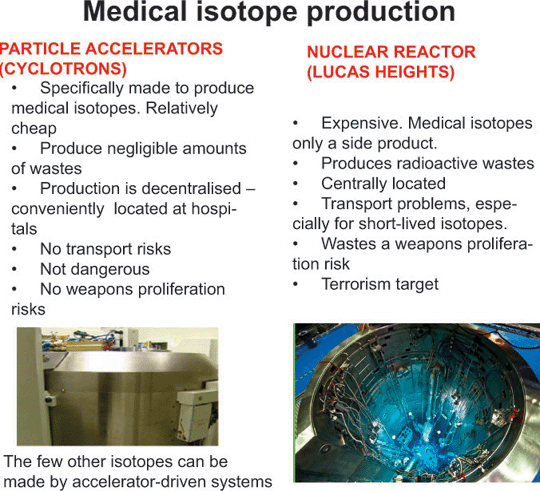
Parliamentary Committee Inquiry into Lucas Heights Nuclear Waste Management Facilities
| Upgrade and extension of radioactive waste management facilities at Lucas Heights House of Representatives, Parliament of Australia, 5 Feb 16 |
 The Parliamentary Standing Committee on Public Works today announced that it is conducting an inquiry into the upgrade and extension of radioactive waste management facilities for the Australian Nuclear Science and Technology Organisation (ANSTO). The Parliamentary Standing Committee on Public Works today announced that it is conducting an inquiry into the upgrade and extension of radioactive waste management facilities for the Australian Nuclear Science and Technology Organisation (ANSTO).
ANSTO’s submission notes that current storage facilities will reach full capacity early in 2017 and although locations for a new facility are being considered, the new facility is not expected to be operational until 2020. The inquiry will examine existing low and intermediate-level solid waste facilities at Lucas Heights that require extension and upgrade, with extension works for the low-level solid waste facilities expected to be completed by April 2017, and works for the intermediate-level facilities to be completed by June 2018. In addition to upgrading and extending storage capacity, works will include upgrading ventilation and security systems, electrical infrastructure and surrounding roads.The estimated cost of the project is $22.3 million and it is anticipated that the Committee will conduct public and in-camera hearings for the inquiry in the near future. Further information on the public hearing will be available soon on theCommittee’s website. Submissions to the inquiry close on 10 March 2016. NB the Parliamentary Standing Committee on Public Works is neither involved in the tendering process nor the awarding of contracts. Enquiries on those matters should be addressed to ANSTO. For media comment – Office of Senator Dean Smith (Chair of the Parliamentary Standing Committee on Public Works) (08) 9481 0349 Committee Secretariat (02) 6277 4636Full details on the project are available on the Committee’s website.
|
Queensland government rejects any nuclear waste dump plan
 Queensland says ‘no’ to national radioactive dump plan February 3, 2016 Tony Moore brisbanetimes.com.au senior reporter The Palaszczuk government has ruled out supporting any plan to build a national radioactive waste storage facility anywhere in Queensland.
That includes Oman Ama, the small town on the Cunningham Highway between Inglewood and Warwick, where a private landowner had put forward his property as a potential radioactive waste site.
Information from the Australian government project confirms intermediate-level radioactive waste would be “temporarily” stored at the chosen facility for many years, while the majority of radioactive waste would be low-level.
The International Atomic Energy Agency says intermediate-level radioactive waste “contains higher radioactivity levels than low level waste. It requires shielding when handled. Intermediate level waste – generated during operation of a nuclear power plant – consists mostly of ion exchange resins used to clean the water circulating through the reactor.”
Queensland has now written to the Australian government and asked that all potential Queensland radioactive waste storage sites be removed from the Australian government’s shortlist of six potential sites.
This was revealed in a letter on January 25, 2016, written on behalf of State Development Minister Anthony Lynham, to one of the opponents of the proposed radioactive waste dump.
Private land holder Gordon Donovan – who owns land at Oman Oma, suggested his property as a radioactive dump. The federal government has offered $10 million for the community which is eventually chosen to accept the waste.
The January 25 2016 letter, from Dr Lynham’s policy advisor, says the Queensland government will not support “in any circumstances” a radioactive waste storage facility in Queensland.
I wish to advise that the Queensland government does not support, in any circumstances, anywhere in Queensland being utilised for radioactive waste storage,” the letter says.
“Minister Lynham has specifically written to the Honourable Josh Frydenberg MP, Minister Resources, Energy and Northern Australia, asking that he remove Queensland sites from the Australian government’s shortlist for the storage of radioactive waste.”
The decision was welcomed by Bob Morrish, from the lobby group Friends of Oman Ama which is effectively southern Darling Downs grazing land with a single service station.
“It is very heartening to us to see that the state government will back their legislation dating back to 2007; that’s their Prohibition of Nuclear Facilities Act,” Mr Morrish said……..http://www.brisbanetimes.com.au/queensland/queensland-says-no-to-national-radioactive-dump-plan-20160203-gmky7j.html
Minister Josh Frydenberg says radiation anxieties are based on myth
Minister dismisses scare campaign, urges residents to embrace opportunity of nuclear waste dump, Courier Mail February 5, 2016 QUEENSLANDERS have been urged not to be scared of radioactive waste, but to embrace the opportunities a nuclear dump could bring.
Resources, Energy and Northern Australia Minister Josh Frydenberg said Queenslanders should not be panicked by nuclear because most fears were based on myth.
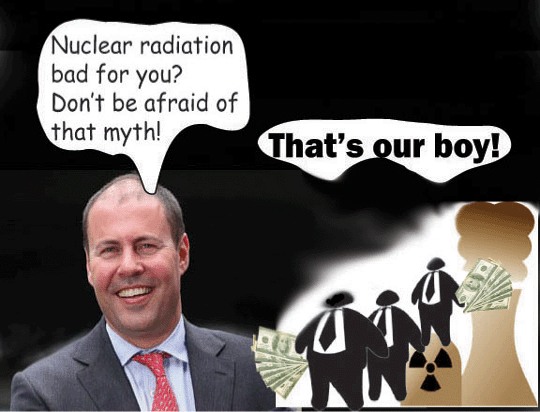
The Federal Government has moved to intervene in the debate after a protest campaign in the tiny locality of Oman Ama, near Inglewood, 250km southwest of Brisbane.
A property owner has offered his land to the Government for a mega low-waste nuclear dump and it is one of Mr Frydenberg’s six preferred sites across Australia.
Mr Frydenberg told The Courier-Mail community feedback was important and up to three sites would soon be short-listed.
“It is also important to remember the number of benefits that will flow to the final chosen community,” he said……..http://www.couriermail.com.au/news/queensland/minister-dismisses-scare-campaign-urges-residents-to-embrace-opportunity-of-nuclear-waste-dump/news-story/1689fe8fe1a64423cefb24806fa2c25f
Renewable energy an economic boon for Australia’s drought affected rural communities
 Renewable energy drought-proofing our farms http://www.weeklytimesnow.com.au/news/opinion/renewable-energy-droughtproofing-our-farms/news-story/558287ca3caffe6c939d83ad1de43e1a February 3, 2016 ANDREW THOMSON The Weekly Times
 Renewable energy is not only a tool to provide clean energy and control the emissions that are changing our climate. It is also a growth industry offering employment and revenue opportunities almost exclusively in regional and rural communities.
For many farming landowners, such as Peter, Leigh and David Watts, of Yeungroon, featured in The Weekly Times last week, lease payments from turbines are a way to drought-proof farms by ensuring ongoing income in tough times.

There is enormous potential to grow the partnerships between rural communities and renewable energy providers.
Prime Minister Malcolm Turnbull has signalled a new approach to renewable energy and this has given businesses such as energy company Acciona the confidence to make major investments in Australia.
Last month, it announced plans to progress the Mt Gellibrand wind farm proposal, which would provide clean power to more than 100,000 households. The project would create more than 100 jobs in the building phase, about 10 ongoing roles, and deliver substantial revenue for the life of the wind farm to landowners, council and the wider community.
Australia’s Renewable Energy Target has generated $18.5 billion of investment and, under the revised target, we expect to see at least another $10 billion by 2020.
Today the industry employs more people than the coal-generation sector in Australia. With stable policy settings, a clear direction on emissions targets and an understanding that Australia requires a more sophisticated approach to energy policy, the renewables sector is well placed to innovate and grow.
Improving technology in the wind sector means we can now generate more electricity from fewer turbines and maintain an income stream for landowners, councils and community organisations in regional and rural communities. It is my hope regional Australia and the renewables sector can grow together. Andrew Thomson is managing director of energy company Acciona
1 This month
17 October, Free Public Talk on Nuclear Issues in South Australia
David Noonan will speak on public interest concerns over the new Roxby Downs Indenture Act 2026 on BHP copper-uranium mining and ore processing in SA, and on how AUKUS may face SA with a High-Level nuclear waste agenda.
Dr Jim Green will discuss international developments in the field of nuclear power including ‘small modular reactors’ and Generation 4 ‘advanced’ nuclear reactor concepts.


Help Aunty Sue Protect Her Land and Sacred Sites From Destructive Rocket Testing.
.

Australians deserve the truth
about
AUKUS – https://aukuspublicinquiry.com/

PETITION – To: Prime Minister Anthony Albanese and the Australian Labor Government

of the week – Australians for War Powers Reform (AWPR)
To see nuclear-related stories in greater depth and intensity

