Campaign against Oman Ama nuclear dump site is gaining momentum
 Group steps up campaign against Oman Ama nuclear dump http://www.warwickdailynews.com.au/news/anti-nuke-dump-petition/2905419/ 21st Jan 2016 THE Friends of Oman Ama are continuing to grow their grassroots campaign against the nuclear waste facility proposed for their community.
From hitting the streets of Inglewood to reaching thousands of people online, the group is doing what it can to get its message across. Placards, banners and signs have been displayed across the area, while leaflets have been distributed to every home in Inglewood. The group’s information street stall in Inglewood is also gathering momentum.
Information street stall group members Vanessa Grady and Rechelle Privitera said they believed the overwhelming mood on the street was people did not want the nuclear waste facility. While some were hesitant about signing the petition, street stall members claimed people were happy to sign once they read the information available.
So far the Friends of Oman Ama’s petition has gathered several hundred signatures. The group is encouraging people to have their say on the issue as the consultation continues.
Resident Sue Campbell said the proposal had challenged the community. “I feel we need to come together as a community and determine our own future,” she said. “We need to decide what we want this community to look like in 10, 20 or 30 years time.”
Community consultation on the issue ends on Friday, March 11, at 5pm.
To have your say visit www.radioactivewaste.gov.au/proposed-sites#3.
People directly involved in the Oman Ama proposal will be given an opportunity to take a tour of the proposed property tomorrow afternoon.
Cyclotrons able to produce medical isotopes; no need for Lucas Heights nuclear reactor
 This production method for Tc-99m can be used by retrofitting various brands of conventional cyclotrons already in use in hospitals and health centres across Canada.
Australian Nuclear science and Technology Organisation (ANSTO) not honest about cyclotrons
 Medical isotope production in Australia: Should we be using reactor based or cyclotron technology? 15th January 2016 Dr Margaret Beavis MBBS FRACGP MPH Medical Association for Prevention of War, Australia Health Professionals Promoting Peace
 Likely Recommendations of the #NuclearCommissionSAust
 Dan Monceaux , Nuclear Fuel Cycle Royal Commission Watch 19 Jan 16 List of what I believe are possible or likely recommendations (in no particular order):
– the repeal of state and federal prohibitions blocking nuclear industrial development
– the consideration of the establishment of a nuclear waste repository in SA
– the development of a ‘nuclear fuel leasing scheme’, whereby Australian miners (inc. BHP Billiton & Rio Tinto) receive spent fuel which was created from Australian uranium, and profit from its receipt
– the establishment of an advanced research centre to support the development of next generation ‘nuclear waste recycling’ reactors
(most likely via the newly formed Future Industries Institute, UniSA)
– the consideration of nuclear energy as a ‘low-carbon energy source’ in the future replacement of coal-fired power plants in Australia’s Eastern states
– the relaxation of safety regulations for nuclear industrial workers (inc. uranium miners) including, potentially, the rejection of the LNT hypothesis https://www.facebook.com/groups/1021186047913052/permalink/1126636220701367/
February 15 #NuclearCommissionSAust’s tentative findings & feedback available
Tim Bickmore Nuclear Fuel Cycle Royal Commission Watch 19 Jan 16 The Tentative Findings will be available to download from the www.nuclearrc.sa.gov.au from 11am, February 15, 2016 or by contacting the office on 08 8207 1480.
Feedback on the Tentative Findings can be provided to the Commission via its website, email or through traditional mail delivery. Details on this process will be on the NFCRC website soon. 16 https://www.facebook.com/groups/1021186047913052/permalink/1126636220701367/
South Australian Cabinet gets two new pro nuclear enthusiasts
 Leesa Vlahos’ elevation to the Cabinet of South Australia in the Jay Weatherill government was announced on 18 January 2016.
Vlahos was described by the Australian Financial Review as ‘staunchly pro-nuclear’ and advocated for nuclear power in Australia during the lead-up to the Royal Commission into South Australia’s future role in the nuclear fuel cycle. In her 2015 submission in response to the Terms of Reference for the Royal Commission she stated that she had been an advocate for a “modern and safe” nuclear industry for South Australia “for years”. She also encouraged an investigation of the possibility of developing Thorium-fueled nuclear power.
Peter Malinauskas’ elevation to the Cabinet of South Australia in the Jay Weatherill government was announced on 18 January 2016.
In February 2014, Malinauskas expressed his openly pro-nuclear position to the media. At the time, the Labor party remained opposed to the establishment of a new nuclear waste repository or nuclear power plant in South Australia. He told The Advertiser:
“I believe climate change is a real challenge we need to face up to, and nuclear energy can be a safe source of base load power, with zero carbon emissions… We should have a mature debate based on science and economics to determine if a nuclear industry is viable in SA.”
That gives the Weatherill gov’t at least 3 spokespeople within Cabinet (including Koutsantonis) who can sing the praises of the Commission’s findings when released next month.
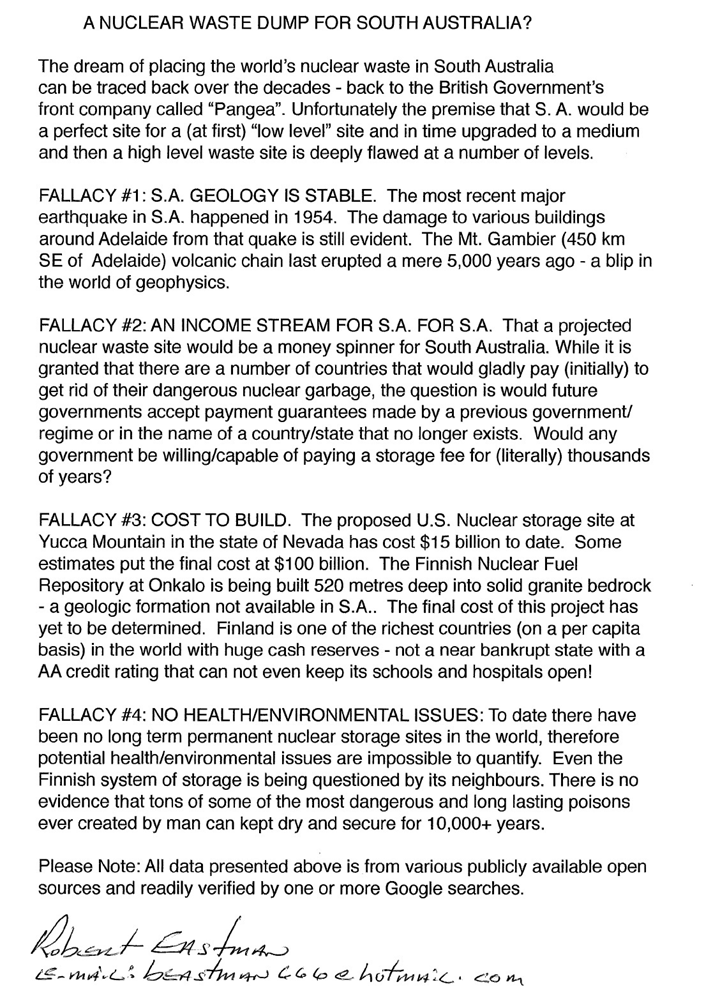
For the public good: Submission to #NuclearCommissionSAust from Robert Eastman
 Robert Eastman’s Submission to South Australia Nuclear fuel Chain Royal Commission – on the issue of Nuclear Waste Importing. Eastman provides documentary information on various requirements.
A song of praise for Synroc – Roger Smart’s Submission to #NuclearCommissionSAust
 Roger Smart’s Submission to South Australia Nuclear Fuel Chain Royal Commission.
– a very short submission on the subject of nuclear wastes. It canned be summed up as a Song Of Praise for the Synroc Technology for storing nuclear wastes.
EXTRACT: “The safest and cheapest option available for disposal of high level nuclear waste”
Nuclear Waste Management (NWM) — an Adelaide based Company founded in 1985……..
In 1991 NWM signed a Heads of Agreement with Mayak Production Enterprise, owned by the Russian Ministry of Power and Energy and Greenlawn Association of the Russian Federation to commence a study for the construction of a SYNROC plant. The Russians selected SYNROC as their preferred waste form for the treatment and disposal of their high level waste. They also commenced geological studies to find sites for the disposal of SYNROC in deep drill holes.
………. it proved impossible to find the political/financial and corporate leadership to secure the funding. The reasons were many but during the 80’s and 90’s, the nuclear industry was on the defensive and investment, other that in programs already in place, was greatly reduced. Consequently, NWM ceased operation in 1998
……. A detailed brochure and other material on SYNROC and NWM have been provided to the Executive of the Royal Commission”
**********************************************************************************************
 Nuclear accident much worse than reported , April 28, 1993 The nuclear accident at the Tomsk-7 reprocessing plant in Siberia on April 6 was much bigger than first reported, and now may seriously impede expansion of the nuclear fuel cycle in Australia.
Spokesperson John Hallam for the antinuclear groups Friends of the Earth and Movement Against Uranium Mining said, “Proposals to build a replacement research reactor in Sydney and a nuclear waste repository in the NT based on Synroc technology would be compromised by a public realisation that both projects depend on the same sort of technology for waste handling that failed so badly at Tomsk”.
Hallam said that information from Russian green groups indicated that the accident was not a 3 on the international nuclear event scale, as earlier claimed, but at least a 5. Chernobyl was a 6…..www.greenleft.org.au/node/4227
Oh my God! Global Warming Is Affecting The TENNIS!
 According to Malcolm Tulloch, director of entertainment, crew and sport at the Media, Entertainment & Arts Alliance (MEAA), the hotter climate is having an impact on the hundreds of people working at the tournament.
 Rising temperatures at Australian Open ’caused by global warming’ http://www.sbs.com.au/news/article/2016/01/18/rising-temperatures-australian-open-caused-global-warming Hot temperatures at the Australian Open tennis tournament may be down to global warming, according to some climate experts.
Analysis from University of Melbourne Atmosphere and Ocean researcher Ben Hague shows January temperatures in Melbourne have risen by 0.8 degrees Celsius each decade since 1987, but in the two weeks of the Australian Open the increase has been 1.25 degrees.
The Bureau of Meteorology 2015 Climate Statement showed days of extreme weather are on the increase across Australia.
A number of tennis clubs have implemented extreme heat policies to fulfill their duty of care to players, including Victoria based Australasian Academy of Tennis Coaches. Continue reading
Queensland launches solar storage battery trial
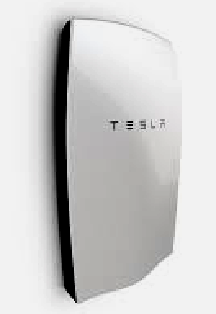 Queensland installs Australia’s first Powerwall battery for solar trial,
  Guardian, Joshua Robertson, 18 Jan 16 Energex, which is owned by the state government, launches a 12-month trial of solar batteries to investigate ways to integrate them into electricity supply
A Queensland government-owned power company has installed the country’s first solar battery storage system from Tesla as it begins a year-long trial into how it can reward consumers who cut their reliance on the electricity grid.
Energex, which has installed a Tesla Powerwall and another storage system from Californian company Sunverge at its Brisbane training facility, will collect data to work out how to integrate solar batteries into the network with financial incentives for customers.
The trial, which will extend monitoring of systems in Energex employees’ homes to those in outside consumers’ in coming months, follows lobbying by the Queensland premier, Annastacia Palaszczuk, of Tesla executives in the US six months ago.
Queensland boasts one of the highest rates of household solar panel systems in the world, although uptake in recent years has been inhibited by a dramatic cut in the rate consumers are paid for power that they return to the grid.
The commercial release of the Powerwall this year is widely expected to drive popular take-up of a system that at best would supply about seven hours of nightly power for televisions, air-conditioning and other appliances……..
Terry Effeney, the chief executive of Energex, said information about the effect of solar batteries on peak demand could allow power network operators to defer costly infrastructure investments or reduce generation where possible.
Contrary to the idea of consumers being able to quit the grid, Effeney said the 12-month trial would “demonstrate that in fact the best way to use batteries and solar is to integrate them into the grid to deliver the best possible outcome to the customers”. http://www.theguardian.com/environment/2016/jan/18/queensland-installs-australias-first-powerwall-battery-for-solar-trial
The Ugly Australian – Peninsula Energy uranium mining in South Africa
Already today, the environment around Beaufort West is contaminated close to the previous mine sites. First field studies by the author show unprotected nuclear wastes with 10 to 20 times the background radiation.
Dust and Radiation – Two Deadly Impacts…… a particular direct relationship between occupational exposure to uranium and its decay products and lung diseases.Mining uranium ore in the Karoo will invariably create huge plumes of contaminated dust. Dust clouds are unavoidable during drilling, blasting and transporting.
Dust suppression by spraying water is only partially effective and creates new problems with contaminated slimes, adding to the environmental cost of groundwater abstraction
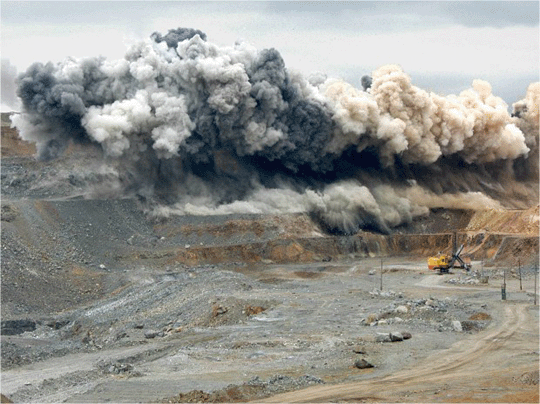
The Karoo has long been known to harbour substantial sedimentary uranium deposits. Now an Australian company [Peninsula Energy , through it’s wholly owned subsidiary Tasman Pacific Minerals Limited] with Russian funding is planning to get the radioactive mineral out of the ground on a major scale.
The company has quietly accumulated over 750 000 hectares of Karoo properties and concessions around Beaufort West and plans to set up a large Central Processing Plant just outside that town.
While the nation is still debating the pros and cons of fracking, the Environmental Impact Assessment (EIA) as the precursor to mining licences is nearing finalisation. During 2016 the Department of Mineral Resources will make a decision on the industry’s application……….
extensive studies on the risks of uranium mining over many decades are available today….yet so far there is no public debate, no strategic assessment process in place in the Karoo.No advocacy groups balance the glossy claims of the industry against sobering experiences on the ground….. Continue reading
Queensland moves to solar energy in a planned way
Queensland searches for a solar fix, THE AUSTRALIAN, JANUARY 18, The acid test for governments, here and everywhere, in the post-Parisian energy environment is turning talk in to meaningful action……Annastacia Palaszczuk’s regime in Brisbane is embarking on a year in which it must put its policies where its mouth was in January 2015, when it scored an upset win in the state elections.
Committed to being the nation’s standard bearer on advancing solar power, the government has sensibly thrown the ball to its new Productivity Commission before it acts…..
The commission’s official role is to come up with a “fair price for solar exports” — that is, the surplus power from householders’ rooftop PV arrays flowing in to the southeastern Queensland grid.
The commission’s draft report is due next month and the final version in May.
Its impact will be felt beyond Queensland’s borders as policymakers elsewhere also have a keen interest in riding the wave of solar enthusiasm that sees the number of Australian homes with PV on their rooftops creeping up towards 1.5 million, a penetration rate of 16 per cent nationally…….
ARIUS ASSOCIATION’s Submission to #NuclearCommissionSAust confuses ethics with greed
AriusAssociation Submission to the Royal Commission on Management, Storage and Disposal of Nuclear and Radioactive Waste
Arius is a a non profit body, (but friendly to the nuclear industry). It addresses nuclear waste disposal. It details structures and measures needed. Arius relies heavily on information from [the failed South Australian] Pangea Project. Its purported aim is for an “ethical project” – ‘to fulfil our ethical responsibilities to future generations’
Arius is upbeat about economic advantages, upbeat about safety and security. It appears to be complacent about a safe uneventful future for nuclear industry.
Nowhere does Arius discuss the historic disasters of the nuclear industry, its intrinsic connection with nuclear weapons proliferation, not the increasing risks of terrorism.
In discussing nuclear waste from an ethical point of view, the option of just stopping making the stuff is not considered.
Despite Arius’ confidence in nuclear industry waste disposal technology, they are ware of the implications:
” The Extremely Long Times that must be considered Repository safety analyses are routinely carried out for a million years into the future. These time scales challenge the conventional basis for the design of technological systems. Designs for such systems are usually based on a combination of past experience and theoretical projections, which can be supported by testing and observations of performance on relevant time scales. Because it is not possible to test and observe the engineered components of a repository over representative time scales, a repository’s safety would ideally be guaranteed by natural processes that have already demonstrated their performance over millions of years.”
However, their central theme seems to be to enthuse over the financial benefits to South Australia.
David Bowman’s Pro Nuclear Submission – Nuclear waste dump to help wildlife!!
 Submission to the Nuclear Fuel Cycle Royal Commission Professor David Bowman, School of Biological Sciences, University of Tasmania
EXTRACT
“I believe there is scope to use uranium mining and nuclear waste storage as a source of funding to tackle the urgent challenge of biodiversity, and particularly the threats to our unique and threatened Australian mammal fauna in the longer term
…….Australia’s insularity, tectonic and political stability make it an ideal setting for high-level nuclear waste storage. Uranium mining and waste storage could potentially provide a funding base for an internationally significant conservation intervention throughout outback Australia. To provide this capital and revenue, I suggest the expectations of mine site restoration are changed from attempts to restore mined areas to their original condition, and instead focus on containing pollution from these sites.
Savings should be invested in establishing at least ten very large predator-proof exclosures (> 500 km2) in the surrounding unmined landscapes in outback Australia. Further, exhausted sites associated with mining in geological stable and arid areas like Olympic Dam could be used for high-level nuclear waste disposal. Income associated with storage of nuclear waste, and the requirement they are managed over the long term (> 100 years), would provide funding for ongoing Aboriginal ranger programs to manage country throughout outback Australia…..”
Golder Associates – another pro nuclear Submission to #NuclearCommissionSAust
You can access this one from http://nuclearrc.sa.gov.au/submissions/?search=Submissions.
Golder Associates Submission on Management, Storage and Disposal of Nuclear and Radioactive Waste. An engineering company, its aim is to show how they have designed and developed projects, and worked with Indigenous and local communities.
Worked with Pangea , ANSTO , AREVA, Ontario Power Generation, They set out an Adaptive Phase Management approach. Set out process for building support with indigenous communities.
1 This month
17 October, Free Public Talk on Nuclear Issues in South Australia
David Noonan will speak on public interest concerns over the new Roxby Downs Indenture Act 2026 on BHP copper-uranium mining and ore processing in SA, and on how AUKUS may face SA with a High-Level nuclear waste agenda.
Dr Jim Green will discuss international developments in the field of nuclear power including ‘small modular reactors’ and Generation 4 ‘advanced’ nuclear reactor concepts.


Help Aunty Sue Protect Her Land and Sacred Sites From Destructive Rocket Testing.
.

Australians deserve the truth
about
AUKUS – https://aukuspublicinquiry.com/

PETITION – To: Prime Minister Anthony Albanese and the Australian Labor Government

of the week – Australians for War Powers Reform (AWPR)
To see nuclear-related stories in greater depth and intensity

