Highly misleading to say that Lucas Heights nuclear reactor is mainly for medical uses
 it would be highly misleading to attribute this predominantly to medical isotope production given the broad range of uses of the HIFAR and MOATA reactors over the last 60 years.
 waste will be deposited in the repository? Less than 1% is medical waste (leftover radium and some disused sources). Most states and territories each only have a few cubic metres of low level medical waste.
What materials will go into waste repositary for Lucas Heights nuclear trash?
 Radioactive waste in Australia, Medical Association for the Prevention
  of War (MAPW) 18 Jan 16 …………….Where does the radioactive waste to be deposited in this repository come from? The repository is designed for “low level” and “intermediate level” waste; as of 2014 a total of 4,906 cubic metres (m3 ).
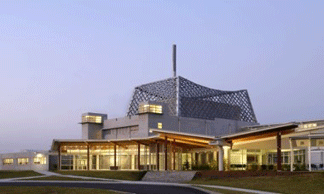
The planned repositary for Lucas Heights returning nuclear waste
 Radioactive waste in Australia, Medical Association for the Prevention of War (MAPW) 18 Jan 16 What will the repository look like? “……The low level waste will be permanently disposed of in a shallow trench covered by 5 metres of soil with plastic and clay lining to prevent water and other materials entering. The nuclear fuel waste, which is intermediate level waste, is too hazardous to be managed in this manner, so will be placed above ground in a temporary purpose-built store3 . Is the repository a permanent management solution? No. This is merely an interim repository for the intermediate level waste. There is no timeline set for a permanent solution. Permanent disposal of intermediate level waste requires deep geological burial. So the Commonwealth repository follows IAEA recommendations only for the low level waste (see below). It does not meet the permanent disposal needs of the intermediate level waste, and defers accountability indefinitely
BHP not interested in nuclear waste import – Submission to #NuclearCommissionSAust
BHP’s Submission on wastes is very short. Two major points –
- reiterates call to remove uranium mining from being listed as a Matter of National
Environmental Significance 9NES) in the Federal Government’s Environment Protection and Biodiversity Conservation Act (EPBC Act). - doesn’t want to have any involvement in storage or disposal of nuclear waste.
BHP Billiton Submission to Royal Commission http://nuclearrc.sa.gov.au/app/uploads/2015/11/BHP-Billiton-03-08-2015.pdf
EXTRACT “Management, Storage and Disposal of Nuclear and Radioactive Waste BHP Billiton’s experience with radioactive waste management and storage at Olympic Dam is limited to the storage of tailings and other low level contaminated materials generated during the treatment of ore……
Tailings storage and management is common in mining operations throughout the world, and in this respect the management of tailings at Olympic Dam is no different to that of other BHP Billiton operations not involving uranium (e.g. copper or nickel), or indeed other mining operations worldwide.
Given this similarity, the demonstrated level of environmental management and the low level of radioactivity involved, the treatment of tailings from uranium operations should be considered as akin to that of other metal mining operations. Correspondingly, it does not warrant being considered a matter of national environmental significance that triggers the requirements of the EPBC Act.
BHP Billiton does not handle or manage intermediate and high-level radioactive wastes. Nevertheless we understand that current thinking is toward long term storage rather than disposal, as it is foreseeable that the contained energy may be able to be harnessed in the future.
Irrespective of whether storage or disposal is preferred, BHP Billiton considers that either option would be inconsistent with our core business of mining and the production of high quality copper and associated by-products at Olympic Dam.”
Change Australia’s Environmental Protection Laws – ANSTO”s submission to #NuclearCommissionSAust
 EXTRACT from ANSTO Submission http://nuclearrc.sa.gov.au/app/uploads/2015/11/Australian-Nuclear-Science-and-Technology-Organisation-03-08-2015.pdf
Legislative and regulatory
Significant legislative changes would be required in order to develop a South Australian nuclear power industry. At present, nuclear power is prohibited in Australia. At the Commonwealth level, the Environment Protection and Biodiversity Conservation Act 1999 (Cth) effectively prohibits the construction or operation of nuclear fuel fabrication plants, nuclear power plants, enrichment plants or reprocessing facilities.
In addition, the Australian Radiation Protection and Nuclear Safety Act 1998 (Cth) prevents the CEO of ARPANSA from licensing the siting,construction or operation of such facilities by Commonwealth entities. At the South Australian level, there is a conditional ban on conversion and enrichment (see section 27 of the RadiationProtection and Control Act 1982).
In addition to the removal of those legislative barriers, legislation would also be required in order to upgrade the existing regulatory structure or create new a regulatory structure capable of performing the functions required for the licensing of nuclear power reactors. There would
also need to be legislation governing nuclear liability in order to bring Australia into line with international norms……..
BHP’s Submission to #NuclearCommissionSAust – “No particular health risks from uranium mining”
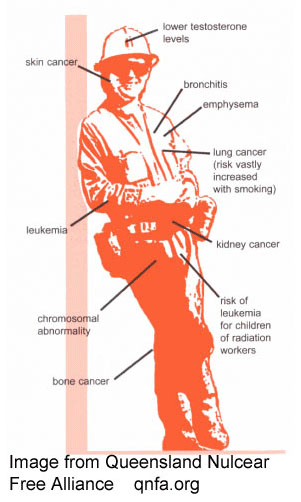 A not very exciting Submission, in which BHP outlines its work at Olympic Dam. The major point is that BHP wants to remove uranium mining from being listed as a Matter of National Environmental Significance 9NES) in the Federal Government’s Environment Protection and Biodiversity Conservation Act (EPBC Act).
BHP maintains that the health risks from uranium mining are not really different from the risks in any other type of mining.
On the future for the uranium market, BHP is cagey, pointing out that copper is the major money-spinner from Olympic Dam
BHP Billiton – Submission to RC ISSUESPAPER 1 Exploration, Extraction and Milling http://nuclearrc.sa.gov.au/app/uploads/2015/11/BHP-Billiton-03-08-2015.pdf
EXTRACT
“…..We believe this Commission to be an important opportunity to seek changes that will reduce barriers to entry into uranium extraction and exploration. We make two important recommendations: Continue reading
Australian Workers Union complacent about health, sends pro nuclear Submission to #NuclearCommissionSAust
Not surprisingly, the AWU Submission concentrates on JOBS. They quote (to my mind) some rather ambitious and over-confident forecasts on the employment future, with the nuclear fuel chain.
AWU enthusiasm focuses on the opportunities in uranium mining, – says little about o the other phases of the full nuclear chain. Confident of the economic benefits of that chain, and keen for nuclear waste importing.
Notably, their Submission says very little about health: it is very complacent about radiation safety.
AUSTRALIAN WORKERS UNION SUBMISSION TO SA Nuclear Royal Commission http://nuclearrc.sa.gov.au/app/uploads/2015/11/Australian-Workers-Union-03-08-2015.pdf
Scott McDine- National Secretary The Australian Workers’ Union Level10, 377-383 Sussex Street, Sydney NSW 2000 Phone: 02 8005 3333 1 Fax: 02 8005 3300 Website: www.awu.net.au I Email: members@nat.awu.net.au
EXTRACT
“……This submission asserts that the potential economic and employment benefits of the nuclear fuel cycle are vast, and that failure to act would represent a lost opportunity for South Australia. It also acknowledges Australia’s capacity to manage the safety, environmental and security risks associated with the nuclear industry…… Continue reading
AREVA’s published Submission to #NuclearCommissionSAust
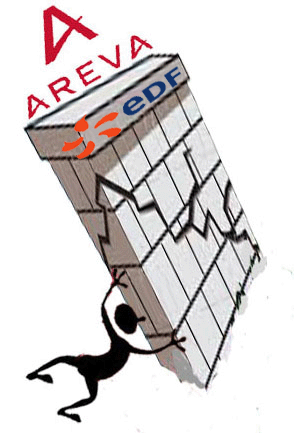 The RC published only one Submission, from AREVA Australia I think that we can be pretty confident that AREVA sent in other Submissions , including one on waste management.
The published Submission is pretty boring – deals only with uranium mining and exploration. AREVA does acknowledge the current poor uranium market, but looks to future growth, without any convincing reason. I list some extracts below, – they are not very notable.
I thought that the relatively large time that the RC spent with AREVA was more interesting. Ironically, the RC in France met with AREVA on the day after President Hollande ordered AREVA to merge with EDF, to save it from bankruptcy.
4 June 15 Visit to AREVA Tricastin, France.
- Explanation of AREVA’s conversion plant and the development of the project;
- Tour of conversion plant construction site;
- Explanation of AREVA’s Georges Besse II operating enrichment plant;
- Tour of GB II enrichment plant facilities.
Visit to AREVA Melox, France.
- Explanation of AREVA’s operating mixed oxide fuel fabrication plant and the use of mixed oxide fuels;Tour of mixed oxide fuel fabrication facilities.
5 June 15 Visit to AREVA La Hague, France.
Visit to EDF Flamanville, France.
8 June 15 Meeting with AREVA.
- Discussion of future nuclear energy demand, barriers to investment in the nuclear fuel cycle and the economics of investment.
SUBMISSION SOUTH AUSTRALIA: NUCLEAR FUEL CYCLE ROYAL COMMISSION
ISSUE PAPER #1 EXPLORATION EXTRACTION AND MILLING
IAN JOHN (JOE) POTTER RP GEO 24 JULY 2015
AREVA Resources Australia Pty Ltd A.B.N. 44 009 758 481 68 Greenhill Rd Wayville SA 5034 Tel: + 61 8 8292 9300 Fax: + 61 8 8377 7903 Email: infoARA@areva.com
“INTRODUCTION
AREVA is at present the world’s largest, integrated company in the nuclear cycle”…. (Ed. note. -That’s no longer true)
“CONCLUSIONS and RECOMMENDATIONS Continue reading
ANSTO’s Submission to #NuclearCommissionSAust – not keen on Thorium
Thorium fuelled nuclear power reactors are often put forward as a possible alternative to uranium 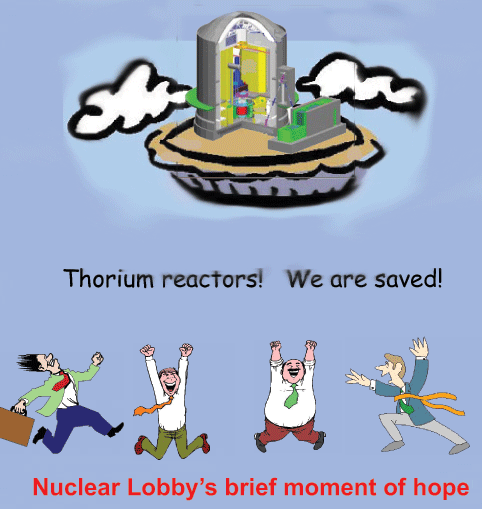 fuelled reactors on the basis of a number of arguments, not all of which are accurate. For example, proponents of thorium reactors often claim that the thorium fuel cycle is resistantto proliferation risks.
However, the production of uranium‐233 during the thorium fuel cycle presents a potential proliferation risk that would require similar safeguards to those in place for the uranium fuel cycle today (ANSTO 2013).
Although the thorium fuel cycle is a theoretically feasible source of energy, there is limited evidence that significant investment in future thorium technologies would improve on the well established technologies and systems in place for the uranium fuel cycle, for which Australia is already one of the world’s largest exporters…..
ANSTO’s Submission (on all 4 Issues papers) says surprisingly little about nuclear waste management. It directs those remarks to how expert ANSTO itself is at managing nuclear waste.
It is enthusiastic about the future for nuclear power, but I note that it uses that “escape” word “potential” when predicting that good future. No author is named.
ANSTO Submission http://nuclearrc.sa.gov.au/app/uploads/2015/11/Australian-Nuclear-Science-and-Technology-Organisation-03-08-2015.pdf EXTRACTS
“nuclear power, in countries with limited potential for hydropower, is the most efficient and cost‐effective low emissions fit‐for‐service base‐load electricity generation option……
new generation nuclear power plants under construction across the world represent a mature and safe technology; and future nuclear technology has the potential to further improve safety while reducing cost and up‐front capital investment requirements…..
“Safety Continue reading
Let’s examine the pro nuclear Submissions to #NuclearCommissionSAust: here’s one
An example of pro nuke submission from an individual representing in a company. His theme is that waste import would be a great economic boon to South Australia, but only if it is part of a full nuclear fuel chain. He quotes some significant safety risks, but seems to dismiss them as not so serious. He is delightfully enthusiastic, but vague, on the economic benefits.
Henry Askin sent in a submission on Nuclear Waste (Issues paper4 ) http://nuclearrc.sa.gov.au/app/uploads/2015/11/Henry-Askin-24-07-2015.pdf )
Dr. Henry J Askin Director, U-SAFE PTY LTD U-Safe Pty. Ltd. was founded in 2006 to promote the construction and operation of a safe permanent storage and disposal repository for the radioactive by-products of the nuclear fuel cycle.
Askin’s conclusion is vague on the economic result of importing nuclear waste, by itself. But enthusiastic if it is part of the whole nuclear fuel chain:
“The economic benefits will depend on the extent of commitment to the full nuclear fuel cycle, the cost of studying and building the repository, the operating costs and moreover the extent of funding provided by the eventual client entities. Estimation of costs is highly problematic, since there are no equivalent benchmark projects available……
It is not practical to establish an enrichment and reprocessing facility in the state unless in conjunction with nuclear power generation as well. These processes are intensive in electricity consumption and would result in very significant greenhouse gas emissions if conventionally powered. On the other hand, if it were decided to establish a full nuclear fuel cycle industry necessarily including the adoption of nuclear power generation, the economic benefits would be incalculable.
Effects would spread directly throughout the various areas of transport, high technology processing and fabrication of fuel rods, material supply and construction and the initiation of tertiary specialist training in all aspects of nuclear engineering, and spill widely throughout the general service and retail economy.”
Economics. He starts with enthusiasm for the economic benefits of waste importing:
“It is without question that if a best in class ILW and HLW repository was accessible the electricity utilities operating the nuclear power stations and the reprocessing facilities would avail themselves of it. This is evidenced by the 1998/1999 campaign by Pangea Resources seeking to establish a deep subsurface repository in Western Australia. The company was created by British Nuclear Fuels, Golder Associates and Nagra, the latter being a Swiss radioactive waste management entity. Management of the public relations was a spectacular failure, with both WA and SA introducing legislation prohibiting the establishment of nuclear waste waste dumps in 1999 and 2000 respectively.
However Pangea, now known as ARIUS, continues efforts internationally.”
“Considering the increasing imperatives to remove HLW from vulnerable temporary storage in the vicinity of source reactors, safe disposal would not be expected to be price or cost sensitive. In fact, the generators of this waste would in all probability be prepared to fund the construction of the repository in addition to paying ongoing storage costs for the operation and maintenance of the facility.”
But it would really only be economic if Australia first had the full nuclear fuel chain:
“If the industrial capacity to conduct such full cycle processing were to be established in the state, the magnitude of the resulting economic benefits would go a long way towards the acceptance of international waste and the concomitant construction of the deep storage repository. “
On the safe storage/disposal of nuclear waste:
Within salt domes or mines ……….The most successful of these is the Waste Isolation Pilot Plant (WIPP), opened for business in 1999 at Carlsbad New Mexico. ( ha ha successful?)
Drigg is a surface storage facility (ha ha currently threatened by flooding in Cumbria)
He then lists the technical problems in geology for waste disposal
On security risks:
“The principal security risks would appear to be related to protest activities by anti nuclear groups and more seriously, terrorist action. The former would be unlikely to penetrate the perimeter of the surrounding exclusion zone, and be limited to hindrance of transport logistics for limited periods. There is abundant experience in managing this category of essentially nuisance behavior and is not considered to be of concern.
Far more serious is the possibility of terrorist attack with the objective of acquiring ILW and/or HLW for the assembly of devices capable of area denial in populated or strategic locations, the ‘dirty bomb’ strategy. Although the material would be potentially lethal for those involved, in this age of suicide bombing this is perhaps not an inhibition. However if a deep burial repository were to be established in a remote semi desert area of inland Australia unauthorized access would be a major challenge”
On transport:
“The greatest vulnerability would lie not with the repository itself but with the waste delivery transport chain” “Transport of waste to the repository could pose hazards but is unlikely to adversely affect the environment to any greater extent than normal transport” (ha ha what about the huge derailment of sulphuric acid transport, Queensland, in December?)
Planned New South Wales solar farm may have Aboriginal stakeholders
 Wind company seeking Aboriginal stakeholders for possible solar farm development http://www.abc.net.au/news/2016-01-13/wind-company-seeking-aboriginal-stakeholders-for-possible-solar/7086478 By Kerrin Thomas The company behind the White Rock Wind Farm, to be located in northern New South Wales, is considering developing a solar farm nearby and is seeking Aboriginal stakeholders to assist in preparing a heritage assessment.
Construction of Stage 1 of the White Rock Wind Farm is expected to start soon, at the site 24kms west of Glen Innes.
70 wind turbines will be constructed initially, expected to produce enough energy to power 75,000 homes a year.
The proponent, Goldwind Australia, has now engaged a company to conduct an assessment of the Aboriginal heritage impacts of a potential solar farm adjacent to the wind farm site.
The company is proposing a 20 to 25 MW facility that would occupy an area of about 50 hectares, with power to be exported through the wind farm’s substation.
NGH Environmental has been engaged to seek information from Aboriginal Stakeholders with cultural knowledge of the Maybole/Spring Mountain area. The purpose of the consultation with Aboriginal people is to assist the proponent in the preparation of the Aboriginal heritage assessment.
Those involved in the process will be required to assist in the determination of the cultural significance of any Aboriginal objects or places within the subject area.
Registrations close later this month.
Queensland could get huge boost for its solar industry
 Queensland solar farms in the race for federal funding http://www.couriermail.com.au/news/queensland/queensland-solar-farms-in-the-race-for-federal-funding/news-story/54e6f7e5880087d774e2661f94898c12 January 15, 2016 JESSICA MARSZALEK The Courier-Mail THE Sunshine State could be set for a huge boost to its solar industry with 10 large-scale solar farms vying for $100 million in Federal Government grants.
The projects earmarked for Queensland, including in Dalby, Proserpine, Oakey, Hughenden, Longreach and Ipswich, are among 22 nationwide invited to make applications to the Australian Renewable Energy Agency (ARENA).
Environment Minister Greg Hunt said that the projects together represented a potential $1.68 billion investment in solar.
“The shortlisted proposals were chosen from a very strong field, demonstrating Australia is ready to invest in utility-scale renewable energy options suited to the 21st century,” Mr Hunt said.
Large-scale solar photovoltaic power is in its infancy in Australia with only three projects commissioned and three more under consideration. It is far fewer than in comparable international markets, with ARENA hoping the technology becomes more competitive in the future as costs come down and government support won’t be necessary.
How can #NuclearCommissionSAust? know waste disposal costs, when France doesn’t?
from Antinuclear Australia Observer, 14 Jan 16 When the French don’t know the cost of deep geological disposal – even within 10 billion Euro’s of an estimate – how can the SA Nuclear Royal Commission claim to know…
Presumably the higher estimate herein of circa 30 billion Euro’s is more accurate and less dependent (ie less rigged) on claimed future ‘technical optimisations’ that may not ever come to pass and shouldn’t be assumed in cost estimates for proposals for SA to take on International High Level Nuclear Spent Fuel Wastes…
The South Australian Nuclear Royal Commission has been full of interest and proposals for Storage of SNF without serious commensurate attention to the cost and implications of Disposal – a multi decade undertaking – and the real risk that in taking SNF waste for Storage the proposed Disposal plans can fail – just as they have and did in USA over last few decades…
EDF already needs to borrow money just to pay its dividend and is set to spend tens of billions of euros on upgrading its ageing reactors, building new nuclear plants in Hinkley Point, Britain and buying the reactor arm of Areva.
“This report is clearly negative for all nuclear operators, and most specifically for EDF and Areva”
EDF shares are down more than 44 percent in the 12 months,
EDF sinks to all-time low as nuclear waste cost estimate soars http://uk.reuters.com/article/edf-nuclear-waste-idUKL8N14W2RO20160112 PARIS | BY GEERT DE CLERCQ Jan 12 Shares in French utility EDF sank to all-time lows on Tuesday after the country’s Andra nuclear waste agency said that storage costs could be higher than EDF’s estimates.
Mirroring German utilities E.ON and RWE , which saw their shares hit decade lows late last year over worries about nuclear decommissioning costs, EDF fell as much as 7.3 percent before recovering to 4.1 percent lower.
A string of brokerage price target downgrades and French forward power prices falling to new decade lows only added to the gloom.
In a report released late on Monday, Andra said costs for the Cigeo deep geological storage project could be as high as 30 billion euros or as low as 20 billion depending on assumptions about different cost factors in coming years.
“There are different views on the calculation, more or less conservative, depending on estimates for future technological progress and optimisation,” Continue reading
ERA’s Ranger uranium mine – dead but ERA just won’t lie down

Did the Australian Labor Party get rid of Martin Ferguson as Minister For The Nuclear Lobby, only to replace  him with Gary Gray -a new Minister For The Nuclear Lobby?
Opposition resources minister Gary Gray has said that a closure of Ranger would have “massive implications” for the economy of Arnhem Land and would be unfortunate for the uranium industry in Australia.
Energy Resources of Australia nears decision on future of Ranger uranium mine, SMH, January 12, 2016 Angela Macdonald-Smith Energy Reporter The future of the Ranger uranium mine in the Northern Territory hangs in the balance as owner Energy Resources of Australia nears a decision on a strategic review.
Rio Tinto-controlled ERA said on Tuesday it would update the market this quarter on the strategic review, which it kicked off in October after being advised by traditional owners that they oppose an extension of production at the mine near Kakadu.
The Mirarr traditional owners refused to back the miner’s bid to extend its processing permits beyond the current expiry date of January 2021.
ERA, 68 per cent-owned by Rio, warned then that it may have to write down its assets as a result. Some analysts calculate the impairment could reach several hundred million dollars. ERA, for whom Ranger is its only producing asset, is due to report its 2015 earnings on January 28…………. Continue reading
What if a nuclear waste train is derailed?
Derailed train in Queensland spills 200,000l sulphuric acid and diesel, Logistics Business Review 28 December 2015 Approximately 200,000l of sulphuric acid and diesel was spilled when all 26 carriages of a freight train derailed in Quarrells, 20km east of Julia Creek in mid-northern Queensland, Australia.

Emergency crews have started clean-up operation in heavy rain and three train staff sustained minor injuries in the accident. Following the incident on Sunday, Queensland Police declared an emergency situation covering a 2km exclusion zone around the crash site.
Queensland Rail said: “Emergency services attended the scene, however, Queensland Rail crews have been unable to access the site as the Flinders highway is currently cut off due to flooding in the region…….
Inland passenger services and freight trains have been affected in the region…… http://www.logistics-business-review.com/news/derailed-train-in-queensland-spills-200000l-sulphuric-acid-and-diesel-4763524
 Train derailment sparks uranium transport fears http://www.abc.net.au/news/2011-12-28/20111228-train-derail-chemical-spill-react/3749716 By Emma Masters An environment group says the derailment of a train carrying hazardous substances raises concerns about the transport of uranium through the Northern Territory.
A freight train transporting containers of copper concentrate was derailed yesterday after flash floods damaged the railway track north of Katherine yesterday.
The Environment Department is investigating reports that containers may have spilled and washed into the Edith River.
Environment Centre NT director Stuart Blanch says the incident is a worrying sign. “This spill highlights a lack of due diligence by the owners of the railway and the people transporting this product,” he said.
“What would have happened to the Edith if there was a spill of uranium oxide into the Edith River?
“That is a real concern, with a lot more uranium coming up from South Australia in the years ahead.”
Meanwhile, Chief Minister Paul Henderson says he is satisfied that copper concentrate was the only toxic substance being carried by the train.
Mr Henderson says it is not radioactive material from a uranium mine in South Australia. “What the environmental impacts may be, I have not been briefed as to what they may be,” he said.He says government officials are on site to carry out a monitoring program.
1 This month
17 October, Free Public Talk on Nuclear Issues in South Australia
David Noonan will speak on public interest concerns over the new Roxby Downs Indenture Act 2026 on BHP copper-uranium mining and ore processing in SA, and on how AUKUS may face SA with a High-Level nuclear waste agenda.
Dr Jim Green will discuss international developments in the field of nuclear power including ‘small modular reactors’ and Generation 4 ‘advanced’ nuclear reactor concepts.


Help Aunty Sue Protect Her Land and Sacred Sites From Destructive Rocket Testing.
.

Australians deserve the truth
about
AUKUS – https://aukuspublicinquiry.com/

PETITION – To: Prime Minister Anthony Albanese and the Australian Labor Government

of the week – Australians for War Powers Reform (AWPR)
To see nuclear-related stories in greater depth and intensity

